1943: Six POWs, inscribed on a ouija board

Here lie the remains of 3529270 Pte T Jackson Manch Reg. CQMS C Anderson FMSVF, A S H Justice USS Houston. 33271– Pte Mar- … here the letters had been eaten away. At the bottom of the board there were several more words which it was not possible to decipher but still discernible were the words

Executed 1/11/43

The WW2 People’s War is an online archive of wartime memories contributed by members of the public and gathered by the BBC. The archive can be found at bbc.co.uk/ww2peopleswar.

This date’s execution — contributed to WW2 People’s War by Chris Comer of Stockport Libraries on behalf of Arthur Lane — concerns six Commonwealth POWs who were shot for attempting to escape at Thambazayat, a prison camp in Burma.

They’re remembered by a fellow-prisoner from their time at the Thailand prison camp Chungkai, where the prisoners pulled off a memorable caper with a ouija board and some of their guards.


Chungkai War Cemetery, on the site of camp’s POW burials. (From Australian War Memorial)

These executions did not reshape history. But this story of a few men under the shadow of a senseless death has the spark of humanity that animates these pages. Read it in its entirety here: part 1 | part 2.

On this day..

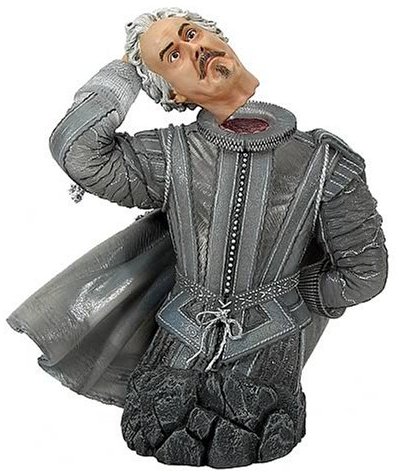
1492: Sir Nicholas de Mimsy-Porpington, Nearly Headless Nick

(Thanks to Elizabeth M. Hull for the guest post. -ed.)

Post-mortem resident of Gryffindor House, Hogwarts School of Witchcraft and Wizardry, Hogsmeade, U.K.

A minor character in J.K. Rowling’s Harry Potter saga, Nearly Headless Nick remains one of the most memorable. Executed — badly — on Halloween of 1492, Sir Nicholas de Mimsy-Porpington became the ghost of Gryffindor House. The school has about 20 resident ghosts: the Grey Lady (Helena Ravenclaw) and the Bloody Baron of Slytherin House died violently as well, in a murder-suicide.

Rowling says that her editor suggested that she cut a ballad Mimsy-Porpington wrote about himself from The Chamber of Secrets. In the song, the ghost claimed to have been executed for “a mistake any wizard could make,” a “piffling error,” a case of wizardry gone wrong. Asked by Lady Grieve (otherwise unknown) to straighten her teeth, Mimsy-Porpington seems to have given her a tusk. “They” imprisoned the piffler immediately, though he cried all night that he could fix his mistake, and his beheading followed the next morning.

Unfortunately for Mimsy-Porpington, his was not the only incompetence: “they’d mislaid the rock/Where they usually sharpened the axe”! The “cack-handed twit” of a headsman said “this may sting a bit” to the gibbering wizard, and swung the axe in the air. Alas, unable to sharpen the blade, the executioner was reduced to bestowing numerous blows: “But oh the blunt blade! No difference it made,” the ghost sang,

My head was still definitely there.
The axeman he hacked and he whacked and he thwacked,
“Won’t be too long,” he assured me,
But quick it was not, and the bone-headed clot
Took forty-five goes ’til he floored me.

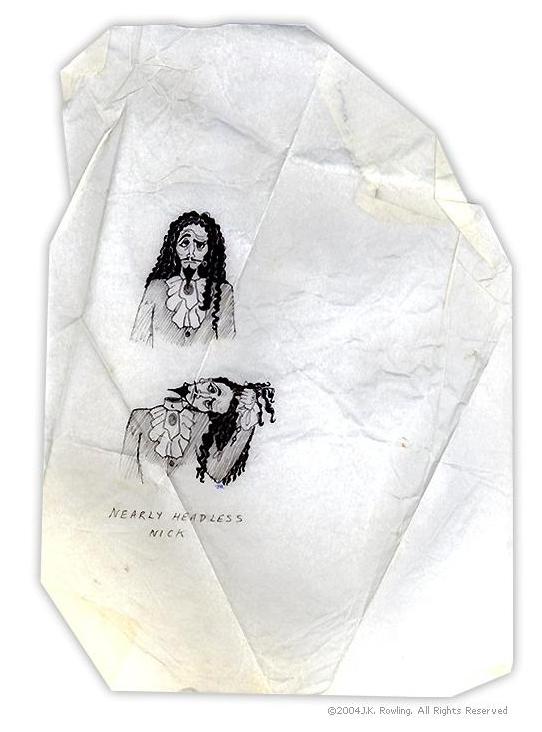
(The full ballad is here and here; the original handwritten version can be seen here.)

After repeated strokes of the edgeless axe, Mimsy-Porpington finally expired. On festival occasions, he re-enacts his near-beheading, a show quite popular with the Hogwarts student body (Prisoner of Azkaban, p. 159).

However, the bone-headed, cloddish headsman was unable to completely behead the wizard. As Ron Weasly notes, the ghost is merely nearly headless.


Nick, as played in the Harry Potter films by John Cleese. Rowling’s own original sketch of Nearly Headless Nick is here.

While he gets a great deal of pleasure from entertaining Hogwarts residents by swinging “his whole head . . . off his neck and . . . onto his shoulder as if it was on a hinge” (Sorceror’s Stone, p. 124), his condition limits his access to the dizziest heights of post-mortem society. Beheading was an aristocratic execution, meant to bring a swift death to the privileged, those able to hunt legally in their lifetime. In the afterlife, the beheaded aristocrats have established a “Headless Hunt” Club, and have blackballed Mimsy-Porpington, who misses their entrance requirements by that much: “‘half an inch of skin and sinew holding my neck on.'” Unable to participate in Club sports like “Horseback Head-Juggling and Head Polo,” Mimsy-Porpington is denied admission into the elite society (Chamber of Secrets, p. 124).

Sadly, their scorn for his crippling condition is not limited to exclusion from their company.

Mimsy-Porpington’s five hundredth Deathday anniversary party, held on Halloween 1992, welcomes hundreds of ghosts from as far away as Kent to a feast of rotten fish, putrid, “maggoty haggis,” and a tombstone cake with grey icing, while an orchestra of 30 musical saws plays waltzes. The Deathday Boy’s speech is interrupted by the members of the Headless Hunt: “Sir Properly Decapitated-Podmore” begins a game of Head Hockey, sending his own head sailing past the humiliated Mimsy-Porpington as he tries to address his guests (Chamber of Secrets, p. 132-7).

Somehow the courageous Gryffindor ghost overcomes this diabolical heads-up-manship and several months as a petrified cloud to live a useful afterlife, helping Harry many times. Most significantly, in the final pages of The Order of the Phoenix, a traumatized and grieving Harry turns to Mimsy-Porpington, hoping to discover a way to keep his dead friend and guardian Sirius Black alive. “‘You’re dead,'” Harry says, “‘But you’re still here, aren’t you? … People can come back, right? As ghosts. They don’t have to disappear completely.'” Mimsy-Porpington gently tells Harry that he can only “‘walk palely'” where his living self once trod, “‘neither here nor there,'” hovering between life and death for fear of the unknown. However, Black risked his life joyously and died laughing; he will not linger between death and life. Harry must live on without him.

There may be historical precedent for Mimsy-Porpington’s death in the botched execution of James Scott, Duke of Monmouth (1685), when the notorious Jack Ketch took five blows to kill the rebel, and finally had to use a knife to sever the last “skin and sinew” connecting the head to the corpse. Monmouth’s hairstyle in portraits from the late 1600s resembles that drawn by Rowling in her sketch of Nearly Headless Nick, although that sketch shows a beard style from the early 1600s, nearly 70 years earlier. Moreover, the ghost enters Harry Potter’s life wearing an Elizabethan neck ruff and says that he has not eaten in nearly 400 years, implying a death in the late 1500s.

In spite of this wibbly-wobbly timeline, Mimsy-Porpington’s deathdate establishes the firm chronology of Rowling’s series: the five hundredth anniversary of his death in 1492 would fall in 1992; therefore the events of Chamber of Secrets (published in 1997) must occur in 1992. The dating of the series is confirmed five books later by the tombstones of Harry’s parents, who died on Halloween Day, 1981 (Deathly Hallows, p. 328). For J.K. Rowling, death, the last enemy — not life — marks the measure of this world’s time.

On this day..

1941: Twenty Red Army officers


Top to bottom: Proskurov, Rychagov, Shtern, and Smushkevich.

“Quantity has a quality all its own.”

-Stalin

The aphoristic Uncle Joe doomed Soviet officers in both quantity and quality on this date in 1941, shooting 20 Soviet officers at the very moment when Mother Russia could have used them most.

This wouldn’t seem like the ideal time for a purge, but old habits are hard to break.

As the Wehrmacht closed in on Moscow, these prisoners had been evacuated to the Volga city of Kuybyshev (today, Samara). In this, they were already treated more courteously than some.

But any semblance of consideration for these fallen brass — to say nothing of bourgeois indulgences like due process — went out the window when an order arrived from Lavrenty Beria:

“Investigation to be stopped, all to be executed by firing squad without delay.”

They were.

Those “all” included:

Many of this day’s victims were rehabilitated after Stalin fell.

Cold comfort, perhaps, but for their survivors there was bloodier satisfaction: the personal order Beria gave to execute them was in turn used against Beria when he was purged.

It’s a bit tangential, but here‘s an interesting interview with one of their contemporaries in Soviet combat aviation, who managed to survive those terrible years (despite being “taken out to be shot on three occasions” while a POW in Spain). There are some pictures of the planes these men would have used in this thread of a Spanish-language military forum.

On this day..

1943: Leonard Siffleet, beach beheading

On this date in 1943, Australian World War II commando Leonard Siffleet was beheaded on Aitape Beach in Papua New Guinea, along with two Ambonese, H. Pattiwal and M. Reharing

A photograph of the Japanese soldier Yasuno Chikao an instant before he strikes off Siffleet’s head was taken from the body of a Japanese casualty later in the war. Published in Life magazine, it became one of the war’s most iconic photos.

On this day..

1983: Maurice Bishop, Prime Minister of Grenada

On this date in 1983, Grenadian Prime Minister Maurice Bishop was shot with seven supporters during the chaotic struggle of power that precipitated a U.S. invasion.

The charismatic Bishop grew up on the small British Commonwealth island in the south Caribbean, attended the London School of Economics, and became the leader of the Marxist New Jewel Movement.

In 1979, Bishop and the NJM overthrew the paranormal government of Eric Gairy (he’s famous for his controversial judging in the wild 1970 Miss World pageant).

Leftist governments in the hemisphere were just the sort of thing to irk the Yankee hegemon. Collaboration with Cuba and Nicaragua to build an airstrip on Grenada … could that open the door for Soviet air support when the Sandinistas invaded Harlingen, Texas?

Ironically, it would be an intra-party Communist coup against the fellow-Communist Bishop that provided the pretext for said hegemon to stanch this existential threat.

A deputy, one Bernard Coard, ousted Bishop in October 1983, apparently a factional dispute in the NJM along ideological lines. Bishop broke out of house arrest and led a march on Coard’s position on this date, contesting his control of the government; the march was broken up and its leadership collared — and, later that day, disposed of.

The Reagan administration didn’t care two figs about Maurice Bishop, but a scene of general chaos offered it all the pretext necessary* to invade on Oct. 25. To save from the red menace, oh, let’s say, a few American med students, plus a little thing called the free world.

Whew!

Years later, that provocative airstrip bears Maurice Bishop’s name.

Audio of several Bishop speeches can be had here; others can be found on YouTube.

* Another possible precipitating factor: a U.S. Marines barracks in Lebanon was spectacularly bombed by terrorists on Oct. 23, 1983, forcing (eventually) American withdrawal. The New Jewel Movement turned out to be an opponent more in Washington’s wheelhouse.

On this day..

1975: The Balibo Five, before the invasion of East Timor

On this date in 1975, five Australia-based journalists were slain in East Timor: executed (ahem, “allegedly”) by Indonesian security forces preparing to invade the former Portuguese colony.

The Balibo Five — Australians Greg Shackleton and Tony Stewart; Britons Brian Peters and Malcolm Rennie; and New Zealander Gary Cunningham — worked for two different Australian networks, but were together filing reports from the village of Balibo during the tense run-up to the December 1975 Indonesian invasion.

Just weeks before this date, the more Indonesian-friendly faction in the newly-independent statelet had been routed into Indonesian West Timor by the revolutionary Fretilin. Indonesian security forces were “covertly” probing into East Timor; to those on the ground, it was obvious that an attack was imminent.

Just three days after Greg Shackleton filed that broadcast, he was dead, along with all those colleagues who had been so moved by their Timorese hosts.

The Anglo journos had counted on their passports to protect them, and prominently advertised their Australian affiliations, believing that Indonesia’s western-backed dictatorship would not risk alienating its Cold War allies. By the official story — it’s still Indonesia’s official story — the Balibo Five nevertheless managed to all find their way into the crossfire when Indonesian troops overran Balibo on October 16.

But western sponsorship of this impending incursion went much deeper than the reporters imagined.

Much to the dismay of the men’s families, Canberra proved quite amenable to burying the matter rather than create a diplomatic incident. It even took a pass on the subsequent execution of another Australian who came to Timor Leste to investigate what happened to the Balibo Five — and was himself killed during Indonesia’s full-scale invasion.

Nevertheless, a considerable body of evidence has accumulated to the effect that the journalists’ death was the cold-blooded elimination of eyewitnesses who “could have testified that there was indeed an invasion by Indonesian troops.”

Australian filmmaker Robert Connolly last year fired new interest in the case by releasing Balibo, a dramatic feature film (shot on location in Balibo with Timorese extras) based on Jill Jolliffe’s book about the journalists.

Balibo is endorsed by East Timor’s president, and banned in Indonesia.

On this day..

1401: Llywelyn ap Gruffydd Fychan, an army marching on his stomach

(Thanks to Jonathan Shipley of A Writer’s Desk for the guest post. -ed.)

It was on this day that a Welsh squire, Llywelyn ap Gruffydd Fychan, was gruesomely executed for thwarting the efforts of King Henry IV’s forces to squelch Welsh resistance to English rule.

First, the man’s stomach was cut out and cooked in front of him. Then, he was hanged, drawn and quartered.

The torturous execution took several hours before he succumbed to death. Then, a grisly postscript: his salted remains were sent to other Welsh towns to deter Welshmen from opposing the king.

Rewind to October, 1399.

Henry IV has been crowned King of England after overcoming the unpopular Richard II. Henry had his predecessor imprisoned and killed, then displayed at St. Paul’s Cathedral to prove to his supporters that he was gone.

Little surprise much of Henry’s reign was spent defending himself against plots, rebellions and assassination attempts. One rebellion? That of Owain Glydwr, who declared himself Prince of Wales in 1400.

This didn’t sit well with the new king. Armed men were sent out to find this treasonous Welshman. Found them they did, though perhaps they wished they hadn’t. In the summer of 1401, on the slopes of Pumlumon, Owain Glydwr crushed Henry’s army. This, too, did not sit well with the king.

Give me leave
To tell you once again that at my birth
The front of heaven was full of fiery shapes,
The goats ran from the mountains, and the herds
Were strangely clamorous to the frighted fields.
These signs have mark’d me extraordinary;
And all the courses of my life do show
I am not in the roll of common men.
Where is he living, clipp’d in with the sea
That chides the banks of England, Scotland, Wales,
Which calls me pupil, or hath read to me?

-Glendower (Glyndwr) in Shakespeare’s Henry IV, Part I

Henry then led a huge army, arriving in Llandovery, to capture this meddling countryman prince.

It was here that the English military met a 60-year-old man. A land owner from Caeo, his name was Llywelyn ap Gruffydd Fychan and the English army strongly suggested he assist them in helping locate Owain Glydwr. Llywelyn agreed.

Little did the English know, as they chased Glyndwr, that Llywelyn was taking them in the wrong direction.

He had two sons, did this Llywelyn, in Owain’s army. Though he knew he’d undoubtedly pay the ultimate sacrifice, he would not betray the Welsh people and his own family but leading the English king to the insurrectionists.

And so he led the English army on a wild goose chase.

For weeks Llywelyn lead the king and his forces through the uplands of Deheubarth. All the while Owain and his men made their escape the opposite direction to consolidate, grow, and fortify.

The king’s patience became taxed. He began to see that Llywelyn was not taking them to their man.

Angrily, the king drug Llywelyn to the town of Llandovery. In front of the castle gates, there in the town square, he was disemboweled and dismembered. Though Glyndwr’s war of liberation fizzled out, Owain was never captured nor betrayed.

Fast forward to the year 2001.

600 years after Llywelyn’s execution, a sculpture is erected. Standing 16 feet tall, erected by the castle he died in front of, is a statue of a cloaked figure, spear and shield in hand, atop a stone base inscribed with Welsh verse.

It is he, Llywelyn, commemorating his ultimate sacrifice.


Llywelyn’s striking steel statue stands watch over Llandovery. Images (c) Canis Major and stused with permission.

On this day..

1553: Prince Mustafa, heir to Suleiman the Magnificent

On this date in 1553, the capable heir apparent to Ottoman Emperor Suleiman the Magnificent was strangled at dad’s order — casualty of the the realm’s lethal harem politics.

If ’tis state thou seekest like the world-adorning sun’s array,
Lowly e’en as water rub thy face in earth’s dust every day.
Fair to see, but short enduring is this picture bright, the world;
‘Tis a proverb: Fleeting like the realm of dreams is earth’s display.
Through the needle of its eyelash never hath the heart’s thread past;
Like unto the Lord Messiah bide I half-road on the way.
Athlete of the Universe through self-reliance grows the Heart,
With the ball, the Sphere—Time, Fortune—like an apple doth it play.
Mukhlisi, thy frame was formed from but one drop, yet, wonder great!
When thou verses sing’st, thy spirit like the ocean swells, they say.

-Prince Mustafa, about himself

Suleiman’s first-born son by his first concubine, Mustafa seemed well-positioned to emerge in the Ottomans’ fratricidal succession.

The racket: when the current sultan dies, all his sons by his various concubines make a rush from their provincial outposts for the capital and fight it out, the winner killing off his half-brothers to consolidate his rule.

This disorderly ascension made, while dad still lived, for fraught internal politicking among the sons for the inside track: the most prestigious positions, and the assignments closest to Istanbul. The various mothers of the contenders jockeyed just as aggressively on behalf of their various entrants in the imperial sweepstakes.

Mustafa was the capable eldest son in a kingdom at its very acme,* but to his misfortune, and the empire’s too, he found himself pitted against one of the ablest women ever to call the Ottoman harem home: Hürrem Sultan, also known as Roxelana (or Roxolana).

A Ukrainian woman kidnapped to the harem by Tartar slavers, Roxelana enchanted Suleiman and soon became his favorite. Therefore, Roxelana also became the rival, with her son and her own potential heir, to Mustafa and his mother.

As the story is told, Roxelana at length contrived to convince Suleiman that Mustafa was in cahoots with the rival Safavid Empire to supplant Suleiman on the throne; Suleiman had his firstborn summoned to his tent on campaign in Anatolia, and straightaway put to death. He’s supposed to have sat by the body in grief for days afterwards, and barely averted a revolt by his elite Janissaries, who much favored the talented Mustafa.

“This terrible tragedy exercised an effect on Ottoman affairs resembling that which the Massacre of St. Bartholomew had on the history of France,” according to The Cambridge Modern History (vol. 3). Roxelana’s unimpressive son “Prince Selim, in whose favour the crime was committed, was the first of a series of degenerate Sultans, sunk in pleasure-seeking or stricken with Imperial mania, under whose sway the Empire went to ruin.”

Consequently, Mustafa is still mourned in Turkey as a tragic turning-point; visitors pay homage to his tomb at Bursa.

Westerners had word of this fascinating palace intrigue through diplomatic correspondents who were not privy to the actual harem, and adopted the story themselves while imaginatively filling in the orientalizing details. Inevitably these imaginings have helped shape the story as it comes to us.

The scenario blending the familiar and the exotic — a European in the court of the Turk; a slave woman dominating the conqueror; fratricidal princes and the alluring seraglio — all set in the heart of the feared Muslim state proved irresistible to literary interlocutors. These made of Suleiman, Mustafa (Mustapha), and Roxelana moral fables, theater (endorsed by Samuel Pepys!), symphony

… and opera (many librettos, this by Hasse):

Not to mention, of course, more titillating fare.

* The PBS documentary Islam, The Empire of Faith does engrossing coverage of Suleiman (including his relationship with Roxelana and the execution of Mustafa) in these video segments: 3, 4, 5.

On this day..

1941: Babi Yar massacre begins

(Thanks to Meaghan Good of the Charley Project for the guest post. -ed.)

Between September 29 and September 30 in 1941, the Nazis, specifically Einsatzgruppe C, shot some 34,000 Jewish people at Babi Yar, a ravine outside of the Ukrainian city of Kiev.

The United States Holocaust Memorial Museum gives a suspiciously specific death count of 33,771. This is considered the single largest mass murder of World War II, and for Kiev it was just the beginning.

In the days prior to the massacre the Nazis put up posters around the city reading:

Kikes of the city of Kiev and vicinity! On Monday, September 29, you are to appear by 08:00 a.m. with your possessions, money, documents, valuables, and warm clothing at Dorogozhitskaya Street, next to the Jewish cemetery. Failure to appear is punishable by death.

The Jews believed they were being resettled. They had no knowledge of Nazi atrocities, as the Soviet press had supressed such accounts. By the thousands they arrived at the cemetery with their belongings, expecting to be loaded onto trains.

Instead they were forced to strip naked and leave their clothes, shoes and possessions at designated places, all while being beaten by the Nazis and their Ukrainian accomplices.

A Ukrainian truck driver and innocent bystander described the scene:

The naked Jews were led into a ravine which measured approximately 150 m long, 30 m wide and 15 m deep. Two or three narrow entrances led to the ravine, through which the Jews were driven. When they arrived at the edge of the ravine they were taken by Schupo officers, and laid down on top of Jews who had already been shot. All this happened very quickly. The corpses were neatly stacked. As soon as a Jew lay there, a Schupo marksman came with an mp and shot him in the neck. The arriving Jews were so shocked when they saw this horrible scene that they were absolutely submissive. It even happened that some lay themselves down and awaited the shot.

There were only two marksmen who carried out the shootings. One marksman was at one end of the ravine, the second one at the other end. I saw the marksmen standing on the already piled-up corpses while shooting one person after another. As soon as a Jew was killed by a shot, the marksman climbed over the corpses of the killed to the next supine Jew, and shot them. This went on again and again, without any distinction being made between men, women, and children. The children were led to the ravine with their mothers, and killed with them.

Babi Yar survivor Dina Pronicheva

Much of what is known about the massacre comes from Dina Pronicheva, a survivor who later testified at the war crimes trials in 1946 and whose story is told in the most graphic terms in Anatoly Kuznetzov‘s memoir/documentary history Babi Yar: a Document in the Form of a Novel.

Contrary to popular belief, Pronicheva was not the only survivor — there were at least three or four others — but she is the most famous one and the only one to testify at the war crimes trials.

Pronicheva, an actress at the Kiev Puppet Theater, tore up her identity card when she realized what was happening. Her last name and her appearance were not typically Jewish, and she told one of the Nazis that she was a Ukrainian who had been seeing someone off and gotten caught up in the crowd.

She was told to stand aside with a group of other people in the same situation. The Nazis decided to shoot them anyway, however, as they could not allow witnesses to come back to the city and tell what they knew.

When it was her turn, Pronicheva jumped into the ravine without waiting to be shot, and played dead among the mass of bodies. As Kuznetzov put it:

It seemed to her she fell for ages — it probably was a very deep drop. When she struck the bottom she felt neither the blow nor any pain, but she was immediately spattered with warm blood, and blood was streaming down her face, just as if she had fallen into a bath of blood. She lay still, her arms stretched out, her eyes closed.

All around and beneath her she could hear strange submerged sounds, groaning, choking and sobbing: many of the people were not dead yet. The whole mass of bodies kept moving slightly as they settled down and were pressed tighter by the movements of the living.

The Germans went around the ravine firing their revolvers into anyone who appeared to be still alive. One SS man got suspicious of Pronicheva’s appearance. He kicked her hard in the chest and then stomped on her hand until the bones cracked, but she managed to remain limp and silent and he went away without shooting her. Eventually she was able to crawl out of the ravine and make good her escape.

Babi Yar continued to absorb bodies throughout the Nazi occupation of Kiev: Jews, Gypsies, Ukrainians, political activists and basically anyone who pissed the Nazis off. The total number of victims will never be known because before they were driven from the area by the Russians, the Nazis dug up the ravine and burned the corpses.


Mass execution of Soviet civilians at Babi Yar. (Source)

A guesstimate would be between 70,000 and 120,000, but some accounts run as high as 300,000. Some traces were left, as Kuznetzov remembers:

The river bed was of good, coarse sand, but now for some reason or other the sand was mixed with little white stones. I bent down and picked one of them up to look at it more closely. It was a small piece of bone … in one place we saw that the sand had turned to gray. Suddenly we realized we were walking on human ashes …

Nearby there had been a fall of sand, following the rains, which had exposed an angular projection of granite and a seam of coal about a foot thick. There were goats grazing on the hillside with three little boys, each about eight years old, looking after them. They were hacking away diligently at the coal with little picks and breaking it up on a granite block.

The coal was brown and crumbly, as though it was a mixture of ashes from a railway engine and carpenter’s glue.

“What are you doing?” I asked.

“See here!” And one of them pulled from his pocket a handful of something that glittered where it was not covered in dirt, and spread it out in his hand.

It was a collection of half-melted gold rings, earrings and teeth. They were digging for gold.

Babi Yar was filled in after the war and the site is now part of a residential neighborhood in Kiev. There were many international protests in 2009 after the city’s mayor announced plans for a hotel on the site, but he changed his mind.

On this day..

1858: Qualchan

“Qualchan came to see me at 9 o’clock, and at 9:15 he was hung.”

George Wright

It was this morning in 1858 that the gaily dressed Yakama Indian guerrilla Qualchan turned himself in to his Anglo hunter, and was promptly put to death.

Wright was prosecuting the Yakima War in the Pacific Northwest — another characteristic Indian conflict featuring a formerly remote tribe suddenly cursed with valuable land by the discovery of gold.

Qualchan (sometimes “Qualchen”, “Qual-Chen”, or “Qualchien”) was among the Yakima chieftains resisting “encouragement” to give up that part of their territory most desirable to white settlers, and eventually, Qualchan killed encroaching white miners and made himself an outlaw.

For more than two years, the army hunted Qualchan in vain as he harried white settlers around Washington — or, as Wright put it,

Qual-Chen … has been actively engaged in all the murders, robberies, and attacks upon the white people since 1855, both east and west of the Cascade Mountains … committing assaults on our people whenever the opportunity offered.

Late in the game, the American military had been reduced to a Bushian with-us-or-against-us posture:

Kamiakin and Qualchan, cannot longer be permitted to remain at large or in the country, they must be surrendered or driven away, and no accommodation should be made with any who will harbor them; let all know that asylum given to either of these troublesome Indians, will be considered in future as evidence of a hostile intention on the part of the tribe.

The expedient that induced this potent commando to throw his own life away was the capture of Qualchan’s father, Owhi, rather dishonorably effected on an invitation to parley, then parlayed into a threat to execute the hostage lest the wanted Yakima produce himself.

“I thought then the worst that could happen would be a few months’ imprisonment,” remembered Qualchan’s wife (who was also present). “You may imagine my terror and consternation when I saw that they were making preparations to hang my husband. I first thought it was a huge joke, but when I saw the deliberateness of their preparations, the fullness of their treachery and cowardice became apparent.”

And since the U.S. was maintaining that draconian view of Qualchan’s collaborators, Wright followed up his triumph with summary hangings over the next several days of several more Palouse. By the month’s end, he was prepared to declare the Indians “entirely subdued.”

Wright’s rough peace caused the nearby creek in eastern Washington to be christened “Hangman’s Creek”, though there’s been a tendency to steer away from that frightful name in recent times. But what better way to honor an indigenous foe of colonial land conquest than by naming a golf course for him?

The unfolding fate of the Yakimas is further explored in the public-domain book Ka-mi-akin, the last hero of the Yakimas, whose title character was Qualchan’s uncle.

On this day..