1915: Augusto Alfredo Roggen, World War I spy

Uruguay-born World War I spy Augusto Alfredo Roggen was shot in the Tower of London on this date in 1915.

Like most German-on-British agents during the Great War — at least, the ones we know about! — he didn’t have much of a run. Although this son of a German national did it by the book by arriving legally and properly registering as a foreigner, he whistled on the security services’ frequency by sending a couple of postcards to a known-to-be-suspect address in the wartime espionage hub of Rotterdam.* The cards were copied and their sender was flagged.

After a few weeks of quietly monitoring his movements, British cops raided his hotel room while Roggen was on “holiday” at Loch Lomond. He had in his possession a revolver and equipment for writing in invisible ink; apparently he’d been intending to photograph facilities at Arrochar Torpedo Range.

Instead, he was tried at Middlesex Guildhall where he gave no evidence and made no defense. The intervention of the Uruguayan embassy on behalf of its national was to no avail.

* The Netherlands’ wartime neutrality made Dutch citizens — who could travel throughout Europe — natural spy recruits. The best-known monument of that era is the executed exotic dancer Mata Hari, who was actually a Dutchwoman named Margaretha Zelle.

On this day..

2011: Li Lei, of whom much was expected

To whom much is given …

BEIJING — A man who in 2009 killed six of his family, including his own children, was executed Friday [September 16, 2011] in Beijing.

Li Lei, 31 years old, stabbed his parents, two sons, wife and sister to death on November 23, 2009, at their home in Beijing’s Daxing District. Li’s sons were aged one and six-years old.

Li was sentenced to death by the Beijing No. 1 Intermediate People’s Court last October, and was ordered to pay 3.45 million yuan (540,000 US dollars) in compensation to his grandmothers and parents-in-law.

Li did not appeal the criminal part of the ruling, but appealed to lower the compensation amount.

In March, the Beijing Higher People’s Court upheld the verdict.

The death penalty was approved by the Supreme People’s Court.

Li told police after being nabbed that he had been annoyed by his family, including his parents, sister and wife, who expected too much from him.

On this day..

1525: Jan de Bakker

Heretical prelate Jan de Bakker went to The Stake at The Hague on this date in 1525.


Stained glass dedicated to Jan de Bakker at Sint-Jacobskerk in The Hague. (cc) image from Roel Wijnants.

A young ordained priest, Bakker (English Wikipedia entry | Dutch), Bakker got interested in early Sacramentarianism and learned at the foot of that Reformation-proximate scholar Erasmus.

His preaching veering outside the bounds of orthodoxy he was imprisoned briefly and soon set aside his holy orders for the baking trade, itinerant evangelizing, and marriage.

After the Inquisition had a go at menacing him into compliance, Bakker had the honor of submitting his living flesh to the flame under the eyes of the Hapsburg governor, Margaret of Austria. “O death, where is thy victory?” were his last words, quoting Corinthians. “O death, where is they sting?” Not so sanguine as he about the pains of the stake, his illicit wife preferred strategic repudiation to scriptural owns.

As he’s remembered as the Protestant protomartyr in the northern Netherlands he’s had a purchase on subsequent generations’ remembrance, and there are some streets and schools named for him.

On this day..

2014: Darfur rebels for killing Chinese oil workers

From news reports:

The management of the federal Kober Prison in Khartoum North on Sunday [September 14, 2014] carried out the death penalty against two men accused of having killed Chinese workers in West Kordofan several years ago.

The members of the Darfur rebel Justice and Equality Movement (JEM) were sentenced to death on charges of murdering the five Chinese who were working at the Abu Dafra oil field in West Kordofan in 2008. 17 others were acquitted.

On 18 October 2008, a group of 35 JEM rebels kidnapped nine Chinese oil workers and a Sudanese driver at the Abu Dafra oil field. The bodies of five workers were found a few days later.

JEM strongly condemned the execution of the “freedom fighters” in Kober prison, stressing that “no JEM combatant had anything to do with the assassination of the Chinese in Abu Dafra.”

Jibril Adam Bilal, the spokesman for the movement, told Radio Dabanga that the trial, in which the two were convicted, was politically motivated. “It was directed by the National Intelligence and Security Service (NISS), and has nothing to do with the judiciary in the country.”

He urged human rights organizations to investigate and document “this crime committed against innocent people.”

On this day..

1917: Private John Abigail

Private John Abigail of the Royal Norfolk Regiment was shot on this date in 1917 for World War I desertion, at the village of Esquelbecq on the French-Belgian border.

He was a four-time offender, the last occasion judiciously ditching his post just before he was ordered over the top into the Passchendaele bloodbath.

Abigail’s name surprisingly appears carved on a war memorial plaque at St. Augustine’s Church in Norwich that long predates the humane 21st century rehabilitation of those shot at dawn. (See it here, at the very top of the right panel.)

The BBC has a short program about him available here.

On this day..

1916: Yakub Cemil, Ottoman putschist

Ottoman officer Yakub Cemil was executed on this date in 1916 as an aspiring putschist.

A Circassian infantryman who served under Enver Pasha in the 1900s, Cemil was an early and ardent supporter of the Committee of Union and Progress. This onetime underground party ascended to national preeminence in 1908, after which Cemil became a sturdy “weapon of the organization”.
He did not shrink to imbrue his hands with blood; allegedly, he assassinated journalist Ahmet Samin Bey in 1910, and on campaign in Libya against the Italian invasion he privately murdered a black lieutenant out of some combination of suspected espionage and racial animus. His implacability was his great asset and his great liability; the eventual father of post-Ottoman Turkeuy, Ataturk is perhaps apocryphally supposed to have mused, “If I one day mount a revolution, Cemil is the first man I want by my side, and Cemil is the first man I will hang afterwards.”

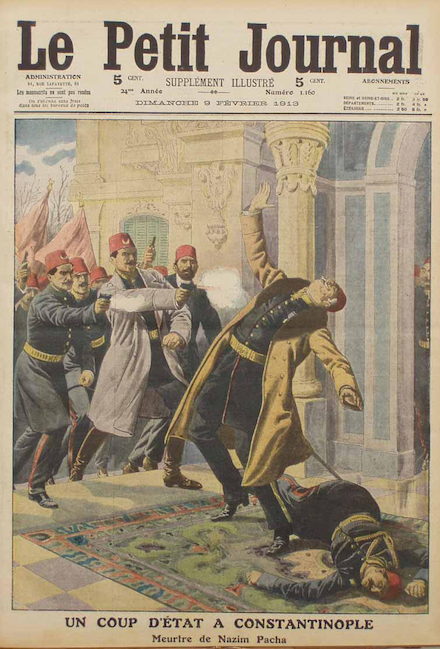
Such provincial homicides were but studies for the main deed of his days when in the 1913 Ottoman coup d’etat when he gunned down War Minister Nazim Pasha on the steps of the Sublime Porte as his CUP comrades barged in to force the resignation of the aging Grand Vizier and take the state firmly in hand.

It was an act that shook capitals around the world.


9 February 1913 edition of Le Petit Journal with a cover depiction of “un coup d’etat a Constantinople: muertre de Nazim Pacha”.

Ironically it was a desire for peace that brought his end. A couple of years deep into the catastrophe of World War I, Cemil rightly perceived the need to extricate his state from the conflict, and began making plans to topple the “Three Pashas” of the CUP whom he had helped to bring to power. His old friend Enver Pasha had no intention of approving the resulting death sentence — indeed, he had caught wind of it and tried persuasion to bring Cemil back onside — but when Enver Pasha was summoned to Berlin for a war council the fellow triumvir Talaat Pasha signed off on the execution with dispatch.

Rumors and legends abound concerning his death, such as shouting “Long live the Committee for Union and Progress!” before the firing squad opened up on him, and an agonizing half-hour bleed-out during which the expiring Cemil scrawled a patriotic slogan in the dirt with his own blood.

On this day..

1731: Catherine Bevan, burned alive in Delaware

On this date in 1731, a double execution of 50-year-old Catherine Bevan and her young servant — perhaps lover — Peter Murphy was nightmarishly marred by Bevan’s burning alive.

Such was indeed the sentence upon her for “petty treason”, a now-archaic legal category that compassed the betrayal — in practice, murder — of an authority. (Compare to “high treason”, meaning the betrayal of the ultimate authority, the sovereign; the legal categories show that these offenses are analogues.) Quite often in such cases the authority in question was the man of the house, and so it was here too: Bevan and Murphy beat and throttled to death her husband, Henry Bevan. Both wife-on-husband and servant-on-master homicide qualified as petty treason.

Crucially for the American colonies, the latter category included slaves in resistance to their masters. Petty treason was an offense elevated beyond “mere” murder because it implied an attack upon the received order upon which all society depended; one expression of the heightened outrage accorded to petty treason was that women* thus convicted could be sentenced to burning, rather than “mere” hanging. This interesting Widener Law Library blog about the Bevan case notes that out of 24 documented burnings of women in early America, 22 were burnings of enslaved women. (Enslaved men were also subject to this fate for crimes particularly threatening to the stability of the Slave Power, like arson.)

Bevan was one of the two exceptions, although it must be noted that there were other prosecutions of white domestic murderesses in the colonial period that simply got the culprits hanged instead of burned. In the looser confines of the New World, the growing English reticence about sending [white] women to the stake predominated; in fact, when Delaware found itself with another spousal parricide on its hands in 1787, its legislature hurriedly amended the still-extant burning-at-the-stake statutes to provide for simple hanging instead.

One reason for the squeamishness was what happened to the widow Bevan.

It was design’d to strangle her dead before the Fire should touch her; but its first breaking out was in a stream which pointed directly upon the Rope that went round her Neck, and burnt it off instantly, so that she fell alive into the Flames, and was seen to struggle.

–Pennsylvania Gazette, September 23, 1731

* “In treasons of every kind the punishment of women is the same, and different from that of men” who in some instances could be drawn and quartered, writes Blackstone. “For, as the decency due to the sex forbids the exposing and publickly mangling their bodies, their sentence (which is to the full as terrible to the sensation as the other) is to be drawn to the gallows, and there to be burned alive.”

On this day..

1767: Elsjen Roelofs

Elsjen Roelofs was broken on the wheel at Assen on this date in 1767 — an unusual fate for a woman, inflicted for poisoning her husband. The sources about her, and the links in this post, are almost exclusively in Dutch.

A farmer’s daughter who made a property-driven arranged marriage to another farmer, Roelofs was seemingly (so a neighbor described) driven to her desperate act when the said Jan Alberts purposed to move away, which would have separated her from her own family.

This poignant story is speculatively novelized by Janne IJmker in Achtendertig Nachten (Thirty-Eight Nights, which was the distance of time between the pregnant Roelofs delivering her daughter in prison on August 2, and the execution of the sentence). (Here’s a review.)

On this day..

1873: James Connor

The Capital Punishment UK Facebook page exhumes a ghastly artifact for us in the form of the September 8, 1873 hanging of James Connor at Kirkdale Gaol … and then his second hanging moments later.

A former boilermaker and sometime prizefighter, Connor had accosted a woman on the street with an aggressive proposition, then come to blows with the good Samaritans who attempted to intervene. One of them died from the blade wounds Connor dealt him; the other survived to firmly fix the identity of the rake.

That was on August 11, not even a full month before the man’s execution, and what was paid in haste was also surely paid in full after the stoical condemned instead of dropping to his death crashed into the side of the scaffold. According to the article shared by CPUK, it was not that the rope itself snapped but that “the splicing of the loop through which one end of the rope passes to form the noose had given way with the weight of the man.”

Either way, having built himself up to die game, Connor was somewhat unmanned at the horror spectacle of having his hood removed to behold prison officials scrambling to reset his gallows for a second pass. Per a broadside report,

After utterring [sic] a few deep groans he muttered to Warder Bradley, “What do you do this, do you call this murder?” The chaplain recommenced his ministrations, and entreated him in tremulous voice to keep up. At this point Connor, although suffering terrible physical pain, was heard to exclaim in a feeble voice, “After this you should let me off; surely this is enough. I stood it like a brick the first time.”

Of course, he had to stand it a second time too. Thankfully a third try was not required to accomplish the deed.

It was one of the last executions in the lengthy and botch-prone career of hangman William Calcraft, who was nearing his 73rd birthday at the time. Already he had was being surpassed in his art by the scientific professionalism of Marwood; by 1874, Calcraft was forced to hang up his brittle nooses for good.

On this day..

1619: Melchior Grodziecki, Istvan Pongracz and Marko Krizin, Jesuits

Jesuits Melchior Grodziecki, Istvan Pongracz, and Marko Krizin earned martyrdom at the hands of the Calvinists 400 years ago today.

A Pole, a Hungarian, and a Croat, respectively, they were emissaries of their vast polyglot empire’s official religion who were unlucky to be in the wrong place when theological differences went kinetic and helped launch the Thirty Years War.

That wrong place was the Hungarian city of Kassa (today the Slovakian city of Košice) which was captured by Protestant Transylvanian prince Gabriel Bethlen on September 5, 1619. Confined to the Jesuit residence, these three were assailed by a mob of soldiers who broke in on the morning of September 7 and demanded their immediate apostasy, putting them to summary torture and eventual beheading when they refused.

All three were canonized in the 20th century.

On this day..