On this date in 1560, a French peasant was hanged outside the home he had made with another man’s wife in the southwestern French village of Artigat (or Artigues).
A poignant, perplexing tale of identity and social place — and possibly even of love — the story of Martin Guerre is at once exactingly local to its time and place, and timeless in its principals’ humanity.
As told in Natalie Zemon Davis’ captivating social history The Return of Martin Guerre, the restless (or ill-tempered) young titular peasant — impotent with his wife Bertrande, tense living with his father-in-law, chafing in rural Artigat — got out of town in 1548, joined one of the soldiering companies crisscrossing Europe, and was heard of no more.
In the centuries before fingerprints, credit cards, cell phones and Facebook, Guerre just disappeared. Constrained by Catholic law not to remarry without proof of his death, Bertrande just had to wait.
Until “Martin” returned in 1556 simply by reappearing at Artigat — moved in with Bertrande — resumed the vanished man’s name and with it his place in the village. There were suspicions from the first that he wasn’t quite right … but this man had Martin’s stories, and the villagers didn’t have so much as a photograph to test him against.
Martin was accepted in Artigat for three-plus years, fathered two children with Bertrande, and managed the estate as head of household. In Davis’s telling, he appears much the better husband and father than the pre-1548 version, and this bolsters her case that Bertrande must have been complicit in the fraud that unraveled in 1560.
Property and inheritance conflicts with Martin Guerre’s uncle (now married to Bertrande’s widowed mother) brought to the courts the novel case: was this man really Martin Guerre?
The inconclusive tools for establishing identity and a deft defense by “Martin” must have made for a riveting legal drama (French link) — with villagers taking up competing sides and the man put to the test of his memory of Martin’s life, which he impressively aced. So thoroughly did the man command the role that
the gesture, deportment, air, and mode of speaking of the prisoner were cool, consistent, and steady; while those who appeared in the cause of truth were embarrassed, hesitating, confused, and on certain points contradictory in their evidence. (Source)
On the point, perhaps, of acquittal, the case was resolved like any legal potboiler should be: with the dramatic reappearance of the real Martin — for so all the conflicting witnesses quickly agreed him to be, and so confessed the imposter husband, Arnaud du Tilh (or Arnaud du Tilb), a peasant from a nearby village also nicknamed “Pansette”. A onetime army buddy of Guerre’s, the enterprising du Tilh had been mistaken for Guerre, and had pieced together enough of the absconded husband’s life that by dint of total recall and superhuman audacity, he made for his own the place in the world that Martin Guerre disdained.
The sentence of the court was that Martin Arnaud
make amende honorable in the marketplace of Artigat, in his shirt, his head and feet being bare, a halter about his neck, and holding in his hands a lighted torch; to beg pardon of God, the king, and the justice of the nation; of the said Martin Guerre, and de Rols his wife; and this being done, the said du Tilh shall be delivered into the hands of the executioner, who after making him pass through the streets, and other public places in the said town of Artigat, with a rope about his neck, at last shall bring him before the house of the said Martin Guerre, where, on a gallows set up for that purpose, he shall be hanged and strangled, and afterwards his body shall be burnt. (Source of the translation, slightly tidied up based on the French version here)
Arnaud du Tilh, and Martin Guerre with him, passed thereupon into the historical memory, for in assigning names to bodies, had the court really sorted out who was who? What does it mean to drop out of one’s society … and what rights can one expect to command upon returning? What did it mean to be Martin Guerre but to live in the house of Martin Guerre and manage the affairs of Martin Guerre? And the characters: Arnaud with his mysterious spark of bravado; Martin and his sudden and unexplained reappearance; the two of them as if cast for one another’s roles in life and crossed up by the gods.
And the mysterious Bertrande — what did she do, and what did she want?
A bit of Rorschach history, then, which accounts for the still-robust liveliness the tale enjoys four and a half centuries later. And let’s admit: a bit of wistfulness for the time you could start on a clean sheet just by changing your name. (Although illiterate 16th century peasants had achieved TSA-quality security protocols in this respect.)
Natalie Zemon Davis, whose own account has been criticized for overclaiming Bertrande’s role and motivations, also consulted as she was writing it for a Gerard Depardieu film of the same title.
On this date in 1850, a 57-year-old Harvard professor expiated upon a gallows at Boston’s Leverett Square the murder of one of the university’s donors.
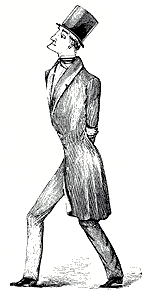
The buzz of Boston in 1849-50, the Parkman-Webster murder case began with the disappearance of one of the crimson’s great benefactors, George Parkman, a Boston Brahmin known for his Ministry of Silly Walks gait about town (see right). According to Oliver Wendell Holmes, Sr. (who appeared as a witness at the trial of Parkman’s accused murderer), “he abstained while others indulged, he walked while others rode, he worked while others slept.”
Also, he inherited a ridiculous sum of money, and was tight with the debtors to whom he lent it.
Back before collection agencies, Parkman disappeared in November 1849 while making the rounds to shake down his borrowers. Within days, suspicion settled on Harvard anatomy and geology professor John Webster, who had squandered his own pile of money buying rock collections and maintaining appearances and such, and sank into desperate hock to the jutting-chinned ambulator who had helped him land the Ivy League appointment in the first place.
A weighty circumstantial case soon formed against Webster, with the invaluable aid of a snoopy janitor who turned up human remains in the office and testified to incriminating-sounding conversations.
Elites-on-elite crime epidemics always churn the scandal mills. Henry Wadsworth Longfellow’s wife Fanny wrote a friend,
You will see by the papers what dark horror overshadows us like an eclipse. Of course we cannot believe Dr. Webster guilty, bad as the evidence looks. … Many suspect the janitor, who is known to be a bad man and to have wished for the reward offered for Dr. Parkman’s body. … I trust our minds will be soon relieved, but, meanwhile, they are soiled by new details continually.
Boston high society was about to see a whole different side of Harvard.
Although perhaps individually explicable — anatomists had plausible reasons to have human remains at work, and other anatomists than Webster could have had access to his office — the cumulative weight of Webster’s ham-handed attempts to declare that he had paid up his debts to Parkman just before the latter’s mysterious disappearance, of the discovery of what (disputed) dental forensics declared to be Parkman’s dentures, of the ghastly appearance of a torso (disputedly) declared to be Parkman’s stuffed in a tea chest at Webster’s offices started to really make the man look guilty.
In view of a mediocre defense, the jury convicted Webster of whacking his own professional benefactor, in the university building erected on said benefactor’s donated plot of land.
While the prof’s seeming post-conviction acceptance of guilt — in a plain strategem to secure clemency — and generally shifty demeanor have cemented him as the definitive perpetrator in the standard historical reading,* Fanny’s snobbish take on the “bad man,” janitor (and moonlight body-snatcher) Ephraim Littlefield, has not been entirely lost to the tradition.
At the end of the day, everything about the case is circumstantial — indeed, besides being historically noteworthy for the first use of dental forensic evidence in a murder trial (forensics we might find rather speculative and unconvincing today), Webster’s case generated a landmark ruling from the judge’s jury instruction establishing “reasonable doubt” as the threshold for criminal conviction rather than the “absolute certainty” Webster’s prosecutors had no hope of attaining; that ruling influences American jurisprudence down to the present day.
And one cannot but notice how many of the circumstances — creepily playing Sherlock Holmes with a freelance dig into the professor’s furnace to discover charred bones, for instance — were provided by the fellow-suspect-turned-star-witness Littlefield, who niftily reaped the $3,000 reward for his offices in substituting Webster for himself under the pall of suspicion.
According to peripatetic crime blogger Laura James, a forthcoming (2009) book promises to revisit the sensational trial, “to examine all the intricacies for ourselves — not aided by the eager voice of the janitor.”
* Bemis, one of the prosecutors, wrote the go-to source on the Webster trial, available from Google Books; another contemporaneous account is here.
On this date in 1890 the iconic symbol of the American death penalty made its grisly debut upon the person of William Kemmler at New York’s Auburn Prison.
The long New World tradition of hanging condemned prisoners came under fire as a barbarism in the late 19th century, leading reformers to look for killing procedures less likely to result in a horrendously protracted strangulation or a midair decapitation. As Empire State Governor David Hill put it,
The present mode of executing criminals by hanging has come down to us from the dark ages, and it may well be questioned whether the science of the present day cannot provide a means for taking the life of such as are condemned to die in a less barbarous manner.
On this stage, Executed Today presents a rogues’ gallery of homo Americanus, the salesmen and swindlers who would help the U.S.A. ride the lightning.
The Dentist
A true renaissance man, Buffalo dentist Dr. Alfred Southwick, applied his active mind to the need to better kill a fellow, and soon hit upon an inspiration — that is to say, a town drunk hit upon an electrical generator and died instantaneously, and the observant Southwick said “eureka!”
Without the subsequent industry of this neglected gentleman, who added to his repertoire scientifically-minded electrical butchery of animals alongside political gladhandings to bring a flutter to a busybody’s heart, the Chair’s entire oeuvre of machismo-sadism might have missed the country altogether. Just imagine living in a world where New York had pioneered its other leading reform alternative: lethal injection.
(This, incidentally, is why the chair is a chair, and not a bed or a stake or a St. Andrew’s Cross: because the guy who thought of it spent all day administering his own tender mercies to seated penitents.)
The Plutocrats
As Southwick nagged his senator and shocked stray cats into the great hereafter, the gears of commerce strove relentlessly ever-onward. The business of America was ever business, and never more so than the Gilded Age.
And the business of killing people was about to become the biggest business there was.
The age of electricity was buzzing into incandescence, and two rival standards were at currents amped over eventual dominance of this stupendous industry. Thomas Edison’s earlier Direct Current (DC) standard was being challenged by Nikolai Tesla’s Alternating Current (AC), backed by the financial muscle of George Westinghouse.
Cheaper and more efficient, AC tilted the playing field against Edison. Seeing his days numbered, the Wizard of Menlo Park fought back the way any dinosaur industry would: dirty.
This clip of the electric demise of a circus elephant — don’t hit “play” if you’re not up for animal cruelty — is from some years later (Edison kept tilting at windmills and megafauna carcasses as his DC empire disappeared), but it’ll give a sense of the horrifying spectacle.
With the New York legislature’s embrace of Southwick’s seated voltage people-eater, Edison turned his PR gears on the state, demanding they adopt his competitor’s “deadlier” current for the contraption. And they did, reflecting a widespread belief inculcated by Edison’s experiments — as this New York Times article on an Edison crony’s public livestock-killing show in the days leading up to the advent of the electrocution law indicates:
The experiments proved the alternating current to be the most deadly force known to science, and that less than half the pressure used in this city for electric lighting by this system is sufficient to cause instant death.
After Jan. 1 the alternating current will undoubtedly drive the hangmen out of business in this State.
Too bad for Edison that the business he was really trying to kill was made of sturdier stuff.
The Alcoholic Vegetable Merchant
As the 1880’s wane, we come at last to our subject — in several senses of the term — an illiterate nobody of German stock who chanced to kill his common-law wife with just the right timing to join in a new kind of experiment.
William Kemmler mounted a “cruel and unusual punishment” appeal against his sentence funded by Westinghouse himself: no dice. Perhaps appreciating the odd foothold on history he was about to attain, he showed little worry as he entered the execution room and sat himself — “undoubtedly the coolest man in the room,” a journalist present reported.
The End of the Beginning
That reporter’s description for the New York Herald graphically captures humanity’s first horrible encounter with this “humanitarian” machine, beginning with the prisoner’s parting remarks.*
Doubtless he knew that his words will go down in history and he had his lesson well learned. He addressed his audience [in] a commonplace way and without hesitation.
…
“Well, gentleman, I wish everyone good luck in this world, and I think I am going to a good place, and the papers have been sa[yi]ng a lot of stuff that isn’t so. That’s all I have to say.”
And so with a parting shot at what he was good enough to refer to not long ago as “those d—d reporters,” William Kemmler took his leave of earth. The quiet demeanor of the man as he entered had made a strong impression on those in the room. His self-possession after his oratorical effort simply amazed them. He got up out of his chair as though he were anxious to try the experiment, not as though he courted death, but as though he was thoroughly prepared for it. …
There was no delay. Kemmler constantly encouraged the workers at the straps with “Take your time; don’t be in a hurry; do it well; be sure everything is all right.” He did not speak with any nervous apprehension.
Warden Durston leaned over, drawing the buckle of the straps about the arm. “It won’t hurt you, Bill,” he said, “I’ll be with you all the time.”
A minute later Kemmler said, “There’s plenty of time.” He said it as calmly as the conductor of a streetcar might have encouraged a passenger not to hurry.
…
Kemmler was pinioned so close that he could hardly have moved a muscle except those of his mouth.
The Warden took a last look at the straps. “This is all right,” he said.
“All right,” said Dr. Spitzka, and then bent over and said, “God bless you, Kemmler.”
“Thank you,” said the little man, quietly.
“Ready?” Said the Warden.
“Ready,” answered the doctors.
“Goodbye,” said the Warden to Kemmler. There was no response.
GAVE THE SIGNAL.
The Warden stepped to the door leading into the next room. It was then forty-three and one-half minutes past six o’clock by the prison clock. “Everything is ready,” said the Warden to some one hidden from view in the next room.
The answer came like a flash in the sudden convulsion that went over the frame of the chair. If it seemed rigid before under the influence of the straps, [it] was doubly so now has it strained against them.
The seconds ticked off. Dr. McDonald, who was holding the stopwatch, said “Stop.”
Two voices near him echoed, “Stop.”
The Warden stepped to the door of the next room and repeated the word “Stop.”
As the syllable [passed] his lips the forehead of the man in the chair [grew] dark [in] color, while his nose, or so much of it as was exposed, appeared a dark red.
There was very little apparent relaxation of the body, however. [A] fly lighted on the nose and walked about unconcernedly. The witnesses drew nearer to the chair.
“He’s dead,” said Spitzka, authoritatively.
“Oh, yes, he’s dead,” said McDonald.
“You’ll notice,” said Spitzka, “the post-mortem appearance of the nose immediately. There is that remarkable change that cannot be mistaken for anything else, that remarkable appearance of the nose.”
The other doctors nodded [assent]. They looked at the body critically for a minute and then Spitzka said, [“]oh, undo that now. The body can be taken to the hospital.”
“Well, I can’t let you gentlemen out of here until I have your certificates,” said the Warden.
FOUND SIGNS OF LIFE.
It was while this businesslike conversation was going on that Dr. Balch made a discovery.
“McDonald,” he cried, “McDonald, look at that rupture,” he pointed at the abrasion of the skin on Kemmler’s right thumb. In the contraction of the muscles the figurehead[?] scraped against it and removed the skin, and from that little [wound] blood was flowing-[an] almost certain indication of life.
A low cry of horror went through the assemblage.
“[Turn] on the current,” excitedly cried Dr. Spitzka. “This man is not dead.”
The crowd fell back from the chair, as though they were in danger. The Warden sprang into the closed door and pounded on it with his hand.
“Start the current!” he cried. As he spoke of fluid began to drop from Kemmler’s mouth and to run down his beard; a groaning sound came from his lips, repeated and growing louder each time.
It seemed [an] age before the card was again turned on. In fact it was just seventy-three seconds from the end of the first contact when the first sound was heard to issue from Kemmler’s lips, and it was not more than a half [minute] before the card was again turned on.
RECOVERING CONSCIOUSNESS.
But every second to that time the horrible sound from those groaning lips was becoming more distinct, [a straining] of the chest against the leather harness stronger and more evident.
The man was coming to life. The spectators grew faint and sick. [Men] who had stood over dead and dying [men] and had cut [men] to pieces without an emotion [grew] pale and turned their heads away.
One witness was forced to lie down while one of the doctors fanned him.
But [the end] came at last. There was another convulsion of the body, and … it became rigid with the rigidity of iron.
“That man wasn’t dead,” cried Spitzka excitedly. As he spoke the body twitched again. The electrician had given the current gain new alternation and now 2,000 volts [were] playing in short, successive shocks down Kemmler spine. The sound ceased with the first convulsion, but the fluid continued to trip from the mouth and down the beard, making the body a sickening spectacle.
“Keep it on now until he’s killed,” said one of the doctors. …
“Keep it on! Keep it on!” Cried Warden Durston through the door.
Silence reigned for a moment. A bell without began to [toll] solemnly. …
BURNED BY THE CURRENT.
Then from the chair came a sizzling sound, as of [meat] cooking on hand. Following it immediately a billow of smoke came from the body and filled the air of the room with the odor of burning hair.
There was a cry from all the members of the little group, and Warden Durston cried through the door leading to the next room to [turn] the current off.
More shocking — so to speak — papers ran the next day’s headline “Kemmler Westinghoused,” the verb “to Westinghouse” being another shameless Edisonian bid to stamp his marketing project onto the Queen’s English. This fine, rounded, archaic neologism the right sports anchor could resuscitate as a fresh synonym for thrashing, horsewhipping, poleaxing, or else (in greater justice) for moderation and decency as the only principal in the sordid affair that rejected death-dealing by electricity.
(Officially, Edison also opposed the death penalty. Like Dr. Guillotin, he was doing his part for humanity in the meantime … just with a little skin in the game. Did we mention the business of America is business?)
Official reviews for the “art of killing by electricity” were, ahem, mixed.
“They could have done better with an axe.”**
-George Westinghouse
“Strong men fainted and fell like logs on the floor.”
-New York Herald
“Revolting … a disgrace to civilization.”
-New York Times
“We live in a higher civilization from this day on.”
-Alfred Southwick
Books (remarkably numerous!) about the creation of the electric chair
It should, in fairness, be noted that the U.S. was not the only country (pdf) to mull an electrocution chair in the 19th century … but it was (and for a long time remained) the only one to actually use one.
* The Herald excerpt, along with several other articles from the same paper about the Kemmler execution, is here, but the text has obviously been generated from a scan with uneven results. As I do not have access to the originals, [bracketed] remarks in the excerpt indicate this author’s own interpretations or interpolations of seemingly mistaken transcriptions.
** Some sources make it “would have done better with an axe.”
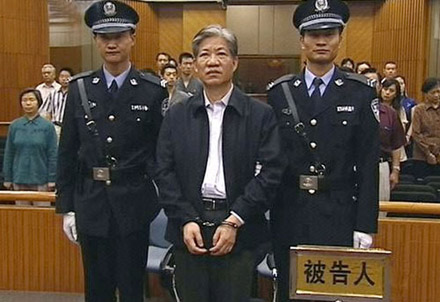
One year ago today, China made to clean up its image — with public health advocates, if not with human rights advocates — by executing* its former Food and Drugs minister for economic crimes.
Zheng Xiaoyu, China’s drug regulation capo from 1994 to 2005 and only (“only”?) the fourth minister-level official to be put to death in China since the immediate aftermath of Mao Zedong’s reign, was sentenced for extracting bribes from pharmaceutical companies he nominally regulated in exchange for approving their worthless and/or unsafe products.
One bogus antibiotic he rubber-stamped killed ten in China before it was pulled from the market, but it was dangerous Chinese products exported abroad — including lethal pet food ingredients to the United States and a cough syrup that killed dozens in Panama — that lit a fire under the export-driven colossus. The court that rejected his appeal explicitly referenced Zheng’s danger to China’s international reputation — simultaneously shifting focus from structural weaknesses by individualizing them to Zheng’s personal failings.
On this same day it announced Zheng’s death, China anxiously unveiled plans to safeguard the food supply for its upcoming turn under the Olympic klieg lights. That acid test is now upon it: opening ceremonies are mere weeks away as of this writing.
It may have been a politically-driven execution and an unusually heavy sentence, but Zheng’s passing was exulted in China. Someone even tried to put his name on a rat poison — rejected for that most distinguished reason of modern capitalism, Zheng’s own intellectual property in his name.
For an interesting dive into the social and legal currents surrounding this case, check out this .pdf edition of Criminal Bar Quarterly.
* The method of execution was not announced, and to my knowledge has not been conclusively documented. Gunshot was the longtime standby for Chinese executions, but China has shifted heavily towards lethal injection in recent years; it’s generally assumed that Zheng suffered the latter fate.
On this date in 1979, the putschist government of Ghana shot former military rulers Frederick William Kwasi Akuffo and Akwasi Amankwaa Afrifa along with four others at the Teshie Military Range for corruption.
Twenty-two years before, Ghana had become the first black sub-Saharan former colony to gain independence, but after a 1966 coup it had staggered through political and economic chaos. Six different men had been head of state in that span, three of them deposed by coups. By 1979, General Fred Akuffo‘s government was the target of explosive anger.
Enter Flight Lieutenant Jerry Rawlings, who had actually failed in a coup attempt in May and was in line for execution himself before his mates toppled the government on June 4.
Seeking to stabilize the situation — and, Rawlings himself has said, riding the tiger of popular fury — the new government served up a few high-profile morsels on charges of pilfering the treasury in order to forestall a general slaughter of senior officers by the armed forces’ lower ranks.
There was no alternative. We had to contain it within the military so it didn’t spill into the civil front — if it had it would have been terrible.
We had no choice but to sacrifice the most senior ones — the commanders.
Another former head of state, Gen. Ignatius Kutu Acheamphong, had been shot earlier in the month; on this date, Akuffo and Gen. Akwasi Afrifa, one of the original 1966 plotters who had ruled Ghana in 1969-70, followed him. Afrifa, ironically, had written to Acheamphong worrying that political upheaval and military discipline could find them … well, where it eventually found them:
I feel greatly disturbed about the future after the government … In order to discourage the military from staging coups in the future, how about if they line all of us up and shot us one by one? I do not certainly want to be arrested, given some sort of trial and shot.
All these shootings had an unseemly character of haste and summary justice; charges against the four senior ministers* shot along with the former rulers have struck an especially sour note. Rawlings has claimed that he only wanted the two former heads of state shot and tried unsuccessfully to stop the other four executions.
I attempted to prevent it and sent an officer but the firing squad shot the officers before their commander could give the order … you must understand our country was in a state of rage then, not different from what Russia was when it had its revolution.
…
I was a partial hostage to that situation. I had no force. The authority that I enjoyed was my moral authority with the people. Their action (the execution of the senior officers by the boys) was to curtail the anger of the nation.
Rawlings would hand power over to a civilian government, which he then overthrew again in 1981 — looking like this:
He would run Ghana for the next two decades, the last eight years after winning elections. Rawlings’ legacy is much up for debate, but to many he cuts the figure of a benevolent dictator (how many former strongmen have fan pages?) whose human rights abuses were mild in the scheme of things and helped usher in a relatively prosperous and democratic Ghana that stands a very far cry from the country he took over in 1979.
Rawlings himself has graduated to a sort of global elder statesman — for instance, he recently called for fair elections in Zimbabwe. And he has not been hesitant to justify his political actions, as in this interesting BBC interview from 2005 — in which, pressed on the executions of the former state ministers, he concedes:
There were some of them who probably deserved it. Pardon me for putting it that way. There were some of them who did not — very brilliant, beautiful officers. But we had no choice but to make that sacrifice.
The bodies of all the officers executed in June of 1979 were exhumed for “fitting burial” under Rawlings’ successor in 2001.
* One of the aides held the Ghanaian high jump record at the time of his death, a mark not surpassed until 1996.
On this date in 1934, three members of a quartet that had — eventually, with Keystone Cops ineptitude — killed a vagrant in an insurance scam during the Great Depression were electrocuted at Sing Sing.
Mike Malloy, the victim of Daniel Kriesberg, Anthony Marino and Frank Pasqua (and Joseph Murphy, whose execution this day was stayed, but who followed his collaborators to the chair on July 5 of that same year), has chiseled out a weirdly Bunyanesque footnote of Americana as “the man who wouldn’t die.”*
The troubles the would-be murderers had getting rid of the 50-year-old drunk after they conned him into signing less than $2,000 worth of insurance papers are outright black comedy. The New York Daily Newsremembered this noteworthy homicide last year. Yes, it’s murder, but it happened 75 years ago. Go ahead and laugh.
After several weeks of feeding Malloy free liquor [in an attempt to have him drink to death], Marino noted that it was starting to cost him money. More distressing was Malloy’s health: His pallor had lifted and spirits soared courtesy of the free booze. More active measures would be required to hasten Malloy’s demise.
Murphy, a former chemist, told Malloy that some “new stuff” had come in. Malloy drank it, commented on how smooth it tasted and then collapsed to the floor. They dragged him to the back room and anticipated that they would need to pay off a physician for a “hush job” death certificate.
One hour later, a refreshed Malloy bounded back to the bar with a mighty thirst, unaffected by the alcohol Murphy had laced with car antifreeze.
Over the next few days the gang spiked Malloy’s drinks with stronger doses of antifreeze, then turpentine and, finally, horse liniment with rat poison. Malloy kept beaming and kept drinking, soaking up the good times spent with his new friends. The crew decided a switch to food would best hasten Malloy’s death.
Marino served him raw oysters – soaked in wood alcohol. After downing two dozen, Malloy was so enthused by the cuisine that he encouraged Marino to open up a restaurant. The next course included an entrée of rotten sardines mixed with tin shavings. Same result.
Next, the plotters got Malloy stupefied and escorted him to Claremont Park, stripped off his coat, and in the middle of winter opened his shirt and poured 5 gallons of water on him before dumping him into a snowbank. If poisoned liquor and food couldn’t kill Malloy, then the cold blasts of a New York winter would.
Or so they thought. The next evening, Malloy showed up at the speakeasy wearing a new suit. He had really tied one on the night before, he explained, and wound up nearly naked in the park. Fortunately, the police had found him and a welfare organization outfitted him with new clothes.
Exasperated, the gang hired a cab driver, Harry Green, and offered him $150 to run Malloy down with his vehicle. On Jan. 30, 1933, a nearly unconsciously drunk Malloy was driven from Marino’s to Pelham Parkway. Murphy stood him up in the middle of the roadway, and Green backed up his taxi two full blocks to build up enough speed to complete the job. Somehow, Malloy stumbled to safety. They then took Malloy to Gun Hill Road. This time, Green hit him.
The gang gleefully retreated to Marino’s and again waited for an announcement of Malloy’s demise. For days nothing appeared in the newspapers.
Where was he? Malloy was recovering in the hospital under a different name, having sustained a fractured skull, a concussion and a broken shoulder. The indestructible barfly returned several weeks later to the speakeasy and announced he had an awful thirst. The boys’ jaws dropped.
Now desperate, they contacted a professional hit man, but his $500 fee was too expensive. They then shanghaied another drunk, Joe Murray, stupefied him with liquor and stuffed his coat pocket with Malloy’s ID and ran him over with a cab. Murray, a substitute for Malloy in every way, recovered from his injuries after two months in Lincoln Hospital. The only way to knock off Malloy, the gang determined, was murder, clean and simple.
They finally had to stuff a rubber hose down his maw and gas him through it.
Astonishingly, this blockheaded crew came within a fingernail’s breadth of getting away with it, just as they’d gotten away with their innumerable attempted murders** — evidence, really, of just how overrated an achievement the “perfect crime” is. A little baksheesh for a death certificate with a fake cause-of-death, a quick trip to the pauper’s cemetery, and they had already set about collecting the insurance policies before anyone got suspicious.
With four shiftless conspirators and at least two other people who’d been let in on the plot, though, once the sniffing started, their goose was cooked. Soon enough, so were the killers. And it only took the state of New York one try apiece.
* The young Steven Spielberg’s Amazing Stories television show dramatized this implausible story. Why The X-Files never made use of it, no one can say.
** The Daily News reckons it at six; a 1934 New York Times piece counted 10. The investigation suggested that they’d actually done someone else for insurance before, using the winter exposure method that Malloy survived.
On this date in 1917, a 29-year-old former dentist took a seat in Sing Sing’s electric chair — his poisoning career nipped in the bud by woman’s intuition.
The first dentist in our collection, Dr. Waite, was a good looking raconteur, who most likely preferred playing tennis to practicing dentistry. He grew up in Grand Rapids, Michigan, and after graduating from dental school went to South Africa to practice. Waite eventually left Africa under some suspicious accusations and returned to Michigan, where he wooed and married the daughter of John and Hannah Peck.
John Peck was a millionaire pharmacist who owned a reputable drug company in the city. The newlyweds were furnished with posh accommodations in New York City by the grateful Pecks. There, Arthur spent much of his time dabbling in the area of bacteriology, and also took on a mistress.
In January 1916, shortly after Hannah Peck arrived to visit the Waits in New York, she suddenly became ill and died. Her body was immediately cremated and returned to Michigan for burial. In March of the same year, John Peck also went to New York to console his daughter and her husband over the death of his wife. He too soon became ill and died. However, before his body could be cremated an anonymous telegram was received in Grand Rapids stating “suspicion aroused, demand autopsy.” Surprisingly, the autopsy indicated that John Peck was loaded with arsenic, and an investigation ensued.
The accusing finger eventually pointed to the playboy dentist, and he was taken in for interrogation. A search of his dwelling revealed numerous bacterial cultures, as well as texts dealing with toxicology. Under interrogation, Dr. Waite changed his story numerous times. First he stated that he had obtained arsenic for his father-in-law, who wanted to commit suicide to end his grief over the loss of his wife. Then Dr. Waite claimed his own body was inhabited by the spirit of an evil Egyptian priest, who had instructed him to kill his in-laws in order to gain their wealth. Eventually, Dr. Waite felt if he told what had actually happened the courts would find him insane, so he revealed the whole story of administering typhoid, pneumonia, diphtheria organisms, and arsenic while the Peck’s [sic] were undergoing work in his dental chair.
It did not take the jury long to see through the manipulations of Dr. Waite, and they convicted him of the murders. Dr. Waite was electrocuted at Sing Sing Prison on May 24, 1917.
That decisive anonymous tip, it emerged, came from a New Jersey schoolteacher named Elizabeth Hardwick, whose father, one Dr. Cornell, was cousin to the victim. Here’s how the New York Timesreported it (pdf) a few years later, ruminating on the chancy breaks that sometimes solve criminal cases:
The day after Mr. Peck’s death, Dr. Cornell called at the Waite apartment to pay his respects. Waite, with the Peck millions almost in his hands, forgot his suavity for a moment and greeted his father-in-law’s cousin so rudely that Dr. Cornell was hurt. At home that night the doctor expressed his amazement at the demeanor of the erstwhile gracious Waite.
This set the seal on the suspicions which Miss Hardwick had always harbored. Saying nothing to any one she hurried to the telegraph office and sent a telegram to Percy Peck, the murdered man’s son, in Grand Rapids.
…
“This case,” said Commissioner Faurot, “was interesting because a woman’s intuition seized upon a moment’s carelessness on the part of one of the most fiendish murderers in police records to undo the criminal. Without her, the authorities never would have investigated the case. Waite certainly would have murdered his wife and perhaps others before he got through.”
Long forgotten now, Waite — who had smooth-talked his way into New York society seemingly with designs of cutting a swath of bodies through it* — made quite the infamous figure in his day. This Times article (pdf again) from days after his arrest suggests a whiff of the case’s sensation to contemporaries.
* The authorities, who naturally had no incentive to downplay the menace of their killer, figured his wife, his mistress and his mistress’ husband were next in line — though there was also no obvious way Waite could have cashed in on the latter two.
On this date in 1315, an obscure petty noble who had become the king’s right-hand man was hanged by his rivals a few months after his royal sponsor expired.
Late in the epoch-making reign of King Philip the Fair — under whose rule the papacy was hijacked to Avignon and the Templars were crushed — Enguerrand de Marigny was the man loyally keeping the books.
Since Philip was a stubbornly spendthrift fellow, that meant Marigny’s chief pursuit was the creative extraction of new revenues, through fresh taxes and the debasement of coinage. His public esteem suffered commensurately, little aided by the fact that his duties made him fabulously wealthy and the most powerful man in the country, give or take a king.
Said monarch was vigorous in that age-old pastime of the feudal monarchy, centralization of the power scattered among the nobility, further to which end he was happy to promote a competent administrator of scanty lineage and dependable loyalty.
Aggrieved lords, like the grasping Charles de Valois, were ready with their grudges against the unpopular minister when Philip shuffled off in November 1314. When charges of financial impropriety didn’t stick, they cooked up an allegation of sorcery — just then coming into vogue as a trump card in the game of judicial homicide.
Enguerrand hung two years upon the monumentally terrifying Montfaucon Gibbet (the link is to the structure’s French Wikipedia page), but everyone felt just terrible about it later. (the link is French, again) An actual inquiry — they skipped that step when they strung him up — exonerated the luckless minister, allowing his heirs to retrieve his body and a chunk of his fortune from the sympathetic king; Charles was so pursued by guilt that on his deathbed, he sent out a fat dispensation of alms with the request that recipients pray for both Enguerrand de Marigny and himself.
It worked … at least for Marigny’s reputation.
None can tell, after this lapse of time, whether this remorse proceeded from weakness of mind or sincerity of heart, and which of the two personages was really guilty; but, ages afterwards, such is the effect of blind, popular clamor and unrighteous judicial proceedings, that the condemned lives in history as a victim and all but a guileless being. (Source)
It was no hard feelings from Enguerrand’s little brother, Jean. The family influence had landed him a bishopric, and he held the job until his death in 1350, even repelling an English siege of Beauvais during the Hundred Years’ War.
Enguerrand de Marigny comes in for a passing notice as T.H. White affectionately surveys the Middle Ages in The Once and Future King:
What an amazing time the age of chivalry was! Everybody was essentially himself — was riotously busy fulfilling the vagaries of human nature … [a] coruscating mixture of oddities who reckoned that they possessed the things called souls as well as bodies, and who fulfilled them in the most surprising ways.
…
[Y]ou might have seen Enguerrand de Marigny, who built the enormous gallows at Mountfalcon, [sic] himself rotting and clanking on the same gallows, because he had been found guilty of Black Magic.*
That Marigny erected the gallows on which he hung is an oft-repeated claim, an instance of a whole subgenre of moralistic folklore in which death-dealing inventors are hoisted on their own petard. These stories are not always dependable — contra rumor, for instance, Dr. Guillotin was not guillotined — and today’s protagonist may not have a firm hold on this small consolation, either.
Montfauçon was, as Sauval says, “the most ancient and the most superb gibbet in the kingdom.” …
Let the reader picture to himself, crowning a limestone hillock, an oblong mass of masonry fifteen feet in height, thirty wide, forty long, with a gate, an external railing and a platform; on this platform sixteen enormous pillars of rough hewn stone, thirty feet in height, arranged in a colonnade round three of the four sides of the mass which support them, bound together at their summits by heavy beams, whence hung chains at intervals; on all these chains, skeletons; in the vicinity, on the plain, a stone cross and two gibbets of secondary importance, which seemed to have sprung up as shoots around the central gallows; above all this, in the sky, a perpetual flock of crows; that was Montfauçon.
At the end of the fifteenth century, the formidable gibbet which dated from 1328, was already very much dilapidated; the beams were wormeaten, the chains rusted, the pillars green with mould; the layers of hewn stone were all cracked at their joints, and grass was growing on that platform which no feet touched. The monument made a horrible profile against the sky; especially at night when there was a little moonlight on those white skulls, or when the breeze of evening brushed the chains and the skeletons, and swayed all these in the darkness. The presence of this gibbet sufficed to render gloomy all the surrounding places.
The mass of masonry which served as foundation to the odious edifice was hollow. A huge cellar had been constructed there, closed by an old iron grating, which was out of order, into which were cast not only the human remains, which were taken from the chains of Montfauçon, but also the bodies of all the unfortunates executed on the other permanent gibbets of Paris. To that deep charnel-house, where so many human remains and so many crimes have rotted in company, many great ones of this world, many innocent people, have contributed their bones, from Enguerrand de Marigni, the first victim, and a just man, to Admiral de Coligni, who was its last, and who was also a just man.
Hugo — who, let us admit, is not to be depended upon for history — has elevated Marigny to the very first victim of the Montfaucon gallows, but the reader will also notice that the same passage dates the edifice’s construction thirteen years after Marigny’s own execution.
About this point, this blog runs against the limits of its writer’s access to primary documentation and werewithal to pursue it. Sources seem mightily confused on the embryonic era of Montfaucon; at least two other ministers — Pierre de La Brosse, a confidante of the previous king, and Pierre Remy, another royal treasurer hanged a generation after Marigny — also have their own claim to have been hanged on the structure they erected.
It may be that this was actually true of Remy, a less dramatically captivating figure with an official portfolio similar to Marigny’s, and the two simply became conflated in legend. Something certainly seems to have been built during his time, and it may have been the stone replacement for the original gallows.
The suggestion of someone who researched it more thoroughly than I have (another French page, but worth the visit if only for the pictorial schematics) is that the landmark structure may have predated all these men.** Brosse and Marigny, in this conception, may simply have worked various repairs upon it that became magnified in the retelling, while the gallows Remy set up might have been those on the secondary location, erected as a stopgap during a more thorough reconstruction of the permanent site, and/or reserved for more vulgar elements than ministers of the crown.
** We find repeated claims that the alleged “sorceror” Marigny engaged for his capital crime was hanged below him, which would support that notion; I have been unable to identify the provenance of this detail, however.
Dickens spent a good part of the mid-1840’s abroad, with extended stays in North America, Italy and Switzerland, although without much abating his prodigious output. He intended the travelogue Pictures From Italy to help finance his journeys; it met an unenthusiastic reception and rates distinctly among Dickens’ minor works.
This day’s events took place during the latter stages of Dickens’ stay in Italy and — as the distinctly proscriptive last paragraphs of this excerpt indicate — touch a social theme very pressing to the author, one to which he would soon return again. Years later, the utterly unedifying scene of the public guillotine would be fodder for Dickens’ A Tale of Two Cities, whose tragic protagonist has already appeared in these pages.
Of note also is Dickens’ implication — though he doesn’t quite state it outright — that the criminal was uncovered by a secret revealed under the seal of confession, a touchy point for the priesthood as any viewer of television crime dramas will certainly be aware. We have to allow a considerable latitude for a misapprehension on the traveler’s part here, especially given that Pictures as a whole caught considerable heat from the moment of its publication for its relentless anti-Catholicism. (Update: More on the use of confessionals in Papal Rome in this post about the Vatican’s headsman.)
Here’s the scene in its entirety:
On one Saturday morning (the eighth of March), a man was beheaded here. Nine or ten months before, he had waylaid a Bavarian countess, travelling as a pilgrim to Rome – alone and on foot, of course – and performing, it is said, that act of piety for the fourth time. He saw her change a piece of gold at Viterbo, where he lived; followed her; bore her company on her journey for some forty miles or more, on the treacherous pretext of protecting her; attacked her, in the fulfilment of his unrelenting purpose, on the Campagna, within a very short distance of Rome, near to what is called (but what is not) the Tomb of Nero; robbed her; and beat her to death with her own pilgrim’s staff. He was newly married, and gave some of her apparel to his wife: saying that he had bought it at a fair. She, however, who had seen the pilgrim-countess passing through their town, recognised some trifle as having belonged to her. Her husband then told her what he had done. She, in confession, told a priest; and the man was taken, within four days after the commission of the murder.
There are no fixed times for the administration of justice, or its execution, in this unaccountable country; and he had been in prison ever since. On the Friday, as he was dining with the other prisoners, they came and told him he was to be beheaded next morning, and took him away. It is very unusual to execute in Lent; but his crime being a very bad one, it was deemed advisable to make an example of him at that time, when great numbers of pilgrims were coming towards Rome, from all parts, for the Holy Week. I heard of this on the Friday evening, and saw the bills up at the churches, calling on the people to pray for the criminal’s soul. So, I determined to go, and see him executed.
The beheading was appointed for fourteen and a-half o’clock, Roman time: or a quarter before nine in the forenoon. I had two friends with me; and as we did not know but that the crowd might be very great, we were on the spot by half-past seven. The place of execution was near the church of San Giovanni decolláto (a doubtful compliment to Saint John the Baptist) in one of the impassable back streets without any footway, of which a great part of Rome is composed – a street of rotten houses, which do not seem to belong to anybody, and do not seem to have ever been inhabited, and certainly were never built on any plan, or for any particular purpose, and have no window-sashes, and are a little like deserted breweries, and might be warehouses but for having nothing in them. Opposite to one of these, a white house, the scaffold was built. An untidy, unpainted, uncouth, crazy-looking thing of course: some seven feet high, perhaps: with a tall, gallows-shaped frame rising above it, in which was the knife, charged with a ponderous mass of iron, all ready to descend, and glittering brightly in the morning sun, whenever it looked out, now and then, from behind a cloud.
There were not many people lingering about; and these were kept at a considerable distance from the scaffold, by parties of the Pope’s dragoons. Two or three hundred foot-soldiers were under arms, standing at ease in clusters here and there; and the officers were walking up and down in twos and threes, chatting together, and smoking cigars.
At the end of the street, was an open space, where there would be a dust-heap, and piles of broken crockery, and mounds of vegetable refuse, but for such things being thrown anywhere and everywhere in Rome, and favouring no particular sort of locality. We got into a kind of wash-house, belonging to a dwelling-house on this spot; and standing there in an old cart, and on a heap of cartwheels piled against the wall, looked, through a large grated window, at the scaffold, and straight down the street beyond it until, in consequence of its turning off abruptly to the left, our perspective was brought to a sudden termination, and had a corpulent officer, in a cocked hat, for its crowning feature.
Nine o’clock struck, and ten o’clock struck, and nothing happened. All the bells of all the churches rang as usual. A little parliament of dogs assembled in the open space, and chased each other, in and out among the soldiers. Fierce-looking Romans of the lowest class, in blue cloaks, russet cloaks, and rags uncloaked, came and went, and talked together. Women and children fluttered, on the skirts of the scanty crowd. One large muddy spot was left quite bare, like a bald place on a man’s head. A cigar-merchant, with an earthen pot of charcoal ashes in one hand, went up and down, crying his wares. A pastry-merchant divided his attention between the scaffold and his customers. Boys tried to climb up walls, and tumbled down again. Priests and monks elbowed a passage for themselves among the people, and stood on tiptoe for a sight of the knife: then went away. Artists, in inconceivable hats of the middle-ages, and beards (thank Heaven!) of no age at all, flashed picturesque scowls about them from their stations in the throng. One gentleman (connected with the fine arts, I presume) went up and down in a pair of Hessian-boots, with a red beard hanging down on his breast, and his long and bright red hair, plaited into two tails, one on either side of his head, which fell over his shoulders in front of him, very nearly to his waist, and were carefully entwined and braided!
Eleven o’clock struck and still nothing happened. A rumour got about, among the crowd, that the criminal would not confess; in which case, the priests would keep him until the Ave Maria (sunset); for it is their merciful custom never finally to turn the crucifix away from a man at that pass, as one refusing to be shriven, and consequently a sinner abandoned of the Saviour, until then. People began to drop off. The officers shrugged their shoulders and looked doubtful. The dragoons, who came riding up below our window, every now and then, to order an unlucky hackney-coach or cart away, as soon as it had comfortably established itself, and was covered with exulting people (but never before), became imperious, and quick-tempered. The bald place hadn’t a straggling hair upon it; and the corpulent officer, crowning the perspective, took a world of snuff.
Suddenly, there was a noise of trumpets. ‘Attention!’ was among the foot-soldiers instantly. They were marched up to the scaffold and formed round it. The dragoons galloped to their nearer stations too. The guillotine became the centre of a wood of bristling bayonets and shining sabres. The people closed round nearer, on the flank of the soldiery. A long straggling stream of men and boys, who had accompanied the procession from the prison, came pouring into the open space. The bald spot was scarcely distinguishable from the rest. The cigar and pastry-merchants resigned all thoughts of business, for the moment, and abandoning themselves wholly to pleasure, got good situations in the crowd. The perspective ended, now, in a troop of dragoons. And the corpulent officer, sword in hand, looked hard at a church close to him, which he could see, but we, the crowd, could not.
After a short delay, some monks were seen approaching to the scaffold from this church; and above their heads, coming on slowly and gloomily, the effigy of Christ upon the cross, canopied with black. This was carried round the foot of the scaffold, to the front, and turned towards the criminal, that he might see it to the last. It was hardly in its place, when he appeared on the platform, bare-footed; his hands bound; and with the collar and neck of his shirt cut away, almost to the shoulder. A young man — six-and-twenty — vigorously made, and well-shaped. Face pale; small dark moustache; and dark brown hair.
He had refused to confess, it seemed, without first having his wife brought to see him; and they had sent an escort for her, which had occasioned the delay.
He immediately kneeled down, below the knife. His neck fitting into a hole, made for the purpose, in a cross plank, was shut down, by another plank above; exactly like the pillory. Immediately below him was a leathern bag. And into it his head rolled instantly.
The executioner was holding it by the hair, and walking with it round the scaffold, showing it to the people, before one quite knew that the knife had fallen heavily, and with a rattling sound.
When it had travelled round the four sides of the scaffold, it was set upon a pole in front — a little patch of black and white, for the long street to stare at, and the flies to settle on. The eyes were turned upward, as if he had avoided the sight of the leathern bag, and looked to the crucifix. Every tinge and hue of life had left it in that instant. It was dull, cold, livid, wax. The body also.
There was a great deal of blood. When we left the window, and went close up to the scaffold, it was very dirty; one of the two men who were throwing water over it, turning to help the other lift the body into a shell, picked his way as through mire. A strange appearance was the apparent annihilation of the neck. The head was taken off so close, that it seemed as if the knife had narrowly escaped crushing the jaw, or shaving off the ear; and the body looked as if there were nothing left above the shoulder.
Nobody cared, or was at all affected. There was no manifestation of disgust, or pity, or indignation, or sorrow. My empty pockets were tried, several times, in the crowd immediately below the scaffold, as the corpse was being put into its coffin. It was an ugly, filthy, careless, sickening spectacle; meaning nothing but butchery beyond the momentary interest, to the one wretched actor. Yes! Such a sight has one meaning and one warning. Let me not forget it. The speculators in the lottery, station themselves at favourable points for counting the gouts of blood that spirt out, here or there; and buy that number. It is pretty sure to have a run upon it.
The body was carted away in due time, the knife cleansed, the scaffold taken down, and all the hideous apparatus removed. The executioner: an outlaw ex officio (what a satire on the Punishment!) who dare not, for his life, cross the Bridge of St. Angelo but to do his work: retreated to his lair, and the show was over.
Pictures from Italy is available free online from Project Gutenberg.
The date and description would indicate that Dickens witnessed the death of 26-year-old Giovanni Vagnarelli. (See this list of the Holy See’s executions.)
On this date in 1738, the Jewish banker Joseph Suss Oppenheimer was hanged in a metal cage at Stuttgart — overthrown by rival courtiers after the death of his ducal patron.
Daggers had been drawn for Oppenheimer for years prior, but the Duke defended him steadfastly. A year before the execution, almost to the day, the noble had rebuked a petition against him:
Oppenheimer was a faithful servant of his prince and of the state, and was intent in every way upon the welfare of both, for which he deserved the thanks of all. Since instead he was persecuted by envy and ill-will to such an extent that attempts were even made to bring him into disfavor with the duke, the latter accorded him his especial protection and expressly forbade the continuation of such attacks.
But weeks later, the Duke died unexpectedly — and that ill-will immediately poured out upon his minister.
Oppenheimer copped under torture to all manner of crime, but he stood by his faith, refusing even at the brink of the gallows to convert in exchange for his life. His body remained gibbeted for six years; the Jewish community was expelled (although only briefly) following his hanging.
What with the body hanging in public for years on end, the “Jew Suss” worked its way into literary trope for the tenuous place of Jews in German society, some but by no means all of the anti-Semitic variety. Most infamous among his interlocutors was a 1940 Nazi propaganda film — a crude Goebbels project that many participants desperately tried to avoid — available in its entirety online:
Most recently — and far more sympathetically — a 1990’s German chamber opera by Detlev Glanert re-adapts the story.


 The buzz of Boston in 1849-50, the
  Although perhaps individually explicable — anatomists had plausible reasons to have human remains at work, and other anatomists than Webster could have had access to his office — the cumulative weight of Webster’s ham-handed attempts to declare that he had paid up his debts to Parkman just before the latter’s mysterious disappearance, of the discovery of what