2011: Muammar Gaddafi

Dictator Muammar Gaddafi (several alternate transliterations are familiar, such as Qaddafi and Gadhafi) was killed by his captors during the Libyan civil war on this date in 2011 — an act very much on the extrajudicial and summary side of the foggy borderlands defining an “execution”.

Libya’s despot since ejecting the British-supported King Idris way back in 1969, the wily colonel steered his state for 40-odd years; his blend of pan-Arabism, Islamic socialism, pan-Africanism, and direct democracy is known as the Third International Theory and expounded in Gaddafi’s own manual of political theory, The Green Book — which became required reading for generations of his subjects.

Eventually a figure of western vilification and a fixture in the United States’s enemy-of-the-month rotation, Gaddafi’s anti-imperialist credentials earned him respectful eulogies from Palestinians, black South Africans, and Latin American revolutionaries, all of whom he had at times aided. Whatever measure of genuine popular support he earned by measures like land distribution, Gaddafi did not hesitate to buttress with brutality. Internal regime opponents and dissident exiles alike had cause to fear him, and it’s not as if innocent bystanders could sleep easily either: a London constable was shot from the Libyan embassy during demonstrations in 1984, and only worldwide outcry prevented the execution of six foreign doctors who were scapegoated for an HIV outbreak in the early 2000s. Gaddafi’s government in 2008 paid $1.5 billion in compensation to settle a bundle of international terrorism incidents, including the 1986 West Berlin discotheque bombing and the 1988 Pan Am Flight 103 bombing over Lockerbie, Scotland.

Fitting that his own savage end might enter periodization historiography as the fin de siècle américain.

The ham-fisted NATO intervention into Libya’s Arab Spring-era civil war that brought about Gaddafi’s death might be the last that Washington will have undertaken in its purported “hyperpower” era, accountable to none but its own intentions; certainly it was (in the words of James Mann) “the apotheosis of the Obamian approach to the world.”

The aftermath did not flatter the Obamians: post-Gaddafi Libya speedily descended into failed-state status and has spent most of the 2010s cursed by still-continuing civil war, human rights horror, Islamic terrorism, and even open slave markets, with knock-on effects stoking the refugee crisis in Europe.*

The chief advocate of the intervention within the Obama administration, Samantha Power of Strangelovian nomen and Bosnian war dreams, recently published her memoir, The Education of an Idealist and issued the enraging auto-exoneration, “We could hardly expect to have a crystal ball when it came to accurately predicting outcomes in places where the culture was not our own.” Merely being alive for the aftermath of the Iraq omnishambles might have done her the job of scrying; Power’s boss, at least, learned the lesson well enough to shy from the reckless regime-change commitments demanded (including by Power herself) for the Syria conflict that might have brought not only similar catastrophe to its immediate “beneficiaries” but the prospect of nuclear confrontation with Russia. More warfare is surely on humanity’s horizon as the 2020s approach, but with great power competition rising alongside the seas, the prospect that it will be undertaken with such careless self-regard in such a large and consequential state seems remote.

Nor will future Libyas be so vulnerable as Libya, if they can help it. In the years prior, Gaddafi had ostentatiously surrendered his nuclear ambitions in exchange for aid and diplomatic normalization. Other observers like North Korea have justifiably concluded that states armed with nukes don’t get invaded while those armed with Foggy Bottom IOUs are just the next Melos in waiting. They’ll have the horrific viral videos of a bloodied and pleading Gaddafi being brutalized by his captors to remind them.

The dry narrative of his fate, from a UN investigation:

On 19 October 2011, Qadhafi’s son Mutassim decided they should leave Sirte because the thuwar had encircled and entered the city, trapping Muammar Qadhafi and his men in District 2. On the morning of 20 October they set off in a heavily armed convoy of approximately 50 vehicles. The convoy consisted of Muammar Qadhafi; his son Mutassim who was already wounded; Defence Minister Abubakr Younis … and approximately 200 armed men. There were also women and children in the convoy. Some of the armed men evacuated their wounded colleagues from the hospital and these unarmed men were placed in cars with their bandages still on; some still had tubes in their bodies.

The convoy headed east on the main road but ran into a rebel ambush. Numerous cars were badly damaged in the ambush and a number of people were injured. They circled to the sea road and headed west. The convoy split up. At this point a Toyota Corolla in front of Muammar Qadhafi’s green Landcruiser was hit by a NATO airstrike, probably by a Predator drone, and exploded. The explosion set off the airbags in Qadhafi’s car. Muammar Qadhafi and switched cars. The front of the convoy started taking fire from thuwar positions near the power plant and so Muammar Qadhafi, and others took refuge in a house as some of their bodyguards engaged in a fire fight with the rebel positions.

Moments after Muammar Qadhafi entered the house, an airstrike hit the vehicles, setting off secondary explosions. The strike and subsequent explosions left many wounded lying on the ground. At this point the thuwar began shelling the house where Muammar Qadhafi was hiding. Mutassim Qadhafi took approximately 20 fighters and left to look for vehicles. Muammar Qadhafi reportedly wanted to stay and fight but was persuaded to escape. The group belly-crawled to a sand berm. On the way an electrical transformer was struck and electrical wires fell on Qadhafi, striking his head, but he was saved by his blue flak jacket and a Kevlar helmet which was knocked off. The group reached the berm and ran behind it to the road where there were two drainage pipes. The group crawled through the pipes and took up a defensive position on the west side of the road where the pipes terminated.

Muammar Qadhafi crouched outside and between the two pipes. Abubakr Younis was in the right pipe and two fighters took up a position by a berm facing south and the other fighters faced north. The group was sheltered from the road and was unseen by the rebels … [until it] decided the group would make a stand and opened fire on a passing rebel vehicle. There was a fire fight. One of the guards threw a grenade. The grenade hit the top of the cement wall above the pipes and fell in front of Muammar Qadhafi. The guard tried to pick up the grenade but it exploded, killing him … Qadhafi was wounded in the blast by grenade shrapnel that hit and shredded his flak jacket. He sat on the floor dazed and in shock, bleeding from a wound in the left temple.

At that point, one of the party fashioned a white flag from his turban and waved in surrender to the thuwar from the 501st Brigade. The thuwar laid the men on their faces and bound their wrists. Muammar Qadhafi was immediately surrounded by thuwar and beaten. Muammar Qadhafi was heard to ask, “What is going on?” The survivors were placed into vehicles and taken away. [Mutassim Gaddafi and Abu-Bakr Yunis were also killed that same day by their captors. -ed.]

This is where the eyewitness evidence received by the Commission ends. Videos of the scene show Muammar Qadhafi being roughly handled by the thuwar, many screaming “We are Misrata” to identify where they are from. He is apparently stabbed with a bayonet in the buttocks. He is placed on the hood of a vehicle, bloody but alive, before being placed in an ambulance. He clearly has one head wound from the grenade shrapnel, but is otherwise not wounded. This is the last time Muammar Qadhafi is seen alive.

A televised interview of one of those who accompanied Muammar Qadhafi in the ambulance gave an account of what happened next. The young man, who states he is from Benghazi but was travelling with men from the Misrata thuwar when the Qadhafi convoy was attacked, claims he was the one that found Muammar Qadhafi and got into the back of the ambulance with him and two men from the Misrata thuwar. The ambulance started to drive to Misrata. The young man claims there was an argument between himself and the men from Misrata on what to do with Muammar Qadhafi, with him wanting to bring Qadhafi back to Bengazi. He claims he shot Qadhafi in the head and abdomen.

The Commission is unable to verify his claims. Video shows he was in the ambulance when Muammar Qadhafi was placed in it. What is clear is that Qadhafi was alive when he was taken into custody and placed in an ambulance in Sirte by members of the Misrata thuwar and was seemingly dead when the ambulance arrived in Misrata …

According to news reports, the official autopsy states Qadhafi was killed by a gunshot to the head. The Commission was not provided access to the autopsy report despite numerous requests to the NTC. Photos of Muammar Qadhafi’s body were provided to the Commission by members of the medical committee of Misrata who participated in the external examination of Qadhafi’s body … Analysis of the photos of the abdominal wounds by the Commission’s forensic pathologist determined they were penetrating wounds in the epigastric area, the nature of which was difficult to determine from photographs. Interviews with journalists who saw the body indicate Qadhafi was shot once in the head and twice in the abdomen.

* Just months ago as of this writing, the German sea captain Carola Rackete was arrested for breaking an Italian blockade to dock in Sicily with some 40 migrants: they’d been rescued off the coast of Libya.

On this day..

1814: Juan Antonio Caro de Boesi

Above: Cristus Factus Est, composed by the black Venezuelan musician Juan Antonio Caro de Boesi. He was shot on this date in 1814 by the notoriously brutal royalist caudillo Jose Tomas Boves, for his support of independence.

There are oddly conflicting claims that he shared an orchestral martyrdom with Juan Jose Landaeta, the composer of Venezuela’s national anthem; however, most sources date this man’s death to as early as 1812, not in connection with a firing squad but an earthquake. This might be an instance where the unreliable narrator that is Clio has conflated the biographies of two similar figures.

For both of these and others besides from that generation of strife and birth, we submit Caro de Boesi’s Misa de Difuntos (Mass of the Dead).

On this day..

1928: Chen Jue

China Communist revolutionary hero Chen Jue was executed on this date in 1928 by the nationalist Kuomintang.

Chen Jue with his wife Zhao Yunxiao or Yunqi are celebrated revolutionary martyrs for their respective sacrifices of life for the cause in Changsha.

They met pursuing studies of revolutionary praxis in Moscow in the mid-1920s, and returned as revolutionary cadres at just the moment that China fell to open civil war.

In April 1928 both were betrayed to the KMT. Zhao Yunxiao was pregnant; she would be suffered to carry her daughter Qiming to term before quaffing the same cup as her husband. The two swapped red tear-jerking missives before their death, that are preserved at an exhibit at the People’s Revolutionary Military Museum.

“We didn’t believe in ghosts before. Now I am willing to become a ghost,” the man wrote the wife before his execution. “We are here to save the parents, wives and children of the entire Chinese people, so we sacrificed everything. Although we die, our spirits remain with the comrades who yet live.”

“Little baby, your mother will be taken from you when you have no more than a month and a dozen days,” the wife wrote the child months later. “Little baby, I tell you very clearly that your parents were Communists … I hope that when you grow up, you read well and know how your parents died.”*

Their cause, of course, was destined for victory. If history records the destiny of their child, I have not located it.

* Both of these are my amateur-hour translations via online tours, unaided by any actual expertise in Chinese. Caveat emptor.

On this day..

1942: Mark Retiunin’s rebels of the gulag

On this date in 1942, the survivors of a remarkable rebellion in a Soviet gulag camp were shot.

The Ust-Usinsky rebellion in Russia’s northern Komi Republic unfolded in the first months of that same year, under the leadership of an Archangel-area peasant named Mark Andreevich Retiunin.

Retiunin wound up in the area in the usual way, sentenced to the work camps for a bank robbery. But he’d been released in 1938 as a model, industrious prisoner, and now as a non-inmate civilian he managed forestry at the “Vorkutlag” camps near the city of Vorkuta.*

“He was one of those peasant guys who were tried as bandits during collectivization,” another prisoner remembered of him.

He walked like a bear, his red-haired shaggy head was slightly tilted forward, and his eyes looked bearish, too. He was a romantic. In his hut, standing on high stilts, lay a volume of Shakespeare. When I took it and opened it, Retiunin exclaimed “Now there was a man!” and began to recite by heart:

Yet better thus, and known to be contemn’d,
Than still contemn’d and flatter’d. To be worst,
The lowest and most dejected thing of fortune,
Stands still in esperance, lives not in fear!**

“Do you understand? We live in hope, the rise is open! This is not given to every worm.”

From late 1941, pressure on the camp had increased frighteningly with the onset of open warfare against Germany: production quotas increased, and political purges pursued the supposed counter-revolutionary saboteurs that had been conjured by the preceding years’ purge trials. In hushed and furtive conversations, Retiunin marshaled fretful associates upon the incredible path of rebellion. “What do we lose if they kill us?” he reasoned. “We will die at labor tomorrow or in battle today. They will all kill one another in the camps, but first they will shoot all those convicted as counterrevolutionaries, including we civilian employees.” For a period of weeks, aided by a fortuitous vacancy in the local NKVD post, Retiunin and company organized their desperate bid to climb the open rise.

“Special Forces 41” named for either or both of the expiring calendar year, or the roster of their conspiracy, mounted their bid on January 24, speedily disarming flat-footed guards. About 50 camp prisoners joined them; many others fled for their lives. For a few impossible days they had the run of the area before word reached the capitals and a force dispatched by Beria arrived to suppress the revolt.

Retiunin himself was chased to ground with the surrounded remnants of Special Forces 41, and shot himself on February 2 after a furious all-day gunfight. Numerous other rebels were killed in combat over the course of those days; an official count has it 48 killed, 6 suicides, and 8 taken prisoner. But the captives were augmented in the months to come by escapees lurking in the wilderness or settlement fringes by ones and twos, rounded up gradually by a now all-too-attentive NKVD. On October 12, approximately 50 people convicted of involvement or complicity in the rebellion were shot en masse. To the extent anyone heard about the rebellion, they were officially slated with aspiring to “establish ties with either fascist Germany or Finland” although interrogations suggested that mere flight from the camps was the true objective of most, and some rebels actually dreamed of making their way to the Soviet front to earn their lives by establishing their patriotic bona fides.

* This city also gives its name to a completely distinct gulag revolt in 1953 — the Vorkuta uprising. Once a mining hub, latter-day Vorkuta has grown grimly depopulated as the coal veins have played out.

** The opening words of Act IV, Scene 1 in King Lear, spoken by Edgar — who will endure his outcast status to become king by the end of the play.

On this day..

1973: Charles Horman, American journalist in the Pinochet coup

Horman was interrogated at the military school and then transferred to the national stadium for further questioning. He was ordered shot and killed the evening of September 19. According to [redacted] the authorities at the stadium did not know that Horman was an American … the body was taken from the stadium and left at a location to create the idea that he had been killed in a firefight with the military. However, in the confused days following the coup, and after it was known that he was an American, the military sought to hide the fact that he was dead.

Declassified informant’s report (pdf) of the death of Charles Horman

On this date in 1973,* American journalist Charles Horman was extrajudicially executed by the Chilean coup junta of Augusto Pinochet.

Horman was a prizewinning U.S. journalist and filmmaker from the heyday of crusading, adversarial journalism: stateside, he’d made a documentary about napalm use in Vietnam and protested that war at the 1968 Democratic convention in Chicago.

With his wife Joyce, Horman had been living in the Chile of socialist president Salvador Allende since the spring of 1972, reporting freelance while working as a screenwriter. He was right there in the capital on September 11, 1973, to see Allende’s vision ground under tank treads when the Chilean military with U.S. support overthrew the elected civilian government and initiated a litany of horrors.

One of the most emblematic atrocities of Pinochet in his earliest hours was his regime’s commandeering the Santiago football stadium as a makeshift concentration camp for leftists whose blood would desecrate the facility’s recreational purpose.**

The putschists did not fear to extend their terror to subversive Yanks like Horman and (a few days after him) a fellow-journalist named Frank Teruggi — their murders secretly okayed by Pinochet’s CIA comrades.†

There’s a 1978 book investigating this affair, titled The Execution of Charles Horman; the book, and Horman’s fate, inspired the 1982 Costa-Gavras film Missing.

* There are some citations out there for September 17 (the date of Horman’s arrest) or September 19, and a good many general punts to only “September 1973” for this extrajudicial execution/murder. We’re depending for our part on the firm published findings of Chilean judge Jorge Zepeda:

the following day, September 18, 1973 at around 1:35 p.m., military officials took the remains of an unidentified male to the Servicio Medico Legal [Medical Legal Department], and this individual was later fingerprinted and identified as Charles Edmund Horman Lazar, in accordance with Protocol No. 2663/73; the Medical Legal Department concluded that his death had occurred on September 18 at approximately 9:45 a.m. The corresponding death certificate was issued on October 4, 1973 by Doctor Ezequiel Jimenez Ferry of the aforementioned Department.

** In November 1973, the Soviet Union honorably refused to set boots on this boneyard to contest a World Cup playoff and was disqualified as a result — although not before the hosts were made to take the pitch unopposed in a sham “match”.

Thanks to Chile’s consequent advance to the 1974 tourney, a Chilean player holds the distinction of being the first footballer red-carded at the World Cup finals.

† Post-Pinochet Chile unsuccessfully sought the extradition of the former American military mission commander for permitting these murders, when he as the delegate of the coup’s sponsor-empire presumably would have had the juice to forbid them.

On this day..

1916: Yakub Cemil, Ottoman putschist

Ottoman officer Yakub Cemil was executed on this date in 1916 as an aspiring putschist.

A Circassian infantryman who served under Enver Pasha in the 1900s, Cemil was an early and ardent supporter of the Committee of Union and Progress. This onetime underground party ascended to national preeminence in 1908, after which Cemil became a sturdy “weapon of the organization”.
He did not shrink to imbrue his hands with blood; allegedly, he assassinated journalist Ahmet Samin Bey in 1910, and on campaign in Libya against the Italian invasion he privately murdered a black lieutenant out of some combination of suspected espionage and racial animus. His implacability was his great asset and his great liability; the eventual father of post-Ottoman Turkeuy, Ataturk is perhaps apocryphally supposed to have mused, “If I one day mount a revolution, Cemil is the first man I want by my side, and Cemil is the first man I will hang afterwards.”

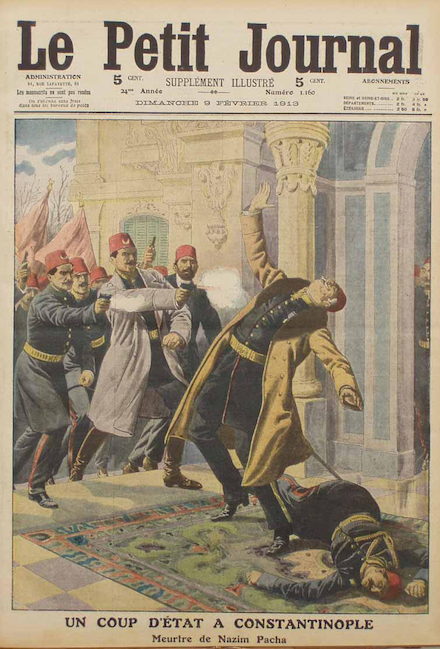
Such provincial homicides were but studies for the main deed of his days when in the 1913 Ottoman coup d’etat when he gunned down War Minister Nazim Pasha on the steps of the Sublime Porte as his CUP comrades barged in to force the resignation of the aging Grand Vizier and take the state firmly in hand.

It was an act that shook capitals around the world.


9 February 1913 edition of Le Petit Journal with a cover depiction of “un coup d’etat a Constantinople: muertre de Nazim Pacha”.

Ironically it was a desire for peace that brought his end. A couple of years deep into the catastrophe of World War I, Cemil rightly perceived the need to extricate his state from the conflict, and began making plans to topple the “Three Pashas” of the CUP whom he had helped to bring to power. His old friend Enver Pasha had no intention of approving the resulting death sentence — indeed, he had caught wind of it and tried persuasion to bring Cemil back onside — but when Enver Pasha was summoned to Berlin for a war council the fellow triumvir Talaat Pasha signed off on the execution with dispatch.

Rumors and legends abound concerning his death, such as shouting “Long live the Committee for Union and Progress!” before the firing squad opened up on him, and an agonizing half-hour bleed-out during which the expiring Cemil scrawled a patriotic slogan in the dirt with his own blood.

On this day..

1964: Mohamed Chabani

On this date in 1964 — one day shy of his 30th birthday — Algerian officer Mohamed Chabani was executed as a traitor.

It’s a verdict that posterity has washed its hands of; Chabani (other transliterations include Shabani and Chaabani) was officially rehabilitated in 1984 and his name decorates public spaces in Algeria.

But in 1964, when Algeria was but two years into her post-France independence, this former FLN fighter become Algeria’s youngest colonel was governor of the fourth military district in Biskra when he fell foul of the Defence Minister Houari Boumediene.

Boumediene was in the process in this interim of consolidating power to his own circle; the following year he would overthrow President Ahmed Ben Bella and rule Algeria until his death in 1978. Boumediene allegedly feared that Chabani would form an independent bloc that could oppose him, and attempted to have the young commander assassinated.

“How long is it since you began to travel by short stages and side-tracks?” the Marquise de Merteuil demanded of Valmont in a different context. “My friend, when you want to get somewhere — post horses and the main road!”

Boumediene’s main road was to arrest Chabani for a supposed separatist plot to break away oil-rich southern Algeria and have him shot in Oran.

On this day..

1853: Gasparich Mark Kilit

On this date in 1853, Hungarian patriot-priest Gasparich Mark Kilit was executed by the Austrian empire for his part in the failed revolutions of 1848-1849.

Gasparich — it’s a Hungarian link, as are most sources about the man — was a Franciscan who served as a camp priest to the nationalist insurgents under Perczel, who made him a Major.

After the revolutions were defeated and suppressed, he managed to live a couple of years under a pseudonym. But, writing for a Hungarian newspaper and dabbling with new radical movements, he was hardly keeping his head down. He’d even become a socialist on top of everything else. Captured late in 1852, Gasparich’s fate might have been sealed by the early 1853 attempted assassination of Emperor Franz Joseph and the resulting pall of state security.

Gasparich was hanged at a pig field outside Bratislava in the early hours of September 2, 1853.

A street and a monument in Zalaegerszeg, the capital of the man’s native haunts, preserve Gasparich’s name for the ages.

On this day..

1588: Eight Catholics after the defeat of the Spanish Armada

On this date in 1588, Elizabethan England celebrated the defeat of the Spanish Armada with Catholic gallows spread throughout London, claiming eight souls in all.

It was earlier that August that English pluck, Dutch reinforcements, and the Protestant Wind had connived to see off that great Spanish fleet and the prospect of Catholic and continental domination.

Although Catholics were liable for life and limb throughout these years it’s hard to put down the large-scale public hangings (some with full drawing-and-quartering pains) of priests and laymen down to coincidental timing, particularly given the unusual choice to distribute them to several gallows all around London. Here, surely, was a triumphant gloat for the furtive adherents of the old faith to ponder.

The Catholic Encylcopedia’s entry on the Venerable Robert Morton, a priest who was put to death at Lincoln’s Inn Fields, surveys the carnage:

At the same time and place suffered Hugh Moor, a layman, aged 25, of Grantham, Lincolnshire, and Gray’s Inn, London, for having been reconciled to the Church by Fr. Thomas Stephenson, S.J. On the same day suffered (1) at Mile End, William Dean, a priest (q. v.); and Henry Webley, a layman, born in the city of Gloucester; (2) near the Theatre, William Gunter, a priest, born at Raglan, Monmouthshire, educated at Reims; (3) at Clerkenwell, Thomas Holford, a priest, born at Aston, in Acton, Cheshire, educated at Reims, who was hanged only; and (4) between Brentford and Hounslow, Middlesex, James Claxton or Clarkson, a priest, born in Yorkshire and educated at Reims; and Thomas Felton, born at Bermondsey Abbey in 1567, son of B. John Felton,* tonsured 1583 and about to be professed a Minim, who had suffered terrible tortures in prison.

Another priest, plus four additional lay Catholics, quaffed the same bitter cup on August 30.

* No relation, however, to the executed assassin John Felton forty years on: that man’s father made his way in the world hunting Catholic recusants to inform upon.

On this day..

1217: Eustace the Monk, turncoat outlaw

On this date in 1217, the pirate Eustace the Monk was defeated in battle and summarily beheaded, scuppering an ongoing invasion that nearly seated a French dauphin on the English throne.

This colorful outlaw commenced life as the younger son of a Boulogne lord, but his conventional path into the Abbey Saint-Wulms was aborted by the murder of his father — leading Eustace to abandon his cowl for a vain attempt at vengeance.

“From a black monk becoming demoniac” — in the words of one chronicle — the man’s career thence proceeded, first rejoining the secular economy as a seneschal and then pivoting to outlawry when his former master turned against him.

His exploits in banditry are greatly embellished and romanticized in the medieval French verse titled Eustache the Monk (peruse in full here; helpful introduction here), including a number of charming and imaginary vignettes that double as moral parables and medieval slices-of-life.

Eustache spotted the Abbot of Jumièges as he was coming down the road. “Sir Abbot,” he said, “stop where you are! What are you carrying? Come now, don’t hide it.” The Abbot answered: “What’s it to you?” At this, Eustache was ready to hit him, but instead replied: “What’s it to me, fat-ass? Upon my word, I’ll make it my business. Get down, fast, and not another word out of you, or I’ll let you have it. You’ll be beaten up so badly you won’t be worth a hundred pounds.” The Abbot thought the man was drunk, and said, more politely this time: “Go away. You won’t find what you are looking for here.” Eustache responded: “Cut the bullshit and get off your horse fast, or you’ll be in for a lot of trouble.” The Abbot got down, frightened now. Eustache asked how much money he had with him. “Four marks,” said the Abbot, “in truth I only have four marks silver.” Eustache searched him immediately and found thirty marks or more. He gave back to the Abbot the four marks he claimed to have. The Abbot became duly furious; for, had he told the truth, he would have got back all his money. The Abbot lost his money only because he told a lie.

Around this time Eustace set up as a freelance English Channel pirate and was regularly employed by the English King John from about 1205 until 1212, when he switched his allegiance back to Philip II of France. Eustace tormented his former English patrons during the civil war in that country that led to the Magna Carta; the rebel barons in this war offered the English throne to the French heir Louis, and Louis invaded and held London and about half the realm, merrily aided by Eustace’s channel buccaneers.

Things went sideways for Louis and for Eustace in 1217; the former suffered a devastating reversal at the Battle of Lincoln.* Our man Eustace, attempting to reinforce Louis’s camp, was intercepted at sea and trounced at the Battle of Sandwich.**

Run-of-the-mill French knights were captured for ransom as per usual;

With Eustance, however, the case was different. When the ship was captured, the English instituted a search for him, and he was at length discovered down in the hold (Matthew Paris says in the bilge-water) by ‘Richard Sorale and Wudecoc’. Then Eustace offered a large sum of money for a ransom, ten thousand marks, as the writer of the Guillaume le Marechal puts it; ‘but it could not be.’ His addition offer (so Wendover) to serve the king of the English faithfully thereafter, if actually made, would have been only a reminder of his previous injuries. It was Stephen Trabe (or Crave) [or Crabbe -ed.], one of the mariners, ‘who had long been with him,’ that executed him, so the Histoire des Ducs de Normandie tells us; or as the poem of Guillaume le Marechal narrates it: ‘There was one there named Stephen of Winchelsea, who recalled to him the hardships which he had caused them both upon land and sea and who gave him the choice of having his head cut off either upon the trebuchet or upon the rail of the ship. Then he cut off his head.’ The head was subsequently fixed upon a lance and borne to Canterbury and about the country for a spectacle. The Romance concludes with the sentiment: ‘Nor can one live long who is intent always upon doing evil.’ (Henry Lewis Cannon


13th century illustration: Eustace gets the chop over the side of the boat.

Eustace’s defeat completely undermined Louis’s position, and the chancer was obliged to retreat to his homeland — where he’d become king in 1223. He’s known as Louis the Lion, which is pretty good, but he was rather convincingly surpassed by his son Saint Louis.

* Known to history as the “Lincoln Fair” for all the looting that occurred afterwards.

** The English maneuver on this occasion was to use an advantageous wind to hurl lime onto the French ships, blinding the enemy crews.

On this day..