1926: Six members of the Babbar Akali movement

(Thanks to India revolutionary Bhagat Singh — himself soon to become an Executed Today client — for the guest post. It was originally published under the title “Blood Sprinkled on the Day of Holi Babbar Akalis on the Crucifix”. -ed.)

ON THE DAY OF HOLI, FEBRUARY 27, 1926, WHEN WE were getting high on our enjoyment, a terrible thing was happening in a corner of this great province. When you will hear it, you will shudder! You will tremble! On that day, six brave Babbar Akalis were hanged in the Lahore Central Jail. Shri kishan Singhji Gadagajja, Shri Santa Singhji, Shri Dilip Sinhghji, Shri Nand Singhji, Shri Karam Singhji and Shri Dharam Singhji, had been showing a great indifference to the trial for the last two years, which speaks of their fond waiting for this day. After months, the judge gave his verdict. Five to be hanged, many for life imprisonment or exile, and sentences of very long imprisonments. The accused heroes thundered. Even the skies echoed with their triumphant slogans. Then an appeal was prefered [sic]. Instead of five, now six were sent to the noose. The same day the news came that a mercy petition was sent. The Punjab Secretary declared that the hanging would be put off. We were waiting but, all of a sudden, on the very day of Holi, we saw a small contingent of mourners carrying the dead bodies of the heroes towards the cremation site. Then last rites were completed quietly.

The city was still celebrating. Colour was still being thrown on the passers-by. What a terrible indifference. If they were misguided, if they were frenzied, let them be so. They were fearless patriots, in any case. Whatever they did, they did it for this wretched country. They could not bear injustice. They could not countenance the fallen nation. The oppression on the poor people became insufferable for them. They could not tolerate exploitation of the masses, they challenged and jumped into action. They were full of life. Oh! the terrible toll of their dedicated deeds! You are blessed! After the death, friends and foes are all alike-this is the ideal of men. Even if they might have done something hateful, their lives at the altar of our nation, is something to the opposite side, could highly and uninhibitedly appreciate the courage, patriotism and commitment of the brave revolutionary of Bengal, Jatin Mukherjee, while mourning his death. But we the cowards and human wretches lack the courage of even sighing and putting off our celebrations even for a moment. What a disheartening deed! The poor! they were given the “adequate” punishment even by the standard of the brutal bureaucrats. An act of a terrible tragedy thus ended, but the curtain is not down as yet. The drama will have some more terrible scenes. The story is quite lengthy, we have to turn back a little to know about it.

The Non-Cooperation Movement was at its peak. The Punjab did not lag behind. The Sikhs also rose from their deep slumber and it was quite an awakening. The Akali Movement was started. Sacrifices were made in abundance. Master Mota Singh, ex-teacher of Khalsa Middle School, Mahalpur (district Hoshiarpur), delivered a speech. A warrant was issued against him, but the idea of availing of the hospitality of the crown did not find his favour. He was against offering arrest to fill the jails. His speeches still continued. In Kot-Phatuhi village, a big ‘Deevan’ was called. Police cordoned the area off from all sides; even then Master Mota Singh delivered his speech. The whole audience stood up and dispersed on the orders of the persident of the meeting. The Master escaped mysteriously. This hide-and-seek continued for long. The government was in a frenzy. At last, a friend turned traitor, and Master Saheb was arrested after a year and a half. This was the first scene of that horrible drama.

The “Guru ka bagh” movement was started. The hired hoodlums were there to attack the unarmed heroes and to beat them half-dead. Could anyone who looked at or listened to this, help being move[d]? It was a case of arrests and arrests everywhere. A warrant was also issued against Sardar Kishan Singhji Gadagajja, but he also belonged to the same category and did not offer arrest. The police strained all its nerves but he always escaped. He had an organisation of his own. He could not bear the violence against unarmed agitators. He felt the need of using arms along with this peaceful movement.

On the one hand, the dogs, the hunting dogs of the government, were searching for the clues, to get his scent; on the other, it was decided to “reform” the sycophants (Jholi Chukkas). Sardar Kishan Singhji used to say that we must keep ourselves armed for our own security, but we should not take any precipitate action for the time being. The majority was against this. At last, it was decided that three of them should give their names, take all the blame on themselves and start reforming these sycophants. Sardar Karam Singhji, Sardar Dhanna Singhji and Sardar Uday Singhji stepped forward. Just keep aside the question of its propriety for a moment and imagine the scene when they took the oath:

We will sacrifice our all in the service of the country. We swear to die fighting but not to go to the prison.

What a beautiful, sanctified scene it must have been, when these people who had given up all of their family affections, were taking such an oath! Where is the end of sacrifice? Where is the limit to courage and fearlessness? Where does the extremity of idealism reside?

Near a station on Shyam Churasi-Hoshiarpur railway branch line, a Subedar became the first victim. After that, all these three declared their names. The government tried its best to arrest them, but failed. Sardar Kishan Singh Gadagajja was once almost trapped by the police near Roorki Kalan. A young man who accompanied him, fell down after getting injured, and was captured. But even there, Kishan Singhji escaped with the help of his arms. He met a Sadhu on the way who told him about a herb in his possession which could materialise all his plans and work miracles. Sardarji believed him and visited this Sadhu unarmed. The Sadhu gave him some herbs to prepare and brought the police in the meanwhile. Sardar Saheb was arrested. That Sadhu was an inspector of the CID department. The Babbar Akalis stepped up their activities. Many pro-government men were killed. The doab land lying in between Beas and Sutlej, that is, the districts of Jullundur and Hoshiarpur, had been there on the political map of the country, even before this. The majority of martyrs of 1915 belonged to these districts. Now again, there was the upheaval. The police department used all its power at its command, which proved quite useless. There is a small river near Jullundur; “Chaunta Sahib” Gurudwara is located there in a village on the banks of the river. There Shri Karam Singhji, Shri Dhanna Singhji, Shri Uday Singhji and Shri Anoop Singhji were sitting with a few others, preparing tea. All of a sudden, Shri Dhanna Singhji said: “Baba Karam Singhji! We should at once leave this place. I sense something very inauspicious happening.” The 75-year-old Sardar Karam Singh showed total indifference, but Shri Dhanna Singhji left the place, along with his 18-year-old follower Dilip Singh. Quite suddenly Baba Karam Singh stared at Anoop Singh and said: “Anoop Singh, you are not a good person”, but after this, he himself became unmindful of his own premonition. They were still talking when police made a declaration: Send out the rebels, otherwise the village will be burnt down. But the villagers did not yield.

Seeing all this, they themselves came out. Anoop Singh ran with all the bombs and surrendered. The remaining four people were standing, surrounded from all sides. The British police captain said: “Karam Singh! drop the weapons and you will be pardoned.” The hero responded challengingly: “We will die a martyr’s death while fighting, as a real revolutionary, for the sake of our motherland, but we shall not surrender our weapons.” He inspiringly called his comrades. They also roared like lions. A fight ensued. Bullets flew in all directions. After their ammunition exhausted, these brave people jumped into the river and bravely died after hours of ceaseless fighting.

Sardar Karam Singh was 75 years old. He had been in Canada. His character was pure and behaviour ideal. The government concluded that the Babbar Akalis were finished, but actually they grew in strength. The 18-year old Dilip Singh was a very handsome and strong, well-built, though illiterate, young man. He had joined some dacoit gang. His association with Shri Dhanna Singhji turned him from a dacoit into a real revolutionary. Many notorious dacoits like Banta Singh and Variyam Singh, too, gave up dacoity and joined them.

There were not afraid of death. They were eager to wash their old sins. They were increasing in number day-by-day. One day when Dhanna Singh was sitting in a village named. Mauhana, the police was called. Dhanna Singh was down with drinks and caught without resistance. His revolver was snatched, he was handcuffed and brought out. Twelve policemen and two British officers had surrounded him. Exactly at that moment there was a thunderous noise of explosion. It was the bomb exploded by Dhanna Singhji. He died on the spot along with one British officer and ten policemen. All the rest were badly wounded.

In the same fashion, Banta Singh, Jwala Singh and some others were surrounded in a village named Munder. They all were gathered on the roof of a house. Short were fired, a cross-fire ensued for some time, but then the police sprinkled kerosene oil by a pump and put the house on fire. Banta Singh was killed there, but Variyam Singh escaped even from there.

It will not be improper here to describe a few more similar incidents. Banta Singh was a very courageous man. Once he snatched a horse and a rifle from the guard of the armoury in the Jullundur Cantonment. Those days several police squads were desperately looking for him; one such squad confronted him somewhere in the forest. Sardar Saheb challenged them immediately: “If you have courage, come and confront me.” On that side, there were slaves of money; on this side, the willing sacrifice of life. There was no comparison of motives. The police squad beat a retreat.

This was the condition of the special police squads deputed to arrest them. Anyway, arrests had become a routine. Police checkposts were erected in almost every village. Gradually, the Babbar Akalis were weakened. Till now it had seemed as if they were the virtual rulers. Wherever they happened to be visiting, they were warmly hosted, by some with fear and terror. The supporters of the regime were defeatist. They lacked the courage to move out of their residences between the sunset and the sunrise. They were the ‘heroes’ of the time. They were brave and their worship was believed to be a kind of hero-worship, but gradually they lost their strength. Hundreds among them were imprisoned, and cases were instituted against them.

Variyam Singh was the lone survivor. He was moving towards Layallpur, as the pressure of police had increased in Jullundur and Hoshiarpur. One day he was hopelessly surrounded there, but he came out fighting valiantly. He was very much exhausted. He was alone. It was a strange situation. One day he visited his maternal uncle in the village named Dhesian. Arms were kept outside. After taking his meals, he was moving towards his weaponry when the police arrived. He was surrounded. The British officer caught him from the backside. He wounded him badly with his kirpan (sword), and he fell down. All the efforts to handcuff him failed. After two years of suppression, the Akali Jatha came to an end. Then the cases started, one of which has been discussed above. Quite recently too, they had wished to be hanged soon. Their wish has been fulfilled; they are now quiet.

On this day..

1947: Jonas Noreika, “General Storm”

On this date in 1947, Lithuanian anti-Soviet partisan Jonas Noreika was executed in Moscow.

Memorial plaque honoring Jonas Noreika in Vilnius; it was destroyed in 2019 by an anti-fascist politician. (cc) image from Alma Pater.

Long held as a hero of Lithuanian patriots, “General Storm”* has been headline news in recent years having his legacy complicated.

It all started when author Silvia Foti, Noreika’s granddaughter, took up her late mother’s unfinished project to write a biography of their famous kinsman. At the time, she accepted the received lore that Jonas Noreika had been an anti-Nazi resister during the Second World War, prior to being an anti-Communist resister afterwards — a story facilitated by Noreika’s 1943 arrest and detention in the Stutthof concentration camp among dozens of other high-profile Lithuanians taken as hostages.

But Foti’s understanding of events evolved painfully, as she described in a wrenching 2018 Salon article with the spoiler-alert title “My grandfather wasn’t a Nazi-fighting war hero — he was a brutal collaborator”.

According to Foti’s research in conjunction with the (since-deceased) director of Vilnius’s Sugihara House and Holocaust researcher Grant Gochin, Noreika was a principal of the anti-Soviet June Uprising sparked by the Nazi invasion of the USSR, but preceding the Wehrmacht’s actual arrival; in those days, Lithuanian militia seized control of towns, often massacring Jews (or, which was tantamount to the same thing, preventing their escape to the Soviet Union). Foti believes that Noreika did exactly this in his town of Plungė in the Samogitia region where he was later appointed as a county administrator during the German occupation.

[Sugihara House director Simon] Dovidavičius; was the first to suggest that my grandfather conducted the initial akcija (action) during World War II before the Germans arrived. It coincided with Operation Barbarossa on June 22, 1941, when Hitler invaded Russia, the same day Lithuania began its uprising with the Germans against the Soviets, marking the start of a Holocaust there, where 95 percent of its 200,000 Jews were murdered, the highest percentage of any country in Europe. (About 3,000 Jews remain in Lithuania today.)

Within three weeks, 2,000 Jew had been killed in Plungė, half the town’s population, and where my grandfather led the uprising. This preceded the January 1942 Wannsee Conference, when Nazi Germany decided to make mass-murder its state policy. Put in more chilling terms, Dovidavičius claimed that my grandfather, as captain, taught his Lithuanian soldiers how to exterminate Jews efficiently: how to sequester them, march them into the woods, force them to dig their own graves and shove them into pits after shooting them. My grandfather was a master educator …

By the end of the trip [to Lithuania] I came to believe that my grandfather must have sanctioned the murders of 2,000 Jews in Plungė, 5,500 Jews in Šiauliai and 7,000 in Telšiai.

Foti’s revelations have been roughly received in a country where the Holocaust complicity of anti-Soviet national heroes remains a very sore subject; there are still monuments to and streets named after her grandfather in Lithuania, and apparently a military academy there even published a prewar antisemitic essay by Noreika in 2016 in a wholly uncritical light.

* Not to be confused with a Philadelphia property repair contractor.

On this day..

1946: Maliq Bushati, Lef Nosi, and Anton Harapi, of Balli Kombëtar

On this date in 1946,* communist Albania executed three former officials of its deposed wartime government.

Fascist Italy occupied Albania during World War II.

In a situation mirroring that of neighboring Yugoslavia, there were two resistance movements that sometimes maintained an uneasy truce and other times went straight at one another’s throats: the communist National Liberation Movement (LNC or LANC), and the nationalist National Front (“Balli Kombëtar”).

In 1943, when Mussolini’s government collapsed, Nazi Germany took over control of Albania. Wary of postwar domination by communists — and the likelihood that this party would not cede bordering “Greater Albania” regions like the Yugoslavian province of Kosovo — Balli Kombëtar cut a deal with Berlin to run a collaborationist government.

Our principals for this date were all prominent figures in that government: Maliq Bushati, the prime minister; Lef Nosi, a member of the High Regency Council, and Anton Harapi, a Franciscan friar who consented to be the Catholic community’s representative in the governing council.

Needless to say, Balli Kombëtar did not long benefit from German support, and succumbed to the partisan movement — both the domestic LNC, and the allied Yugoslavian partisans under Tito. Its adherents faced the fury of their conquerors.


From left: Maliq Bushati, Lef Nosi, and Anton Harapi.

Those who could, fled to the west to enroll as exile auxilia for the coming Cold War: the attempted 1949 Albanian Subversion was one of the CIA’s earliest regime change attempts — notable in that the covert operation was betrayed to Moscow by the Kremlin’s British intelligence mole Kim Philby, resulting in hundreds of deaths.

* The Internet brings some citations for February 20 instead of February 15; I have not been able to locate the source of the discrepancy. The British diplomatic communique reporting on the trial is my authoritative primary source here: “The trial took place, in eight sessions, in a squalid cinema in Tirana before a house packed by Party members who constantly interrupted and jeered, while three military judges on the stage kept hurling accusations and abuse at the defendants, jointly and severally. All three were held responsible for, among other things, Albania’s entire war losses … Defendant’s counsel was howled down as a ‘fascist’ and never succeeded in making himself heard … The three accused were shot two days afterwards, on 15 February.”

On this day..

1032: Hasanak the Vizier

On 28 Safar 423 — that’s 14 February 1032 — Hasanak the Vizier was executed by strangulation in Herat, in modern-day Afghanistan.

He was the powerful state minister for the final six years of the 31-year reign of Iranian Ghaznavid sultan Mahmud.*

When the latter died in 1030, a fight for the succession ensued between the old man’s designated heir Muhammad and Muhammad’s older twin brother Mas’ud. Hasanak backed Muhammad, who lost.

Mas’ud punished his foe by reviving an old charge that Mahmud had laughed out of court years prior — namely, that Hasanak in the course of his hajj pilgrimage had adhered to the rebel/schismatic sect of Qarmatians.**

The writer Abu’l-Fadl Bayhaqi chronicled those years in his History† and devoted an extended narration to the fallen vizier’s trial and punishment. Hasanak’s headless corpse — that bit had been sawed off to deliver as a trophy to a political enemy — reportedly decayed for seven years lashed to a public pillory.

* A Persianate empire ruled by Turkic mamluks that spanned from western Iran, across Afghanistan and Transoxiana (comprising what is now the former Soviet “stans” of central Asia).

** The cause of the suspicion lay in Hasanak’s having chosen to return from his pilgrimage via Fatimid Egypt; the Fatimids and the Qarmatians themselves were both strains of Isma’ilism, a branch of still-extant dissident currents within Shia Islam.

† Arabic speakers can peruse this chronicle at archive.org; if a translated version is available, I have not located it.

On this day..

1943: Lepa Radic, Yugoslav Partisan

On this date in 1943, young Yugoslav partisan Lepa Svetozara Radic went to a German gallows.

A Bosnian Serb — her village today lies in Bosnia and Herzegovina’s Republika Srpska, steps inside the river that forms its border with Croatia — Lepa Radic was just 15 when Europe’s Axis powers invaded Yugoslavia in April 1941. Her family’s established left-wing affiliations brought them swift arrest by the fascist Ustashe, but Lepa and her sister escaped in December and joined Tito‘s Communist partisans.

In early 1943, Nazi Germany mounted a huge offensive against the partisans. On a strategic plane, the offensive failed: the partisans were able to preserve their command structure and fall back, also decisively defeating in the field their nationalist/monarchist rivals, the Chetniks, which set them up to dominate postwar Yugoslavia.

But for those upon whom the blow fell, it was a winter of terrible suffering. The Germans claimed 11,915 partisans killed, 2,506 captured … and 616 executed.

So it was with Lepa Radic. This Serbian Zoya Kosmodemyanskaya was captured during the engagement trying to defend a clutch of civilians and wounded. They publicly noosed her at Bosanska Krupa after she scorned the opportunity to preserve her life by informing on fellow guerrillas with the badass retort, “my comrades will give their names when they avenge my death.” (Various translations of this parting dagger are on offer online.)

After the war, Yugoslavia honored her posthumously with the Order of the People’s Hero.

On this day..

1932: Jose Feliciano Ama, Izalco indigenous peasant

El Salvador campesino Jose Feliciano Ama was hanged in the town square of Izalco on this date in 1932 during a ferocious repression of the peasantry.

In an environment of desperate economic immiseration for nearly all Salvadorans below the landed oligarchy, the heavily indigenous western peasantry rebelled on January 22, 1932 — aided or led by the Communist Party.*
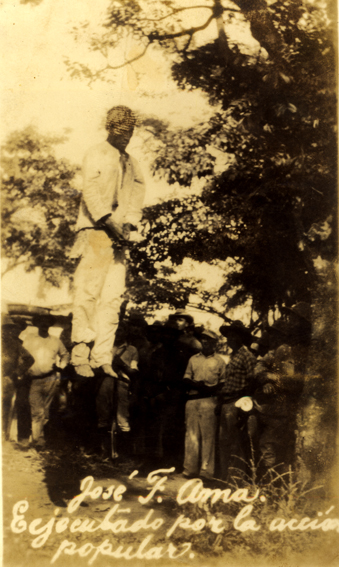
This fate of this rebellion might be inferred by its historiographical sobriquet, the Salvadoran peasant massacre — or simply la Matanza, the slaughter.

In numerical terms, it ran to well into the tens of thousands, maybe up to 40,000 — indiscriminately visited on peasants of originario complexion in the zone of rebellion, batches of them summarily shot into mass graves they’d been forced to dig for themselves.

In the Pipil town of Izalco, where coffee latifundias dominated the best agricultural land,* up to a quarter of the population was butchered. None of those put to la Matanza were more recognizable nor more vividly recalled than the local rebel leader Feliciano Ama English Wikipedia entry | Spanish), extrajudicially noosed in front of the Izalco church. Today a small plaque in this square honors him as a popular martyr.

* See States and Social Evolution: Coffee and the Rise of National Governments in Central America. An heiress of coffee magnate and former president Tomas Regalado allegedly forced our Feliciano Ama off his lands by dint of brute force.

On this day..

1522: Didrik Slagheck

Danish scheming archbishop Didrik Slagheck was burned in Copenhagen on this date in 1522 — sacrificed to his sovereign’s convenience.

Slagheck rolled into Stockholm in 1517 in the train of the papal legate who had been vainly dispatched to calm tempers during the run-up to what became the Swedish War of Liberation.

That’s liberation from Denmark, the effective overlord via the Kalmar Union joining those two countries and Norway besides. In 1520, with ecclesiastical mediation a bust and Sweden restive, the Danish king Christian II invaded. Slagheck made his villainous historical reputation by opportunistically hitching on with the vengeful king, the same king who would execute him in the end.

Things went great for Slagheck at first: he helped queue up the enemies list for the victorious Christian’s demonstrative mass beheading, the Stockholm Massacre. And he got his 30 pieces of krona right away in the form of an archbishopric which had come open along with its former owner’s neck on the occasion of said massacre. Thereafter he commanded troops in the field during the rebellion of Gustav Vasa. By 1521 he’d been kicked upstairs,

promoted to the position of archbishop of Lund, then a Danish see, entering the cathedral at his installation on November 25th with great pageantry and to the sound of martial music. During the same autumn, however, a papal legation in Copenhagen had been investigating what had taken place in Stockholm after the coronation, and five days after his installation as archbishop Slagheck was summoned to give an account of the advice he had given and the manner in which he had acted. Christian II decided to abandon him in an attempt to clear his own reputation, and Slagheck was executed and burnt in Copenhagen on January 24th 1522. (Source)

On this day..

1952: Võ Thị Sáu

Eighteen- or nineteen-year-old student and revolutionary Võ Thị Sáu was shot by the French on this date in 1952.

(cc) image from Michal Manas.

A Viet Minh activist from childhood, Sáu (English Wikipedia entry | the more extensive Vietnamese) got her start in revolutionary praxis chucking a grenade at a group of French soldiers when she was 14.

She did three different turns in French custody over the very few years remaining her, the last of which was at Côn Đảo Prison* awaiting execution for murdering a French officer and a number of Vietnamese collaborators — “crimes” committed before she had attained majority. She poured invective upon the court that condemned her, correctly prophesying that Vietnamese resistance would defeat it.

Today Sáu is well-represented in monuments around Vietnam where she is of course honored as a patriotic hero; her tomb in Côn Đảo receives a steady tribute of offerings from admirers. She’s valorized in the 1994 film Daughter of the Red Earth:

* Later infamous as the location where the next imperial power kept its political prisoners in tiny “tiger cages”.

On this day..

1957: József Dudás, Hungarian Revolution wild card

Hungarian politician József Dudás was hanged on this date in 1957, for participation in the previous year’s abortive Hungarian Revolution.

Although he’d been a Communist in his prewar youth, Dudás won election to the postwar government on the Independent Smallholders line. This agrarian opposition party was gradually pushed out of power and eventually suppressed over the course of the late 1940s; Dudás himself ended up getting arrested and detailed for a long visit to the feared Romanian Securitate.

He’d long since been repatriated as a non-political engineer when the Hungarian Revolution briefly cracked open the horizon of possibilities in the autumn of 1956.

Dudás immediately proved himself not so non-political — and a distinct thorn in the side of the Imre Nagy government. He advocated not only for Hungarian Independence (which was also the title of his newspaper) but also for a multiparty reformulation of the Hungarian state, which was a bit much for Nagy to process during the revolution’s two-week lease on life. Dudás’s penchant for off-script revolutionary improvisations, such as putting out feelers to Soviet commanders and also having his militia lynch agents of the temporarily disempowered secret police, made him an unwelcome wild card and Nagy had him arrested shortly before Soviet tanks re-established control.

The Soviets, of course, also had no use themselves for the peasants’ party deputy who’d been trying to subvert Nagy from the right.

On this day..

1861: Antonino Aberastain

Argentinian politician Antonino Aberastain was executed on this date in 1861, after the Battle of Rinconada del Pocito.

A polymath barrister from Buenos Aires, Aberastain was cursed to live his days amid the long and terrible civil wars — which pitted liberal centralizers (the Unitarian party) against conservative federalists. Aberastain belonged to the former faction.

After an interesting career that saw him by turns lawyer, judge, newsman, and national minister — and for most of the 1840s, exile abroad in Chile when a Federalist warlod chased him out — Aberastain in 1860 led a putsch that deposed and killed the Federalist governor of San Juan in November 1860.

The Federalist counterattack was settled in battle at a place called La Rinconada* on January 11, 1861, and the reader may well infer the outcome from the presence of the Unitarian commander on this site. The victorious Federal commander had him summarily executed the next day.

With the eventual settlement of hostilities, Aberastain settled in as a heroic Sanjuanino; this monument to him decorates a square that’s named for him in San Juan city.


(cc) image from EagLau.

* By coincidence, it had also been the site of a different Unitarian-Federalist battle in 1825.

On this day..