On this date in 1959, in the city of Santa Clara lately captured by Cuban revolutionaries, Col. Cornelio Rojas Fernández, commander of the city’s defeated government garrison, was shot without trial by the order of Che Guevara.
It was just one among hundreds of vengeful executions being visited in those weeks upon authorities of the deposed Batista regime.
Viewers of the televised public shooting saw the stocky commander — the grandson of a hero of the 19th century Cuban War of Independence — walk unafraid to his death in an armed escort, where he exhorted his onlookers until the firing detail sent his fedora flying.
Rojas’s granddaughter Barbara Rangel remains an energetic advocate of her father’s innocence, from Florida. A kinsman named Pedro Rojas Mir was among those killed in the 1961 Bay of Pigs debacle when anti-Castro exiles mounted a failed invasion of Cuba.
More than one hundred prisoners awaiting their sentence have also been slain in their attempts to escape. Here, too, the official story has been written not to be believable, but rather to show the guerrillas and the political parties that even those who have been acknowledged as prisoners are held on strategic reserve: the Corps Commanders use them in retaliation depending on how the battles are going, if a lesson can be learned, if the mood strikes them.
That is how General Benjamin Menendez, Commander of the Third Army Corps, earned his laurels before March 24: first with the murder of Marcos Osatinsky, who had been arrested in Cordoba, and then with the death of Hugo Vaca Narvaja and another fifty prisoners through various, merciless applications of the escape law; the official story of these deaths was told without any sense of shame. The murder of Dardo Cabo, arrested in April 1975 and executed on January 6, 1977, with seven other prisoners under the jurisdiction of the First Army Corps led by General Suarez Mason, shows that these incidents do not constitute the indulgences of a few eccentric centurions, but rather are the very same policies that you plan among your general staff, that you discuss in your cabinet meetings, that you enforce as commanders-in-chief of the three branches of government, and that you approve as members of the Ruling Junta.
On or very near this date in 1977, Argentinian social activist Dardo Cabo was executed by the Argentine military junta.
Cabo (English Wikipedia entry | Spanish) had public notoriety from a 1966 airplane hijacking, for which he served three years in prison; by the 1970s, he was associated with the Montoneros, a Peronist urban guerrilla/terrorist organization.
Considering his prominence, he was an obvious early arrestee of the Argentina military junta in the first weeks after it overthrew Isabel Peron.
Held at La Plata Federal Penitentiary for the balance of the year, Cabo was removed along with Roberto Rufino Pirles on January 5, 1977 for a supposed transfer to another prison. On January 7, the junta “reported that during the transfer of Cab and Rufino Pirles in Zone 1, ‘subversive elements’ in ten cars attacked the vehicle carrying the prisoners. After a brief, intense firefight, the ‘delinquents’ escaped, minus four who were killed. The two prisoners were alos shot in the firefight.” (Source)
They were just two among a series of high-profile militants being held in that same prison unit who were extrajudicially executed under similar circumstances in those weeks — like Montoneros Angel Alberto Georgiadis and Horacio Rapaport, who “committed suicide” during transfer a couple of weeks later.
On this date in 1963, Cameroon guerrilla Tankeu Noé
He had been a commander of rebels in Cameroon’s Littoral Province in the 1950s — fighting what was then a nationalist war against the French, who still held the central African territory as a colony.*
Cameroon attained independence in 1960 but Noé’s outlawed Marxist Union of the Peoples of Cameroon (UPC) stayed outlawed, its leadership in exile. Cameroon’s post-colonial state looked a lot to the UPC like the colonial state: working hand in glove with the French military, both parties intent on crushing the militants. The new ruler of Cameroon, Ahmadou Ahidjo,** used the continuing fight against the insurgency to consolidate power in his own hands, eventually establishing a one-party state.
And the fight was exceptionally brutal, with mass forced resettlement and tens of thousands killed across the last years of French rule and the first years of “independence”. In one noteworthy incident in 1962, dozens of UPC fighters were asphyxiated after being packed together into a sealed train. When the Catholic archbishop publicized the incident and announced plans to say a requiem mass, Ahidjo promptly had him expelled.
Still fighting, Tankeu Noé was captured by the new boss/old boss joint military operations in 1963. Exploiting new powers arrogated that year to suppress regime opponents, the government had him shot in public in Douala, lashed to a power pole.
His movement was strangled over the ensuing years, effectively vanishing after the 1971 execution of Ernest Ouandie. It’s resurfaced as a legitimate political party in 1991 and has contested and sometimes won seats in various elections ever since.
* France had taken it from Germany after World War I.
** Ahidjo finally resigned for health reasons in 1982; within months, he would take exile refuge in France, pursued by an in absentia death sentence. He never returned to Cameroon; he was officially rehabilitated after his 1989 death in Senegal.
On this date in 2016, Saudi Arabia beheaded Shiite Muslim cleric Nimr al-Nimr (familiarly known as Sheikh Nimr) — one of 47 executions carried out in 12 cities throughout the kingdom that included at least four political prisoners (one of them al-Nimr) as well as two foreign nationals.
A prominent dissident who became an emblem of resistance in his predominantly Shiite province of Al-Awamiyah*, al-Nimr had been arrested several times before without blunting his sharp tongue. “People must rejoice at his death,” he offered in June 2012, about the death of militant Wahhabist crown prince Nayef bin Abdul-Aziz Al Saud. “He will be eaten by worms and will suffer the torments of Hell in his grave.”
But here in the terrestrial sphere, Nayef’s death made Salman the crown prince … and queued up Salman’s son, Mohammad bin Salman to become the de facto ruler of the kingdom.
Al-Nimr was seized in July 2012, during crackdowns** on the 2011-2012 “Arab Spring” protests — shot in the leg during the course of his arrest and beaten bloody by his captors. This arrest itself brought thousands into the streets, at least two of whom were shot dead in their own turn as al-Nimr went on hunger strike. By the time al-Nimr was put up on charges in 2014, the aforementioned Mohammad bin Salman — “MbS” of dread popular parlance, infamous for his bonesaws — was well along his rise to power in Saudi Arabia as the hand and the heir who transacted the business of a dementia-addled prince.
Al-Nimr’s October 2014 death sentence for “seeking ‘foreign meddling’ in the kingdom, ‘disobeying’ its rulers and taking up arms against the security forces” drew worldwide condemnation and protests over the ensuing year, a year coinciding with MbS’s overt conquest of political power in Saudi Arabia.
The execution sparked global outrage of varying hues, most sharply from Shiite Iran, where angry protesters attacked the Saudi embassy: not the decisive event but emblematic of Saudi Arabia’s growing enmity with Iran that shapes regional conflicts from Yemen to Iraq to Syria.
* Adjacent to the similarly restive Sunni-ruled, Shiite-majority Gulf monarchy of Bahrain.
** Al-Nimr’s nephew, Ali Mohammed Baqir al-Nimr, is still under a death sentence today that could be ratified by the sovereign at any time. He was arrested in February 2012 for anti-regime protests, when he was only 17 years old.
On this date in 1573, the Swedish commander of Weissenstein (present-day Paide, Estonia), Hans Boije af Gennäs was executed when his fortress was overrun by Russian troops, during the Livonian War.
A walled city with a Teutonic Knights-built keep, Weissenstein sat at a crossroads in interior Livonia and changed hands several times during this decades-long multilateral conflict involving Russia, Sweden, Denmark-Norway, Poland, and Lithuania — the latter two of which united into a Commonwealth during the war.
Big picture, the Livonian War ran from 1558 to 1583; the stakes were, as one might guess, control of Livonia — essentially, the present-day Baltic states of Estonia and Latvia. Long ago this precinct had been the medieval remit of those same Teutonic Knights; after 1561, it was controlled in the south by the Polish-Lithuanian Commonwealth (that’s Latvia), and in the north by Sweden (that’s Estonia, containing Weissenstein).
To the Livonian chroniclers, the Russians were barbaric, sadistic monsters, whose atrocities they described in graphic, sensational detail. According to Renner, the Russians were cruel, bloodthirsty, and inhumane. They massacred men, women, and children among fishermen. They hanged Livonian women from trees and robbed them of their clothing, silver, and gold. They impaled babies on stakes or sharp picket fences, and hacked little children in two and left them, or hacked adults into pieces. They placed a huge stone on the stomach of a pregnant women [sic] to force her foetus from her womb. They burned alive a woman hiding in an oven. They cut off the breasts of maidens and women and hacked off the hands and feet of men. They threw fifty children into a well and filled it with stones. They flayed a man and cut open his side, poured in gunpowder, and blew him apart. They decapitated captives after flaying them and cutting off their fingers and toes. They massacred peasants young and old. They flayed captives in Moscow with whips of braided flails, marched them five miles to a cemetery and then beheaded them with axes. They drove naked peasants into great fires and nailed one peasant to a post and suffocated him with smoke. They tied a captured noble to a tree, cut open his body, and let his intestines fall out. They nailed a ferryman to a door and then killed him with arrows. They killed an old forest overseer by cutting open his body, nailing one end of his intestines to a tree, and then beating him with whips to make him run, pulling out his intestines and bringing about his death. Peasants were drawn and quartered. They murdered captives by snapping their necks in such a way that they suffered for one, two, or three days before expiring. The Tatars cut out the heart of one prisoner (killing him, of course), and ate it, saying that doing so would give them courage.
Russow adds that Russians committed terrible acts of murder, theft, and arson during their invasion. They tortured and tormented Livonians, massacred them, threw poor peasant, their wives and children to their deaths off city walls, hacked to death servitors of Magnus,* roasted captives on spits for days, stole the blanket off a dead woman, deposited children on the ice to die of overexposure or drown, put out a noble’s eyes before flaying him to death, drowned, tortured, and executed captives, sabered captives, plucked out the heart of the living body of a mayor, ripped a preacher’s tongue from his throat, sold captives into slavery, raped maidens and women, threw captives to their deaths off the walls of conquered cities, and starved captives nearly to death. They left the bodies of their victims for wild beasts to eat …
According to Henning, the Russians were bloodthirsty “ignorant barbarians”, who raged like savages, and tortured and killed their enemies in inhuman fashion, including stretching them and breaking them on the wheel. They cut down even the young and the old, women and children, who surrendered with their hands raised, or subjected them to inhuman barbarities and atrocities, and then barbaric slavery. Everywhere they went, they plundered, slew, roasted, and burned. They hacked pregnant women in two, impaled foetuses on fence stakes, slit men’s sides, inserted gunpowder and blew them up, and slit men’s throats and let them bleed to death. They smeared people with thick pine pitch, bound them, and burned them. They gang-raped women and girls, and sold the survivors into slavery to the Tatars. They tore nursing babes from their mothers’ breasts, chopped off hands, feet, and heads, and gutted the remainder of the bodies, stuck bodies on spits and roasted or baked them, and then ate them to satisfy their “diabolical, bloodthirsty hunger” … They massacred innocent Livonian townsmen, wives, and children in retribution for anti-Russian plots in which they had no part. They butchered poor little schoolchildren. Despite safe-conducts to the surrendered occupants of assaulted cities, they sabered them as they departed. Captives too old or infirm to be led into captivity, even nobles, were killed on the spot. Survivors of a castle whose occupants chose to blow themselves up rather than surrendered were sabered, hacked to bits, mutilated, and left unburied to be eaten by birds, dogs, and other wild beasts.
To skip past various twists of state- and warcraft, the Polish-Lithuanian Commonwealth was taking a breather from the fight in the early 1570s, leaving Russia and Sweden mano a mano.
The Russians invaded Swedish-defended Estonia in 1572 with Tsar Ivan the Terrible personally leading the army, and put the small garrison of Weissenstein/Paide to irresistible siege. Nevertheless, it did resist, and these defenders have the distinction of killing during this siege the sinister operative of the tsar — Malyuta Skuratov, so much the emblem of Ivan’s terrible Oprichnina that in Bulgakov’s Master and Margarita, the titular Margarita at an infernal ball can’t help but notice one “face ringed by a fiery beard, the face of Malyuta Skuratov”.
Considering the flaying and intestine-ripping that mere passersby were liable to expose themselves to, the Swedes earned no quarter from Ivan for compounding their resistance with the death of the tsar’s hand. Our man Hans Boije af Gennais (English Wikipedia entry | Swedish) and his chief aides were all impaled and slowly roasted over flames immediately upon Weissenstein’s New Year’s Day capture.
* Magnus, Duke of Holstein was Ivan’s unsuccessful puppet king in Livonia in the early 1570s, but he lost favor after being repeatedly thumped by the Swedes and eventually outright turned against the Russians. Ivan captured him and (alas for Executed Today) did not put him to death, but gratuitously brutalized anyone in Magnus’s train.
This event fell during the brief reign of the Danish king Christian II over Sweden, notably distinguished by the previous year’s Stockholm Bloodbath. Christian held Sweden only by force of arms and his continual bloody exertions to put down resistance have blackened his name in Swedish annals as “Christian the Tyrant”.
While the Ribbings were merely minor rebels in a country teeming with umbrage, their executions contributed a particularly atrocious (albeit perhaps folklorish) episode to that tyrannous reputation.
Not only the brothers themselves but their children also were put to death … and the story has it that after Lindorm Ribbing’s eldest son lost his head, his five-year-old brother pitiably implored the headsman, “My good man. Please do not stain my shirt as you did my brother’s or my mother will spank me.” Moved to tears, the executioner then discarded his sword and exclaimed, “Never! Sooner shall my own shirt be stained then I would stain yours.” Both he and the little boy then got the chop from a less sentimental swordsman.
In the months preceding the final fall of Constantinople in 1453, the great Ottoman sultan Mehmed (II), the Conqueror, caused to be constructed in less than twenty weeks on the European bank of the Bosporus just north of the city a colossal castle which he called Bas-kesen, meaning ‘Decapitator’ or ‘Throat-cutter’. Later called Rumeli Hisar (‘Castle of the Roman Lands’), it stood opposite the Anadolu Hisar (‘Castle of Anatolia’), built in 1394 by his great-grandfather Bayezit I at the narrowest part of the strait (less than 1km across). It consisted of three main towers and fourteen smaller ones connected by inner and outer curtain walls, covering an area of 31,250 sq. m (almost 7.75 acres). The fortress still stands to this day, glowering down upon passing maritime traffic much as it did when it was completed on 31 August 1452.
The view from the still-standing fortress shows its commanding view over the narrow strait. (cc) image from Olga Petrovska.
The main tower in the middle was 22m (72ft) high and 23.3m (76ft 5 in) in diameter, with 6.5m (21ft 4in) thick walls. Named the Halil Pasha after the sultan’s vizier who built it, it stood closest to the shoreline. On it, Mehmed had positioned what were described as ‘bronze tubes capable of discharging balls weighing over six hundred pounds’. He then gave the citadel’s commander, one Firuz Aga, the following explicit instructions:
Do not allow ships sailing from the Hellespont [Dardanelles] to the Black Sea or from the Black Sea to the Hellespont, no matter under whose flag they may be sailing — Genoese, Venetian, Constantinopolitan, Kaffatinian, Trapezundian, Amisinian, Sinopean, or even under my own flag, and no matter what class they are — triremes, biremes, barques, or skiffs — to sail through without first lowering their sails and paying the customs duties; only after they have done so will you permit them to proceed on their way. Use the cannon to sink the ship that does not comply and submit.
Early the following November two Venetian ships destined for the Dardanelles ignored the injunction and passed through the Bosporus without stopping as ordered. Luckily, they survived the consequent cannonade. A third, carrying grain for Constantinople a short time later, was not so fortunate. The earlier experience had evidently served to provide Firuz Aga’s gunners with the proper range. A single stone from one of the cannon ‘shattered the ship’. The crew of thirty, including the captain, a certain Antonio Rizzo, were subsequently captured and taken to the sultan in Didymoteichos (in Thrace, about 37km or 23 miles south of Adrianople — modern Edirne). ‘He gave orders to behead them all except the captain whose life was to be taken by a stake through the anus,’ recorded a fifteenth-century chronicler known only as ‘Doukas’, who claimed he himself saw Rizzo’s rotting corpse only ‘a few days later’. The impact on maritime warfare was just as dramatic. The advent of a true ship-killing weapon spelled the end of one age and the beginning of another.
In his watershed study Gunpowder and Galleys, early modern military historian John Francis Guilmartin concluded that the one technological innovation most responsible for ushering in a new age of warfare was ‘the use of effective heavy cannon’. It was, therefore, fitting that Mehmed II employed perhaps the largest cannon ever built up to that point to vanquish the first great naval power of the passing medieval period. In his campaign to conquer Constantinople, the Ottoman sultan engaged a Hungarian engineer named Orban to produce a sort of supergun which could smash the several-feet thick Theodosian Walls that had protected the capital of the Eastern Roman Empire for a millennium. ‘In three months’ time a terrifying and extraordinary monster was forged,’ testified Doukas. Mehmed’s Greek biographer, Michael Kritovoulos, provided precise dimensions: the barrel was cast in bronze some 20cm (8in) thick; it measured about 8m (26ft 8in) long, with a bore at the muzzle of 76m (30in) in diameter. In a test, the cannon discharged a 544kg (1,200-pound) stone ball which burrowed itself almost 2m (6ft) into the ground over 1.6km (1m) away. Doukas said that thirty wagons pulled by sixty oxen and 200 men were required to haul it from Adrianople to Constantinople where it was positioned to batter the walls south of the Blachernae Palace.
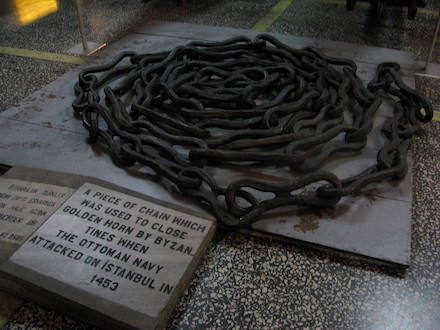
Not content with this ostentatious display of military power, Mehmed then brought to bear the full force of his powerful new fleet. The Byzantines had barred the entrance to the Golden Horn with a giant iron chain suspended on wooden pontoons between two fortified towers, one on each side. (This chain currently resides in the Turkish Naval Museum of Istanbul.)
A squadron of ten Greek warships was stationed outside it, while another sixteen from Genoa, Venice and other western maritime cities guarded it from inside. Previous Ottoman assaults on this defensive cordon had failed, so the sultan circumvented it by building a road of greased wooden logs across Galata Hill behind the Genoese colony of Pera on the side of the Golden Horn opposite the city. He then, on 22 April, had seventy to eighty ‘biremes on wheeled cradles’ hauled over said byway and into the harbour behind the chain. The manoeuvre demoralized the defenders and enabled Mehmed’s naval forces to attack the city’s sea walls from the Golden Horn at the same time that his army assaulted the land walls. Inevitably, Constantinople fell on 29 May 1453. Vanquished were the last vestiges of Byzantine imperial power and its maritime thalassocracy remained only as a distant memory.
On this date in 1805, Cusco‘s Plaza Mayor hosted the hangings of two colonial Peruvian creoles who had aspired to revive the Incan resistance to Spain.
The devastating Tupac Amaru rebellion lay just 25 years in the background here, but these men were not themselves indigenes. They were, however, New World-born, and thus heirs to a resentment at colonial control from half a world’s distance that would within the coming generation separate Peru from Spain.
“Denizens of the lower strata of creole society,” as D.A. Brading writes, the lawyer Jose Manuel Ubalde and the mining entrepreneur Gabriel Aguilar — close friends from a previous association in Lina —
inhabited a world in which Catholic piety, patriotic fervour and personal ambition were fuelled by visions and dreams. For Aguilar obtained Ubalde’s support for proclaiming him Inca emperor of Peru by informing him of a childhood vision in which he had been assured of a great role in his country’s history. Both men agreed that Spanish rule was oppressive and that St Thomas Aquinas had recognised the right to rebel against tyranny. When they conferred with like-minded priests, one cleric cited the prediction of Raynal,* the 1771 representation of the Mexico City Council,** and the example of the ‘Americans of Boston’. But the current of religious emotion that underlay these arguments surfaced when another cleric fell into an ecstasy in Aguilar’s presence, and claimed later to have seen the pretender crowned in the cathedral of Cuzco.
Unfortunately, the path to such a coronation ran through the actions of sympathetic military men — and one of the officers that these conspirators reached out to shopped the plotters before they could set anything in motion.
After their arrest, Ubalde was reminded of the traditional doctrine that, since the Catholic king was God’s image on earth, any challenge to his authority was an attack on God. By way of reply, he insisted on the right of rebellion against tyranny and argued that natural law did not prescribe loyalty to any particular dynasty. After all, the Papacy had just recognised Napoleon as emperor of the French, despite the claims of the Bourbon dynasty to that throne. He went to his execution convinced that Aguilar had been chosen by providence as a creole Maccabee, called to liberate Peru from Spanish rule.
* French Enlightenment figure Guillaume Thomas Francois Raynal anticipated a rebellion that would destroy colonial slave empires from below: “Your slaves stand in no need either of your generosity or your counsels, in order to break the sacrilegious yoke of their oppression … they will rush on with more impetuosity than torrents; they will leave behind them, in all parts, indelible traces of their just resentment. Spaniards, Portuguese, English, French, Dutch, all their tyrants will become the victims of fire and sword.”
** Mexico submitted a notable May 2, 1771 petition to King Carlos III calling for most of the imperial positions in the New World to be staffed by people from the New World rather than home country cronies — and warning that to do otherwise was to invite “not only the loss of this America, but the ruin of the State.” (Source)
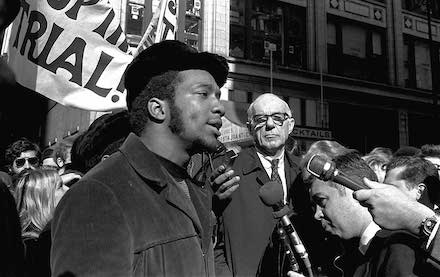
This charismatic — nearly every bio uses this word — 21-year-old star of the Illinois Black Panther Party had in his brief life shown himself a visionary exponent of radicalism; he would end as one of the signal martyrs to his movement’s violent suppression.
Well did he know it.
“If you’re asked to make a commitment at the age of 20 and you say, I don’t want to make a commitment only because of the simple reason that I’m too young to die, I want to live a little bit longer. What you did is, you’re dead already,” Hampton once mused. “You have to understand that people have to pay the price for peace. If you dare to struggle, you dare to win. If you dare not struggle then damnit, you don’t deserve to win … And I think that struggle’s going to come. Why don’t you live for the people? Why don’t you struggle for the people? Why don’t you die for the people?”
Emerging late in 1966 out of Oakland, Calif., the Black Panthers were a revolutionary and pointedly armed movement that fused black power demands with critique of the entire edifice — war, imperialism, capitalism and the rest of it. Although the organization was dissolved in 1982, the Panthers’ actions and legacy are still quite controversial and their mere specter remains a potent bogeyman for much of contemporary white America.
One thing is for sure: in their moment, they scared the shit out of the powers that be. Within months of its founding, the Federal Bureau of Investigation turned upon the Panthers its COINTELPRO program of domestic surveillance, suppression, and assassination. One particularly notorious FBI memo drew a bead on “Black Nationalist-Hate Groups” with an avowed intention to “prevent the rise of a ‘messiah’ who could unify, and electrify, the militant black nationalist movement” — and to “pinpoint potential troublemakers and neutralize them”.
Fred Hampton isn’t mentioned by name in this chilling missive from early 1968; he was just then beginning to emerge onto the FBI’s index of rabble-rousers. (Literally, the feds had a list called the “Rabble Rouser Index”.) He was fresh out of high school in 1966, and subsequently a wildly successful NAACP chapter leader, but gravitated to the new Illinois Panthers organ by 1968 where he quickly became its most outstanding organizer and spokesman, the prospective future face of a stirring cross-racial, class-conscious justice movement that Hampton perceived with a wisdom well beyond his years. Under his leadership the BPP spun out health care programs, legal aid programs, and free breakfast programs; he forged the original Rainbow Coalition* that brought rival street gangs and activist groups from different racial communities into a shared political ambition.
“We’re going to fight racism not with racism, but we’re going to fight with solidarity,” Hampton said. “We’re not going to fight capitalism with black capitalism, but we’re going to fight it with socialism.”
Just as energetically did the FBI work — and succeed, in the end — to break up such alliances, using informers and agents provocateur and false flags to encourage schisms and discredit leaders. Chicago’s police department was a ready collaborator in these operations; its relationship was the Panthers was hostile and often violent. Just three weeks before Hampton’s murder, two Chicago cops and a 19-year-old Black Panther were killed in a shootout. (Hampton was in California at the time.)
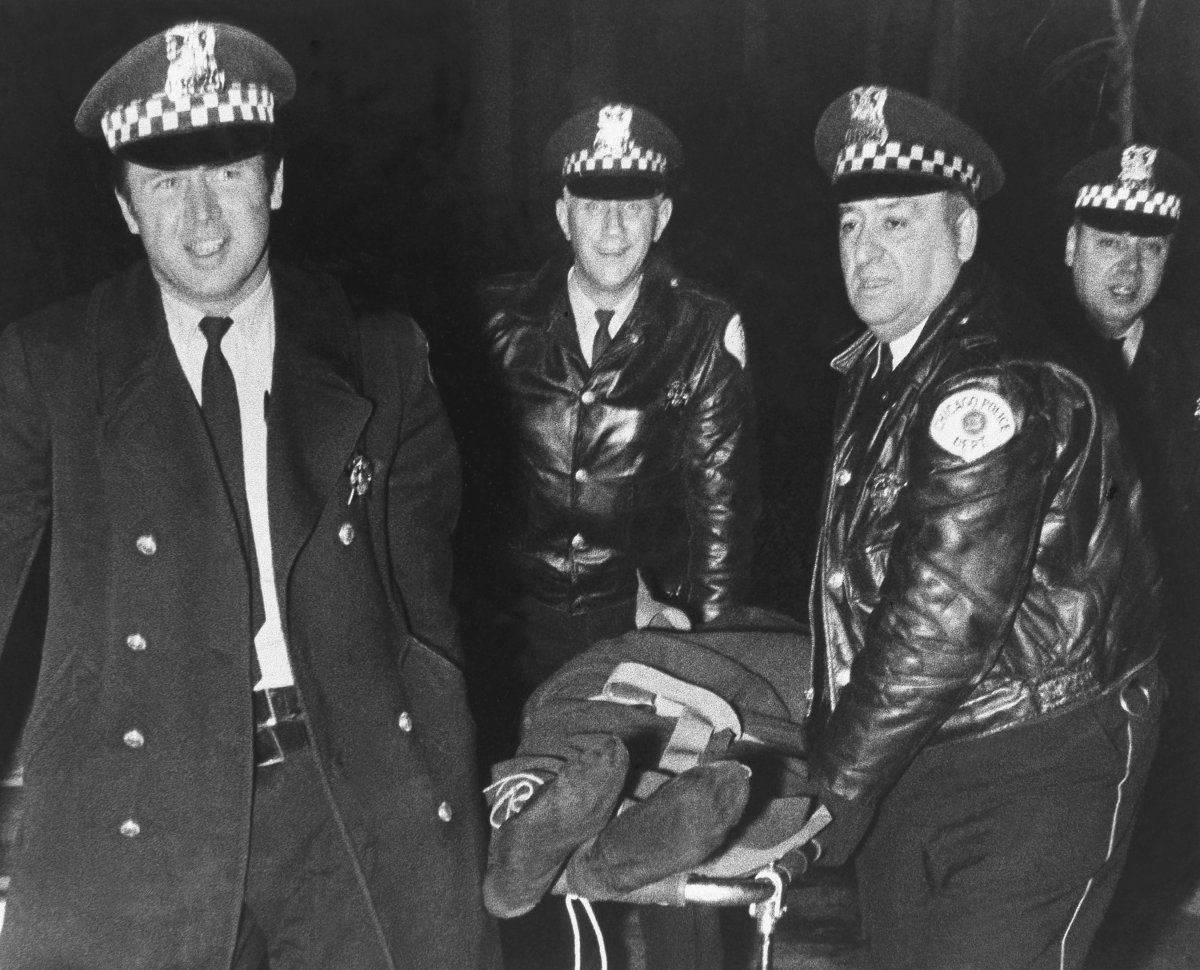
We don’t have the full documentary paper trail with deliberations and countersigned orders, but the known facts (and the smug grins of the cops) admit no reasonable dispute this side of performative naivete that Hampton was assassinated by a state death squad — “executed”, if you like, to fit an admittedly expansive read of this here site‘s mandate.
A compromised Hampton bodyguard named William O’Neal gave his FBI handler — who also happened to be running the Chicago COINTELPRO operation targeting the Panthers — a detailed floor plan of Hampton’s apartment, which the FBI shared with the Chicago police for a raid putatively hunting illegal weaponry. On the night of December 3, O’Neal slipped Hampton a barbituate to dull his reactions for what was to come; surviving comrades would describe Hampton being roused amid the early-morning fusillade only with difficulty, responding barely and in “slow motion” even as Chicago police stormed front and rear entrances and poured nearly 100 rounds into the place. Another Hampton aide named Mark Clark, sitting watch, was blasted dead in the initial barrage, convulsively discharging his shotgun once into the ceiling as he fell. It was the only shot fired that night by any of the Black Panthers.
By the account of Hampton’s eight-months pregnant partner Deborah Johnson, corroborated by other Panthers in the apartment, Fred Hampton was injured by the volley, but alive — and cold-bloodedly finished off with a coup de grace.
First thing that I remember after Fred and I had went to sleep was being awakened by somebody shaking Fred while we were laying in the bed. Saying, “Chairman, Chairman, wake up, the pigs are vamping, the pigs are vamping!” And, um, this person who was in the room with me, kept shouting out “we have a pregnant sister in here, stop shooting”. Eventually the shooting stopped and they said we could come out. I remember crossing over Fred, and telling myself over and over, “be real careful, don’t stumble, they’ll try to shoot you, just be real calm, watch how you walk, keep your hands up, don’t reach for anything, don’t even try to close your robe”. I’m walking out of the bedroom, there are two lines of policemen that I have to walk through on my right and my left. I remember focusing on their badge numbers and their faces. Saying them over and over on my head, so I wouldn’t forget. Um, as I walked through these two lines of policemen, one of them grabbed my robe and opened it and said, “Well, what do you know, we have a broad here.” Another policeman grabbed me by the hair and pretty much just shoved me — I had more hair then — pretty much just shoved me into the kitchen area. It was very cold that night. I guess that it snowed. And, ah, the back door was open. Some people were on the floor in the kitchen area. I think it was Harold Bell was standing next to me in the kitchen area. They, ah, it was a police, ah, plainclothes policeman there, and I asked him for a pin, so I could pin my robe, because it was just open. And he said, “Ask the other guy.” And, ah, then somebody came back and handcuffed me, and Harold Bell behind the back. I heard a voice come from the area, I guess from the dining room area, which was, the kitchen was off from that area. And someone said, “He’s barely alive, he’ll barely make it.” The shooting, I heard some shooting start again. Not much. Just a little shooting, and, um, and someone said, “He’s good and dead now.” I’m standing at the, um, kitchen wall, and I’m trying to remember details of these policemen’s face, say it over and over in my head, and, and badge numbers, so, you gotta remember, gotta remember. And then when I felt like I was just going to really just pass out, I started saying the ten-point program over and over in my head. Um, at one point I turned around, the shooting had continued again, and I saw the police drag Verlina Brewer and throw her into the refrigerator. And it looked like blood was all over her. And she fell to the floor and they picked her up and threw her again. I saw Ronald Satchel bleeding. I kept trying to focus on the ten-point program platform, because I, again, I wanted to take myself out of that place. And I knew I just couldn’t break down there. Because I didn’t know if I would be killed, or what would happen.
Incidentally, Hampton’s killing was also a key catalyst for the terroristic turn of the Weather Underground — whose decisive “war council” meeting occurred later that same month of December 1969, with Hampton’s blood heavy in the air (and his picture prominently displayed on the wall) as an emblem of the futility of pacific resistance within the belly of the beast. “It was the murder of Fred Hampton more than any other factor that compelled us to feel we had to take up armed sturggle,” said David Gilbert, who’s now serving a prison sentence for a deadly bank robbery. “We wanted to create some pressure, to overextend the police so they couldn’t concentrate all their forces on the Panthers. We wanted to create a political cost for what they were doing. And we also felt that to build a movement among whites that was a revolutionary movement, a radical movement … it had to respond when our government in our name was destroying the most promising, exciting, and charismatic leadership to come out of the Black movement in a long time.” (Source) It was a paradoxical inspiration, since Hampton himself had criticized the emerging Weathermen after their “Days of Rage” riot in Chicago as “anarchistic, opportunistic, individualistic,” and even “Custeristic” — as in Indian Wars cavalryman George Armstrong Custer, famous for his defeat — “in that its leaders take the people into situations where they can be massacred. And they call that revolution.”
* The name and concept of the Rainbow Coalition were later revived by Jesse Jackson in his left-wing presidential challenges in 1984 and 1988, but there is not a continuous institutional thread from Hampton’s coalition to Jackson’s. Jackson did, however, deliver a eulogy at Hampton’s funeral on December 6, 1969.
Ethnic Hungarians Sass Kálmán and Istvan Hollos were shot in Romania on this date in 1958. Links in this post are in Hungarian.
Both were condemned — along with a third man, Vilmos Balasko, his sentence subsequently commuted — as the result of a mass trial earlier that year of alleged traitors and saboteurs.
The trial targeted the large ethnic Hungarian population in Transylvania, bordering Hungary, in the aftermath of the 1956 Hungarian Revolution. There the feared Romanian secret police rolled up culprits for offenses ranging from subversive leaflets in simpatico with failed revolution, to a general penumbra of perceived unreliable loyalty.
Istvan Hollos, a lawyer and teacher, had fought in the German-allied Hungarian army during World War II and unsuccessfully attempted to flee to Switzerland afterwards. Sass Kálmán was a Calvinist pastor once close to anticommunist peasant party leader Ferenc Nagy; a previous brush with political scrutiny had been shielded by towering general Pal Maleter, but Maleter’s participation in (and execution for) the 1956 revolution played against Kálmán too. (A third man, pastor Vilmos Balasko, was condemned to death in the same mass trial but he received clemency and was released a few years later in a general amnesty. He lived until 2004 and published a memoir after the fall of the Iron Curtain.)
Kálmán’s Reformed Church, whose adherents are predominantly ethnic Hungarians in Transylvania, treat Kálmán as a martyr and have pressed hard for his official rehabilitation — thus far, to no avail.

 On this date in 1959, in the city of Santa Clara lately captured by Cuban revolutionaries, Col. Cornelio Rojas Fernández, commander of the city’s defeated government garrison, was shot without trial by the order of Che Guevara.
 A prominent dissident who became an emblem of resistance in his predominantly Shiite province of