1644: Mary Latham and James Britton, adulterous lovers

One James Britton, a man ill affected both to our church discipline and civil government, and one Mary Latham, a proper young woman about 18 years of age, whose father was a godly man and had brought her up well, were condemned to die for adultery, upon a law formerly made and published in print.

It was thus occasioned and discovered. This woman, being rejected by a young man whom she had an affection unto, vowed she would marry the next that came to her, and accordingly, against her friends’ minds, she matched with an ancient man who had neither honesty nor ability, and one whom she had no affection unto.

Whereupon, soon after she was married, divers young men solicited her chastity, and drawing her into bad company, and giving her wine and other gifts, easily prevailed with her, and among others this Britton. But God smiting him with a deadly palsy and fearful horror of conscience withal, he could not keep secret, but discovered this, and other the like with other women, and was forced to acknowledge the justice of God in that having often called others fools, etc., for confessing against themselves, he was now forced to do the like. The woman dwelt now in Plymouth patent, and one of the magistrates there, hearing she was detected, etc., sent her to us.

Upon her examination, she confessed he did attempt the fact but did not commit it, and witness was produced that testified (which they both confessed) that in the evening of a day of humiliation through the country for England, etc., a company met at Britton’s and there continued drinking sack, etc., till late in the night, and then Britton and the woman were seen upon the ground together, a little from the house. It was reported also that she did frequently abuse her husband, setting a knife to his breast and threatening to kill him, calling him old rogue and cuckold, and said she would make him wear horns as big as a bull. And yet some of the magistrates thought the evidence not sufficient against her, because there were not two direct witnesses; but the jury cast her, and then she confessed the fact, and accused twelve others, whereof two were married men. Five of these were apprehended and committed, (the rest were gone,) but denying it, and there being no other witness against them than the testimony of a condemned person, there could be no proceeding against them.

The woman proved very penitent, and had deep apprehension of the foulness of her sin, and at length attained to hope of pardon by the blood of Christ, and was willing to die in satisfaction to justice. The man also was very much cast down for his sins, but was loth to die, and petitioned the general court for his life, but they would not grant it, though some of the magistrates spake much for it; and questioned the letter whether adultery was death by God’s law now.* This Britton had been a professor in England, but coming hither he opposed our church government, etc., and grew dissolute, losing both power and profession of godliness.

March 21 [1643/44*]. They were both executed, they both died very penitently, especially the woman, who had some comfortable hope of pardon of her sin, and gave good exhortation to all young maids to be obedient to their parents, and to take heed of evil company, etc.

–John Winthrop‘s journals, specifically this volume

While Puritan courts were certainly known to execute for sexual transgressions, Mary and James appear to be the only documented case in the history of [what is now] the United States of an outright execution for adultery.**

The crime and the setting inevitably call to mind Nathaniel Hawthorne’s The Scarlet Letter, and indeed he would likely have known about this case from Winthrop’s journals.

There are, however, even more compelling parallel cases — which, if they do not end on the scaffold, are at least as dramatic from the standpoint of posterity.

The case of the woman branded for adultery first appeared in the records of York, in what is now Maine. Dated 15 October 1651, the entry reads:

“We do present George Rogers for, & Mary Batchellor the wife of Mr. Steven Batcheller minister for adultery. It is ordered by ye Court yt George Rogers for his adultery with mis Batcheller shall forthwith have fourty stripes save one upon the bare skine given him: It is ordered yt mis Batcheller for her adultery shall receive 40 stroakes save one at ye First Towne meeting held at Kittery, 6 weekes after her delivery & be branded with the letter A.”

Beside that entry, written in the same hand, is the notation, “Execution Done.” It appears that Charles Edward Banks, in his History of York, Maine (1935), recognized the connection between Hawthorne’s novel and this case, for he refers to Mary Batchellor’s branding in a section titled “The Scarlet Letter.”

… the similarities between Hester Prynne and Mary Batchellor are so outstanding that is is tempting to argue for a direct source. For example, Mary Batchellor’s adultery is the only known case involving a child that can be linked to Hester’s plight. By postponing execution of the sentence until six weeks after Mrs. Batchellor’s delivery, the officials of York obviously considered the health of the unborn child. Hawthorne suggests a similar delay in the novel, for when Hester and Pearl appear in the opening scaffold scene, Pearl is “some three months old”.

It’s rather interesting to notice that in Latham and Britton’s case, even the judges who ultimately sentenced the lovers to die were overtly reluctant about doing so: the subtext of Winthrop’s narrative suggests to this reader that, had the pair not confessed, everyone would have been more than happy to use the “two witnesses” loophole to avoid noosing a concupiscent teenager stuck in a barren marriage. Whatever our caricature of them, Puritan elites too had some sense of proportionality about these things.

Even in Hawthorne, where the protagonist is punished only with public shaming, one of the crowd complains,

“This woman has brought shame upon us all, and ought to die. Is there not law for it? Truly, there is, both in the Scripture and the statute-book. Then let the magistrates, who have made it of no effect, thank themselves if their won wives and daughters go astray.”

And they have, ever since.

Thanks to Laura James of the (alas) dormant true-crime blog CLEWS for bringing this case to our attention.

* 1643/44: England was observing the legal new year on March 25 at this point.

** See the Espy file.

On this day..

1945: Lena Baker

What I done, I did in self-defense, or I would have been killed myself. Where I was I could not overcome it.

-Lena Baker’s final statement

The state of Georgia has only ever electrocuted a single woman: African-American maid Lena Baker, put to death on this date in 1945 for murdering her abusive employer.

Baker was a sharecropper and a former sex worker hired to care for white mill owner Ernest Knight as he recuperated from a broken leg. This, as Baker’s biographer Lela Bond Phillips puts it, “developed into a sexual relationship.”

A twisted, sometimes-violent relationship.

Both Knight and Baker were alcoholics, and the Knight liked to keep his domestic in the gristmill for days on end.*

As an interracial liason, it was also entirely taboo; Knight’s son tried everything to separate his dad from this scandalous arrangement, including moving the family and beating up Baker.

Knight pere was even more committed to keeping her.

On the night of April 29-30, 1944, the elder Knight locked Baker up in the mill, after she’d attempted to flee him. Baker testified that after Knight got back from church — it was Sunday, after all — Baker tried to leave over Knight’s threats. The two fought over Knight’s pistol, and the fight ended when the pistol discharged through Knight’s head. As to how it went off or who pulled the trigger, Baker said she didn’t know.

Although the irascible, hard-drinking Knight wouldn’t have won any popularity contests among his white neighbors, this breach of the color line was prosecuted both vigorously and speedily: a one-day trial that August (the all-white, all-male jury goes without saying, right?) sufficed to send the maid to her death.**

She’s (obviously) the subject of the 2008 film Hope & Redemption: The Lena Baker Story.

* Virtual imprisonment of domestic labor: not a thing of the past.

** In 2005, the Georgia Board of Pardons and Paroles — which turned down Baker’s clemency application in early 1945 — issued a posthumous pardon suggesting that a non-death penalty manslaughter charge would have been the more appropriate conviction. Baker’s family and defenders read that as vindication; there’s a detailed NPR story about it here.

On this day..

1561: Cardinal Carlo Carafa, papal nephew

On this date* in 1561, the once-powerful Cardinal Carlo Carafa was put to death by strangulation in Rome’s Castel Sant’Angelo — victim of deadly Vatican politics.

Fruit of a powerful Neapolitan noble house — it was a Carafa who stuck fig leafs on Michelangelo nudes — Carlo Carafa went out on campaign in the dynastic wars chewing up the peninsula in the 16th century. In some outlandish vindictive pique, he elevated an offense from a Spaniard into not only a reason to switch sides to the French, but a reason to do stuff like massacre Spaniards in a captured hospital. Class act all the way.

When the boy’s (similarly pro-French) Carafa clansman ascended St. Peter‘s throne as Pope Paul IV in 1555, Carlo Carafa beat his sword into a galero as the Catholic Church’s newest cardinal-nephew.**

In this capacity, he had the whip hand in Vatican foreign policy in the late 1550’s … until the growing reports of his reprobate lifestyle led Paul IV to demote him. Virulently anti-Protestant, the obnoxiously upright Paul had been preoccupied intensifying the Inquisition. He took personal umbrage once convinced of his relative’s unworthiness: “He had planned to make his reign the period of great reforms,” writes Kenneth Meyer Setton. “The corruption of Cardinal Carlo Carafa had made a travesty of his efforts.”

These travesties included rumors of the love that dare not speak its name. Poet Joachim du Bellay, according to Who’s Who in Gay and Lesbian History, made sport of ecclesiastical buggery in Les Regrets:

now you should mourn
handsome Ascanio himself, Ascanio, O pity!
Ascanio, whom Carafa loved more than his own eyes:
Ascanio, whose face was handsomer
than that of the Trojan cupbearer, who pours for the gods

(Carafa had a plentiful menu of heterosexual scandals attributed, too. And other good stuff like starting an idiotic war of choice — with Spain, of course — that despoiled Church coffers and reversed the Vatican’s strategic interests.)

In such a state of disgrace — and more importantly, having been stymied in their anti-Spanish foreign policy — the Carafa house and faction was in line for something more serious than public humiliation when the disappointed octogenarian pontiff passed away later in 1559.

Upon the succession of a rival Medici pope, Pius IV, Carlo Carafa was hailed before a kangaroo court with his brother and partner-in-dissipation Giovanni on a rap sheet with every real and imagined indiscretion of their wild years.† Carlo was strangled and Giovanni Carafa beheaded.

Despite the nephews’ undoubted viciousness, their executions were basically about power and policy.

And though they had also screwed up policy, the next pope decided to look forward-backward, not backward-backward. In 1567, Pius V posthumously rehabilitated the naughty dead Carlo; today, you’ll find his now-vindicated remains interred at the family chapel in Rome’s Santa Maria sopra Minerva cathedral.

“The people wish to be deceived; let them be deceived.”

–Carafa

* Seems like the best-sourced date, albeit uncertain — as discussed in this biography.

** Cardinal-nephews are the etymological source of the word nepotism.

† Carafa’s defense attorney was the noble Marc’ Antonio Borghese, father of a then-prepubescent kid named Camillo who would grow up to be Pope Paul V.

On this day..

1906: Johann Otto Hoch, bluebeard

On this date in 1906, still implausibly claiming his innocence, “Johann Otto Hoch” was hanged for the murder of his wife.

Though Hoch died “merely” for that one homicide, he was suspected of numerous others in a prolific career of avaricious bigamy.

Born as Jacob Schmidt in Germany a half-century or so before he hanged, Hoch immigrated to the U.S. in the 1880s and started wife-hopping for fun and profit, recycling names almost as frequently. (Hoch just happens to be the alias he was using when arrested: actually, it was the name of one of his victims, “a warped keepsake stored in an evil mind.”)

It’s a classic scam, really: woo, wed, and walk out — taking the spurned spouse’s assets with. Rinse and repeat. In 1905, Charlotte Smith of the Women’s Rescue League estimated that “no less than 50,000 women who have been married, robbed and deserted by professional bigamists.” (Chicago Tribune, Sept. 5, 1905)

“Marriage was purely a business proposition to me,” Hoch eventually admitted.

Sometimes Hoch was content to vanish with the cash (with nice twists, like a hat left by a riverbank to suggest drowning). Other times, he went above and beyond the standard in the professional-bigamy industry and availed the expedient of loosing the matrimonial bonds (and the purses of life insurers) by graduating himself to widowhood.

Precisely how many women he poisoned off with arsenic isn’t known exactly, but it’s thought to range into the double digits. And when he was on his game, he was known to churn through the ladies at breakneck speed. His last murder victim, and the one he hanged for, was Marie Walcker of Chicago … but as Marie lay dying of her husband’s expert ministrations, Johann, bold as brass, proposed to Marie’s sister Amelia. Those two “lovebirds” married a week later and within hours, the groom had disappeared, pocking $1,250.

Call Amelia doltish if you will, but she went straight to the police. It turned out it was Hoch who recklessly set himself up for capture with this whirlwind double-dip courtship, and the very freshly buried evidence of his recent malignity was easily retrieved from his late ex’s stomach. When arrested in New York, Hoch had a hollow pen full of arsenic.

Naturally, the marriage proposals poured in as Hoch awaited trial early in 1905.

Hoch was actually within moments of hanging in July 1905 when his defense team finally managed to raise the last $500 necessary to lodge an appeal. That’s right: justice with a co-pay. The legislature had considered, but had not passed, a law giving every death-sentenced person the right to appeal to the Illinois Supreme Court, and in lieu of such a measure, an appellant had to pony up for the privilege.

On this day..

2009: Minurul Islam and two friends, for a dowry death

On this date in 2009, a husband was hanged with two friends for murdering a wife who shorted him on his dowry.

The three were hanged at one minute past midnight in western Jessore jail after they failed to secure presidential pardons for the murder of Minu Ara, 18, the official, Kamrul Huda, said.

Minurul Islam and his two friends were sentenced to death in 2002 by the supreme court for killing Ara after her father failed to pay a promised dowry of 100,000 taka. [$1,450 US]

Their execution follows that of two men in southern Bangladesh in December over a similar dowry murder.

So-called “dowry deaths” — including not only outright murder but suicide driven by in-laws’ mistreatment — reportedly produces several thousand deaths per year in South Asia, including Pakistan and India.

On this day..

1912: Albert Wolter, white slaver

A century ago today, 20-year-old Albert Walter strolled the 15 feet from the death cell to the Sing Sing electric chair, calling out “Good-bye boys” to his fellow-prisoners as he died for the murder of 15-year-old Ruth Wheeler in a possible white slavery crime two years earlier.

Wolter left a note steadily — all the reports remark on the youth’s sangfroid; he took a nap while the jury went to deliberate with his life in its hands — avowing his innocence, and indulging the “hope there may come a time when the conscience of the perpetrator will overpower him, and he will come to the front and acknowledge his guilt.” He charitably added for “those who have maliciously prosecuted and killed me, for them I pray God’s forgiveness.”

Lots of New Yorkers would have had to ask it.

Despite his cool under fire, Wolter was overwhelmingly acclaimed the guilty party, the evidence against him being as close to airtight as circumstantial gets.

Newsmen ravenous for virginals despoiled by outlanders instantly sunk fangs into the story of the layabout 18-year-old German immigrant — idle lifestyle the product of parasitism upon the drudgery of a young countrywoman toiling 12-hour days at a bakery — who lured the “saintly” stenographers’ school graduate to his apartment with the promise of work and had her charred and headless trunk bundled up on the fire escape by morning. (Other charred remains, and Wheeler’s monogrammed signet ring, were retrieved from inside the apartment.)

Reporters soon sketched the persona of a burgeoning little pimp who had already routed several girls into prostitution. In amid the decadence and displacement of fin de siecle industrialization, you couldn’t ping a more heart-racing (pdf) moral panic than white slavery.*


Sale in a Roman Slave Market, by Jean-Leon Gerome (1883).

Congress was at that very moment in the process of legislating the (still-extant) Mann Act named for the Illinois legislator who sponsored it after a notorious 1909 Chicago case.

But the Big Apple, as the country’s largest city and its gateway for Europe’s polyglot huddled masses, was the reputed center of the whole reputed business.

This illustration from Fighting the Traffic in Young Girls is outstandingly captioned:

“THE FIRST STEP. Ice cream parlors of the city and fruit stores combined, largely run by foreigners, are the places where scores of girls have taken their first step downward. Does her mother know the character of the place and the man she is with?”

The men and the women who engage in this traffic are more unspeakably low and vile than any other class of criminals. The burglar and holdup man are high-minded gentlemen by comparison. There is no more depraved class of people in the world than those human vultures who fatten on the shame of innocent young girls. Many of these white slave traders are recruited from the scum of the criminal classes of Europe.

And in this lies the revolting side of the situation. On the one hand the victims, pure, innocent, unsuspecting, trusting young girls — not a few of them mere children. On the other hand, the white slave trader, low, vile, depraved and cunning, — organically a criminal.

-Chicago U.S. District Attorney Edwin Bell, prefacing the bodice-ripping 1910 Fighting the Traffic in Young Girls**

While the Empire State enacted its own Wolter-inspired law charging schools with vetting the employers who recruit their graduates, Wolter entered the criminal justice system on greased lightning (just like he left it). He was a condemned murderer within five weeks of Ruth Wheeler’s death.†

Wolter himself (evidently surprised to learn that he was old enough for the death penalty; that may not have been the case where he was from) tried to put the blame on a phantom Teuton, one “Frederick Ahner” who was the mastermind in Wolter’s own fall and who must have done the Wheeler business while Wolter was out at the park. That’s “the perpetrator” to whom Wolter’s last letter refers: his conscience never led Ahner to so much as materialize, much less to confess.

The fate of Wolter’s bakery-girl cohabitant — and, one might think, prospective accessory — Katchen “Katie” Mueller was very different. She precipitously aligned herself with her lover’s prosecutors, urged “My dear Al” to confess (almost successfully), and got respectable patronage “to break away from the life she had been leading”. A year after Wolter’s electrocution, Mueller’s redemptive next marriage made the society pages.

* Wolter may have been (pdf; see p. 61 footnote) a specific inspiration of the 1919 Theodore Dreiser play “The Hand of the Potter”, which is all about the era’s white slavery panic.

** Similar dubious (pdf) vice-crusader porn is to be had in (among many other period pieces) a 1911 tract by another Chicago prosecutor, Clifford Roe. Though The Great War on White Slavery is in the public domain, I haven’t been able to locate a complete text online — only this excerpt.

† On the other hand, the then-protracted period of 22 months required to proceed from conviction to execution made Wolter “dean of the death house” by the time he died.

On this day..

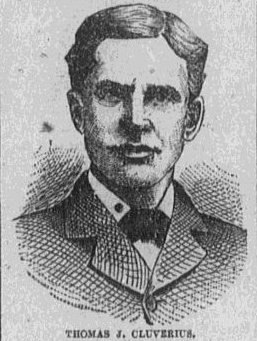
1887: Thomas Cluverius, Richmond murderer


Dallas Morning News, January 14, 1887.

On this date in 1887, a long-running (for the time) legal drama in Richmond ended with the hanging of Thomas Cluverius for murder.

On Friday the 13th — March 13, 1885 — Cluverius killed his cousin and lover Lillian Madison, who was eight months pregnant with his child, an act “as dark as any that can be found in all the calendar of crimes.” (Columbus Daily Enquirer, Jan. 15, 1887)

From the illicit affair to the shocking crime of passion and calculation to the damning lost watch key found at the site of the murder: everything conspired to spill newsprint, not only in Virginia but nationwide.

Nevertheless, by the time he hanged, the young lawyer was supported by at least a chunk of public opinion prepared to credit his dogged insistence on innocence.* He maintained it all the way to the scaffold. The drama of a potential gubernatorial reprieve, backed by hundreds of Old Dominion worthies, went to literally the very last hour of the condemned man.

The facts of this case now 125 years in the grave enjoy meticulous and evocative coverage at The Shockoe Examiner, a Richmond blog that we come to via Murder by Gaslight’s Cluverius post.

We’re very pleased on this occasion to interview a writer who has given “Tommie” and “Lillie” a more literary treatment. John Milliken Thompson‘s first novel The Reservoir (review), just published in the summer of 2011, illuminates the timeless conflicts between lust and propriety, in the very specific locale of post-Reconstruction Richmond.

ET: For you as a writer, how did you come by this story, and why did you decide to make it your first novel?

JMT: I came across a brief mention of the case in a book on Richmond history and made a mental note of it.

Sometime later I began looking into the case and, after finding all kinds of material on the trial and on Richmond in the 1880s, I became more and more intrigued. A failed attempt to turn the story into a nonfiction account led me to write it as a novel.

Book CoverWhat was the most challenging thing about approaching the story?

Creating believable, interesting characters within a compelling plot is THE challenge of writing any piece of fiction. This one was no different, though it helped to have a historical framework and tons of good material to turn to.

That said, one of the toughest things about telling this story was getting the voice right. My goal was to create a narrative that could get close in to Tommie’s head, without revealing too much (to the reader or himself), and then pull farther back.

I found it interesting that you said you “felt so connected to these long-dead people that [you] owed it to them to get it right,” because I have that sense myself sometimes. In the end, what are you hoping that 21st century readers take away from the story? What did you take away from it?

In the end, I think what I most want is for readers to feel moved by the plight of these young people, who made some crucial mistakes and paid dearly for them. We all make mistakes in our youth; sometimes we learn our lessons before we get in deeper, sometimes not.

The inference is that Tommie killed Lillian because she was pregnant. How damaging would Lillian’s giving birth really have been to Tommie socially, professionally, or otherwise? Do we need to look for more complex motivations?

That’s a good question, and Tommie even considers what his life would be like if he had “done the right thing” by Lillie and married her. Even if he had been able to live down the scandal of marrying a pregnant girl, which in those days and in their circle would’ve been significant, it would still not have been the life this ambitious young man had envisioned for himself.

And what about the world he lived in — 1880s Virginia, and the place of the crime, Richmond. What’s this place like a generation after the Civil War? And why did this crime in this place become national news?

Well, Richmond, the former Confederate capital, was making a comeback after being ravaged by the war. This event caught the interest of the general public because of the high standing of the families involved and because the lawyers trying the case were distinguished men and famous orators.

Despite maintaining innocence to the last, it seems pretty difficult to imagine that Thomas Cluverius was actually innocent. Still, at the time there were plenty of people who apparently thought he might be. Why on earth did he attract that level of support? If not for the watch-key, might he have avoided conviction altogether?

That’s the fickle nature of the public — once the scapegoat has been cast out, there is a lingering sense of doubt and guilt that causes many of us to look into our own hearts … let he who is without sin.

I think the watch-key did play a big role, but it wasn’t necessarily the sine qua non. I think the sheer volume of testimony offered by the prosecution overwhelmed any reserve the all-male jury might have felt. The burden of proof, in fact if not by law, lay with the defense, and the proof (of innocence) simply wasn’t there.

What are you working on next?

I’m finishing up a coming-of-age novel about a young woman who suffers a number of poignant losses in turn-of-the-century North Carolina. By the way, until “turn-of-the-century” means turn of the 21st (maybe in two decades?) I’m using that phrase to mean turn of the 20th.

Thanks for inviting me on your blog.

* Or empathize with the young lawyer’s lost-potential pathos.

On this day..

2009: Mosleh Zamani, because sex kills

On this date in 2009, Mosleh Zamani was hanged in Iran for making the beast with two backs.

And you thought you’d seen sexual hangups.

Twenty-three at the time of his execution, Zamani was all of 17 years old when he committed the “crime” that earned him the rope.

That crime: abducting and raping a 24-year-old woman.

So, okay, one might say: pretty rough punishment but also pretty serious misbehavior.

Save for a few minor details. Like, that the “raped” woman was actually Zamani’s girlfriend. And that she said the sex was consensual. Apparently this testimony from the mere victim was superseded by three random village prudes willing to complain about what the licentious youth get up to these days.

Given his cruel treatment, it will not surprise that Zamani was an ethnic Kurd and that his legal representation fell somewhere between poor and nonexistent.

Persian speakers (I am not one) can take in this interview with the young man’s family.

On this day..

1869: Nicholas Melady, the last public hanging in Canada

Thanks to John Melady, author of Double Trap, for the guest post about his kinsman. -ed.

I was standing with my father, looking at the ruins of an old house. I thought what remained of the brickwork was interesting, until Dad said, rather offhandedly: “And this is where the murder happened.” I was rather shocked, and asked what he meant.

His answer led me to write Double Trap, the story of the last public hanging in Canada.

Briefly, the tale goes something like this.

A man named Nicholas Melady Senior, my great-grandfather’s half brother, amassed substantial landholdings in Huron County, Ontario Canada, prior to 1868. In the years just before that, he played various family members off against each other, and depending on his whim, one or other of them would be promised his inheritance. His son Nicholas Junior was used worst of all. He worked without pay for his father, was promised all or at least some of the lands, but then was told he would get nothing — several times.

One night, Nicholas Senior, who was commonly called The Old Man, was in bed with his new wife, when Nicholas Junior and two of his friends, all of whom were drunk, broke into the Old Man’s house. A terrible fight ensued, and it included a hand gun and an axe, but at the end of the thing, the Old Man and his bride were dead.

After some very shoddy detective work, Nicholas Junior and his two friends were rounded up and lodged in a basement cell of an old house in nearby Seaforth, Ontario. (The local magistrate owned the place.) Part of that cell still exists, including the barred window the culprits would have looked through — at the rest of the cellar. It is rather creepy to visit, and while I researched Double Trap, I did not want to be there for long, and never at night.

In due course, the three desperadoes were sent to an even more chilling old jail in Goderich, Ontario. (It is now a Canadian historic site, and is visited by throngs of people every year.) There, Nicholas Junior’s friends ultimately turned against him.

However, before that happened, local detectives used a unique stratagem to gain evidence against Nicholas. I could never be sure where they got the idea. They hired a beautiful young woman who was born in Michigan, (who was likely a prostitute) and talked her into spending time in a cell in the jail. She was paid to gain the trust of Nicholas, and hopefully a confession.

In that sense, she was the first part of the “double trap,” in the book’s title.

The woman was given the name “Jenny,” and in time, by dropping notes where he would find them, and ultimately putting herself in a position where she could whisper to him through his cell window, (she positioned herself in the women’s exercise yard; he was inside his cell), she caused him to fall in love with her. All of her notes, and his as well, were used in the trial that followed. The two never actually touched each other.

When she walked into the courtroom during the trial and took the stand to describe her job and show the letters Nicholas had written, he was utterly speechless with shock. He had completely trusted her, and to him, her betrayal was total.

The execution of Nicholas Melady was a macabre affair, as were events leading up to it. His death cell was positioned quite close to where he was hanged. He could hear workers building his scaffold, and while I cannot prove it, I believe he would have been able to witness the construction of the thing. The death cell still exists, and in researching this book, I visited it several times. Now that is creepy.

So is the ground where he took his final few steps, out to the scaffold. It was built on top of the prison wall. He went up the steps on the inside, then lurched to his death, down the outside of the wall — where all the spectators waited to see the spectacle. His fall, through the trapdoor in the gallows floor was the second trap of the book’s title.

The execution was the last public one in Canada. Three weeks later the government of the country abolished public executions because they were regarded as too barbaric. There was controversy however, around the one for Nicholas. Many people felt he had been betrayed, by his accomplices, and by “Jenny,” and so lots of talk in the community made the public officials fear that there would be demonstrations the day of the death.

For that reason, they moved the execution time up by about three hours. “Only” about 300 people witnessed it. Several thousand came to see the spectacle later in the day, but by the time they reached the site, the show was over. His body was cut down, and for reasons I could never fathom, was actually waked for two days in the same house where the killings took place. Lots of the curious came to see the corpse of the killer, laid out for display.

The day after the execution, the New York Times was the first newspaper on the street with the story. I could find no trace of “Jenny,” or what became of her after her jailhouse job. Her testimony in court was never really challenged.

I was able to position myself in the cell where Nicholas was when he whispered to “Jenny.” I then went into the women’s exercise yard and by leaning against the jail wall easily understood how the conversations between the two transpired.

The book is Double Trap, by John Melady. Published by Dundurn, and available in the United States at Dundurn Publishing, 2250 Military Road, Tonawanda, New York 14150. In Canada, the pub address is: Dundurn Publishing, 3 Church Street, Suite 500, Toronto, Ontario M5E 1M2 In Britain, the address is: Gazelle Book Services Limited, White Cross Mills, High Town, Lancaster, England LA1 4XS.

On this day..

2010: Shahla Jahed, the footballer’s lover

At 5:00 a.m. this date last year, Shahla Jahed was hanged at Iran’s Evin prison for murdering the wife of Iranian footballer Nasser Mohammadkhani.

An international human rights cause celebre from the time of her 2004 conviction in a sordid televised trial, Jahed was also Mohammadkhani’s wife under a “temporary marriage” arrangement that was secret from his “real” wife Laleh Saharkhizan. So you might say, his mistress.

Both these women’s last day of liberty was the one in 2002 that Saharkhizan turned up knifed to death while Mohammadkhani was in Europe on soccer business. Jahed was arrested immediately, beginning a “taboo-breaking” legal odyssey.

After months of refusing to talk, she confessed to the murder in prison, even re-enacting the crime.

But by the time of her trial — in which an emotional, combative Jahed conducted her own defense — she very plausibly claimed that the confession had been extracted by torture. Here’s a bit of it, from the documentary Red Card (banned in Iran) that can be enjoyed in full on YouTube:

While Jahed herself made for can’t-look-away TV, the appearance of a onetime champion athlete in a feet-of-clay turn has led this affair to be compared to the O.J. Simpson murder case.

Like the Juice, Mohammadkhani was temporarily in some danger of death penalty charges himself; he spent several months in prison. Ultimately, he avoided jeopardy to his neck as a potential accessory or instigator by Jahed’s repudiated I-did-it-myself confession — possibly another reason why Jahed confessed in the first place — but the former striker did endure 74 lashes for the revelation that he and his temporary wife enjoyed chilling out with opium. Strictly verboten in Iran, of course.

And Mohammadkhani’s brush with the law scarred his honor even more than his backside. Beyond the possibility that she took the heat for him, the celebrity athlete potentially in a position to use his pull to save a woman’s life clammed up as her case progressed and deferred to his late wife’s family’s decision whether or not to give Jahed mercy. Reportedly, Mohammadkhani even attended the hanging — where Jahed again sobbed and begged for mercy until one of Saharkhizan’s relatives personally kicked the chair out from under Jahed’s feet.

The case itself had an unusually long lifespan in the judiciary; Jahed had been imprisoned well over eight years by the time she died. In 2008, the gears were even stopped by Ayatollah Hashemi Shahroudi, a figure known in Iran for his support of de-escalating capital punishment generally.

Shahroudi’s ordering a new investigation provided fodder for critics like Amnesty International who considered the trial unfair.

Iranian journalist Fereshteh Ghazi, who as a political prisoner in 2004 briefly shared a cell with our principal, made an even stronger critique.

Even if Shahla had committed the crime, which she didn’t, Shahla and the murdered wife are both victims of a male-dominated society, a system that gives all the rights to men. Shahla, Laleh [the murdered wife], and all other women like them are all victims of flaws in the Iranian judicial system and Iran’s unequal judicial system. Even the person who pulled away the chair today in her execution is a victim of the system.

Apropos of the women-in-the-judicial-system theme, Jahed’s case and even her execution were to some extent overshadowed by the simultaneous headline-grabbing matter of Sakineh Mohammadi Ashtiani, an Azeri woman who was at the time fighting a repugnant sentence of stoning for adultery. By December 2010, Iran had backed off the stoning bit without quite agreeing that Ashtiani wouldn’t be executed in some other way; in January 2011, it remitted Astiani’s death sentence altogether.

On this day..