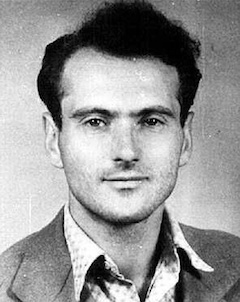
1958: Istvan Angyal, Hungarian revolutionary

On this date in 1958, Angyal Istvan was hanged for the failed 1956 Hungarian revolution.

A working-class Jew who survived Auschwitz as a boy — his mother and sister were not so fortunate — Angyal was a convinced leftist who became disaffected with the Hungarian regime not because of its Communism but because of its failure to realize the democratic and egalitarian aspirations of that ideology.

A fixture on the youthful intellectual ferment in Budapest in the early 1950s, he was one of the leaders of street protests against Soviet domination during the doomed Hungarian Revolution of 1956, even conferring personally with Prime Minister Imre Nagy during its last days. In a gesture that not all of his comrades would have supprted, he set out the hammer and sickle along with the Hungarian national flag on November 7, the very eve of the revolution’s defeat, arguing to Soviet troops that they were fighting against true communism.

He’s commemorated today at an Angyal István Park in Budapest; it’s evidently “a modern social place with free Internet” and a nifty paper plane art installation.

On this day..

1859: Yoshida Shoin, samurai sage

The name at the head of this page is probably unknown to the English reader, and yet I think it should become a household word like that of Garibaldi or John Brown. Some day soon, we may expect to hear more fully the details of Yoshida’s history, and the degree of his influence in the transformation of Japan …

–Robert Louis Stevenson

On this date in 1859,* Japan’s fading Tokugawa Shogunate beheaded samurai sage Yoshida Shoin as an enemy of the state.

Inheriting leadership of an unprosperous samurai house by the untimely death of his adoptive father, Yoshida (English Wikipedia entry | the much more detailed Japanese) studied war and philosophy from the age of five but understood right away that the classics he knew backward and forward were no match for the American gunships that steamed into Edo Bay in 1853.

Keen to learn the barbarian’s secrets, Yoshida and a friend named Sakuma Shozan* surreptitiously presented the American flotilla with an illicit request to come aboard. The American Commodore Perry never knew their identities, but he remembered the two “men of some position and rank, as each wore the two swords characteristic of distinction, and were dressed in the wide but short trowsers of rich silk brocade. Their manner showed the usual courtly refinement of the better classes, but they exhibited the embarrassment of men who evidently were not perfectly at their ease, and were about doing something of dubious propriety. They cast their eyes stealthily about as if to assure themselves that none of their countrymen were at hand to observe their proceedings, and then approaching one of the officers and pretending to admire his watch-chain, slipped within the breast of his coat a folded paper.” That paper, in courtly Mandarin, implored the visitor that the authors

have been for many years desirous of going over the ‘five great continents,’ but the laws of our country in all maritime points are very strict; for foreigners to come into the country, and for natives to go abroad, are both immutably forbidden … we now secretly send you this private request, that you will take us on board your ships as they go out to sea.

Instead, the shogunate clapped them in cages.

Would that iron bars could contain the shock Commodore Perry’s ships had given to Japan. Those islands had long closed themselves against the West save for narrow apertures on Dutch Learning. The evident superiority of American arms and the consequent necessity of accepting unequal treaties proved a fatal blow to the shogunate. Anger at the shogun manifested in a movement to restore the rights of the emperor — a position that the shogunate had centuries before reduced to a mere figurehead.

Our man Yoshida Shoin emerged from prison as a teacher whose loyalty hewed to the emperor. In vain did the shogunate attempt to purge such characters, for their cause far outstripped this or that man. Several of Yoshida’s students would be important players in the coming Meiji Restoration that did indeed reanimate the imperial office and topple the shogunate by the late 1860s.

By that time, Yoshida was rated a martyr and spiritual forerunner, for the dying shogunate had indeed seen fit to destroy him: “the old story of a power upon its last legs,” as Stevenson’s biography figures it: “learning to the bastille, and courage to the block … He failed in each particular enterprise that he attempted; and yet we have only to look at his country to see how complete has been his general success.”

* The Gregorian date. By the Japanese calendar it occurred in the tenth month, and some sites erroneously place it in October for that reason.

** Shozan was destined to be assassinated in 1864 by Kawakami Gensai.

On this day..

1907: Afanasi Matushenko

On this date in 1907,* revolutionary sailor Afanasi Mat(y)ushenko was executed for his part in tsarist Russia’s Potemkin mutiny.

The son of a liberated serf, the Ukrainian Matushenko (English Wikipedia entry | the more detailed Russian) absconded in his childhood to enter imperial Russia’s industrial economy. After spending the late 1890s — his mid teens to early twenties — on the railroads and the docks he was conscripted into the navy.

The revolutionary year of 1905 finds Matushenko a quartermaster aboard the soon-to-be-famous battleship Potemkin stationed at Sevastopol, already politically radicalized enough to have participated in a revolutionary barracks riot the previous November.

Eisenstein is mandatory where the Potemkin is concerned but the fact is that the mutiny was not spontaneously generated: it had been planned, and Matushenko was a part of the planning.

On the day of the rising, it was he who led brother-sailors in a protest against worm-ridden rations, and he who eventually crossed the rubicon into mutiny by calling them to arms. He personally killed several of the ship’s officers, and with the mutiny’s success he was elected the chair of the ship’s executive committee.

The Potemkin sailed for Odessa where her aspirations to catalyze a wider rebellion ran (metaphorically) aground, and eventually sailed for Romania. Matushenko lived abroad for two years as a political refugee, crossing paths with kindred souls but indistinct in his political outlook, nearly terroristic. The leftist writer Vladimir Posse met Matushenko in Geneva and found him

Matyushenko … did not go into theory. And his practice was to destroy — precisely the destruction, not the elimination, of all the chiefs, all the masters, and above all the officers. For him, the people were divided into masters and subordinates … the lower ranks can free themselves only when the officers are “simply” destroyed. He himself killed two or three of his superiors during a riot on the Potemkin. And it seemed to him that the essence of the revolution lay in such murders. In this spirit, he wrote bloodthirsty proclamations to sailors and soldiers, urging them to kill officers. He thought that with such a program it was easy to attract all the sailors and most of the soldiers to the side of the revolution …

He considered himself to be doomed to die in battle or on the scaffold … He considered living in an emigrant position to be dishonorable, something of a betrayal. In his view, a true revolutionary is one who not only kills, but also dies himself.

In June 1907 he acted on the latter beliefs and returned to Russia — where he was promptly arrested and condemned by a military court to fulfill his prophesied destiny.

Several cities in the Soviet Union, including Sevastopol itself, had streets named for Sailor Matyushenko, and a Black Sea minesweeper received that name in 1969.

* November 2, 1907 per the Gregorian calendar. Tsarist Russia was still hanging on to the Julian calendar at this time.

On this day..

1944: Werner Seelenbinder, communist grappler

Left-wing athlete Werner Seelenbinder was executed by the Third Reich on this date in 1944.

An Olympic Greco-Roman wrestler, Seelenbinder’s plan to scandalize patriots by refusing to make the Nazi salute from the podium at the 1936 Berlin games was scratched when he came in fourth in the event.

Nevertheless, Seelenbinder (English Wikipedia entry | German) had already by then given more material aid to Hitler’s foes by using his sportsman’s travel itinerary as cover to act the courier for the banned Communist party.

Arrested in 1942 during the smash-up of the Robert Uhrig resistance ring, Seelenbinder was tortured horrifically in prison but died with courage — as he had pledged in a last letter to his father.

The time has now come for me to say goodbye. In the time of my imprisonment I must have gone through every type of torture a man can possibly endure. Ill health and physical and mental agony, I have been spared nothing. I would have liked to have experienced the delights and comforts of life, which I now appreciate twice as much, with you all, with my friends and fellow sportsmen, after the war. The times I had with you were great, and I lived on them during my incarceration, and wished back that wonderful time. Sadly fate has now decided differently, after a long time of suffering. But I know that I have found a place in all your hearts and in the hearts of many sports followers, a place where I will always hold my ground. This knowledge makes me proud and strong and will not let me be weak in my last moments.

As a visible public person who died in resistance to fascism, Seelenbinder made for ready national-icon material in postwar Germany … but because of his red affiliations he was honored in this fashion mostly in East Germany. (Indeed, even a sports club that had been named for him weeks after the war’s end, in the American-occupied sector, stripped his name right off a few years later to keep with the times. The stadium was reverted to its Seelenbinder christening in 2004.)


East Berlin’s Werner-Seelenbinder-Halle was demolished in 1993 and replaced by the Velodrom.

On this day..

1685: Elizabeth Gaunt, for refuge

(Thanks to Thomas Babington Macaulay for the guest post on “the blackest [case] which disgraced the sessions” prosecuting the Rye House Plot to kidnap and murder King Charles II and his Catholic brother soon-to-be-heir James. It originally appeared in Macaulay’s History of England. -ed.)

Among the persons concerned in the Rye House plot was a man named James Burton. By his own confession he had been present when the design of assassination was discussed by his accomplices.

When the conspiracy was detected, a reward was offered for his apprehension. He was saved from death by an ancient matron of the Baptist persuasion, named Elizabeth Gaunt.

This woman, with the peculiar manners and phraseology which then distinguished her sect, had a large charity. Her life was passed in relieving the unhappy of all religious denominations, and she was well known as a constant visitor of the gaols.

Her political and theological opinions, as well as her compassionate disposition, led her to do everything in her power for Burton. She procured a boat which took him to Gravesend, where he got on board of a ship bound for Amsterdam. At the moment of parting she put into his hand a sum of money which, for her means, was very large.

Burton, after living some time in exile, returned to England with Monmouth, fought at Sedgemoor, fled to London, and took refuge in the house of John Fernley, a barber in Whitechapel.

Fernley was very poor. He was besieged by creditors. He knew that a reward of a hundred pounds had been offered by the government for the apprehension of Burton. But the honest man was incapable of betraying one who, in extreme peril, had come under the shadow of his roof.

Unhappily it was soon noised abroad that the anger of James was more strongly excited against those who harboured rebels than against the rebels themselves. He had publicly declared that of all forms of treason the hiding of traitors from his vengeance was the most unpardonable. Burton knew this. He delivered himself up to the government; and he gave information against Fernley and Elizabeth Gaunt.

They were brought to trial. The villain whose life they had preserved had the heart and the forehead to appear as the principal witness against them.

They were convicted. Fernley was sentenced to the gallows, Elizabeth Gaunt to the stake. Even after all the horrors of that year, many thought it impossible that these judgments should be carried into execution. But the King was without pity. Fernley was hanged. Elizabeth Gaunt was burned alive at Tyburn on the same day on which Cornish suffered death in Cheapside.

She left a paper written, indeed, in no graceful style, yet such as was read by many thousands with compassion and horror. “My fault,” she said, “was one which a prince might well have forgiven. I did but relieve a poor family; and lo! I must die for it.”

She complained of the insolence of the judges, of the ferocity of the gaoler, and of the tyranny of him, the great one of all, to whose pleasure she and so many other victims had been sacrificed. In so far as they had injured herself, she forgave them: but, in that they were implacable enemies of that good cause which would yet revive and flourish, she left them to the judgment of the King of Kings.

To the last she preserved a tranquil courage, which reminded the spectators of the most heroic deaths of which they had read in Fox. William Penn, for whom exhibitions which humane men generally avoid seem to have had a strong attraction, hastened from Cheapside, where he had seen Cornish hanged, to Tyburn, in order to see Elizabeth Gaunt burned. He afterwards related that, when she calmly disposed the straw about her in such a manner as to shorten her sufferings, all the bystanders burst into tears.

It was much noticed that, while the foulest judicial murder which had disgraced even those times was perpetrating, a tempest burst forth, such as had not been known since that great hurricane which had raged round the deathbed of Oliver. The oppressed Puritans reckoned up, not without a gloomy satisfaction the houses which had been blown down, and the ships which had been cast away, and derived some consolation from thinking that heaven was bearing awful testimony against the iniquity which afflicted the earth. Since that terrible day no woman has suffered death in England for any political offence.


Newgate, 22d of Octob. 1685.

Mrs. Gaunt’s Speech, written the Day before her Sufferings.

Not knowing whether I should be suffered or able, because of Weaknesses that are upon me through my hard and close Imprisonment, to speak at the Place of Execution; I writ these few Lines to signifie, That I am well reconciled to the Way of my God towards me, though it be in Ways I looked not for; and by Terrible Things, yet in Righteousness; having given me Life, he ought to have the disposing of it, when and how he pleases to call for it; and I desire to offer up my AH to him, it being but my reasonable Service; and also the first Terms that Jesus Christ offers, that he that will be his Disciple, must forsake all, and follow all; and therefore let none think hard, or be discouraged at what hath happened at me; for he doth nothing without Cause, in all he hath done to us, he being holy in all his Ways, and righteous in all his Works; and ’tis but my Lot in common with poor desolate Sion at this Day.

Neither do I find in my Heart the least Regret for what I have done in the Service of my Lord and Master Jesus Christ, in succouring and securing any of his poor Sufferers, that have shewed Favour to his righteous Cause: Which Cause, though now it be fallen and trampled upon, as if it had not been anointed, yet it shall revive, and God will plead it at another Rate than ever he hath done yet, and reckon with all its Opposers and malicious Haters; and therefore let all that love and fear him, not omit the least Duty that comes to Hand, or lyes before them, knowing that now it hath need of them, and expects they shall serve him.

And I desire to bless his holy Name, that he hath made me useful in my Generation to the Comfort and Relief of many Desolate Ones, and the Blessing of those that are ready to perish has come upon me, and being helpt to make the Heart of the Widow to sing. And I bless his holy Name, that in all this, together with what I was charged with, I can approve my Heart to him, that I have done His Will; tho’ it does cross Man’s Will, and the Scriptures that satisfie me are. Isaiah 16. 4, Hide the Outcasts, betray not him that wandereth. And Obad. 13 14, Thou shouldst not have.given up those of his that did escape in the Day of his Distress.

But man says, You shall give them up, or you shall die for it. Now who to obey, judge ye.

So that I have Cause to rejoyce and be exceeding glad, in that I suffer for Righteousness Sake, and that I am accounted worthy to suffer for Well-doing, and that God has accepted any Service from me, which has been done in Sincerity, tho’ mixed with manifold Infirmities, which he hath been pleased for Christ’s Sake to cover and forgive.

And now as concerning my Fact, as it is called, alas it was but a little one, and might well become a Prince to forgive; but he that shews no Mercy, shall find none: And I may say of it in the Language of Jonathan, I did but taste a little Honey, and lo I must die for it. I did but relieve an unworthy, poor, distressed Family, and lo I must die for it.

Well, I desire in the Lamb-like Gospel Spirit to forgive all that are concerned, and to say, Lord, lay it not to their Charge; but I fear he will not: Nay, I believe when he comes to make Inquisition for Blood, it will be found at the Door of the furious Judge; who, because I could not remember Things through my Dauntedness at Burton’s Wife’s and Daughter’s Vileness, and my Ignorance, took Advantage thereat, and would not hear me, when I had called to Mind that which I am sure would have invalidated their Evidence; tho’ he granted something of the same Nature to another, yet denied it to me.

My Blood will also be found at the Door of the unrighteous Jury, who found me Guilty upon the single Oath of an Out-lawed Man; for there was none but his Oath about the Money, who is no legal Witness, though he be pardoned, his Out-lawry not being’ recalled; and also the Law requires two Witnesses in Point of Life: And then about my going with him to the Place mentioned, ’twas by his own Words, before he was Out-lawed, for ’twas two Months after his absconding; and tho’ in a Proclamation, yet not High Treason, as I have heard; so that I am clearly murdered by you.

And also Bloody Mr. A. who has so insatiably hunted after my Life; and though it is no Profit to him, through the ill Will he bore me, left no Stone unturned, as I have Ground to believe, till he brought it to this; and shewed Favour to Burton, who ought to have died for his own Fault, and not bought his own Life with mine; and Capt. R. who is cruel and severe to all under my Circumstances, and did at that Time, without all mercy or Pity, hasten my Sentence, and held up my Hand, that it might be given; all which, together with the Great One of all, by whose Power all these, and a Multitude more of Cruelties are done, I do heartily and freely forgive, as against me; but as it is done in an implacable Mind against the Lord Christ, and his righteous Cause and Followers, I leave it to him who is the Avenger of all such Wrongs, who will tread upon Princes as upon Mortar, and be terrible to the Kings of the Earth: And know this also, that though ye are seemingly fixt, and because of the Power in your Hand, are writing out your Violence, and dealing with a despiteful Hand, because of the old and new Hatred; by impoverishing and every Way distressing of those you have got under you; yet unless you can secure Jesus Christ, and all his Holy Angels, you shall never do your Business, nor your Hands accomplish your Enterprizes; for he will be upon you ere you are aware; and therefore, O that you would be wise, instructed and learn, is the Desire of her that finds no Mercy from you,

Elizabeth Gaunt.

On this day..

1660: John Carew, regicide

This morning Mr. Carew was hanged and quartered at Charing Cross; but his quarters, by a great favour, are not to be hanged up.

–Diary of Samuel Pepys, October 15, 1660

John Carew, one of the 59 Parliamentarians to sign the death warrant of King Charles I, was executed on this date in 1660 for regicide. He was the second regicide upon the gallows in a week of bloodshed, following the October 13 butchery of Major General Thomas Harrison.

According to the Memoirs of Edmund Ludlow, Carew

was a gentleman of an ancient family in the county of Cornwall, educated in one of the universities, and at the inns of court. He had a plentiful estate, and being chosen to serve in the great parliament, he was elected into the council of state, and employed in many important affairs; in which he shewed great ability. He found the same usage from the court as major-general Harrison had done, being frequently interrupted, and counsel denied, though earnestly desired by him, in that point of law touching the authority by which he had acted: when he saw that all he could say was to no purpose, he frankly acknowledged, that he sat in the high court of justice, and had signed two warrants, one for summoning the court in order to the king’s trial, and another for his execution. Upon this, the court, who were well acquainted with the disposition of the jury, permitting him to speak, he said, That in the year 1640, a parliament was called according to the laws and constitution of this nation: That some differences arising between the king and that parliament, the king withdrew his person from them; upon which the lords and commons declared — Here the court being conscious, that their cobweb coverings were not sufficient to keep the light of those truths he was going to produce, contrary to the liberty they had promised, interrupted him, under colour that what he was about to say, tended not only to justify the action for which he was accused, but to cast a ball of division among those who were present. But Mr. Carew going on to say, The lords and commons by their declaration — Judge Foster interrupted him again, and told him, he endeavoured to revive those differences which he hoped were laid asleep, and that he did so to blow the trumpet of sedition; demanding, if he had ever heard, or could produce an act of parliament made by the commons alone? To this he would have answered, but was not permitted to finish what he began to say, or hardly any one thing he endeaoured to speak in his defence during the whole trial; Mr. Arthur Annesley particularly charging him with the exclusion of the members in the year 1648, of which number he had been one; to which he only replied, That it seemed strange to find a man who sat as a judge on the bench, to give evidence as a witness in the court. These irregular proceedings, unbecoming a court of judicature, obliged Mr. Carew to address himself to the jury, leaving them to judge of the legality of his trial; and appealing to their consciences, whether he had been permitted to make his defence. But they, who were not to be diverted from the resolutions they had taken, without any regard to the manner of his trial, declared him guilty as he was accused.

On this day..

1822: General Berton

On this date in 1822,* General Jean Baptiste Berton (sometimes Breton) was guillotined in Poitiers.

A young junior officer during the French Revolutionary Wars, Breton/Berton scaled the Napoleonic ranks in the early 19th century and was elevated by the Corsican’s own hand to Brigadier General.

Upon Napoleon’s 1815 return from exile Breton rallied to the ex-emperor’s cause but he did not suffer the worst of it after Waterloo, instead scribbling his memoirs in enforced half-pay retirement.

This situation permitted the ex-marechal-de-camp both the time and the liberty to dabble in that era’s rife conspiracies intending the overthrow of the Bourbons — a fact which was exposed by mischance when one of the young cavalrymen he had recruited was killed in an accident with incriminating documents in his pockets. Agents provocateur baited him thereafter into a treasonable and doomed rebellion.

* Some sources give October 6, which was a Sunday. Primary documentation prefers October 5.

On this day..

1499: Paolo Vitelli, duplicitous commander

On this date in 1499, Florence decapitated its chief general for dereliction of command.

Paolo Vitelli, a noted condottiero whose family had taken over Citta di Castello, was hired by the post-Savonarola Florentine Republic during the Italian Wars to campaign against Florence’s traditional rival, Pisa.

“If this man had taken Pisa, nobody can deny that it would have been proper for the Florentines to keep in with him,” mused Machiavelli years later in The Prince. “For if he became the soldier of their enemies they had no means of resisting, and if they held to him they must obey him.”

The prospective kingpin made fantastic progress against the Pisans, and when news reached his Florentine patrons that Vitelli had taken a key gate in Pisa’s walls, the city smugly began drawing up wishlists of humiliations to heap upon the vanquished. But at the critical moment, “just when the whole army, and especially the youthful Florentines who had joined the camp as volunteers, were carrying all before them by their indomitable ardour, they were suddenly ordered to retreat. And Paolo Vitelli, seeing the unwillingness of the soldiers to obey, rushed among them with his brother Vitellozzo* and drove them back with blows.”

As jaws hit tables all around Florence, Pisa’s defenders were hurriedly patching the breach and retrenching. The attackers had ransacked their treasury to finance the expedition; there was nothing for a do-over. Had Vitelli quailed, or was he playing some double game? Either way, Machiavelli lamented — contemporaneously this time, in his capacity as an emissary of state — “We should have preferred defeat to inaction at so decisive a moment.”

With mingled urgency and circumspection, Florence’s leaders arranged to invite Vitteli to a war council at which he was arrested. Interrogated on September 30th, he was beheaded the very next day.

* Three years later, Paolo’s brother Vitellozzo would also achieve the pages of Executed Today … and once again did so under the sharp eyes of Machiavelli.

On this day..

1943: Mao Zemin, brother of Mao Zedong

Mao Zemin, younger brother of Communist leader Mao Zedong, was executed on this date in 1943.

A party cadre since 1921, the non-chairman Mao served a variety of economic leadership posts for the Red Army.

As of early 1941, Mao (English Wikipedia entry | the far more voluminous Chinese) was detailed to the western province of Xinjiang, where the warlord Sheng Shicai maintained friendly relations with the neighboring Soviet Union.

To Mao’s grief, this “King of Xinjiang” saw in the unfolding global war an opportunity to realign.

After the German invasion of the USSR in 1941, Sheng boldly flipped his affiliation from Moscow to the nationalist Kuomintang government with which he had theretofore maintained only the frostiest of relations. Crackdowns on Communists ensued too, and both Mao Zemin and Chen Tanqiu were both arrested, tortured, and executed as a result.

Needless to say this KMT-Xinjiang axis did not hold the Celestial Empire’s destiny and the whole decision to fade Moscow looks pretty dumb in retrospect. Sheng, however, surely did not much regret the gambit since he was able to follow the nationalists to Taiwan and spend a comfortable retirement writing memoirs like Sinkiang: Pawn or Pivot?

Mao’s son Mao Yuanxin, a still-living pensioner as of this writing, was a political figure in the 1970s who was jailed post-Gang of Four.

On this day..

1714: Geczy Julianna, the White Woman of Locse

On this date in 1714, Geczy Julianna was executed in the marketplace of Gyor as a traitor.

“The White Woman of Locse” — which is also the title of an 1884 romantic novel about her life by Mor Jokai — this woman allegedly betrayed that place* into the hands of imperial Habsburg troops during Hungary’s unsuccessful 1703-1711 rebellion. Sober historians view her as simply a person trusted to serve as the emissary between the garrison and its Habsburg besiegers which role would eventually entail her communicating the defenders’ surrender.

She salvaged her reputation for posterity — and set herself up for torture and execution — by paying the betrayal forward to the empire when she destroyed a number of documents sought by the imperial marshal Janos Palffy that could have incriminated Kuruc nobles in plotting for a renewal of hostilities.

“How can a woman sacrifice her whole country for a kiss, and then sacrifice her handsome head for the same country?” Jokai mused of his paradoxical subject. “What reconciles the heaven and hell in the character of a woman?”

* Formerly part of Hungary’s northern reaches, this town today resides in Slovakia.

On this day..