1812: Claude-Francois de Malet and his conspirators

Two centuries ago today,* the author of one of the weirdest attempted coups in history was shot with his co-conspirators.

Picture Valkyrie in Napoleonic Europe.

Claude-Francois de Malet (English Wikipedia entry | French) had spent the years of his confinement for republican sensibilities painstakingly readying bogus orders and decrees for the eventual rollout of the most audacious putsch you’d ever want to putsch.

While Bonaparte was off on campaign trashing Russia, Malet broke out of his sanitarium and went to work.

Donning a general’s uniform, Malet on Oct. 23, 1812 presented a forged announcement of the Emperor’s recent demise … and started issuing orders. He bluffed the release of imprisoned allies, and got a legitimate general to order the arrest of Napoleon’s most prominent deputies in Paris. (It’s a good job that general obeyed Malet, because when one officer asked to kindly see the arrest warrant Malet was using on him, Malet responded by shooting him in the face.)

For a few hours that morning the Malet conspirators almost put themselves in control, almost normalized their sudden rearrangement of authority with its reassuringly familiar official paperwork. Later, when interrogated for the identities of his accomplices, Malet would retort, “You, yourself, Sir, and all of France — if I had succeeded!”

But the attempted coup which aimed so high ultimately made for little but tantalizing counterfactual history. Officers with clearer heads soon realized that they had received communiques from the Emperor dated after his purported October 7 death; one of those officers arrested Malet.

A tribunal was constituted later that same date. It had little difficulty condemning 14 (French link) during the small hours of the morning on Oct. 29. They were shot later that same day (at least, most of them were; there are oddly conflicting accounts on this point). This public-domain French text preserves a first-person narration of the scene, in which Malet himself — usurping authority to the very last — commands the firing platoon that’s lined up to shoot his comrades.

120 bullets riddled these unfortunates, who fell all except Malet. He stood on his hands and knees and raised his hands to his chest as he was only wounded, and retreated to the wall on which he leaned:

“And me, my friends!” cried he, “You forgot me!”

(One of the executed fellow-officers was Gen. Victor Lahorie. Lahorie’s lover was Sophie Trebuchet, and his lover’s son, Victor Hugo, was about to catapult himself to literary fame.)

While the Malet plot failed on its own terms, it got quite a lot farther than it had any right to expect — and this fact rightly alarmed the Corsican.

“Bad News From France”, by Vasily Vereshchagin, depicts a retreating Napoleon — bunking in an Orthodox church — finding out about Malet.

Was his position that precarious? And why, if some officers genuinely believed him dead, did nobody hail as emperor his infant son and designated heir?

Napoleon had already begun his catastrophic retreat from Russia when he got word of Malet’s attempted coup d’etat; the struggling Grande Armee was dwindling daily under the battering of cold, desertion, and Russian snipers. Now this?

Upon discovering his late narrow escape from a homefront conspiracy, Napoleon left his miserable troops under the command of Murat* and raced ahead of them back to Paris to secure his own position.

This new confluence of domestic vulnerability and foreign defeat marks the beginning of the end for Napoleon. Europe ganged up on the weakened French, and less than 18 months after Malet faced his executioners, France’s own generals forced Napoleon to abdicate.

* Murat soon ditched the army himself to try to preserve himself as King of Naples. (That didn’t end well.) The once-gigantic army’s remnants finally straggled home under the third-string leadership of Eugene de Beauharnais — the capable son of Josephine’s guillotined first husband.

On this day..

1942: Helmuth Huebener, Mormon anti-Nazi


Poster announces Helmut Hubener’s execution.

On this date in 1942, 17-year-old Helmuth Hübener was executed at Plotzensee Prison for listening to the BBC.

Huebener was a Mormon youth with the political perspicacity to abhor fascism from a very young age: the former Boy Scout (Mormons really take to scouting) ditched the Hitler Youth after Kristallnacht, which happened when Huebener was only 10 years old.

As Germany forged ahead towards worse horrors in the years, conscientious people of all ages had moral dilemmas to resolve. Mormons in Nazi Germany weren’t persecuted per se and to keep it that way that small community generally kept its head judiciously down.

Not Huebener.

Horrified by the privations of their Jewish neighbors, Huebener with fellow Mormon teens Karl-Heinz Schnibbe and Rudi Wobbe began illegally listening to foreign radio broadcasts and using the material to compose anti-fascist pamphlets for distribution around Hamburg.

Themes like Germany’s coming defeat (a Huebener circle favorite) never went over well with the authorities; a 1939 law decreed that “Whoever willfully distributes the broadcasts of foreign stations which are designed to endanger the strength of resistance of the German people will, in particularly severe cases, be punished with death.”

Huebener’s friends, aged 18 and 16, were judged only sufficiently severe for hard labor sentences; both survived the war but have since died. Huebener as the ringleader got the death penalty. (The local Mormon congregation expediently excommunicated him, a judgment later reversed from church headquarters in Salt Lake City.) And clearly Huebener was failing to “support the troops”, in the present-day parlance: his own older brother Gerhard had been drafted into the Wehrmacht and was away at the front.

“My Father in heaven knows that I have done nothing wrong,” young Helmuth wrote shortly before his beheading. “I know that God lives and He will be the proper judge of this matter.”

The Latter-Day Saints church, not usually thought of as a hive of anti-authority activity, has only gradually warmed up to celebrating its appealing young resistance martyr.

In addition to a number of books, Huebener is the subject of the documentary Truth & Conviction as well as the forthcoming feature film Truth & Treason.

A few books about Helmuth Huebener

Three Against Hitler and When Truth Was Treason were written by Huebener’s un-executed confederates.

Novels inspired by Helmuth Huebener

On this day..

1901: Johannes Lotter, Boer War “rebel”

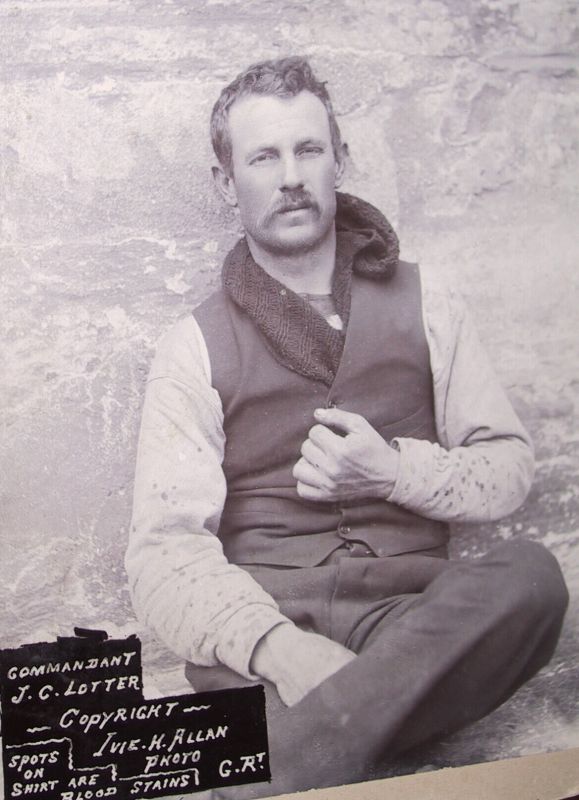
On this date in 1901, Commandant Johannes Lotter was shot at Middelburg.

Along with Gideon Scheepers, Lotter is one of the most famed Boer guerrillas from the Second Boer War.

Regarded by the British as one of their most nettlesome adversaries in that dirty guerrilla war, Lotter was captured in a bloody early September ambush when matters were well into an unpleasant scorched-earth endgame.

This was cause for much slapping of backs among the Union Jack set, and earned for his captor an immediate promotion.


Lotter’s captured men being jubilantly escorted into Graaff-Reinet.

Lotter almost immediately found himself in the dock for — well, all the things one does in a dirty guerrilla war.*

And one other thing: sedition.

The British charged Lotter as a rebellious subject of the British Cape Colony — rather than a resident of one of the independent neighboring Boer states — who owed allegiance to the British crown; upon this premise things like “killing troopers in war” became “murdering troopers”.

Lotter’s trial hung on his papers.** The defendant “pleaded that he was a Free State burgher, and, as such, entitled to the usage of civilised warfare and a legal combatant’s privileges.”

But he was in a bit of a pickle when it came to proving that the “Commandant Lotter” the British discovered on voting rolls for the Cape Colony city of Colesburg was a different guy. Innocent Blood: Executions During the Anglo-Boer War (its title telegraphs its Boer sympathies) summarizes:

his Free State citizen document was in a small case, which was lost or destroyed theday of surrender. Witnesses for the defence gave evidence that they had seen these papers. British intelligence stated that it could find no proof of his Free State citizenship in Bloemfontein. Lotter responded by asking how he could prove his citizenship when all his witnesses were still on commando and that he had been granted no time to call upon them.

Hey, the guy had six whole weeks from capture to execution to sort it all out.

A “Chair Monument” — there’s a picture of it on this page — commemorates Lotter and his fellow commando Pieter Wolfaardt at the place outside Middelburg where they were shot together on Oct. 12, 1901.

A number of additional prisoners from Lotter’s command taken with him in that same ambush were also eventually executed.

* Specifically: murdering two native spies; killing three British soldiers; blowing up railway lines; and sjamboking loyalist civilians.

** When the British later captured Scheepers, who was unquestionably not a Cape rebel, they simply charged his similar conduct as war crimes to the same capital effect.

On this day..

1817: Gertrudis Bocanegra, Mexican independence heroine

On this date in 1817, Mexican War of Independence heroine Gertrudis Bocanegra was publicly shot in her native town of Pátzcuaro for treason.

Bocanegra (English Wikipedia entry | Spanish), a literate Enlightenment woman was already 45 years old when the rebellion against the Spanish empire broke out.

Her husband and son joined Hidalgo‘s forces, in which service they would lay down their own lives.

Gertrudis Bocanegra kept a safe house, gathered supplies and money, shuttled messages … until Spanish authorities arrested her in 1817 and tortured her for information. (Need one even ask if the noble Bocanegra informed on her compatriots?)

She’s known as La Heroína de Pátzcuaro and is the namesake for, among other things, a plaza in that city and the striking Biblioteca Gertrudis Bocanegra, where one can find this:


(cc) image from eperales depicts Juan O’Gorman‘s monumental Historia de Michoacan. We’ve seen this monument before, as it depicts the Spanish burning to death the last native Tarasco ruler.

Bocanegra’s own execution is also shown in the mural — in the lower right, obscured by the bookshelves in the photograph above, but captured in detail in this Spanish blog post.

On this day..

782: 4,500 Saxons by order of Charlemagne

On an unknown date in the latter half of 782, Charlemagne did some seriously nasty business with a captured army of Saxons.

In the late 8th century, the King of the Franks was fighting a decades-long running campaign against Saxon tribes at the edge of his sprawling European empire.

One part Christianizing the pagans and two (or more) parts territorial aggrandizement, Charlemagne’s exertions on the Rhinish frontier were opposed by Widukind, or Witikind, or Widochind, whose “forest-child” name belies its owner’s legendary ferocity.


Widukind was reclaimed in the Renaissance as a patriotic or national figure. (Source)

In the summer of 782, when Charlemagne perhaps thought he had whatever passed for peace among the querulous Saxons, Widukind raised a revolt and dealt the Franks a stinging defeat that put a couple of imperial legates into the ground and made some martyrs out of clerics he found in the wrong place at the time.

Charlemagne’s forces counterattacked and routed the Saxons at the Battle of Suntel (or Sonnethal) Mountain, and thereupon

questioned the primores of the Saxons, all of whom be had summoned to attend him, as to who was responsible for the rebellion which had taken place. And since they all declared that Widukind was the author of this wickedness but were unable to deliver him up in view of the fact that he had taken himself off to the Northmen once the deed had been done, no fewer than 4500 of the others, those who had fallen in with his promptings and committed such a gross outrage, were handed over and at the place on the river Aller called Verden, at the king’s command, all beheaded in a single day. Thus was punishment executed; and the king then retired to winter-quarters at Thionville, where he celebrated both the Lord’s birthday and Easter in the customary fashion.

This merciless slaughter of prisoners is one of the lasting blights on Charlemagne’s impressive reputation. Even so, the reputation had the last word: three years later, Witikind was finally defeated and delivered up, in person, to the Frankish ruler … who accepted the Saxon pagan’s submission and forced him to convert to Christianity.


Charlemagne receives Witikind’s submission at Paderborn in 785.

On this day..

1763: Gabriela Silang

On this date in 1763, the mestiza Philippines national hero Maria Josefa Gabriela Carino Silang was captured and summarily hanged — along with a number of the soldiers she had led against the Spanish.


Monument to Gabriela Silang in Makati City, Philippines. (cc) image from Jun Acullador.

Gabriela took primary leadership of a 2,000-strong rebel army after its co-leader, her husband Diego, was assassinated by his enemies in May 1763.

Said enemies were the Spanish colonial authorities, whom Diego and his helpmate Gabriela had raised revolt against and with an army wielding homemade muskets and blowguns, driven from the capital of Ilocos Sur. It was Great Britain’s occupation of the Philippines during the Seven Years War that opened the opportunity for the rebellion: the British even appointed Diego Silang governor of the province his army was in the process of conquering. They just didn’t actually help him.

Spain’s assault on the rebels, once organized, was sufficiently overwhelming to drive Gabriela Silang out of the city of Vigan, and then to repel her counterattack — the occasion for her capture and her death.

Gabriela Silang is memorialized in a number of monuments and place names in the Philippines; the women’s organization GABRIELA also engineered its acronym to pay tribute to her.

On this day..

1642: Henri Coiffier de Ruze, Marquis of Cinq-Mars

On this date in 1642, with the last words “Mon Dieu! Qu’est-ce que ce monde?”, 22-year-old former royal favorite Cinq-Mars was beheaded at Lyon’s Place des Terreaux.

Henri Coiffier de Ruze (English Wikipedia page | French) had been under Cardinal Richelieu’s protection since the boy’s father died in 1632; in 1639, the Red Eminence introduced the then-19-year-old whippersnapper to Louis XIII as a prospective royal favorite (read: lover).

Though the king did indeed take to the youth, Cinq-Mars, in the age-old custom of sullen teenagers everywhere, soon found the luxurious profligacy of the favorite’s life rather overbalanced by irritation at both of his sickly, aging patrons.

Tart talk to intimates graduated to something more serious after Richelieu rudely put the kibosh on Cinq-Mars’s (unrealistic) designs on a wealthy noblewoman — which was also a bid to parlay his tenuous favorite gig into some lasting power.

Now considering himself personally begrudged of the Cardinal, Cinq-Mars fell into the conspiracies (French link) to depose, assassinate, or otherwise replace him.

Eventually Cinq-Mars would go so far as a real blockbuster (French again): he signed a secret pact with the Spanish king to support a noble revolt in exchange for handing over French possessions, a seditious plan also backed by perennial plotter Gaston d’Orleans, the king’s scheming brother.

Our angry moppet had more than met his match in Richelieu, however: the cardinal’s agents intercepted (more French) the treasonable correspondence and had Cinq-Mars dispatched this date along with his confederate de Thou.


Execution of Cinq-Mars and De Thou in Paris (1642), engraving by Johann Luyken, Paris, Bibliothèque nationale de France (via)

Richelieu himself was already dying as he undid this last conspiracy against him. The cardinal succumbed on December 4, 1642 … with Louis following him into the grave the next May.

While Richelieu’s name is fixed in the firmament of history and literature, Cinq-Mars has to make do as the namesake of a rarely-seen Gounod opera, based on the 1826 historical novel Cinq-Mars by Alfred de Vigny.

On this day..

1536: Skipper Clement, rebel

On this date in 1536, the Danish rebel Skipper Clement was put to death at Viborg.

Clement (English Wikipedia entry | Danish) was a naval officer for the Danish king Christian II.

When said heavy–handed monarch was deposed by his own uncle Frederick, Clement turned privateer … and when said deposing-uncle Frederick died in 1533, Clement entered the ensuing civil war between supporters of the still-imprisoned ex-king Christian II and those who backed Frederick’s own son Christian III. This was also a social and political war over the Reformation.

Clement went to war for his former boss, Christian II, instigating a 1534 North Jutland uprising of the Catholic peasantry that in October of that year trounced the Protestant noble army sent to suppress it at the Battle of Svenstrope Mose (Svenstrop Bog or Moor).

That battle clinched Clement’s reputation as one of the great peasant-rising leaders, and also clinched for Clement the fate that usually befalls such characters. Shortly after, Clement’s aristocratic ally cut his own deal with Christian III and abandoned the rabble to a vicious counterattack. In December 1534, General Johan Rantzau stormed the rebel strongholdof Aalborg, slaughtering two thousand peasants, reducing freeholding farmers to tenants, and bringing Clement home in chains for a grand finale.

The captured commander languished in his dungeon awaiting the conclusion of the civil war. It took a good year under siege for Rantzau to bring Copenhagen to heel, but once that city capitulated in August 1536, Clement was brought out of storage for use as a victory cigar. (Danish link)

On September 9, 1536, wearing a lead crown to mock his ambition, Clement had his head chopped off, and his remains were dismembered and set up for public display.

Danish speakers may enjoy these short audio narrations of the Svenstrope Mose and Aalborg engagements. Aalborg parents may enjoy sending their children to Skipper Clement International School.

On this day..

1944: Six Milice collaborators in France

On this date in 1944, just days after the Liberation of Paris secured the restoration of the French Republic, six collaborators were publicly shot in the foothills of the French Alps. They were the condemned of the first court-martial to sit in liberated France.

A London Times correspondent estimated that 4,000 or more of their countrymen braved cruel wind and rain to cheer the traitors’ deaths meted to these young members of the Vichy government’s hated milice.
They were among ten members of that militia captured at a training grounds in Grenoble, and the shooting of these six was preceded by a loudspeaker announcement decrying the tribunal which tried them for having the softness merely to imprison the other four.

“The Liberation Committee considers that the sentences which failed to inflict the death penalty on all the militiamen not to be in conformity with the wishes of the French people and accordingly promises, in conformity with those wishes, to see that the composition of the court-martial is revised in order to avoid a repetition of such weakness.” The people answered with a cheer.

–London Times, Sep. 4 1944

The executions, carried out on a grounds the Gestapo had once used to executed Resistance members, were also photographed, and the striking images published in the Oct. 2 issue of Life magazine. Once available online from Life at this now-dead link, the gallery is reproduced at this Chinese page; Warning: Disturbing Content.

Photographer John Osborne, later a noted editor and habitue of Richard Nixon’s enemies list, would not have been a candidate for the Resistance’s court.

“I am susceptible as most,” he wrote in Life‘s original dispatch. “When I first saw the 10 men and boys in the courtroom dock at this trial, I wanted to cry. They looked so young, wretched, unshaven … It was very easy to sentimentalize over these men, all of whom were underlings. It was easy to agree with the [collaborators’] chief defender, Pierre Guy, that France would be harming only herself if she killed them now.”

On this day..

1481: Michal Olelkowicz and Iwan Holszanski, Lithuanian princes

On this date in 1481, two Lithuanian princes were beheaded in Vilnius for plotting the assassination of the Polish-Lithuanian king.

This late 15th century was a heady time for Poland under the Jagiellon dynasty, and one of this dynasty’s going projects was keeping the adjacent realms of Poland and Lithuania linked together. In time, they would become formally joined, but at this point they were independent entities “united” only by the personal union of the Jagiellon monarch himself.

That monarch in the late 15th century was the redoubtable Casimir IV (Kazimierz IV): Grand Duke of Lithuania since 1440, King of Poland since 1447. Casimir’s family hailed from Lithuania; indeed, as that place had been last European place to Christianize, Casimir’s own father had been born a pagan.

Casimir IV’s eponymous son is St. Casimir, patron saint of both Lithuania and Poland; both actively honor his feast date of March 4.

Lithuania agonistes

Lithuania had a strong independent streak (pdf), and its boyars did not necessarily see eye to eye with the Grand Duke. Casimir was keen on centralizing Lithuania’s administration and checking the potential rivalry of the most powerful Lithuanian families, the classic seeds of crown-vs-nobility conflict the world over.

And both watched with a wary eye the growth of Muscovy under the energetic leadership of Ivan III, aka Ivan the Great.

That expanding state in the 1470s gobbled up the buffer city-state of Novgorod; Ivan III’s newly-minted honorific Tsar of all the Rus(sians) openly announced his designs on Lithuania’s own historically Slavic Ruthenian territory. “The gatherer of the Russian lands,” Ivan is known as … and Lithuania (much larger then than it is now) stood to be the gatheree.

The Great Stand on the River Ugra

Come 1480, Casimir was allied against Moscow with the Mongol Horde, the famous “Tatar yoke” that had been collecting Russian tribute for two-plus centuries. In Russian historiography this is the crucial moment when that yoke is thrown off, and the Muscovites accomplished that in part by crossing up the Lithuanians.

The Horde, having marched through Lithuanian territory, assembled on the banks of the Ugra River, opposite a waiting Muscovite army. Neither army attacked. Instead, they waited … and waited … and waited some more.

The Horde, for its part, was waiting for reinforcements from its Lithuanian ally. But those reinforcements never arrived, thanks in part to Russia’s alliance with Crimean khan Mengli Giray, who seems to have absorbed Casimir’s attention in the fall of 1480 with a vexing combination of raids into southern Lithuania and dilatory ceasefire diplomacy. Distracted by the homeland threat, Lithuania never got around to supporting the Horde … and the Horde, after freezing itself on the banks of the Ugra for a couple of months, simply marched away in frustration.

Moscow never again paid it tribute … and its Crimean ally destroyed the Great Horde utterly in 1502.

Chop

This was the context, back in Lithuania, for the attempt on Casimir’s life that would cost two princes their heads. Notwithstanding his unhelpful alliance with the Great Horde, it seems apparent that Casimir himself espoused a fundamentally western policy: the Jagiellon dynasty had branches in Hungary, Bohemia, Germany, and Casimir had more taste for meddling in these realms than dealing with Russia. One could imagine how a Lithuanian magnate out his lucrative Novgorod trade would feel like the head man didn’t really have his eye on the ball; in 1478, a Lithuanian delegation even requested that Casimir appoint a Lithuanian governor to look after the interests of the Grand Duchy. (Casimir refused.)

And these nobles were getting it at both ends, since Casimir’s state-centralization project meant that they were being cut down to size in terms of their internal political power, too.

Apparently with the support of Moscow itself (whose expansionary interest is self-evident) Iwan Holszanski and Fedor Bielski hatched a plan to murder the Grand Duke and his sons on Palm Sunday, 1481 — which was also the occasion of Fedor Bielski’s wedding. The idea was to replace him with Michal Olelkowicz (Mikhail Olelkevich), who had been Novgorod’s elected prince-ruler in the late 1460s; it’s not clear to me if Olelkowicz himself was actually in on the scheme.

Casimir, at any rate, caught wind of the plot. Legend has it that a servant decorating a room ran across the conspirators’ weapons niches and reported it; it’s alternately alleged that the assassins meant to jump Casimir while out on his favorite pastime, hunting.

However it was supposed to go down, it didn’t work. Bielski was able to flee to Moscow (ditching his newlywed bride), but left Holszanski and the coup’s prospective beneficiary Olelkowicz to suffer beheading this date upon evidence “brighter than the sun” of their treason.

Sources:

This webcache page.

The Polish-Lithuanian State 1386-1795, by Daniel Stone.

Russia’s Steppe Frontier: The Making of a Colonial Empire, 1500-1800, by Michael Khodarkovsky.

On this day..