On this date in 1804, royalist counterrevolutionary Georges Cadoudal was guillotined in Paris with eleven of his chouan brothers-in-arms.
Cadoudal (English Wikipedia entry | the much more detailed French) was the French Revolution’s ultimate antagonist, a Breton notary (and commoner, obviously) who obstinately resisted the bloody progress of those years to the last of his strength.
His decade of royalist adventures (French) reads* like an adventure novel, a mind-bogglingly perilous series of revolts, captures, escapes, rappelling, martial exploits, diplomatic intrigue, terrorist plotting, high principles, low politics … a desperately heroic (or anti-heroic) struggle using every resource of a changing world to claw back the lost age of Bourbons.
After that dynasty’s last (up until then) king was guillotined in 1793, the intrepid Cadoudal staked his life to the 1793 Vendee rising, mounted an insurrection at Brest, and became one of the principal leaders of the anti-revolutionary Chouannerie fighting les bleus around northwest France through the 1790s.
Beaten but not bowed, Cadoudal took refuge in England when those campaigns came to grief following the royalist debacle at Quiberon, but he was never one to retire to the exile social circuit. Cadoudal remained an active schemer against the France of a rising Napoleon Bonaparte, and he was backed now by Britain’s statecraft … and her gold.
Spurning a proffered arrangement with the Corsican — who, say what one will, could recognize ability when he saw it — Cadoudal instead oversaw a dramatic 1800 assassination attempt on Napoleon that didn’t get the dictator but blew a bunch of Parisian bystanders to smithereens.
This effort having failed, our persistent intriguer slipped back into France to attempt an even bolder venture to kidnap Napoleon and elevate the Duke of Enghien — the going Bourbon candidate, who lurked on the French frontier to rush into the power vacuum.
This didn’t work either. As outlandish as the idea seems with benefit of hindsight, it was hardly a crackpot plan — as attested by the credentials of its participants.
“All Europe laughs at the conspiracy in Paris; it was, however, a well-built machine. Men, money, everything was ready. Bonaparte was to be taken alive and carried out like lightning from one post to the sea and the English fleet … I am inconsolable that it missed its mark. Those who criticize the French princes that they do not risk themselves while others fight for them, they will be the first to cry: What madness! How childish! [that d’Enghien risked himself] That is how men are made.”
Which is a long way of saying that it still comes down to wins and losses.
Having lost, the Bourbon pretender (he’s a pretender because he lost, of course) d’Enghien was arrested and immediately shot for his trouble; Cadoudal, taken on the streets of Paris,** was around long enough to see the hated Bonaparte take sufficient warning from the conspiracies against him to vest his governance in the imperial dignity. That was proclaimed on May 18. (The famous coronation wasn’t until December.)
“We have done better than we hoped,” the doomed Cadoudal remarked caustically from his dungeon. “We intended to give France a king, and we have given her an emperor.”
He was rock-ribbed in his royalism to the very last.
He’d met Napoleon face to face years before in an abortive parley — when Cadoudal was offered, and rejected, the bribe of a lucrative Republican military commission — and now Cadoudal’s proposed victim let it be known to him that mercy was his for the asking. The indignant Breton scorned as dishonorable the very idea of supplicating Napoleon, even when the invitation was refreshed as he underwent the fatal toilette on his final day. His dozen-strong party went to their deaths this date taking heart from following the very footsteps of their martyred king.
The Execution of Georges Cadoudal, by Armand de Polignac … who portrayed several scenes of the conspirators.
A very lovely mausoleum in his native village of Kerleano preserves Cadoudal’s remains (reburied honorably there after his Bourbon Restoration finally came to pass), and his memory.
On this date in 1915, twenty activists of the Armenian Hunchakian political party were publicly hanged in Istanbul’s Beyazit Square.
A couple of other very grainy (newspaper?) images are here.
These unfortunates had participated in a 1913 convention that resolved — secretly, so they thought — upon treating to a programme of political assassinations of the nationalist Young Turks then driving belligerent policy against Armenians.
Unfortunately for them, the Sublime Porte had sublime ears.* It pounced on the prospective terrorists at the first opportunity, and gave them a couple of years in a dungeon before a wartime show trial days just days after Armenian genocide had commenced.
Paramaz, who’s probably the most individually famous of the twenty, has a recently-erected monument in Meghri. He’s also credited with a movingly humane exchange with an Ottoman judge, each reflecting on their respective impasse vis-a-vis nationhood and self-determination.
“The attributes of history in our reality are arranged in such a way that what constitutes ‘patriotism’ for one is viewed as destructive treason by the other,” quoth the judge (!!!) to the defendants.
And thus the mutual relations between nations living together amount to the negation of international law and social concepts. Today is the last session of these trials … There was something unusual and unqualifiable in these trials. Unqualifiable because neither you nor us had enough wisdom to penetrate each other’s [worlds].
…
You cannot imagine, effendis, that it is with such grief that I will pronounce the depth of my conviction regarding the patriotism accumulated in you. What can be more heartbreaking tht warm blooded beings like you full of life have sacrificed logic to sentiments … What great deeds vigorous individuals like you could have accomplished, if the ideal of a common welfare had been pursued under one banner … What benefits could have been borne from a mutual understanding that eluded [us], the other end of which is sad and dark. You languished with the idea that you are struggling against injustice; while have felt, every minute, that the rules of the world are abasing higher tendencies under the weight of cruel necessities.
This reflection led Paramaz, who today is an Armenian national hero for his martyrdom at the Turks’ hands, to reciprocate:
I, who has never cried in my life … I am not ashamed to say that I was deeply moved by the sincerity of [the judge] Khurshid Bey’s speech … and I cried, I, Paramaz, because Khurshid Bey put his finger on the wound when he stated, ‘What good deed could have been accomplished …’ I cried because in those words I found the brilliance of truth.
[Yet] we would be asking the same question, and add, What was left that we did not do for the welfare of this country. We accepted such sacrifices, we spilled so much blood and spent so much energy to bring about the brotherhood of Armenians and Turks; we lived through such suffering to elevate each other through trust. And what did we see? Not only did you condemn our gigantic efforts to sterility but also consciously pursued our annihilation …
Gentlemen, judge people by their work, by their traditions, within the realm of their ideas. I am not a separatist from this country. On the contrary it is [this country] that is separating itself from me, being incapable of coming to terms with the ideas that inspire me.
Mutual empathy notwithstanding, the end for these twenty was indeed sad and dark.
* An Armenian informant named Arshavir Sahagian attended the conference and finked out its design. He was killed for his troubles on December 25, 1919, according to Raymond Kevorkian.
These self-helping workers — both members of the socialist Social Democratic Party; Juchacz was a Reichstag member — had to flee to League of Nations-administered Saarland with the rise of the Nazi dictatorship … and from there, soon enough, on to France.
There the Vichy government arrested her in 1942 (Juchacz got out to the United States), and deported Kirchner to Germany to answer as a traitor.
She had a sentence of “only” ten years at hard labor, but the case was unexpectedly reopened in 1944 so that the cartoon villain of fascist jurisprudence, Roland Freisler, could give her a spittle-flecked death sentence for having “treasonably rooted herself in the evilest Marxist high-treason propaganda.”
Kirchner’s native Frankfurt has a Johanna-Kirchner-Straße, and in the 1990s awarded a Johanna-Kirchner-Medaille to anti-fascists.
On this date in 1944, Italy’s fascist rump government shot its former naval commander in Parma.
Inigo Campioni (English Wikipedia page | Italian) was both a Senator and the Admiral in charge of Italy’s main battle fleet when war came in 1940.
Knocked for overcaution during a few engagements with the British, he was relieved of his leading command position by the end of that year.
Come September 1943, he was at the island of Rhodes when Italy agreed to an armistice with the Allies. This was actually quite an unlucky spot to be, since the Germans, anticipating this development, had prepared a lightning Dodecanese Campaign to seize Italy’s positions in the Greek islands.
Many Italians resisted the German incursion, and suffered some of the war’s more infamous massacres for their trouble.
Campioni, who likewise recognized the government that signed the armistice, was captured within three days.
Unlike those recalcitrant Italians who met a summary fate, the admiral’s stature made him worth the trouble of trying to persuade. He was shipped first to a camp in Poland then to a prison in the northern Italian fascist statelet still headed by his former boss, Mussolini.
Campioni just kept refusing to recognize this Italian Social Republic: even to the end, he had a reprieve from shooting on offer for the price of an expedient word.
For never speaking that word, and instead suffering the fusillade with fellow-admiral Luigi Mascherpa, Admiral Campioni has been well-honored in posterity.
On this date in 1920, the Cheka shot famed female soldier Maria Bochkareva (or Botchkareva).
The “Russian Joan of Arc” was a peasant woman from Novgorod by way of Siberia.
She’d been in the workforce since the age of eight, and had passed almost continuously through abusive male relationships (violently drunken father, marriages to two wife-batterers). She’d also in that time shown herself a natural leader, and become a construction foreman.
It seems the great war came for Bochkareva as a liberating, almost redemptive, force: at least, that is the conclusion of hindsight.
In her memoir Yashka: My Life as Peasant, Exile and Soldier (freely available here), she recalls the spirit of patriotism that swept Russians into war, just as it did German and French and British youths.
a gigantic wave of popular enthusiasm, sweeping the steppes, valleys, and forests of vast Russia, from Petrograd and Moscow, across the Ural mountains and Siberia, to the borders of China, and the Pacific coast.
There was something sublime about the nation’s response. Old men, who had fought in the Crimean War, in the Turkish Campaign of 1877-78, and the Russo-Japanese War, declared that they never saw such exaltation of spirit. It was a glorious, inspiring, unforgettable moment in one’s life. My soul was deeply stirred, and I had a dim realization of a new world coming to life, a purer, a happier and a holier world.
…
“Go to war to help save the country!” a voice within me called.
This dovetailed nicely (we do not say insincerely) with Bochkareva’s own striving for a more meaningful life than was on offer in her second marriage.
To leave Yasha for my personal comfort and safety was almost unthinkable. But to leave him for the field of unselfish sacrifice, that was a different matter. And the thought of going to war penetrated deeper and deeper into my whole being, giving me no rest.
Bochkareva appealed directly to the tsar and secured his personal permission to enlist. She earned several decorations for heroism in the tsarist army … and when the Romanovs fell, the pre-Bolshevik revolutionary government under Alexander Keresnky gave her permission to create an all-female formation: the Women’s Battalion of Death.
(“Of Death” was a bombastic cognomen any unit could receive by pledging never to surrender.)
“Come with us in the name of your fallen heroes,” Bochkareva implored in an appeal to Russian women in June 1917. “Come with us to dry the tears and heal the wounds of Russia. Protect her with yours lives. We women are turning into tigresses to protect our children from a shameful yoke — to protect the freedom of our country.”
Maria Bochkareva, center, supervises shooing practice. (Source)
Some 2,000 answered the summons.
Only around 300 of these could withstand Bochkareva’s iron discipline, and though other women’s battalions would follow (one, for instance, defended the Winter Palace against the Bolsheviks), only Bochkareva’s saw service on the front.
The Women’s Battalion at a Moscow ceremony in the summer of 1917.
Although amenable to Kerensky’s Provisional Government, Bochkareva was an unmitigated anti-Bolshevik.
According to her memoirs, her “tigresses” continued fighting while the rest of the front was fraternizing, and enraged her male comrades by drawing artillery fire. She had to flee male soldiers intent on lynching her when she was still fighting after peace was announced. She had a hard time getting used to the idea of the new Soviet government, and the feeling was mutual: her battalion was soon disbanded and it wasn’t long before she took a steamship into exile.
(Her memoirs contain a harrowing account of her once being detained as a counterrevolutionary and barely avoiding execution.)
That memoir of Bochkareva’s was dictated in New York in 1918, just a few months since she had been in the trenches facing the Kaiser. Clearly she did not believe her mission to “heal the wounds of Russia” had been accomplished, for it was her attempt to return to the fight against the Bolsheviks that doomed her: in spring 1919, she went to the Russian Urals during the civil war to try to form a women’s unit under the White Admiral Kolchak.
But she was captured by the Reds inside of a year, and sentenced as an enemy of the people.
There’s an interesting open-access academic article about Bochkareva and the woman-soldier phenomenon here, as well as a larger bibliography here.
Alimohammadi, a Tehran University physics professor, was slain in January 2010 by a booby-trapped motorcycle parked next to his car just as he left for work in the morning.
Whether that’s specifically true in Alimohammadi’s case is arguably a bit harder to judge, since he was not directly involved in Iran’s nuclear program. Iran’s western opponents have speculated that Tehran itself murdered him because he was a (low-key) supporter of the country’s opposition who in death could serve as an official martyr.
That would be awfully convenient: official martyrs come cheap but Iran doesn’t exactly have a limitless supply of particle physicists.
Accurately or not, Fashi confessed to carrying out Alimohammadi’s assassination, claiming that he was recruited, paid, and trained by the Mossad for the job.
On this date in 1388, James Berners, John Beauchamp, and John Salisbury were convicted by the “Merciless Parliament” of treason, and put to immediate death.
You could say that relations between the branches of government were a bit on the frayed side, since crown and parliament had civil war for political primacy. Parliament won.
It just wasn’t quite one of those all-out, kill-you-when-we’re-done wars to depose the king outright. (That would come later.) “We do not rebel or arm ourselves against the King except in order to instruct him,” one of the rebelling Lord Appellant told His Majesty.
“Instructing” Richard II meant politically isolating him and then mercilessly — hence the resulting parliament’s name — attainting his aides and allies for treason.
So all that spring, young Richard II helplessly “presided” over a parliament where his supporters were condemned on trumped-up charges.
This date was the turn for Sir John Beauchamp of Holt and Sir James Berners (or Barnes), two guys noble enough to suffer “merely” beheading, plus Sir John Salisbury, who was far enough down England’s class hierarchy that he got to endure the full drawing and quartering treatment.
Berners may have been the father of a 15th century prioress and author, Juliana Berners.
This woman wasn’t the type to keep to her cloister and meditate: Berners wrote books on her vigorous pastimes of heraldry, hunting, and hawking. Her Treatise of Fishing with an Angle remains one of the seminal books for the sport of angling.
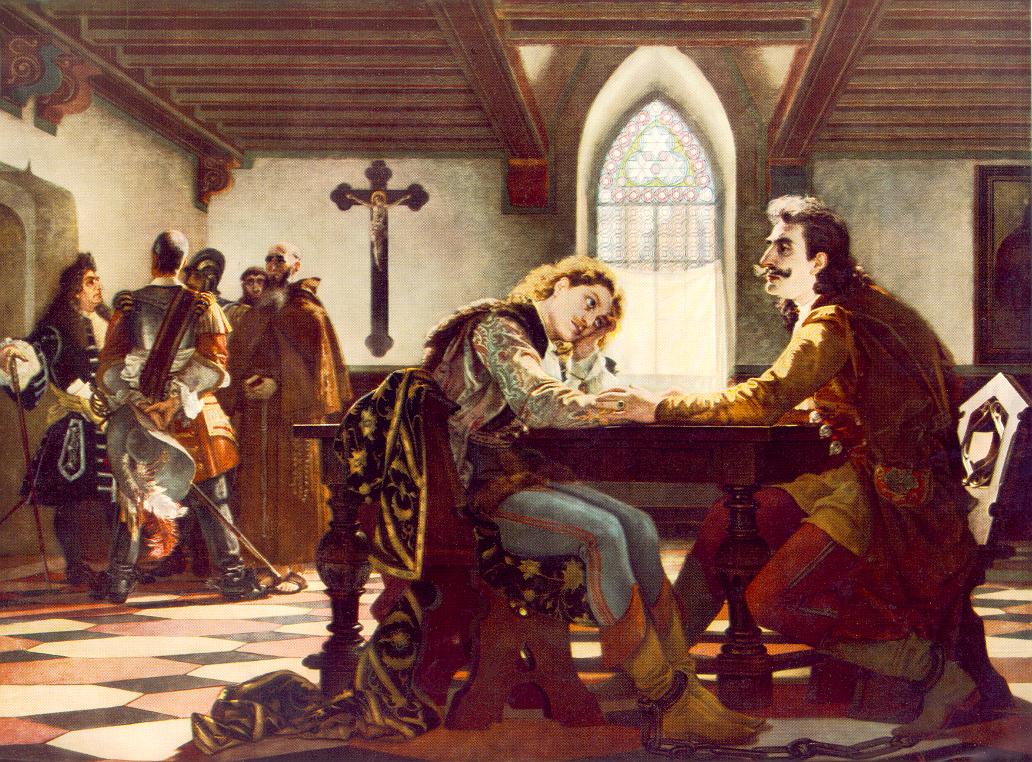
The Zrinski-Frankopan Conspiracy — or Magnate Conspiracy — was the product of great powers chess in central Europe … and specifically, of the frustration of these lords in the frontier zone between the Austrian and the Ottoman Empires at being a sacrificial pawn.
Instead, they’d take control of their own destiny and be a self-sacrificial pawn.
Croatia and Hungary had been on the perimeter of Hapsburg authority for generations, and seen the rising Ottomans push well into Europe.
In the latest of innumerable wars, the Austrians had trounced the Ottomans, potentially (so the Croats and Hungarians thought) opening the door for reconquest of lost territory. Croatia in particular had been nibbled away by Ottoman incursions into a “remnant of a remnant.” Emperor Leopold I thought otherwise: he had Great Games to play in western Europe as well and didn’t find this an auspicious moment to go all in in the east.
Rather than following up his victory by trying to run the Turks out of their half of divided Hungary, or out of Transylvania, Leopold just cut an expedient peace on status quo ante terms quite a bit more favorable to Istanbul than the latter’s military position could demand.
The aggrieved nobles started looking around for foreign support to help Hungary break away.
This scheme never came to anything all that palpable, perhaps because the operation’s leading spirit Nikola Zrinski got himself killed by a wild boar on a hunt, and definitely because no other great powers wanted to get involved in the mess.
The boar-slain’s younger brother Petar, his wife Katarina, and Katarina’s half-brother Fran Frankopan, also better litterateurs than conspirators, inherited the scheme’s leadership, and its penalty.
Zrinski and Frankopan in the Wiener-Neustadt Prison, by Viktor Madarasz (1864)
Royal vengeance against the plot shattered two mighty noble houses: the Zrinskis were all but destroyed by the seizure of their estates. The Frankopans — an ancient and far-flung family whose Italian Frangipani branch was even then about to yield a pope — were done as major players.
After these executions, anti-Hapsburg sentiment metastasized in Hungary into outright rebellion.
But in what was left of Croatia, the loss of the two largest landholders spelled the end of effective resistance until the era of 19th century romantic nationalism — when our day’s unfortunates were recovered as honored national heroes.
Zrinski and Frankopan are pictured on modern Croatia’s five-kuna bill, and were both reburied in Zagreb Cathedral after World War I finally claimed the Austrian Empire. (They also got memorial plaques in Wiener-Neustadt) Their mutual relation Katarina Zrinski, who avoided execution but was shut up in a convent, was a writer as well, and has ascended to the stars of founding patriotess, seemingly the go-to namesake for most any Croatian women’s civic organization. (Dudes honor the House of Zrinski by slapping the name onto sports clubs.)
Like everyone else on that parchment, they were in a world of hurt when Oliver Cromwell died and Charles II returned to the throne. And like a great many of those who figured to reap the whirlwind, they sensibly fled the realm.
Had they stayed hunkered down in Germany, they might have died in their beds.
Instead, they trusted a friend … and died half-hanged, emasculated, disemboweled, and chopped to pieces on a scaffold.
It was an ugly sight from start to finish. The capture of these fugitives was a dirty business mixing treachery, diplomatic subterfuge, and dubious legality, all in the service of violent statecraft. Sort of like it was ripped from the Downing Street memo.
This guy was coming into the prime of his continent- and polity-spanning career: from Puritan New England, to the West Indies, to a gig in Cromwell’s army during the English Civil War. (It was John Okey himself who hooked Downing up: Downing matriculated with Harvard University’s first graduating class thanks to Okey’s sponsorship, and it was in Okey’s regiment that Downing was retained as chaplain.)
An able diplomat for the Protectorate, Downing was able to communicate his discreet abjuration to the exiled Charles II once the handwriting was on the wall, and he therefore effected a convenient volte-face and went right to work for the new boss … even when it meant hunting down his own friends and patrons. You might say it was the zeal of the converted, but maybe it was better-expressed by Downing’s own pledge to secure the refugees with vigor “as much as if my life lay at stake in the busines.”
Sound policy, considering his history. And he couldn’t have pulled it off with an ounce less.
Officially, the Low Countries had agreed not to give refuge to regicides: in reality, regicides could rest pretty easy there. Pro-immigrant, pro-Protestant,* and jealous of their sovereignty, the Dutch had little desire to enforce such clauses at any level of government; and, thanks to a federal structure, multiple state organs each held effective veto over enforcement. Moreover, a silly legalistic fetish required that fugitivies have warrants sworn out against them — warrants that would cause regicides’ many friends and sympathizers to raise the alarm before the target could be taken, which is exactly what happened when Downing tried to get Edward Dendy arrested in Rotterdam.
Downing cogitated all manner of extra-legal options to black-bag a few of the Protectorate personnel for his Majesty’s pleasure. What he ended up with was cunning, vicious, and just barely legitimate.
Turning one of the regicides’ contacts with threats and bribery, he secured advance warning of Barkstead, Corbet, and Okey’s planned visit to Delft in early March 1662. He then waited until the very day he planned to spring his trap to procure a general arrest warrant (concealing the names of his prey) from the Estates General’s capable leader Johan de Witt, and pounced within hours — using a force of his own men and a little more payola to circumvent the inevitable reluctance of the local bailiffs.
Now that the regicides were in irons, Downing had to double down on duplicitous diplomacy by maneuvering to get them delivered to the English — and that against a growing popular resistance as their capture became known. The Delft aldermen dilated; sympathetic local worthies visited the prisoners in their cells; petitions on the Englishmen’s behalf circulated nationwide. The notion of actually marching these guys out into English hands seemed to promise a riot.
Downing spread more palm grease around, maneuvered to frustrate legal aid for the prisoners, posted his own men to watch the prisoners 24-7, and after several tense days finally made arrangements
in the dead of the night to get a boate into a litle channell which came neare behinde the prison, and at the very first dawning of the day without so much as giving any notice to the seamen I had provided … forthwith to slip them downe the backstaires … and so accordingly we did, and there was not the least notice in the Towne thereof, and before 5 in the morning the boate was without the Porto of Delft, where I delivered them to Mr. Armerer … giving him direction not to put them a shoare in any place, but to go the whole way by water to the Blackamore Frigat at Helverdsluice.
Downing was exultant.
“This is a thing the like thereof hath not been done in this country and which nobody believed was possible to be done,” he gloated in his correspondence. “And there is not a thing that hath happened these many yeares that hath occasioned so much discourse here, saying that they are now no longer a free Countrey, and that no man is now sure here.” De Witt and the Dutch Estates General, having never had any intention to actually deliver a regicide to condign punishment in England, had been embarrassingly played. Ordinary Hollanders were infuriated and ashamed at having been a party to the whole business.
Nobody could dispute the excellence of Downing’s operation. But anybody on either side of the channel who wasn’t a dyed-in-the-wool Royalist was somewhere between discomfited and revolted by it, especially as it was achieved against his own personal benefactor by a guy who had once urged Cromwell to make himself king.
Diarist Samuel Pepys (who witnessed the executions, reporting the victims “very cheerful” on that occasion) recorded the mood of the English burgher upon the news
that Sir G. Downing (like a perfidious rogue, though the action is good and of service to the King, yet he cannot with a good conscience do it) hath taken Okey, Corbet, and Barkestead … all the world takes notice of him for a most ungrateful villaine for his pains. (Pepys’s March 12 and March 17 entries for this year)
See: Ralph C.H. Catterall, “Sir George Downing and the Regicides,” The American Historical Review, Vol. 17, No. 2 (Jan., 1912)
* Dutch affinity for religious dissent and for foreigners was all of a piece with its prosperous mercantile empire. One liberal Englishman (quoted by James Walker in “The English Exiles in Holland during the Reigns of Charles II and James II,” Transactions of the Royal Historical Society, Fourth Series, Vol. 30 (1948)) proposed that “Liberty of Conscience would be a more serious blow to Holland than all the victories yet gained.”
On this date in 1945, in the dying days of the Third Reich, 42-year-old Johann Georg Elser was executed by gunshot in the German concentration camp Dachau. He died for a failed attempt on Adolf Hitler’s life more than five years before.
It goes without saying that, had he been successful, he would have changed history immeasurably.
Elser, who went by his middle name, didn’t fit the profile of someone who would try to kill Hitler.
He wasn’t a Jew, a Communist or a member of any of the other minority groups the Nazis persecuted. He wasn’t political at all, in fact.
A carpenter by trade, with one illegitimate son, his hobbies included playing the zither and the double bass.
He was the kind of ordinary, working-class German the National Socialists tried to reach out to. But from the very start, he made it clear how much he despised them and all that they stood for.
He was a practical man at heart and was not interested in political discussions. He had no desire to change other people’s minds, but he steadfastly refused to make any accommodation to the new regime. When Hitler’s speeches were broadcast, he would silently leave the room… In May 1938, a Nazi parade threaded its way through his hometown of Königsbronn. Elser, like many others, turned out to watch, but as those around him gave the Hitler salute, he refused to do likewise. When a colleague reminded him that it might be sensible to conform, he replied curtly, “You can kiss my ass.” He then ostentatiously turned about and started whistling to himself.
How Elser’s silent, passive resistance turned into action is unclear, but by the autumn of 1938 he had made up his mind to kill the Führer.
Unsure how to accomplish this, he traveled to Munich to get some ideas. Every year on “Die Neunte Elfte”, the November 8-9 anniversary of the Beer Hall Putsch, Hitler came to the Bürgerbräukeller and gave a speech to the old guard.
That day in 1938, actually just hours before another would-be assassin tried to kill Hitler, Elser slipped into the beer hall pretending to be an ordinary customer and “noted the layout of the room, the position of the lectern and the patent lack of effective security measures.”
He had found his place and his time: he decided that the following year, he would plant a bomb in the Bürgerbräukeller, timed to go off right in the middle of Hitler’s big anniversary speech and kill him and as many Nazis as possble.
Elser’s meticulous planning and preparations over the next twelve months were nothing short of amazing. He stole a fuse and some gunpowder, and got a job at a quarry specifically so he could acquire some explosives. Knowing nothing about bombs, he made countless prototypes and tested them in empty fields in the countryside.
In the spring of 1939, he went back to Munich and the Bürgerbräukeller to make some detailed sketches of the building and find an appropriate place to hide the bomb. He chose a thick stone pillar behind the lectern, which supported a balcony. In August, he brought his tools and bomb-making materals to Munich to set about with his final phase of the plan.
The fastidious assassin’s modus operandi was shockingly simple, and shockingly bold.
He would visit the Bürgerbräukeller every night at around 9:00 to take his evening meal. An hour or so later, he would sneak up to the gallery of the function room, where he would hide in a storeroom until the bar closed and the building was locked.
Thereafter, he was free to work by flashlight until the bar staff returned at around 7:30 a.m., when he could sneak out of a back entrance.
His first priority was to chip out a cavity in the stone pillar to hold the bomb. But, finding the pillar was now dressed with wooden cladding, Elser was forced to spend three nights sawing a hole in the wooden surround.
Every sound had to be muffled, every speck of sawdust collected and disposed of: he could afford to leave no evidence of his presence. Even the sawn wooden panel was fashioned into a flush-fitting secret door.
Good thing he was a carpenter.
Having accessed the pillar, he could now begin to dig out a recess for the bomb. Using a hand drill and a hammer and chisel, he spent most of the following month loosening mortar and prising out bricks — all of which, of course, had to be meticulously tied and removed from the scene in a cloth sack.
Progress was painfully slow.
In the cavernous hall, every hammer blow he struck echoed like a gunshot, and to escape detection he had to time his blows to coincide with external sounds, such as the passing of a tram or the automatic flush of toilets. Working by night preparing the pillar in the Bürgerbräukeller, he labored by day putting the finishing touches to his bomb and, of course, the elaborate timing mechanism.
It all took two months.
On November 2, six days before the Big Day, Elser finally concealed his bomb, which had been put in a wooden box lined with cork to muffle the ticking sound of the timing mechanism, in its hidey-hole. Hitler’s speech was scheduled to start at 9:00 p.m. on November 8 and would last for an hour. The bomb was set to go off at 9:20.
It did so, right on time, with a spectacular explosion that smashed the stone pillar, brought down the overhead balcony and ceiling, shattered windows, blasted out doors, killed eight people and injured 67 more.
The only problem was, Hitler wasn’t among the dead or wounded. In fact, he wasn’t even there.
He had pressing business in Berlin and wanted to get back that same night, so he had rescheduled his speech for 8:00 p.m. instead of nine. He finished and left the building at 9:07, thirteen minutes before the big reception Elser had prepared for him. By the time the bomb went off, Hitler was already on the train back to Berlin.
That Elser failed was through no fault of his own: it was just sheer, terrible, rotten luck.
British Prime Minister Benjamin Disraeli once said, “Assassination has never changed the history of the world.” Perhaps he is right in most cases, but it’s hard to believe that statement is true when it comes to Hitler. In this case, thirteen minutes substantially altered the history of Europe for the rest of the century.
Getting back to Elser: ever the careful planner, he knew what to do to protect himself once the bomb went off. He was miles away from Munich at the time, trying to sneak over the border into Switzerland. Unfortunately, he was caught by German border guards.
At first they thought it was a routine arrest, but then they saw the contents of his pockets, which included a postcard of the Bürgerbräukeller and sketches of his bomb design. The guards didn’t yet know about the assassination attempt, of course, but what they saw made them suspicious and they turned him over to the Gestapo.
On November 13, Elser confessed everything. When a flabbergasted Hitler read the preliminary investigative report which supported Elser’s lone-bomber story, he demanded, “What idiot conducted this investigation?”
He couldn’t wrap his mind around it, and neither could anyone else.
In the wake of the assassination, mass arrests were made: anyone who seemed unusually interested in the Munich speech, or didn’t express sufficient enthusiasm for the Nazi Party, could fall under suspicion of being part of the plot.
At Munich’s Feldherrnhalle on Nov. 11, Hitler conducts a memorial ceremony for the victims of Elser’s assassination bid.
As Moorhouse explains,
To many Nazis, Elser was simply an enigma. He was an ordinary German. He exhibited none of the typical signs of “degeneracy” that they claimed to be combating: apart from his brief flirtation with Communism, he was a virtual teetotaler, not promiscuous, did not consort with Jews, and was not close to the Church. In fact, he was exactly the sort of solid, upstanding, working-class German that they thought they had won over — and, indeed, that had become the backbone of the Nazi Party.
Unable to believe Elser’s claims of full responsibility, the Nazis concluded he must have been “led astray” at the very least, perhaps by agents of British intelligence. In spite of beatings, torture, and other coercion, however, Elser stuck to his story, even building another bomb, identical to the first, right in front of his interrogators to prove he could do it by himself.
He never managed to fully convince them; in fact, for decades after the war, historians and other scholars theorized about who else was in on his plan. Some speculated that the attack was even engineered by Hitler himself, to gain support for his cause and to create an excuse to crack down on dissidents.
It wasn’t until 1970 that two German historians who studied the matter announced there was no evidence that Elser had acted in concert with anyone else or even told anyone about his plans.
It may seem surprising that Elser managed to live for four and a half years after his attempt on Hitler’s life, but there was a explanation perfectly reasonable from the standpoint of a totalitarian bureaucracy.
After his confession, Elser was sent to the the Sachsenhausen Concentration Camp. He was given enough to eat, and two rooms, and even allowed to play the zither again, but he was kept in solitary confinement all those years. The Nazis — still operating on the theory that the British were ultimately behind the assassination attempt — stashed Elser away as a witness in a show trial against British leaders after the German invasion of the British Isles. Talk about hubris.
Of course, this invasion never happened, and as the tide of war turned against the Germans it became clear that Elser had outlived whatever usefulness he might have had. In February 1945, he was transferred from Sachsenhausen to Dachau.
He met his end quietly, taken outside his cell by a young SS officer and shot in the back of the neck. A week later, it was reported that he had been killed in an Allied bombing. By the end of the month, Dachau was in Allied hands.
At least six cities in Germany, including Königsbronn and Stuttgart, have places named after him, or monuments or plaques erected in his memory.

 Cadoudal (English Wikipedia entry | the much more detailed French) was the French Revolution’s ultimate antagonist, a Breton notary (and commoner, obviously) who obstinately resisted the bloody progress of those years to the last of his strength.


 Inigo Campioni (
 The “Russian




 It goes without saying that, had he been successful, he would have changed history immeasurably.


