“Mr Joseph Hani was hanged for treason in the Burj at 5 a.m. At 8 a.m. 40 families deported.
-Diary of Mrs. Harry Dorman, April 5, 1916*
The unfortunate Joseph Hani — Yusuf al-Hani — was among the worthies of Beirut’s Maronite Christian community to petition the French consulate for western aid in detaching Lebanon from the Ottoman Empire.
With the development of World War I, the French ambassador Francois Georges-Picot abandoned the embassy … without removing or destroying this sort of incriminating correspondence. As a result, the Turks ransacked the embassy and identified several dozen of reproachable loyalty to the Porte to put to death.
May 6 — Martyrs’ Day — honors these victims, but Hani was among the very first of them.
While most of the other Maronite signers were able to fly, Hani stuck around to face the music. A British agent was able to contact the implicated characters in Aley Prison, and received the plaintive answer,
‘Where are the English? Where are the French? Why are we left like this?’
* I believe an ancestor of the current president of the American University of Beirut, Peter Dorman. The source of the diary citation is Nicholas Z. Ajay Jr.’s “Political Intrigue and Suppression in Lebanon during World War I” in International Journal of Middle East Studies, Apr., 1974.
On this date in 1946, fascist Hungarian politicians Laszlo Baky and Laszlo Endre were executed by hanging in Budapest for their role in the decimation of Hungarian Jewry.
These two charmers were major figures in Hungary’s horrible final months of World War II.
This occupation lifted the virulent anti-semites Baky and Endre into national power, because along with keeping Hungary in the Axis coalition, the Nazis also forcibly overcame its junior partner’s former reticence about Jewish genocide.
Adolf Eichmann arrived into Nazified Hungary and used our day’s two principals (along with another executed collaborator, Andor Jaross, they’re known as the “deportation trio”) as his instruments. Within months, hundreds of thousands of Hungarian Jews were being shipped to the gas chambers. This period is one of the waypoints of pernicious Nazi race theory, when the collapsing German regime spent military resources urgently needed at the front to organize the mass slaughter of Jews.*
And they had to work fast, because by that next winter the Red Army was seizing Budapest. These enthusiastic fascist operators did not fare well by the postwar government.
* To do justice to the breadth of the human capacity, this is also the time and place where we find Raoul Wallenberg minting lifesaving Swedish passports by the thousands.
The effort saw stateside refugees of the Upper Canada Rebellion, also known as the Patriot War, organize an attempt to overthrow British-Canadian authority between Windsor and Niagara. But a brief incursion (a few houses were captured) failed to trigger a general response in a populace that was all risings’ed out, while United States authorities stayed well clear of these troublemakers. Officials had little difficulty mopping them up.
Six different people (named here) were executed at intervals in London, Ontario, beginning on January 7, 1839 — and ending with the two this date.
Amos Perley was a New Brunswick native who had been an American resident (citizenship status is unclear) for some time, but fell in with the Patriots.
Joshua Doane was a Quaker — a sect ordinarily leery of armed conflict and liable to be considered disloyal as a result — who abandoned the whole pacifism thing in favor of the Patriot cause. He’d had to beat it over the border when the last round of Upper Canada disturbances had been put down the previous winter: he wouldn’t get another chance after the 1838 invasion fizzled.
I am at this moment confined in the cell from which I am to go to the scaffold. I received my sentence today, and am to be executed on February 6th. I am permitted to see you tomorrow, any time after 10 o’clock in the morning, as may suit you best. I wish you to think of such questions as you wish to ask me, as I do not know how long you will be permitted to stay. Think as little of my unhappy fate as you can; as from the love you bear me, I know too well how it must affect you. I wish you to inform my father and brother of my sentence as soon as possible. I must say good-bye for the night, and may God protect you and my dear child, and give you fortitude to meet that coming event with the Christian grace and fortitude which is the gift of Him, our Lord, who created us. That this may be the case, is the prayer of your affectionate husband,
JOSHUA G. DOANE.
At this point, “people [in London] were so fed up” with the intermittent public hangings they’d been subjected to that the remaining condemned had their sentences commuted instead to penal transportation, and got shipped to Australia instead.
The disruptions did, however, help to contribute to the 1840 political unification of Upper and Lower Canada.
On this date in 1537, an Irish lord and his five uncles were hanged and beheaded at Tyburn for revolting against Henry VIII: the last act in an entire cycle of executions.
The Rumored Execution
Thomas FitzGerald‘s father, the king’s Lord-Deputy of Ireland, had been summoned to London to answer the complaints of his rivals and there committed to the Tower.
Said rivals then cunningly circulated reports that dad had been beheaded, inducing the hot-headed (and finely-appareled) heir Thomas to renounce his allegiance and rebel with a dramatic retinue of 140 silk-bedizened gentlemen.
The Summary Execution
The Earl of Kildare hadn’t really been executed at all: he just died of shock and grief upon reading the reports of what his son had got up to in his absence.
Thomas and his silk went off to find some allies to relieve it, hoping to play a Catholic-resentment card against Henry VIII’s riftwithRome.
But the local response was desultory and while the new Earl of Kildare was busy beating the bushes, the English took the castle — issuing to its garrison the “Maynooth Pardon”, the ironical sobriquet for executing most of the lot.
Silken Thomas’s Execution
His rebellion having been all downhill since the big silken resignation, Thomas was eventually induced by promises of safekeeping to surrender himself to the royal mercy.
But said mercy was not forthcoming, and he endured a year-plus locked up in something less than his trademark finery — “I have had neither hosen, doublet, nor shoes, nor shirt but one; nor any other garment but a single frieze gown … so I have gone wolward, and barefoot and barelegged,” he complained in a letter — until, attainted by the Irish Parliament, he was executed with his kinsmen.
Although the Kildare title disappeared for a time, Thomas FitzGerald’s young but hunted half-brother escaped to the continent, bounced all over Europe for a decade, picked up an education, fought the Turks, and returned to receive his family’s peerage re-granted so he could practice alchemy in his castle as “the Wizard Earl”.
When next in Kildare Town, stand a drink or two for these hearty bygone Geraldines at the Silken Thomas pub.
One was the Sun King, Louis XIV of France, whose decades-long rivalry with William tracked William’s interesting career all the way to the throne of England.
William III, equestrian. Consider yourself foreshadowed.
Another was Sir John Fenwick, an English nobleman whom William supposedly slagged* when they were fighting together in the Low Countries — and who likewise still carried the enmity when William had become his sovereign.
On this date in 1697, the latter rivalry came to a fatal end for John Fenwick on the headsman’s block. The funny thing was that the stroke turned out to cost King William III his own life as well.
You couldn’t say that Fenwick came late to the Jacobite cause; he’d been a strong adherent of the beleaguered Catholic-esque Stuart dynasty, and signed off on the 1685 execution of its previous Protestant challenger Monmouth.
But if it prosper, none dare call it treason. In 1688, the Low Countries prince with the low estimation of Baronet Fenwick hopped the channel and successfully overthrew the last Stuart monarchking James II.
With the Glorious Revolution, Fenwick’s personal and political were very conveniently aligned in loyalty to the exiled James … except that his formerly patriotic loyalty to James was now the traitorous cause of Jacobitism.
Fenwick kept up his Jacobiting in the 1690s, got arrested and released once, and then finally found himself implicated in a plot to murder William. Though his allies managed to spirit one of the potential witnesses against him away to the continent, Parliament passed — ever so narrowly — a bill of attainder to condemn Fenwick to death. (There’s a more detailed account of the legal and political maneuverings here and here.)
A failed assassin in life, Fenwick would blunder Gavrilo Princip-like into accidental success … but only after his own execution.
As a condemned traitor, Fenwick’s estate was seized by the crown, and the king personally claimed his prey’s equine ride (either a horse with a sorrel coat, or a horse named Sorrel, or both).** Not long after Fenwick’s death, this horse stumbled on a molehill, throwing its royal rider. William broke his collarbone in the accident, developed pneumonia, and died — leading Jacobite sympathizers to dote on the animals (both horse and mole) who had authored their enemy’s misfortune.
Illustrious steed, doubtless most worthy of the sky,
To whom the lion, bull, and bear would give place;
What happy meadows bore thee happily?
What happy mother gave you her nutritious teats?
Is it from the land of Erin you are come to oblige your country,
Or is it Glenco or the Fenwick race which produced you?
Whoever thou art, mayst thou prosper, I pray memorable one: and
May saddle never more press thy back, nor bit thy mouth.
Avenger of the human race, when the tyrant dies,
Mayst thou thyself enjoy the liberty thou wilt give to others.
A lovely sorrel enjoys the liberty of a happy meadow. (Nutritious teats not pictured.) (cc) image from SMALLORBIGOFMEN.
* During the Dutch campaign, William “had reflected very severely upon his [Fenwick’s] courage, which occasioned his making returns that provoked the Prince to say, that if he had been a private person he must have cut Sir John’s throat.” Just your basic primate poo-flinging.
** Leaving aside his ultimate fate, quite an understandable move by William: the Fenwicks were famous for their horse husbandry.
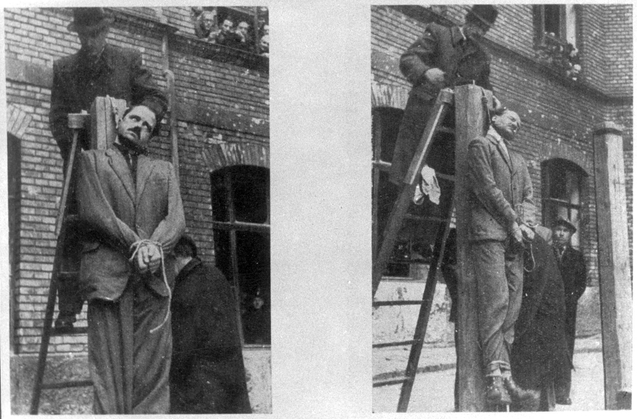
On this date in 1971, at least four former members of Guinea’s government were publicly hanged for supposed complicity in the previous year’s Portuguese invasion from neighboring Guinea-Bissau.*
It did not scruple to make examples of men and women in very high places. Ousmane Balde (or Baldet) was Guinea’s former Finance Minister, Magassouba Moriba an Interior Minister, Barry III (also known as Ibrahima Barry; the link is French) the former Secretary of State. Keita Kara Soufiana had been Chief of Police. Loffo Camara was a National Assembly member.
Besides the quality of its reprisal victims, Conakry went in for quantity, too. Somewhere close to 100 death sentences were handed down with the barest of legal pretense, and the majority of them actually carried out on and around this date.
Personally arranging the grisly tableau for our hanged ex-ministers was a captain, Diarra Traore, who would one day help to overthrow the Guinean government, become Prime Minister … and wind up executed himself for his trouble.
* Guinea-Bissau was at that time still a Portuguese possession, known as Portuguese Guinea.
On this date in 1801, a Jacobin chemist was wrongly executed for Royalists’ plot against Napoleon.
Our scene is France, the year following Napoleon’s coup of 18th Brumaire (November 9, 1799 on the stodgy old Gregorian calendar). Marx’s “first time as tragedy”* saw the Corsican achieve monarch-esque power, and the months ensuing saw a plethora of plots against him.
The ranks of aggrieved potential assassins included both Jacobins, incensed at the military dictatorship, and Bourbons, incensed that it wasn’t their dictatorship — in both cases exacerbated by Napoleon’s decisive battlefield triumphs which consolidated his hold on power.
On Christmas Eve 1800, the man on horseback was a man in a carriage, careening through Paris to catch a performance of Haydn’s oratorio The Creation.
When, all of a sudden, a gigantic explosion on the Rue Saint-Nicaise attempted to un-create the First Consul. It failed, exploding after Napoleon had passed and before Josephine’s family followed, “merely” killing and maiming fifty-some miscellaneous Parisian bystanders instead.
Kablamo! The explosion of the Infernal Machine.
The Catherine Delors historical novel For the King (author’s teaser) is built around investigating the Plot of the Rue Saint-Nicaise.
shocked with the wild atrocity of such a reckless plot, became, while they execrated the perpetrators, attached in proportion to the object of their cruelty. A disappointed conspiracy always adds strength to the government against which it is directed; and Buonaparte did not fail to push this advantage to the uttermost.
This “Infernal Machine” had actually been built by disgruntled monarchists at the instigation of intriguer Georges Cadoudal, as was swiftly discerned by Napoleon’s Minister of Police, the ruthless ex-revolutionary Joseph Fouche.
Realpolitik exigencies — Napoleon was trying (unsuccessfully) to reach political terms with the royalist faction — instead drove a rush to pin the detonation on the Jacobins.
Who, it should be said, made themselves the primary suspects by virtue of the fact that they’d also been trying to blow up Napoleon. Chevalier had been arrested a couple of months before when a bomb of his, evidently an experiment for a similar Jacobin plot, loudly blew up near Salpetriere.
Four other Jacobins followed Chevalier to death later in January (and two royalists actually involved in the bomb got the same treatment). Some 130 other prominent Jacobins (French link) were expelled on Napoleon’s say-so — no legislative consultation — to the empire’s far-flung colonies, pretty much putting the remains of the long-supine revolutionary left permanently out of the picture as a political force.
Two politically sensitive cases, otherwise unrelated to one another, were joined in hanging at Iran’s Evin Prison on this day last year, possibly in a tit for tat following the November assassination of a nuclear physicist.
Ali Saremi
Ali Saremi cut the highest profile of the two, a 63-year-old member of the People’s Mujahedin of Iran (PMOI, aka MEK or MKO).
The PMOI/MEK/MKO, originally a Marxist revolutionary group opposing the dictatorship of the Shah, split with the theocratic Iranian Revolution.
Camp Ashraf was still there when the U.S. invasion rolled into Baghdad in 2003. (As of this writing, it’s only just now being closed.) While MEK has long been considered a terrorist organization, including by the U.S. State Department,* Iraq’s new occupiers also found this nest of exiles a convenient ally for its own campaign against Iran’s mullahs.
The organization has been much in the news of late both as a bargaining chip in regional diplomacy, and for lavishly bankrolling a lobbying campaign to get off everybody’s official terrorism lists — positioning itself as simply an Iranian opposition group. (It claims to have renounced violence.)
From Tehran, of course, there’s much less gray shading: the MEK is an enemy.
Saremi, a longtime member, was arrested four times for his association with the group.
The first time was in 1976; the last, and ultimately fatal, in 2007. He had just returned from Camp Ashraf to visit his son and commemorate the anniversary of Iran’s late-1980s mass execution of prisoners, an atrocity that claimed a large share of MEK sympathizers in apparent retaliation for the organization’s aforementioned wartime aid to Baghdad.
Saremi got the all-purpose mohareb death sentence — roughly, “waging war against God,” which can potentially compass any resistance to the Islamic Republic — basically for having a going association with PMOI. According to NCRI, Saremi’s prosecutor alleged that
[h]e visited Ashraf and during that he received necessary trainings and returned to the country … and eventually he was arrested in August 2007 for his repeated activities and participation in counter revolutionary ceremonies and gatherings in support of PMOI and dispatching reports to this grouplet (PMOI). During a search in his house some CDs, films, pictures from PMOI and hand written organizational documents linked to the grouplet were found and confiscated.
Ali Saremi’s portrait and memory are now powerful props for the MEK terrorism de-listing campaign.
Ali Akbar Siadati
Also hanged this day was a man named Ali Akbar Siadati, about whom only sketchy information appears to be available.
Siadati was condemned for spying for Israel from 2004 until his arrest in 2008, allegedly supplying Iran’s foe a wide range of sensitive military information — a crime to which Siadati confessed, according to the state news agency IRNA.
Who Siadati was, how he had access to military intelligence, and why (apart from money) he might have betrayed it seems to be publicly obscure.
That prospectively apocalyptic year of 1666 saw the onset of the Scottish Covenanters‘ mass martyr-making under the English gallows.
Three dozen or so were put to death in the aftermath of the Battle of Rullion Green. Among them, nine men — seven in Ayr, two in Edinburgh — paid with their necks on this date.
The Covenanter tragedy stretches back to the first English Civil War, when English parliamentarians enlisted the aid of Scottish Presbyterians by agreeing to a covenant guaranteeing presbyterian church governance in Scotland and England. Essentially, that meant representative ecclesiastical authority, rather than top-down power from the king, via bishops.
The Presbyterians took this covenant very seriously indeed.
This expedient political arrangement flew apart post-hostilities, especially when the Presbyterians’ parliamentary faction got on the wrong side of Cromwell‘s New Model Army.* “Pride’s Purge”, the de facto army coup d’etat which made possible the execution of Charles I, essentially consisted of kicking out of Parliament the Presbyterian types who were ready to strike a deal with the king at the army’s expense and then governing with the remainder.
This made Presbyterians, for whom reformed church governance was the issue, amenable to inroads from the royalist camp. As soon as Charles I lost his head, the un-purged Presbyterian Scottish Parliament recognized Charles II … on condition that he get on board.
Charles was not exactly an enthusiastic partner.
A political cartoon shows Scottish Presbyterians literally holding King Charles II’s nose to the grindstone.
Nevertheless, Charles II did sign on the dotted line as the price for a Scottish throne and a play at restoration … but the army stomped that, too. An exasperated Cromwell asked of these quarrelsome Scots with their presbyter hangup,
“I beseech you, in the bowels of Christ, think it possible you may be mistaken!”
Mistaken or not, the beaten Presbyterians were optimistic — it’s a ridiculous optimism, in retrospect — that the post-Cromwell Restoration of the exiled monarch would finally Presbyterianize the island. But in 1660, it was Charles wielding the grindstone.
Much to his former allies’ chagrin, Charles rolled back the previous years’ church reforms, booted dissenting clerics, and cemented episcopacy.
The Presbyterian frustration here is understandable; they twice came out on the winning side in the civil war carrying signed pledges from the victors, and were twice balked of their prize. And the balked prize was only God’s work on earth.
The remaining seven executed this date in Ayr are notable in part because they ought to have been eight.
Memorial stone for the Covenanters executed in Ayr on December 27, 1666. Image (c) Stephen Wagstaff and used with permission.
Ayr’s public executioner fled rather than put godly Scotsmen to death. A Highlander named William Sutherland, who served the same office, was retrieved from nearby Irvine, but he too refused even when threatened with torture.**
The beneficiary of these principled refusals, in body if not in soul, was Cornelius Anderson, one of the eight doomed to die in Ayr who was finally prevailed upon to take the job of hanging his fellows in exchange for his life. Faltering spirit fortified with too much brandy, Anderson clumsily dispatched this group; later, since the obdurate Irvine hangman had been sacked, he had to do the same to two more Covenanters there.
Guilt-ridden and reviled, Anderson actually might have been the most miserable man on the scaffold. He came to a miserable end.
His conscience troubling him, he went to Ireland, where he was no better; nobody would either give him work or lodging. He built a little house in some common place near Dublin, where he and it and all were burnt to ashes. (Source)
* Specifically, they wanted to disband said army, and do so without coughing up its back pay.
** Sutherland’s torture included the summoning of a firing squad ostensibly to execute him if he failed to perform the executions. He called that bluff and was not executed, thereby depriving this site of a rare and precious “Executioner executed for failing to execute” entry.
On this date in 1872, China’s Panthay Rebellion came to an end with the surrender, suicide, and execution — in that order — of Du Wenxiu.
The Panthay Rebellion (also known as the Du Wenxiu Rebellion) was one of several cataclysmic revolts to shake foundering imperial China in the 19th century.
This one was centered in the city of Dali (also known as Talifoo) in the southeastern Yunnan Province, near the Burmese border.* The rebels in question were the Hui people, a predominantly Muslim ethnic group who had been pushed around for years by Qing officials and by the ethnic Han.
The backstory of Han-on-Hui ethnic cleansing in the 1840s makes for harrowing reading, lowlighted by the 1845 massacre of 8,000 Hui in Baoshan.
An even more ambitious operation in May 1856 went down in Kunming, where a massacre — Qing officials publicly posted a directive to “kill [the Hui] one and all”** — claimed several thousand more and razed the city’s mosques. This outburst spawned an attempt at wholesale ethnic cleansing throughout the province … but that attempt blew back on its perpetrators by triggering a rebellion that would require a generation to tame.
The unexpected tenacity of Hui resistance was multiplied by the disadvantages for the Chinese state of operating in a distant and mountainous territory, and its preoccupation with the much larger simultaneous Taiping Rebellion. Though these considerations were not sufficient to dissuade local officials from picking the fight in the first place, they would help them come to regret it.
Hui resistance quickly coalesced into an organized rebellion, and that rebellion overran Dali by the end of the year, establishing itself as the seat of an independent kingdom called Pingnan Guo. Meanwhile, the onset of the Second Opium War left China incapable of contemplating a reconquest.
Du Wenxiu, the half-Han Islamic convert rebel leader acclaimed Sultan Sulaiman of Dali, was therefore left with some operating room to establish a Hui state. He led a pluralistic nation (for the Hui themselves were and are a pluralistic identity) in the western half of Yunnan, stretching from the Tibetan frontier almost to Kunming. (They came close but never quite managed to take this city).
Alas, in due time and with sufficient stability elsewhere in China the Pingnan state came under withering attack from the late 1860s. It sought help from the British as a potential foil against Chinese power, but the aid was not forthcoming and probably would have been too little and much too late. The Pingnan / Panthay / Hui state
ended much as it had begun — in a bloody massacre of the Hui populace. On 26 December 1872, imperial troops surrounded Dali, the Pingnan capital. Du Wenxiu, in a move that he hoped would spare the lives of the city’s residents, made the decision to hand himself over to the Qing general. Swallowing a fatal dose of opium as his palanquin carried him to the Qing encampment, Du was already dead by the time that he was delivered to the Qing commander. Not to be robbed of the gratification of killing him themselves, Qing officials hastily dragged Du before the Qing troops to be decapitated.† According to Emile Rocher, a French adviser to the provincial officials in Yunnan at the time, Du’s head was encased in honey and sent to the emperor.
Du’s sacrifice, however, was in vain. Three days later, imperial troops began a massacre that, according to the government’s own conservative estimates, took ten thousand lives by the time it was concluded — four thousand of the victims were women, children, and the elderly. Hundreds drowned trying to escape from Dali by swimming across Erhai Lake. Others attempted to flee through the narrow passes at either end of the valley. All were chased down and slain by the Qing troops. The imperial soldiers were ordered to cut an ear from each of the dead. These grisly trophies filled twenty-four massive baskets and, together with Du’s severed head, were sent to Beijing, where they served as a silent and unequivocal corroboration of the Pingnan regime’s bloody demise.**
Du Wenxiu was within living memory when the Qing themselves fell; shortly after that happened, an honorary tomb was constructed for the martyred rebel outside Dali.
* “Panthay” is a Burmese word for Chinese Muslims.
** David Atwill, “Blinkered Visions: Islamic Identity, Hui Ethnicity, and the Panthay Rebellion in Southwest China, 1856-1873,” The Journal of Asian Studies, Nov. 2003. This article and/or Atwill’s book (review) on the same subject appear to be the ultimate source of nearly every accessible English resource on the Panthay Rebellion.
† According to the London Times (Aug. 27, 1873) the aides and litter-bearers who accompanied the dying Du to the Qin camp were also beheaded for their troubles. It ballparks the ensuing butchery at 40,000 to 50,000 souls.




 Ali Saremi cut the highest profile of the two, a 63-year-old member of the


