1956: Juan Jose Valle, Peronist putschist

On this date in 1956, the Argentine military junta crushed a Peronist revolt with the summary execution of its leader, Juan Jose Valle.

Gen. Pedro Eugenio Aramburu had overthrown the populist Juan Peron government in 1955, and now ruled Argentina as President.

General Valle was shouldered out for his affiliations with the former regime: throughout the months following the coup, the Peron party was systematically proscribed and its leaders barred from politics.

In exile, Peron urged radical action by these disenfranchised followers, and Valle attempted to mount a revolt in June 1956.*

This operation was well-scouted by the government, and crushed instantly — with a couple dozen of its adherents summarily shot. (Spanish link)

Well, the Peronist party slogan was, “Our Lives for Peron.”

Valle avoided the initial slaughter, but he was captured in an apartment in Buenos Aires on this date and shot at the city’s National Penitentiary in the evening.

“Shot for trying to overthrow the government” doesn’t quite sound off the scale of typical coup outcomes, but in Buenos Aires in 1956, these executions were shockingly disproportionate relative to the handling of many recent unsuccessful coups. Actually, the Aramburu government had just that February repealed the death penalty as a statutory option for plotting a coup.

But it wasn’t using statutes to handle the Valle coup: it declared martial law, and handled subversives at its own discretion. (It rescinded martial law and ceased any further executions on June 13.)

The authorities’ brutal response was something of a turning point in Argentine political relations and culture. Throughout the Peronist decade even the harshest critics of the regime could not accuse it of executions of this sort, even though coups had been attempted against it. Bloodshed on this scale for political reasons was unprecedented in the political and military history of Argentina.

–Politics and Education in Argentina

Aramburu himself would catch a bit of the blowback for authoring this “turning point”: in 1970, the former president was kidnapped (Spanish-language site) by the pro-Peron Montoneros guerrillas and himself summarily executed shortly thereafter — allegedly in specific retaliation for having shot Gen. Juan Jose Valle.

And the literary fallout was hardly more complimentary. Argentine writer Felix Luna penned La Fusilacion (The Firing Squad) the next year;** set during Argentina’s 19th century civil wars, it’s plainly informed by that country’s more contemporaneous problems.

* Valle’s top co-conspirator was another general, Raul Tanco. In a strange coda, Tanco managed to escape execution by claiming asylum in the Haitian embassy. Pro-government gunmen kidnapped him from that refuge and turned him over to the army, but in a gesture of diplomatic courtesy, Aramburu returned Tanco to the embassy unharmed, with apologies to the Haitians for the breach of decorum.

** It’s also a 1962 movie.

On this day..

1716: Banda Singh Bahadur

On this date in 1716, legendary Sikh warrior Banda Singh Bahadur attained his martyrdom.

Born Lakshman Dev, the man who would become Banda Bahadur went on a spiritual wandering jag as a young man and chanced to be plucked out of hermitage by Sikh guru Gobind Singh.

When this guru’s efforts to make inroads for Sikh interests with the new Mughal Emperor Bahadur Shah foundered, the converted hermit (now returned to the martial exercises of his caste) was tasked with a punitive expedition against one of the more obnoxious governors.

The zealous general did his mentor one better, attracting thousands of sympathetic followers and carving out a Sikh kingdom in Punjab in the early 1710s.

This proto-state (forerunner of an actual state in the next century) was in due time outmuscled by the Mughals, capturing the rebels’ last redoubt by means of a perfidious assurance of leniency that would not be forthcoming. Not at all.

The captured were marched back to Delhi, along with the pike-mounted heads of their fallen comrades, and there subjected to grisly mass executions.

British diplomats making nice with the Mughal court at the time recorded the scene.

The great rebel Guru (Bandu, the Sikh) who has been for these twenty years so troublesome in the province of Lahore, is at length taken with all his family and attendance by the Subahdar, or Viceroy, of that province. Some days ago they entered the city laden with fetters, his whole attendants which were left alive being about 780,* all severally mounted on camels, which were sent out of the city for that purpose, besides about 2,000 heads stuck upon poles, being those who died by the sword inb attle. He was carried into the presence of the King, and from thence to a close prison. He at present has his life prolonged with most of his officers, in hopes to get an account of his treasure in several parts of his kingdom, and of those that assisted him, when afterwards he will be executed for the rest. There are one hundred each day beheaded. It is not a little remarkable with what patience they undergo their fate, and to the last it has not been found that one has apostatised from the new formed religion.

Their captain’s turn finally came this date when — spurning conversion to Islam, as had his fellows — he saw his son slaughtered before his eyes, then was hacked limb from limb.

On this day..

1671: Stenka Razin, Cossack rebel

On this date* in 1671, famed rebel Stepan (Stenka) Razin was publicly butchered in Moscow.


On that day, following four days of torture, he was led to an executioner’s scaffold in Red Square in the company of his younger brother, Frol. The list of Razin’s crimes and then his sentence were read out to him. The punishment was to be “an evil death befitting the wicked — by quartering.” According to eyewitness accounts, Razin then crossed himself and submitted to the executioner. Normally, death by quartering requires that the executioner first chop off the right arm of the convicted man at the elbow, then his left leg at the knee, then the left arm at the elbow, then the right leg at the knee, ending the whole gruesome process by decapitation. In the case of Razin, the executioner made only the first two cuts when, for some reason — perhaps for fear of Razin’s power over the assembled multitude — he was told to end it all and chop off the head. To complete the sentence, the executioner then went back and severed the remaining limbs of the already headless Razin. The limbs and the severed head were taken to Bolotnaia ploshchad’ across the Moscow River and displayed on spikes. The body was thrown to the dogs. Frol, who was supposed to be executed in a similar manner, began screaming his willingness to cooperate with the authorities midway through his brother’s execution. He was led back to prison, interrogated further, and executed on 26 May 1676.

–Playing Robin Hood: The Legend as Performance in Five Centuries

Stenka Razin’s unpleasant end came with the consolation of a ticket to immortality as Russia’s go-to folklore bandit.

In life, Razin led the most renowned internal rising against the Romanovs, lasting from 1667 to 1671.

Marshaling the underclasses (literally, the “naked ones”: the Cossacks had class issues) in the semi-lawless southern reaches of the realm, Razin segued smoothly from from a career of brigandage into suzerainty over a quasi-state around the Volga with the help of a sympathetic peasant uprising.


Stepan Razin on the Volga (1918), by Boris Kustodiev.

Throw back a frosty glass of Stepan Razin beer, brewed in St. Petersburg since 1795.

Razin’s revolt had scope and duration enough to trounce a Persian expedition against him. He bestrode the Volga — sailed the Caspian — raided foreign lands — established a Cossack republic.

It was an impressive run while it lasted. But like most peasant revolts, it was ultimately on the receiving end of the trouncing.

Captured and hailed to Moscow for his demonstrative end, Razin’s story lives strong in Russian culture and folklore even though his body ended up in bits and pieces.

Razin is the subject, for instance, of the first Russian feature film, a 1908 silent.

According to the Russian Wikipedia, Razin was even the subject of the first foreign dissertation about a Russian figure.

During the late 19th century’s reactionary period, Boris Glazunov put Razin’s capture to symphony.

In the Soviet era, poet Yevgeny Yevtushenko wrote about Razin’s execution, and so did Dmitri Shostakovich.

Best-recognized and most universally beloved is the folk tune “Ponizovaya Volnitsa”, which celebrates Stenka and the mighty waterway that bore him to posterity, the Volga.

* June 6, 1671 per the Julian calendar. It was June 16 in those countries that had already adopted the Gregorian calendar.

On this day..

1797: Gracchus Babeuf, for the Conspiracy of Equals

If the “revolutionary extremist” exists at all as an identifiable type, he exists in purest incarnation in Gracchus Babeuf. No revolutionary better fits the description “narrowminded to the point of genius”; few have defined their heaven more clearly or crusaded so fanatically, ascetically, so religiously to bring it to earth.

–Gracchus Babeuf: The First Revolutionary Communist

On this date in 1797, Francois-Noel Babeuf lost his head for the Conspiracy of Equals — the last Jacobin upheaval of the French Revolution, or the first Communist upheaval of post-Revolution modernity.

Francois-Noel — he styled himself “Gracchus” after the populist Roman tribunes — was a young man of Desmoulins‘ generation but from a considerably more hardscrabble background. Like the starry-eyed Dantonist scribbler, Babeuf discovered himself a brilliant journalist and pamphleteer with the onset of the Revolution; he did several prison stints during various revolutionary phases of the early 1790s for his too-radical-for-school opinions.

He did another in 1795 under the French Directory for his firebreathing rag Le Tribun du Peuple, which was particularly unfashionable stuff during the post-Robespierre Thermidorian regime.

Nothing daunted, Babeuf emerged from prison the leading apostle of the Parisian proletariat which had by then been decisively separated from power.

The order of the day was class consolidation with the spoils of the aristocracy apportioned among a new oligarchy of wealth. As France rushed headlong towards Bonaparte and Bourbon restoration, Babeuf was the man left to rally “the party which desires the reign of pure equality.”

The French Revolution was nothing but a precursor of another revolution, one that will be bigger, more solemn, and which will be the last.

The people marched over the bodies of kings and priests who were in league against it: it will do the same to the new tyrants, the new political Tartuffes seated in the place of the old.

–Manifesto of the Equals, 1796

One can see why later revolutionaries — Marx included; Babeuf makes a cameo in the Communist Manifesto — would adopt this sort of thing as a harbinger of the next century’s revolutions.

And if the Directory had known who Nicholas II would be, it would have had no intention of going the way of his family.

Instead, it shut him down in February, 1796: Napoleon Bonaparte personally carried out the operation, just days before he wed Josephine.


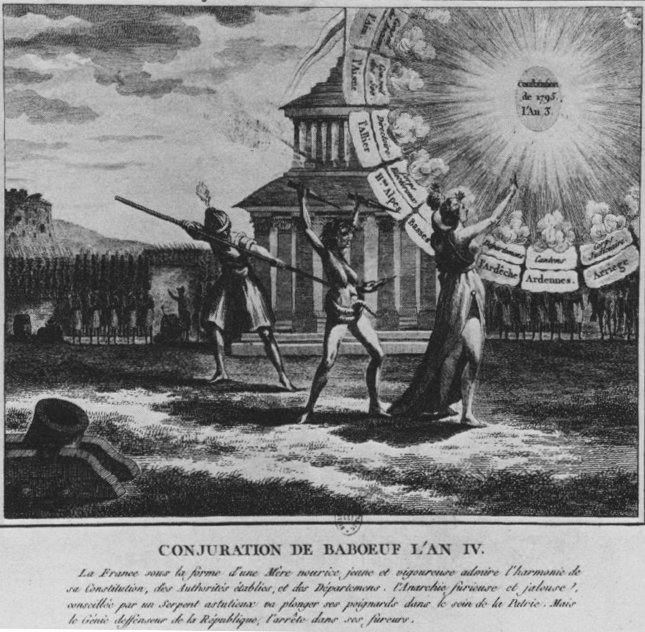
The Babeuf Conspiracy. Anonymous French print.

Babeuf’s party comes down to us as a “conspiracy,” under which word the state would charge him and which his follower Philippe Buonarroti would later rebrand the “Conspiracy of Equals”. It was not so much a grassy-knoll type of conspiracy as it was an underground organization.

When its adherents placarded Paris with the seditious “Analysis of the Doctrine of Babeuf” as the city endured a potentially dangerous economic crisis in April 1796, the government was put to a test of its strength.

It passed.

Having infiltrated Babeuf’s network, it arrested the principals on the eve of the Conspiracy’s intended insurrection. They were hailed out of Paris (a safeguard against sympathetic risings) to the commune of Vendome and there put on trial.* Babeuf and his associate Augustin Alexandre Darthe were condemned to death on May 26th and guillotined the very next day.

The last gasp of the French Revolution dropped with their heads into the basket.

Revolutionary Babeuvism, however, had scarcely just begun.

I don’t know what will become of the republicans, their families, and even the babies still at their mothers’ breasts, in the midst of the royalist fury that the counter-revolution will bring. O my friends! How heart-rending these thoughts are in my final moments! … To die for the fatherland, to leave a family, children, a beloved wife, all would be bearable if at the end of this I didn’t see liberty lost and all that belongs to sincere republicans wrapped in a horrible proscription.

-Babeuf’s last letter to his family

* The trial of Babeuf was itself a jurisprudential milestone: it was the first French trial to be transcribed verbatim.

What might look today like a nifty little advance for efficient judicature was bitterly controversial in 1797. The French Revolution had overturned an ancien regime practice of professional magistrates accepting legal testimony by written deposition and deciding matters behind closed doors. The liberte, egalite, fraternite way would instead demand that testimony be given live in the courtroom where citizen jurors could weigh its credibility.

Babeuf’s lawyer, Pierre-Francois Real, protested against the court stenographers, arguing that “The law insists that the system of written depositions not be restored in any way. That system will undoubtedly return if any means are used to save testimony given orally.”

There’s a fascinating disquisition on the curious and contradictory development of this issue and the way it “violates … common assumptions about the advance of textuality in the West” during the French Revolution in Laura Mason, “The ‘Bosom of Proof’: Criminal Justice and the Renewal of Oral Culture during the French Revolution” The Journal of Modern History, March 2004.

On this day..

71 B.C.E.: The followers of Spartacus

… a Thracian of Nomadic stock, possessed not only of great courage and strength, but also in sagacity and culture superior to his fortune, and more Hellenic than Thracian. It is said that when he was first brought to Rome to be sold, a serpent was seen coiled about his face as he slept, and his wife, who was of the same tribe as Spartacus, a prophetess, and subject to visitations of the Dionysiac frenzy, declared it the sign of a great and formidable power which would attend him to a fortunate issue.

-Plutarch, The Life of Crassus

On an uncertain date roughly around this time in 71 B.C.E., some 6,000 survivors of the shattered rebel slave army of Spartacus in Rome’s Third Servile War were crucified along the Appian Way.

The specific chronology of this legendary warrior, leader of the last major slave revolt against Rome, is necessarily foggy, but in fine, he broke out of a gladiators’ camp in 73 B.C.E. and went on to lead a slave army some 100,000 strong up and down the Italian peninsula for two solid years, repeatedly stomping Roman forces sent to suppress him.

His motivations remain mysterious; if one likes, one can project back on him an anachronistic anti-slavery project, but it’s more likely he was just trying to get by day by day as the greatest empire* on the planet harried his every move and internal divisions tore at the rebel camp.

Nevertheless, Spartacus and army prospered, and plundered, in the very heart of that empire, and gave Senators reason to fret the security of their capital even as their legions carried Roman arms from Spain to Palestine.

The army (for the gladiators organized it with military discipline, realizing a mob would be easy prey for Rome) was trapped, at last, at the toe of the Italian boot by Roman plutocrat Crassus, later to become a patron of, and fellow triumvir with, Julius Caesar. Abandoned by pirates with whom the slave army attempted to negotiate passage, it was a desperate situation. Spartacus, writes Appian, “crucified a Roman prisoner in no-man’s land to demonstrate to his own troops the fate awaiting them if they were defeated.”

Duly inspired, Spartacus and his army broke out of the Roman circumvallation around February of 71 B.C.E. Hemmed in by a second Roman force, the slaves turned to fight their pursuer, Spartacus dramatically sticking a blade into his own warhorse before the fight as another one of those conquer-or-die pregame speeches.

In The Spartacus War, Barry Strauss estimates April of 71 B.C.E. for that decisive battle. The slaves lost it; Spartacus died in combat, and his ancient calumniators vied to sing his heroism on the field.

But 6,000 survivors did not go down fighting to the death. These, Crassus staked out along one of Rome’s principal highways, the carcasses left to disintegrate there for months or years.

He’s easy to admire now,** but slave revolts scare the bejeezus out of slave societies, and the Spartacus rising would keep generations — centuries — of Romans sweating about a potential repeat. (At least, elite Romans, the ones whose voices remain for us.)

Their pejorative take on Spartacus (aside from his personal valor and martial excellence, for which even hostile writers gave him credit) was long the received wisdom on this upsetter of divinely established social order. “From a small and contemptible band of robbers,” sniffed Saint Augustine of the gladiators, “they attained to a kingdom.” They “enjoyed whatever pleasures they wished, and did what their lust suggested.”

The present-day reader’s readiest association is likely the much more admiring — and famously homoerotic, which is now yet another connotation for the gladiator’s name — Stanley Kubrick classic Spartacus, which turns 50 this year and gave to the cinematic canon the stirring “I’m Spartacus!” scene as the captured slave army defiantly embraces death.

This episode is completely ahistorical, but so what? One of the wildest things about this sword-and-sandal production is how much of it isn’t made-up. Like the premise: in the lifetime of Julius Caesar, a few guys busting out of gladiator school using nothing but kitchen utensils threatened for two years to turn the Eternal City and its far-flung realms upside-down.

* Okay, still a republic, if you like. But those days were fast coming to a close.

** Especially for modern leftist radicals; Marx and Che Guevara were both big fans; German communists Rosa Luxemburg and Karl Liebknecht named their movement for Spartacus, and it was during Berlin’s “Spartacus Week” that they were murdered.

A number of sports clubs in the former Soviet bloc also carry the Spartacus name, including Russian football power Spartak Moscow as well as several clubs in Bulgaria, which currently governs most of the rebel slave’s ancestral homeland of Thrace.

A few books about Spartacus

On this day..

1641: Thomas Wentworth, Earl of Strafford

On this date in 1641, the doomed English monarch Charles I regretfully sacrificed one of his ablest ministers to the headsman.

Thomas Wentworth and loyal doggie, painted c. 1639 by Anthony van Dyck.

Thomas Wentworth, Earl of Strafford had cut his teeth in Parliament in the 1620s as an advocate of the rights of the Commons as against those of the king, but the notion that he’d be hoisted by his own petard would be little comfort to a King soon destined to find himself in similar straits.

After Parliament forced through the 1628 Petition of Right (and Wentworth’s pro-monarchist personal rival George Villiers, Duke of Buckingham had been conveniently assassinated) Wentworth went over to the king’s camp with the sententious declaration

The authority of a king is the keystone which closeth up the arch of order and government.

The authority of that king, which Wentworth now worked vigorously to uphold during the crown’s Parliament-free Personal Rule of the 1630s, also elevated Wentworth to higher honors.

He would have occasion to exercise his own “personal rule” as dictatorial viceroy in Ireland, and when push came to shove between King and Commons, advocated the most tyrannical measures to compel the compliance of obstinate Englishmen.

By 1640, Wentworth had become in the eyes of his enemies the very embodiment of the monarch’s every sin, and when Charles was obliged by his deteriorating situation to summon Parliament once more, its first order of business was the impeachment of this obnoxious retainer. When Wentworth skillfully repelled the charges and won acquittal on April 10, his parliamentarian opponents simply passed a bill of attainder condemning him to death anyway.

The only thing that stood in the way of the chop was the signature of that ruler whom Wentworth had served so loyally. As Charles dithered — for he had personally guaranteed Wentworth his safety upon his most recent summons to London — popular hatred for the Earl threatened to escalate the crisis into something much more dangerous for the throne.

In one last gesture of fealty, Wentworth dashed off a note to his sovereign, magnanimously releasing him from any obligation save political calculation.

Sire, out of much sadness, I am come to a resolution of that which I take to be the best becoming me; and that is, to look upon the prosperity of your sacred person and the commonwealth as infinitely to be preferred before any man’s private interest. And therefore, in few words, as I have placed myself wholly upon the honour and justice of my peers, I do most humbly beseech you, for the preventing of such mischiefs as may happen by your refusal to pass this bill, by this means to remove this unfortunate thing forth of the way towards that blessed agreement, which God, I trust, shall for ever establish betwixt you and your subjects. Sire, my consent herein shall acquit you more to God than all the world can do beside. To a willing man there is no injury done; and as, by God’s grace, I forgive all the world with a calmness and meekness of infinite contentment to my disloding soul, so, Sire, I can give the life of this world with all cheerfulness imaginable, in the just acknowledgment of your exceeding favours; and only beg that, in your goodness, you would vouchsafe to cast your gracious regard upon my poor son and his three sisters, less or more, and no otherwise, than their unfortunate father shall appear more or less guilty of this death. (Quoted here)

This letter’s place in the annals of sacrificial loyalty is compromised only slightly by its author’s dismay upon finding out that his feckless majesty had quickly taken up the offer:* Wentworth rolled his eyes heavenward and exclaimed

Put not your trust in princes, in a son of man, in whom there is no salvation.**

But the miscalculation was done.

Two days after Charles signed off, Wentworth was beheaded on Tower Hill to the rapture of an audience supposed to have numbered 200,000 strong.


Strafford Led to Execution, by Paul Delaroche, with Thomas Wentworth, Earl of Stafford, receiving the blessing of his ally, the imprisoned Archbishop William Laud.


1642 pamphlet illustration of the beheading, from here.

As things went from bad to worse for Charles in the years ahead, he would have many occasions to regret the sacrifice of so loyal and energetic a minister … and to lament, upon hearing his own death sentence, that he was suffering divine judgment for this date’s act of expedient faithlessness.

A few books about Thomas Wentworth

* In acceding to the sentence, Charles proposed giving Strafford the best part of a week to prepare himself. Parliament ignored that request and set the execution for the very next day.

** That’s Psalm 146:3.

On this day..

1939: Evgeny Miller, White Russian

On this date in 1938, former tsarist Gen. Evgeny Miller was executed in Moscow, having been brazenly kidnapped by the Soviet NKVD from exile in France.

Miller opposed the 1917 Russian Revolutions (both of them) and ended up on the wrong side of the ensuing civil war as Aleksandr Kolchak‘s man in Archangel.

There, Miller (he was half-German) was the beneficiary of the Entente powers’ anti-Soviet incursion of British, French, American and Canadian troops.

These powers soon found that their respective peoples, wearied by the late world war, had little appetite for spilling more blood in the service of enthroning a Romanov, and cut bait in 1920.

Miller wisely did likewise, and watched the great workers’ and peasants’ republic take shape from the safety of Paris — where, in the 1930s, he chaired the anti-communist Russian All-Military Union (ROVS).

Soviet intelligence had infiltrated this body, however, and hatched a bold plot* to shanghai Miller and smuggle him out of the country in order to cause ROVS leadership to pass to the Soviets’ own agent, Nikolai Skoblin. Although they got Miller, they didn’t quite pull off the putsch, since the wary general had left behind a note outlining his suspicions of Skoblin in the event foul play should befall him.

Imprisoned at Lubyanka, Miller was personally interrogated by NKVD boss Nikolai Yezhov, but according to Vladislav Goldin and John Long,

little or nothing of what Miller had to report about the recent activities of the ROVS was unknown to the NKVD … the leaders of the NKVD found themselves saddled with a prominent prisoner of no significant value to Soviet intelligence and from whose capture, at the same time, nothing useful could be derived by way of publicity or propaganda.

…

The fall of Ezhov sealed the doom of General Miller, whose abduction had from the outset been his inspiration. In these circumstances, given his continuing uselessness to the NKVD, Miller’s elimination became an inevitable element in Commissar Beria‘s liquidation of the so-called Ezhovshchina, an operation which lasted from late 1938 through at least 1940. Although part of this undertaking involved the release of up to 200,000 of Ezhov’s prisoners, no such option was available in the case of General Miller for whose disappearance the Soviet government had consistently denied any responsibility. Accordingly, on 11 May 1939, after more than nineteen months of agonizing solitary confinement, Commissar Beria, with no viable alternative, ordered the trial and execution of the long-suffering General Miller in a process, ironically, that was fully implemented in less than twenty-four hours.

…

[it was] an ill-conceived, poorly executed and totally unnecessary adventure that, in the end, failed to benefit any of its apparent perpetrators.**

Skoblin, for his part, fled, disappearing to a still-unknown fate. His wife, Nadezhda Plevitskaya, copped a 20-year sentence for helping arrange the kidnapping, and died in prison.

They may not have gotten ROVS, but at least they made celluloid. Skoblin’s shadowy activities in France in this period are the inspiration for the 2004 French film Triple Agent.

* Georgy Kosenko, who we’ve previously met in these pages, helped orchestrate the kidnapping. (Times being dangerous as they were, the wheel of Red Terror turned against Kosenko so quickly that Miller actually outlived him.)

** Goldin, Vladislav I. and Long, John W. “Resistance and Retribution: The Life and Fate of General E.K. Miller”, Revolutionary Russia, 12:2 (1999), pp. 19-40.

On this day..

1794: Four members of the Targowica Confederation

On this date in 1794, four members of Poland’s pro-Russia Targowica Confederation were convicted of treason by a revolutionary court, and promptly hanged before a jeering mob in Warsaw.


The Hanging of traitors at Warsaw’s Old Town Market Square, by Jean-Pierre Norblin de La Gourdaine

This spectacle unfolds in a revolutionary age, which finds the first constitution in Europe* written … in Polish?

There was good reason.

The once-proud empire had been reduced to a pliable rump state under a sclerotic aristocracy.

The Polish Constitution of May 3, 1791 aimed for national rebirth with a constitutional monarchy and circumscribed nobility. This nationalist ferment was opposed equally by the Russian monarch Catherine the Great, and by a league of those circumscribed, sclerotic nobles which constituted itself the Targowica Confederation and immediately “invited” Russia to invade. Russia was happy to oblige.

This launched the countries into a war whose predictable outcome further reduced Polish territory in 1793.

There’d be one more hurrah for independent Poland, however: a 1794 national uprising under the leadership of war hero** Tadeusz Kosciuszko.

In Warsaw, that uprising drove the Polish King Stanislaw August Poniatowski† into Warsaw Castle as it overwhelmed the Russian garrison.

On May 9, four prominent Targowica supporters who had the misfortune to be trapped in the city — Jozef Ankwicz, Piotr Ozarowski, Jozef Zabiello and the Bishop of Livonia Jozef Kossakowski — were tried and demonstratively hanged.

Unfortunately for the Kosciuszko Uprising, the next day would mark Prussia’s entry into the fray, on the side of Russia, exacerbating the already dire balance-of-forces situation.

By the next year, defeated Poland ceased to exist altogether, partitioned among its stronger neighbors Russia, Prussia and Austria.

The historical legacy, nevertheless, is pretty clear. Kosciuszko has monuments in every Polish city, while targowiczanin remains an epithet for “traitor” in the Polish tongue to the present day.

* Except the Corsican Constitution.

** Kosciuszko was already an old hand at the revolution game: he’d crossed the Atlantic to fight for George Washington in the American Revolution.

† Catherine the Great’s former lover.

On this day..

1792: Jacob Johan Anckarström, assassin of Gustav III

On this date in 1792, Jacob Johan Anckarström lost his right hand and his center head for murdering Gustav III.

Like some other nobles, this officer considered the “theater king” and enlightened despot Gustav III a, well, despot.

Times being what they were, regicide was in order, to usher in an age of constitutional liberalism.

A conspiracy of Swedish nobles surrounded the royal victim at a masquerade ball on March 16, 1792, and shot him in the back. Alas for them, the scene was immediately sealed and the attendees unmasked before the gang could get away.

Although in the confusion nobody knew whodunit among those disguised revelers, it was only a matter of time before the discarded murder weapon was identified as Anckarström’s.

(Actually, it was a much longer matter of time before it became a “murder” weapon. The king only succumbed to the infection 13 days later.)

Five were condemned to death, but the four who hadn’t pulled the trigger were commuted to exile instead. Exile for regicide? Maybe that’s making you wonder why they all thought it was such an oppressive regime they all lived under.

Jacob Johan Anckarström could give them the answer. He was said to have met his beheading joyfully, which would only be natural after he’d been flogged in chains in three different parts of the city over the preceding three days.*

For readers of Swedish (or exploiters of online translation), there’s much more about Jacob and his dastardly plot here and here.

Appropriately, given the murder’s stagey venue, the Anckarstrom assassination was great performance art material in the 19th century. Verdi based Un Ballo in Maschera on it, although he’s given the principals a generic love-triangle relationship — and because of mid-19th century censorship, the iteration of it below is set in colonial Boston with “Anckarstrom” sporting the very New England name “Rennato”.

Although this particular plot didn’t achieve the revolutionary thing its authors intended, it didn’t have the opposite effect either. The king’s teenage son Gustav IV Adolf succeeded the throne, with an unsurprising hatred of Jacobinism. But in the tumult of the Napoleonic Wars (that also cost Sweden its dominion over Finland), Gustav IV was deposed and a liberal constitution adopted.

* He wasn’t handled with kid gloves in prison, either, but you can take in the scene over the libation of your choice at the present-day cafe that occupies Anckarstrom’s onetime dungeon. The joint is named for another Swedish political martyr, Sten Sture.

On this day..

1723: Major Jean Abram Davel

On this date in 1723, Major Jean Davel was beheaded for an abortive separatist bid in Vaud.

The French-speaking Swiss Canton was at this time under the heavy-handed domination of neighboring Bern(e), part of an oligarchic arrangement of power in Switzerland that would provoke regular unrest.

Davel (German Wikipedia page), a notary turned soldier who had fought at Villmergen, identified with the underdog.

On March 31, 1723, Davel took advantage of a general absence of bailiffs gone to Berne for government sinecures, and marched 600 men to the Vaud capital of Lausanne to pitch the town on breaking away from its Teutonic overlords.

Instead, the city worthies paid him lip service just long enough to betray him.*

“I see well enough,” Davel observed, “I will be the first victim in this affair.”

Yup.

But he held firm under torture to his insistence that the revolt was his doing alone (well, his and God’s), and perhaps thereby saved others from sharing his fate.


The Execution of Major Davel, by Charles Gleyre. A very in-depth analysis of this work by Michel Thevoz titled “Painting and Ideology: A Commentary on a Painting by Charles Gleyre” is available in pdf form here.

Davel is noted for checking out with a unique scaffold speech, discoursing on a topic rarely explored on that platform: the role of music in worship.**

As concerns the praise of God, in what manner is it sung? Is there any sense of orderliness, any real music, anything whatever calculated to excite and sustain the devotion? Yet this part of divine service is one of the most considerable and the one by which is the most effectively demonstrated the lifting up of our hearts to God … Such being the importance of this part of Christian worship, I cannot too much emphasize my exhortation to you to give it a new and serious attention, in order to correct the faults of which you are at present guilty in connection with it.

In a similar vein, the 52-year-old groused at the kids these days, to wit, young divinity students in attendance who, in the immortal tradition of kids these days throughout all days,

neglect your studies for worldly pleasure. You take no pains to learn music, which is so necessary for the singing of God’s praises. The songs of the church form an essential part of divine worship, and have an infinite value in helping us to lift our hearts to God. I pray you, then, to apply yourselves with all possible zeal to your preparation for the holy ministry.

Music in worship was in the Zeitgeist, and 1723 in liturgical composition suggests the (otherwise wholly unrelated to Davel) move by Johann Sebastian Bach that very year to Leipzig. Bach took up his post there just weeks after Davel lost his head, and would spend the remaining 27 years of his life in Leipzig. But it only took him until the very next Easter to lift up his congregation’s heart to God with the Johannes-Passion.

* Better late than never, Lausanne gave Davel a statue.

** According to Percy A. Scholes, “Church Music: A Plea from the Scaffold,” The Musical Times, vol. 78, no. 1136 (Oct. 1937).

On this day..