1989: Arnaldo Ochoa and Tony de la Guardia

In the predawn hours this date in 1989, Cuban Gen. Arnaldo Ochoa was shot in a pasture at a West Havana military base along with Col. Antonio “Tony” de la Guardia and Captains Antonio Padrón and Jorge Martinez — all convicted of treason against the Cuban Revolution because of drug trafficking.

Before his abrupt fall just weeks before this date, Arnaldo Ochoa was one of the shining stars of Castro’s Cuba.

One of the Sierra Maestre guerrillas, Ochoa had fought with Che Guevara in the Battle of Santa Clara that toppled the Batista regime.

In the decades that followed, he rose to become one of the most powerful officers in Cuba, serving in Venezuela, Angola, Ethiopia.

But in early June 1989, and shortly after a Mikhail Gorbachev state visit to Cuba delivered the bad news that the crumbling Soviet Union would be withdrawing its subsidies to Havana, Ochoa and State Security officer Tony de la Guardia* were suddenly busted for running a drug-smuggling operation — essentially conspiring with the Colombian Medellion cartel to exploit Cuba’s position on the most direct routes to Florida, and corruptly skimming the proceeds in the process.

There seems to be little doubt among those in the know that they were doing exactly that, but endless speculation about what else they were up to — what the executions were really about.

There is the year, to begin with, which is why we’ve mentioned Gorbachev; Castro was hostile to the Soviet leader’s glasnost reforms, and could read well enough the dangerous direction of change in eastern Europe. He wanted Gorbachev to put the brakes on.

Ochoa was seen as a charismatic figure of a more liberal outlook and close to Russian officers to boot, and one school of thought has it that he therefore looked like the sort of man who might be able to mount a coup or serve as the KGB’s catspaw if it came to regime change.

Whether or not Ochoa was targeted on that basis, Castro surely did not regret during those dangerous transitional years as Russian patronage slipped away the salutary effect this day’s doings would have had on any other potential aspirants for his job.

That consideration, whether it was primary or tertiary, probably helps explain the purge’s old-school show trial vibe. On television, Ochoa confessed to it all, and assured the court,

If I receive this sentence, which might be execution … my last thought will be of Fidel, for the great revolution he has given our people.

(Although what that thought would have been is a different matter. After falling out with Ochoa over military operations in Angola, the Cuban dictator had bugged his general’s environs and thereby eavesdropped on numerous of caustic remarks about himself.)

The drug charges, too, point the way towards plausible hidden agendas.

Fidel and Raul generally took a cautious approach to the drug business — hardly virginal, but reputedly avoiding particularly egregious entanglements lest they gift-wrap the hostile Yankees a pretext for invading. (Given what happened to Panama later in this eventful year, that would have been a reasonable concern.)

At the same time, it’s all but inconceivable that they were taken completely unawares by “revelations” that their aides were up to something shady.

So the hypotheses in this area run the gamut from: Ochoa and de la Guardia taking an authorized but circumscribed covert operation and avariciously expanding it beyond any possible license; to, everyone at the top being up to his eyeballs and Ochoa and de la Guardia eliminated when it became expedient to bury their firsthand knowledge of Fidel’s firsthand knowledge. Timing, again, is suggestive; with the coming withdrawal of Soviet protection, this might have been seen in Havana a prudent moment to trim sails on narcotics transshipment.

Whatever Arnaldo Ochoa and Tony de la Guardia may have known or sensed about the wheels-within-wheels of Havana politics, they took it to their grave 21 years ago today. Perennial declarations of the Castros’ imminent fall have made the rounds ever since, but until that old stopped clock manages to tell the right time, it’s likely that the rest of us will have to content ourselves with guesswork.

* De la Guardia was a friend of the writer Gabriel Garcia Marquez. In this very year, Marquez dedicated The General in his Labyrinth to the soon-to-be-disgraced colonel.

Speaking of de la Guardia literary connections: Tony’s daughter, Ileana, has also published a book.

On this day..

1916: Cesare Battisti and Fabio Filzi

On this date in 1916, the Austro-Hungarian empire executed Cesare Battisti and Fabio Filzi for treasonous Italian nationalism.

It was the multiethnic Habsburg state that was itself dying of its constituents’ national aspirations; in little more than two years, the state entity that carried out this day’s sentences would no longer exist at all.

Pre-World War I, Battisti (English Wikipedia entry | Italian) was actually a Socialist representative in the Austrian parliament.

When the unpleasantness broke out, though, he made a break for the peninsula where he agitated* (successfully) for Italian entry into the fray against Austria-Hungary. Irredentists had long coveted Habsburg properties with a heavy Italian population, like the Adriatic port of Trieste and Battisti’s own native Trento; the war offered an opportunity to swipe those territories, notwithstanding Italy’s putative prewar alliance with the Austrians.

Although already 40 years of age when Italy entered the war, the intrepid Battisti enlisted to fight. He was captured along with an otherwise obscure subaltern, Fabio Filzi, on the Alpine slope of Monte Corno (now known as Monte Corno Battisti) repelling the Austrian Strafexpedition.**

Austria did not stand on ceremony with these men; their capture took place on July 10, their trial on July 12, and their executions at the Castello del Buon Consiglio — an ironic Calvary, for a parliamentarian — later that same day. (To complete the scene, the strangulation-hanging was botched when Battisti’s first rope broke.)

The Austrian writer Karl Kraus would observe that “they thought they were hanging Italy, but it was really Austria on the gallows.”

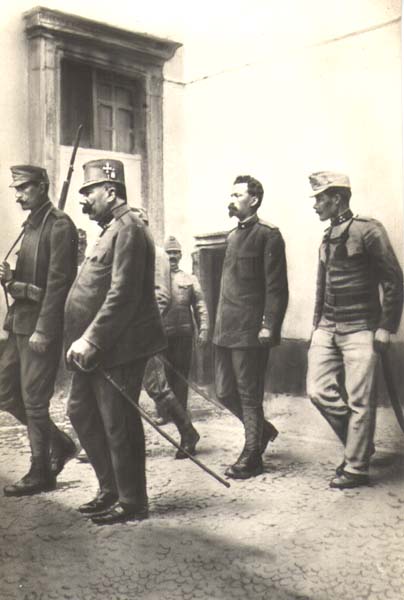
Whichever one it was, they took a lot of pictures.


Battisti and Filzi as prisoners.


Battisti leaving the courtroom en route to his execution.


Battisti approaches the scaffold.


Battisti waiting at the scaffold as the sentence is read.


The Austrian army offers a prayer and salute to the shrouded body of Cesare Battisti.

* As a socialist who broke against the internationalist position and in favor of violent nationalism, Battisti was an ally of Benito Mussolini. It was Battisti, actually, who pioneered the socialist-nationalist-newspaperman act upon which Mussolini would later raise is own star, to such an extent that Battisti’s paper, Il Popolo — the apparent inspiration behind Mussolini’s own subsequent paper, Il Popolo d’Italia — gave the still-obscure future Duce some of his earliest gigs.

A martyr’s death during World War I fortuitously spares Battisti’s legacy the unpleasant association with his friend’s postwar turn towards fascism, so there are many streets and plazas named for Battisti, as well as a memorial in Trento. He’s also honored by name in the 1918 patriotic tune La Leggenda del Piave (lyrics).

** “Punitive expedition”.

On this day..

1285: Tile Kolup, pretender

On this date in 1285, a pretender to the Holy Roman Empire* throne was burned at the stake in Wetzlar, Germany.

Kolup (English Wikipedia page | German) found room to perpetrate his fraud via the “King in the mountain” legend.

This myth of a past hero who sleeps out of sight, awaiting the opportune moment for return, has a wide cultural currency; King Arthur would be the readiest example for most Anglos.

In Germany from the 13th century, a similar myth attached to Emperor Frederick I “Barbarossa”, who had suddenly drowned during the Third Crusade in 1190 after reigning as Holy Roman Emperor for nearly 40 years. It’s a myth with enough resonance for this poem by 19th century German romantic Friedrich Rückert:

The ancient Barbarossa,
Frederich, the Kaiser great,
Within the castle-cavern
Sits in enchanted state.

He did not die; but ever
Waits in the chamber deep,
Where hidden under the castle
He sat himself to sleep.

The splendor of the Empire
He took with him away,
And back to earth will bring it
When dawns the promised day.

The chair is ivory purest
Whereof he makes his bed;
The table is of marble
Whereon he props his head.

His beard, not flax, but burning
With fierce and fiery glow
Right through the marble table
Beneath his chair does grow.

He nods in dreams and winketh
With dull, half-open eyes,
And once an age he beckons
A page that standeth by.

He bids the boy in slumber:
“O dwarf, go up this hour,
And see if still the ravens
Are flying round the tower.

“And if the ancient ravens
Still wheel above us here,
Then must I sleep enchanted
For many a hundred year.”

(To say nothing of the resonance for the Nazis who codenamed their invasion of the Soviet Union Barbarossa.)

Anyway, by the time we lay our scene late in the 13th century, when the Hohenstaufen line has tragically vanished, a version of this myth — the “Emperor of Peace” (German link) — has attached itself to Barbarossa’s grandson, Frederick II. Like Frederick I, he was a great and long-lived consolidator of the Empire; unfortunately, he’s been dead since 1250. Or has he?!

Tile Kolup appears in 1284 claiming to be this Frederick, who would have been going on 90 years old at this time. The good citizens of Cologne are his first audience, and he totally bombs with them; only their conviction that he’s more madman than usurper gets him run out of town with only a taunting.

But he finds a more receptive crowd in Neuss, and for a time keeps a court there and issues documents on Frederick II’s authority. Rudolph I, King of the Romans and butt of reindeer jokes, eventually nabs him in nearby Wetzlar and tortures him into admitting his imposture.

There are some succinct German biographies of this falsche Friedrich here and here.

* “This agglomeration which was called and which still calls itself the Holy Roman Empire was neither holy, nor Roman, nor an empire.” -Voltaire. (And the coffee talk lady.)

On this day..

1816: Jorge Tadeo Lozano, Colombian Renaissance man

On this date in 1816, Jorge Tadeo Lozano was executed by firing squad in a Bogota temporarily reconquered for the Spanish crown.

Scientist, journalist, essayist and man-about-town Lozano (English Wikipedia entry | Spanish) sprang from the stock of New World Spanish nobility.

He studied literature, philosophy, medicine, chemistry, mathematics, mineralogy, botany; he served in the Spanish military and traveled in Europe; he returned to his native New Granada, where he became drawn into the liberal ferment with a celebration of the emerging bourgeoisie obviously contextualized by his scientific education.

Money, like the blood of a body, gives life and shares with each and every one proportionally the movement and robustness that it needs to freely comply with the action that it must complete as a member of society … This inistrumental motive of wealth can not be hushed, if it is to produce an effect … in the manner of electric flow [it] passes through bodies, leaving them with a glowing heat, also enlivens the arms and hands through which it passes… (Studies in the History of Latin American Economic Thought)

As a member of the constituent assembly, he helped draft an 1811 constitution that acknowledged the authority of the Spanish crown, but not of its viceroy, creating (so its signers thought) a new commonwealth state. Lozano thereupon became the first President of Cundinamarca, essentially the forerunner to the present-day Colombian presidency.

Since Lozano turned out to be a better botanist than executive, he resigned the office after a few months.

Only after Europe had sorted out the Napoleonic wars did the Spanish free up the resources for a brutal reconquista of their errant provinces. But when it came, under a general with the macho nickname El Pacificador, it had intellectuals just like Lozano right in its sights.

Even though he’d been back at lower-profile scribbling since his stint at the top, Jorge Tadeo was just the sort of guy Pablo Morillo targeted for demonstrative executions over the second half of 1816.

Thus perished the persons of the greatest wisdom, the most virtuous and wealthy, in New-Granada. The object which Morillo had in view, was to extinguish intelligence, remove men of influence, and destroy property, so that, in future, there should be none capable of originating or directing another revolution. (Source)

Thus perished Lozano this date, along with another intellectual, Miguel Pombo (Spanish link) among a whole train of patriotic martyrs over the months of Morillo’s rule.

The policy of killing these men to deprive New Granada of revolutionary potential was, however, an abject failure: just three years after these men were shot as traitors to that distant European line, Simon Bolivar detached Colombia from Spain at the Battle of Boyaca.

On this day..

1972: Three Somali officers for an attempted coup

On this date in 1972, Somali Generals Muhammad Ainanshe Gulaid and Salad Gaveir, along with Col. Abdulkadir bin Abdulla,* were publicly shot in Mogadishu by a 90-man** (!) firing detail for attempting a coup the previous year.

Forged from the decolonized territories formerly known as British Somaliland and Italian Somaliland, Somalia had weathered a rocky 1960s before Siad Barre seized control in a 1969 military coup.

Muhammad Ainanshe Guleid had been Barre’s second vice-president (the first was also arrested for another supposed plot, though not executed), so the alleged conspiracy would have been treason at the very highest level. It’s obscure at this point to what extent the arrests might be attributed to an actual intended coup as against internecine politics within the ruling Supreme Revolutionary Council, or even whether those categories were wholly distinct.

“They were charged,” according to An Encyclopedic Dictionary of Conflict and Conflict Resolution, 1945-1966 (it makes great bathroom reading) “with treason in a plot to assassinate the president … and other high officials and to return the socialist country to capitalism.”

The Soviet-backed Barre had plenty of problems over the next two decades, but actually managed to hold the tumultuous country until 1991. Then rebels finally deposed the dictatorship. Neither those rebels nor anyone else, however, was able to establish an effective central government — leaving Somalia to become the anarchy/libertarian paradise it’s famous as today.

(Juxtapose: the Barre regime’s attempts (pdf) at establishing a more conventional tourist profile.)

* Each of these names have several possible transliterations. Actually, later this same year, Barre would announce an official choice of Latin script for the heretofore unwritten Somali language; schoolchildren at this time had to learn English, Italian, Arabic, and Somali.

** The source for the 90-man firing squad figure is I.M. Lewis, “The Politics of the 1969 Somali Coup” in The Journal of Modern African Studies, Vol. 10, No. 3 (Oct., 1972). As the title indicates, our day’s principals are not the author’s chief concern, but he adds apropos of Barre’s doomed efforts to shift loyalties away from tribes and towards the state that the massive fusillade party “was anti-tribal in composition, and that the Government would see to the funeral arrangements — traditionally a lineage responsibility.”

On this day..

1346: Simon Pouillet

From the Grandes Chroniques de France:

En celuy an, le samedi premier jour de juillet, fu fait à Paris une horrible justice, — né onques mais n’avoit esté faite semblable au royaume de France. Combien que nous lisons que l’empereur Henri en fist une autèle, et en Angleterre aussi, une autre fois en avint une autre semblable, toutes voies à Paris onques mais n’avoit esté telle , — d’un bourgois de Compiègne appellé Symon Pouilliet, assez riche, qui fu jugié à mort et mené aux halles de Paris; et fu estendu et lié sur un estal de bois, ainsi comme la char en la boucherie, et fu ylec copé et desmembré, premièrement les bras, puis les cuisses et après le chief ; et après pendu au gibet commun où l’en pent les larrons. Et tout pour ce qu’il avoit dit, si comme l’en luy imposoit, que le droit du royaume de France appartenoit mieux à Edouart, roy d’Angleterre, que à Phelippe de Valois. De laquelle mort tout honteuse, France pot bien dire la parole de Jhésucrist qui disoit : « Ci sont les commencemens des douleurs, » si comme il sera monstré par après.

The gist of the bolded bit:

a wealthy Compiègne bourgeois called Simon Pouilliet was broken and dismembered in Paris, and gibbeted on the common gallows. And all for saying that the right of the kingdom of France belonged more to Edward, king of England, that to Philippe of Valois.*

Come and see the violence inherent in the system!

There was cause, however, for the House of Valois to be oversensitive to Pouillet’s treasonable take on royal genealogy: it was at least plausibly true.

Edward’s interest in actualizing his nominal claim to the French throne had by this point precipitated the opening dynastic skirmishes of what would eventually (a hundred-plus years later) become remembered as the Hundred Years’ War.

And as the chronicle concludes on a note of melancholy, Simon Pouillet’s horrific butchery would be an omen of his realm’s coming sorrows.

Eight weeks later, the English sowed the battlefield of Crecy with the flower of French chivalry and established a foothold at Calais that would help sustain generations of bloodily inconclusive combat.

Then, from 1348, the Black Death ravaged Europe, bringing for its survivors the economic shock of a labor shortage, weird social movements like the flagellants, and a pervasive sense of fatalism that ate at humanity’s social bonds.

A few years after that, the French king, Philip’s successor John the Good, was actually captured by the English at the Battle of Poitiers, and ransomed as a hostage for a ruinous sum.

There’s no record whether the wind whistling through the remains of Simon Pouillet dangling on Montfaucon whispered “I told you so.”

* Pouillet had not acted on this notion — he’d merely been popping off, possibly while sauced. The absence of any actual intent on the speaker’s part, however, did not lessen the treason, as explained in The Law of Treason and Treason Trials in Later Medieval France:

The general royal position on treason by words was summed up in 1432 by Jean Barbin, king’s proctor in the Parlement of Poitiers, in the prosecution of the Fleming Hennequin Bize. ‘By word and by deed’, he began, ‘one commits the crime of lese-majesty: by deed when one makes an attempt on the person of the princeps; and by word when one speaks sinisterly of him or his acts.’ Barbin asserted furthermore that it was worse ‘to disparage by word than to injure by deed’, but he neglected to explain why.

On this day..

1890: Major Panitza, by Stefan Stambolov

Sophia, June 28, 1890

With reference to my telegram of this day’s date, I have the honour to report that this morning Major Panitza was conducted from his place of confinement in town to the camp of Bali Effendi, close to Sophia, where the troops are quartered for the summer, and in presence of the whole brigade drawn up in military file he was shot by a peloton of twenty-four soldiers.

Major Panitza fell uttering the cry, “Long live Bulgaria.”

After the execution, Major Marinoff, the Commandant of the Sophia garrison, addressed a short speech to the troops, in which he said that Major Panitza had met his death in just punishment for treason against his Prince and country, and that a similar fate would be dealt out to whosoever should prove a traitor to the interests of the Fatherland.

The troops maintained a perfectly impassive attitude throughout the proceedings, and the execution of the condemned in the presence of the garrison shows that the Government wished to make an example which should be a warning to the officers to refrain from the political intrigues that had during the last few years become so prevalent, and that were dangerously undermining the discipline and loyalty of the army.

–British and foreign state papers, vol. 83

Having recently gained independence by backing its Slavic brethren against its longtime Ottoman master in the Russo-Turkish War, Bulgaria was enjoying all the perquisites of being a minor power pressed between major powers.

The leading concern of its able, authoritarian, and justifiably paranoid leader* Stefan Stambolov — “the only Prime Minister in Europe who receives his visitors with a revolver lying next to the ink-stand on his desk,” in the New York Times’ description — was the interest of Bulgaria’s “benefactors” in St. Petersburg in turning this breakaway Ottoman province into an ever more pliant Russian instrument.

Whether it was the coreligionists or their coin who inspired it, many in Bulgaria felt sincere loyalty to Russia; in an age of empires, it wouldn’t have been unreasonable statecraft to opt for the security of dependency.

With that object in mind, Major Panitza hatched a dangerous plot to overturn the Bulgarian government. His plot conjured an equally dangerous reprisal from Stambolov — who was determined to keep as much independence as Bulgaria could sustain.

Despite fairly widespread sympathy in the army and the populace for Panitza’s plot, and of course in the face of entreaties of Russia, Stambolov had the execution carried out with impolitic dispatch just weeks after the court-martial did its work.**

Many outside of Bulgaria saw statesmanlike quality in Stambolov, but his severe rule exemplified by his unpopular ruthlessness towards Major Panitza made him many enemies at home. Stambolov was himself assassinated shortly after resigning from government in 1895, and his corpse abused en route to its resting place.

* Generally transliterated “Stambouloff” or “Stambuloff” during his own lifetime, this gentleman got control of the state by mounting a counter-coup against a Russian putsch. Since the Russians still succeeded in definitively dethroning the sitting Bulgarian king, Stambolov’s hand alone guided the unsteady Bulgarian ship of state for a time.

Stambolov eventually installed an Austro-Hungarian noble as Prince Ferdinand I (the two came to hate each other). Later titled “tsar”, Ferdinand was the grandfather of Simeon II, who achieved the unusual distinction of becoming Prime Minister of Bulgaria through democratic election in 2001.

** Panitza’s co-conspirators got various prison terms, including the former Commandant of the Sofia garrison, a gentleman sporting the Strangelovian moniker Lieutenant-Colonel Kissoff.

On this day..

1497: Michael An Gof and Thomas Flamank, leaders of the Cornish Rebellion

On this date* in 1497, two commoners who led an uprising against the Tudor dynasty were hanged at Tyburn.

Sore about a tax hike imposed to fight a Scots army supporting pretender Perkin Warbeck, Cornwall rose against Henry VII early in 1497.

“Henry Tudor’s” legitimacy on an English throne he had recently conquered was still a bit shaky, which is why he had to worry about pretenders to begin with (and also why his son would become so infamous looking for heirs).

Despite disappointingly finding no help for their cause in oft-rebellious Kent, the Cornish men decided to go it alone.


A statue of Michael Joseph An Gof and Thomas Flamank. Image (c) John Durrant and used with permission.

Under the leadership of blacksmith Michael Joseph (or Michael An Gof; An Gof simply translates as the man’s profession) and barrister Thomas Flamank (or Flammock) — injudiciously joined by one Lord Audley** — 15,000 or so marched to the outskirts of London, where they were trounced in the Battle of Deptford Bridge.

As commoners, Joseph and Flamank were condemned to the barbarous hanging-drawing-quartering death, but Henry commuted it to simple hanging with posthumous dismembering lest the popular leaders’ public torture spark fresh trouble in their native stomping-grounds. (Michael Joseph prophesied that posterity would confer upon these martyrs “a name perpetual and a fame permanent and immortal.” The authorities still did the dismembering bits, only posthumously, and put the heads up on pikes.)

After all, the fact that these troublemakers had marched right up to London before anyone had opposed them underscored Henry’s own potential vulnerability. Even the noble that Henry sent out to whip the marchers might have had one finger to the wind before deciding which side would be the winner.

As events would prove, the king was right to worry.

First as tragedy, then as farce

Seeing how much latent disaffection had been readily converted to action in Cornwall, Perkin Warbeck decided to make his big move later that same year in 1497 by landing there near Land’s End.

A few thousand joined the ensuing Second Cornish Uprising, but it came to much the same end — and resulted, this time, in Warbeck’s own capture and eventual execution.

* Some Wikipedia articles assert June 24, but June 27 seems attested by better authorities. I have not been able to pin down primary documentation proving either date, but the maintenance of June 27th as “An Gof Day” disposes the case. (There was a big 500th anniversary march for the occasion in 1997.) Claims that all three were executed on June 28 appear to be simply mistaken.

** As a peer, Audley got the chop instead of the hemp: he was beheaded on June 28. The rank-and-file were generally pardoned.

On this day..

1669: Roux de Marsilly, employer of the Man in the Iron Mask?

On this date in 1669, a French Huguenot agent was publicly broken on the wheel in Paris.

On the dangerous political chessboard of 17th century Europe, the allegiance of Restoration England — governed once again by a dynasty with known Catholic sympathies — was a great prize for contending Catholic and Protestant powers on the mainland.*

While Charles II of England and the Catholic Louis XIV of France maneuvered towards a secret accord that would lead to devastating war against the Protestant Netherlands, Roux de Marsilly was busy in London trying to enlist England into a Protestant alliance against France.

Finding the avenues blocked, Marsilly retired to Switzerland and was there abducted by French spies who knew what he was up to.

A trumped-up rape charge served that country’s statecraft, and despite an offer by the prisoner to spill some beans in exchange for his life — and then a suicide attempt —

hee wounded himself … for he knew before hee should dye, butt he thought by dismembering himself that the losse of blood would carry him out of the world …

— Roux could not avoid his fate. In fact, out of fear that Marsilly could still succumb to his self-injury, they

sent word … which made his execution be hastened. Saturday about 1 of the clock he was brought on the skaffold before the Chastelet and tied to St. Andrew’s Crosse all which was while he acted the Dying man and scarce stirred, and seemed almost breathless and fainting …

they went to their worke and gave [Marsilly] eleven blows with a barre and laid him on the wheele. He was two houres dying.

(Both quotes above from this correspondence.)

For all those two agonizing hours, Roux de Marsilly really only merits a footnote in a different story.

The Man in the Iron Mask

The mysterious Man in the Iron Mask was first documented in French custody later in the summer of 1669, and he would remain a guest of the Bourbon dungeons until 1703.

The identify of this person — or maybe persons, since it’s been argued that there are multiple threads conflated into the one legend — has never been conclusively established, much to the profit of literature.

One of the stronger contenders for the crownmask, however, is a prisoner named “Eustace Dauger”, who may in fact have been Roux de Marsilly’s former valet, one “Martin”.

The case for Martin-as-Dauger-as-masked-man is made most comprehensively by Andrew Lang in The Valet’s Tragedy and Other Stories.

The hypothesis, roughly outlined, is that England and especially France were trying to tie up the loose ends of whatever plots Marsilly had authored, and got hands on his servant to interrogate him about the highly sensitive machinations he might have been privy to.

Possibly having established that Martin/Eustace had no actual information to betray, he still remained under lock and key out of some admixture of bureaucratic inertia and the remorseless paranoia of the security state. Crazy.

[T]he Man in the Iron Mask (if Dauger were he) may have been as great a mystery to himself as to historical inquirers. He may not have known WHAT he was imprisoned for doing! More important is the probable conclusion that the long and mysterious captivity of Eustache Dauger, and of another perfectly harmless valet and victim, was the mere automatic result of the ‘red tape’ of the old French absolute monarchy. These wretches were caught in the toils of the system, and suffered to no purpose, for no crime. The two men, at least Dauger, were apparently mere supernumeraries in the obscure intrigue of a conspirator known as Roux de Marsilly.

…

Marsilly was publicly tortured to death in Paris on June 22, 1669. By July 19 his ex-valet, Dauger, had entered on his mysterious term of captivity. How the French got possession of him, whether he yielded to cajolery, or was betrayed by Charles II., is uncertain. … By July 19, at all events, Louvois, the War Minister of Louis XIV., was bidding Saint-Mars, at Pignerol in Piedmont, expect from Dunkirk a prisoner of the very highest importance–a valet! This valet, now called ‘Eustache Dauger,’ can only have been Marsilly’s valet, Martin, who, by one means or another, had been brought from England to Dunkirk. It is hardly conceivable, at least, that when a valet, in England, is ‘wanted’ by the French police on July 1, for political reasons, and when by July 19 they have caught a valet of extreme political importance, the two valets should be two different men. Martin must be Dauger.

* And, of course, for the Catholics and Protestants in England. This struggle would come to a head in due time, to the grief of the Stuarts.

On this day..

1683: James Smith and John Wharry, Covenanter bystanders

Inscription on a marker on the road from Kirkintilloch to Kilsyth* in Scotland:

In this field lies the corpse of John Wharry and James Smith, who suffered in Glasgow, 13 June 1683, for their adherence to the Word of God, and Scotland’s Covenanted Work of Reformation: ‘And they overcame them by the blood of the Lamb, and by the word of their testimony; and they loved not their lives unto the death'” (Rev. xii. 11)

Halt, courteous passenger, and look on
Our bodies dead, & lying under this stone.
Altho’ we did commit no deed,** nor fact
That was against the Bridegroom’s contract,
Yet we to Glasgow were as prisoners brought,
And against us false witness they sought.
Their sentence cruel and unjust they past,
And then our corps on scaffold they did cast.
There we our lives and right hands also lost.
From Glasgow we were brought unto this place
In chains of iron hung up for certain space.
Then taken down interred here we ly–
From ‘neath this stone our blood to heaven doth cry.
Had foreign foes, Turks, or Mahometans,
Had Scythians, Tartars, Arabian Caravans,
Had cruel Spaniards, the Pope’s blood seed,
Commenced the same, less strange had been the deed;
But Protestants, profest our Covenants to,
Our countrymen, this bloody deed could do.
Yet notwithstanding of their hellish rage
The noble Wharry stepping on the stage
With courage bold and with a heart not faint,
Exclaims, This blood now seals our covenant–
Ending, They who would follow Christ should take
Their cross upon their back, the world forsake.


Image (c) Maria ‘Mia’ Gaellman | http://www.mariaphoto.co.uk/

The epitaph above is from this Victorian text, which further observes:

The probability is, that what is called on the new stone “the old tombstone” is not much older than this [the 19th] century, and that it is the successor of an older one on which may have been inscribed the following epitaph:

Halt, passenger, read here upon this stone
A tragedy, our bodies done upon.
At Glasgow Cross we lost both our right hands,
To fright beholders, th’ enemy so commands;
Then put to death, and that most cruelly.
Yet where we’re slain, even there we must not lie,
From Glasgow town we’re brought unto this place,
On Gallow tree hung up for certain space.
Yet thence ta’en down, interred here we lie
Beneath this stone; our blood to heaven doth cry.
Had foreign foes, Turks or Mahometans,
Had Scythian Tartars, Arabian caravans,
Had cruel Spaniards, the Pope’s bloody seed,
Commenc’d the same, had been less strange their deed.
But Protestants, once Covenanters too,
Our countrymen, this cruel deed could do:
Yet, notwithstanding this, their hellish rage,
The noble Wharrie leapt upon the stage.
With courage bold, he said, and heart not faint,
‘This blood shall now seal up our covenant,’
Ending, ‘they who would follow Christ, should take
‘Their cross upon their back, the world forsake.'”

* Kilsyth lays claim to be the birthplace of curling.

** Smith and Wharrie, apparently uninvolved civilians, were seized as the nearest available guys to punish after a Covenanter guerrilla attack near Inchbelly Bridge.

On this day..