European-educated and on retainer by the colonial German government, Bell was hardly the subversive type: rather, as the head of the largest clan of the important Duala tribe, he was the guy that Berlin looked to to uphold its authority.
This mutually satisfactory relationship began unraveling in 1910, with the Reich’s plan to abnegate the 1884 treaty under whose auspices it intruded into Kamerun (Cameroon) in the first place.
Seeking to confine the Duala to a few coastal villages — and subsequently, to push those Duala to less desirable inland territory — Berlin managed the rare feat of uniting the tribe’s various families, and pushing Rudolf Manga Bell himself into (surprising, to Germany) resistance.
When petitions to the Reichstag were ignored, the Duala began (Bell’s own degree of involvement in this seems to be a disputed point) making noises about holding Berlin in breach of the colonial treaty and finding itself a new European patron, like France or England.
And one notes the year in this post’s title, which would become momentous to Germany for other reasons. “The coming war,” notes Victor T. LeVine, “made it appear that Manga Bell had been plotting with Germany’s enemies.”
Bell was arrested for treason in the first half of 1914, as the Germans seized prime Bell land along the Wouri River.
In the conflict that became remembered as World War I, the first declarations of war were made in the very first days of August; Axis and Ententethe Central Powers and Triple Entente lined up against one another in the colonial territories, too, and German administrators in Kamerun realized that they were about to face an invasion from neighboring British and French colonies.
So it was in an atmosphere of panic and a view towards desperate internal repression that Bell was tried for treason on August 7, 1914, along with his friend and fellow-traveler Martin Paul Samba — and put to death the very next day.
Postscript
The Allied invasion had taken Duala and the other principal cities of Kamerun from the Germans by the end of September; over an 18-month campaign, the Germans were totally defeated in the territory, which France and England claimed as victors’ spoils after the war. (Also inheriting the tense relationship with the Duala; France was still trying to sort out the 1914 German expropriations that started the whole mess decades later.)
As a result, Rudolf Duala Manga Bell’s son, Alexander Ndoumbe Duala Manga Bell, not only inherited his father’s royal position among the Duala — he became Cameroon’s first elected representative to the French National Assembly.* There’s more about that guy here.
It is here that the Germans part ways with Cameroon’s national story, but there was almost a “peace in our time” diplomatic reconquista.
Although Hitler originally held the colonial movement in great disdain, in the late 1930s his regime ‘adopted’ and coordinated this movement. After 1936 the renewed campaign for the recuperation of German colonies had its desired results among the Allied powers. In discussions between the French Foreign Minister, Yvon Delbos, and the American Ambassador, William Bullitt, proposals were considered for the appeasement of Germany including tariff reductions, the involvement of the Third Reich in the development of Africa, and finally the granting of a colony to Germany, probably the Cameroons. In November 1937, during talks between Premier Chautemps, Prime Minister Chamberlain, Eden and Delbos, the suggestion was allegedly made by Chamberlain that France should ‘hand the Cameroons to Germany at once without any quid pro quo’.**
* Ralph A. Austen, “The Metamorphoses of Middlemen: The Duala, Europeans, and the Cameroon Hinterland, ca. 1800 – ca. 1960”, The International Journal of African Historical Studies, Vol. 16, No. 1 (1983).
** Richard A. Joseph, “The German Question in French Cameroun,” Comparative Studies in Society and History, Vol. 17, No. 1 (1975)
On this date in 1781, South Carolina patriot Isaac Hayne was hanged for breaking his conditional British parole and re-enlisting in the American Revolution.
Though Hayne is not, to us, the most famous revolutionary executed by the British, he might have been considered by his contemporaries as the most prominent individual to go to the scaffold for the cause.
These prisoners were required to swear an oath of allegiance to the crown in exchange for their parole, which Hayne reluctantly agreed to do because his family had been hit with smallpox.
He declared to a friend that,
as they [the British] allow no other alternative than submission, or confinement in the capital, at a distance from my wife and family, at a time when they are in the most pressing need of my presence and support, I must, for the present, yield to the demands of the conquerors. I request you to bear in mind, that previous to my taking this step, I declare that it is contrary to my inclination, and forced on me by hard necessity. I will never bear arms against my country … I do not mean to desert the cause of America.
But as the British southern campaign foundered over the year ahead, the mother country eventually attempted to call him up to do just that: bear arms against his country.
Hayne thought his parole terms protected him from ever having to serve against the colonies, so he simply got back into the fight on the revolutionary side instead. He was captured in that capacity.
The British commander Francis Rawdon handled his relapsed prisoner with uncommon severity, putting him to a drumhead military tribunal with a preordained outcome and refusing the many public pleas for leniency.
The irregular and vengeful nature of these proceedings, and Hayne’s seemingly honorable conduct, raised hackles on both sides of the Atlantic; shortly after hanging Hayne, Rawdon returned to the British Isles to find a good deal of pointed criticism of his behavior. (Parliament quashed any damaging official inquiry, and Lord Rawdon actually extracted an apology from the peer who had the temerity to motion the investigation — an intolerable impeachment on Rawdon’s honor.)
The Hayne incident was widely understood to have been conditioned by British frustration at its failing fortunes in the war. By the time of the execution, the redcoats held nothing of South Carolina save Charleston itself. General Cornwallis had recently marched north from the Palmetto State; in a few weeks’ time, he would surrender his sword and the British cause alike after the decisive British defeat at Yorktown, Virginia.
And though the commandants at Charleston scarcely anticipated that stunning reversal, they had only a few months before suffered the upsetting (but more legally tenable) hanging of the honorable British Major John Andre as a result of the Benedict Arnold affair. British forces were reputedly on the lookout for any opportunity to trade tit for tat.
Continental Gen. Nathaniel Greene alleged that the British officer who received the petition for Hayne’s life simply wrote on it John Andre — and sent it back.
It was during this exchange of Senatorial disquisitions that Webster delivered one of the noted orations of the antebellum era, the aptly-named Second Reply to Hayne:
I have not allowed myself, Sir, to look beyond the Union, to see what might lie hidden in the dark recess behind. I have not coolly weighed the chances of preserving liberty when the bonds that unite us together shall be broken asunder. I have not accustomed myself to hang over the precipice of disunion, to see whether, with my short sight, I can fathom the depth of the abyss below; nor could I regard him as a safe counselor in the affairs of this government, whose thoughts should be mainly bent on considering, not how the Union may be best preserved, but how tolerable might be the condition of the people when it should be broken up and destroyed. While the Union lasts, we have high, exciting, gratifying prospects spread out before us and our children. Beyond that I seek not to penetrate the veil. God grant that in my day, at least, that curtain may not rise! God grant that on my vision never may be opened what lies behind! When my eyes shall be turned to behold for the last time the sun in heaven, may I not see him shine on the broken and dishonored fragments of a once glorious Union; on States dissevered, discordant, belligerent; on a land rent with civil feuds, or drenched, it may be, in fraternal blood! Let their last feeble and lingering glance rather behold the gorgeous ensign of the republic, now known and honored throughout the earth, still full high advanced, its arms and trophies streaming in their original lustre, not a stripe erased or polluted, not a single star obscured, bearing for its motto, no such miserable interrogatory as “What is all this worth?” nor those other words of delusion and folly, “Liberty first and Union afterwards”; but everywhere, spread all over in characters of living light, blazing on all it sample folds, as they float over the sea and over the land, and in every wind under the whole heavens, that other sentiment, dear to every true American heart, – Liberty and Union, now and for ever, one and inseperable!
When not being rhetorically posterized by New England gasbags, Robert Hayne made time to pen a justification for his famous forebear’s conduct for the Southern Review in 1828 — comparing the British behavior of executing rather than detaining a prisoner who broke parole to the massacre at Jaffa Napoleon notoriously ordered in 1799.
(Actually, Isaac Hayne’s old nemesis Francis Rawdon had only died in 1826; Robert Hayne wrote his piece to confute a vindication of himself that Lord Rawdon — also recognized by his subsequent titles, Earl of Moira and Marquess of Hastings — had authored, decades after the fact, of his conduct in the Hayne matter.)
Though this 37-page slog of Robert Hayne’s is obviously in the public domain by now, it appears it is not yet freely available online. However, it’s the source of the otherwise unattributed quotes in this article.
On this date in 1976, the real-life Soviet political officer whose naval mutiny inspired Tom Clancy’s Cold War thriller The Hunt for Red October was shot in Moscow for treason.
No, unlike his fictional counterpart Marko Ramius (Sean Connery, in the 1990 cinema adaptation excerpted above), Valery Sablin didn’t make it to the West.
But the real Valery Sablin wasn’t trying to make it.
Sablin was the political officer aboard the submarine-killer Storozhevoy. He was also a dedicated Leninist incensed at the notoriously corrupt gerontocracy of the Leonid Brezhnev era.
When he led his mutiny in Riga, his plan was to take the Storozhevoy to St. Petersburg and, Aurora-like, sound the tocsin for a Soviet Tea Party to restore the ideals of the Revolution.
Basically, Sablin had the exact opposite intent of his literary offspring.
This being the 1970s, when figuring out what the devil was happening in the black box of the USSR constituted its own academic discipline, the incident was misinterpreted in the western media — but understandably so.
The sea route from Riga to St. Petersburg begins in a westerly direction, towards Sweden, and the spectacle of Soviet fighters turning back a vessel steaming for Gotland (combined, of course, with the natural susceptibility of the western audience to the notion) suggested that the mutineers had aimed not at revolution, but at defection.
Under the headline “Newspaper Reports Soviet Ship Mutiny” sourced to Agence France-Presse and datelined Stockholm, Jan. 22, the Jan. 23, 1976 Washington Post reported:
Crewmen on board a Soviet coast guard vessel in the Baltic mutinied and tried to sail the ship into Swedish territorial waters in November, the evening newspaper Expressen said today.
Citing foreign visitors recently returned from Riga, the paper said the mutiny took place Nov. 7 after celebrations in Riga marking the Soviet revolution.
The paper said a Soviet submarine and a number of helicopters forced the ship to return to Riga.
This was the version of the story that aspiring spy novelist Tom Clancy encountered. In his reworking, it became the bold (and successful) defection of a state-of-the-art Soviet submarine and its deft commander … effected, of course, with a little help from the derring-do of the spooks at Langley.
Moscow was pleased to let this be the version that people heard, to the extent they heard anything at all of the incident. Though not exactly flattering, it was much less threatening than the potential storyline of “Soviet officers are so fed up with party corruption that they’re trying to revolt”.
It’s pretty safe to say that the Valery Sablin who died this day would not have had a lot of sympathy for Marko Ramius,* and still less for the Reaganite writer who turned Sablin’s deed inside-out and made it the cornerstone of his own personal mint.
Trust the fact that history will judge events honestly and you will never have to be embarrassed for what your father did. On no account ever be one of those people who criticise but do not follow through their actions. Such people are hypocrites — weak, worthless people who do not have the power to reconcile their beliefs with their actions. I wish you courage, my dear. Be strong in the belief that life is wonderful. Be positive and believe that the Revolution will always win.
-Sablin’s last letter to his son
Russian speakers may enjoy this documentary about the Sablin mutiny.
* Another inversion: in order to make his break for the Free World, the fictional (and, significantly, ethnically Lithuanian) Ramius murders the ethnically Russian political officer, Ivan Putin, assigned to his ship; the real Sablin was himself that zealous political officer, and imprisoned the ship’s captain in the course of the mutiny.
On or about this date in 1608, explorer Samuel de Champlain judged guilty and had executed for plotting his own murder a Norman locksmith among his host of men establishing the Quebec settlement.
Though there were previous European forts on the site, Quebec City had been formally founded by Champlain just a month earlier, on July 3, and we here join the exposition of the public-domain Pioneers of France in the New World.
Hanging judge: Samuel de Champlain monument in Ottawa. Creative Commons image from dugspr.
They were pioneers of an advancing host, — advancing, it is true, with feeble and uncertain progress, — priests, soldiers, peasants, feudal scutcheons, royal insignia: not the Middle Age, but engendered of it by the stronger life of modern centralization, sharply stamped with a parental likeness, heir to parental weakness and parental force.
In a few weeks a pile of wooden buildings rose on the brink of the St. Lawrence, on or near the site of the market-place of the Lower Town of Quebec. The pencil of Champlain, always regardless of proportion and perspective, has preserved its likeness. A strong wooden wall, surmounted by a gallery loopholed for musketry, enclosed three buildings, containing quarters for himself and his men, together with a courtyard, from one side of which rose a tall dove-cot, like a belfry. A moat surrounded the whole, and two or three small cannon were planted on salient platforms towards the river. There was a large storehouse near at hand, and a part of the adjacent ground was laid out as a garden.
In this garden Champlain was one morning directing his laborers, when Tetu, his pilot, approached him with an anxious countenance, and muttered a request to speak with him in private. Champlain assenting, they withdrew to the neighboring woods, when the pilot disburdened himself of his secret. One Antoine Natel, a locksmith, smitten by conscience or fear, had revealed to him a conspiracy to murder his commander and deliver Quebec into the hands of the Basques and Spaniards then at Tadoussac. Another locksmith, named Duval, was author of the plot, and, with the aid of three accomplices, had befooled or frightened nearly all the company into taking part in it. Each was assured that he should make his fortune, and all were mutually pledged to poniard the first betrayer of the secret. The critical point of their enterprise was the killing of Champlain. Some were for strangling him, some for raising a false alarm in the night and shooting him as he came out from his quarters.
Having heard the pilot’s story, Champlain, remaining in the woods, desired his informant to find Antoine Natel, and bring him to the spot. Natel soon appeared, trembling with excitement and fear, and a close examination left no doubt of the truth of his statement. A small vessel, built by [Francois] Pontgrave at Tadoussac, had lately arrived, and orders were now given that it should anchor close at hand. On board was a young man in whom confidence could be placed. Champlain sent him two bottles of wine, with a direction to tell the four ringleaders that they had been given him by his Basque friends at Tadoussac, and to invite them to share the good cheer. They came aboard in the evening, and were seized and secured. “Voyla donc mes galants bien estonnez,” writes Champlain.
It was ten o’clock, and most of the men on shore were asleep. They were wakened suddenly, and told of the discovery of the plot and the arrest of the ringleaders. Pardon was then promised them, and they were dismissed again to their beds, greatly relieved; for they had lived in trepidation, each fearing the other. Duval’s body, swinging from a gibbet, gave wholesome warning to those he had seduced; and his head was displayed on a pike, from the highest roof of the buildings, food for birds and a lesson in sedition. His three accomplices were carried by Pontgrave to France, where they made their atonement in the galleys.
On this date in 1570, Russian tsar Ivan IV Grozny — Ivan the Terrible — carried out one of his most infamous and horrible atrocities with hundreds executed on Red Square.
Ivan the Terrible, by Viktor Vasnetsov. (Cropped image; click for the full painting.)
We find ourselves in 1570 almost a quarter-century into the reign of this complicated, frightening figure. It is the oprichnina, the bloodiest spell of Ivan’s authority: years of torture, purges, and political violence vividly symbolized by the tsar’s black-clad personal Gestapo, the oprichniki.
“Children of darkness,” the exiled noble Kurbsky called these dreadful Praetorians. “Hundreds and thousands of times worse than hangmen.”
A dangerous time to draw breath, but a particularly dangerous time for any boyar, men of the feudal nobility whom Ivan set his iron hand to mastering. This, after all, was the historical task of monarchs at this time, and it was everywhere accomplished with bloodshed.
Already stung by the defection — and subsequent nasty correspondence — of one such noble, Andrei Kurbsky, Ivan was downright paranoid about disloyalty during the long-running Livonian War against Muscovy’s western neighbors, Poland, Lithuania and Sweden.
Ivan became ever readier to equate dissent with treason and to ascribe his military reverses to conspiracies on the part of his aristocratic commanders, rather than to the shortcomings of his war-machine in general. A vicious circle thus emerged – of military failures; suspected treachery; the suspects’ fear of condemnation and liquidation, and flight abroad.*
The innocent have nothing to fear!
Taking it into his head that the ancient, rival city of Novgorod — one of the cradles of Russian civilization — was scheming to deliver itself to the newly-formed Polish-Lithuanian Commonwealth, Ivan led an army there that in early 1570 massacred thousands of Novgorodians.**
He wasn’t done yet.
Returning to Moscow with his blood up, Ivan subjected his numerous Novgorodian prisoners to a savage regimen meant to uncover the extent of their nefarious doings. And it wasn’t long before the locals (who were, after all, just as suspect in Ivan’s eyes) got swept up in it, too. Politically-motivated magistrates with torture-induced confessions and denunciations did the dreadful things they always do.
This date in 1570 turned out to be the affair’s crowning carnival of barbarism.
“The Russian capital had seen many horrors in its time,” wrote Soviet-era historian A.A. Zimin (cited in this biography of Ivan IV). “But what happened in Moscow on 25 July, in all its cruelty and sadistic refinement, outdid all that had gone before and can perhaps be explained only by the cruel temperament and the sick imagination of Ivan the Terrible.”
Ivan Viskovaty (English Wikipedia link | French) had been one of Russia’s leading men on foreign affairs for a generation, as well as a longstanding ally of the tsar.
Nevertheless, he would be the first and most prominent victim on Red Square this date. Viskovaty’s rival Andrei Shchelkalov, who succeeded Viskovaty as the foreign affairs minister, neatly stitched up the senior diplomat for being in on the Novgorod “plot” as well as more exotic schemes to hand over southern cities to Turkey and the Khanate.
On July 25, in the middle of the market-place, eighteen scaffolds were erected, a number of instruments of torture were fixed in position, a large stack of wood was lighted, and over it an enormous cauldron of water was placed. Seeing these terrible preparations, the people hurried away and hid themselves wherever they could, abandoning their opened shops, their goods and their money. Soon the place was void but for the band of opritchniks gathered round the gibbets, and the blazing fire. Then was heard the sound of drums: the Tsar appeared on horseback, accompanied by his dutiful son, the boyards, some princes, and quite a legion of hangmen. Behind these came some hundreds of the condemned, many like spectres; others torn, bleeding, and so feeble they scarce could walk. Ivan halted near the scaffolds and looked around, then at once commanded the opritchniks to find where the people were and drag them into the light of day. In his impatience he even himself ran about here and there, calling the Muscovites to come forward and see the spectacle he had prepared for them, promising all who came safety and pardon. The inhabitants, fearing to disobey, crept out of their hiding-place, and, trembling with fright, stood round the scaffold. Some having climbed on to the walls, and even showing themselves on the roofs, Ivan shouted: “People, ye are about to witness executions and a massacre, but these are traitors whom I thus punish. Answer me: Is this just?” And on all sides the people shouted approval. “Long live our glorious King! Down with traitors! Goiesi, Goida!”
Ivan separated 180 of the prisoners from the crowd and pardoned them. Then the first Clerk of the Council unrolled a scroll and called upon the condemned to answer. The first to be brought before him was Viskovati, and to him he read out: “Ivan Mikhailovich, formerly a Counsellor of State, thou hast been found faithless to his Imperial Highness. Thou has written to the King Sigismund offering him Novgorod; there thy first crime!” He paused to strike Viskovati on the head, then continued reading: “And this thy second crime, not less heinous than thy first, O ungrateful and perfidious one! Thou hast written to the Sultan of Turkey, that he may take Astrakhan and Kazan,” whereupon he struck the condemned wretch twice, and continued: “Also thou hast called upon the Khan of the Krim Tartars to enter and devastate Russia:† this thy third crime.” Viskovati called God to witness that he was innocent, that he had always served faithfully his Tsar and his country: “My earthly judges will not recognize the truth; but the Heavenly Judge knows my innocence! Thou also, O Prince, thou wilt recognise it before that tribunal on high!” Here the executioners interrupted, gagging him. He was then suspended, head downwards, his clothes torn off, and, Maluta Skutarov, the first to dismount from his horse and lead the attack, cut off an ear, then, little by little, his body was hacked to pieces.
The next victim was the treasurer, Funikov-Kartsef, a friend of Viskovati, accused with him of the same treason, and as unjustly. He in his turn said to Ivan, “I pray God will give thee in eternity a fitting reward for thy actions here!” He was drenched with boiling and cold water alternately, until he expired after enduring the most horrible torments. Then others were hanged, strangled, tortured, cut to pieces, killed slowly, quickly, by whatever means fancy suggested. Ivan himself took a part, stabbing and slaying without dismounting from his horse. In four hours two hundred and been put to death, and then, the carnage over, the hangmen, their clothes covered with blood, and their gory, steaming knives in their hands, surrounded the Tsar and shouted huzzah. “Goida! Goida! Long live the Tsar! Ivan for ever! Goida! Goida!” and so shouting they went round the market-place that Ivan might examine the mutilated remains, the piled-up corpses, the actual evidences of the slaughter. Enough of bloodshed for the one day? Not a bit of it. Ivan, satiated for the moment with the slaughter, would gloat over the grief of the survivors. Wishing to see the unhapy wives of Funikov-Kartsef and of Viskovati, he forced a way into their apartments and made merry over their grief! The wife of Funikov-Kartsef he put to the torture, that he might have from her whatever treasures she possessed. Equally he wished to torture her fifteen-year-old daughter, who was groaning and lamenting at their ill fortune, but contented himself with handing her over to the by no means tender mercies of the Tsarevich Ivan. Taken afterwards to a convent, these unhappy beings shortly died of grief — it is said.
Thanks to this sort of wholesale purging, Ivan the Terrible became in the 20th century something of an allegorical shorthand for Joseph Stalin, whose ownreignofterror was a touchier subject for direct commentary. By that same token, and capturing the multifaceted meaning of the word Grozny, (both awful and awe-inspiring) Soviet patriotic mythology co-opted Ivan and his allegedly farsighted cruelty as a state- and nation-builder.
Sergei Eisenstein’s Ivan the Terrible — a planned trilogy of films of which only two were completed, due to Stalin’s distaste for his greatest director’s interpretation — captures a view of Ivan IV Grozny from the shadow of wartime Stalinist Russia. (The two extant films can be seen in their entirety on YouTube, and are well worth the watching.)
The more conventional take is that, especially by his later years, the guy’s tyrannical paranoia had metastasized enough to send him plum off his rocker. In 1581, that favorite son who had accompanied Tsar Ivan to Novgorod, and to Red Square on this date, piqued his father’s rage during an argument — and in a fury, Ivan struck him dead.
Detail view (click for the full, gorgeous canvas) of Ilya Repin‘s emotional painting of Ivan the moment after he has mortally wounded his son. Incited to his own act of lunacy by the tsar’s riveting madman expression, iconographer and Old Believer Abram Balashov slashed these faces with a knife (image) in the Tretyakov Gallery in 1913.
The capable young heir’s senseless death effectively spelled the end for Russia’s Rurikid Dynasty descended from the half-mythical Norse founder of Rus’, Rurik. That argument from order and progress in favor of Ivan’s ferocity inconveniently runs up against the fact that what he actually bequeathed to the next generations of Russians was the rudderless, war-tornTime of Troubles, when rival claimants struggled for the throne.
Ivan IV is sure to remain a controversial, compelling figure for many a year to come. Released just a few months ago as of this writing, and in a time when Ivan comparisons are coming back into vogue for the ominous contemporary Russian state, Pavel Lungin’s Tsar (review) mounts a gory critique of its subject.
* Jonathan Shepard, book review in The Historical Journal, vol. 25, no. 2 (June 1982).
** Novgorod by 1570 was not as important as it had once been, but Ivan’s sack massively depopulated the city, essentially destroying its remaining strength as an independent commercial center.
† The allied Ottoman Turks and Crimean Khanate did in fact devastate Russia (and pillage Moscow) the very next year.
This date in 1756 saw the decapitation in Stockholm of four nobles tight with Queen Louisa Ulrika for an attempted coup d’etat.
Louisa Ulrika was a sister to Prussia’s Frederick the Great, married off to the Swedish crown for reasons of statecraft. Old Fritz had, all the same, suggested a different sibling to the Scandinavians inasmuch as Louisa was “an arrogant, temperamental intriguer.”
They probably should have taken the hint. Instead, they were taken with the beauty and the brains.
As Frederick predicted, Louisa found the Swedish setup during its 18th century Age of Liberty quite unsatisfactory: the monarchy played second fiddle to a powerful parliament, the Riksdag.
Before long, she commenced her temperamental intriguing.
Some well-placed bakhsheesh among the parliamentarians enabled Louisa to exercise some pull behind the scenes. But overall, the Queen thought much better of that Prussian system she had left behind: enlightened despotism, with an accent on the despotism. Wasn’t this supposed to be the Age of Absolutism?
Comely and charismatic, she soon began gathering supporters of this idea around her court, the so-called Hovpartiet (Swedish link) of strong-monarchy types. And eventually, Louisa felt strong enough herself to throw off the shackles of the estates — dragging along in this scheme the king, Adolf Frederick.
To finance this ambitious project, Louisa literally pawned the crown jewels.
Naturally, putting the crown jewels in hock is a slightly different matter from fencing a hot Rolex. The bankers who obtained this impressive debt security started making their own inquiries, and diplomatic rumors started circulating. That obnoxious Riksdag started demanding to see and inventory the royal hoard on the presumptuous grounds that it was state property.
Stalling for time against these persistent auditors, Louisa managed to gather some of the armaments intended for her project and set about hiring Stockholm criminals for a false flag operation which would enable the crown to restore order against some manufactured civic disturbances and thereby seize state power.
Erik Brahe (the one who was executed on this date). Image from this public domain German text; German speakers can get more on this day’s doing here.
These henchmen, notably bastard noble son Ernst Angel, indiscreetly boasted about the coming royal putsch down at the local watering-hole, and pretty soon the whole embarrassing thing had been blown wide open.
Embarrassing to Louisa, that is. The royals got to keep their jobs — though Adolf Frederick had feared he might go the way of Charles Stuart.
But for the less pedigreed members of the plot, there was a heavier price to pay than shame: eight men in the Hovpartiet lost their heads.
This date saw the end of Erik Brahe (Swedish Wikipedia link), Johan Puke (and his), Jakob Gustav Horn and Magnus Stålsvärd.
Three days later, the loose-lipped Ernst Angel joined them, along with Gabriel Mozelius, Per Christernin and Israel Escholin. (Names-to-dates associations from this Swedish article.)
A Genealogical Digression…
One is caught up by the distinguished name “Brahe”, one of those among the first batch of beheadings on July 23, 1756. This aristocratic cavalryman was indeed a member of the redoubtable Brahe family (more Swedish) whose most illustrious offspring was Danish astronomer Tycho Brahe. (Although there was also a Brahe among the casualties of the Stockholm Bloodbath: they go way back.)
At any rate, this date’s Erik was a distant relative to Tycho, and a relative as well of Tycho’s Swedish cousin also named Erik Brahe, who was at Tycho Brahe’s deathbed in 1601. That other, older Erik Brahe has lately come in for some suspicion as a guy who might have murdered Tycho Brahe. Growing misgivings about the circumstances of the astronomer’s sudden death have just this year caused Tycho Brahe’s remains to be exhumed for further study. (But so far, no smoking gun.)
He was among the revolutionary council that governed the country after Joao Bernardo (Nino) Vieira‘s 1980 coup d’etat.*
This latter strongman was finally assassinated in 2009, but in the interim he was one of the world’s most plotted-against heads of state — in no small part because he came from a tiny ethnic group, and had a fraught relationship with military brass from the plurality (but not majority) Balanta. Vieira needed Balanta officers like Correia to keep the army on his team. Balanta officers like Correia had to wonder whether they needed Vieira.
Correia had perhaps been involved in a 1982 coup attempt that got a tank commander executed, but such was the danger to Vieira of alienating the Balanta (and Correia’s personal following in the military) that rather than face prosecution, he was simply shifted from Minister of the Armed Forces to the less martial post of Minister of Rural Development in the aftermath. Two years later, still trying to keep his treacherous officer inside the tent pissing out, Vieira took him on as Vice-President.
Despite these relative concessions, however, neither Correia nor his fellow military men were thwarted in their drive to augment their power, and in November I985 they planned to overthrow the regime and to install Correia as President and [Balanta lawyer] Viriato Pan as Vice-President. Correia and about one dozen Balanta were immediately arrested before their coup could be implemented; a total of 53 accused conspirators were later convicted, including Correia and Pan, who were both executed along with four others in July 1986.**
“This event,” reports Human Rights Library, “is vividly remembered in Bissau, where rumor has it that Correia’s eyes were gouged out before he was shot. True or not, this belief is clear evidence of the gruesome reputation of the security forces.”
* Just a captain at the time of the 1980 coup, Correia was a colonel at the time of his execution.
** Joshua B. Forrest, “Guinea-Bissau since Independence: A Decade of Domestic Power Struggles,” The Journal of Modern African Studies, March 1987.
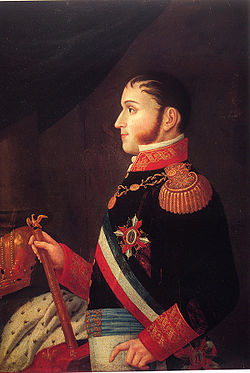
On this date in 1824, the Mexican officer who had made himself emperor was shot at the village of Padilla.
Iturbide‘s military acumen saw him through a meteoric rise in the service of what was then New Spain.
Iturbide rejected an early offer of generalship from the pro-independence leader Hidalgo in favor of spending the 1810s ably quashing the insurgency.
In a bizarre twist of fate, however, it would be Iturbide who would himself cement Mexican independence.
En route to try to finish off the last major rebel leader, Vicente Guerrero, Iturbide caught wind of the recent del Riego liberal revolt back in the mother country,* which had triggered civil war in Spain.
For the conservative royalist general, heir himself to a Basque noble lineage, the potential collapse of Bourbon authority in Spain raised the frightening specter of social upheaval.
All Iturbide’s work killing guerrillas for the sake of public order could come to naught if the Spanish monarchy collapsed or ceased projecting its power overseas … and then who knew what would emerge from the resulting power vacuum in Mexico?
So Iturbide cut a deal with Guerrero to consummate the Mexican War of Independence by separating from Madrid on an essentially conservative basis — a political breakaway without a social revolution. Independent Mexico would make nice with the Spaniards already living there, keep Catholicism as the official state religion, and get itself a constitutional monarchy of its own to insulate itself from the chance outcomes of continental politics across the ocean.
And when Iturbide marched into Mexico City and encountered a crowd conveniently imploring him to take the throne, well, who was he to deny them?
And so Iturbide transitioned smoothly from scourge of the revolution to its man on horseback,** immediately splintering the coalition that lifted him to power.
Contrary to this allegorical take on Iturbide’s coronation, he crowned himself — Bonaparte-like.
Only months after his July 1822 coronation, Iturbide shuttered Congress and began arresting the opposition. Meanwhile, Ferdinand VII had emerged from the Spanish fray as the (momentary) winner, leaving his upstart former subjects without international support.
A general that the freshly-minted emperor had himself had promoted, one Antonio Lopez de Santa Anna — yes, the Alamo guy — declared against Iturbide by the end of 1822, and come the following spring, Agustin I was a European exile, in the paradoxical position of drawing a pension from Mexico while also officially considered a traitor and outlaw.
In Tuscany and then England, Iturbide published an autobiographical justification — Statement of Some of the Principal Events in the Public Life of Agustín de Iturbide — then finally took up a much-asked-for invitation from Mexican conservatives to return and become the savior of his country against internal breakdown and a potential Spanish attack.
Founded on vainglory, this expedition was destined for fiasco; within five days of touching Mexican soil, Iturbide was serenading a firing squad with the last words, “Mexicans! I die with honor, not as a traitor; do not leave this stain on my children and my legacy. I am not a traitor, no.” Apparently they were serious about that injunction never to return.
When in Mexico City, relive happier times for our day’s subject at the Palace of Iturbide where he briefly maintained himself in the purple.
And do think twice about styling yourself Emperor of Mexico, since the only other person to claim that title also ended his reign in front of a firing squad.
* Ironically, it was a body of soldiers assembled for a reconquista of Spain’s independence–minded New World possessions that enabled del Riego to mutiny.
** Iturbide paused in the revolution’s good graces just long enough to design the Mexican flag.
Does it dry up
like a raisin in the sun?
Or fester like a sore–
And then run?
Does it stink like rotten meat?
Or crust and sugar over–
like a syrupy sweet?
Those lines, written for 20th century America’s struggle with racism, are rooted in the timeless conflict between the haves and the have-nots, and those “exploding” dreams deferred have provided more than a few subjects for these morbid pages.
This date in 1749 saw the beheading of writer and reluctant revolutionary Samuel Henzi (German Wikipedia page), along with two fellow-conspirators in a plot to overthrow the aristocratic government of Bern(e).
Still operating off a 13th century constitution, Berne had ossified into an oligarchic society with privilege derived from heredity and the capable but low-born frustratingly locked out. This arrangement had provoked intermittent uprisings and challenges, but as of the mid-18th century, it was still going strong, and “patricians mockingly observed that the citizens must be stripped of their feathers, that they might not want to fly.” (Source)
Henzi was a man with the ambition and the talent to soar above his place.
Eloquent, cultured, a guy to bang out some French poetry on the side, Henzi had been among a group of lower gentry who in 1744 petitioned for a change to Bern’s governing council, which at that time had become a privately held dynastic trust among a few top burghers.
For a suggestion as incendiary as allocating council seats by lot the better to represent the class, Henzi was treated as a rebel and exiled to Neuchatel.
dass ein eingewurzelter Staatskrebs mit Demuth nicht geheilt werden kann; nein! man muss den Degen in die Faust nehmen, wenn man die verlorne Freiheit wieder erobern will.*
Returning on a pardon, he found that not much had changed. The doors to employment in the civil administration shut tight against him, and not being bought off with a minor sinecure he fell in with a circle of malcontents dreamily conspiring to blow the whole thing up.
These plotters were exposed and three considered ringleaders — merchant Samuel Niklaus Wernier, Stadtlieutenant Emanuel Fueter, and Henzi — were beheaded on this date, each reputedly requiring more than one stroke of the sword.
On embarking with their two sons to quit the Helvetic territory, the wife of Henzi exclaimed, “I would rather see these children sink in the Rhine-stream than they should not one day learn to avenge the murder of their father.” However, when the sons came to manhood, they displayed more magnanimity than their mother; and one of them, who rose to distinction in the service of the Netherlands, requited with good offices to the burghers of his native town the unmerited misfortunes which they had brought upon his family. (Source)
Henzi’s fate greatly excited German dramaturg (and original Conehead) Gotthold Lessing — indeed, he would remark that no other event moved him so deeply.
Almost immediately after Henzi’s decapitation, Lessing wrote his first tragedy, the never-finished but aptly-titled Samuel Henzi, which is available in the original German here.**
Wann man des Staates Flehn, der sie aus Gunst erkoren,
Der nur aus Nachsicht fleht, empfängt mit tauben Ohren;
Wann wer der Freiheit sich das Wort zu reden traut,
Zum Lohn für seine Müh ein schimpflich Elend baut;
Freiheit! wann uns von dir, du aller Tugend Same,
Du aller Laster Gift, nichts bleibet als der Name:
Und dann mein weichlich Herz gerechten Zorn nicht hört,
So bin ich meines Bluts –– ich bin des Tags nicht wert.
* That is, “humility cannot cure the cancer of the state; one must take the sword in fist.” The comment is cited in Edward M. Batley, “‘Tu executes comme tes maitres jugent!’ – The Henzi Affair and the question of Lessing’s political judgment”, German Life and Letters, July 1984.
** Lessing’s next stab at stagecraft in the key of seria produced what’s generally described as the German theater’s first domestic or bourgeois tragedy, Miss Sara Sampson (German Wikipedia entry).
On this date in 1926, 15 people who had been sentenced to death only the day before for attempting to assassinate Turkish statesman Atatürk were hanged in Constantinople.
Ziya Hursit (English Wikipedia entry | Turkish), a former National Assembly delegate who didn’t see eye to eye with Atatürk, generally goes down as the ringleader in this affair.
Their object? To gun down the President during a visit to Izmir a few weeks previous. When interrogated, Hursit “admitted at the outset his intention to kill the President of the Republic.” (London Times, June 29, 1926)
Frictions with said President had been growing over the preceding months, as Atatürk broke the eggs to make the Turkish Republic’s omelet.
In early 1926, Mustafa Kemal also sought to bring the manner in which Turkish society was regulated into line with European countries. On 17 February 1926, the Turkish parliament approved a new civil code which was translated almost verbatim from the civil code in the Swiss canton of Neuchatel. The changes it introduced included: granting Turkish citizens the right to choose their own religion, thus abolishing the previous prohibition on apostasy from Islam; officially recognizing only civil marriage ceremonies conducted by representatives of the civil authorities … outlawing polygamy; making divorce dependent on a decision of the courts; lifting the ban on Muslim women marrying non-Muslims; and granting men and women equal inheritance rights.
The new Civil Code was followed by a battery of further legal reforms to try to bring Turkey into line with contemporary Europe. On 1 March 1926, parliament approved a new Penal Code, which was translated from the Italian Penal Code of 1889. A Code of Obligations was introduced on 22 April 1926, again based on the one in Swiss canton of Neuchatel. On 9 May 1926, parliament approved a new Commercial Code, which was largely based on German law.
This first of the Turkish Republic’s political assassination attempts and arguably its last serious bid to reverse secularism licensed an efficient purge and further consolidation of power by Atatürk, who over the weeks ahead shattered the remnants of the Unionists and Progressive Republicans and settled in for essentially secure autocratic governance for the balance of his life.
The alleged conspirators in the hit — not all of them as eager as Hursit to avow responsibility over the two-plus weeks’ trial — were hanged at a couple different locations in the former capital this date, bearing placards damning them for “attempting to assassinate our President, Mustapha Kemal Pasha, who is the saviour of Turkey’s honour.” One of them had a botched execution with a broken rope and a do-over.
(The quote is from the London Times dispatch about the executions, printed July 15, 1926. This story gives the figure of 15 hanged; it appears to me that the correct number that date was either 13 or 14, with two additional death sentences handed down in absentia. It was, in any event, more death sentences than the public prosecutor himself had demanded (11) in the case.)

 European-educated and on retainer by the colonial German government, Bell was hardly the subversive type: rather, as the head of the largest clan of the important Duala tribe, he was the guy that Berlin looked to to uphold its authority.
 Though Hayne is not, to us,
 No, unlike his fictional counterpart Marko Ramius (Sean Connery, in the 1990 cinema adaptation excerpted above),




 Henzi’s fate greatly excited German dramaturg (and original Conehead)
 Ziya Hursit (