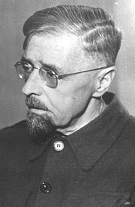
1946: Laszlo Bardossy, former Prime Minister

Laszlo Bardossy, one of Hungary’s several wartime Prime Ministers, was shot on this date in 1946.

Bardossy was a longtime diplomat who had become Minister of Foreign Affairs under Pal Teleki — the Count fate tragically cast to lead Hungary into the Second World War’s meatgrinder.

An esteemed geographer in his non-political life, Teleki foresaw the whirlwind Hungary might reap should she ally herself with Germany. But the conservative governments he affiliated with drew much of its vitality from a restive irredentist movement wishing to retrieve for “Little Hungary” remnants of its historical empire that had been stripped away after World War I.

Under Teleki’s predecessor Bela Imredy, Hungary gratefully reclaimed sovereignty over parts of Slovakia and Ruthenia as its price for supporting Hitler’s seizure of Czechoslovakia in 1938; two years later, German arbitrators returned northern Transylvania from Romania to Hungary.

These were halcyon days for Hungary: for the pleasure of doubling its territory it had not been required to accept German occupation or political direction.

But those days changed for Teleki, whose ministry from 1941-1942 was characterized by an increasingly uphill struggle to maintain a free hand in the shadow of Berlin’s growing strength. In the end he couldn’t manage it, and when (with the support of Hungary’s regent and many of his peers in government) Germany marched into Hungary in 1941 en route to invading Yugoslavia, a country Hungary had a peace treaty with, Teleki shot himself and left behind an anguished note: “We broke our word, out of cowardice … we have thrown away our nation’s honor. We have allied ourselves to scoundrels … We will become body-snatchers! A nation of trash. I did not hold you back. I am guilty.”

With Teleki’s death, Hungary now became a firm partner of the Axis powers — a move personified by the immediate elevation of our man Bardossy.

His first order of business was joining the invasion of Yugoslavia, once again snatching back a piece of territory Budapest considered rightfully hers. He also tightened Hungary’s anti-Semitic laws — Bardossy’s Third Jewish Law basically attempted to cut Jews out of the economic life of the kingdom — and began approving deportations to Germany and direct massacres by Hungarian troops.

The enthusiasm of Bardossy’s participation in Germany’s project might have been his undoing — in the immediate political sense as well as his eventual fate. By the next spring, with Hungarian troops taking casualties as the junior associates in a dangerous invasion of the Soviet Union, Prince Regent Miklos Horthy was again looking to put some daylight between Hungarian policy and German, and he sacked Bardossy. Bardossy joined the leadership of a fascist party that eventually supported the pro-Nazi government installed by German invasion in 1944.

He was arrested after the war and tried as a war criminal by a People’s Court for war crimes and collaboration.

On this day..

1946: The Neuengamme camp war criminals

On this date in 1946, eleven men convicted by a British war crimes court of war crimes at the Neuengamme concentration camp hanged at Hamelin prison.

Neuengamme held about 106,000 prisoners from 1938 until the British overran it on May 3, 1945. (In a tragic coda, many of the last prisoners died when the ships to which they had been transferred were mistakenly strafed by the Royal Air Force that same day.)

Though its primary purpose was slave labor — Neuengamme inmates cranked out bricks and armaments — rather than extermination, close on half of its residents died of the maltreatment. Anne Frank’s elderly roommate-in-hiding “Albert Dussel” (his real name was Fritz Pfeffer) died there of enterocolitis in 1944; Suriname national hero Anton de Kom succumbed to tuberculosis at Neuengamme days before it was liberated.

Nor was Neuengamme above more direct methods — of course it wasn’t. As the Third Reich collapsed, Neuengamme was used to dispose of 71 leftists for no better reason than the Nazis begrudged their potential postwar life; meanwhile, Jewish children who had been subjected to medical experiments were hanged by their stonehearted SS doctor.

That gentleman, Alfred Trzebinski, was one of the men in the dock for Neuengamme, and ultimately, one of the men on the scaffold.*

Camp commandant Max Pauly and SS SchutzhaftlagerfĂĽhrer Anton Thumann were among the 10 others executed for Neuengamme, all together on October 8, 1946.

* Sigmund Freud’s grandson Walter worked for the War Crimes Investigation Unit on (among other cases) Trzebinski’s Bullenhuser Damm school hangings.

On this day..

1965: Kenneth Roraback and Rocky Versace, Vietnam War POWs

According to a UPI wire story from Saigon which ran in American newspapers beginning Monday, September 27,

The Viet Cong said they executed two American prisoners Sunday … Although the broadcast did not say so, the executions apparently were in retaliation for the deaths Thursday of three anti-American demonstrators. The demonstrators were convicted by a military tribunal of engaging in terrorist activities and put before a firing squad in a soccer stadium at Da Nang.

An earlier execution of a Viet Cong terrorist by the government June 24 brought an announcement from the Communists that they had executed Sgt. Harold G. Bennet[t], a captive from Arkansas.

The two men shot on September 26 — whose names are garbled in the initial news report, since “the names were received phonetically” — were Sgt. Kenneth Mills Roraback and Capt. Humbert Roque “Rocky” Versace.

In 2002, Versace would be posthumously awarded the Congressional Medal of Honor — the first Vietnam War soldier so decorated on grounds of unwavering defiance as a POW.

On this day..

1946: Leon Rupnik, Erwin Rosener, and Lovro Hacin, for the occupation of Slovenia

On this date in 1946, the postwar state of Yugoslavia executed a trio of World War II occupation figures.


Left to right: Leon Rupnik, Erwin Rosener, and Lovro Hacin.

An Austro-Hungarian subject by birth, Leon Rupnik followed his native Slovenian soil into (proto-)Yugoslavia after the empire collapsed in World War I, and climbed the military ranks in the interwar era.

General Rupnik, as he could then be called, was the man tasked with engineering fortifications along the Italian and Austrian borders to ward off a fascist invasion. Modeled on the Maginot Line and every bit as effective, the Rupnik Line was little more than a speed bump when the Germans and Italians swept in during April of 1941.

But Gen. Rupnik was an open Nazi sympathizer, so sentimentality for his failed bunkers scarcely deterred him from joining the new occupation government as an enthusiastic collaborator, and he served or a time as the president of the German puppet province and the mayor of its capital, Ljubljana.

Erwin Rosener was a onetime brownshirt who became an SS General and was tasked by Heinrich Himmler with suppressing partisan resistance in Slovenia. He did the usual dirty things such a job entails, ordering torture and executions of hostages; Gen. Rosener also helped Gen. Rupnik organize the right-wing paramilitary Home Guard (Domobranci).

Lovro Hacin, the third member of the doomed party, was the police chief of Ljubljana.

Rupnik was shot. Rosener and Hacin were executed by hanging.


Rupnik (leftmost on the platform) reviews fascist Dombranci militia with Bishop Rozman and (rightmost) Gen. Rosener, January 30 1945.

Three others escaped execution at the same trials. Vilko Vizjak and Mha Krek both drew prison terms; Bishop Gregorij Rozman did as well, but his trial occurred in absentia and Rozman lived out his in exile.

On this day..

1914: Eugene Odent, the mayor of Senlis

On the second of September in 1914, the mayor of Senlis, France, was shot by the occupying Germans in the opening weeks of World War I.


Detail view (click for the full image) of a map of the British Expeditionary Force’s retreat in northern France during the first days of World War I.

The beautiful ancient town, where the Carolingian dynasty met its end (King Louis V was killed in a hunting accident there in 987, enabling Hugh Capet to take the throne), unhappily found right in the path of the German army smashing its way towards Paris as France and her allies gave way.

German troops reached Senlis by the first of September, and overwhelmed the city in a minor battle.

On guard from the experience of being picked off by franc-tireur snipers during the Franco-Prussian War many years before, the Germans entered this urban skirmish with far more concern for the safety of their troops than for that of noncombatants. A number of civilians were seized for use as human shields by the Germans as they moved through the streets, and some others reportedly executed summarily. Numerous buildings were torched.

In doing all this, the occupying army considered itself entitled not to suffer the resistance of its new (if ever so temporary) subjects — indeed it insisted upon the point with lead. On September 2, the German firing squads shot several French civilians accused of firing at German soldiers. The French Wikipedia page on the affair gives these names:

  • Romuald-Emile Aubert, 52
  • Jean-Stanislas Barber, 66
  • Cottereau Arthur-Lucien, 17
  • Pierre Dewert, 45
  • MĂ©gret Gabriel, 52
  • Jean-Baptiste Pommier, 67
  • Rigault Arthur, 61
  • Louis Simon, 36

Hours later, the town’s mayor Eugène Odent heroically shared their fate. He had been accused by the Germans of orchestrating “terrorist” civilian resistance — shuttering buildings for the convenience of snipers, failing to demand orderly submission from his neighbors, and generally inconveniencing the new boss. (Most of Senlis’s 7,000 residents had fled town ahead of the approaching attack, presumably shuttering up in the process.)

The stunning German attack seemed on the brink of capturing Paris at this point, but just days later the disordered French “miraculously” — it’s literally known as the Miracle of the Marne — threw the invaders back at the Battle of the Marne.

This battle crushed Berlin’s dream of a knockout victory and allowed the combatants to settle in for four bloody years of miserable trench warfare. It also enabled the French to recapture Senlis, whose horrors — Eugene Odent and all — were collected for early entry into the war’s annals of barbaric-Hun propaganda.

On this day..

1946: Vojtech Tuka, Slovakian Prime Minister

Slovak fascist politician Vojtech Tuka was hanged on this date in 1946 by the postwar Czechoslovakian government.

A lawyer, academic, and journalist, Tuka spent the decade leading up to World War II in prison for inciting Czechoslovakia’s Slovakian half to break with the Czechs.

These calls found their footing in 1938-39 when the Third Reich’s expansion crippled Czechoslovakia; a newly autonomous Slovak region under Prime Minister Jozef Tiso soon began pushing for outright independence.

In fact, one of the last actions of the pre-war Czechoslovakian state was to deploy troops to occupy Slovakia under martial law and (momentarily) depose Tiso on March 9, 1939. This desperate attempt to preserve Czechoslovakia was the action triggering Germany’s outright takeover of Czech territory. Tiso was in full support, and in reward he got restored as leader of the now “independent” Slovakia … in reality a German client state.

Tuka was right there for the ride.

In October 1939, Tiso became President of Slovakia, and appointed our man Vojtech the Prime Minister. Tuka would hold that office for the bulk of the coming war years, until ousted by the Slovak National Uprising late in 1944, and distinguish himself early for his enthusiasm in deporting Jews to German camps — and implementing comprehensive domestic anti-Semitic laws.*

But that decade in prison had not done Tuka’s health any favors. He suffered a stroke late in the war, and emigrated, wheelchair-bound, to Austria. He was arrested there and returned to Slovakia; by the time of his trial, he had suffered multiple strokes and was partially paralyzed.

Nevertheless, he was condemned as a war criminal for throwing Slovakia into war against the Soviet Union and for the defeated Slovak Republic’s anti-Jewish measures.

* Dieter Wisliceny, an Eichmann assistant, was a key German liaison to the Slovaks.

On this day..

1946: Ion Antonescu

Romania’s wartime fascist dictator Ion Antonescu was shot on this date in 1946.

Antonescu (hand raised) and Adolf at Nazi headquarters in June 1941. Behind them are Ribbentrop and Keitel.

An army officer who worked his way up to the brass via his exploits in the Second Balkan War and then in World War I, Antonescu emerged as a major nationalist politician in the interwar period. He was the elite political figure who allied with Corneliu Codreanu‘s Iron Guard movement.

Antonescu became the Defence Minister in a a far-right government, was temporarily shouldered out of the state by King Carol II‘s coup, and then re-emerged as the leading alternative when Carol’s government was undone by the tectonic political crises in the run-up to World War II. After territorial concessions wrung by Romania’s neighbors triggered protests against the king in Bucharest, Antonescu on September 5, 1940, forced Carol to transfer dictatorial power to him — and shortly thereafter, he forced Carol to abdicate altogether.*

That left Carol’s son Michael the figurehead of state, and Ion Antonescu the actual strongman — at least, once he tamed the Iron Guard.

Antonescu oriented Romania towards Hitler’s Germany, including a fairly enthusiastic involvement in the Holocaust.**

For Germany, it was an important alliance: Romania’s oil fields were essential to powering the Reich’s mechanized army. And Romania ultimately fielded the largest Axis army other than Germany and Italy themselves with well over one million men under arms by the summer of 1944. For Romania, well, opportunism is as opportunism does: as Antonescu put it, echoing an ancient argument, “in today’s circumstances a small country which is under threat, such as ours, does not do what it wishes, but what it can.”

The Romanian “General Antonescu Army Group” joined the fateful invasion of the Soviet Union. Romanian divisions were prominent at Stalingrad where some 150,000 were lost as casualties or prisoners.

The turn of the war’s tide put Romania in a grievous dilemma whose parameters ran something like this:

  • Maintain Antonescu’s personal grip on power
  • Maintain the territorial expansion Romania had achieved early in the war
  • Exit the war without going down in Germany’s Gotterdammerung

… pick one of three. Provided it’s the last one.

As the Red Army approached from the northeast and American bombers struck from Italy and North Africa, Antonescu scrambled to sound out what kind of a deal he could cut with the Allies.

Antonescu might perhaps have negotiated without the desperation due his position,† and dilated with his decreasingly patient enemies while the Germans flattered him with the dream that he could still retain conquered Bessarabia (present-day Moldova). Only with the Soviet army on his doorstep was Antonescu finally disabused of the statesman’s dream and office both — when King Michael ousted Antonescu and immediately switched Romania to the Allied side.‡ This move accepted the Soviet occupation that was about to become a fait accompli, and put Romanian soldiers into the field for the last months of the war fighting against their former German allies.

It also put Antonescu into Soviet custody. He rode out the war under guard in Moscow, then was shipped back to postwar Romania where he would serve as the feature attraction of the People’s Tribunals.

One hundred eighty-seven people answered war crimes charges to these bodies; there were 13 death sentences, but only four were actually executed.§ All four — Transnistria governor Gheorghe Alexianu, Interior Minister Constantin Vasiliu, and Foreign Minister Mihai Antonescu (no relation — were shot on this date at Jilava. The executions were filmed.

* Carol went into exile, never to see his native soil again. He died in Portugal in 1953.

** “Of all the allies of Nazi Germany, Romania bears responsibility for the deaths of more Jews than any country other than Germany itself,” according to a 2003-2004 commission. “Efforts to rehabilitate the perpetrators of these crimes are particularly abhorrent and worrisome. Nowhere else in Europe has a mass murderer like Ion Antonescu, Hitler’s faithful ally until the very end, been publicly honored as a national hero.” (The full report is available here; the quoted lines come from its executive summary.)

† Berlin was keeping an eye on Romania’s separate-peace feelers, too, and had prepared a plan to occupy Romania should it attempt to desert the Axis. This is precisely the fate that befell Nazi-allied Hungary … but in Romania’s case, Germany never had the moment to implement the plan.

‡ Michael was, like his father, forced into exile in 1947; he did not return to Romania until after the collapse of Communism. Now in his nineties, King Michael is still alive as of this posting and remains the claimant should Romania ever re-establish its monarchy.

§ Six of the 13 death sentences were delivered in absentia. Notable among those fled souls was the Hungarian writer Albert Wass: Wass had escaped to the United States, which refused repeated appeals by Communist Romania to deport him. There is a running struggle in both Hungary and Romania over whether to rehabilitate Wass or posthumously rescind his death sentences. (Postwar Hungary condemned him, too.)

On this day..

1949: Hiroshi Iwanami

On this date in 1949, Dr. Hiroshi Iwanami was hanged on Guam for murdering ten American POWs during World War II.

The commanding officer of the naval hospital on Japan’s South Pacific stronghold of Truk, Iwanami was condemned by the postwar U.S. Navy war crimes tribunal for overseeing — and rather reveling in — the sadistic murders of ten American POWs that fell into his hands in 1944.

As described in Timothy Maga’s Judgment at Tokyo: The Japanese War Crimes Trials:

From the Newcastle (NSW, Australia) Morning Herald & Miners’ Advocate, July 16, 1947

In addition to murder, Iwanami was charged with “preventing the honorable burial” of bodies and with “dissection” and “mutilation” of them. Iwanami had used all ten of his victims for so-called medical experiments. Four of his January 1944 victims had tourniquets placed on their arms and legs by Iwanami for long periods. Two of the POWs had their tourniquets removed in two hours, and the other two at the end of seven hours. The latter two died immediately of shock, but the former survived. On the same day, four others were injected with streptococcus bacteria to cause blood poisoning. All four developed high fevers and soon died.

On February 1, 1944, the two survivors from the tourniquet experiment were marched to a hill in back of the hospital. Naked, with their legs stretched out as far as possible, the men were tied to stakes. Iwanami’s staff then placed a small explosive charge three feet in front of each foot of each victim. The resulting explosion blew off the feet of the men, but both victims survived. Their amazing endurance was short-lived, because Iwanami ordered the men strangled; an aide accomplished the task with his bare hands. Their bodies were returned to the hospital, where they were dissected, and all vital organs were placed in specimen jars. Only some of the organs from the blood poisoning victims were kept, and their bodies were tossed off a nearby cliff.

During an evening meal near the end of July 1944, Iwanami asked his staff if they would assist him in experiments on two more POWs. Instead of answering quickly in the affirmative, the men asked about the value of such experiments. Refusing to discuss the issue, Iwanami ordered his men, instead, to participate in the execution of the two POWs. This time there was no opposition to the order. The two Americans were suspended from a bar placed between two trees. With the order to “stab with spirit,” the hospital staff then began their bayonet practice. There was little left of the bodies after the practice was over, and those bodies, one of them headless, were buried near the scene of the execution. Shortly before his capture, Iwanami had the bodies exhumed and thrown into the sea.

… the trial was as bizarre as the defendants. Three of Iwanami’s old hospital staff members committed suicide, leaving word that they would rather die than testify against their commanding officer. Another, Lt. Shinji Sakagami, took great pride in the fact that he had strangled two POWs. A staunch advocate of the Japanese war effort and, like so many of his colleagues, convinced that death was better than surrender, he hoped his actions in Truk would serve as a warning to the future enemies of Japan. Iwanami was sentenced to death, although he attempted to cheat the hangman. Smuggling a small, sharpened pencil into his holding cell, Iwanami stood at one end of the tight quarters, shouted “Banzai,” and vaulted against the opposite wall. The pencil was held close to his heart, but it did little damage. Both witnesses on the scene and the commission wondered why a surgeon would have failed to aim the pencil properly. Iwanami’s hanging proceeded as planned, and the most generous verdict for a member of his staff was ten years in prison.

On this day..

1948: Hans Karl Möser, for rocketry

In 1943, punishing Allied bombing had chased Germany’s brilliant rocket scientist Wernher von Braun and his team away from the Baltic port of PeenemĂĽnde where their pioneering work on the V-2 rocket had taken such a heavy toll on London.

Casting about the Third Reich for a suitable spot to base the missile team, the rocketeers settled on the Kohnstein, a hill in Thuringia already hollowed out by gypsum mines. This tunnel network was readily adapted into a subterranean munitions factory called Mittelwerk — difficult for the Allies to find, and once they found it, difficult to bomb.


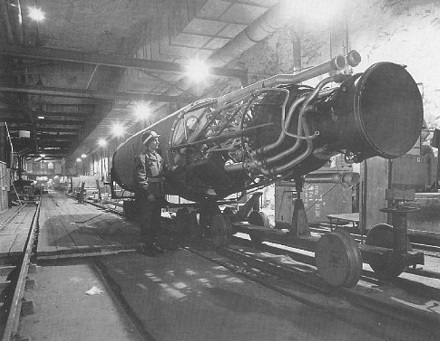
A U.S. Army soldier poses with a half-assembled V-2, one of about 250 such rockets found in the Mittelwerk labyrinth when the facility was captured.

With the facilities and the big brains in place, only one thing was missing: millions of man-hours of labor.

Nazi Germany had that in plentiful supply.

Beginning in late 1943, concentration camp inmates at Buchenwald began to be funneled out to a new facility, Mittelbau-Dora. Initially just a Buchenwald sub-camp, Dora grew over the course of 1944 into an immense facility holding 50,000 prisoners — a handful of German undesirables, but mostly captured foreign nationals: French, Dutch, Polish, Czech, and Russian. Short of food, sleep, and clothing for the 1944-1945 German winter, they were systematically worked to death in the Mittelwerk shafts to build a better bomb.

Our day’s principal, Hans Möser/Moeser (English Wikipedia entry | German) was an SS-ObersturmfĂĽhrer who made a living throughout the war years pulling guard detail in a number of concentration camps.

On May 1, 1944, Möser was transferred from Auschwitz to Mittelbau-Dora. It was the last job he would ever hold, but were Möser on the market today his C.V. would laud his team-player orientation and project management skills on a high-priority initiative. No doubt he was just the sort of reliable agent who understands how things are done that the world’s mad bombers need at their back.

“Ninety percent of the prisoners lived and worked in the tunnel of the mine,” testified one German who worked at Dora as a secretary and doctor’s aide.

As a result of the uninterrupted work in the mines and the absence of any installation for forced draft and ventilation, there prevailed a stuffy cold atmosphere, which made breathing difficult. The prisoners also slept in the subterranean tunnel in big chambers hewed out of the rocks, in five beds on top of each other. Already in 1944 3,500 prisoners used to sleep in such a room. In the tunnel of the mine there was no ater, the prisoners got absolutely insufficient quantities of tea for drinking purposes. But for weeks they were not able to wash themselves. As a result of the heavy work in the mines and of the bad food numerous prisoners died from exhaustion during their work.

According to that same testimony, the camp received a frightful order on Good Friday, which fell on March 30 in 1945: drive every last prisoner into those tunnels and bring down the caves around them. “No prisoner should be allowed to fall into Allied hands alive.”

The speedy arrival of the American 3rd Armored Division and 104th Infantry Division just days later prevented that order from taking effect.

The facilities themselves, too, were to be destroyed as part of Hitler’s scorched-earth “Nero Decree” intended to deny the benefit of German industry and infrastructure to the arriving conquerors. But Hitler’s War Production Minister Albert Speer was intentionally ignoring that order, a decision that might well have helped him avoid hanging at the Nuremberg trials.

Mittelwerk was a valuable capture indeed for the Allies. The Americans who first occupied it, and then the Russians who took it over a few months later, ransacked it for parts and technical specifications. The V-2 was the first man-made object to reach space, blasting at the speed of sound to the edge of orbit before plummeting back with its payload into the heart of London or wherever. It’s the ancestor of the long-range, intercontinental ballistic missiles that would come later, as well as the space programs of the countries who could build such missiles.

And of course, it wasn’t just the parts.

Wernher von Braun himself was the top prize of all — the young genius (he was just 33 when World War II ended) with the weapons of the future in his skull. As Germany collapsed in 1945, von Braun and his team of engineers had resolved to surrender themselves to the Americans rather than the Russians, but they too were subject to an order given the SS to execute the scientists if their capture appeared imminent. The Fuhrerbunker knew as well as the Allies how valuable this asset was.

In the event, von Braun managed to give himself up to a surprised American private. He disappeared into American custody, the crown jewel of “Operation Paperclip” that grabbed some 1,500 scientists from Germany and helpfully whitewashed their past misdeeds — misdeeds like Nazi party affiliation, and participating in slave labor camps.

Firing guided rockets into space was one thing. Unfortunately for our man Möser, his own skill set of bullying subordinates was not in short supply for either of the Cold War antagonists.

Möser was the one defendant (among 15) condemned to death at the resulting trial of Dora camp personnel. Rocket scientists, naturally, were not present for the occasion; Wernher von Braun and his team were hard at work at this time at Fort Bliss, Texas adapting the V-2 to the American Hermes program.

But at Dora, it had been Möser’s job to oversee camp discipline and labor strength for the slaves doing the grunt work manufacturing von Braun’s brainchild. Testimony convinced the court that the SS man had done this far too brutally, and perhaps with sadistic pleasure.

Several witnesses testified Möser frequently beat prisoners and participated in executions, often shooting at the men who were hanged for camp infractions — while they were hanging, or after they were taken off the gallows. (And of the latter, some already dead and some still alive.) “The accused told the twelfth witness that it was a pleasure to give the mercy shots, like shooting a deer.”

Möser for his part countered that he took no joy himself in the beatings and killings that he had to conduct as part of his job — and that the camp commandant had early on reprimanded him for leniency, threatening that “in view of the importance of the V-weapons operation, this could be interpreted as sabotage because it reduced the work efficiency.” How’s that for a hostile work environment?

(There’s a large .pdf of the entire trial summary here. Möser’s section begins on page 36 of the pdf (page 68 per the numbering in the scanned book pages).)

His presence on this here site betrays the outcome. On this date in 1948, Hans Möser was hanged at Landsberg Prison along with several other (unrelated) convicted war criminals.

On this day..

1946: Ernst Lohmeyer, theologian

On this date in 1946, the Soviets occupying East Germany executed Bible scholar Ernst Lohmeyer.

A fifty-five-year-old professor when the NKGB whisked him out of his apartment without explanation to his dumbfounded wife, Lohmeyer (English Wikipedia entry | German) was an important Protestant theologian of the interwar period with a knack for eschewing the opportunistic choice.

By refusing to disavow Jewish associates, his academic career got derailed in the 1930s, despite his producing influential critical commentary on the Gospel of Mark;* by patriotically serving in the Wehrmacht despite his reservations about the Third Reich, he set himself up to profile as an undesirable after World War II.

For a long time, Lohmeyer’s fate was, if not difficult to guess, obscure in its particulars. Not until 1957 was his execution in a forest near Hanshagen officially confirmed; he had been condemned by a military tribunal for participating in the German occupation of Sloviansk even though he wasn’t personally associated with any known atrocities.

The post-Soviet Russian state officially exonerated Lohmeyer in 1996. The University of Greifswald, where Lohmeyer was teaching when arrested, has a theology faculty building named for him.

* Lohmeyer postulated that the Gospel of Mark reflected a contemporary-to-the-evangelist (that is, post-Jesus) conflict between Christian communities in different locales, and that Mark himself was associated with Galilee’s Christians and therefore structured his narrative to exalt this location.

On this day..