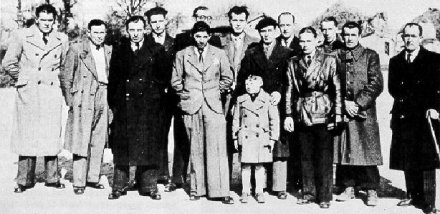
1944: Jakob Edelstein and family

(Thanks to Meaghan Good of the Charley Project for the guest post. -ed.)

On this date in 1944, Jakob Edelstein, his wife Miriam, their twelve-year-son Arieh and his mother-in-law Mrs. Olliner were shot to death at the Auschwitz Concentration Camp in Poland. They had been inmates in Auschwitz since the previous December; Jakob had been in an isolation cell the whole time while the others stayed in the so-called “Family Camp.”

For two years prior they’d lived in Theresienstadt (also known by its Czech name, Terezin), a the former Czech fortress town that had been turned into a city just for Jews. Jakob Edelstein was named Eldest of the Jews and was nominally in charge of the place, but in practice he had no choice but to cater to the whims of the Nazis. He was assisted by a deputy and a council of twelve.

Edelstein, a Czech Jew born in 1903, had been a leader within the Jewish community in Prague and had had papers for himself and his family to emigrate to Palestine. But when the Nazis took over Czechoslovakia, Edelstein and the other Zionist leaders decided it was their duty to stay and do what they could for the community during this time of crisis.

He became a liaison between the Germans the Jewish community and tried to facilitate immigration to Palestine. From 1939 to 1941 he made several trips back and forth between Czechoslovakia and Palestine, with permission from the Germans, trying to find ways for more Jews to emigrate.

Theresienstadt was a strange place: neither concentration camp nor ghetto but something in-between, it was billed as a “paradise” and a “gift” from Hitler to the Jewish people.

Elderly Jews were sent there, as well as Jews who were “prominent” for some reason or had Aryan connections (such as Jews who had a non-Jewish spouse). It was advertised as a luxurious resort community where they could live out the rest of their lives in ease and plenty.

Residents were allowed to receive food packages from the outside, and send postcards (one per month, limited to 30 words, and censored).

Many people believed the propaganda and were persuaded to go there voluntarily, signing all their possessions and assets to the German government in exchange for what they thought would be a comfortable and peaceful retirement.

The 500-ish Danish Jews who weren’t evacuated to Sweden by the Danish Underground right after the Nazi invasion of Denmark were ultimately sent to Theresienstadt. Many talented artists, actors, musicians and scholars lived there. The Nazis would ultimately make a propaganda film about how wonderful life was in Theresienstadt, and a Red Cross delegation toured the place and came away satisfied.

As you might have guessed, living conditions within the fortress city didn’t exactly live up to what it said in the brochures.

It’s true that it was possible to survive in Theresienstadt for an extended time period, even for the duration of the war. There were no gas chambers and relatively few executions. Certainly it was worlds apart from, say, Auschwitz or Treblinka. But that was as close to “paradise” as it got.

Theresienstadt was, as George E. Berkley says in his book Hitler’s Gift: The Story of Theresienstadt, “a joke hatched in hell.”

Yes, there were stores, more than a dozen of them, but their stock consisted of “goods the Nazis had originally confiscated from the residents and later found they didn’t need or want.”

Theresienstadt, like the Lodz Ghetto, had a bank and its own money, but there was nothing to spend it on. “The ghetto crowns,” Berkley says, “were used mostly like Monopoly money in playing cards and other games. Still, the bank staff kept themselves busy balancing their books, and auditors arrived regularly from Berlin to ensure the accuracy of the bank’s essentially fictitious accounts.”

Theresienstadt’s population, at its peak, was 58,497, in a town which before the war had a population of less than 10,000. Nearly everyone had lice, toilets and taps were scarce, and disease was rampant.

Families were separated, with husbands, wives and children each residing in different barracks.

“Horrendous as Theresienstadt housing conditions may have been,” Berkley says, “they were not the residents’ chief source of daily suffering. Food, or rather, the lack of it, weighed on them much more heavily.” The menu, he explains,

consisted chiefly of bread, potatoes, and a watery soup. Some margarine and sugar — about two ounces a week of the former and less than one and one-half ounces of the latter — were sometimes included. The residents were also to receive up to four ounces of meat, mostly horseflesh, and up to eight ounces of skim milk a week, though many a week would see less or none of those foodstuffs available. No fruits were ever officially distributed, and turnips were the only vegetable to show up with any regularity.

Estimates of total per capita calories provided daily ranged from 1300 or less, to 1800, with the lower figure being more frequently mentioned. This should be compared with the “Special Regime” given the worst offenders in the Soviet labor camps which provided about 2,000 calories.

According to modern nutritional guidelines, to maintain a healthy weight, the average adult with an average level of physical activity needs 2,000 to 2,500 calories a day. At Theresienstadt all inmates between age 14 and 70 had to work long hours, many of them at strenuous jobs. In addition to being calorie-deficient, the Theresienstadt rations lacked essential vitamins and minerals. It’s no wonder that one survivor later recalled, “After three months in Theresienstadt, there was only one feeling left in my body: hunger.”

Six months after his arrival, Edelstein and the Council of Elders made a difficult decision about the food problem, as Berkley records:

It became apparent that an even distribution of the food supply would not allow the ghetto to survive. Those doing heavy work needed more than those doing normal work, and the latter needed more than nonworkers. In addition, children required extra rations, for they represented the Jewish future…

Thus, heavy workers … began to receive a little over 2,000 calories of food a day. Children were to get 1,800 and regular workers a little over 1,500. But the daily intake for nonworkers, which included most of the elderly, fell to less than 1,000 calories.

This terrible choice, however necessary to the population’s long-term survival, consigned thousands of people to death.

But even though starvation and disease took many lives, the most deadly aspect of life in Theresienstadt was deportation.

Contrary to what the propaganda messages said about people living out their lives in Theresienstadt, it was largely a transit camp. Most people who arrived would be sent on “to the east” sooner or later; some of them lasted only a few days in the fortress city before being deported.

Although certain classes of people, such as decorated World War I veterans, “prominent” people and those over 65, were in theory exempted from deportation, in practice anyone could be sent away and just about everyone ultimately was.

Approximately 145,000 denizens passed through Theresienstadt during the course of its existence, most of them from Czechoslovakia, Germany, and Austria. About a quarter of these inmates died within Theresienstadt itself. Another 88,000 were deported to Auschwitz and other camps in the East, almost all of them dying there. Out of about 15,000 children who passed through Theresienstadt, less than 2,000 survived, and some estimates put the number in the low hundreds.

When the camp was liberated, it had a population of about 17,000, and most of those had arrived in the during the final months of the war.

Jakob Edelstein didn’t know about the gas chambers when he became Eldest of the Jews at Theresienstadt in December 1941, but he knew that conditions in the East were very bad and realized that, in order for the community to sustain itself, as many people as possible had to remain within Czechoslovakia.

As a committed Zionist, he hoped that the young people in the camp would survive and go on to colonize Israel. Like most other leaders of Jewish communities throughout Nazi-occupied Europe, he made the decision to cooperate with the occupiers in hopes of saving lives.

And as far as that goes, he failed, as the numbers quoted above indicate. But if he failed, so did everyone else.

Unlike many Jewish officials in the Nazi ghettos, he wasn’t corrupt and he wasn’t a toady to the Germans. It’s worth noting that he had many opportunities to flee the country with his family, even after the war started: all he had to do was not come back to Europe after one of his trips overseas.

But he stayed, because he felt he had a responsibility to his beleaguered people.

Edelstein did the best he could with what he had to work with, which is all you can say for anybody. He worked tirelessly, making himself available at all hours, and under his leadership the camp developed a welfare system as well as many cultural and sports activities.

His job as Eldest of the Jews in Theresienstadt, trying to play the balancing act between advocating for his people and not pissing off the Germans, was always extremely stressful, difficult and dangerous.

But things really started to go downhill for him after the city’s first commandant, Siegfried Siedl, got reassigned to Bergen-Belsen in July 1943.

Siedl’s replacement, Anton Burger, hated Czechs and took an immediate dislike to Edelstein as a result. He replaced Edelstein with Paul Eppstein [German language link, as is the next], a German, and demoted Edelstein to first deputy to Eppstein. Benjamin Murmelstein, an Austrian, became second deputy.

This wasn’t enough for Burger, however, as George Berkley records:

As leader of the Czech Jews, [Edelstein] naturally bore the brunt of Burger’s hatred for them. The new commandant had not only deported many of his countrymen and his chief aide … but had also moved Germans and Austrians into key positions formerly held by Czechs. Burger had apparently also stirred up his own superiors against him for during the fall some bakery workers, looking out the window, saw and heard Eichmann sharply dressing down Edelstein and even threatening to have him shot.

The incident alarmed Edelstein’s many loyal followers and the next day the leaders of Hechalutz, the largest Zionist organization in the camp, met with him to urge him to flee. They said they could help him escape … But though he suspected a Nazi scheme to get rid of him, Edelstein refused to run away.

In the end, the Nazis didn’t need to trump up any charges of insubordination or sabotage against their former Eldest of the Jews: they found some real “crimes.” It seems that Edelstein had been saving people from deportation by allowing them to remain in Theresienstadt, off the books, and adding the names of dead people to the transport lists to make the numbers match up.

He was immediately arrested. It was November 9, 1943, the fifth anniversary of Kristallnacht.

Edelstein was kept in custody in Theresienstadt until December 18, when he and his mother-in-law, his wife, and his young son were sent to Auschwitz with a transport of 2,500 others. The transport became part of the Auschwitz “Family Camp”, joining 5,000 Czech Jews who’d arrived there from Theresienstadt in September.

Edelstein’s family was allowed to join the Family Camp. Edelstein himself was put in the punishment block and subjected to interrogation although not, apparently, tortured. He gave nothing away.

In March 1944, the residents of the Family Camp who’d arrived in September were gassed. The December group was allowed to stay alive for the time being.

On June 20, an SS officer went to Edelstein’s cell and told him he’d been sentenced to death. While the condemned man (who’d become quite popular in jail) was taking leave of his fellow inmates, the SS officer got impatient and snapped, “quickly, quickly.”

Edelstein replied, “I am the master of my last movements.”

He was driven to the execution site and then the car went away to fetch Miriam, Ariah and Mrs. Olliner. Miriam had measles and had to be brought on a stretcher. The Nazis forced Jakob Edelstein to watch as his wife, child and mother-in-law were shot to death. He was the last of them to die.

The remaining residents of the family camp were gassed in early July 1944.

Paul Eppstein was executed in Theresienstadt in September. Murmelstein became Eldest of the Jews in his place and actually managed to survive the war. Because he had lived, he spent the rest of his life under a cloud of distrust and suspicion as a possible collaborator.

Siegfried Siedl was hanged for war crimes in 1947. Anton Burger escaped Allied custody (twice) after the war, assumed a new identity and died of natural causes in Essen in 1991. His true identity wasn’t discovered for years after his death.

After the war, the city of Theresienstadt reverted to its former name of Terezin, and the fortress became an internment camp for ethnic Germans, who found themselves quite unpopular in the newly liberated Czechoslovakia and were expelled from the country in droves. The internment camp closed in 1948.

The modern town of Terezin has a population of 3,500 and is noted for its manufacture of knitwork and furniture. Tourists from all over the world come to learn about its important role in one of the most tragic events in modern history.

On this day..

1699: Madame Tiquet, “nothing more beautiful”

On this date in 1699, Madame Angelique-Nicole Tiquet lost her beautiful head … eventually.

The talk of every Parisian in the spring of 1699 for attempting the life of her husband, Angelique-Nicole Carlier had been well-known in Paris circles since the 1670s; coincidentally or not, that was a period when a perceived boom in “husband-killing” burgeoned the phenomenon into an outright moral panic.

In those bygone days, Mademoiselle Carlier did her manslaying metaphorically, wielding only her limitless charms (not excluding a wealthy inheritance left by her industrious albeit untitled late father). This reputed “masterpiece of nature,” alas, exchanged her magnum opus for deniers on the livre when she succumbed to the suit of Claude Tiquet, a respected councilor of the Parlement of Paris so bedazzled by the young woman that he did not pause to consider her liberalities. Although quite past her in age, Tiquet won her hand with the promise of wealth so capacious that he wooed his intended with a bouquet of flowers studded with 15,000 l. worth of diamonds — and plied her aunt with still more largesse to advance his case.

But actually, Monsieur Tiquet was not wealthy. He stretched his fortune to acquire these amorous bribes as, let us say, investments in a happy future.

“Thus they united their fortunes for life, equally blinded as to each other,” George Henry Borrow wrote. “Such are the steps that lead to the most unhappy destinies.”

The wife’s prodigality — and her belated discovery as she blew through the putative family fortune that it was he who had married the money, and not she — soon brought domestic relations to a frosty pass.

Madame kindled a more edifying romance with a young captain of the guards; Monsieur strove in vain to check her moves with locked doors and snooping skulks. They separated to distinct wings of the family house, seeing one another only rarely — and in deathly silence — while each schemed his or her embittered schemes. Years they wasted at this intolerable impasse.

Despairing at last of being rid of either her horrible husband or his horrible debts, Madame Tiquet took her plotting far enough to compass her spouse’s death. “It is impossible,” she cried in one unguarded moment to a friend, “for me to have any enjoyment of myself while my husband lives, who is in too good health for me to look for such a quick revolution of fortune.”

So she engaged the services of her porter and of a freelance villain, and on the evening of April 8, 1699, these two assassins ambushed Claude Tiquet as he returned from a friend’s house and shot him three times. One ball only barely missed the heart. Tiquet survived, and he demanded those who came to his aid take him not to his own house but back to his friend’s. Of enemies, he said, “I have none but my own wife.”

This scenario speedily became the talk of Paris, and it did not take long for sentiment to coalesce against the wife. The hired assassins implicated Madame Tiquet in a years-long conspiracy to murder her husband whose previous installments — a missed ambush; a failed poisoning — had come to naught. Both Madame Tiquet and the porter, Jacques Moura, received a sentence of death, each appropriate to their respective stations: she to lose her neck, and he to swing from his.

There nevertheless remained some ambiguity about her real guilt, for the evidence was mostly circumstance and inference and colored by the purely titillating qualities of the public scandal. And then there was the fact that she was an attractive woman.

Angelique’s brother, a guardsman like the condemned woman’s lover, organized a petition for pardon. Surprisingly, even Monsieur Tiquet threw himself at Louis XIV‘s feet to plead for the life of his would-be murderess and the mother of his children. But it is said that when the Sun King wavered in his firmness, the Archbishop of Paris himself insisted upon the sentence. That prelate’s warning that save Madame Tiquet’s head should drop, no man could feel safe in his house must have fallen very ominously from the lips of the executive manager of Parisian confessionals.

Madame Tiquet heard the final failure of her appeals this day from an official who in the springtime of life had himself numbered among Mademoiselle Carlier’s suitors. And because the condemned would still not consent to confess the plot, that admirer was further obliged to order her to the cruel water torture to extract her statement.

In this procedure, the poor sinner is stretched out as on the rack, and eight pots of water painfully forced down the gullet. Madame Tiquet endured only a single pot before she calculated her inability to withstand the procedure and admitted all. Even so she continued to insist on the innocence of her lover: “I took care not to let him into the secret, else I had lost his esteem forever!”

These justice-satisfying preliminaries dispensed with, the condemned were conducted to the Place de Greve to suffer the penalty of the law. Thousands crowded the streets and windows, as was becoming the style for the execution spectacle of the era. Genuinely contrite or else wanting to play the part, she conversed humbly with her confessor and her condemned porter, exchanging absolutions and exhortations to die with Christian firmness.

Proceedings were delayed by a thunderstorm, although Madame Tiquet showed nothing but equanimity to wait at the foot of the scaffold while the weather passed. Jacques Moura hanged first: the undercard attraction.

Then the talk of all the town mounted those beams to give her own final performance, one remarked upon by all observers for its poise and stagecraft. The later memoirs of the Sanson family, written after that name inscribed itself on the guillotine during the French Revolution, dramatized the scene. It includes the regrettable inability of their own ancestor Charles Sanson de Longval* to equal the doomed woman’s grace under pressure.

When Angelique’s turn was come, she advanced, gracefully bowing to my ancestor, and holding out her hand, that he might help her to ascend the steps. He took with respect the fingers which were soon to be stiffened by death. Mdme. Tiquet then mounted on the scaffold with the imposing and majestic step which had always been admired in her. She knelt on the platform, said a short prayer, and, turning to her confessor,

“I thank you for your consolations and kind words; I shall bear them to the Lord.”

She arranged her head-dress and long hair; and, after kissing the block, she looked at my ancestor, and said:

“Sir, will you be good enough to show me the position. I am to take?”

Sanson de Longval, impressed by her look, had but just the strength to answer that she had only to put her head on the block.

Angelique obeyed, and said again:

“Am I well thus?”

A cloud passed before my ancestor’s eyes; he raised with both hands the heavy two-edged sword which was used for the purpose of decapitation, described with it a kind of semicircle, and let the blade fall with its full weight on the neck of the handsome victim.

The blood spurted out, but the head did not fall. A cry of horror rose from the crowd.

Sanson de Longval struck again; again the hissing of the sword was heard, but the head was not separated from the body. The cries of the crowd were becoming threatening.

Blinded by the blood which spurted at every stroke, Sanson brandished his weapon a third time with a kind of frenzy. At last the head rolled at his feet. His assistants picked it up and placed it on the block, where it remained for some time; and several witnesses asserted that even in death it retained its former calmness and beauty.

“Nothing was more beautiful” than Madame Tiquet’s lifeless severed head, one spectator discomfitingly enthused.

For an interesting consideration of the Tiquet affair, including her posthumous use in polemical melodrama either critiquing or celebrating her repentance of a life of iniquity, there’s a freely downloadable academic paper here. It’s by the author of this wild true-crime mystery unfolding elsewhere in France at just about the same time.

* Charles Sanson de Longval was the first Sanson executioner, the founder of the dynasty of headsmen. He had fallen into the dishonorable profession from a much more respectable social station and had been transplanted to Paris from Rouen only a few years before.

On this day..

1887: Ellen Thomson and John Harrison, lovers

Ellen Thomson, the only woman ever executed in Queensland, was hanged this date in 1887, along with her lover John Harrison — both condemned for murdering Ellen’s husband William.

Ellen arrived at Port Douglas in the late 1870s, already a widowed mother.

She became a housekeeper for William Thomson, a man almost twice her age.

Unsurprisingly, they ended up in matrimony.

Unsurprisingly, that May-December match ended in grief.

Ellen’s relationship with the younger marine John Harrison brought the conflict to a head; the husband was murdered in October of 1886. On the eve of the hanging, Harrison attempted to protect his paramour by claiming sole responsibility for the crime … but it was too little, too late. Both were hanged at Boggo Road Gaol.

Port Douglas’s Court House Museum still maintains an exhibit on this milestone case.

On this day..

1944: Massacre at Oradour-sur-Glane


(cc) image from fintbo.

(Thanks to Meaghan Good of the Charley Project for the guest post. -ed.)

On this date in 1944, four days after the Allied invasion of Normandy, an SS battalion from the 2nd SS Panzer Division massacred almost the entire village of Oradour-sur-Glane in west central France, slaughtering in all 642 people.

You can read all about this hecatomb and its aftermath on this very thorough and impressive website dedicated to the atrocity, from which much of the information in this account is drawn.

The tiny village, which you could walk through in all of ten minutes, had been the victim of mistaken identity.

Twenty miles away was a somewhat larger town with a similar name, Oradour-sur-Vayres, which was known for its Resistance activity. Adolf Diekmann, commander of the SS battalion, had been informed that the French Resistance had captured an SS officer (possibly the kidnapped Waffen-SS Sturmbahnfuhrer Helmut Kampfe, who had been executed by the Resistance earlier that same day) in Oradour-sur-Vayres and decided reprisals were needed, but he got the two villages mixed up and went to Oradour-sur-Glane instead.

When the SS arrived in the village at lunchtime, they ordered all the inhabitants to assemble in the fairground to have their papers checked. Everyone had to come, including children and the sick. Six people who were not residents but happened to be in the village at the time were also sent to the fairground.

Twenty villagers who had some compelling reason to avoid the Nazis, or merely had a bad feeling about the whole thing, hid or left the village as soon as the SS division showed up. These twenty survived. One seven-year-old boy, Roger Godfrin, was spotted and shot at, but survived by playing dead. He was the only survivor in his family, and the youngest survivor from the town.

The women and children were locked in the village church, and the men were lead to barns and sheds where the machine guns were set up. They were shot in their lower bodies and legs, in order to prolong their deaths. One of the men, who’d lost a leg in World War I, supposedly cried out, “Those bastards! They have cut my other leg off!”

After the shooting, as the men of Oradour-sur-Glane lay helpless, the SS men locked the sheds and set them on fire.

Only six men were able to escape. They hid in some rabbit hutches for several hours before attempting to escape the village. Five of them made it, but Pierre-Henri Poutaraud was spotted later that day and shot dead. The SS man who shot him then tethered a horse to Poutaraud’s outstretched hand.

In all, 190 men were killed.

The SS division then went back to the church, set off a smoke bomb inside it, and set the building on fire. Anyone who tried to get out of the church was machine-gunned. One woman cried out that she was German, not French, and begged to be released, but the SS shoved her back into the flames.

47-year-old Marguerite Rouffanche was able to slip out the back window, and another woman followed her with her seven-month-old baby, but all three of them were shot and only Marguerite survived, hiding in a garden for more than 24 hours until help arrived. Her two daughters were killed. (Marguerite refused to leave Oradour after the massacre. She remained there for the rest of her ninety-one years and is now buried in the village cemetery.)

The church fire and shootings claimed the lives of 247 children and 205 women.


Children from the village’s girl’s school, in the 1942-1943 school year. All of these girls were killed in the massacre.

Unbeknownst to the Nazis, there were several Jews living in the village, among them five children between the ages of eight and fifteen. Twelve of them were killed. In the case of a Jewish family called Pinede, the parents decided to present themselves for inspection but told their three children to hide. The children survived; their parents did not. One of those three Jewish survivors was still alive as of 2004.

Several days passed for the 26 survivors were permitted to bury their dead. Only 52 of the bodies could be identified; the other ones were burned too badly to be recognizable.

Collective punishment in reprisal for the actions of others was par for the course in Nazi-occupied Europe, and Adolf Diekmann had directed his unit to commit a number of mass shootings. Even so, he didn’t have authorization for the bloody events at Oradour-sur-Glane and his commanding officer requested for a court-martial, saying, “I cannot allow the regiment to be charged with something like this.” Field Marshal Erwin Rommel supposedly volunteered to preside over the court-martial himself.

But before that could happen, the war took care of Diekmann: he was killed on the Normandy front on June 19, hit in the head with shrapnel, a mere nine days after his last atrocity. The front, in fact, took care of most of his unit: only 65 of the 200 members survived the war.

In 1953 in Bordeaux, a military tribunal convened to hear the case against the surviving members of the 2nd Panzer Division. Only 22 of them were present in the courtroom; the others were in East Germany, which refused to extradite them. All but one said they’d been conscripted into the SS; one of them admitted he’d joined voluntarily to fight Communism.

To further complicate matters, 15 of the defendants present were actually French nationals of German descent, from Alsace-Moselle, and 14 of them claimed they’d been drafted against their wishes.

(After they conquered France, Germany declared inhabitants of Alsace to be German citizens whether they wanted to be or not, and drafted the region’s men. The conscripts were known in France as Malgre-nous, meaning literally “despite ourselves.”)

In addition, eight of the French defendants had been under the age of 18 when they were drafted into the SS, making them minors under French law. Many French people, including some of the survivors of Oradour-sur-Glane, viewed the Alsatian conscripts as fellow-victims of Nazi Germany and didn’t believe they should be held responsible for their actions.

Most of the defendants were cagey.

They implicated each other, but not themselves, admitting to some specific offenses but denying other, far more serious ones. One man, for example, said he’d been part of an execution squad that shot 20 men, but insisted he’d only helped load the machine guns and hadn’t personally shot anyone. Another said he hadn’t been in Oradour-sur-Glane at all, but was stationed as a sentry outside the village to prevent escapes. Only one of the defendants had admitted to killing anyone at all prior to the trial.

Twelve members of the victims’ families came to watch the trial proceedings, including an eight-year-old girl whose father and grandfather had been killed. Marguerite Rouffanche was ill at the time of the trial and very weak, but she showed up anyway and testify about her experience. Roger Godfrin, the little boy who played dead, also testified.

The tribunal’s judge demanded the defendants view photographs of the charred corpses of the victims, saying, “Let them look at the glorious work of the valiant Third Company of Der Führer Regiment.”

When the prosecutor summed up the case, he referred to the defendants’ evasive statements and said, “You might as well say despite the heaps of ashes and ruins, that the massacre never took place. But the people of Oradour are dead.”

The tribunal deliberated for thirty-two hours before returning its verdicts. One of the defendants was able to prove he hadn’t been in Oradour-sur-Glane the day of the killings, and was acquitted. The rest were convicted.

The 46 members of the SS unit who hadn’t shown up for trial were sentenced to death in absentia, as was one of the German nationals and one of the French. The others got various prison sentences, mostly between five and eight years, none exceeding twelve years. The Germans tended to get longer prison terms than the French. In addition, the Germans were prohibited from residing in France for at least twenty years.


Survivors of the Oradour-sur-Glane massacre.

No one in France was happy with the tribunal’s ruling: some said the sentences were too harsh, others, too lenient. In the face of widespread protests from the Alsace area and threats to secede from France, the French National Assembly passed a bill granting amnesty to all Malgre-nous (at a vote of 319 to 211, with a whopping 83 abstentions) and 13 of the 14 Frenchmen were released only eight days after the verdict was rendered. (One of them, the one who had volunteered for the SS, got no sympathy from anyone and no such leniency.)

Germany was upset, saying it was unfair to pardon the French SS but not the Germans. But within five years, everyone had been freed. No one was actually executed.

In 1981, East German authorities tracked down Heinz Barth, a second lieutenant in the 2nd Panzer Division, and put him on trial in their country for his role in the Oradour-sur-Glane Massacre.

He never tried to deny his participation in the attack, and used the old “just following orders” defense, saying, “In war one acts harshly and with the means available.” Barth admitted he helped round up the village men and personally shot fifteen times into the crowd. He also acknowledged responsibility for the deaths of nearly 100 people in Czechoslovakia.

Barth was convicted in 1983 and sentenced to life in prison. In 1991, still behind bars, he was awarded a pension as a “war victim” because he’d been wounded in Normandy in August 1944 and lost a leg. The resulting howls of protest led the government of a newly reunited Germany to pass a law stripping convicted war criminals of their pensions.

Barth was released from prison in 1997, and managed to finagle his war pension back somehow. He died of cancer ten years later, at the age of 86.

Marguerite Rouffanche died in 1988. Her fellow-survivor Roger Godfrin died in 2004.

The survivors of Oradour-sur-Glane created a new village after the war, but the burned-out ruins of the old village remain, with rusted cars, sewing machines, bicycles and other personal items lying in plain sight on the street, a grim testimony to what happened there nearly seventy years ago.


The ruins of the village of Oradour-sur-Glane today. (cc) image from Olivier Lepicier.

On this day..

1541: Margaret Pole, Countess of Salisbury

Thanks for the guest post to Nancy Bilyeau, the author of The Crown and The Chalice, thrillers set in Tudor England. The main character is Joanna Stafford, a Dominican novice.

On this date in 1541, 68-year-old Margaret Pole, countess of Salisbury, was beheaded within the confines of the Tower of London, as befitted her rank. She was cousin to Henry VIII’s mother, and well trusted by the king for years. Yet this intelligent and dignified aristocrat died without trial in a horribly botched execution that is considered a low point of Henry’s reign.

Margaret knew better than most how difficult it was to survive royal storms if your family was close to the throne. Yet despite all her efforts to stay out of danger, it was her family that doomed her to the axe in the end.

George Plantagenet, Duke of Clarence and brother to Edward IV, was her father and Isabel Neville, oldest daughter of the “Kingmaker,” Earl of Warwick, her mother. This glittering pair didn’t last long. Mother died of disease (some whispered poison); the duke, disloyal to his brother the king, was drowned in a barrel of Malmsey in the Tower of London.

First Murderer. Take him over the costard with the hilts of thy
sword, and then we will chop him in the malmsey-butt
in the next room.

Second Murderer. O excellent devise! make a sop of him.

-Shakespeare’s Richard III, Act 3, Scene 4. Margaret Pole is an ensemble character with no lines in this play.

Once the Tudors were in charge, royal children were either imprisoned, such as Margaret’s brother, who spent the rest of his life in the Tower of London,* or assimilated. At the age of 14, Margaret was married to Sir Richard Pole, a trusted relation of Henry VII‘s. The marriage was not unhappy, and they had four sons and one daughter.

When Catherine of Aragon arrived in England to marry Prince Arthur, Margaret became one of her ladies and a deep friendship sprang up. Years later, when Margaret was a relatively young widow, tall and red-haired, and Catherine was married to Arthur’s brother, Henry VIII, Margaret was singled out for several great honors. In 1512, the king gave Margaret many of the lands of her Warwick grandfather and a family title. She became the countess of Salisbury in her own right.

Margaret was selected by king and queen to be the governor for the 9-year-old Princess Mary, their only child. In a separate, vast household, she would be the one to guide Mary toward her destiny as heir to the throne. Some of Margaret’s own children made excellent marriages, such as her daughter Ursula to the oldest son of the duke of Buckingham. Her son, Reginald, began to shine as a cleric and intellectual; Henry VIII paid for his studies at the University of Padua.

The Pole family fortunes crashed — as so many others did — after Anne Boleyn became the second wife of Henry VIII. Not surprisingly, Margaret had sided with Catherine and Mary during the divorce struggle. When in 1533, the king’s men came to Mary’s household to claim her jewels as part of Henry’s move to bastardize his daughter, Margaret refused to hand them over. She was then discharged from her office by the king, who called her a “fool.”

Margaret did and said nothing else that was publicly critical of the king. She never saw Catherine of Aragon again and rarely saw Mary, to whom she had been a second mother. She spent her time in country retirement. She adhered to traditional Catholic doctrine, and priests lived in her homes. This was not illegal, but as religious reform gained steam, it brought her under scrutiny.

However, from the safety of France and Italy, her son, Reginald, chose to make public remarks sharply critical of Henry VIII. He published a treatise in 1536 attacking the king’s claim to superiority over the English church and calling on the princes of Europe to depose him. The king was enraged.

Margaret and her oldest son, Henry Pole, Lord Montagu, wrote Reginald letters pleading with him to cease his attacks. “Do your duty or you will be my undoing,” she warned — correctly.

In 1538 another of Margaret’s sons, Geoffrey, was questioned and then confined in the Tower of London. He eventually gave statements that his brother, Montagu, and their relations and friends sympathized with Reginald Pole and had privately criticized Henry VIII. Under law, this was treason, punishable by death. All the noblemen accused of being part of the “Exeter Conspiracy” were executed. But there was no proof that Margaret Pole ever wrote or said anything that fell under the definition of treason.

It didn’t matter. She was questioned, held under house arrest, and then imprisoned in the Tower of London for two years. She suffered in the winters, and Henry VIII’s fifth wife, the teenage Catherine Howard, bravely sent her some warm clothes.

A minor rebellion broke out in England, led by a Neville, her mother’s family, but unconnected to Margaret. Nonetheless, it seems to have prompted Henry VIII to eliminate the woman whom he had once trusted and admired, who was his closest female relative after his daughters.

Early in the morning of May 27, the Constable of the Tower woke up Margaret to tell her she would die within the next few hours. The ailing countess replied she had never been charged with any crime.

Because of her royal descent, she was executed on the Tower grounds, on the same spot as Anne Boleyn five years earlier, before more than 100 spectators. There was not enough time to erect a scaffold; also, the executioner was not in residence, only his novice.

Margaret commended her soul to God and asked the spectators to pray for the king and queen, Prince Edward and of course the Princess Mary. Reports conflict on what happened next. Some say she refused to kneel before the block on the ground, or to stand still. The novice swung at her with his ax, hacking at her shoulders, before managing to kill her. It may have taken 10 chops.

Margaret Pole was buried in the Chapel of St Peter Ad Vincula, within the Tower, not far from Anne Boleyn, Thomas Cromwell, Sir Thomas More and Cardinal John Fisher. Within the year Catherine Howard would join them. In the 19th century Macauley said of St Peter Ad Vincula, “In truth there is no sadder spot on earth than that little cemetery.”

* The rest of Edward Plantagenet’s life ended at the block in 1499, after he tried to escape with Perkin Warbeck.

On this day..

2001: An adult actress stoned to death in Evin prison


(From the May 22, 2001 Eugene Register-Guard, which is also the source of the quoted text below.)

Sex workers face a struggle worldwide for labor rights and human rights. At the extreme end of the criminalization spectrum was the fate of the unidentified 35-year-old woman who, according to the Iranian newspaper Entekhab, “was partially buried in a hole at Tehran’s Evin prison and stoned to death Sunday.”

She had been arrested eight years before for acting in “obscene sex films,” which of course are as prevalent in Iran as everywhere else.

On this day..

1794: Elisabeth of France, sister of the king

The 25-strong batch dispatched to the guillotine on the Place de la Revolution during the Terror on this date in 1794 included Princess Elisabeth, the sister of the late guillotined King Louis XVI.

Princess Elisabeth (English Wikipedia entry | French) was the staunch conservative* of her family’s generation and not afraid to advertise it.

Required by the revolutionary tribunal to identify herself, she retorted (since her brother’s death passed the succession to the imprisoned child Louis XVII), “I am called Elizabeth Marie de France, sister of Louis XVI, aunt of Louis XVII, your King.” The papers just reported that she said “Elizabeth Marie.”

This fate cannot have surprised her: her correspondence anticipates a bloody reckoning with the revolutionary “monsters from hell” from years earlier, and reflects the figure in the royal household pushing the king and queen on immoderate courses like their famous attempted escape. (Elisabeth posed as a maid with the fugitive party.) “The Assembly is still the same; the monsters are the masters,” she wrote in February 1790. “The king, and others, from the integrity of their own natures, cannot bring themselves to see the evil such as it is.”

Elisabeth was nevertheless quite attached to her brother and her sister-in-law, and swore an oath to keep with Louis XVI and Marie Antoinette during the royal couple’s harrowing attempt to ride out the revolution. She courageously quaffed the every terror that family endured all the way to the dregs; when the mob stormed the Tuileries on June 20, 1792, she was momentarily mistaken for the queen and thereby put in peril of her life. “Do not undeceive them!” she warned an associate who was about to save her by correcting the misapprehension.

Elisabeth’s correspondence shows her not “merely” self-sacrificing but a keen observer of events who pushed her brother to rein in the revolution by force … and pushed her exiled brother the Comte d’Artois** to do likewise. For Elisabeth, bloodshed would be necessary, and desirable sooner than later — in contrast to the national-reconciliation stuff the doomed king was still hoping for.

By the end Paris of the Terror probably didn’t really need any better reason to cut off Elisabeth’s head than the fact of her bloodlines — “sister of the tyrant.” There are enough little hagiographies out there concerning Elisabeth’s piety and loyalty, however, that some think she should eventually be proposed as a candidate for Catholic canonization.

* She might as well be: royals couldn’t save themselves even by going full Republican.

** The future King Charles X.

On this day..

1664: Elsje Christiaens, Rembrandt model

On or about this date in 1664, a Danish teenager named Elsje Christiaens was strangled at Amsterdam for murder.

The date is a little shaky; I don’t know if it’s directly documented (the verdict, we know, came down on May 1). Whenever the execution took place was, it culminated an extremely short stay in Amsterdam for the young woman.

This was boom time for the Dutch Republic, the last apex years before it all went to hell. Naturally, wealthy Amsterdam drew immigrants: for a penniless Jutland 18-year-old like Elsje Christiaens (English Wikipedia entry | Dutch), here was opportunity.

In mid-April 1664, she took a room to lay her head while she looked for domestic employment.

Two weeks later, she still hadn’t found a job but her landlady expected rent. When she came to demand it and Christiaens tried to stall her, the confrontation turned tragic: the landlady started thwacking her shiftless boarder with a broomstick, and Christiaens defensively grabbed a nearby hand-axe and knocked the poor woman down a flight of steps — to her death.

The sentence called for her killer to be strangled while being beaten with the very same axe. Then her body was to be hung up publicly with the same weapon, and left “until the winds and birds devour her.”

Of course that happened long ago. But at this time, veteran corpsepainter and Dutch Golden Age master Rembrandt van Rijn was hanging out in Amsterdam, living in reduced circumstances after creditors dunned him into the poorhouse.

This was the first woman executed in 21 years, and Rembrandt did not mean to miss his opportunity to sketch it. On May 3, presumably the same day as Elsje Christiaen’s execution, he hired a boat to row him out to the Volewijck moor where the body had been hung up. That day the master sketched the immigrant girl’s freshly-executed corpse, and its shameful axe.

The novelist Margriet de Moor has dramatized the sketchy backstory of Elsje Christiaens and her chance intersection with one of the art world’s greatest names in De schilder en het meisje. Unfortunately for most, this book appears to be available only in Dutch, which is also the language of these reviews: 1, 2, 3.

Rembrandt wasn’t the only Dutch painter haunting Amsterdam’s execution-grounds in 1664.

In this landscape — serene despite its landmarks — Elsje Christiaens is visible on the right. The little copse of gibbets she’s a part of comprises prisoners executed since 1660, according to Michiel Plomp.*


Anthonie van Borssom‘s 1664 ink-and-watercolor painting of the Volewijck execution site.

The gallows stood at the Volewijck until 1795. Today, that once-hard-to-reach peninsula is a residential district in Amsterdam-Noord.

* “Rembrandt and His Circle: Drawings and Prints,” The Metropolitan Museum of Art Bulletin, Summer 2006.

On this day..

1933: The “killers” of Pavlik Morozov

(Thanks to Meaghan Good of the Charley Project for the guest post. -ed.)

Pavlik Morozov was one of the must well-known figures in the Soviet Union. Every Soviet schoolchild learned his name and the story of his heroic life and tragic death. On April 7, 1933, his alleged killers — his own grandparents, uncles and cousin — were executed by firing squad for his murder.

A postage stamp honoring the Moscow statue honoring little Pavlik Morozov. Many more Pavlik propaganda images are here.

While most Morozov monuments have long since been destroyed or removed from public view, apparently a few still persist.

The legendary Pavlik, a Russian boy who lived in the remote village of Gerasimovka in western Siberia, was a member of the Young Pioneers, a kind of Communist version of the Boy Scouts designed in indoctrinate youth into the Soviet way of thinking. When the superlatively loyal child found out his father, Trofim, was acting against the state, he denounced him to the secret police, the OGPU. (Accounts differ as to what Trofim’s misdeeds actually were; he may have hoarded grain, or sold forged documents, or both.) The result was that Trofim was sent to a labor camp, never to be heard from again.

The Morozov family, not being good Communists like he was, were furious with him for the denunciation. Soon after his father’s trial, in early September 1932, his grandparents, his uncle and his cousin murdered him while he and his eight-year-old brother Fyodor were picking berries in the woods. (Fyodor was taken out too, as he was a witness.) The boys’ bodies weren’t located for several days and it’s unclear when they actually died.

An OGPU officer, Ivan Potupchik, who was another of Pavlik’s cousins, found them. The murderers were arrested in due course, and Pavlik became a martyr and an example for every Soviet child to look up to — a Stalinist passion play, the horrid little saint of denunciation. As Soviet dissident writer Yuri Druzhnikov wrote in this article,

Indeed, it is virtually impossible for someone not born and raised in the USSR to appreciate how all-pervasive a figure Morozov was … [E]veryone in the Soviet Union, young and old alike, used to know about Pavlik Morozov. His portraits appeared in art museums, on postcards, on match-books and postage stamps. Books, films, and canvases praised his courage. In many cities, he still stands in bronze, granite, or plaster, holding high the red banner. Schools were named after him, where in special Pavlik Morozov Halls children were ceremoniously accepted into the Young Pioneers. Statuettes of the young hero were awarded to the winners of sports competitions. Ships, libraries, city streets, collective farms, and national parks were named after Pavlik Morozov.


A reconstruction of the suppressed Eisenstein film based on the Pavlik Morozov story, Bezhin Meadow. Aptly, its supposed ideological flaws got some of its own participants arrested.

The Cult of Pavlik declined significantly once World War II began and there were other young heroes to exalt, and even more so after Stalin’s death. Still, even into the 1980s public figures praised the child as an “ideological martyr.”

The problem, as you might have guessed already, is that almost none of the accepted story about Pavlik is true. While not entirely made up, his Soviet-official biography was always thick with exaggerations, distortions and outright lies.

This Los Angeles Times article explains that Druzhnikov first got interested in Pavlik Morozov in the mid-1970s, when he attended a conference that included a discussion of “positive heroes of Soviet culture.” Pavlik was mentioned, and Druzhnikov asked just what was so positive about someone who had betrayed his own father. A few days later, he was summoned to KGB headquarters and two agents told him very firmly, “do not touch this subject.” It backfired: more curious than ever, Druzhnikov began secretly researching the case.

The book that resulted, Druzhnikov’s Informer 001: The Myth of Pavlik Morozov, was written in the early 1980s, but it was too politically sensitive for publication at the time. Instead it circulated privately among intellectuals and dissidents as Samizdat. It finally saw publication in Russian in 1988, and was then translated into English in 1993. (The full text of this book is available online for free here … in Russian.)

British historian Catriona Kelly published a second book on the subject in 2005, Comrade Pavlik: The Rise and Fall of a Soviet Boy Hero. By then, nearly all the surviving witnesses were dead. But unlike Druzhnikov, Kelly was able to obtain access to the official records of the Morozov murder trial and used them as a major resource.

These two authors got as close to the truth as one is able to get at this late date.

The Real Pavlik’s Life and Death

Pavlik Morozov’s story is sordid and mysterious as only a grand Soviet propaganda myth can be.

There really was a boy named Pavel Morozov (his name was the Russian equivalent of “Paul”) in Gerasimovka, but his nickname was Pasha or Pashka, not Pavlik. He was not ethnically Russian but of Belorussian descent on both sides of his family, as were most of the inhabitants of Gerasimovka. He could not have been member of the Pioneers, since there was no Pioneers troop where he lived.

When Yuri Druzhnikov began picking apart the Pavlik Morozov myth in the 1980s, he was able to talk to those still alive who had known the youth. In addition to the elderly villagers in Gerasimovka, he also interviewed Pavlik’s mother and his sole surviving brother, Alexei. (Another brother, Roman, was killed in World War II.)

Druzhnikov developed the following data points:

  • The exact date of Pavlik’s birth is unknown; his own mother didn’t remember it when asked in her old age. He was probably between twelve and fourteen at the time of his death.
  • The villagers of Gerasimovka who knew Pavlik and were interviewed by Druzhnikov did not remember him fondly: he was variously described as a “hoodlum,” a “rotten kid” and a “miserable wretch, a louse” who enjoyed smoking cigarettes and singing obscene songs.
  • Pavlik enjoyed denouncing his neighbors for breaking the rules; he “terrorized the whole village, spying on everybody.”
  • According to his former schoolteacher, he was almost illiterate; in fact, Druzhnikov believed he may have been slightly mentally retarded.
  • Pavlik’s whole family was the Russian equivalent of poor white trash. Tatiana was a mentally unstable and quarrelsome woman who was widely disliked in the village. After Trofim’s arrest, the state seized all his property and so the family went from mere penury to the brink of starvation.

Druzhnikov’s witnesses from Gerasimovka remembered Trofim Morozov’s denunciation, trial, and exile, which was central to the Pavlik-the-martyr myth. They remembered the boy testifying and said he didn’t seem to understand what was going on.

Kelly, however, examining the historical records twenty years after Druzhnikov, could find no documentary evidence of any trial — nor any proof that Pavlik had denounced his father to the OGPU or that Trofim had been convicted of political offenses and exiled.

Trofim had definitely disappeared from Gerasimovka by the time of his sons’ murders, but Kelly believes it’s entirely possible that he simply walked out of little Pavel’s life and wasn’t put in a labor camp at all. If Pavlik did in fact denounce his father, it was probably at the behest of his mother, Tatiana, and not for political reasons: Trofim had deserted the family and moved in with a mistress.

Tatiana was bitterly angry about her husband’s defection, and Pavlik, as the oldest male member of the household, was stuck with the exhausting household and farm chores his father had once performed. The family certainly did not want for points of friction … and Pavlik Morozov’s murder certainly had nothing to do with politics.

However, one of the four people put to death for the crime might actually have been involved after all.

After the Murders

The murdered boys were buried quickly, before the police even arrived to investigate. No photographs were taken, experts consulted or forensic tests performed. No doctor examined the bodies, and it isn’t even known how many wounds the victims suffered.

Within short order, however, investigators had rounded up five suspects: Pavlik’s uncles, Arseny Silin and Arseny Kulukanov; his grandparents, Sergei and Ksenia Morozov, both of whom were in their eighties; and his nineteen-year-old cousin, Danila, who lived with Sergei and Ksenia.


The accused.

The only physical evidence to implicate them was a bloodstained knife and some bloody clothes found in Pavlik’s grandparents’ house. As Druzhnikov records:

The prosecution had at its disposal two pieces of material evidence that were found in the home of Sergei Morozov: the knife, which was pulled out from behind the icons during the search, and the blood-spattered trousers and shirt — though whose clothes they were, Danila’s, the grandfather’s, or someone else’s, and whose blood was on them remained unknown. The court did not demand a laboratory examination of the blood stains.

It’s worth noting here that Danila had recently slaughtered a calf for Pavlik’s mother; this would provide an alternative, innocent explanation for the bloody clothes.

During their nationally publicized show trial in November 1932, the defendants presented incriminating yet often wildly conflicting statements abut the murders, and virtually no other evidence was presented. Druzhnikov details the farcical proceedings, which lasted four days:

Witnesses for the prosecution (about ten people) … did not introduce facts but demanded that the court employ “the highest measure of social defense” — execution. In fact, there were no defense witnesses at all. At the trial there was only one defense counsel, but during one of the court sessions he stepped forward and announced to the hall that he was revolted by the conduct of his clients and refused to defend them further. After this the lawyer withdrew with a flourish, and the trial concluded without him.

Four of the five were convicted and sentenced to death for “terrorism against representatives of the Soviet Government.” Sergei, Ksenia, and Danila Morozov, and Arseny Kulukanov, were all shot in April after the inevitable rejection of their appeals. (Arseny Silin was able to produce a credible alibi and was acquitted.)

Tatiana supported the convictions and testified against the defendants. Stalin later purchased her a resort home in the Crimea, where she lived until her death in 1983.

Were They Guilty?

Druzhnikov, researching the case fifty years later, concluded that Pavlik and his brother were deliberately set up to be murdered by agents of the OGPU, who treated the murders as political and the children as martyrs, bringing righteous proletarian wrath upon a fiercely independent village which had so far successfully resisted collectivization.

“The murder,” he wrote towards the end of his book, “could only have been committed, or at least provoked, by the hands of the OGPU.”

Stalin’s regime would become famous for its terrifying show trials. “A show trial in the Urals,” Druzhnikov suggests, “called for a show murder.” Because, in Gerasimovka, “there really was no crime. The peasants living there were peaceful; they didn’t want to kill one another. So they needed help.”

Kelly, on the other hand, suggested that the appearance of the crime scene, with no attempt to hide the bodies by burying them or dumping them in the nearby swamp, suggests an impulsive act of violence probably committed by a local teenager or teenagers. (One wonders, however, why it took so long for searchers to find bodies supposedly lying in plain sight.)

Kelly’s best guess was that Pavlik’s cousin Danila may have actually been guilty after all, possibly acting in concert with another villager his own age, Efrem Shatrakov: Danila and Pavlik had a very nasty argument over a horse harness only a few days before Pavlik and Fyodor disappeared, and Pavlik had allegedly denounced the Shatrakov family for possessing an unlicensed gun, which was confiscated.

In fact, Danila’s statements to the authorities made reference to his fight with Pavlik about the harness, and Shatrakov actually confessed to the murders, but later retracted his statements and was let go.

In any case, as Kelly wrote, if one or more of the defendants convicted at the trial happened to be guilty, either of committing the murders or as accessories after the fact, “they most certainly did not receive a fair trial, and the corpus delicti upon which the sentence was based was without question seriously flawed.”

No matter who killed Pavlik, as Druzhnikov says, the final result is this: “It is a historical commonplace that Stalin ruthlessly converted living people into corpses. In this instance, he effected the conversion of a corpse into a living symbol.”


The only known real-life photograph of Pavlik Morozov, at center under the arrow, taken as a school class portrait by a wandering photographer in 1930.

On this day..

1752: Mary Blandy, “forgiveness powder”

(Thanks to Meaghan Good of the Charley Project for the guest post. -ed.)

On this date in 1752, 32-year-old Mary Blandy was hanged for the murder of her father, Francis. He had died in agony on August 14 the previous year, having been sick for months.

That Mary had poisoned her father with arsenic was not in dispute; the evidence proved it and she admitted it herself, even before he died.

The question was as to her motive, and her intentions. Mary conceded she had caused Francis’s death, but denied having ever meant to harm him.

The events that lead to Francis Blandy’s demise at the age of 61 began in 1746. Mary was Francis’s beloved only child and an old maid by the standards of day. They lived in Henley-Upon-Thames, Oxfordshire, UK.

Although scarred from a bout with smallpox, she was well-educated, witty and intelligent, and advertised a dowry of £10,000. But she had never been able to find a suitor her father approved of, until Captain William Henry Cranstoun came along.

Cranstoun was several years older than Mary, short, ugly, a compulsive gambler and not terribly bright, but he was a member of the Scottish aristocracy, the younger son of an earl. When he proposed in 1747, both father and daughter happily said yes.

Unfortunately for the two lovers, Francis Blandy soon learned that Cranstoun was already encumbered with a wife and child back in Scotland. Cranstoun swore (falsely) that he was not legally married to the woman and she’d only ever been his mistress; smitten Mary believed him, but Francis didn’t take kindly to the deception and he showed his would-be son-in-law the door.

Cranstoun, however, was not going to let a £10,000 dowry slip through his fingers so easily.

While he tried (unsuccessfully) to annul his existing marriage, he remained in touch with Mary for years and told her about a special powder made by wise women in Scotland, which caused those who took it to forgive their enemies.

Mary was skeptical, but Cranstoun swore it really worked and said he’d taken it once himself and felt its effects. He obtained some of the powder and convinced Mary to start slipping it into her father’s food and tea, so his heart would soften and he would allow his daughter to marry the man she loved.

Such was Mary’s story, at any rate, and she stuck with it until her dying day.

She swore she did not realize the magic powder was toxic. Sure, Francis rapidly became sick with heartburn and stomach pains, but he had suffered these symptoms before. Then his condition worsened. He vomited constantly and all of his teeth fell out. Mary finally summoned a doctor.

By then it was too late, for both father and daughter. The family servants became suspicious after several of them got violently sick when they drank tea intended for Francis.

One of them noticed a white grainy substance in the bottom of a bowl of gruel Mary had fed her ailing father. The servants took the substance to Francis’s doctor, who determined it was arsenic. Around the same time, another servant saw Mary throw a bundle of Cranstoun’s letters into the fire. She also tried to burn a packet which the servant rescued from the flames; it contained white powder identical to the arsenic that was rapidly burning through the old man’s entrails from the inside out.

When he was informed his daughter had poisoned him and guessed why, Francis refused to be angry with her, saying, “Poor love-sick girl! What will a woman not do for the man she loves?”

As he lay in extremis, Mary rushed to his bedside and begged her father to forgive her. An indulgent parent to the very end (or perhaps the “forgiveness powder” really had worked), he blessed his wayward child and told her he would “pray to God to bless thee, and to amend thy life.” He blamed Cranstoun for everything.

A few days later he was dead.

Mary ran from the house after his death, pursued by an angry mob, and took refuge in the Little Angel Pub. Eventually she was persuaded to surrender herself to the authorities. On August 17, she was arrested.

When Francis’s estate was settled, its worth was determined to be only about £4,000. Cranstoun would have never gotten that £10,000 dowry: it didn’t exist.

James C. Whorton discusses her trial in his book The Arsenic Century: How Victorian Britain was Poisoned at Home, Work and Play:

‘A vast concourse of people’ gathered for the trial, including many students from the university (whom one prosecutor could not resist lecturing ‘See here the dreadful consequences of disobedience to a parent’). The proceedings lasted but a single day, albeit a long one, running from eight in the morning till nine at night. Conducting herself ‘with more than masculine firmness’, Mary continued to insist that she was the victim of a cruel deception (‘What women can withstand the arguments and persuasions men will make of us?’), but the jury would have none of it. Devoting only five minutes to deliberation, not even retiring from the courtroom, they pronounced the defendant guilty.

Just before her execution, Mary wrote out her side of the story, which can be read in full online. Whorton records her death:

The prisoner was hanged five weeks later, on 6 April 1752, still avowing her innocence: ‘May I not meet with eternal salvation,’ she declared from the scaffold, ‘nor be acquitted by the almighty God, in whose awful presence I am instantly to appear,’ if guilty. Then, ‘without shedding one tear,’ Mary Blandy pulled her handkerchief over her face and dropped into eternity.

Her last words were, “For the sake of decency, gentlemen, don’t hang me high.”

There was a lot of public sympathy for Mary, particularly after her execution, but none for Captain Cranstoun.

The Newgate Calendar called him a “profligate wretch” and “a disgrace to the noble blood from which he derived existence.” He escaped the grip of British justice by the skin of his teeth, going into hiding in the Continent when he found out about his fiancee’s arrest.

In the end, however, he got what was coming to him: nine months after Mary’s death, in Belgium, he was stricken by an unspecified intestinal ailment and met much the same end as Francis Blandy.

There was plenty of news coverage about Mary’s case, which had all the hallmarks of a morality play, and which was, in fact, made into one titled The Fair Parricide: A Tragedy in Three Acts. On top of this was the controversy over Mary’s intentions: was she was a conniving and ruthless little minx, a lovesick and pathetically naive girl, or something in between? The Newgate Calendar summed it up thusly:

With regard to Miss Blandy, the public have ever been divided in opinion on her case. Those who have presumed on her innocence have tacitly acknowledged that she was very weak, which contradicts the accounts we have of her genius and mental acquirements. On the contrary, those who have insisted on her guilt, have made no allowances for the weakness of the female mind; nor considered the influence of an artful man over the heart of a girl in love.

Her solemn declaration of her innocence would almost tempt one to think that she was innocent; for it is next to impossible to suppose that a woman of her sense and education would depart this life with a wilful lie in her mouth.

Be all this as it may, an obvious lesson is to be learnt from her fate. — Young ladies should be cautious of listening to the insidious address of artful love as they know not how soon, and how unsuspectedly, their hearts may be engaged to their own destruction, founded on the violation of all their nobler duties.

Mary Blandy was buried between her parents in the Henley Parish Church. There is no trace of her grave today, but her ghost is said to haunt the Little Angel Pub and also the site of her execution, which is the present-day Westford shopping center.

She would be remembered for hundreds of years after her death. Scottish lawyer and true crime writer William Roughead published an examination of her case, The Trial of Mary Blandy, in 1914; it is available free online here. Roughead concluded Mary had deliberately murdered her father. The case was made into a BBC miniseries, and in 1950, Joan Morgan published a novel based on the story, called The Hanging Wood, later retitled simply Mary Blandy.

Update: Because you can find anything on the Internet: the story of Mary Blandy in shadow puppetry.

On this day..