On this date in 1916, German forces occupying Belgium shot Gabrielle Petit at Schaarbeek for espionage.
Petit, orphaned as a child, was a 21-year-old Brussels saleswoman and governess when the First World War began.
In 1914, she helped her wounded fiance, soldier Maurice Gobert, cross the front lines into the Netherlands to rejoin his unit.
This was already a no-no — just the thing, in fact, that would soon get British nurse Edith Cavell shot by the Hun. But Petit went way beyond into outright espionage.
Having impressed British officers upon her successful delivery of Maurice by relating everything she could remember about the German army’s disposition, she got a crash course in spycraft and returned back over the lines. For a year and a half, she continued funneling information about troop movements as well as distributing the then-underground (but today still-extant) newspaper La Libre Belgique.
Captured in February 1916, she refused to trade her life for the identity of any other operative, and was shot for spying.
Although Gabrielle Petit didn’t get anything like Nurse Cavell’s wartime propaganda play, her story became well-known after the Armistice and resulted in a state funeral, various films and books, and a monument in Brussels’ Place Saint-Jean.
On this day in 1883, Emeline Lucy Meaker was hanged for the murder of her nine-year-old sister-in-law and ward, Alice. She was the first woman executed in Vermont and almost the last; the only other one was in 1905, when Mary Mabel Rogers was hanged after killing her husband for his insurance.
Alice’s father died in 1873 and her impoverished mother sent her and her brother Henry to live in an overcrowded poorhouse. There, the little girl was reportedly sexually abused. Others noted that she was “a timid, shrinking child—of just that disposition that seems to invite, and is unable to resist—persecution.”
In 1879, Alice and Henry got a chance for a better life when their much older half-brother* Horace (described by crime historian Harold Schechter as a “perpetually down-at-heels farmer”) agreed to take them in for a lump sum of $400. However, Horace’s wife, Emeline, was unhappy at this extra burden. She referred to Alice as “little bitch” and “that thing.”
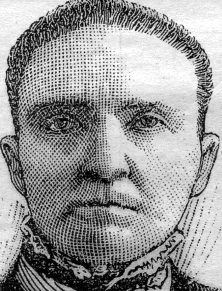
Married to Horace when she was eighteen, forty-five-year-old Emeline was (according to newspapers at the time) a “coarse, brutal, domineering woman,” a “perfect virago,” a “sullen, morose, repulsive-looking creature.” To be sure, these characterizations were deeply colored by the horror provoked by her crime. Still, there is little doubt that … Emeline’s grim, hardscrabble life had left her deeply embittered and seething with suppressed rage — “malignant passions” (in the words of one contemporary) that would vent themselves against her helpless [sister-in-law].
Young Alice’s life, however difficult it may have been before, became hell after she went to live with her half-brother and his family.
She was forced to do more and heavier chores than she was capable of, and for the slightest reason, Emeline would beat her horribly with a broom, a stick or whatever else was at hand.
Soon Alice’s sister-in-law dropped the pretense of punishment and simply hit Alice whenever she felt like it. Emeline was quite literally deaf to the little girl’s screams, as she had a severe hearing impairment. So did Horace.
Some of the neighbors later said they could hear the child’s cries from half a mile away, and Emeline had no compunctions about abusing Alice in front of visitors. Everyone in in their small community of Duxbury was aware of what was going on, but no one bothered to do anything about it until it was too late.
Less than a year after Alice’s arrival, Emeline decided to do away with her. The crime is reported in detail in Volume 16 of the Duxbury Historical Society’s newsletter.
Emeline convinced her twenty-year-old “weak minded” and “not over bright” son, Lewis Almon Meaker, to help. He later said his mother had persuaded him that Alice would be “better off dead” and that “she wasn’t a very good girl; no one liked her.”
Emeline’s first suggestion was to take Alice out into the mountain wilderness and leave her there to die, but Almon thought this was too risky. Instead, on the night of April 23, 1880, Almon and Emeline woke up Alice, shoved a sack over her head and carried her to the carriage Almon had hired in advance. They drove to a remote hill and forced Alice to drink strychnine from her own favorite mug, which her mother had given her.
Twenty minutes later, the child’s death agonies ceased and Almon buried her in a thicket outside the town of Stowe.
Emeline and Almon, people who had been concerned about the riskiness of a previous murder plot, didn’t bother to get their stories straight about the unannounced disappearance of their charge, so when the neighbors asked where Alice had gone their contradictory explanations for her disappearance raised suspicions.
On April 26, a police officer subjected both mother and son to questioning. Almon didn’t last long before he broke down and confessed. He led the deputy sheriff to the burial site and they disinterred Alice’s remains, still visibly bruised from her last thrashing. Because the deputy’s buggy was small, Almon had to hold Alice’s corpse upright to keep it from falling out during the three-hour journey back to Roxbury.
That must have been some ride.
Emeline and Almon were both charged with murder. Each defendant tried to put as much blame as possible on the other, but both were ultimately convicted and sentenced to death. Almon’s sentence was commuted to life in prison, but Emeline’s was upheld in spite of years of appeals and a try at feigning madness.
Her violent tantrums, attempts at arson, and attacks on the prison staff didn’t convince anyone she was crazy — they merely alienated her family and others who might have otherwise supported her. Once she realized she wasn’t fooling anybody, she calmed down and passed her remaining days quietly knitting in her cell.
On the day of her execution she asked to see the gallows. The sheriff explained to her how it worked and she declared, “Why, it’s not half as bad as I thought.” For the occasion — she had a crowd of 125 witnesses to impress — she wore a black cambric with white ruffles.
The not-half-bad gallows snapped Emeline Meaker’s neck, but it still took her twelve minutes to die. Emeline wanted her body returned to her husband, but Horace refused to accept it and it was buried in the prison cemetery.
Ten years after his mother’s execution, Almon died in prison of tuberculosis.
* Some reports say Alice was Horace’s niece rather than his half-sister.
(Thanks to historian Courtney Thomas for the guest post. -ed.)
On March 25, 1586 Margaret Clitherow, the wife of a York-based butcher, was subjected to one of the more obscure forms of capital punishment in early modern England: she was pressed to death, the mandated form of punishment for those who refused to enter a plea to a legal charge.*
Margaret was a victim of increasingly stringent attitudes toward recusants in the second half of Elizabeth I’s reign (1558-1603): Margaret was pressed to death just a year before the execution of Mary Queen of Scots for her role in a Catholic plot to overthrow the Elizabethan regime and two years before the 1588 Spanish Armada.
The two officials who were tasked with carrying out the sentence allegedly employed several beggars to perform the job instead and Margaret was taken to the toll-both on the bridge that straddles the river Ouse where she was stripped and had a handkerchief tied over her eyes as a blindfold. She was then placed upon a rock roughly the size of a baseball or an adult’s fist and a large panel of wood (roughly the size of a door) was put on top of her and slowly loaded with 700-800 pounds of rocks and stones.
In theory the smaller rock beneath her would break her back when the heavy rocks were piled on.
Witnesses report that she expired within about fifteen minutes. Other victims of this punishment were not typically so lucky. For example, Giles Corey, executed in Salem in 1692, had weights slowly piled on him for a period of several days (being asked daily before more weight was added if he wished to enter a plea to the charge that he was a warlock) before he expired.
Margaret was born Margaret Middleton in 1552/3, the daughter of a wax-chandler named Thomas and his wife Jane, the daughter of Richard Turner, an innkeeper. One of four children, she was born during the reign of Mary I (who has gone down in history with the unfortunate (but not entirely undeserved) appellation “Bloody” attached to her).
A bit of background on the process of the various reformations in England is necessary to understand why Margaret’s Catholic beliefs were treated so harshly.
Having broken with the Roman Catholic Church and founded the Anglican Church in the 1530s through a legislative reformation designed to assist him in securing the dissolution of his marriage to Catherine of Aragon so that he could wed Anne Boleyn, Henry VIII saw many of his religious policies undone by his heirs.
He was succeeded on the throne in 1547 by his son (with his third wife, Jane Seymour), Edward VI, who made England into a more recognizably Protestant state than Henry appears to have intended (while Henry was interested in reforming stances, he appears to have identified most strongly with Catholic principles and geared his reformation toward abolishing the authority of the Pope in English ecclesiastical affairs, rather than changing beliefs and practices).
Edward was, however, a short-lived king, having died in 1553 after but six years on the throne. He was succeeded by his half-sister Mary (daughter of Henry’s first wife Catherine of Aragon) who was a devout Catholic and spent much of her reign steering England back into the port of Catholicism — a task which involved martyring approximately three hundred of her subjects for their Protestant sympathies.
Mary, in turn, was succeeded by Elizabeth, the daughter of Henry’s second wife, Anne Boleyn. Elizabeth was of a Protestant mindset and reinstituted the Anglican Church. Though initially reluctant to persecute people for their beliefs (she expressed herself as having no desire to “make windows into men’s souls”), political circumstances involving a plethora of plots on the part of Catholics (both real and perceived) against the Queen resulted in a hardening of attitudes.
While fines and penalties were in place for non-attendance at Church of England services, the regime also began to enforce strict penalties against those found guilty of sheltering priests and Jesuits. And it was to these laws that Margaret fell victim.
On July 1, 1571, when she was about eighteen years old, Margaret wed John Clitherow, a local York butcher and a widower with two sons. The number of children borne by Margaret to her husband is unknown; in addition to her stepsons William (1563-1636) and Thomas (d. 1604), she bore Henry (b. 1572) and Anne (1574-1622) and there is mention of other pregnancies but the details do not survive.
In 1574, when she was twenty one, Margaret experienced a spiritual awakening and converted to Catholicism.
While her husband did not join her in converting, members of his family also held Catholic sympathies and he was not unsupportive of her conversion, with the exception of one recorded incident when he railed against Catholics while drunk at a banquet.
Margaret soon became highly involved in northern England’s underground Catholic community. She regularly held masses in her home in the Shambles (where she assisted her husband with his business) and her son, Henry, traveled to Rheims (a Jesuit centre) to train for the priesthood. Inside her home, Margaret created a series of architectural features to facilitate the concealing of priests, including a priest hole and a hole which was cut between the attics of her house and the adjoining house which could be used by a priest to escape in the event that the house was searched.
Inevitably Margaret’s involvement with the local Catholic community drew official censure, and from 1576 onwards, John Clitherow incurred regular fines for her refusal to attend Church of England services with him. She was also imprisoned several times for her refusal to conform, serving three separate terms in York Castle as a recusant (August 1577 – February 1578; October 1580 – April 1581; March 1583 – winter 1584).
Once released, despite her efforts at concealment, on March 10, 1586 Margaret was arrested for harbouring priests (which, in 1585 had been made a capital offense). In a search of her house, a frightened child had revealed the location of a secret room containing Catholic paraphernalia and designed to shelter a priest.
After her arrest, Margaret was jailed and on March 14 she appeared at the assizes. Although she was repeatedly asked to plead, she refused a trial by jury and thereby incurred the penalty of peine forte et dure: being crushed or pressed to death. Margaret maintained that her refusal to plead was a measure to prevent her children and servants having to testify against her and also served to protect the souls of the jury which would find her guilty. It is very likely that she also wanted to protect other local recusants who had assisted her and desired to prevent the revealing of their identity, which a trial would have uncovered. However, many contemporaries simply thought her mad and wondered at her seeming indifference to her husband and children — and Margaret’s willingness to abandon them for martyrdom.
Yet, despite her imminent death, Margaret allegedly did not forget her family in her final days and reportedly sent her hat to her husband and her hose and shoes to her daughter, Anne. Some people, including her father-in-law, engaged in scurrilous mongering and postulated that Margaret’s willingness to die stemmed from guilt over an illicit encounter with her confessor, whose child she now carried. Such views, however, did not attain much popularity.
After her sentencing, she was visited by several local Protestant preachers and kin, who endeavoured in vain to persuade her to plead guilty and throw herself on the mercy of the assize justices. She also appears to have been pregnant at the time as many people urged her to publicly admit her condition and thereby obtain a stay of execution.
Margaret steadfastly refused to consider any of these things; she had embraced martyrdom. After her death, local family and friends (one of whom, John Mush, later authored a biography that remains the primary source for her life) found her corpse (buried anonymously as a criminal) and reinterred her in an unknown location in accordance with Catholic rites.
After his wife’s death, John Clitherow married for a third time and remained a convinced Protestant until his own death. The couple’s children, however, embraced their mother’s Catholic faith. Anne Clitherow was briefly imprisoned in 1593 for her refusal to attend Church of England services and eventually became a nun at the convent of St. Ursula’s in Louvain in 1598. Henry (the son who had traveled to Rheims) studied first to be a Capuchin (he joined that order in 1592) and then to become a Dominican. He died, possibly insane, without having firmly settled on an order. Margaret’s stepson, William, became a priest in 1608, and her other stepson, Thomas, a draper, was imprisoned for his recusancy. He died in Hull prison in 1604.
Margaret’s work for the English Catholic community and her martyrdom resulted in her canonization in the twentieth century. She was beatified in 1929 and canonized in October of 1970 — one of the Forty Martyrs of England and Wales. After her execution, somebody apparently chopped off her hand to preserve as a relic at the Bar Convent in York. Margaret’s feast day in the current Roman Catholic calendar, together with that of the other thirty-nine English martyrs, is May 4 — although in England it is celebrated on August 30.
A few books about Margaret Clitherow
* Editor’s note: the trial could not begin without a guilty/not-guilty plea, so pressing was a means of forcing a mum defendant to the bar. Brute force often succeeded in extracting the necessary plea; however, because death by pressing preceded trial or conviction, a defendant hardy enough to undergo that fate could use it as a means to skip to the “execution” without suffering the other pains of criminal conviction. In Margaret’s case, she avoided the potential implication of other furtive Catholics at trial; in Giles Corey’s case, he avoided forfeiting his property upon the inevitable witchcraft conviction, and passed his estate to his heirs instead.
On this date in 1825, a woman named Peggy Facto was hung on Plattsburgh, N.Y.‘s Broad Street Arsenal Lot.
Facto — or “Facteau,” which variant recalls the French influence here on the shores of Lake Champlain — started her way to the gallows the previous autumn when some neighborhood dogs unearthed the remains of a human infant. It had been partially burned in a fireplace, and when found it still had fast about its throat the cord used to choke it to death. (Plus, of course, the dogs had done their own damage.)
This hideous discovery led back to our day’s principal character, the local mother of two [living] children whose husband had abandoned her due to her affair with a guy named Francis LaBare. Both Peggy and Francis were indicted for “being moved and seduced by the instigation of the devil” to murder their inconvenient bastard immediately after birth.
They faced separate trials for the crime, just hours apart on January 19, 1825, on very similar evidence. Witnesses established the discovery of the body, and an acquaintance named Mary Chandreau testified that she had seen Peggy Facto in an obvious late stage of pregnancy that August. This woman also visited Peggy Facto in jail before trial, and testified that Peggy admitted to having taken a string from one of her gowns to furnish the strangulation-cord.
While this evidence was sufficient to condemn Peggy Facto upon mere minutes of juror deliberation, the same case against Francis LaBare resulted in an acquittal. The mother, who did not testify at her own trial, did take the stand at LaBare’s trial, claiming (according to the notes of the judge), that immediately after she delivered the child, Facto
asked [LaBare] to go find her mother & he refused. She then asked him to go find Mrs. Chandreau & he refused, and next asked him if he meant to let her die there & he said the damned old bitch, I can do better than she can. She then requested him to help her & he did & then the child was born & he took it out and went off & was gone an hour, and when he returned … he came towards her with a knife & threatened her life if she said anything about it.
This quote, and much of what is known about Peggy Facto generally, comes via the research of Plattsburgh judge Penelope Clute. See here and here for HTML versions of the article, or here for a pdf.
It’s difficult to account, on the face of it, for the wildly differential outcomes of these trials; the all-male juries might have something to do with it.
At any rate, while LaBare walked, judge Reuben Walworth* pronounced Facto’s fate with enough fury for two … and a distinct disbelief in Facto’s attempt to blame LaBare:
there are very strong reasons for the belief that your own wicked hands have perpetrated the horrid deed. And if there was any other guilty participator in the murder, that your own wickedness and depravity instigated and persuaded him to participate in your crime. To the crime of murder, you have added the crime of perjury, and that in the face of Heaven, and even on the very threshhold of eternity. I am also constrained to say, it is much to be feared, that you will meet more than one murdered child, as an accusing spirit at the bar of Heaven.
Wretched and deluded woman! In vain was the foul and unnatural murder committed under the protecting shade of night, in your lone and sequestered dwelling, where no human eye was near to witness your guilt.
Facto’s only “appeal” after her half-day trial was the clemency consideration of Gov. DeWitt Clinton, a petition that ended up garnering a great deal of popular support, on three stated grounds:
As to the policy of executing any person for the crime of murder when the public opinion is much divided on this subject
Even Judge Walworth ultimately supported this appeal, despite his confidence “that the woman was perfectly abandoned and depraved and that she had destroyed this child and probably the one the year previous, not for the purpose of hiding her shame which was open and apparent to everybody that saw her but for the purpose of ridding herself of the trouble of taking care of them and providing for their support.”
The governor disagreed, arguing that the sort of enlightened people who signed on to death penalty appeals were out of touch with the rank terror necessary to keep the criminal orders cowed.**
So on March 18, 1825, an enormous crowd (fretfully many of them women) summoned from all the nearby towns slogged through spring-muddied roads to be duly cowed by the execution of the infanticide. The condemned, visibly terrified, barely made it through her death-ritual without fainting away, but she managed to re-assert her innocence from the gallows. (Some of the firsthand newspapering is here.)
After execution, Peggy Facto’s remains were turned over to the Medical Society for dissection. “A great many went to see her body, although it had been agreed that it should not be seen,” one woman later recollected in her memoirs. “Many young men went. So much talk was made of this that they said that no other body should ever be given to the doctors.”
** “Their excellent character elevates them above those feelings which govern the conduct of the depraved … if terror loses its influence with them then indeed the life of no man will be secure.” For more on the evolution of the idea of “exemplary deterrence” as the death penalty’s raison d’etre, see Paul Friedland.
On this date in 1662, two elderly women were hung at Bury St. Edmunds for bewitching various neighborhood children.
This trial, the second notable witch trial at Bury St. Edmunds in the mid-17th century, got going when a well-off merchant, Samuel Pacy repeatedly declined to buy herring from Amy Denny (also spelled Deny or Duny in various accounts). Denny was heard muttering something indistinct as she left the house, and soon Pacy’s daughter Deborah was seized by the “most violent fits, feeling most extream pain in her Stomach, like the pricking of Pins, and Shreeking out in a most dreadful manner like unto a Whelp, and not like unto a sensible Creature.”
Actually, Deborah had already been hit with “”was suddenly taken with a Lameness in her Leggs, so that she could not stand” even before Amy Denny’s visit. Nonetheless, she apparently called out Amy Denny’s name during her throes of this most recent affliction. When an area doctor couldn’t diagnose the situation, Pacy finally filed a witchcraft complaint.
That was Oct. 28, 1661, when Amy Denny was clapped in irons. Two days later, the heretofore unperturbed eldest daughter (age: 11) came down with the same stuff. Anyone with a bit of experience in multiple-child is probably conjuring up an alternative hypothesis right this moment.
Both girls now commenced a litany of woes, coughing up pins, and reporting visions of evil little witches’ familiars like mice and flies, and having dreams “that Amy Duny and Rose Cullender would appear before them holding their Fists at them, threatning, That if they related either what they saw or heard, that they would Torment them Ten times more than eve they did before.”
Rose Cullender was another local widow of advanced age. Like Denny, Cullender had a pre-existing reputation as a witch.
By the time these two crones went on trial on March 10 — a week before their hangings — three other teenage girls were rocking the same symptoms. They even showed up to court, where they “fell into strange and violent fits, screeking out in a most sad manner, so that they could not in any wise give any Instructions in the Court who were the Cause of their Distemper.” Yet another woman deposed that Amy Denny had, several years before, bewitched both of her children, killing one of them: she said she caught a toad lurking around her ailing child, threw it in the fire, and the next day Denny was covered with burns. She didn’t say why she hadn’t mentioned any of this before.
The scientist Thomas Browne turned up to provide expert testimony that witchcraft did exist and that “the Devil” could exacerbate otherwise natural illnesses arising from an imbalance of the four humours.
stir up and excite such humors, super-abounding in [human] Bodies to a great excess, whereby he did in an extraordinary manner afflict them with such distempers as their bodies were most subject to, as particularly appeared in these children; for he conceived, that these swooning fits were natural, and nothing else but that they call the Mother, but only heightened to a great excess by the subtlety of the devil, cooperating with the malice of these which we term witches, at whose instance he doth these villanies.
Despite the court’s confidence as to the existence of witchcraft (The judge — more on him in a bit — instructed the jury that there could be no question on this point, only as to whether the children at hand were indeed bewitched at the defendants’ hands), it did its best impression of skepticism, trying to verify the sorcery by means of whatever tests it could. Unfortunately, the era’s forensics left something to be desired.
Samuel Pacy’s daughters’ reactions to Amy Denny were tested in a few different ways. For instance, as they sat near-comatose with fists clenched, nobody in the court could pry open their stubborn hands … but they popped right open when Amy Denny touched them. Elizabeth once broke out of her torpor to scratch and claw wildly at Amy Denny.
This little girl failed a more plausible test, however. When she was blindfolded and touched by two different women, she had the same reaction to both Amy Denny and the control contact. This embarrassing result was waved off by the widespread conviction in the courtroom that nobody “should counterfeit such Distempers, being accompanied with such various Circumstances, much less Children; and for so long time.” By the time of the trial, it was fully five months since Amy Denny had tried to get the Pacys to buy her darn herring.
In the end, none of the six still-living children supposedly affected by the witches testified directly. Their creepy presence in court did the talking for them. Within the hour after jurors handed down convictions for both women, all the children were freed of their symptoms. Both women, however, refused the many imprecations to confess and set their souls right before execution on March 17.
Hale’s reputation gave the weight of juridical precedent to his witchcraft superstition.
Across the pond in New England, the Salem witch trials judges would refer to this very case when determining to admit so-called “spectral evidence” from the shitty little fabulistspossessed children who accused various townsfolk of enspelling them.
Witch trials apologist Cotton Mather dedicated a whole chapter (under the title “A Modern Instance of Witches, Discovered and Condemned in a Tryal, before that Celebrated Judg, Sir Matthew Hale”) to the authority established by the Cullender-Denny trial.
It may cast some Light upon the Dark things now in America, if we just give a glance upon the like things lately happening in Europe. We may see the Witchcrafts here most exactly resemble the Witchcrafts there; and we may learn what sort of Devils do trouble the World.
The Venerable Baxter very truly says, [“]Judge Hale was a Person, than whom no man was more Backward to condemn a Witch, without full Evidence.[“]
Now, one of his latest Printed Accounts about a Tryal of Witches, is of what was before him … it was a Tryal, much considered by the Judges of New-England.
… [Mather spends several pages outlining the investigation and trial] …
The next Morning, the Children with their Parents, came to the Lodgings of the Lord Chief Justice [i.e., Hale, although he was not Chief Justice in 1662], and were in as good health as ever in their Lives; being restored within half an Hour after the Witches were Convicted.
The Witches were Executed, and Confessed nothing; which indeed will not be wondered by them, who Consider and Entertain the Judgment of a Judicious Writer, That the Unpardonable Sin, is most usually Committed by Professors of the Christian Religion, falling into Witchcraft.
We will now proceed unto several of the likeTrials among our selves.
On this date in 1676, the Combe Gibbet was put to its first and only use.
Adulterous lovers George Bromham (or Broomham) and Dorothy Newman had been doomed by the Winchester Assize for murdering the wife and son of Bromham’s inconvenient marriage. “With a staff,” the trial record says. Ouch.
The two were sentenced to hang together “in chaynes near the place of the murder,” which demonstrative sentence required the erection of a brand-new purpose-built double gibbet just for the occasion, high atop Inkpen Beacon, the 975-foot hill overlooking the countryside.* After execution, they were taken down, laid out a nearby barn (inevitably to become known as “Gibbet Barn”), and then strapped back up on the double-gallows in chains for a few days.
Although this dreadful landmark has never been used again, it’s stood ever since. Or, technically, a succession of different versions have stood, but the point is that there’s still today a large, black execution device looming over scenic Berkshire. It’s a nice place for a walk. (pdf)
When next in West Berkshire, top your visit to the Combe Gibbet with a refreshing Gibbet Ale at Inkpen Common’s Crown and Garter Bed & Breakfast. (That’s where the Gibbet Barn used to be.)
The murder behind the gibbet was the the subject of a student film called Black Legend in 1948 — the first movie made by future legendary director John Schlesinger.
* Bromham was from Combe, and Newman from neighboring Inkpen, and the murder itself took place on the towns’ border. In the great tradition of municipal politics, there was a consequent dispute over the bill for setting up this gibbet; they were forced to split the bill.
Late this night in 1969, a platoon of seven Navy SEALs slipped into the Mekong Delta village of Thanh Phong.*
At their head was a 25-year-old lieutenant, the future United States Senator Bob Kerrey.
Thanh Phong was reportedly an official U.S. Army free fire zone. That meant that any Vietnamese civilians within it were presumptively enemies and could be slain at will — according to the U.S. Army, if not to any recognizable law of war.
In Thanh Phong, they were slain. Nearly every single person in the town.
Gregory Vistica’s disturbing investigation brought this story to wide public attention in 2001; he subsequently expanded his investigation into a book.
Kerrey’s Raiders — the commando team’s comradely self-designation — were hunting a local National Liberation Front “general secretary” purported to be in Thanh Phong. By “hunting,” we mean they intended to murder him; given the nature and timing of the operation, it was presumably part of the brute-force assassination program Operation Speedy Express and/or its equally sinister CIA-run cousin, the Phoenix Program.
On this particular mission, Lt. Kerrey’s team first encountered an unexpected hut, not on their map. Fearing the people inhabiting it would blow their cover, they entered and killed the five inhabitants: quietly, intimately, at close quarters with their knives. It was an old man, a woman, and three young children. It’s a nasty business but it’s not what qualifies Thanh Phong as a potential execution … though it may explain the execution that followed.
After these unfortunate villagers were disposed of, the SEALs moved on towards the doomed hamlet. This same platoon had been to Thanh Phong two weeks before, and reported then that it held nothing but a few women. On February 25, they found much the same scene: no “general secretary.” Just 16 women and children.
Klann: We gathered everybody up, searched the place, searched everything.
Rather: What was the make-up of this group?
Klann: Probably a majority of em were kids. And women. And some younger women.
Rather: So you got all the people out of there.
Klann: We herded them together and in a group.
Rather: Were any of these people armed?
Klann: I don’t believe so.
Rather: Fair to say you didn’t see any weapons?
Klann: I didn’t see any.
Rather: Did you decide pretty quickly or not that the target of your mission, the Viet Cong leader, was not among them?
Klann: Yeah, we got together and we were, hey the guy ain’t here. Now we got these people, what do we do now?
Rather: What did you do then?
Klann: We killed them.
Rather: What do you mean, you killed em?
Klann: We shot them all.
Rather: Was an order given for that or was it more or less spontaneous?
Klann: I don’t think we would have acted spontaneously on something like that. There was an order given.
Rather: What was the order?
Klann: To kill them.
Rather: Why?
Klann: Cause we’d already compromised ourselves by killing the other group.
Rather: Whose responsibility, whose obligation as it to say that?
Klann: The ultimate responsibility fell on Bob Kerrey.
Rather: Do you remember him saying that?
Klann: I don’t remember his exact words, but he was the officer in charge. The call was his.
Rather: And then what happened?
Klann: We lined up, and we opened fire.
Rather: Individually or raked them with automatic weapons fire?
Klann: No. We, we just slaughtered them. It was automatic weapons fire. Rifle fire.
Rather: At roughly what range?
Klann: Six feet, ten feet, very close.
Rather: Then did the shooting stop?
Klann: Yeah, for a little bit.
Rather: Was it quiet?
Klann: It was dead quiet. It was dead quiet. Then you could just hear certain people, hear their moaning. So we would just fire into that area until it was silent there. And that was it. And, and until, we were sure that everybody was dead.
Rather: You said certain people were moaning or making noises. Were all those adults?
Klann: A few. I remember one baby still crying. That baby was probably the last one alive.
Rather: What happened to that baby?
Klann: Shot like the rest of em.
Klann’s testimony of a summary execution comports with that of a Vietnamese woman who says she hid on the outskirts of the tiny village and witnessed the slaughter.
Bob Kerrey has a different version of these events. The reader is invited to peruse the evidence available and conclude as desired; for me, Kerrey’s version is not very persuasive especially given the witness testimony to the contrary and the known normalization of atrocities in Indochina.
Kerrey agrees with Klann that the entire village ended up slaughtered together in a heap; a complaint against this atrocity was officially filed with the Army by Vietnamese locals within days of the incident, so there’s not much scope to deny the outcome. But Kerrey claims this happened when the SEAL team received incoming fire as they approached the village, then started shooting back wildly in the dark. Only after the bullets stopped flying did they find the civilians 50 to 100 yards further on.
Improbably — but much more consistent with an intentional, close-range massacre — all these women and children chanced to be huddled together, and all of them were stone dead from the crossfire. Not a one of these people accidentally winged in the night was wounded but alive, says Kerrey.
Kerrey’s commentary in Vistica’s initial story and its follow-ups suggests the judicious politician he had by that time become. In 2001 he had just retired from the Senate and was an elder statesman in government; he was said to be weighing a 2004 presidential bid. (His actual next gig, not anticipated at the time the story broke, was the 9/11 Commission.)
In interviews with Vistica and subsequently, Kerrey waffled and qualified cagily — shifting from a flat denial, to a weird acknowledgment that “it’s possible a slight version of that happened.” He wouldn’t commit to asserting that there really was incoming fire. He moved the conversation wherever possible to the abiding torments of conscience and the slipperiness of memory and perspective, as if this could span the distance from “summary execution” to “accidentally killed in the crossfire.” He maintained that there were only men in the first hut — that hut, alone among the village — but that this was only an indirect recollection since he didn’t enter it or participate in the killings.
“Please understand,” Kerrey emailed to Vistica in 2000, “that my memory of this event is clouded by the fog of the evening, age and desire.” Desire is a striking word to select.
For all their plausible deniability, Kerrey’s remarks on this matter markedly lacked indignation at bearing such a monstrous charge. Kerrey’s great and unfeigned sense of personal guilt was oddly mirrored by his inability to own a specifically culpable act. The Senator expressly declined to deny Gerhard Klann’s “memory.” (Klann said Kerrey urged him not to talk about Thanh Phong.)
Kerrey won a Bronze Star for Thanh Phong. “The net result of his patrol,” according to a citation Kerrey has acknowledged is fanciful, “was 21 Viet Cong killed, two hooches destroyed and two enemy weapons captured.”
Seventeen days after Thanh Phong, Kerrey’s service career came to an end when a grenade exploded at his feet during another assassination mission. Kerrey earned the Congressional Medal of Honor for continuing to direct fire while crippled by wounds on that day; by accounts, he spent the several years following mired deep in depression.
“I went out on a mission and after it was over I was so ashamed I wanted to die,” he said of Thanh Phong in 2001. “This is killing me. I’m tired of people describing me as a hero and holding this inside.”
It goes without saying that war crimes in Vietnam remain much too sensitive for the U.S. to grapple with formally. The story is out there now, but it’s been effectively reburied as far as the American public memory goes — another everyday horror in a horrible conflict. More information might oneday surface, but the matter will only be adjudicated between Gerhard Klann, Bob Kerrey, their comrades that night, and their Maker.
Not so in Vietnam where — with all due respect to the pangs that conscience can exact — the real victims lie.
February 25, 1969 has a dedicated exhibit in Ho Chi Minh City’s War Remnants Museum.
A display of the sewer pipe where the three children killed at the first hut tried to hide, along with photographs and an explanatory placard describing the Thanh Phong massacre, at the War Remnants Museum in Ho Chi Minh City. (cc) images by Schwede66.
* The only other member of the team who has spoken publicly, Mike Ambrose, backs Klann’s version of the hut narrative, and (mostly) Kerrey’s version of the (non-)execution. As Vistica’s initial investigation was going public, Kerrey convened a meeting of the other Raiders, their first since Vietnam; the group issued a statement denying that they had committed an execution of prisoners.
On an uncertain date perhaps around February 1136, the Welsh princess Gwenllian (or Gwenlhian, or Gwenliana) lost a battle to a Norman lord, who had her summarily beheaded.
This execution occurred in the aftermath of the Norman conquest. Having taken England, those invaders had made inroads into its western neighbor, even temporarily occupying much of the country.
But Welsh lords pushed the Normans back, and we find those Normans at this moment in disarray over an internal succession crisis — a period known as “The Anarchy”.
While these two men in Gwenllian’s life met up with one another to plot their next moves, Norman raids on Deheubarth forced Gwenllian to lead a force into the field to fight them.
It was a sight “like the queen of the Amazons, and a second Penthesilea,” writes the chronicler. “Morgan, one of her sons, whom she had arrogantly brought with her in that expedition, was slain, and the other, Malgo, taken prisoner; and she, with many of her followers, was put to death.”
That was a bummer for Gwenllian — doomed to haunt the castle under whose walls she fought her fatal battle — but not only her, as her bereaved proceeded to mount a furious counterattack “with a vast destruction of churches, towns, growing crops, and cattle, the burning of castles and other fortified places, and the slaughter, dispersion, and sale into foreign parts, of innumerable men, both rich and poor.”
For centuries afterwards, Welsh armies took the field crying “Revenge for Gwenllian!” The field where the battle was fought is named in her honor, as is a spring there that’s reputed to have welled up at the spot where her head fell. She’s even been speculatively — maybe a bit hopefully — identified as a possible author of the Mabinogion, a Welsh literary classic, but she’s definitely the subject of a bardic lullaby —
Sleep, Gwenllian, my heart’s delight
Sleep on through shivering spear and brand,
An apple rosy red within thy baby hand;
Thy pillowed cheeks a pair of roses bright,
Thy heart as happy day and night!
Mid all our woe, O vision rare!
Sweet little princess cradled there,
Thy apple in thy hand thy all of earthly care.
Thy brethren battle with the foe,
Thy sire’s red strokes around him sweep,
Whilst thou, his bonny babe, art smiling through thy sleep
All Gwalia shudders at the Norman blow!
What are the angels whispering low
Of thy father now
Bright babe, asleep upon my knee,
How many a Queen of high degree
Would cast away her crown to slumber thus like thee!
There’s obvious, as-yet-unrealized commercial potential here in this sacrificial princess (though she’s not to be confused with Gwenllian of Wales). Word is that a silver screen treatment of the Gwenllian legend is circulating in Hollywood studios looking to duplicate the success of Braveheart.
On this date in 1862, Margaret Coghlan (sometimes spelled “Coughlin” or “Coghlin”) was hanged in Tasmania, Australia for the murder of her husband.
Described as a “gray-headed old woman,” Margaret was, like many residents of the colony, a transported convict.
The murder happened on January 5, less than six weeks before Margaret’s date with death. It was a fairly typical domestic homicide: the Coghlans had a drunken quarrel and Margaret’s husband threw an iron bar at her. He missed and she picked it up and beat him until he was unconscious and perhaps dead.
This much might be colored self-defense, but then Margaret administered coup de grâce by slitting her husband’s throat.
In an act worthy of one of those “dumb criminals” books, she then placed the razor in her husband’s own hand to try to make it look like he committed suicide. But the authorities did not believe the man could have beaten himself to death with the iron bar, cut his throat afterwards and left someone else’s fingerprints in blood on the razor.
According to newspaper coverage of the event, Margaret made the usual scaffold speech acknowledging the justice of her sentence and the foulness of her crime:
I acknowledge fully the justice of my sentence, I deserve this, and a thousand deaths, if that were possible, for the horrible crime I have committed. Drink, the curse that has been on me, strong drink, has caused all my misery—everything has been sacrificed for strong drink … May all forgive me whom I have injured, offended, or scandalised, by my evil living.
She was hanged by Solomon Blay, “the colony’s most unpopular public servant.” He was a convict like Margaret, transported from England after he pleaded guilty to counterfeiting. Margaret would turn out to be the last woman hanged in Tasmania, although the state didn’t abolish the death penalty for more than a hundred years after her execution.
On this date in 1708, the slave “Indian Sam” and an unnamed black woman were put to death for the murder of a prominent Queens landowner named William Hallet. The woman was burned; the apparent principal of the plot was hung in gibbets with a blade or spike positioned to torment him as he twisted … a terrible landmark for what Graham Russell Hodges calls the “closing vise of slavery.”
(Two additional accomplices were also hanged later, and several other slaves questioned whose ultimate fate was unknown.)
New York had greatly curtailed Africans’ liberties with its 1706 “Code Noir”, and the growing conflict would soon give birth to a bloody slave revolt.
But grievances were settled, too, at the rough and ready level of private violence. One witness recounted (pdf) the scene.
William Hallet junior who labored at a place called Hellgate his wife and five children in a quarter of an hour were all murdered by one Indian slave whom he had up for 4 years. There was a negro woman Slave in the house who was to him in counseling him in this bloody matter. Both he and his wife have gone at Justice Hattely house with some others … about seven at night [Hallet and his wife] returned home and went to bed … The slaves were watching their opportunity for they had to do it that night, and the house being something dark, [Indian Sam] came into the house and had a[n] axe laid behind the door and seeing his Master asleep took the axe and struck him first with the edge and then with the back of it. The first shook awakened his wife who was abed in the same room and she called murder, thereupon he struck her with the back of an axe on the head. There was one child lying in a box about 7 or 8 years of age. Those he murdered with the back of an axe and then drags the Young Child out from its murdered mother and Struck it on the head. The mother of the murdered child was also big with child.
From Lord Cornbury,* Governor of New York, later recounted what followed to the Board of Trade (Feb. 10, 1708):
… I have nothing new to acquaint you with, only that a most barbarous murder has been committed upon the Family of one Hallet by an Indian Man Slave, and a Negro Woman, who have murder’d their Master, Mistress and five Children; The Slaves were taken, and I immediately issued a special commission for the Tryal of them, which was done, and the man sentenced to be hanged, and the Woman burnt, and they have been executed; They Discovered two other Negros their accomplices who have been tryed, condemned & Executed.
Later that year, New York passed another law imposing potentially torturous executions (“pains of Death in such manner and with such Circumstances as the aggravation and Enormity of their Crime in the Judgement of the Justices … shall merit and require”) for slave conspiracies.
Hallet was the descendant of one of New York’s prominent early grandees whose name long remained prominent, which would lead us to suppose that the restaurant calledWilliam Hallet in nearby present-day Astoria is not altogether coincidental.

 Petit, orphaned as a child, was a 21-year-old Brussels saleswoman and governess when the First World War began.
 Soon Alice’s sister-in-law dropped the pretense of punishment and simply hit Alice whenever she felt like it. Emeline was quite literally deaf to the little girl’s screams, as she had a severe hearing impairment. So did Horace.

 Noted jurist