1846: Elizabeth Van Valkenburgh, in her rocking chair

On this date in 1846, a 46-year-old woman lamed from a fall got noosed in her rocking chair in Fulton, N.Y.

Elizabeth Van Valkenburgh had been widowed at 34 with four children, when her first husband died of dyspepsia and exposure. “There is no foundation,” the prisoner explained, “for the report that I had in any way hastened his death, nor did such a thing ever enter my mind.”

She remarried shortly thereafter to John Van Valkenburgh, apparently a violent drunk, whose depredations eventually led Elizabeth to get rid of him by spiking his tea with arsenic. “To this act I was prompted by no living soul,” she said in her confession. “I consulted with no one on the subject, nor was any individual privy to it.” She may have been keen to clear any public suspicion from her oldest children — they were old enough to try to get mom to move out of the house with them and offer to help take care of the younger kids. She suffered a fall from a barn’s hayloft as she was hiding out, which crippled her leg.

The key original documents from her trial, including the death sentence and the rejection of clemency (a petition to which 10 of Valkenburgh’s 12 jurors subscribed) are preserved here.

Oh, and one other thing. On the eve of her hanging, the condemned murderess produced a germane revision to her aforementioned confession, recalling that there may actually have been some foundation for the report that she also hastened her first husband’s death.

With respect to my first husband I should have stated that about a year before his death I mixed arsenic, which I purchased several months previously at Mr. Saddler’s in Johnstown, with some rum which he had in a jug, of which he drunk once, and by which he was made very sick and vomited, but it did not prevent his going to work the next day and continuing to work afterwards, until the next June. His feet and the lower part of his legs became numb after drinking this, which continued until his death, and his digestion was also impaired.

I always had a very ungovernable temper, and was so provoked by his going to Mr. Terrill’s bar where he had determined to go and I had threatened that if he did go he should never go to another bar, and as he did go nothwithstanding this, I put in the arsenic as I have said.

Right.

Because of the her impaired mobility, the condemned poisoner was carried in her rocking chair to the gallows, and stayed right in it for the whole procedure. They noosed her up sitting in the rocker, and dropped the platform to hang her as she rocked away in it.

On this day..

1912: Four blacks lynched in Hamilton, Georgia

By dint of the grueling publishing schedule, this site is rarely equipped to follow as deeply into the wilderness as one might like the trailheads uncovered day by day.

Today is 101 years since a lynching in Hamilton, Georgia that made national news and is just pregnant with curious little details that seem like they ought to attract an enterprising researcher.

The four, whose names are conflictingly reported, were tenant farmers of Norman Hadley, described as “a well-to-do unmarried farmer.” Some days before, Hadley was killed with a few .32 and .38 caliber gunshots through a window while sitting home alone.

Why were these four promptly arrested? What was known or believed about their probable grievance against Hadley — especially given the inclusion of a woman? We know that some topics of race relations were taboo at this period, and the bare facts seem suggestive of a much richer background where the nearby Columbus Enquirer-Sun only murmurs that “it was known that he [Hadley] had had some trouble with these negroes.”

Professing himself ignorant of any stirring popular violence — even though the superior court had only just announced a hurried special sitting so that it could try the case with speed lest vigilantes do what they ultimately did — the local sheriff blithely absented himself from town on the night of the 22nd. Would he have done that were he not Norman Hadley’s uncle? Late that evening,

[The crowd] advanced on the jail and throwing [the jailer] to one side broke the doors down. The terrified negroes were hustled out at the point of guns and marched outside the town. There they were quickly strung up. Immediately their writhing bdies became silhouetted against the sky, revolvers and rifles blazed forth and fully 300 shots were fired before the mob dispersed and left its prey to the winds.

The “prey” — all four of the prey — protested innocence every step of the way.

Whatever was abroad in the town, the wire stories that carried this lynching into press runs around the country found “no motive for the killing of Hadley” that “can be advanced by people here.” But they were absolutely certain: the sheriff had said during the preceding week that the accused were all trying to put the blame on one another, but that “it is not known why the negroes, or whoever killed him did so.” (Columbus Ledger, Jan. 18, 1912) So the interrogation never got around to why?

Whatever skeletons were in Harris County closets, the story’s national import was helped along by the near-simultaneous release of a study indicating that the state of Georgia had contributed a quarter (19 out of 71) of the previous year’s lynchings. It fit the narrative, as they say.

The African-American Savannah Tribune, as one might imagine, editorialized indignantly (Jan. 27, 1912):

The lynching of the four Negroes, one woman and three men, at Hamilton, Ga., on Monday night to avenge the death of a prominent white farmer, which was supposedly committed by the victims, was one of the most brutal and wanton crimes ever perpetrated in this state. There was not even the usual confessions of the unfortunate victims given out, in fact they professed their innocence to the end, but the mob was bent on taking their lives and therefore carried out their murderous intentions. The case was as follows: On last Sunday afternoon the man, who was murdered, was sitting in his home alone, a shot was fired through he window and he fell dead. That afternoon four Negro tenants were arrested charged with the murder and the next night they were taken out and lynched. The sheriff, who was uncle of the dead man feared no lynching and took a trip to Columbus, Ga., and in the mean time the Negroes were seized and put to death. Even circumstancial evidence against the Negroes was slight but they had to die to appease the wrath of the mob. Surely such crimes cannot much longer continue without some effort being put forth on the part of the law abiding citizens to stop them. Such dastardly crimes as this are indicative of the low value which is placed upon human life, especially if the life be that of a Negro.

The tone of moral outrage contrasts rather markedly with the Columbus Ledger‘s “let the law take its course” demand for a more orderly hanging scene.

The Hamilton Lynching

Law abiding citizens of Harris county have doubtless been made to blush with shame at the result of last night’s lynching, which cannot but be condemned by all lovers of good government.

Residents of that county were justly wrought-up over the killing of one of their prominent young citizens and punishment for the guilty party or parties could not have been too severe. But the law should have been allowed to take its course.

Judge Gilbert of the Chattahoochee circuit had, upon urgent request of the citizens of Harris, called a special term of the superior court of that county to investigate the case and give the four negroes a speedy trial, that justice might be meted out witout delay, and it appears that everything possible had been done to bring about the apprehension and speedy punishment of the blacks who murdered young Hadley.

Therefore, it seems to the Ledger that there was absolutely no excuse for the acts of last night.

These men may have put to death the guilty parties, or they may have lynched several innocent blacks. They doubtless feel confident that they got the right negro, but have they assurance of this fact?

Law-abiding citizens cannot endorse the acts of this mob, and we must condemn the incident, or any other which tends to disregard law and disrupt government.

Less sentimental still — the heartless progressivism of economy — was the Ledger‘s reasoning on Jan. 26.

Lynching and Business

Lynching has a business side. Most of us have considered more or less the other aspects of it — the breaking of law, creation and increase of a spirit of lawlessness, the turning back of civilization and the taking of human life, without warrant or justification, which is plain murder.

But, lynching has a business side, which is worth consideration at this time.

In other sections the South is regarded by literally hundreds of thousands of otherwise well-informed people as a country of miasma, fever, laziness and lynching …

Day after day, wee after week and year after year, Southern newspapers and other influences that are devoted to the best interests of the South hammer away at this misinformation about our section in efforts to dissipate it. bout the time they seem to be making some headway along comes a lynching or a massacre, like that in Harris county, and the people of other sections believe that their first opinions and ideas were right and have been confirmed. And most assuredly they hae a reason for thinking so.

Just now the South has opportunities that it has never had before. For many years the tide of home-seekers and the trend of capital seeking investment has been westward … [but they are now] turning to the South — and it should be remembered that there are more homeseekers and investors in this country than ever before.

But mob rule, lawlessness, ruffianism and murder will not attract them. Even the leader of a mob would hardly want to move to a lawless section of some other part of the [coun]try. No man who has sense enough to make money to invest would buy property in a section in which the law is so disregarded, for robbery is a lesser crime than murder.

If Harris county alone should suffer for the massacre that has been permitted in the shadow of its courthouse, the balance of us would have little to say. But Harris county will not be the only one to suffer. Muscogee will suffer and so will every county in Georgia and so will the whole South.

It is about time for people in this part of the country to look the matter squarely in the face from a business view point.

On this day..

1979: Pin Peungyard, Gasem Singhara, and (twice) Ginggaew Lorsoungnern

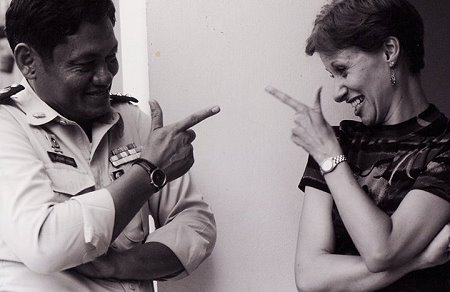
For this date’s entry we turn to The Last Executioner — the memoirs of Chavoret Jaruboon, who was the last prison executioner in Thailand.


Bang. The late (he died in 2012) Chavoret Jaruboon, on the left.

Thailand uses lethal injection today, but our narrator here was the last to conduct executions by that country’s previous execution method, a unique shooting arrangement that prevailed through 2002.*

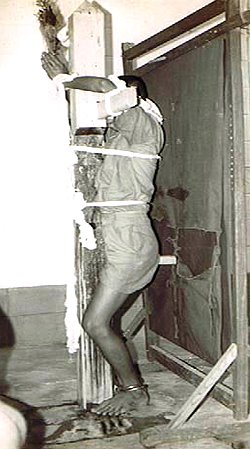
The prisoner to be executed was tied to a wooden cross, hands pinned in a prayerful position (wai), and facing a wall; behind him (or occasionally, as in today’s post, her), a screen; behind the screen, Chavoret Jaruboon with a mounted automatic rifle that would discharge a burst of up to 15 bullets into the vicinity of the heart, generally terminating life immediately.

The clientele this date were three members of a kidnap gang. Ginggaew Lorsoungnern, a former domestic for a Pathumwan, Bangkok family, had picked up from school the six-year-old child who was her former charge and delivered her to a bunch of toughs. When the ransom delivery went awry — the parents were supposed to toss the money out of a moving train at the spot of a flag, but missed the flag owing to darkness — the enraged kidnappers stabbed the little boy to death. Ginggaew allegedly flung herself over the child in a vain effort to protect him.

Inasmuch as her inside position was the lynchpin for the whole operation, however, these hystrionics would not save her from reprisal. (It wasn’t quite judicial reprisal since the execution was carried out by executive decree: not uncommon in dictatorial 1970s Thailand.) It probably didn’t help that coroners discovered soil in the victim’s lungs … meaning that when they’d dumped his body into its grave, he wasn’t yet dead.

The case was a media sensation. The late executioner’s 21st century book (copyright date: 2006) says that he was even then still “constantly asked about Ginggaew.” For what it’s worth, he thought the sentence was too harsh for her part in the crime. But executioners don’t get to make these decisions.

Ginggaew was the first woman shot in Thailand since 1942, and the first that Chavoret Jaruboon ever saw executed. In his time, he shot three women; Ginggaew is not among their number because in 1979, he was only a member of the execution team, not the man with his finger on the trigger. He was an “escort”, part of the team that brought the doomed from their cell to the execution chamber and then removed the corpse.

Escort duty was “one of the most emotional roles in the whole process of execution,” he writes. “Even the executioner does not have to see the body after he has done his job.”

And on January 13, 1979, the day Ginggaew died followed by two of her collaborators, the escorts had especially unpleasant duty.

While the men died stoic, Ginggaew was frantic, and fainted repeatedly over the hours before execution. “I didn’t do it, I didn’t kill the boy,” she pleaded. “Please don’t kill me, I didn’t kill him.”

Worse was to come.

At 5pm Ginggaew was selected to be brought to the execution room first. The escorts helped her to her feet but she immediately crumpled to the ground. She sobbed that she felt too weak to stand … As she approached the room she had to be revived from another faint.

I found this very difficult to deal with. Between us [escorts on the execution team] we finally got the stricken woman to the cross. She cried while they bound her at the waist, shoulders, and elbows. Her arms were brought up over the beam in a position of prayer. Still, she struggled and tried vainly to break free. The escorts pulled across the screen and fixed it so that the white square indicated where her heart was. Then they stepped out of range. I walked to the gun to load it and aim it at the target on the screen. I was aware that Ginggaew was still struggling. Normally once the prisoner was fixed to the cross they gave up fighting, but this was not the case with her. I secured the gun over her stifled sobs, locking it into position. When I was satisfied, I nodded at Prathom to take over. He took his position and at 5.40pm exactly he released ten bullets into Ginggaew’s body.

Doctor Porngul went up to her and checked for the pulse and retina response. As expected, he confirmed her dead. The escorts quickly untied her body, which was bleeding profusely from the chest, and laid her face down on the floor. She jerked and twitched a little. This wasn’t out of the ordinary but was distressing to witness. Her chest burst open and the blood looked like it would never stop flowing. They carried her into the morgue, the tiny room that we used just off the execution hall. I followed them just to make sure everything was alright. They placed her gently on the bed and we went out to prepare for the next one. What happened then will never leave me.

As the second prisoner, Gasem, was brought into the execution room, there was a sound from the morgue. I could see everything from where I was standing as the door was wide open — Ginggaew was trying to get up. The shocked escorts and I ran back to her. There was blood everywhere. One of the escorts rolled her over and pressed down on her back to accelerate the bleeding and help her die. Another escort, a real hard man, tried to strangle her to finish her off but I swept his arms away in disgust. We stood there watching her gasp for breath for I don’t know how long, but it could only have been a minute or two. I was filled with pity for her. I couldn’t help thinking that she was dying the way that little boy had died — except suffocating from blood instead of earth.

Meanwhile, Gasem had been shot. He died instantly from ten bullets. He had not resisted his death in any way, and spoke to nobody on the way to the cross. After the doctor confirmed that Gasem was definitely dead he checked on Ginggaew. Amazingly she was still breathing. It was a horrible, horrible situation. He told the escorts to put her back on the cross. The men complied, somewhat relieved to be able to just follow orders. It was a grim, nauseating job and they were covered in her blood when they turned to pull the screen across. This time the full quota of 15 bullets were used, and finally, she was dead.

You might wonder why we didn’t just shoot her where she lay, but it would have been against the regulations. Also, I don’t know that any of us could have stood so close to the young girl and pulled the trigger. As it was, the escorts moved as quickly as possible, each of us was concerned that her suffering should not be prolonged.

Pin had had to wait outside for ten minutes until Ginggaew was carried to the morgue for the second time. He was then brought in and tied to the cross. At 6.05pm Prathom pulled the trigger, sending 13 bullets into his back. The doctor went to check on him and discovered that he too was still alive, only just, but still breathing all the same. I loaded the gun again and Prathom shot a further ten bullets, this time killing him instantly. We were all in need of more than one stiff drink that evening.

There are a couple of reasons why Ginggaew had such a terrible death. Firstly her heart wasn’t on the left side as with most people. She most probably had Kartagener’s Syndrome, which is when a person is born with their heart on the right-hand side instead of the left. And even if it was she wasn’t secured firmly enough to the cross so she was able to move around, therefore the bullets would miss their target. It showed the importance of binding the prisoner as tightly as possible, for their own sake. I had my doubts when she was first pronounced dead. I thought I could detect some strain in her neck, and maybe that’s why I followed the escorts to the morgue. The head should normally flop backwards with the cross being the only support for the limp body.


Ginggaew, Gasem, Pin, and all others who were executed by shooting entered the execution building through this red door … now disused and overgrown since Thailand scrapped shooting. Pic from this Norwegian Amnesty International page.

After Thailand switched to lethal injection, Chavoret Jaruboon retired to a monastery. His books show no disquiet about his career. He explicitly supported the death penalty.

“What I do is empty this story (the executions) from my mind. If I don’t do that I don’t know what (the executions) will do to me.”

-Chavoret Jaruboon

* We’ve previously written about a 2001 execution by gunfire in Thailand.

On this day..

1655: Jane Hopkins, Bermuda’s last known witch execution

The last known witchcraft execution in Bermuda history occurred on this date in 1655.

The isolated English colony was at this period laboring under social crisis, or a set of crises. It had been declared in rebellion by Cromwell‘s parliament for taking too-vigorous umbrage at King Charles‘s execution. Its official C of E ministers were being challenged by breakaway independents of various stripes of Puritanism. The tobacco crop blew away one year. And it may have had a perilous gender imbalance (too many women, too few men: Bermuda definitely did have this problem in the 18th century). (Source for this whole paragraph) Perhaps it’s no surprise that its Puritan governor* would oversee a spasm of witch persecutions from 1651 to 1655.

Jane Hopkins and another woman named Elizabeth Page were both stuck in the dock on this occasion. They’d recently arrived on the Mayflower** and the captain “did vehemently suspect them to be witches,” seemingly on account of their traveling sans male.

Page bewitched the ship’s helm according to a witness who beheld her run “her finger over the compas, And yt ran round from North to South, And turned backe againe.” That’s pretty impressively infernal, but here in the 17th century they knew to look for some hard forensic evidence … so a group of matrons in Bermuda was empaneled to feel Elizabeth Page up in search of a witch’s teat. Much to the woman’s good fortune, she possessed “not any marke or spotts or signes … only something more than ordinary (in a certain place).” She was accordingly acquitted.

Jane Hopkins’ body was not so ordinary.

The eyewitness testimony against her was a fellow-passenger to whom Hopkins sighed that she wished God would send some sign clearing up all these suspicions of devilry. A rat — ubiquitous in seafaring life, mind you — promptly appeared. To add to this damning divine indictment, a peeping tom on the ship watching her dress had noticed some sort of mark on her shoulder.

Sure enough, Hopkins’s gropers discerned “in her mouth a suspicitious marke and under her arme she hath a dugge or Teat, And upon her shoulder a wart, and upon her necke another wart … all these were insensible when they were prickt.” With this sort of slam-dunk evidence, the jurymen could hardly do otherwise than agree that Hopkins “hath felonously and wickedly consulted and covenanted with the Devil & him hath suckled and fedd contrary to nature & the law of God and man, as doth appeare by markes & signes upon her body.” (The full trial records can be perused here)

It’s not absolutely certain that Jane Hopkins was the last person executed in Bermuda for witchcraft. There were several additional witch prosecutions to follow in the 17th century: some ended in acquittal, others in conviction. There was even at least one more death sentence, but that hanging was stayed and the final disposition of the case is unknown.

* Governor Josiah Forster’s legacy for the isles — other than hanging witches — was the “Forster Chair” made in his honor.

** Not the same ship as the Mayflower of Plymouth Colony fame.

On this day..

1868: Priscilla Biggadike, exonerated Stickney murderess

On this date in 1868, Priscilla Biggadike withstood one last gallows-foot plea from her minister to admit to poisoning her husband.

‘I implore you not to pass away without confessing all your sins; not only generally, but especially this particular case, for which you are about to suffer. I had hoped that you would have made that confession, and thus have enabled me, as a minister of Christ, to have pronounced the forgiveness of your sins … It has grieved me much to find that [you] still persist in the declaration, that you are not accountable for your husband’s death; that you still say that you did not administer the poison yourself; that you did not see any other person administer it, and that you are entirely free from the crime. Do you say so, now?

The Prisoner, still in a firm voice, said, yes.

The Chaplain. — There is only one [hope] left, that you have endeavoured to confess your sins to God, though you will not to your fellow creatures. All I can now say is that I leave you in the hands of God; and may he have mercy on your soul. What a satisfaction it would be to your children, to your friends, to your relations, to know that you had passed from death into life, in the full persuasion that your sins were forgiven you … I am sorry I cannot exercise that authority [to pronounce sins forgiven] at the present moment.

Then, at the stroke of 9 a.m., she was hanged by ten-thumbed executioner Thomas Askern. True to form, Askern made a mess of it, and Biggadike painfully strangled to death with the rope’s knot infelicitously positioned under her chin* … although, since this execution was behind the walls of Lincoln Castle (in fact, it was the first female hanging after an 1868 Act of Parliament had made all hangings private), at least it didn’t incense a vast concourse of onlookers.

Posterity, though, has taken plenty of umbrage at Priscilla Biggadike’s fate.

She and her late husband Richard kept two lodgers in a two-room house in the village of Stickney.

Richard already suspected an affair between Priscilla and one of those lodgers, Thomas Procter (or Proctor), when he returned home from work on September 30, 1868, enjoyed tea and cakethat his wife had made for him, and then fell violently, fatally ill. The post-mortem examination showed Richard Biggadike had been poisoned with arsenic.

Priscilla Biggadike and Thomas Procter were both arrested on suspicion of murder but charges against Procter were soon dropped.

Priscilla was known to have quarreled with her husband over that whole infidelity thing, and she had alluded at least once to having arsenic around for killing mice. She was accordingly found guilty of poisoning him, though “only,” in the words of the jurors when the judge pressed the question, “upon the ground of circumstantial evidence.”

Indictment, trial, conviction, and execution for the “Stickney Murderess” wrapped up in two months’ time. But the discharged co-accused, Thomas Procter, years later made a deathbed confession that it was really he who poisoned Richard Biggadike.

(During the investigation, Priscilla had even attempted to blame Thomas Procter, reporting that on one occasion prior to the murder he’d even made what looked like an attempt to poison Richard by mixing white powder into his tea, after which Richard became sick. Police didn’t regard the accused as a particularly credible source for obvious reasons, but it’s hard to believe anyone would have failed to follow up on that sort of lead.)

On account of that whole wrongful-hanging mix-up, Priscilla Biggadike received a posthumous pardon. She’s even had a short musical made about her conviction, which was recently performed in Lincoln Castle. If you visit, you can still see the cell where she passed her final days.

* The bad botch of this job led Lincolnshire officials to audition for their next execution a local cobbler and amateur noose enthusiast destined to revolutionize the British hanging with his scientific approach: William Marwood.

On this day..

1635: Hester Jonas, cunning-woman

On this date in 1635, the aged cunning-woman Hester Jonas was beheaded as a witch in the city of Neuss.

Torture chair-illustrated title page of Hetty Kemmerich’s study of German witchcraft prosecutions, including but not limited to Hester Jonas’s. Sagt, Was Ich Gestehen Soll! has not been translated from German, but is available from Amazon.de.

Jonas (English Wikipedia entry | German), one of the better-known German witch-hunt victims, was an epileptic midwife who knew her way around the mandrake.

She was around 64 years of age when longstanding rumors of her witchiness triggered her arrest in the Hexenprozesse-crazed atmosphere of the Thirty Years War. The city’s mayor came right out and accused her of taking the devil into her bed, signaling that Jonas would have a difficult time escaping the scaffold.

Although the accused denied the charges at proceedings in November, ten hours naked in a spike-studded torture chair secured the customary confession — in this case, to fornicating in the turnip field with a black man named “Hans Beelzebub” who gave her magical powers. (Source, in German)

She managed to escape confinement the very night after she made these “admissions” but was re-taken, and her attempts to repudiate her previous self-incriminations flogged out of her.

After the executioner struck off her head, burned her body, and scattered her ashes to the four winds, her husband got the executioner’s bill for 65 Thalers.

20th century Dusseldorf poet Peter Maiwald wrote a “Ballade von der Hester Jonas” in honor of our date’s victim. The German band Cochise released an interpretation of this ballad on its 1979 album Smoke Signals.

On this day..

1711: Phebe Ward, Thomas Pritchet and John Matthews

“Of these twelve Persons, 9 having obtain’d the Mercy of the QUEEN’s most gracious Reprieve (which I hope they will take care to improve) only 3 are now order’d for Execution.”

Ordinary of Newgate

The three unlucky ones order’d for Execution on December 22, 1711, were these:

Phebe Ward was a young woman who had lately moved to London from Yorkshire … but not alone, as it turned out. She was pregnant by a Yorkshire lad whose marriage proposal she nonetheless spurned.

Ward got a maidservant gig in a London home, but vigorously denied her condition. Pregnant servants were liable to firing, though the Ordinary of Newgate says that Ward’s tried to offer hers good treatment and care for the little bastard. Ward stuck to her “I’m not pregnant” story, delivered the child, suffocated it, and threw it down a well.

Thomas Pritchet was a mere 16 years old but already had seven years service in the royal navy. A native son of the London proletariat, Pritchet had robbed two men (one upon the highway, another by burgling his house) not five weeks before his execution; at the gallows he insisted that these were his first forays into crime.

John Matthews was “born of good Parents” and “formerly liv’d like a Gentleman” in Wales, but having no profession the exhaustion of his revenues caused him to become a professional thief … specializing in the increasingly valuable 18th century status symbol, the wig.

He’d been pardoned for his crimes twice before, so this indictment for stealing 24 ounces of hair and two perukes sealed his fate.

We noticed yesterday the voice of the Newgate Ordinary. A generation on here, the former Ordinary Samuel Smith was long in the ground. His successor, Paul Lorrain had really figured out Smith’s profitable racket.

Lorrain banked a healthy £200 annually selling his Ordinary’s Accounts, which he standardized and padded out from Smith’s versions into six-page pamphlets — not to mention spinoff publications (pdf) capitalizing on his gallows brand.

The celebrated sincerity of every culprit’s dying conversion led a later wag to call the hanged “Lorrain’s Saints.” In Moll Flanders, published two years after Lorrain’s 1719 death, Defoe has an unnamed character of his office who seems clearly based on the late divine. Moll, like Defoe himself,* finds the Ordinary repulsive.

THE Ordinary of Newgate came to me, and talk’d a little in his way, but all his Divinity run upon Confessing my Crime, as he call’d it, (tho’ he knew not what I was in for) making a full Discovery, and the like, without which he told me God would never forgive me; and he said so little to the purpose, that I had no manner of Consolati|on from him; and then to observe the poor Creature preaching Confession and Repentance to me in the Morning, and find him drunk with Brandy and Spirits by Noon; this had something in it so shocking, that I began to Nauseate the Man more, than his Work, and his Work too by degrees for the sake of the Man; so that I desir’d him to trouble me no more.

It’s less certain that Lorrain’s ministrations were unwelcome to all of Newgate’s denizens, or that they were hypocritical or cynical on their own terms.

He preached a theology (surely requisite for one in his position) of a saving grace capable of overcoming the most dissolute life and appears every ounce in earnest in exerting himself for what he took to be the redemption of his charges. He reports preaching to this date’s trio that they ought “to implore it of that good and merciful God, who is always more ready to give, than Men can be to ask; and who (as he has declar’d) desires not the Death of Sinners, but that they should turn from their wicked ways, and live: i.e. that they would return to God by sincere Repentance, and Amendment of Life here, and so obtain (thro’ a lively Faith in Christ) an Eternal Life of Bliss and Glory hereafter.”

In the last prior hanging date before this one, Lorrain had found one seasoned burglar “obstinate” and plainly irritated by his ministrations.

“But I told him,” Lorrain related, “that I must not flatter him to the destruction of his Soul, and thereby bring Guilt upon my own. And therefore, I would not give over pressing him to make such a sincere Acknowledgment of his Faults, and give such Proof of his Repentance, as might rejoyce my Heart from the Satisfaction I should have, that this would procure Peace to his Conscience.

“Though you exclaim never so much against what I offer you, I am fully resolv’d to endeavour the Salvation of your Soul.”

Lorrain got his man. He did more times than not.

He plied even ready confessors for “Particulars” to ferret out their crimes — and sometimes, their accomplices. (Recall that London had no police force at this time.) Those who bent themselves to Lorrain’s appeals would expunge all their wrongdoing, embrace the ceremony of their own mortal expiation, purging themselves of their sins, supplicating heaven, announcing the justice of their fate and warning the onlookers against it. They would, so the Ordinary thought, be fit for divine salvation no matter how bloody their former deeds.

One other point on which we can’t help but feel some kinship to this industrious priest: in the best tradition of death-bloggers everywhere, this content so piously wrung from wicked hearts Lorrain did not scruple to monetize:

ADVERTISEMENTS.

ROBERT WHITLEDGE, who formerly lived at the Bible in Creed-Lane, is removed to the Bible and Ball in Ave-Mary-Lane near Ludgate, where all Booksellers and others may be furnisht with Bibles and Common-Prayers of all Sorts, with Cuts or without, Ruled or Unruled, Bound in Turky Leather or Plain. Mr. Sturt’s Cuts Curiously Engrav’d; also other fine Cuts fitted for all Sizes and Common-Prayers. The Welsh Bible, Welsh Common-Prayer, and Welsh Almanack. The Duty of Man’s Works of all Sizes. The Duty of Man in Latin. Latin and French Common-Prayers. Tate and Brady’s New Version of Psalms, with the New Supplement. Dr. Gibson on the Sacrament. The Statutes at large, in Three Volumes. Washington and Wingate’s Abridgment of them. The Lord Clarendon’s History of the Rebellion, in Folio and Octavo. The New Translation of Æsops Fables. Also Bp. Beveridge’s Works, in 5 vol. And Dean Stanhope on the Epistles and Gospels, in 4 vol. All which Books and Cuts are likewise sold by J. Baker in Mercers-Chapel

Lately publish’d for the Use of Schools,

Vocabularium Latiale; or, a Latin Vocabulary in two parts. The First being a Collection of the most usual and easie Latin words, whether primitive or derivative; with their signification in English, after the order of the Eight parts of Speech, giving a Specimen of each, and most naturally shewing the gender, increase, declension and motion of Nouns and Pronouns, with the Conjugation-Preterperfect Tense and Supine of Verbs both Simple and Compound. The Second, shewing the variation and declining of all the declinable parts, both regular an irregular. By Tho. Dyche, School-Master in London, Author of a new Spelling-book, entitul’d, A Guide to the English Tongue. Printed for S. Butler, at Bernard’s-Inn-Gate, in Holbourn, J. Holland, near St. Paul’s Church-yard, and A. Collins, at the Black-Boy in Fleet-street. Price 1 s.

London printed, and are to be Sold by J. Morphew, near Stationers Hall.

* For more about Paul Lorrain (and Defoe’s loathing of him), see:

Robert Singleton, “Defoe, Moll Flanders, and the Ordinary of Newgate,” Harvard Library Bulletin, Oct. 1976.

Lincoln Faller, “In Contrast to Defoe: The Rev. Paul Lorrain, Historian of Crime,” Huntington Library Quarterly, Nov. 1976.

On this day..

1692: A batch at Tyburn, escorted by the Ordinary of Newgate

December 21 was an execution date at Tyburn in 1692, with eleven men and women put to death.

They were, as usual, physically escorted on the 21st — and spiritually escorted in the days leading up to that black date — by the Ordinary of Newgate.

We have often referred to this character and, in the present series, cited him repeatedly.

But who was the Ordinary of Newgate? Why is he so omnipresent in our English hanging narratives?

This clergyman was appointed to London’s stinking prison to tend to the souls of its inmates, particularly those condemned to die.

Under the tenure of Samuel Smith, the Ordinary of Newgate began in about 1684* to put out a regular broadsheet published the day after London’s eight or so annual hanging-days. Laboriously titled The Ordinary of Newgate, His Account of the Behaviour, Confession, and Dying Words of the Malefactors who were Executed at Tyburn, it was sold by street-peddlers for (at first) a penny.

A typical Ordinary’s account by Smith had a three-act arc:

  1. An account of the honored clergyman’s own sermonizing, even the literal day-by-day exhortations and their progress (or not) in bringing the condemned round to a satisfactory spiritual state. The Account for December 21, 1692, for instance, begins:

    THE Ordinary preacht several Sermons to the Condemed Criminals being Twenty One. The first was on the Lord’s-Day immediately before their Condemnation on the Monday following, from this Text, viz. The 19th. Psalm, the 12th. Verse. Who can understand the Errors of his Life? Cleanse thon me from my secret Faults. The Observation from the Words was this, That the smallest Sins even Errors in Opinion and Infirmities in our Obedience to God’s Laws, ought to be repented of, as needing pardoning Mercy.

  2. Biographical thumbnails of the condemned, of no regular format but often remarking the person’s age, profession, birthplace, and life circumstances … and always attentive to whether s/he had come by repentance. This is Samuel Smith’s take on one of the 11 hanged today:

    Robert Marshal: Condemned for Murthering William Curtys, in White-Chappel. He pretended now, as formerly, that he is blind, and Begged under that Disguise. But being denied Relief by Curtys, Marshal, with his Begging-staff, in both his Hands, struck him on the Head, and made a Fracture in his Skull, of which he died; and he immediately attempted to run away. He confessed on Tuesday, that though his Sight was not strong enough for Labour, yet he could see his Way, in Walking, so as to go safely. He was born in Jamaica, bred up a Sea-man . He was unwilling to give any Account of his Life, being very obstinate.

  3. The scene at Tyburn itself, with the Ordinary’s prayers and the public behavior and confessions of the doomed.

    They were fervently exhorted to Confess their Faults, the Effects of which had brought them to such disgrace: After which the Ordinary took great pains with them in Prayer, and other suitable Applications, to bring them to a sense of the near approaches of Death; to which they adher’d, and joined in the Prayers; and singing of a penitential Psalm in as fervent a manner as could be reasonably expected from Persons of so mean Education, as were the most of them. They lamented their dismal Fall, desiring all Spectators of such a Tragedy to be warn’d by them, &c.

    As to the Particulars of their Confessions. they did not much enlarge themselves; only the Blind Man was penitent, and desired all Persons to take warning by him; owning that he could see; hoping God would forgive him all his Offences, &c.

In the 18th century these hang-day reports would expand even further.

For historians these records, formulaic as they are, remain “a unique and inestimable source of knowledge of the poor people who were hanged.” (Linebaugh).

For the Ordinary’s contemporaries, they were something else besides: the voice of authority on “the Malefactors,” their usual submission, the facts of their lives and the expected public lessons of the crimes and punishments.** Certainly the Ordinary was at pains to assert his “official” status; in the Account at issue for this date’s hanging, he appends the notice,

Whereas there formerly have been, and still are, several False Accounts in Print, in relation to the Condemned Prisoners; and particularly, this very Session, that Robert Marshal, the Blind Beggar, was Executed two Days since; which is utterly false: The Ordinary thinks it necessary to acquaint the World, (to prevent the like for the future,) that no true Account can be given of the Condemned Prisoners Behaviour, Confessions, and Last Dying Speeches, which is not Attested under his own Hand.

Accept no substitutes!

The Ordinary had good reason to defend his position, for the Ordinary’s own livelihood depended upon his marketing his black-bordered pamphlets. This was naked entrepreneurship, direct to Smith’s pocket, and his product stood in competition with every other scandal-sheet hawker crowding the gallows.

Nor was the printed word the only way to monetize the office of Ordinary. In an environment when many people were condemned to death and many were pardoned, Smith was accused of shaking down prisoners to intervene for more lenient treatment.

For instance, in this wonderfully vicious send-off to the cleric after he died in 1698, satirist Thomas Brown accuses Smith (in the bolded passage) of taking payola to help illiterate prisoners claim benefit of clergy — an anachronistic legal mechanism wherein a condemned first-time offender could escape the noose by showing that he could read. (The loophole was reformed in 1706 to eliminate the reading test entirely, although this also came with making many offenses no longer “clergyable” at all.)

An Elegy on that most Orthodox and Pains-taking Divine, Mr. Samuel Smith, Ordinary of Newgate, who died of a Quinsey, on St. Bartholomew’s Day, the 24th of August, 1698.

Tyburn, lament, in pensive sable mourn,
For from the world thy ancient priest is torn.
Death, cruel death, thy learn’d divine has ended,
And by a quinsey from his place suspended.
Thus he expir’d in his old occupation,
And as he liv’d, he dy’d by suffocation.
Thou rev’rend pillar of the triple-tree,
I would say post, for it was prop’d by thee;
Thou penny-chronicler of hasty fate,
Death’s annalist, reformer of the state;
Cut-throat of texts, and chaplain of the halter,
In whose sage presence vice itself did faulter:
How many criminals, by thee assisted,
Old Smith, have been most orthodoxly twisted?
And when they labour’d with a dying qualm,
Were decently suspended to a psalm?
How oft hast thou set harden’d rogues a squeaking,
By urging the great sin of Sabbath-breaking;
And sav’d delinquents from Old Nick’s embraces,
By flashing fire and brimstone in their faces?
Thou wast a Gospel Smith, and after sentence
Brought’st sinners to the anvil of repentance;
And tho’ they prov’d obdurate at the sessions,
Couldst hammer out of them most strange confessions,
When plate was stray’d, and silver spoons were missing,
And chamber-maid betray’d by Judas kissing.
Thy christian bowels chearfully extended
Towards such, as by their Mammon were befriended.
Tho’ Culprit in enormous acts was taken,
Thou would’st devise a way to save his bacon;
And if his purse could bleed a half pistole,
Legit, my lord, he reads, upon my soul.

Spite of thy charity to dying wretches,
Some fools would live to bilk thy gallows speeches.
But who’d refuse, that has a taste of writing,
To hang, for one learn’d speech of thy inditing?
Thou always hadst a conscientious itching,
To rescue penitents from Pluto’s kitchen;
And hast committed upon many a soul
A pious theft, but so St. Austin stole:
And shoals of robbers, purg’d of sinful leaven,
By thee were set in the high road to heaven.
With sev’ral mayors hast thou eat beef and mustard,
And frail mince-pies, and transitory custard.
But now that learned head in dust is laid,
Which has so sweetly sung, and sweetly pray’d:
Yet, tho’ thy outward man is gone and rotten,
Thy better part shall never be forgotten.
While Newgate is a mansion for good fellows,
And Sternhold‘s rhimes are murder’d at the gallows;
While Holborn cits at execution gape,
And cut-purse follow’d is by man of crape;
While Grub-street Muse, in garrets so sublime,
Trafficks in doggrel, and aspires to rhime;
Thy deathless name and memory shall reign,
From fam’d St. Giles’s, to Smithfield, and Duck-lane.
But since thy death does general sorrow give,
We hope thou in thy successor will live.
Newgate and Tyburn jointly give their votes,
Thou may’st succeeded be by Dr. Oates.

* There are irregular Smith accounts from the late 1670s (he took over the position in 1675) as he felt out the genre, but he only institutionalized the periodical in the mid-1680s.

** Smith and all the Ordinaries harp endlessly on what amount to “gateway crimes”: idleness, drunkenness, bad company, and especially (as our satirist observes) breaking the Sabbath. They’re constantly inveigling prisoners to warn the execution crowd against these vices.

On this day..

1684: Jane Voss, narrow escapee

On this date in 1684, Jane Voss was hanged

We pass over for this entry her four companions in death: a couple of forgettable gentleman highwaymen; a murderer fled to the continent; a coiner named D’Coiner.

Each a fellow with an interesting tale of his own, no doubt, but for Jane Voss one notices her perpetual proximity to the gallows. It’s a reminder that for a certain class of person, the omnipresent prospect of a sudden trip to the hanging-tree — intended as a mortal terror — was little but the everyday circumstance of a life nasty, brutish and too often short.

A chapbook of the day’s crop* records that the notorious Jane’s “frequent felonies and often Convictions have made her known to most in and about London, she having been above 12 times in Newgate, and several times Condemned to dye.”

She fortuitously escaped such a fate as an an accessory to Thomas Sadler’s theft of the High Chancellor’s ceremonial mace eight years before.

Not being a principal culprit in that escapade, Voss got off with penal transportation, only returning (at least insofar as the English authorities knew) legally after her transportation term had ended.

Our correspondent alleges that “no less than 7 Persons, whom had passed for her Husbands, have at several times been Executed for Robberies, &c.” Indeed, one notorious highwayman named John Smith (alias Ashburnham) hanged earlier in April 1684 had made a point of asking the Newgate Ordinary to send word to Jane Voss to cool it lest she follow him.

Alas, it was right about this time that Jane snatched her last silver tankard. She’d had too many reprieves to escape this time … save for the mandatory stalling mechanism of pleading her belly.**

* “True account of the behaviour, confessions, and last dying words, of Capt. James Watts, Capt. Peter Barnwell, Daniel D’Coiner alias Walker, Richard Jones, and Jane Voss alias Roberts,” 1684. (via Early English Books Online)

** Here’s Jane Voss’s Old Time Restoration England Pregnancy-Simulating Potion: drink “a Gallon of New Ale and Honey” before examination. Use as needed.

On this day..

1691: Eleven at Tyburn

“Having Intangled themselves in the snares of Death, by their Dissolute Practices, against all the warnings of Publick Justice on other Criminals,” as the Ordinary’s Account puts it, 11 men and women “provokt the Lord to set them out, as monuments of his present severe, yet Righteous Judgement” and therefore hanged together on this date at London’s Tyburn gallows.*

Murderers (and -esses)

William Harsey was taken literally red-handed, found by the St. Katherine’s watch passed out drunk, still gripping a bloody knife. He’d wetted the blade in three different bodies that night, one of them his good friend (also drunk). Two died; one survived to testify against Harsey.

Mary Mott‘s infant son was found lying dead in a gutter on her rooftop, by a laborer working on the chimney. She claimed it was stillborn, but was unable to prove it: the presumption in such instances went against the mother, on the grounds that every infanticide would simply claim stillbirth otherwise.

Thieves

William Smith “said that he was guilty of all sins except Murther, he named Sabbath breaking, Drunkenness, and Uncleanness.” John Barret, a burglar, copped to the same trio of gateway sins.

Less repentant were two other robbers who had no use for the Ordinary’s god-bothering, to the detriment of their bloggable biography: Richard Johnson, who “was not concerned for his bad Life, and withdrew himself from Chappel,” and Anne Miller, who “refused to come to the Chappel, saying she was a Papist.”

Posterity has much more on Mary Jones, a scarf-maker whose lover squandered all her revenues and drove “Moll” to make an illicit living by the dexterity of her fingers. Having been branded on the hand for picking the royal chocolatier’s pocket, Jones turned to the boom trade in shoplifting London’s growing traffic of valuable little textiles like stockings and lace.

She must have had no small gift for the five-fingered discount as she practiced it for 3-4 years. “She was apprehended for privately stealing a piece of satin out of a mercer’s shop on Ludgate Hill, whither she went in a very splendid equipage and personated the late Duchess of Norfolk, to avoid suspicion of her dishonesty; but her graceless Grace being sent to Newgate, and condemned for her life at the Old Bailey.”

Hanging day would hardly be complete in the late 17th century without a highwayman like William Good, who with a buddy (uncaptured) carriage-jacked a gentleman on the London-Hackney road and made off with the 12-Days-of-Christmas-like trove of “a Dyaper Napkin Value 12 d. Twelve Larks, Two Ducks, and an Embroidered Wastcoat.”

Where Good hangs, there will you also find Malice — Humphrey Malice, to be exact, “Condemned for Robbing a Gentleman in Chelsy Field” in which crime he nevertheless enjoyed “no share in the spoil.” His better remunerated (and less interestingly named) confederate Edward Booth hanged with him. The gentleman in question was Malice and Booth’s second victim of the night, the first having been a more working-class sort who was stripped stark naked and could still only produce eight coppers. Malice and Booth gave him a vengeful thrashing for their trouble and told him “that the next time he went abroad, he should put more Money in his Pocket.”

Thomas Taylor, a parson’s son “addicted to idleness,” was in fact quite industrious when it came to robbery. There’s a story from his career of engineering a buffoonish caught-in-the-town-pillory routine to distract a crowd of yokels while his pickpocket buddies plucked them clean. His fatal crime was an even more audacious twist on the same, in which Tom, acting alone this time, fired a barn, then joined the resulting rescue scramble and made off with a trunk full of plate and £140 cash. He would later admit this was not the first time he had used this gambit.

The arson was the source of his condemnation, but we could not pass over the Newgate Calendar’s remembrance of a different and dreadfully amusing larcenous exploit … which also goes to show the very private, and very punitive, nature of crime prevention in those days.

Taylor being pretty expert at picking of pockets, he set up for himself; and one day going to the playhouse in Drury Lane, very well dressed, he seated himself by a gentleman in the pit, whose pocket he picked of about forty guineas, and went clean off. This good success tempted Tom to go thither the next day in a different suit of clothes, when, perceiving the same gentleman in the pit whose pocket he had picked but the day before, he takes his seat by him again. The gentleman was so sharp as to know his face again, for all his change of apparel, though he seemed to take no notice of him; whereupon putting a great quantity of guineas into the pocket next Tom, it was not long before he fell to diving for them. The gentleman had sewed fishing- hooks all round the mouth of that pocket, and our gudgeon venturing too deep, by unconscionably plunging down to the very bottom, his hand was caught and held so fast that he could in no manner of way disentangle it.

Tom angled up and down in the pocket for nearly a quarter of an hour; the gentleman, all the while feeling his struggling to get his hand out, took no notice, till at last Tom, very courteously pulling off his hat, quoth: “Sir, by a mistake, I have somehow put my hand into your pocket instead of my own.” The gentleman, without making any noise, arose and went to the Rose Tavern at the corner of Bridget Street, and Tom along with him, with his hand in his pocket, where it remained till he had sent for some of his cronies, who paid down eighty guineas to get the gudgeon out of this dry pond. However, the gentleman, being not altogether contented with this double satisfaction for his loss, most unmercifully caned him, and then turning him over to the mob, they as unmercifully pumped him and ducked him in a horse-pond, and after that so cruelly used him that they broke one of his legs and an arm.

Taylor, the Ordinary reported, “behaved himself very undecently and unhandsomely, all the way from Newgate to Tyburn.”

* A good round number: it was Tyburn’s second 11-spot of the year.

On this day..