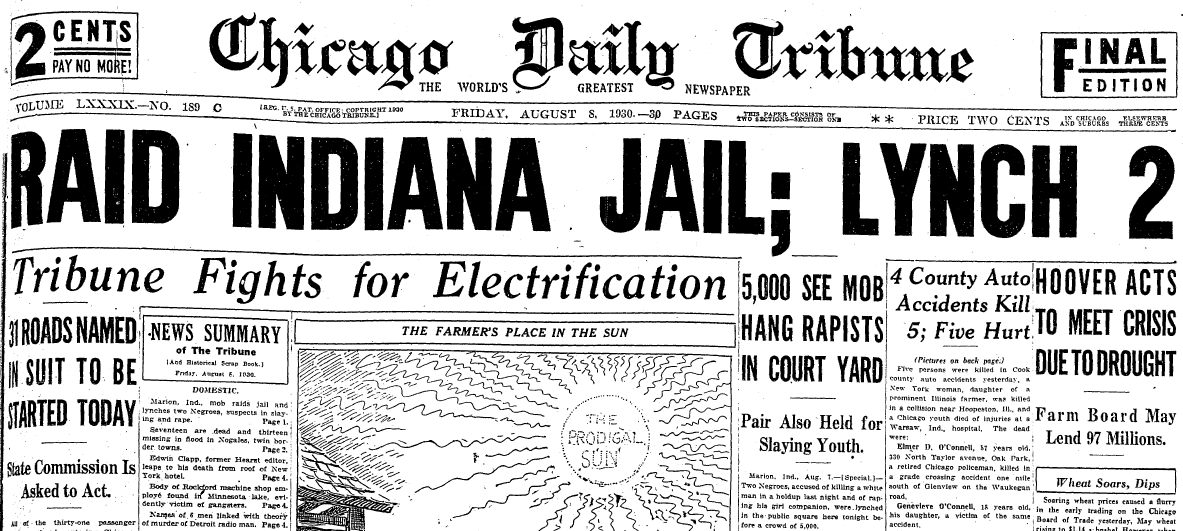
On this date in 1930, two black youths were lynched in Marion, Indiana for murdering a white man and raping his girlfriend.
(The rape allegation — although it, and not the homicide, seems to have been the thing that triggered the lynching — was subsequently withdrawn, and there were even rumors that the white girlfriend was a lover and confederate of one of the lynched men. It’s just one strand in the very human tapestry around the “last classic lynching north of the Mason-Dixon line” explored by Cynthia Carr in Our Town: A Heartland Lynching, a Haunted Town, and the Hidden History of White America.)
Shipp, who is said to have confessed killing the white man, Claude Deeter, 23, of Fairmount, Ind., was hanged from an elm tree in the courthouse yard. Smith, whom the girl identified as her assailant, was thrown from a third floor window of the jail with a noose around his neck and strangled.
…
Reports of the crimes and confessions, published in Marion newspapers this afternoon, stirred this quiet community of 23,000 to intense excitement. There was no hint of the impending violence, however, until 8:30 p.m., when a motorcade of Deeter’s fellow townsmen arrived from Fairmount.
The Fairmount delegation, numbering about 100, gathered in the public square, openly displaying their guns and shouting for a lynching … The sheriff led his deputies to the front door, argued a moment with the leaders of the mob and then ordered the tear bombs thrown. Blinded, the lynchers fell back for a few minutes, but returned and began the sledge hammer siege which forced the jail doors within ten minutes. No shots were fired on either side.
Following the lynching the mob gathered in the square for an hour, some proposing to drive the 2,000 members of the Negro colony from the city and burn their dwellings. Peace officers from Indianapolis, Kokomo, Fort Wayne, and other towns were arriving however, and gradually the mob broke up.
The corpses hung in the square for hours, attracting throngs of gawkers — including a photographer able to snap this picture:
Teacher/poet Abel Meeropol ran across this photo of the Shipp-Smith lynching a few years later in a magazine, and it so “haunted” him — his word — that he penned the anti-lynching poem “Strange Fruit”. You know it from Billie Holiday‘s arresting vocal rendition.
Southern trees bear strange fruit
Blood on the leaves
Blood at the root
Black bodies swinging in the southern breeze
Strange fruit hanging from the poplar trees
Pastoral scene of the gallant south
The bulging eyes and the twisted mouth
The scent of magnolia sweet and fresh
Then the sudden smell of burning flesh
Here is a fruit for the crows to pluck
for the rain to gather
for the wind to suck
for the sun to rot
for the tree to drop
Here is a strange and bitter crop
Abel Meeropol was no passing sentimentalist himself, but a prolific left-wing activist. During the McCarthy years, he adopted the children of the Rosenbergs when the latter were electrocuted as Soviet spies. As faithfully as those two orphaned boys have carried the torch for their lost birth parents, they also still carry an adoptive surname: Michael Meeropol and Robert Meeropol.
A third person was almost lynched in the same Marion, Ind., incident, but 16-year-old James Cameron (sometimes called “Herbert” or “Robert” in the 1930 news reports) managed to convince the mob that he wasn’t involved. Just how he managed this feat and what he’d really been up to is another strand of Carr’s tapestry: many of the Marion blacks as well as whites she interviewed overtly mistrusted Cameron.
At any rate, the crowd let him off with a beating, and Cameron served time as an accessory to the crime.
After release, he became an anti-lynching activist in Indiana and, later, Wisconsin — where he founded a (since-shuttered) Black Holocaust Museum. He started several NAACP chapters.
In the more immediate aftermath, it was far from a given that this date’s effusion of summary justice wouldn’t cascade into a generalized racial pogrom.
As the Tribune article notes, the lynch mob mulled attacking the black community, ultimately dissuaded by the gradual arrival of lawmen. By the next day, the Indiana national guard had occupied Marion. The Tribune on Aug. 10 reported the town “peaceful to all outward appearances but acutely aware of an undercurrent of racial antagonism that it feared might flame into open warfare at any moment.”
Lest this seem a bit over-the-top, recall that all this went down just a few years since a lynch mob in Tulsa had metastasized into one of America’s most notorious race riots. The prospect of wholesale bloodletting was very real.
When the local attorney general and grand jury waved away the small matter of punishing mob leaders, several of whom were publicly known by name, Indianapolis attorney general (and Marion native) James M. Ogden drove up to town and personally filed indictments, to the fury of white residents.
“It was astonishing to see and feel the mob atmosphere that still prevailed nearly seven months after the murder,” wrote a correspondent for The Nation. Ogden’s deputies were “looked upon as enemies of the community, not only by the mob, but also by most of the court officials.” After all-white juries acquitted the first two people tried, the state dropped its remaining indictments.
The maelstrom of race and politics and history that emerged from that first fatal transaction — a brutal but banal Lover’s Lane heist — grew so far beyond the original cast of criminal and victim that they practically became secondary to the story.
On August 8, 1930, a wire story datelined Fairmount, Ind., ran in the Indianapolis Star (but not the Marion papers):
Deep regret that the negro slayers of their son Claude, were lynched in Marion last night by a mob, was expressed today by Mr. and Mrs. William Deeter, members of the Apostolic faith, a sect similar to the Quakers.
“God should have been the judge,” said the elderly Deeter. “They had no right to do it,” his wife assented.
Both are opposed to capital punishment and did not want to see the negroes put to death for their crime.
On August 6, 1942, in the Warsaw Ghetto, Polish/Jewish hero Janusz Korczak marched with his orphans to the death trains and into legend.
The man, his activities in the ghetto, and above all his famed final walk to the Umschlagplatz, are mentioned in many books and memoirs about the ghetto.
Korczak’s real name was Henryk Goldschmidt. He took the name Janusz Korczak (pronounced “ya-nish kor-chok”) for his writing and it wound up taking over his entire life, a la Mark Twain.
Born in an observant Jewish household in Warsaw (which was then Russian Territory) in either 1878 or 1879,* he became man of the house after his father suffered a nervous breakdown in 1889 and eventually had to be hospitalized.
By thirteen, bored by school, he was writing poetry and learning foreign languages by himself. He went to medical school and served as a military doctor with the Russian Army in the Sino-Japanese War of 1905-1906. Eventually he was promoted to the rank of major.
Korczak’s true calling wasn’t in medicine, however, but in writing and in working with children. He found himself drawn to neglected and abused youngsters, and believed in treating every child with honesty and respect.
While he was in China with the military, his first book, Child of the Drawing Room, became famous in Poland. He didn’t realize he was a celebrity until he returned home.
He tried to distance himself from his writing and his fame and be an ordinary pediatrician, but people wanted to see him, to the extent that they would pretend their children were sick in order to entice him to their homes.
Korczak wrote later that one woman claimed her sons had the flu and, when he made a house call, insisted on serving him tea.
“Have you been writing anything lately?” she asked.
“Prescriptions,” he replied, and left, realizing he’d been had.
In 1910, he gave up his medical practice to start an orphanage for Jewish children age seven to fourteen. His institution was very different from most of that time and place, for Korczak had very democratic ideas: the children wrote their own newspaper and had their own parliament and court system.
If one child had a falling-out with another, the urchin could “sue” and bring a case to be decided before the orphanage court, which met once a week. (Even teachers and other staff members could be sued.) The orphanage court also held trials for children accused of violating one of the home’s rules.
Children were rewarded for good behavior, and spanked only as a last resort. Every child had a private, lockable drawer to hold their most precious belongings. Korczak carefully monitored the children’s health and also acted as a sort of informal therapist, encouraging them — most of them orphans from backgrounds of desperate poverty and abuse — to talk about their feelings. The children called him Pan (“Mister”) Doctor.
When World War I broke out, Korczak left the orphanage to serve in the Army again. He left it in good hands, however, in the care of teachers and staff he had trained himself.
“All the world is submerged in blood and fire, in tears and mourning,” he wrote sadly of his war experiences.
It was while in the trenches on the Eastern Front that he began writing a book on child development, titled For The Love of a Child. In 1918, the war finally ended, Poland became a free and independent nation, and Korczak returned to his orphans in Warsaw.
He stayed busy, setting up a second orphanage in 1919, and afterwards writing King Matt the First. The novel, a children’s story about a young boy who becomes king and puts the country’s children in charge, became a bestseller throughout the country in the wake of the calamity lately unleashed by the grown-ups. The sequel, King Matt on the Desert Island, was also a commercial success.
Korczak continued to work for his children, however; he consulted at Warsaw’s juvenile court, and in 1928 founded third orphanage, called Our Home, which had attached dormitories for teachers-in-training and was intended for Catholic children.
In 1925, Korczak wrote another book called When I Am Little Again, told from the point of view of a middle-aged teacher and meant to be read by both children and adults.
He started a children’s newspaper, the Little Review, in 1926. Saying he wanted to “defend children” in his new paper, he invited children from all over Poland to write and tell him the stories of their lives. The newspaper lasted until 1939.
He also hosted a hugely popular radio show, using the name “Old Doctor.” The program was terminated in 1937, however, after only a couple of years; Korczak’s employers with the radio station were reluctant to keep a Jew on the air. When his identity became known, the right-wing press castigated him, saying that as Jew he could never be a real Pole and shouldn’t be allowed to educate Polish children.
Like any public figure, Korczak had his critics. Anti-Semites called Our Home “a new nest of Masonry and potential Communism erected in the heart of the capital.” Communists said his institutions weren’t Communist enough; Zionists criticized him for not directing the children towards a life in Palestine; religious Jews said there wasn’t enough religion in the orphanages while assimilationist Jews said there was too much.
Yet Korczak’s methods worked.
In a follow-up study he conducted of all the former residents 21 years after the first of his institutions was opened, he found that only a few had turned to crime or prostitution as adults. The same could not be said for children who graduated from other children’s homes in Poland.
During the 1930s, many of Korczak’s friends encouraged him to move to Palestine to escape the growing problems in Poland. He actually visited a kibbutz there, but he couldn’t make up his mind whether or to go; he had trouble leaning Hebrew and wasn’t sure a man of his age could start a whole new life.
“I don’t have forty years to spend in the desert,” he wrote to a friend.
Germany’s invasion of Poland in 1939 settled the question for him; leaving the country was no longer an option. Korczak volunteered for the Army again, but was turned down due to his age.
As the Nazis tightened their strangehold around Poland and Poland’s Jews, Korczak did the best he could to shied his orphans from the chaos, suffering and bigotry around them.
He turned his pen to appeals for funds for the children. As a protest against the occupation, he walked around the city openly in his old Polish Army uniform as well as the required Star of David armband.
The uniform proved surprisingly useful: he told a friend that when he went door to door asking for money for the children, “Some people are generous, but not everyone. If they’re difficult, I just undo my coat and reveal my Polish uniform. They get so nervous about having someone in uniform in their place that they give me something just to make me leave.”
The Warsaw Ghetto opened in 1940, and the orphanage was outside its boundaries, so they had to move. (Later, the Germans reduced the size of the ghetto, and Korczak’s orphanage had to relocate again.)
The Warsaw Ghetto was a kind of hell for Jews; allotted rations of only 800 calories a day — if they could get that — people died in droves of starvation and related diseases, including typhus and tuberculosis, as well as deliberate murder by the Nazis and their collaborators.
As recorded in Betty Lifton’s biography, a gentile friend, Igor Newerly, offered to help Korczak escape this fate:
“Everyone’s worried about your going into the ghetto with the children,” Newerly told him. “Just say the word and we’ll get you false identity papers to live on our side.”
“And the children?”
“We’ll try to hide as many as we can in monasteries and private homes.”
Korczak put down his cigarette, took off his glasses in their cheap round metal frames, and began wiping them with his handkerchief as he always did when he was stalling for time.
Finally, he asked: “Do you realize how difficult it would be to hide one hundred and seventy Jewish children — that’s that’s how many we have now.”
“We’d try,” Newerlv repeated.
“But can you guarantee me that every child will be safe?”
Newerly shook his head sadly: “I’m afraid that’s impossible. We can’t guarantee anything” — he
paused — “even for ourselves.”
Korczak thanked his friend, but turned him down. He would take his chances in the ghetto. His decision was sensible for the time — the “Final Solution” had not been conceived of, and no one knew what the eventual fate of the ghetto residents would be.
Lifton records:
On the day they were scheduled to depart, November 29, the children lined up in the courtyard as rehearsed, while Korczak made a final inspection of the wagons filled with the coal and potatoes that he had so arduously procured on his daily rounds. The children waved goodbye sadly to the Polish janitor, Piotr Zalewski, who was staying behind to care for the house. His face was swollen almost beyond recognition from the beating he had received the day before when he and the laundress had applied to the Nazi police for permission to go into the ghetto with the orphans. The Germans had thrown the laundress out, but detained Zalewski for questioning. Didn’t he know that Aryans were no longer allowed to work for Jews? When the janitor replied that after twenty years of service he considered the orphanage his home, the Germans thrashed him with whips and rifle butts.
[…]
The orphans tried to sing as they marched out of the courtyard and into the street, clutching their few possessions. The green flag of King Matt, with a Jewish star on one side, flew over the little parade as it made its way through the teeming streets the short distance to 33 Chlodna Street. When they reached the place where the wall cut along Chlodna, slicing its “Aryan” half off from the ghetto, they found German and Polish police at the gate demanding identification, as if they were crossing a foreign border.
Within the ghetto, Korczak continued his activities for children’s welfare.
He tirelessly solicited aid for the orphanage to keep the children clothed and fed. He and others held benefit concerts and poetry readings, and put posters all around the ghetto saying “OUR CHILDREN MUST LIVE” and “A CHILD IS THE HOLIEST OF BEINGS.”
He took the job as director of a hopelessly underfunded shelter that housed a thousand children; in spite of his efforts, the mortality rate there was sixty percent.
Everywhere children were dying of starvation and disease on the streets or in filthy, overcrowded hovels; Korczak lobbied for the creation of a sort of hospice where they could at least breathe their last in clean, quiet surroundings.
For himself he functioned mostly on pure willpower. It was hard for him to eat when he knew the children were hungry. Five shots of pure alcohol a day, mixed with water, provided precious calories.
Yet his health was failing. His friends noticed how emaciated he had become: “ill, wasted and stooped.” He had a persistent cough and a doctor who examined him diagnosed him with pulmonary edema. Nightmares interrupted his sleep. “How hard it is to live,” he wrote, “how easy to die!”
Yet he carried on.
In the summer of 1942, it became increasingly apparent that the ghetto would be liquidated. Igor Newerly approached Korczak again and offered to help save whoever he could.
Korczak declined his offer again, but gave him his diary for safekeeping — a sign that Korczak, too, knew the end was coming. He had decided to throw his lot in with the children.
In July, the Nazis announced that there were “too many Jews” and they were sending away the children, the old, the sick and anyone else who could not work. Orphans, of course, would be at the top of the list. Resettlement meant death, and many of the ghetto residents knew it, although a substantial number clung to the hope that they would be placed in work camps and find someway of surviving a little longer.
Adam Czerniaków, the Warsaw Ghetto Chairman and Korczak’s personal friend, took his own life rather than supervise the deportations.
For the next few weeks, people were marched or dragged to the death trains, packed inside and driven off to the Treblinka Extermination Camp for gassing.
Many people tried to hide, for the most part unsuccessfully, to escape being deported. Some of the ghetto residents were so hungry that they volunteered to go, because the Nazis promised bread and marmalade to anyone who reported of their own accord.
Korczak’s orphanage’s turn came on August 6. He and the staff had made up their minds earlier: all of them would go together. And they would go quietly, in an orderly fashion, so as not to frighten the children.
Their walk to the death trains, witnessed by thousands, has passed into Holocaust legend.
Lipton records:
The Germans had taken a roll call: one hundred and ninety-two children and ten adults. Korczak was at the head of this little army, the tattered remnants of the generations of moral soldiers he had raised in his children’s republic. He held five-year-old Romcia in one arm, and perhaps Szymonek Jakubowicz…
Stefa followed a little way back with the nine- to twelve year-olds. There were Giena, with sad, dark eyes like her mother’s; Eva Mandelblatt, whose brother had been in the orphanage before her. Halinka Pinchonson, who chose to go with Korczak rather than stay behind with her mother. There were Jakub, who wrote the poem about Moses; Leon with his polished box; Mietek with his dead brother’s prayer book; and Abus, who had stayed too long on the toilet.
There were Zygmus, Sami, Hanka, and Aronek, who had signed the petition to play in the church garden; Hella, who was always restless; big Hanna, who had asthma; and little Hanna with her pale, tubercular smile; Mendelek, who had the bad dream; and the agitated boy who had not wanted to leave his dying mother. There were Abrasha, who had played Amal, with his violin; Jerzyk, the fakir. Chaimek, the doctor; Adek, the lord mayor. , and the rest of the cast of The Post Office, all following their own Pan Doctor on their way to meet the Messiah King. One of the older boys carried the green flag of King Matt, the blue Star of David set against a field of white on one side. The older children took turns carrying the flag during the course of their two-mile walk…
The young protagonist of Jerry Spinelli’s novel Milkweed described it this way:
The orphans were going by. They were marching. Their heads were high and they were singing the song I had learned. I sang along with them. Not one was dressed in rags. Everyone wore shoes. Doctor Korczak lead the way…
“The very stones of the street,” wrote Yehoshue Perle, another chronicler, “wept at the sight of the procession.”
As the group waited for the trains to leave, Korczak’s many friends were seeking out anyone with influence, desperately trying to get them out of Umschlagplatz and back to the orphanage to die another day.
It was said that a German officer, who had been a fan Korczak’s King Matt books as a child, offered him the chance to leave — without the children. Korczak refused.
His presence kept the children calm; if he left them they might panic. He knew what was coming, and he knew he could not force the children to face death alone. The fact that he was in such poor health and probably would not have survived the war in any case does not make his sacrifice any less.
Eventually the orphans and the staff boarded the train and were hauled away. There were no survivors. His name is listed on a memorial stone at the site where Treblinka once stood — the only such stone with a name on it.
Korczak’s legacy is not just in books; his name and image have been used in a lot of memorabilia over the years, and have appeared on stamps in Poland, Israel and Germany. In 1991, Polish filmmaker Andrzej Wajda made a film about Korczak and his last march. There are four statues of him in Warsaw, and a school for street children in Thailand is named after him.
From Andrzej Wajda’s Korczak.
* His year of birth is uncertain; Korczak himself may not have known it.
On this date in 1909, Georges-Henri Duchemin was guillotined in Paris for murdering his mother. It was the first execution in that city in a decade.
An aimless gadabout, Duchemin mostly sponged off his dear mom, and the filial bond of nature proved insufficiently developed to restrain him strangling the old lady when she held out on him one time.
The ungrateful child made off with a couple hundred francs, but his sister knew right where to direct the police.
His lawyer bid to represent the killer as unbalanced (French link; most of the material on this criminal is in French). The general public horror of parricide and the undisguisedly mercenary nature of the murder made it a no-go.
France had taken a death penalty hiatus of three-plus years from late 1905 to early 1909, under the anti-death penalty president Armand Fallieres. But even those in the first half of the decade had been elsewhere than the capital: Paris hadn’t seen the national razor shave a head since Alfred Peugnez in 1899.
“[Juve] led Fandon just behind the guillotine, to the side where the severed head would fall into the basket. ‘We shall see the poor devil get out of the carriage, and being fastened on to the bascule, and pulled into the lunette.’ He went on talking as if to divert his own mind from the thing before him. ‘That’s the best place for seeing things: I stood there when Peugnez was guillotined, a long time ago now, and I was there again in 1909 when Duchemin, the parricide, was executed.-
–Fantomas
On this date in 1882, William Hamilton “Ham” Yeatts was hanged in Chatham, Va., for the murder of his friend Pressley Adkerson.
When a fellow lures you to a deserted stretch of rural train-track and pops a cap in your head, it’s a given that he’s nursing some manner of grievance.
In the case of Ham Yeatts, that grievance is said to have been a rivalry with Pressley Adkerson — really, we couldn’t make these names up — over the affections of the local knockout, Fanny Rorer. This here page claims that Yeatts, having just wed the girl, was aghast to discover that his friend had deflowered her premaritally.
But we take note of this report of the hanging in the Richmond Daily Dispatch to the effect that the provocation was merely the victim’s nasty prophecy that Yeatts was liable to end up in a penitentiary, the stronger cuckolding allegation arising as the doomed youth made a desperate play for clemency.
Yeatts’s hanging was delayed by a week when he raised these claims of offended manhood — resulting in a bid on his life by a lynch mob, “defeated of their laudable ambition by the alertness of the guards”* — but it was all to no avail.
He requested that he be executed in a blue flannel suit, and that his body be encased in a metallic coffin with a glass face and be placed in an upright position in a cemented grave with steps leading down into it so that those who wished to see him “lying in state” could do so.
So … add vanity to wrath, envy, and lust on Ham’s cardinal sins register.
After the execution the crowd turned their attention to the circus, which had just entered the town, and Yeatts and his crime were for the time forgotten.
Oh.
Though sometimes described as the last hanging in Pittsylvania County, it apparently wasn’t.
Yeatts was only one of four men hanged in various places around the U.S. that August 4, as the Augusta (Ga.) Chronicle described in its next day’s edition …
FERNANDINA, Fla., August 4. — Merrick Jackson, colored, was hanged here to-day, at 1 o’clock, p.m. He murdered a colored boy, named John Thomas, near King’s Ferry, on November 19, 1881. On the scaffold he offered up a prayer, and thanked the Sisters of Charity for their kindness to him. He met his fate with composure. He died by strangulation.
JACKSONVILLE, Fla., August 4. — Harrison Carter, colored, who murdered Lewis Adams, colored, at Baldwin, in this county, on January 6, 1882, was executed in the ail hard here to-day.
MOBILE [Ala.], August 4. — Armand Coleman, colored, was hanged, to-day, at West Point, Miss., for the murder of Georgia Bright, on May 13, 1880. He was sentenced to be hanged on May 4, 1881, and the case was carried to the Supreme Court, where he was resentenced, but respited by the Governor till to-day. Three thousand persons were present, a large number of whom were negro women. The prisoner ascended the scaffold with a firm step, smiling pleasantly. He said he was willing to go and trusted in God. He denied his guilt to the last.
It was not all the hangman’s day, however. Louisiana Gov. John McEnery respited the scheduled August 4 execution of Jack Chapman in Bossier parish. (Chapman still hanged, on September 22.)
* The Daily Inter Ocean (Chicago, Ill.), July 31, 1882.
On this date in 1573, William Kirkcaldy of Grange was hanged at Edinburgh. A marker at Edinburgh Castle honors the man who “held this castle for Queen Mary from May 1568 to May 1573 and after its honourable surrender suffered death for devotion to her cause.”
It’s a surprising epitaph.
The fellow’s father, James Kirkcaldy, was one of the realm’s prominent Protestants, and young William worked in France as an English secret agent in the 1550’s while that same Queen Mary held court there as the consort of crown prince turned underprepared child-king Francis II.
After Francis died in 1560, his widow returned to Scotland — not only as Mary, Queen of Scots but as a potential Catholic champion for the throne of England itself.
Kirkcaldy was a natural enemy in a confusing political situation. Scotland in the 1560s slid into civil war between the “Marian” party and the (more Protestant, more pro-English) “king’s men” supporting the regents governing in the name of Mary’s son, James VI.*
As one might expect, Kirkcaldy was a king’s man. He beat Mary in battle in 1567 and took her prisoner, helping force her abdication; after she escaped and had another go at it, he beat her again, and Mary fled to England, never to see Scotland again.
But a funny thing happened to Kirkcaldy on his way to the winner’s circle. In the jockeying that followed Mary’s flight, a fellow pol pulled him over to the Marian party.
Kirkcaldy’s considerable talents now strained themselves for the return of the monarch and the curtailment of the regents. He lost.
When it came again to open conflict, the king’s men (backed by aid from England) trapped Kirkcaldy in Edinburgh Castle and besieged it until the man was forced to surrender to the scanty mercy of his captors and the immortality of that latter-day plaque.
On this date in 2007, cousins Majid and Hossein Kavousifar (or Kavoosifar, or Kavoosi-far) were publicly hanged in Tehran for murdering a judge.
The judge in question had been noted for clapping some democracy activists in jail, but the authorities insisted that the case wasn’t political — that Majid admitted targeting Hassan Moghaddas (whose outsized portrait grotesquely decorated the scene) in a personal vendetta, as well as killing a couple of other people in a string of robberies.
Age-appropriate entertainment? A spectator at the hanging.
And while the 24-year-old Hossein died in fright, 28-year-old Majid played to those onlookers in the most insouciant execution pictures you’ll ever want to see.
Warning: Graphic images (and video) follow. (Many more can be searched up around the web.)
On this date in 1946, Soviet Gen. Andrei Vlasov and 11 fellow members of the Russian Liberation Army were condemned to death in Moscow for German collaboration, and immediately hanged.*
Vlasov was at the peak of his career at the outset of World War II, and earned a decoration for his part in defending Moscow against the Nazi invasion.
And then, as a German prisoner, he switched sides.
The conversion of a top Soviet general, who now professed anti-bolshevism, was a stupefying propaganda coup for Germany, and the recent hero of Moscow was quickly employed authoring anti-Soviet leaflets and persuading POWs of the virtues of working for Berlin.
Somewhat more guarded were the Germans when it came to forming up the military unit our defector was supposed to be head of, the Russian Liberation Army, a phantom force of patriotic anti-communist Russians fighting for their country’s self-determination free of Uncle Joe.
In reality, this “army” didn’t exist beyond the patches slapped onto the various anti-Soviet Russians who signed up to fight against the motherland. And it’s not too hard to reckon why.
Though Russian nationalism might be an expedient club to beat the Red Army with, it was just as liable to boomerang on a Reich itself bent on eastward expansion. A German interrogator of Vlasov in 1942 writing of the captive officer’s notions of national renewal concluded his report editorially (Russian link), “Russia for hundreds of years has constantly threatened Germany, regardless of whether it was the tsarist or the Bolshevik regime. Germany is not interested in reviving the Russian state.”
Besides, given the Nazis’ racial ideology, could these Slavs be trusted in a pinch? Enough to hand them their own command structure? The thousands of eastern front POWs who volunteered to serve Berlin could be suspected of having made the devil’s choice due less to principled anti-Stalinism than the fearful privations of a German camp. (Vlasov himself is often accused of changing teams for some venal reason of cowardice or greed.)
Only late in 1944, when the prospective long-term problems of Russian nationalism had been rendered academic to Berlin by the progress of the war, did the scattered collaborator units get organized into an actual army under Vlasov’s command.
The ineffectual ROA only got into one real scrap with the Red Army, and confirmed German suspicions about Slavic reliability in the last days of the war by turning its German guns against the SS in support of the Czechs’ Prague Uprising.
But surely nobody counted on returning to Stalin’s good graces with this last-second conversion.
From that successful engagement, Vlasov’s men fled out of Prague towards the American occupation zone, desperate not to be taken by the Red Army.
They made it. But after just a few days in American hands, Vlasov was turned over at a Russian checkpoint.
Though structured by the Allied powers’ Yalta accords, which stipulated repatriation into Stalin’s hands of any Soviet citizens held in the West, Vlasov’s handover might at the moment have been part of what must have been innumerable quid pro quo arrangements to sort out command and control in the disaster area late dignified as the Third Reich.
Historian Patricia Wadley has hypothesized that Vlasov’s detention by the Soviets conditioned the landing just an hour later of an airlift to evacuate the airman’s POW camp Stalag Luft I from behind Soviet lines.
However they got their hands on him, the Soviets made no mistake once they had him. Most of Vlasov’s junior officers were executed, and his rank and file dispatched to Siberia. The brass got a three-day trial — in camera, not a show trial; they were still defiant — from July 30 to August 1, with the inescapable result.
Vlasov’s legacy after the fact remains debatable. In the official Soviet story, of course, he’s a Nazi collaborator and that’s that. Aleksandr Solzhenitsyn attempted to vindicate Vlasov in The Gulag Archipelago, and one can find pro-Vlasov posts and tributes — but post-Communist Russia has shown no interest in overturning the verdicts against the ROA.
One might allow him sincerity in his convictions, but only at the cost of allowing that his movement had no independent force in the war save what Germany breathed into it for Germany’s own reasons. Something like that holds true for nearly every human being caught up in the eastern front in those terrible years.
Some have characterized Vlasov a vile collaborator; others have seen him as a Russian national hero. Neither description quite fits. Andrei Andreevich Vlasov, given to drink and fits of fatalism and inertia in captivity, lacked the sterling character deemed essential for a martyr. On the other hand, the ROA chief was anything but a Nazi — he caused his German supporters discomfort with his strong Russian nationalism and his personal refusal to lend his voice to the prevailing, official anti-semitism. He possessed neither a Quisling‘s moral blindness to questions of patriotism nor a Joan of Arc‘s penchant for self-immolation. He came closer to the mean of most humans, aptly personifying the nightmarish predicament which confronted millions of the Eastern Front’s victims. Vlasov, like multitudes of other helpless Soviet citizens, was cruelly pulverized between the enormous and unfeeling millstones of Nazism and Communism. Shuffled about Europe’s wargame board, first by Stalin, then by Hitler, Vlasov was a pawn in the epic struggle just like the lowliest POW or forced laborer. He fantasized a Russia minus Marx, and though his failure was complete, he still came closer than any other Russian since the Civil War to fulfilling that dream.
-Mark Elliott, “Andrei Vlasov: Red Army General in Hitler’s Service,” Military Affairs, Apr. 1982
* Vlasov’s execution was announced in Pravda on Aug. 2, but with no reference to the precise time. (The sentence was certainly issued in the very early morning of Aug. 1.) Though some sources continue to list Aug. 2 as Vlasov’s execution date, Aug. 1 seems much better attested.
Henri of Navarre, in prevailing over his rivals for power in France and becoming King Henri IV, had good cause to appreciate Gontaut’s service, and even consider the man a friend.
But our Gontaut, having ascended the posts of Admiral, Marshal, Governor of Burgundy — and, of course, Duke — still coveted greater prestige. “Ambitious, arrogant, and of no great intelligence,” is this popular history’s judgment. (p. 360)
So he started conspiring with the Duke of Savoy — even as Gontaut bore the French standard in the field against this same character — for an arrangement to set himself up as an independent ruler or otherwise do something seriously deleterious to Henri’s kingdom.
The stories consistently report (pdf) that the lenient Henri was disposed to pardon his man if Gontaut would but make the show of submission implied in begging pardon, confessing his sin, vouchsafing loyalty, and all the rest of it, but out of pride and/or stupidity, Gontaut did not do it.
This fatal vanity recommended the Duc de Biron as a character study for his contemporary, English playwright George Chapman, whose The Conspiracy and Tragedy of Charles, Duke of Byron was published in London (heavily censored, at the insistence of the French ambassador) in 1608.
* Charles de Gontaut’s father, Armand de Gontaut, was also godfather to the child who would grow up to become Cardinal Richelieu.
On this date in 1915, New York City cop and New York City mafioso Charles Becker was electrocuted at Sing Sing for engineering a hit on bookie Herman Rosenthal.
This case of police corruption and gangland gunplay owned the Big Apple’s headlines in the early nineteen-teens — it even gets a callout in The Great Gatsby. Whether it was rightly decided has been hotly contested ever since.
Sing Sing had already prepared for Becker’s death.
Invitations had been despatched in the middle of July to those chosen to witness the execution. There were three dozen in total, and they went to doctors and to a sanitary engineer, to representatives of the press, and to the operators of several wire services. One, scarcely surprisingly, was sent to Swope of the World, but the reporter — to his undoubted chagrin — was recuperating from a bout of rheumatic fever and his doctor had forbidden him to attend. Swope despatched another World reporter in his stead; the man arrived at Ossining bearing a large sheaf of handwritten instructions setting out in considerable detail exactly how the story should be covered. Preparations were also made to cater for the needs of the large body of newsmen expected to descend on Sing Sing without the benefit of invitations. Linemen spent several days installing additional telegraph wires and Morse code senders in a shack opposite the death–house.
Inside the condemned cells, white curtains were fitted across the bars of all the cells that Becker would have to pass on his way to the execution chamber, so that the other inmates would not be able to see him as he walked by. In the execution chamber, guards tested each piece of equipment. The lieutenant’s electrocution was scheduled to be the first at which a new system of signals would be used, as the New York Times reported:
Instead of the old method, by which the executioner signalled with his arm to the man in charge at the power plant, there is a little electric button behind the chair, and above it is tacked a placard bearing the following gruesomely suggestive instructions: “Five bells, get ready; one bell, turn on the current; two bells, turn on more current; three bells, turn on less current; one bell, shut off current; six bells, all through.”
New York’s newspapers remained predominantly hostile to the condemned man. The Times spoke for most of the Manhattan press when it observed that Becker’s death sentence was a punishment not just for Herman’ s death, but for the arrogance Rosenthal’s killer had displayed during his strong–arm days: ‘He paid for the times when “Big Tim” called him “Charlie”. He paid for his one–time power, that almost of a dictator, over the underworld of New York. And he paid for his pride in all this.’ Several dailies had issued their reporters with instructions to study Becker carefully for signs of weakness or incipient collapse; in the end, opinion seemed evenly divided between those who thought that the policeman continued to display an ‘iron nerve in the face of doom’ and those who discerned the onset of a nervous breakdown.
The lawyers were more generous. [Williiam] Bourke Cockran paid tribute to his client’s astounding self–control: ‘His hand is just as cool and his voice as steady as can be.’ John McIntyre said that he had never previously doubted the verdict of a jury in a murder trial. ‘But in this case I say that if Becker is executed tomorrow I will carry to my grave the conviction that at least one innocent man has suffered the death penalty.’ And Joseph Shay, another of the lieutenant’s old attorneys, released a statement of his own: ‘I believe that Becker is dying a martyr, and that his innocence will be established in time, perhaps by the deathbed confession of Vallon or Webber. Rose is too low to confess even on his deathbed.’
Becker himself was woken early on his last morning. At 8am his prison clothes were exchanged for special black cotton shirt and trousers, made without metal buttons or wire stitching; he was given black felt slippers instead of shoes. A guard shaved a spot on his temple, ready for the electrode. Another appeared carrying a pair of shears and neatly slit Becker’s trouser leg almost to the knee. When the time came this would allow the death–house guards to affix a second wire to the condemned man’s calf.
The next portion of the day was passed in writing: a love letter for his wife, a final statement for the press. At two in the afternoon the policeman saw his relatives for the last time. His brothers John, the detective, and Jackson, now a Wall Street broker, found him sitting in his cell, gazing at a small photograph of Helen that he kept on the wall. The meeting was so difficult that the two men were relieved when one of the other prisoners along death row broke the awkward silence by singing ‘Rock of Ages’. Becker joined in with the chorus.
Helen Becker reached Sing Sing, pale and breathless from her journey, soon after 11pm. Her husband had been waiting for her with increasing anxiety for most of the evening. Becker was so popular in the death–house that he had received special permission to spend more than an hour and a half with his wife in the warden’s room. The guards, who had been given strict instructions to keep their eyes on the prisoner at all times, turned their backs as the couple embraced for the final time. ‘No condemned man at the prison had ever had such sympathetic treatment,’ observed the World.
Helen left the prison at 1.30 in the morning, and Becker was returned to his cell. ‘I am tired of the world and its injustice to me,’ he told Father Curry, the New York priest. ‘My happy life has been ruined; I have not been given a chance a mere dog would get.’ Warden Osborne, coming to say good-bye at 2.30am, found his prisoner awake and sitting on the edge of his cot, ‘his chin sunk in his hands’. At four, Father Cashin heard Becker’ s last confession, which contained no admission of guilt and ended with the firm assertion: ‘I am sacrificed for my friends.’
The execution was set for 5.45am. Outside the walls, a double line of guards poked long sticks through the fence that marked the limit of the prison grounds to keep back the crowds assembling there. Inside, the executioner – a small, sharp-faced, balding electrician dressed in a baggy grey sack suit, a striped shirt, polka–dot tie and pointed patent leather shoes – checked his equipment for the final time.
Becker was the one hundred and sixteenth prisoner to die at Sing Sing since electrocution was first used to execute a man in August 1890. The victim on that occasion had been an axe-murderer named William Kemmler, who was accidentally subjected to ‘a far more powerful current than was necessary’ and died ‘in convulsive agony’, flames jetting from the base of his spine and purplish foam spewing from his lips. The technique for electrocuting a man had been refined somewhat since then, but it was still common for the death-house to fill with the odour of burning flesh and scorched hair as the moistened electrical conductors placed against the condemned man’s skin dried out. A lengthy electric shock could ‘turn blood into charcoal and boil a brain’. When a prisoner was ready to enter the chamber, he was issued with thick muslin underwear, and little wads of cotton would be forced into his ears and nostrils to prevent scalding brain fluids spurting forth uncontrollably when the current was applied.
Thomas Mott Osborne, who had vowed never to be present when a man in his charge was being executed, walked away from the death–house at 5am, leaving Deputy Warden Johnson to bring the policeman from his cell. Becker, who was still awake when Johnson came for him, went quietly to his death. A dozen steps took him from his cot to the door leading to the execution chamber. At 5.42 the witnesses clustering inside saw a narrow red door swing open, and the condemned man entered the room. He walked with a strange, hobbled gait, his knees locking involuntarily. His face was a mask. The chair, surprisingly insubstantial, stood on a thick rubber mat almost in the centre of the room. There was no glass and no partition to separate Becker from the witnesses who had come to watch him die, the nearest of whom sat only 10 feet away. The electric chair itself, the man from the American observed, ‘had had a double coat of varnish and its metal fixtures had been burnished for the occasion.’ Straps dangled loosely from its arms and legs, and a heavily–insulated wire hung from a goose-necked fixture above it. The policeman’s guards, anxious to spare the condemned man the agony of a lengthy wait, hurried so much with the buckles that they neglected to secure one of the restraints that stretched over his chest. Becker’s last words, uttered as another leather strap was fastened across his mouth, were a recitation of the Catholic litany: ‘Into Thy hands, O Lord, I commend my spirit.’
Five bells rang, then one. The executioner took his hands out of his pockets and threw a long wooden lever on the wall. The raucous drone of electricity filled the room, a green flash shot from the equipment and Becker’s muscular body lurched forward against the straps, his head twisting sideways and upwards as though attempting to escape the shock.
Charley Becker was the largest man ever brought into the execution chamber at Sing Sing, and it may be for this reason that his electrocution was horribly botched. Too little current was applied at first, so that the death agonies became protracted. The temperature within the dying man’ s body rose to 140 F, the loose strap across his chest burst open, flames were seen to spurt from his temple, and despite the administration of 1,850 volts for a full 60 seconds, Charles Farr, the death–house doctor, found Becker’s heart ‘not only still beating, but pounding strongly.’ In the end it took nine minutes and three separate jolts to kill the prisoner, though the representative of the World observed that ‘to those who sat in the grey-walled room and listened to the rasping sound of the wooden switch lever being thrown backward and forward, and watched the greenish-blue blaze at the victim’s head and feet and the grayish smoke curling away from the scorched flesh, it seemed an hour.’ The whole affair was described in later years as ‘the clumsiest execution in the history of Sing Sing.’
As the reporters gathered to witness the execution filed out of the chamber, they were handed copies of Becker’s final letters. The first was addressed to Governor Whitman:
You have proved yourself able to destroy my life. But mark well, Sir, these words of mine. When your power passes, the truth about Rosenthal’s murder will become known. Not all the judges in this State, nor in this country, can destroy permanently the character of an innocent man.
The second letter was a final testament. Becker had spent much of the night memorising it, in the hope of being allowed to deliver it himself, but the guards had not permitted this.
‘I stand before you,’ this statement began,
in my full senses knowing that no power on earth can save me from the grave that is to receive me, and in the presence of my God and your God I proclaim my absolute innocence of the crime for which I must die. You are now about to witness my destruction by the State … And on the brink of my grave, I declare to the world that I am proud to have been the husband of the purest, noblest woman that ever lived, Helen Becker. This acknowledgement is the only legacy I can leave her. I bid you all goodbye. Father, I am ready to go.
CHARLES BECKER
When most of the reporters had left, Becker’s corpse was removed to the autopsy room for the usual examination, arms dangling, head hanging back, legs swinging. Dr Farr stripped the black cotton shirt from the lieutenant’s hulking body, and was startled to discover that it concealed the little photo of Helen that Becker had kept on the wall of his cell. The dead man had pinned it to his undershirt, with the face turned inward, over his heart.
On this date in 1947, three members of an Irgun commando team who had engineered a massive prison break of Zionist terrorists were hanged for the affair.
A team of guerrillas attacked the prison from the outside, coordinating with imprisoned Irgun and Stern Gang operatives who had explosives smuggled into their cells to help detonate their way through the walls. Hundreds of prisoners — most of them Arabs availing the opportunity — escaped.
According to the London Times (May 6, 1947), 16 escaping prisoners were slain in the affray, with eight British guards and police wounded.
More crucially for our purposes, five of the guerrillas who assailed the prison were captured. Three — Haviv Avshalom, Yaakov Weiss, and Meir Nakar — were taken armed, and sentenced to death by the British.
To browse the contemporaneous western press coverage is to visit a Holy Land very familiar to the present-day reader, filled with “terrorists” and “extremists” and “fanatics” and “murderers” abetted by “those who incite them from a safe distance and supply the funds and the weapons which they put to such deadly use.”* Except that this discourse was directed at Jews, not Arabs.
One good way to earn such an imprecation would be to kidnap two British soldiers and hold them hostage against the execution of the sentence. That’s exactly what the Irgun did.
The British searched for their men, but disdained to stoop the majesty of the law at the pleasure of some seditious blackmailer. So, early this morning at that same Acre Prison they had lately helped to liberate, Avshalom, Weiss, and Nakar went to the gallows.
Left to right: Avshalom, Weiss, and Nakar.
Palestine awaited with anxiety the expected discovery of two kidnaped British sergeants whom the Irgunists have vowed to kill in retaliation. The Mosaic law of vengeance applies and any show of clemency would be regarded by the extremists as evidence of cowardly submission.
The Irgun had already applied that Mosaic law of vengeance.
On the evening of that same July 29, it hanged its two hostages, intelligence corps sergeants Clifford Martin and Marvin Paice. The bodies were moved and strung up in a Eucalyptus grove near Netanya, to be discovered the next day, booby-trapped with a land mine. A scornful note announced their condemnation for “criminal anti-Hebrew activities.”
The bodies of Sgts. Clifford Martin and Marvin Paice, as discovered on July 31, 1947, hanging from Eucalyptus trees.
Moderate, mainline Zionists were horrified.
Of all the crimes that took place till this day on this land, this is the most grievous and disgusting one and will stain the purity of our peoples struggle for freedom. May this act of hanging remain as a sign of Cain on the doers of this disgraceful deed! The heavens and the earth are my witnesses that most of our population took desperate measures to free the hostages and prevent this shame.
Said disgraceful deed-doers were far from apologetic.
And you could say they had a point, since although the threat did not prevent the death sentences at hand from being carried into execution, its example proved to be a lively deterrent: Avshalom, Weiss, and Nakar were the last Zionists executed by the British. Then-Irgun leader, and later Israeli Prime Minister, Menachem Begin made no bones about the trade.
A Times editorial for Friday, Aug. 1 fulminated against “the violent deeds of the Palestine terrorists [that] will not readily be effaced,” comparing them to “the bestialities practised by the Nazis themselves.”**
Over the ensuing long weekend’s summer bank holiday, racist riots against Jews shook Britain. Jewish businesses, cemeteries, and synagogues were smashed up and vandalized all over the island, to the horror this time of milquetoast liberals like the Manchester Guardian, with again-familiar lines like: “to answer terrorism in Palestine with terrorism in England is sheer Hitlerism. We must be desperately careful to see that we do not let ourselves be infected with the poison of the disease we had thought to eradicate.”
Fine points for debate in Britain, which within months was bugging out of the Levant as open war engulfed Palestine — the violent birth pangs of modern Israel and its embrace of its own subject populace with its own frustrated national ambitions pursued by its own violent extremists.
* London Times editorial, May 21, 1947.
** Irgun propaganda’s riposte: “We recognize no one-sided laws of war. If the British are determined that their way out of the country should be lined by an avenue of gallows and of weeping fathers, mothers, wives, and sweethearts, we shall see to it that in this there is no racial discrimination.”


 The man, his activities in the ghetto, and above all his famed final walk to the Umschlagplatz, are mentioned in many books and memoirs about the ghetto.
 An aimless gadabout, Duchemin mostly sponged off his dear mom, and the filial bond of nature proved insufficiently developed to restrain him strangling the old lady when she held out on him one time.


 It’s a surprising epitaph.



 The son of
  This case of police corruption and gangland gunplay owned the Big Apple’s headlines in the early nineteen-teens — it even gets a callout in The Great Gatsby. Whether it was rightly decided has been hotly contested ever since.