Oh Gentlemen, see, see dead Henrys wounds,
Open their congeal’d mouthes, and bleed afresh.
Blush, blush, thou lumpe of fowle Deformitie:
For ’tis thy presence that exhales this blood
From cold and empty Veines where no blood dwels.
Thy Deeds inhumane and unnaturall,
Provokes this Deluge most unnaturall.
There long persisted superstition* of ancient vintage that the wounds of a murder victim will bleed in the presence of the murderer.**
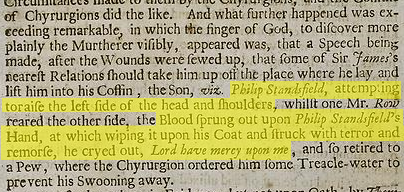
This date in 1688 saw the execution in Edinburgh of one Philip Standsfield (sometimes Stansfield or even Standfield) for parricide, his conviction being secured in part by the supposed accusation of his father’s corpse.
The prodigal firstborn of James Standsfield was an incorrigible scoundrel, and the state had a considerable circumstantial case to the effect that said scoundrel finally popped the old man to prevent disinheritance. (It also appeared that he’d tried to do it other times over the years.)
Circumstantial evidence is nice.
But how about some forensic evidence to really cinch a conviction? No DNA evidence here in the 17th century, so maybe something a little more … supernatural?
From A True Relation of a Barbarous Bloody Murther etc., available here.
The King’s Advocate insisted — over the objections of a defense attorney that “it was a superstitious observation, founded neither upon law nor reason” — that the corpse’s having bled on Philip Standsfield but none of the others in his party simultaneously attempting to move it “he must ascribe … to the wonderful Providence of God, who in this manner discovers murder.”
Divine forensics. That’s even better than the arson evidence Texas used to kill Cameron Willingham.
the said Philip Standsfield to be taken upon Wednesday next, being the 15th of February instant, to the Market-cross of Edinbrugh, and there, betwixt two and four o’clock in the afternoon, to be hanged on a gibbet till he be dead, and his tongue to be cut out and burnt upon a scaffold, and his right hand to be cut off and affixed to the east port of Haddingtoun, and his body to be carried to the Gallowlie betwixt Leith and Edinburgh, and there to be hanged up in chains; and ordains his name, fame, memory, and honours to be extinct, his arms to be riven forth and delete out of the books of arms …†
Well, you get the idea. Executed Today would like to apologize to the dempster of Edinburgh for keeping Philip Standsfield’s name, fame, and memory alive.
In our defense, we are hardly the only ones: this is thought to be the last time that Scottish law employed the bleeding-corpse “test”.
* Some other instances of purported “bleeding at the touch” may be perused here.
** In a 1927 piece in the Journal of the American Institute of Criminal Law and Criminology, Canadian jurist William Renwick Riddell says this folk belief “was wide spread and is not dead yet” and offers in a footnote (perhaps by way of explaining his interest) that “when at the Bar, I was once offered such evidence by my client; but I declined to use it.”
† The execution was botched, and the gibbeted body illicitly pulled down and tossed in a ditch — which is where the elder Standsfield’s had been discovered.
In the year 1554, there was imprisoned at Ghent, in Flanders, for following Christ and living according to God’s commandments, a young brother named David, who, when examined, freely confessed his faith. Being asked what he thought of the sacrament, David said, that he considered it nothing else than idolatry. Then a priest said to him, “Friend, you err greatly, that you so readily confess your faith, for it will cost you your life, if you do not change your mind in time.” Thereupon David sweetly replied, “I am ready to shed my blood for the name of Christ, even though it should be here in this place; for God is my salvation, who will keep me, and preserve me from all evil.” The priest said, “It will not be as good as though you were put to death secretly here in this place; but you will be burnt publicly at the stake, for an everlasting reproach.” He was then brought into the court, where he was condemned to death, and his sentence was read, namely, that he had fallen from the true faith into heresy, and was therefore, according to the imperial edict, sentenced to be strangled and burned. David said, “No one will ever be able to prove by the Scriptures, that the faith for which I must now die is heresy.”
There was also sentenced to death with him a woman named Levina, who rather forsook, not only her six dear children, but also her temporal life, than her dear Lord and Bridegroom Jesus Christ. Arriving on the scaffold, David attempted to kneel down in order to offer up his prayer to God, but he was prevented, and they were immediately driven away to the stakes, standing at which, David said to Levina, “Rejoice, dear sister; for what we suffer here is not to be compared with the eternal good that awaits us.” (Rom. 8:18) When about to offer up their sacrifice, both exclaimed, “Father, into thy hands do we commend our spirits.” A little bag of gunpowder was tied to each of them, whereupon they were strangled and burned. But there happened a manifest miracle of God; for though they were completely burned, and the fire was as good as extinguished, David was seen to move his head, so that the people exclaimed, “He still lives.” The executioner seized the fork, and thrust it three times into his bowels, so that the blood flowed out; yet even after this he was still seen to move, hence, the executioner threw a chain around his neck, and bound him to the stake, and thus broke his neck.
Thus these two valiantly fought their way through, firmly trusting in God, who did not let them be confounded, since they had firmly built their building upon the only foundation; wherefore they shall never perish, but abide forever.
On this date in 1892, two outlaws were hanged (and a third spared at the last moment) in Gori, Georgia — part of the tsarist Russian Empire.
Josef Djughashvili, the future Stalin, was a teenager when he saw an 1892 public hanging in Gori.
The most noteworthy executioner present on this occasion was not on the scaffold, but in the audience: a 14-year-old student at an orthodox church school named Joseph Djugashvili. You know him by his later, steely revolutionist alias: Stalin.
This precocious, ferocious youth attended the public hanging with school mates to whom he was already a natural leader.
He and his friends sympathized with the doomed Caucasians, so insouciant at being strung up by the tsarist oppressor: conversing after the gruesome spectacle, Djugashvili would maintain that the men had not been consigned to hell, for they had suffered enough in the present.
But this boy was not made for theologizing; though he proceeded to seminary school in Tiflis — the best education prospect for an impoverished family — he disappeared thence into the life of professional revolutionary outlawry.
The recent (and well-received) biography Young Stalin recaptures this scene from Joseph Djugashvili’s youth.
The condemned men had stolen a cow and, in the ensuing pursuit, had killed a policeman. But the boys learned that the criminals were actually just three “peasants who had been so oppressed by landowners that they escaped into the forest,” petty Robin Hoods, attacking only local squires and helping other peasants …
The boys were fascinated. “Soso Djugashvili, me and four other schoolboys climbed a tree and watched the terrifying show from there,” remembers one of the group, Grigory Razmadze … Another spectator whom Stalin would later befriend and promote was Maxim Gorky, then a journalist, soon to be Russia’s most celebrated writer.
The Gorelis sympathized with these brave Caucasian bandits … The crowd became menacing; double ranks of Russian soldiers encircled the square. The drums began to beat. “The authorities in uniforms lingered around the scaffold,” wrote Gorky in his article. “Their dreary and severe faces looked strange and hostile.” They had reason to be nervous.
The three bandits in leg irons were marched onto the scaffold. One was separated from the others — he had been reprieved. The priest offered the two condemned men his blessings; one accepted and one refused. Both asked for a smoke and a sip of water. Sandro Khubuluri was silent, but the handsome and strong “ringleader,” Tato Jioshvili, smiled and joked valiantly before the admiring crowd. He leaned on the railings of the gallows and, noticed Gorky, “chatted to people who had come to see hi die.” The crowd threw stones at the hangman, who was masked and clad completely in scarlet. He placed the condemned on stools and tightened the nooses around their necks. Sandro just twirled his moustache and readjusted the noose. The time had come.
The hangman kicked away the stools. As so often with Tsarist repression, it was inept: Sandro’s rope broke. The crowd gasped. The scarlet hangman replaced him on the stool, placed a new noose round his neck and hanged him again. Tato also took a while to die.
Even Joseph Stalin was a child once.
One would have to really like the difficult-to-prove notion that executions have a brutalizing effect encouraging violence in others in order to see in this hanging the germ of the incomprehensiblesuffering young master Djugashvili would eventually unleash.
It’s not like this was Stalin’s only childhood exposure to brutality, and not too many of those buddies who watched this date’s hanging grew up to kill 20 million people.
Gori was one of the last towns to practise the ‘picturesque and savage custom’ of free-for-all town brawls with special rules but no-holds-barred violence. The boozing, praying and fighting were all interconnected, with drunken priests acting as referees… [At festivals during Stalin’s youth] the males in each family, from children upwards, also paraded, drinking wine and singing until night fell, when the real fun began. This ‘assault of free boxing’—the sport of krivi—was a ‘mass duel with rules’; boys of three wrestled other three-year-olds, then children fought together, then teenagers and finally the men threw themselves into ‘an incredible battle,’ by which time the town was completely out of control, a state that lasted into the following day—even at school, where classes fought classes.
This is Russia, not Georgia: festive Maslenitsa fisticuffs.
The small Georgian town that spawned the first name in Soviet terror actually maintained a public statue to its most famous son until 2010 — when it was finally removed in an apparent anti-Russian gesture in the wake of the South Ossetia war.
On this date in 2004, the former deputy governor of China’s Anhui province was executed for official corruption.
It was just weeks after Wang’s conviction for grifting some 100 million yuan in real estate transactions dating back to the mid 1990’s.
We suppose Wang did his appeals no favors by steadfastly denying guilt — although he might have reckoned that the national “determination … to fightcorruption” thwarted any such plan.
Instead of confessing to his crimes, Wang had stood against the public prosecutors and even continued to seek bribes during the investigation from some private business owners, said Wang Huanhai, head of the investigation team.
According to the prosecutor, Wang attempted to use the bribe to buy over more relations, hoping the Central Commission for Discipline Inspection of the Chinese Communist Party would spare him from being inquisited.
During the first trial on Dec. 29, 2003, Wang denied all the allegations, but in the latest trial confessed to most of the crimes and argued for a light penalty on the grounds that the bribes he had taken were not big enough to justify a death penalty.
His request was turned down, given the amount involved in the case as well as his resistance to investigation.
Wang’s prosecutors said he was an orphan and had climbed up the social ladder with an inferiority complex. “That’s why he was dictatorial and could not stand anyone questioning him,” said Wang Huanhai, “Nor did he ever confess to his wrongdoing in public.”
On this date in 1984, India hanged Kashmiri nationalist Maqbool Bhat.
A terrorist to his enemies and a freedom fighter to his friends, Bhat was born in the Kashmir region back when it “was ruled by the Dogra Family and the entire Kashmiri nation was living a life of slavery.”
When Bhat was a nine-year-old child, the prince of Jammu and Kashmir inked a bitterly controversial accession of his domain to the foundling independent nation of India. Kashmir has been hitched to the adjective “troubled” ever since.
The broader Kashmir region remains a warren of competing claims among Pakistan, India, and China. Bhat operated not for any of these governments, but for Kashmiri independence … and since he came of age in the revolutionary twilight of colonialism, he did not shy from putting the fight in freedom fighter. Bhat was an early exponent of an armed independence struggle.
Both India and Pakistan proscribed as terrorist Bhat’s Jammu and Kashmir National Liberation Front (forerunner of the still-extant JKLF, which is the same acronym less the middle letter); both those longtime subcontinent antagonists arrested Bhat at different times for subversive activities. The most notable: Bhat engineered an airplane hijacking in 1971 to push his cause onto the world’s front pages.
But the hostage-taking game came a-cropper for the Kashmiri rebel.
Languishing under a dormant death sentence for the 1968 murder of an Indian policeman,* Bhat unexpectedly became the focus of his fellow-travelers’ revolutionary ardor: in Birmingham, England, Kashmiri activists kidnapped Indian diplomat Ravindra Mhatre in an attempt to force a hostage exchange.
When Delhi refused to deal, the captors executed Mhatre. Within days, India traded tit for tat by stringing up Bhat — a man who in life had been known for his boast that “nobody has the rope which can hang men.”
They may not have got their man, but they sure got a martyr.
This morning in Dubai, Emirati sailor Rashid al Rashidi was executed by firing squad for raping and murdering four-year-old Moosa (Mousa) Mukhtiar Ahmed in a mosque washroom.
The pedophiliac crime on the first day of Eid al-Adha in 2009 shocked the United Arab Emirates. Eleven judges have okayed the death sentence; even one of al Rashidi’s own lawyers demonstratively resigned himself from the case of “the suspect who brought shame to mankind.”
Minutes past midnight today, Central Daylight Time, Martin Link died by lethal injection at Missouri’s Bonne Terre state prison.
It’s just Missouri’s second execution since 2005, a marked decline from its five-per-year clip over the decade preceding.*
Condemned for raping and murdering an 11-year-old girl in 1991, Link “showed little willingness to fight the death penalty,” according to the Kansas City Star. (Not so little that he actually dropped appeals, mind.) He at least once attempted suicide in prison.
In common with many present-day U.S. executions, Link’s was also shaped by the nationwide shortage of sodium thiopental, one of the essential drugs in the traditional lethal injection cocktail.
(It’s an anesthetic, the first of three drugs administered and used for the purpose of inducing rapid unconsciousness so the other two can get to the killing business … though the sodium thiopental dose is itself potentially lethal, and some states have experimented with lethal injections using only that one drug.)
While other thiopental-scarce jurisdictions have moved towards alternative chemicals and injection procedures, Missouri did a classic three-drug injection using some of its dwindling stockpile — which was due to expire on March 1, anyway. What the plan might be for the next Show-Me State execution, whenever that might be, nobody seems ready to say. If recent trends are any indication, they’ve got plenty of time to work it out.
The chemical compounds, no doubt, were the last things on the minds of those directly concerned. Both the victim’s family and the investigating police officers reportedly planned to observe the procedure with some satisfaction.
“It was such a horrendous crime,” one of the officers told a reporter. “I’ve got a picture of that in my mind right now … of seeing the little girl and everything. It’s kind of hard to put it out of your mind.”
* Stats per the Death Penalty Information Center’s very handy execution database.
There is sweeping over Texas, as never before in her history, a wave of crime. Murder, theft, robbery and holdups are hourly occurrences that fill the daily press. The spirit of lawlessness has become alarming. Our loose method of dealing with violators of the law is in a large degree responsible for the conditions that today confront us.
It was just after midnight on this date in 1924 that the state of Texas first used its new electric chair, supplanting public hangings with a regime of private executions administered by the state.
Five men, all black, died in rapid succession on the new contraption. (Although witnesses, “sickened by the odor of burning flesh that filled the room, were given a brief respite” between the fourth and the fifth executions.) It was a half-year’s worth of backlog built up while the new death chamber had been constructed for the transition from county-level hangings.
Robert Perkinson’s Texas Tough: The Rise of America’s Prison Empire chronicles the evolution of that state’s prison regime after the Civil War in lucid, page-turning prose. We’re very grateful that he’s allowed Executed Today to mark the Lone Star State’s era of electrocutions with this brief excerpt from that book.
Although elected as a progressive, Pat Neff was the first Texas governor to make hard-fisted, no-nonsense crime fighting a central part of his political identity.
… Neff proposed tougher penalties for bootleggers, an expansion of the Texas Rangers, and the abolition of the state’s suspended sentencing law, an innovation enacted at the end of leasing. He also radically curtailed executive clemency. …
Walter Boyd, aka Leadbelly, was … caught in Neff’s clutches. “‘Dat man ain’ gonna tu’n you loose, ol’ Walter,'” his fellow convicts told him. “‘He wouldn’ tu’n his own mammy loose.'” … Leadbelly had tried everything but running to regain his freedom. Through hard work on the line, he had convinced a captain to request that his escape record be expunged, which under a different governor would have enhanced his chances of parole. About a year after his arrival at Sugar Land, Leadbelly’s father showed up carrying a “fat roll of bills.” He had sold the family’s last parcel of land and tried, rather brazenly, to buy his only son’s freedom, but the warden turned him down …
[Leadbelly] was well known as a musician. When he heard that Governor Neff was planning a personal inspection, he composed a special song. Neff was “a big, fine-lookin’ man,” he recalled, and “sho was crazy about my singin’ an’ dancin’. Ev’y time I’d sing a new song or cut a few steps he’d roll me a bran-new silver dollar ‘cross the flo'” Once his audience warmed, Leadbelly presented his unusual appeal.
Please, Governor Neff, be good and kind,
Have mercy on my great, long time.
With his boot tapping and strings blazing, the musician hit all the conventional clemency notes. He called himself Neff’s “servant,” pleaded on behalf of his wife Mary (in reality his girlfriend), lamented his thirty-year sentence, and even offered an oblique critique.
Some folks say it’s a sin,
Got too many women and too many men.
… In de pen.
Neff himself remembered the encounter almost as vividly. In his autobiography, The Battles of Peace, he painted the singer as a happy minstrel and himself as the benevolent master. “On one of the farms … was a negro as black as a stack of black cats at midnight,” he wrote. “This negro would pick his banjo, pat his foot, roll his eyes, and show his big white teeth as he caroled forth in negro melody his musical application for a pardon.” In his paternalistic way, the governor was moved, or at least amused. He announced that he would grant the supplicant’s request but in his own time. “Walter, I’m gonna give you a pardon,” Leadbelly remembered Neff telling him, “but I ain’ gonna give it to you now. I’m gonna keep you down here to play for me when I come, but when I get out of office I’m gonna turn you loose.” True to his word, the governor enjoyed Leadbelly’s high-spirited performances on command whenever he visited the lower farms, then set him free on his last day in office.
Few other convicts were as fortunate. Despite the costs to taxpayers, almost a thousand more convicts entered Texas prisons than were allowed to leave during Neff’s four-year reign. Inmates sentenced to death, most of them African Americans and Hispanics convicted of rape or murder, found especially little sympathy. Largely in response to lynching, which the governor condemned, Texas centralized the death penalty in 1923. Previously, every county had carried out its own executions, usually in the form of public hangings. Progressives hoped that by sequestering such events at the Walls, they would discourage mob sentiment and encourage reverence for “the majesty of the law.” But the site and method of execution did not alter its racial dynamics.
Following the lead of New York and other states, lawmakers also ordered prison officials to carry out executions by a new technique, one they perceived as “more modern and humane,” the electric chair. Huntsville officials thus built a new death house, the very same in use today, and by the end of the year a squat, straight-backed throne — soon christened Ol’ Sparky — was ready for operation. Governor Neff wasted little time in authorizing its use.
On a visit to the Walls in January, the governor stopped in to visit with five men he would soon send to their deaths. “A queer feeling creeps over you as you pass the death cell and pause,” he wrote. “They knew, and I realized, that I held within my hand the power to save them from the electric chair. How feeble were words, both theirs and mine, at such a time.” Not long after the governor departed, the men, all of them African American, ranging in age from twenty to thirty-nine, were approved for elimination.
In a dramatic gesture of conscience, Huntsville’s warden, R.F. Coleman, resigned his post only days before. “It just couldn’t be done,” he told reporters. “The penitentiary is a place to reform a man, not to kill him.” But a replacement was quickly found, and the Walls’ inaugural electrocutions went forward as scheduled. At nine minutes after midnight, the first condemned man, Charlie Reynolds, was escorted by two guards into the brightly lit death chamber. He blinked rapidly, reported a witness, was speedily strapped in the chair, and then stiffened violently when the new warden threw the switch. Within the hour, four other men met the same fate.
That execution of a black slave and his white lover was exceptional — and, of course, the chronicles of the Cape are replete with less exceptional fare, the humdrum penal brutality of an 18th century colony disposed of in a sentence of two between reports of smallpox outbreaks, price fluctuations, the transit of slave ships, and all the other business of frontier life.
A slave condemned to be burnt alive for arson; another to be hanged for theft … Two white men hanged for desertion, sheep-stealing, and attempt to murder … A Javanese “Guru” sentenced to death for instigating slaves to run away, harbouring and arming them … Matthys of Ternate punished for running away and cattle theft, &c. Sentenced to be hanged … A slave hanged for breaking into the house of Lieutenant Captain Slotsboo … Five slaves sentenced to be broken, and a female slave to be scourged … Two soldiers sentenced to run the gantlope …
And so on.
This date marks a number of such executions for a minor slave revolt (incidents of slave insubordination also pepper the Colony records). At three full entries in the chronicle, 16 implicated slaves, and some spectacularly savage punishments, it must have been one of the more noteworthy of its day; what the colonial register leaves us is just enough to suggest the forgotten suffering and resistance of the half-nameless chattel of yesteryear.
1714.
January 7 — Some 16 fugitive slaves who had conspired, armed themselves, and did much mischief. They resisted the officers of justice, shot a soldier, and murdered a Hottentot woman. They were now brought up for examination.
February 7 — The sentences passed on the fugitive slaves, and the whole history of the case. “Tromp” to be empaled alive, and to remain in that position till he dies. “Cupido” to be put on a cross, his right hand to be cut off, and with “Neptunus” to be broken on the wheel, and then to be left on a hurdle until dead. “Titus” to be broken with the coup de grace. Jeroon and Thomas to be hanged; three others to be scourged and have their right heels cut off. The eleventh prisoner is merely to look on, and afterwards to be sent home; paying the costs however.
February 8 — The empaled convict found strangled in the morning. He had received some linen from a kind friend during the night for the purpose. He would otherwise have been still alive.
On this date in 1821, a first-time whaleship crewman named Owen Coffin was executed by a comrade to feed three starving mates.
Coffin was the second-to-last victim of an event which shocked the whaling community and inspired the novel Moby Dick.
Owen Coffin was a 17-year-old aboard a doomed whaling vessel called the Essex. He was cousin to George Pollard, Jr., who was making his first trek to the Pacific whaling grounds as a ship’s captain.
The Essex sailed from Nantucket Island in 1819, one of dozens of ships to leave port in search of whales and, ultimately, whale oil. In spite of the large numbers of whales slaughtered by whalers around the world, the Essex had the unfortunate honor of taking part in the first documented violent encounter by a sperm whale on a whaleship.
Of the whales available to the whalers of the day, the sperm whale was most prized: aside from the typical blubber found on all whales, which could be processed for its “oil” (actually a free-flowing form of wax), this whale’s head was filled with the clean-burning substance called spermaceti, a name inspired by its resemblance to the sexual fluid. Spermaceti fetched a high price at market when sperm whales were in sufficient abundance to hunt them.
At the time, Nantucket Island was the center of the whaling world.
The industry was primarily run by Quaker businessmen, who negotiated profit-sharing rates for young, largely local crews willing to risk their lives in search of whales. To fill out the ship numbers, poor non-Nantucketers were imported from other New England ports. The Essex was no different: the ship originally held 21 crewmembers, eight of whom came from off-island.
The ship’s journey began inauspiciously by being flattened in a squall, but after repairs, she continued on in pursuit of whales. The ship made its classic trip around the southern tip of South America, put in to port in Ecuador, then traversed 2000 miles of ocean westward in search of a recently-discovered sperm whale hunting ground.
The Essex being rammed by a sperm whale, sketched by crewmember Thomas Nickerson.
And the crew did find whales and made a mildly successful trip of it … until it really pissed off the wrong whale.
The Essex discovered a group of sperm whales consisting of two females and one male. When the call went out, the three small whaleboats — built to be light and fast for the pursuit — launched.
These boats separated the females from the male, and one of the crews made a kill. It was around that time that the male, probably already distraught at being partitioned from his group, first ran into the 38-foot Essex. The jostle, which may have been accidental, apparently further upset the abnormally large whale, which briskly left the area, made a sharp turn, then swam all-out on a direct collision course with the Essex.
The old timber ship didn’t stand a chance.
The crew which had stayed aboard the main vessel watched in horror as the Essex was shattered beneath them. Two of the whaleboat crews noted the sinking and returned quickly, and Captain Pollard immediately set his crew about saving as many of the provisions as they could, including water and food.
But the speed with which the Essex went under left them with too little of both. As the final whaleboat made its way to the carnage, it was clear that the full crew complement was doomed to a long trip on a trio of very small boats.
Call Me Ishmael
Pollard and first mate Owen Chase hatched a plan (crewman Thomas Nickerson indicates that it was largely Chase who pushed the plan) to set sail for South America, thousands of miles distant and through unfavorable currents and winds, rather than for the Pacific Islands, about half as far away and in the direction of both favorable winds and currents.
The choice was sealed by fear of the unknown and a century of tales of South Pacific cannibals. Hopefully they came to appreciate the irony.
The crew went through its supplies in the first month at sea, and finally came ashore at Henderson Island, a raised, uninhabited coral reef that they mis-identified.
The fortunate crew found a temporarily available freshwater spring from which to refill their casks, and they subsisted on local fauna for several days while deciding their next course of action. Though Tahiti lay just a few hundred miles westward (again, in the direction of favorable winds and currents), our wayfarers opted to continue towards South America.
Three of the crew decided to stay behind. The remaining 17 crewmembers set out in late December 1820, and again quickly depleted their supplies.
One of the ships — carrying the second mate but no navigational equipment — was separated from the others during a storm and never heard from again, leaving two to carry on under increasingly desperate circumstances.
Cannibal Corpse
Passengers on both boats began succumbing to want and exposure, and their starving former comrades had little choice but to devour their remains.
The boat containing Owen Chase, Thomas Nickerson, and Benjamin Lawrence was eventually rescued by the Indian off the coast of Chile, and both Nickerson and Chase wrote accounts of the the survivors’ cannibalism.
Yet it was aboard Pollard’s boat that the most gruesome events unfolded.
The deaths of two crewmen had provided for the others — but not nearly enough to hope for landfall.
Short on food and water and despairing of bringing all four remaining souls to port, Charles Ramsdell suggested that the quartet draw lots to both remove one consumer from the boat and provide for the remaining three. Pollard objected to subjecting his crew to such a fate, but Barzillai Ray and Owen Coffin agreed to the plan. The lots were cast, and Coffin pulled the black spot. The other three cast again to decide his executioner, and Ramsdell was chosen.
Pollard’s account indicates that he immediately spoke up for Coffin, offering himself up in place, but Coffin demurred and prepared himself for the execution.*
The following day, February 6, Coffin dictated a short note to his mother and declared, as per Pollard’s diary, that “the lots had been fairly drawn.”
Charles Ramsdell shot Owen Coffin, then joined Ray and Pollard in consuming his remains.
Ray died just days later, and Ramsdell and Pollard barely survived the next two weeks. When the Dauphin came up alongside the whaleboat on February 20, its crew thrilled to the spectacle of Ramsdell and Pollard sucking on the bones of their dead crewmates, emaciated beyond recognition.
Based on their statements about the events of the previous 95 days, a vessel was dispatched to find the three Henderson Island survivors. Because the crew had mis-identified the island, however, the search took longer than expected. Not until April 5, 1821, were the three located … out of fresh water and also scarcely alive.
A few books about the Essex
The Essex was a legend in its own time, and the story of the sinking and the harrowing events which followed continue to circle around Nantucket Island. Though the island’s economy collapsed less than 30 years later, Herman Melville kept the story alive through his literary classic Moby-Dick — which directly describes the Essex disaster in one of its many digressive expositions, and culminates in the vengeful captain’s ship being annihilated by the mighty whale.**
Closer to modern times, the rock group Mountain’s album and eponymous song “Nantucket Sleighride”, which was used as the theme song to London Weekend Television’s Weekend World, is dedicated to Coffin.
Coffin is not the only sailor adrift ever selected for cannibalism by lot, but his case is unusual because the particulars are so well-documented. Several other cases are provided in Philbrick’s In the Heart of the Sea. Arthur Gordon Pym uses a victim by the name of Richard Parker, coincidentally the same name as a man who was actually cannibalized in 1884‡ in an affair leading to the famous common law case R v Dudley and Stephens, wherein the killers were charged with murder and sentenced to 6 months in prison — unlike the 1835 incident of the Francis Spaight, which saw the crew acquitted for three such killings.
* One of the crueler accounts of such lot drawing occurred aboard the Peggy, where crewman David Flatt pulled the short straw. However, prior to the execution the following morning, the crew was rescued. Flatt, however, had a breakdown in the intervening hours and suffered mental illness which persisted even after their rescue.
** He was also inspired by the story of Mocha Dick, a notorious white whale which survived dozens of encounters with whalers and is now available in trenta sizes.
† Arthur Gordon Pym is Poe’s only full-length novel.
‡ Richard Parker was also the name of a man executed for the Nore Mutiny, as well as one killed in the wreck of the Francis Spaight in 1846 — not to be confused with the Francis Spaight on which cannibalism occurred 11 years prior.



 It was just weeks after Wang’s conviction for
 The pedophiliac crime on the first day of
  It’s just Missouri’s second execution since 2005, a marked decline from its five-per-year clip over the decade preceding.*
