(Thanks to Carl Pyrdum, III, the author of the hilariously incisive blog Got Medieval, for this guest post — which originally appeared as part of his decidedly irreverent Medieval Months stroll through the Catholic Church’s quirky calendar of saintly feast days. -ed.)
While not one of the Holy Helpers proper, St. Agatha, whose feast falls on February 5, has special powers to heal ailments of the breasts, on account of having had hers cut off for refusing to worship pagan idols.
Like Bartholomew, she is usually depicted in the unfortunate after state in iconography, carrying her severed breasts before her on a tray or plate.
Because detached breasts sort of resemble bells, she’s the patron saint of bellfounders, and because they also kind of resemble dough, she works double duty as the patron of bakers, too. Oh, and just to be clear, that last sentence isn’t one of those clearly nonsensical sentences I pepper my writing with for purposes of the comedy. Agatha is the patron saint of severed boobs and everything that kind of looks like a severed boob.
The treats on the left are a traditional Cataniacassata known as “Agatha’s breasts” or “Virgin breasts” (“Minni di Vergini”). Image (c) Gergely Sipos and used with permission.
On this date in 1940, the former Soviet People’s Commissar for Agriculture was shot for treason.
The 1930’s were a scary time in the USSR, but the agricultural posts — forced collectivizations, production quotas, and screw-ups that starved thousands — were particularly fraught.
R.I. Eikhe inherited the job from a fellow purged in the trial of the 21. And, unsurprisingly, he went the same way.
It was another former agricultural commissar (of Ukraine), Nikita Khrushchev, who managed to succeed Stalin.
When, in 1956, Khrushchev made his “secret speech” denouncing the savagery of his predecessor, the fate of his old comrade Eikhe was lamented in detail.
Excerpted below is the relevant portion of Khrushchev’s report, as cited here.
The great modesty of the genius of the revolution, Vladimir Ilyich Lenin, is known. Lenin had always stressed the role of the people as the creator of history, the directing and organizational role of the party as a living and creative organism, and also the role of the central committee.
…
Lenin never imposed by force his views upon his coworkers. He tried to convince; he patiently explained his opinions to others. Lenin always diligently observed that the norms of party life were realized, that the party statute was enforced, that the party congresses and the plenary sessions of the central committee took place at the proper intervals.
In addition to the great accomplishments of V. I. Lenin for the victory of the working class and of the working peasants, for the victory of our party and for the application of the ideas of scientific communism to life, his acute mind expressed itself also in this that lie detected in Stalin in time those negative characteristics which resulted later in grave consequences. Fearing the future fate of the party and of the Soviet nation, V.I. Lenin made a completely correct characterization of Stalin, pointing out that it was necessary to consider the question of transferring Stalin from the position of Secretary General because of the fact that Stalin is excessively rude, that he does not have a proper attitude toward his comrades, that lie is capricious, and abuses his power. . . .
Vladimir Ilyich said:
“Stalin is excessively rude, and this defect, which can be freely tolerated in our midst and in contacts among us Communists, becomes a defect which cannot be tolerated in one holding the position of the Secretary General. Because of this, I propose that the comrades consider the method by which Stalin would be removed from this position and by which another man would be selected for it, a man, who above all , would differ from Stalin in only one quality, namely, greater tolerance, greater loyalty, greater kindness, and more considerate attitude toward the comrades, a less capricious temper, etc.”
As later events have proven, Lenin’s anxiety was justified …
…
Stalin originated the concept enemy of the people. This term automatically rendered it unnecessary that the ideological errors of a man or men engaged in a controversy be proven; this term made possible the usage of the most cruel repression, violating all norms of revolutionary legality, against anyone who in any way disagreed with Stalin, against those who were only suspected of hostile intent, against those who had bad reputations. This concept, enemy of the people, actually eliminated the possibility of any kind of ideological fight or the making of one’s views known on this or that issue, even those of a practical character. In the main, and in actuality, the only proof of guilt used, against all norms of current legal science, was the confession of the accused himself, and, as subsequent probing proved, confessions were acquired through physical pressures against the accused. . . .
Lenin used severe methods only in the most necessary cases, when the exploiting classes were still in existence and were vigorously opposing the revolution, when the struggle for survival was decidedly assuming the sharpest forms, even including a civil war.
Stalin, on the other hand, used extreme methods and mass repressions at a time when the revolution was already victorious, when the Soviet state was strengthened, when the exploiting classes were already liquidated, and Socialist relations were rooted solidly in all phases of national economy, when our party was politically consolidated and had strengthened itself both numerically and ideologically. It is clear that here Stalin showed in a whole series of cases his intolerance, his brutality, and his abuse of power.
…
Stalin’s willfulness vis-a-vis the party and its central committee became fully evident after the 17th party congress, which took place in 1934. . . .
It was determined that of the 139 members and candidates of the party’s Central Committee who were elected at the 17th congress, 98 persons, that is, 70 percent, were arrested and shot (mostly in 1937-38). [Indignation in the hall.] . . .
…
The majority of the Central Committee members and candidates elected at the 17th congress and arrested in 1937-38 were expelled from the party illegally through the brutal abuse of the party statute, because the question of their expulsion was never studied at the Central Committee plenum.
Now when the cases of some of these so-called spies and saboteurs were examined it was found that all their cases were fabricated. Confessions of guilt of many- arrested and charged with enemy activity were gained with the help of cruel and inhuman tortures. . . .
An example of vile provocation of odious falsification and of criminal violation of revolutionary legality is the case of the former candidate for the central committee political bureau, one of the most eminent workers of the party and of the Soviet Government, Comrade Eikhe, who was a party member since 1905. [Commotion in the hall.]
Comrade Eikhe was arrested on April 29, 1938, on the basis of slanderous materials, without the sanction of the prosecutor of the USSR, which was finally received 15 months after the arrest.
Investigation of Eikhe’s case was made in a manner which most brutally violated Soviet legality and was accompanied by willfulness and falsification.
Eikhe was forced under torture to sign ahead of time a protocol of his confession prepared by the investigative judges, in which he and several other eminent party workers were accused of anti-Soviet activity.
On October 1, 1939, Eikhe sent his declaration to Stalin in which be categorically denied his guilt and asked for an examination of his case. In the declaration he wrote:
“There is no more bitter misery than to sit In the jail of a government for which I have always fought.”
On February 2, 1940, Eikhe was brought before the court. Here he did not confess any guilt and said as follows:
“In all the so-called confessions of mine there is not one letter written by me with the exception of my signatures under the protocols which were forced from me. I have made my confession under pressure from the investigative judge who from the time of my arrest tormented me. After that I began to write all this nonsense. The most important thing for me is to tell the court, the party and Stalin that I am not guilty. I have never been guilty of any conspiracy. I will die believing in the truth of party policy as I have believed in it during my whole life.”
On February 4 Eikhe was shot. [Indignation in the hall.] It has been definitely established now that Eikhe’s case was fabricated; he has been posthumously rehabilitated.
The outcome in the kangaroo court for anyone involved in the previous year’s near-miss bomb attack on Hitler was foreordained. Just the day before, the movement’s ineffectual but conscientious political statesman Carl Goerdeler had hanged for it.
But a funny thing happened to the lawyer and reserve officer Schlabrendorff on the way to the gallows.
As he awaited this date his tongue-lashing and inevitable condemnation at the hands of the vituperative Nazi judge Roland Freisler, a bombing raid led by Jewish future Nuremberg prosecutor Robert Rosenthal struck the People’s Court — killing not the prisoner, but the judge, who was reportedly found still clutching his prey’s file.
“It is God’s verdict” was the succinct epitaph issued by a worker at the hospital where they raced his body, and nobody cared to dispute the subversive remark.
Hysterically badgering defenseless prisoners in farcical show trials, ostentatiously obeisant to the Reich, and personally responsible for thousands of executions, Freisler was a hard guy to admire. His role model for courtroom demeanor was supposed to be the ruthless purge trials of the Soviets.*
(Freisler also attended the Wannsee Conference, where Reinhard Heydrich organized the Final Solution. What a guy.)
In the confusion of the bomb blast, Schlabrendorff was hustled off to detention un-sentenced, and spent the last months of the war being shifted from one concentration camp to the next. The Third Reich — and admittedly, it had a few other things on its mind in those days — neglected to kill him, trial or no.
Schlabrendorff went on to become a West German constitutional court judge, though in this career he could hardly be as memorable as his onetime persecutor.
That Schlabrendorff miraculously escaped the war with his life thanks to a timely explosion was a particular irony: Hitler had once unwittingly been preserved from a Schlabrendorff assassination attempt by a bomb that failed to detonate.
In a March 1943 attempt on Hitler’s life, Schlabrendorff himself had passed one of Hitler’s entourage a package supposedly containing two bottles of cognac for delivery to another officer. In fact, the package was meant to blow up Hitler’s plane.
When [Hitler] was boarding the plane I started the mechanism of the delayed-action bomb … timed to explode within half an hour. At a sign from Tresckow, I handed the parcel to Colonel Brandt,** the member of Hitler’s escort who had promised to take it. It was a great nervous strain to remain quiet at this juncture.
…
After more than two hours of waiting, we got the shattering news that Hitler had landed safely …
We were stunned and could not imagine the cause of the failure … even worse would be the discovery of the bomb, which would unfailingly lead to our detection and the death of a wide circle of close collaborators.
After considerable reflection Tresckow resolved to ring up Colonel Brandt at Hitler’s headquarters and ask whether the parcel for General Stieff had already been delivered. Brandt replied that it was still in his keeping. This gave us hope that the bomb had not been discovered. Its delivery had to be prevented by all means. So Tresckow asked him to keep the parcel. He added there had been some mistake. I would call on him the following day to exchange the parcel, as I had anyway to go on official business to headquarters in East Prussia.
On some military pretext, I flew to Headquarters with the regualr messenger plane. I called on Colonel Brandt and exchanged a parcel containing two bottles of brandy for the one containing the bomb.
I can still recall my horror when the man, unaware of what he held, smilingly handed me the bomb and gave it a jerk that made me fear a belated explosion. Feigning a composure I did not feel, I took the bomb, immediately got into a car, and drove to the neighboring railway junction of Korschen. From there a sleeper train left for Berlin in the evening.
At Korschen, I got into a reserved compartment, locked the door, and … dismantled the bomb … The mechanism had worked; the small bottle had broken; the corrosive fluid had consumed the wire; the striker had hit forward; but — the detonator had not fired.
* Not the only ostpolitik admiration the Nazis showed for their battlefield foes’ ruthlessness; Hitler, similarly, applauded (sometimes envied) Stalin’s 1930s purge of the officer corps.
** This Heinz Brandt, too, has another unwitting part left to play in the story of the German resistance: it was he who, on July 20, 1944, moved Col. Stauffenberg’s deadly parcel behind an oaken table support, preserving Hitler from the bomb’s worst effects. Brandt died in that explosion.
On this date in 1945, Carl Friedrich Goerdeler, godfather of the anti-Hitler resistance that had bid unsuccessfully for his assassination, was hanged at Plotzensee Prison. With him went fellow regime foes, Johannes Popitz and Father Alfred Delp.
The monarchist pol Goerdeler enjoys pride of place as one of the first German elites to opposite Hitler, though that opposition was not quite so early as the very beginning. Goerdeler was a creature of the pre-Nazi establishment, and shared many of perspectives that prepared that world to accommodate national socialism: Goerdeler bitterly opposed the Versailles Treaty, wanted to take a bite out of Polish territory, and had the customary strictly-within-legal-bounds anti-Semitism of his class. Even lying under sentence of death late in 1944, having denounced the Holocaust to his Gestapo interrogators, his “Thoughts of a Condemned Man” reflected,
We should not attempt to minimize what has been happening, but we should also emphasize the great guilt of the Jews, who had invaded our public life in ways that lacked all customary restraint.
A German patriot, then, committed to a “a purified Germany with a government of decent people”; a humanist Liberal from a bygone age, who had no weapons to fight a terror state.
As Mayor of Leipzig, he openly opposed the Third Reich’s excesses and pushed to moderate its policy.* In 1937 he copped a principled resignation and started cultivating contacts abroad, warning of Hitler’s aggression — also managing to impress his foreign interlocutors with his incapacity to affect events himself. His many memoranda urging Hitler to moderate this or that outrage went for naught.
The resistance circle around Goerdeler, which drew in his fellow-sufferer Popitz,** would be marked throughout the war years by that incapacity — a monument to high-minded failure, eternally short of the last ounce of will or that one key resource.
Goerdeler’s name adorned the ministry of many a fanciful post-Hitler government, but he himself, according to his friend and fellow-conspirator Gerhard Ritter, “preferred to begin with a debate rather than a power stroke”.
To be sure, the man looked in vain for some decisive form of aid: within the Reich, the sympathetic Wehrmacht brass couldn’t quite see their way to something as radical as breaking their loyalty oaths; without, he got no terms short of unconditional surrender from the Allies.
But even come the summer of 1944 when all was well past lost, Goerdeler entertained delusions of persuading Hitler to give up power voluntarily, and opposed Stauffenberg‘s assassination gambit.
Indecision would be no defense when he was hailed before bloodthirsty judge Roland Freisler for treason.
Goerdeler and Popitz, both viewed as influential with Germany’s Western enemies, were kept alive for months after the judicial purges commenced: Himmler‘s hope for a back channel deal. Our man had many hours in this Gethsemane for that essential contemplation of the 20th century.
In sleepless nights I have asked myself whether a God exists who shares in the personal fate of men. It is becoming hard to believe it. For this God must for years now have allowed rivers of blood and suffering, mountains of horror and despair for mankind … He must have let millions of decent men die and suffer without moving a finger.
We do not know what account Goerdeler gave of himself to the afterlife; even the account he left of himself for our terrestrial posterity is disputable.
“I ask the world to accept our martyrdom as penance for the German people,” he wrote in prison. Is it enough to accept for Goerdeler himself? His actions, intrepid by the standards of most countrymen, were fatally unequal to the heroism demanded of his circumstance. By any measure, his is a very human tragedy.
Carl Goerdeler’s brother Fritz shared the same fate a few weeks later. Other family members were imprisoned at Dachau; Carl’s son, Reinhard Goerdeler, became an accountant after the war and is the “G” in the big four firm KPMG.
* Including Berlin’s heretically expansionary economic policy. Goerdeler hated Keynes; his prescription for the capitalist crisis of the 1930s was falling wages, low deficits, a mighty Reichsmark, and free trade. (The April 1938 Foreign Affairs published a Goerdeler essay entitled “Do Government Price Controls Work?” Answer: no.)
It would be too much to say that Berlin’s profligacy outraged him as much as the fact that it was being squandered on dishonorable war, but said profligacy was definitely on the bill of attainder.
** Father Delp, the other man hanged this date, was involved in the resistance but even Freisler’s court decided he wasn’t in on the July 20 plot.
On this date in 1931, Italian anarchist Severino di Giovanni was shot in Buenos Aires for a terroristic bombing campaign.
Having just cracked his twenties, the young Abruzzo native fled to Argentina with the rise of Benito Mussolini.
Argentina was a popular destination for Italian emigrants, so Giovanni landed right in a yeasty community of emigre anarchists. And Argentine anarchists, for that matter: anarchism burgeoned in early 20th century Buenos Aires.
Giovanni was among the most active — and most vocal. He founded his own paper, Culmine, to advocate his brand of propaganda of the deed.
Iconoclasts! Rebels against all oppression and injustice! Young temperaments uncowed by all the storms of life, the time has come when we must COOPERATE with all our powers in order to save the lives of Sacco and Vanzetti, and the revolutionary dignity which moves us. Let us light the fuse on the dynamite of vengeance! Let us destroy the obscene caste of slavers and let us commit ourselves to the most desperate struggle for the complete liberty of the two inmates of the jail at Charlestown!”
And Giovanni wasn’t just messing around.
Though little-known to present day Anglophones, Severino Di Giovanni was one of the most energetically committed anarchist terrorists in history, and a giant (and controversial, among his comrades) on the Argentine anarchist scene.
Further to Sacco and Vanzetti’s cause, Giovanni bombed the U.S. embassy in Buenos Aires (withstanding police torture upon his subsequent arrest), a George Washington statue, a Ford Motor Company concession, a tobacco firm attempting to commercialize the Sacco and Vanzetti name, and U.S. banks as part of his campaign. After Sacco and Vanzetti’s execution, Giovanni attempted to orchestrate a strike on the American President-elect Herbert Hoover during his state visit to the southern cone.
The Braintree martyrs were far from Giovanni’s sole concern, however; late in the 1920s his circle authored a number of bombing attacks on various targets of reactionary violence and bourgeois complacency, including the Italian embassy, locally-based fascists, and possibly even the editor of one of the rival anarchist journals that opposed his dynamite-oriented politics.
Spending monotonous hours among the common people, the resigned ones, the collaborators, the conformists; that isn’t living, that’s a vegetative existence, simply the transport, in ambulatory form, of a mass of flesh and bones. Life needs the exquisite sublimity experienced by rebellion of mind and arm.
Haters gonna hate, and collaborators gonna collabor-ate.
The anarchists who’d been complaining that Giovanni’s bomb-chucking would only make a right-wing coup more likely must have been in full I-told-you-so mode when a right-wing coup happened in 1930. Weeks later, Giovanni was finally taken in a firefight, along with his comrade Paulino Scarfo.
In a drumhead military tribunal, their lawyer was so impolitic in his advocacy that he himself was arrested after the sham proceedings, and eventually deported.
Giovanni met his firing squad fusillade with an energetic “Evviva l’Anarchia!” Scarfo shared his fate a few hours later.
On this date in 1879, Takahashi Oden was put to death for murder at Tokyo’s execution grounds — the last woman beheaded in Japanese history.
Oden confessed to slaying her lover, and was also suspected of poisoning off her husband.
This made her perhaps the most infamous of Japan’s dokufu, poison-women — a perceived epidemic of the early Meiji period. Oden’s infamy thrust her into the crime genre’s characteristic harvest pulp literature, like Takahashi Oden yasha monogatari. (Takahashi Oden, the She-Demon’s Tale)
“Oden’s body became part of a scientific discourse that worked to produce ‘knowledge’ about feminine norms based on determinist biological differences,” Sharon Chalmers observes. “Deviancy was also characterised in terms of ‘masculine’ traits … [and] female transgression was read as sexual excess.”
And the feeding frenzy of the popular press around each new dokufu only exaggerated the effect: the sexual rapacity angle moved media.*
Since Japan was all about divining the secrets of the human form from the condemned, Oden was dissected after her death.
According to Murder Most Modern: Detective Fiction and Japanese Culture, the anatomizing team was especially keen on delineating that scientific discourse of feminine deviance. And, of course, the pamphleteers were keen on publicizing it. In this case, standing as we do today outside the surgeons’ intellectual framework, we can readily discern the corpse’s role for these men as grist for the ideological mill.
Immediately following her execution, her body was taken to the hospital affiliated with the Metropolitan Police Office (Keishicho) and dissected by an army surgeon and three regular doctors. Some accounts of this autopsy reveal that these doctors focused their attention on Oden’s genitalia during the procedure. Her bizarre autopsy is said to have been prompted by a newly emerging field of study called zokaki ron, roughly “the study of (re)productive organs.” A cross between sheer superstition and legitimate study of anatomy, zokaki ron was getting much scholarly as well as popular attention as one of the branches of science recently introduced from the West. After the autopsy, the primary operating surgeon, Osanai ken (1848-85), made the following report on Oden: “Abnormal thickness and swelling of the labia minor. Over-development of clitoris. Enlargement of vagina.” For Osanai — a skilled physician who is credited with having performed the first operation in Japan with chloroform and even makes an appearance in Shibue Chusai (1916), a novel by Mori Ogai (1862-1922) about a doctor of Chinese medicine in late Edo period Japan — such physical abnormalities explained Oden’s violent nature: after all, she ruthlessly slit her victim’s throat and left him in a pool of his own blood, and it took several blows for the authorities to execute her as she kicked and screamed in resistance.
Autopsy of Takahashi Oden, from Takahashi Oden yasha monogatari.
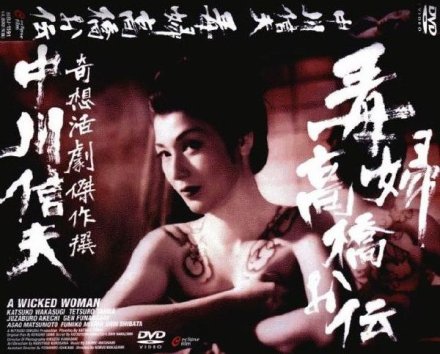
Though a lot of water has passed under the bridge since Oden’s day, she was the subject of a 1958 Nobuo Nakagawa film, Dokufu Takahashi Oden.
Katsuko Wakasugi as the title character in Dokufu Takahashi Oden.
* For more on the Oden story as crime literature, see Mark Silver’s “The Lies and Connivances of an Evil Woman: Early Meiji Realism and ‘The Tale of Takahashi Oden the She-Devil'” in Harvard Journal of Asiatic Studies, June 2003 — or, his book Purloined Letters: Cultural Borrowing and Japanese Crime Literature, 1868-1937.
On this date in 1869, Chauncey W. Millard was shot in Provo, Utah, for a stagecoach murder and robbery.
Despite the trust fund moniker, Chauncey Millard was an underbelly character, a youth of uncertain age (18 or 19, went the estimate) who had drifted west from an abusive apprenticeship. His complete backstory — not even his name* — was never fully assayed, and the Utah authorities did not keep his acquaintance more than a few weeks before they shot him. “It was snowing like this when I done it,” he remarked on his execution day: frontier justice had not allowed even a single season to elapse.
Though slightly different configurations of his backstory are to be found, all recognize him as a youth barely grown from out of that vast and indistinct vagabondage of lumpen marginalia consigned to the shadowlands to scrap for their bread. He wanted any education save a self-made career of small-time savagery. His life was nasty, brutish, and short.
The San Francisco Daily Evening Bulletin of Jan. 5, 1869, presents a representative summation, channeling a wire story from the scene:
DREADFUL DEPRAVITY — The Salt Lake Reporter of December 24th has the following:
The young man now in the county jail, for the murder of Swett, certainly comes as near being a complete reprobate as any we have met. He tells the story of the murder, and the unsuccessful attempt on Mayfield, with great circumstantiality of detail, adding in conclusion: “Well, Mayfield needn’t be afraid of ever being killed by a pistol, for it can’t be done. His life is insured. I shot at him four times, fair as ever a man did, and with good aim too, and never hurt him.” After the killing, he fled across a ridge, and the next day hired to a Bishop there to herd sheep. As he relates the story, the Bishop spoke of his intention to buy a beef, upon which the young man asked: “Have you got money enough to buy a beef?” “No,” said the Bishop, “but I think I can trade for it.” The prisoner adds very complacently: “I think he was a little scared, but if he had money enough to buy a beef, I thought I would pop him over, take what he had, and light out!” When arrested he merely said: “I suppose you’ll string me up to the first good limb you come to, but I’ll take a nap first.” Upon which he lay down in the wagon and snored quite lustily for four hours.
On awaking he expressed some surprise at not being hanged at once, and was told in this country every man could have a trial and a choice between being hanged or shot. To which he made reply: “By —, that’s bully, I’ll take shooting all the time.” He first gave his name as Chauncey Millard, stating that he had no recollection of his father; but soon after spoke of his mother’s maiden name being Millard, to his paternity is rather doubtful. He was born in the South;** early neglected and abused, and taught nothing worth knowing, his hand was against every man and a good many hands against him. The man to whom he was apprenticed mistreated him, and his first crime was destroying his master’s property for revenge. This was at the age of 13; not long after that he became a bushwhacker, and with a few companions robbed or murdered rebel or Union soldiers indifferently. With the return of peace he came West, and relates several crimes and attempts committed in this Territory.
He expresses a willingness to die, saying he has tried to make money by crime and made a failure. Strangely enough the young man has what phrenologists would call “rather a good head,” and presents an interesting but terrible case of “perverted moral instinct.” He is 18 or 19 years of age, not above the latter, though he is not certain of his age. He presents a curious case of the youthful criminal, made so by the utter neglect of moral cultivation.
Calling him, as one source does, “Utah’s version of Billy the Kid” would probably be more corrective of William Bonney’s inflated legend than of Millard’s utter obscurity.
The tawdry particular of his death: having no kin, and no care, he heedlessly made the Faustian bargain to salvage some last juvenile diversion in this world in exchange for the mortified flesh he was about to take leave of.
The execution proved what a human fiend Millard was. Selling his body to Doctor Roberts of Provo for a pound of candy, he calmly ate the sweets while sitting in the executioner’s chair awaiting the fatal shot.
* Chauncey Millard was the name he gave the lawmen, at least; his real identity was never clearly established, though the Salt Lake City News reported shortly before “Millard’s” hanging that guards found a tattoo reading “C.E. Otoway” on his arm and hypothesized that to be his real name. Did 19th century drifters usually tattoo their own names on their bodies?
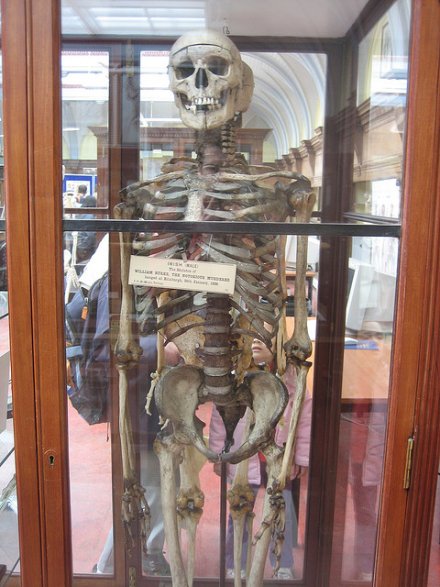
Wanted: corpses. Apply to Doctor Robert Knox, MD, FRSCEd, Professor of Medical Studies, Barclay’s Medical College, Surgeon’s Square, Edinburgh. Reference William Burke, hanged Jan. 28, 1829.
Robert Knox was a noted physician in his prime, in the early 1800s.
A surgeon, anatomist, and zoologist, Knox studied anatomy in London, then headed off to Africa in the army. Field surgery was a brutal business, and the poor anatomical knowledge at the time made it even more terrifying for those involved.
In 1821, Knox moved to France to work in the shadow of his heroes, Georges Cuvier and Étienne Geoffroy Saint-Hilaire; a year later, he was back in Edinburgh, making himself a career academic.
When his old professor came calling in 1826 with an opportunity to teach at Surgeon’s Square in Edinburgh, Knox jumped at the chance. As a partner to Barclay and curator of the school’s museum, Knox was well aware of the significant problem that faced the school: corpses were hard to come by.
And since the Royal College of Surgeons at Edinburgh certified the school as a prep course for entrance to University, coming up with bodies became a very important task.
If there’s one way to ruin your career, it’s to be caught paying a few pounds for fresh murder victims.
So it was for Knox, who gave out 7 pounds, 10 shillings for the body of an itinerant lodger who died in William Burke’s building in 1827.
This transaction led Burke to realize that such lodgers weren’t paying as much alive as dead. As a collector of bodies, Knox also had a strict no-questions-asked policy, and Burke and his partner William Hare exploited that to its fullest extent.
Almost a score of suspicious bodies later (and after the price had inflated to 10 pounds per), the pair was found out, given away as suspects by the lame and mentally disabled “Daft Jamie” Wilson, then caught when the late Marjory Campbell Docherty was found by a fellow tenant under one of Burke’s lodge’s beds.
Hare copped to a string of murders* and played stool pigeon in exchange for a lighter sentence.
Burke went to the gallows to “vehement cheering from every quarter, mingled with groans and hisses.” (London Times, Feb. 2, 1829)
“When the cheers had subsided, the wretched man was assailed with every epithet of contempt and abhorrence,” the Times continued. “Not a single indication of pity was observable among the vast crowd: on the contrary, every countenance wore the lviely aspect of a gala-day.”
William Burke’s hanging.
As a corpse himself, Burke made one final contribution to science’s insatiable desire for bodies: his cadaver went straight from the gallows to the practiced hands of one Dr Alexander Monro, who performed a complete lecture while dissecting the murderer’s corpse.
Knox, for his part, paid not with his neck but with his reputation.
Though never charged with a crime, the doctor was run out of the the lecturing business, first by subtle and not-so-subtle actions by the University, and eventually by the passage of the Anatomy Act of 1832.
He was also unable to obtain any surgical post after the incident and spent his later years writing academic books and papers, none of which have lasted like the doggerel that shadowed his steps.
Burke’s the butcher, Hare’s the thief,
Knox, the boy who buys the beef.
A few books about Burke and Hare
Anatomy of Anatomy
Robert Knox was operating under the Murder Act of 1751, which expressly forbade the burial of an executed murderer while permitting the malefactor’s dissection.
The Act had the dual effect of allowing the state to gibbet executed criminals (both hanging in chains and dissection were considered an added ignominy, beyond the punishment of the gallows), and of supplying the budding medical community with an immediate source of fresh bodies.
As courses in anatomy became more commonplace, though, the need for cadavers increased dramatically, and the business of selling bodies for science was born.
Typically, these sales manifested themselves in body-snatching — wherein “resurrectionists” illicitly exhumed a freshly buried corpse and conveyed it to some physician’s ready scalpel.
This grim trade in turn spawned a variety of security measures. The favored dead were defended by fences, watchtowers, and human lookouts. But nothing could eliminate the industry.
In particular, those with little money or no immediate relatives were unlikely to be buried in these gated graves; that left their remains ripe for the remaindering. As well, the increase in demand made so-called anatomy murder a possibility. Burke and Hare may have been notorious for the offense,** but they did not invent it.
In that case, two nurses (Jean Waldie and Helen Torrence) on death watch bartered a decent price of two shillings to sell the body of an ill child to a local surgical college. His death was delayed, and the nurses smothered him, possibly through simple carelessness.
Shortly after the Murder Act, simple economics made pikers of Torrence and Waldie. In the 17th century, England executed hundreds of prisoners a year, each a potential dissection. As Dr D.R. Johnson writes in his Introductory Anatomy:
The dissections performed on hanged felons were public: indeed part of the punishment was the delivery from hangman to surgeons at the gallows following public execution, and later public exhibition of the open body itself. …
Agents representing surgeons would bargain with condemned prisoners not under sentence of dissection (remember this only happened for murder: hanging was in vogue for stealing a sheep or even a loaf): occasionally prisoners struck a bargain to pay expenses, to provide for a family or to buy the customary decent apparel for the hanging.
Supply was unreliable, however: riots at public hangings became common, partly because of the paltry nature of hanging events, partly from superstition. The body was often reclaimed by relatives and the unpopular anatomists stoned, defeated and out of pocket. Competition was often so fierce that a rival anatomy school carried off the body.
Dissection was unpopular and other medical uses were to be found for a recently hung body – the cure of scofula, goitre, wens, ulcers, bleeding tumours, cancers and withered limbs for example. To prevent riots and disorder the Sheriff of London took all bodies of hanged men, except those sentenced to dissection, into his own custody and handed them to the relatives for burial.
Human Trafficking
Hanoverian Britain sure did keep the gallows busy. But the pace of hangings had abated by the 19th century just as demand boomed. The math didn’t add up.
Anatomy schools (officially) dissected some 592 corpses in 1825; at the time of the Burke and Hare murders, only about 50 executions were carried out annually, and each college was guaranteed just one a year.
That meant a shortfall of close to 550 bodies. With limited supply and significant demand, surgical colleges and anatomical lecturers were willing to pay top dollar for new cadavers … and the anatomical murder business really got legs.
And while the execution of Burke was met with applause from the community, in London, another group was already hard at work both body snatching and murdering its way into the classroom.
The London Burkers were caught in 1831 and convicted of murdering a 14-year-old whose cadaver they sold to St Bartholemew’s Hospital for 9 guineas.† The killers, Thomas Williams and John Bishop, had offed several others prior to the lad in question, making about the same price on each body.‡ In the grand, Burkean tradition of anatomical murderers, these miscreants were also dissected after their execution.§
Williams and Bishop were just two of a group of resurrectionists known collectively as the London Burkers, who claimed to have stolen upwards of 1,000 bodies from nearby cemeteries. That made the Burkers the largest known exploiters of the anatomical trade.
Over the decades after the Murder Act, though, resurrectionists were walking a dangerous line in their communities.
Reverence for the dead sparked community outrage when graves were found empty or disturbed, and it was often the anatomists themselves who felt the wrath of crowds.§§ In Glasgow in 1803, surgeons were threatened by an unruly mob and were forced to seek police protection; in 1813, an empty grave caused a similar furor. Punishments moved from fines to jail time as the surging demand made body-snatching an ever more lucrative trade.
A few books about body-snatching
By the time of the Burkers, anatomists were generally presumed to be body thieves in some capacity, a hostile sentiment graphically underscored during the Aberdeen riots of 1831. When a dog unearthed what looked like a human bone behind the Aberdeen surgical college, a mob coalesced and stormed the lecture hall.
The lecturer (“Dr Moir” — little else is known about the man) fled in terror as the hall was burned to the ground. Soldiers and police clashed with the crowd, which was thought to be over 10,000 strong. Hours later, the riot subsided, but Aberdeen was no longer a friendly place for a prospective medical talent.
And where Burke and Hare were still not quite sufficient to convince the House of Lords to take up a measure providing anatomists with alternatives for corpse acquisition, the Burkers and the Aberdeen riots apparently were.
The underground economy of resurrectionists was supplanted by the Anatomy Act of 1832, which allowed individuals to donate themselves or their unwilled kin to science for a pittance of compensation.
Anatomy murder is, of course, still the subject of horror movies. Like this one, or for the more classically inclined, this 1945 Boris Karloff/Bela Lugosi vehicle adapted from a Robert Louis Stevenson story inspired by Burke and Hare:
* The murders included at least one husband/wife pair, a mother and, later, her (adult) daughter, and a grandmother and her young grandson. They are also known as the West Port Murders.
** Burke entered the English language as a verb meaning … well, pretty much exactly what Burke got up to.
Dr. Murray, in the new English Dictionary, gives the following definition of the verb to ‘burke.’ ‘To murder in the same manner or for the same purpose as Burke did: to kill secretly by suffocation or strangulation, or for the purpose of selling the victim’s body for dissection,’ and the familiar lines are quoted from the Ingoldsby Legends: —
But when beat on his knees, that confounded De Guise
Just whipped out the “fogle” that caused all the breeze,
Pulled it tight round his neck until backwards it jerked him,
And the rest of the rascals jumped on him and burked him.
† 9 pounds, 9 shillings; by the time of the transactions, the guinea was no longer technically in use, but the term had stuck at the 21-shilling mark.
‡ Over the course of their 6 active months, the pair went from asking 8 guineas to asking 12 guineas; apparently 9 was the negotiated price with St Bartholemew’s.
§ The Burkers are the subject of the song “The Resurrectionist” by the Pet Shop Boys. (Lyrics)
§§ Edinburgh also had trouble as far back as 1742, when several surgeons’ homes were attacked by locals; a local beadle suspected of the crimes also had his home, dubbed resurrectionist hall, burned during the mob incident.
On this date in 1550, the leaders of England’s Prayer Book Rebellion were hanged, drawn, and quartered at Tyburn.
When Henry VIII dropped dead in 1547 and pitched his contentious realm and dubious progeny into the mid-Tudor crisis, Henry’s old theological henchman Thomas Cranmer really got to work.
During the unsteady regency of Henry’s sickly heir, Cranmer would push frenetically to make the religious reformation that his former boss never completely backed. The Archbishop sent to the continent for Protestant theologians like Peter Martyr who could help him “do away with doctrinal controversies and establish an entire system of true doctrine.”
The piece de resistance of Cranmer’s project was his Book of Common Prayer — a reformed liturgy, and in English, to go with the new English Bible. Many centuries — and revisions — later, it’s still the basis of Anglican services and of rites in many other Protestant denominations.
In 1549, it debuted to decidedly mixed reviews.
Enforced by Parliament’s Act of Uniformity, the Book of Common Prayer replaced all Latin liturgies on Whitsunday 1549, and for many of England’s Catholics, it was one affront too many. (The country’s bumpy economic realignment couldn’t have helped matters.)
On Whitmonday, traditionally-minded parishioners in West Devon unimpressed* with this newfangled vernacular service forced their local cleric to break out the old vestments and say Mass in Latin. State attempts to enforce the ban soon produced a martyr for the cause — one William Hellyons, melodramatically impaled on a pitchfork — and a march to Exeter that spiraled into outright revolt, heavy with suppressed Cornish nationalism.
We, the Cornishmen, whereof certain of us understand no English, utterly refuse this new English.
Religion, theology, the liturgy, the text of the Scripture … these were things that early modern Europeans were ready to fight and die for.
Since this considerable plunder of Church wealth had been widely redistributed to the English gentry, talk about repossessing it really emptied the pews of potential allies.
At any rate, neither Latin nor monastic restoration would be provided as carrots; London under Lord Protector Edward Seymour instead put down the rising with the more customary stick.
Such principals as remained were reserved a more awful fate: drawing and quartering at Tyburn. These seem to be the chaps who endured it:
Henry Bray, Mayor of Bodmin
Landowner and military leader Humphrey Arundell
Landowner John Wynslade
Thomas Holmes
John Bury
Bill Ind, Anglican Bishop of Truro, made news in 2007 acknowledging “that the English government behaved brutally and stupidly” in crushing the rebellion.
We wyll haue the Sacrament hang Oller the hyeghe aulter, and there to be worshypped as it was wount to be, and they whiche will not thereto consent, we wyll haue them dye lyke heretykes against the Holy Catholyque fayth.
We wyll haue . . . images to be set vp again in euery church, and all other auncient olde Ceremonyes vsed heretofore, by our mother the holy Church.
We wyll not receyue the newe seruyce because it is but lyke a Christmas game, but we wyll haue oure old seruice of Mattens, masse, Euensong and procession in Latten as it was before.
SANTA BARBARA, Oct. 20 — [By the Associated Press.] Mary Dezirello, aged 22 years, was shot and instantly killed this morning at 10 o’clock by Ramon Lopez, a Spaniard, aged 38 years. Lopez has been bothering the girl with his attentions for some time past, and had made threats of violence against her, declaring that if she did not marry him she should not marry anyone.
This morning he called at her father’s residence and called her out to the gate. He wanted to make up with her. She refused to have anything to do with him, when he pulled a big Colt’s revolver and shot her through the body. She died almost instantly. Lopez then shot twice at himself, without effect, and then walked away.
Shortly afterwards an officer came up and went toward Lopez’s house, which is in the same block. Lopez fired three shots at the officer without effect and was then arrested and locked up. Threats of lynching were so strongly made that this afternoon the murderer was taken to Ventura for safe keeping.
“Bound to Hang Him”
Los Angeles Times, Oct. 22, 1890
SANTA BARBARA, Oct. 21 — [By the Associated Press.] A vigilance committee was formed here yesterday to avenge the death of Mary Dezirello, the young girl who was murdered early yesterday morning by Ramon Lopez, because she refused to accept the latter’s attentions. The prisoner was taken to Ventura during the afternoon, but the committee did not believe this and last night over one hundred men visited the County Jail and demanded that Lopez be delivered to them.
The keys were given to the leader and the jail and courthouse searched, but the murdered [sic] was not found. The feeling against Lopez is at fever heat, and it is reported that members of the Vigilance Committee have sworn to hang him. The officers in Ventura feared that the crowd would go there to take the prisoner, and this morning Lopez and Edwardo Espinosa, another Santa Barbara murderer, were placed on a train at Ventura and taken to Los Angeles for safe-keeping.
It is reported here tonight that the mother of the murdered girl is dying on account of the tragedy, and that her father is nearly crazed.
“Last Day on Earth”
Los Angeles Times, Jan. 26, 1891
SANTA BARBARA (Cal.) Jan. 25 — [Special.] This was the last day for Ramon Lopez on this terrestrial sphere. Tomorrow, at some time between the hours of 10 and 3, he will be hanged in the jail-yard here for the murder of pretty Mary Dezirello in October last. Everything is in readiness and the rope has been thoroughly tested. He has spent much of the day in company with a priest.
Sheriff Broughton opened the gates to the jail-yard yesterday and today, and hundreds availed themselves of the opportunity to see a scaffold ready for the hangman. There is considerable suppressed excitement over the event. Lopez eats heartily and is cool and quiet. Several peace officers from adjoining counties are already in the city for the purpose of witnessing the execution.
“Only One Hitch; An Artistic Execution at the Channel City”
Los Angeles Times, Jan. 27, 1891
SANTA BARBARA, Jan. 26 — [Special.] Another life has been snuffed out in obedience to the mandates of the law. Ramon E. Lopez was executed on the gallows here today by the Sheriff of this county in a most expeditious and faultless manner. People who have witnessed a large number of executions say that they never saw anything of the kind so perfectly accomplished.
The sentence of Lopez said that he should be hanged by the neck until dead some time between the hours of 10 a.m. and 3 p.m. of today. Sheriff Broughton had not given out what would be the exact time of the hanging. By 10 o’clock, however, a large number of curious people, including a few women, were on the grounds, some of whom, of course, held permits which were to admit the bearers of the jail yard. About this time it was rumored around that the execution would be at 11 o’clock.
THE FAVORED FEW.
At 10:30 o’clock the gate to the jail inclosure was opened, and the ticket-holders were allowed to pass in one at a time, but before they were permitted to pass under the canvas where the scaffold was erected, each one was required to sign his name in a large blank book, which was kept near the entrance. About one hundred and fifty names were registered in this manner in this manner, which constituted probably three-fourths of those who witnessed the execution. At 10:57 o’clock Sheriff Broughton ascended the platform, and, addressing the crowd below, said: “Gentlemen, I think that a proper respect for the prisoner requires that you should all remove your hats and cease smoking when he comes upon the platform. Please do so from that time until the execution is over.”
THE PRISONER’S APPEARANCE.
The speaker then went down the steps and entered the jail, but reappeared almost immediately afterward, accompanied by the prisoner, two deputies and a Catholic priest. The condemned man was dressed in black, wore a plain black tie and carried aloft a large Roman cross. While crossing the yard to the scaffold the priest read aloud in Spanish an invocation from a small book. Lopez walked with a firm, deliberate tread across the grounds and up the steps. A general murmur went through the crowd of “How cool he is!” “What nerve!”
CONFESSED TO THE PRIEST.
The priest then stepped to the edge of the platform, and, looking down upon the heads below, said in broken English: “This man has confessed to me that he is guilty of the crime for which he is about to be hanged; he says that he deserves the punishment, and wishes me to ask all whom he may have offended, to forgive him; he is ready.”
Lopez’s arms and legs were then tied securely by the deputies. In about one minute the black cap was placed over his head, followed immediately by the fatal rope, and at 11:05 Sheriff Broughton pressed the pedal to the platform with his right foot, the trap door was free, and the condemned
SHOT LIKE AN ARROW
through the aperture beneath him, a distance of six and a half feet, and there he remained suspended for fifteen minutes, during which time not one tremor or convulsion of any kind was discernable. His neck had been dislocated by the fall, and he moved not a muscle.
The body vibrated very slightly but did not turn round, and remained exactly was when it dropped. This was considered very remarkable by the crowd. The knot, which had been placed under the left ear, by some means slipped around almost under the center of the chin.
THE BODY CUT DOWN.
At the end of the time mentioned the corpse was lowered into a coffin and was taken away by a local undertaker. Two physicians took turns testing the heart’s action and one of them reported to the Sheriff that “the prisoner is dead” at the end of the fifteenth minute.
The condemned man uttered not a word during the ordeal of the final preparations. Immediately after he ascended the platform the town clock struck eleven times. Lopez soon after turned his face to the south and upward, and seemed for a moment to
GAZE FULL UPON THE SUN,
which shone in uninterrupted rays upon him. This was his only voluntary act while on the platform, except kissing the cross, which the priest placed to his lips. The rest of the time he stood perfectly still with his eyes closed, and was apparently the most composed man on the platform.
“The Crime and Criminal”
Los Angeles Times, Jan. 27, 1891
SANTA BARBARA, Jan. 26 — [Special.] For days and days almost the sole topic of conversation here among all classes has been the forthcoming execution of Ramon E. Lopez. This was partly the result of the extraordinary nature of his crime, for which he has suffered death, and partly from the fact that it is the first legal execution ever held in the county. During these days of discussion the condemned man has occupied a small cell upstairs in the county jail, under the eyes of the “death watch,” pacing up and down in his small room or lying stretched out on his cot, conversing with the attendants or an occasional visitor, or playing on his favorite instrument — the guitar.
RESIGNED TO HIS FATE.
He was a small, compactly built Spaniard with a typical Castilian face and a very large head which required a 7 1/2 hat. When seen by your correspondent a few days ago he was perfectly calm and collected, and seemed everyway resigned to his impending fate. He was asked if he had any statement for the public, but answered in the negative and added: “The poor girl I loved so well, is gone to her long home; I shall soon go too. I am ready; there is nothing more to be said.”
I learn that Lopez was a man of considerable intellectual attainments, being especially well versed in the history of his own and contemporary nations. He was a natural mechanic of unusual skill. He had worked at the blacksmith’s trade, but of late years was principally engaged in repairing complicated machinery, including watches and clocks. He was born and raised in this city and was 38 years of age. He has relatives in Los Angeles, Ventura and San Jose.
LOPEZ’S CRIME.
The murder he committed was among the most atrocious and inexcusable known to the annals of crime. About 8 o’clock in the morning of October 20, last, he called at the home of his victim in one of the principal residence streets of this city, summoned her to his side, and without even the pretext of a personal quarrel, shot her down on the spot. She was his sweetheart, and they had been engaged to be married. Her parents were opposed to the match and she felt compelled to break off the engagement, and for this she lost her life! Her name was Mary Dezirello, and she was young, beautiful, and accomplished.
WANTED TO LYNCH HIM.
The reading public will probably remember the frantic attempts of a mob which came near lynching the murderer, and of his being spirited away by the officers to Ventura, and later to Los Angeles, in order to save his neck. He remained in the Los Angeles County Jail for a month and was then returned to this city. He was tried in December last and promptly convicted of murder in the first degree, the jury occupying only twenty minutes in finding a verdict.
ANOTHER VICTIM.
But this was not his only crime. He killed Henry Heldt in Los Angeles in 1883, in a row at a dance, and got three years at San Quentin for manslaughter, but was pardoned out a few years since by Gov. Stoneman. Lopez has not been guilty of any of the smaller vices so common to murderers. On the contrary, he has generally led a quiet, peaceable and industrious life, but has always been known to possess an ungovernable temper.
THE SOLACE OF RELIGION.
During the last few days of his life he was under the almost constant tutorage of his father confessor. His prison life has otherwise been quiet and uneventful. A few Christian ladies did, occasionally, visit him and pray and sing in his presence. He was always attentive and respectful to them, and generally asked them to return again. There has been a notable lack of that sickly sentimentality in his case so often displayed by the morbid and curious. It may be worth while to state that after the murder, and before he left the spot, Lopez fired two shots over his own head as if to take his own life; but he seems to have exercised considerable caution in doing so, since neither of the shots took effect.
A STRANGE ADVERTISEMENT.
A few days before the killing this extraordinary notice appeared over Lopez’s signature in one of the local papers:
All those desiring to marry a certain girl might be on the lookout, as their steps, manners and customs will be made known through the press next week in a historical point of view.
This was no doubt meant for a threat against any gentleman who might sue for the girl’s hand in marriage.
THE INSTRUMENT OF DEATH.
The scaffold, which was erected in a corner of the jail yard, has been ready since Friday last, and has been viewed by hundreds of people who were admitted to the premises by the Sheriff. The framework and platform of this scaffold was made in San Bernardino several years ago and its first service was in the case of the murderer McDowell, about the year 1883. Since that time it has done yeoman’s service in “removing” Silvas and Martinez in Los Angeles. It was also got in readiness to add dramatic effect to the taking off of one [Fritz] Anschlag, but that accomplished butcher chose his own method of quitting the earth, and cheated this useful instrument. It was shipped here from Los Angeles several days ago, and althrough it looks a little scarred and weather-beaten, seems sufficient for much substantial service in behalf of good society yet.


 The monarchist pol Goerdeler enjoys pride of place as one of the first German elites to opposite Hitler, though that opposition was not quite so early as the very beginning. Goerdeler was a creature of the pre-Nazi establishment, and shared many of perspectives that prepared that world to accommodate national socialism: Goerdeler bitterly opposed the Versailles Treaty, wanted to take a bite out of Polish territory, and had the customary strictly-within-legal-bounds anti-Semitism of his class. Even lying under sentence of death late in 1944, having denounced the Holocaust to his Gestapo interrogators, his “Thoughts of a Condemned Man” reflected,
 Having just cracked his twenties, the young
  Oden confessed to slaying her lover, and was also suspected of poisoning off her husband.
 Almost a score of suspicious bodies later (and after the price had inflated to 10 pounds per), the pair was found out, given away as suspects by the lame and mentally disabled “Daft Jamie” Wilson, then caught when the late Marjory Campbell Docherty was found by a fellow tenant under one of Burke’s lodge’s beds.