1209: The Oxford clerks

On an uncertain date speculatively identified with December 6, in either 1208 or (more usually attributed) 1209, the near-riotous townspeople of Oxford hanged two or three student “clerks” at that settlement’s famous university.

About this time, a certain clerk engaged in the liberal arts at Oxford killed a certain woman by accident and when he found that she was dead he decided to flee.

But when the mayor of the city and many others who had gathered found the dead woman they began to search for the killer in his house which he had rented together with three of his fellow clerks.

Not finding the man accused of the deed they seized his three fellow clerks who said they were wholly ignorant of the murder and threw them into prison; then a few days later they were, by order of the King of the English, in contempt of the rights of the church, taken outside the city and hanged.

When the deed had been done, both masters and pupils, to the number of three thousand clerks, left Oxford so that not one remained out of the whole university; they left Oxford empty, some engaging in liberal studies at Cambridge and some at Reading.

The Flowers of History, as translated for the Beeb

This ugly affair rooted in the ancient conflict between university and town caused much of the ancient academy‘s student population to flee town — some proceeding to found Oxford’s rival institution Cambridge. (This pdf short story on the Cambridge site dramatizes events.)

The conflict between the town and university at Oxford over this bloodletting persisted until 1214 when a Papal legate settled the dispute in favor of the university.

The authors of the hanging were required to carry the bodies to an honorable resting place, and the town was required to host a dinner for poor students once every year — on St. Nicholas‘s day, Dec. 6, which on that basis has become associated with the otherwise never-specified date of the unfortunate clerks’ demise.

On this day..

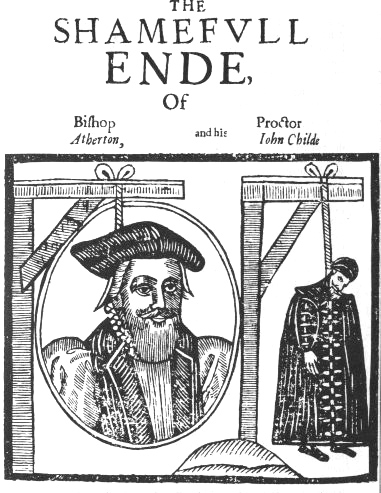
1640: Bishop John Atherton, buggerer

On this date in 1640, John Atherton achieved the unenviable distinction of being the only Anglican bishop hanged for buggery.* (His proctor, and alleged lover, John Childe, got the same treatment a few months later.)


Suppose a Devill from th’infernall Pit,
More Monsterlike, then ere was Devill yet,
Contrary to course, taking a male fiend
To Sodomize with him, such was the mind
Of this Lord Bishop, he did take a Childe
By name, not years, acting a sinne so vilde
-From the text of the pamphlet this image decorates

The Oxford-educated Englishman was appointed Lord Bishop of Waterford and Lismore by King Charles‘s hated governor Thomas Wentworth.

It may well have been the internecine politics of the day that claimed Atherton’s life, just as the civil wars they engendered in the ensuing decades claimed the original trial records.

While posterity is left to speculation, Atherton was defended in print in those years as well. (Defended as no homo, that is — not defended on principle against ubiquitous anti-gay laws.) If it wasn’t really a voracious sexual appetite (not exclusively same-sex**), goes this argument, it was intra-Protestant infighting, with Atherton’s successful clawback of land for the weak Irish Anglican church stepping on the toes of the local land barons who had recently expropriated it.

This politics outside the boudoir argument gets compelling treatment in Mother Leakey and the Bishop, a historical investigative thriller that links Atherton to a weird ghost story† in his native Somerset — that of “Old Mother Leakey,” the Minehead ghost.

Mother Leakey was Atherton’s mother-in-law, and Somerset family members claimed she haunted them — including with a message for the bishop that one of his sisters-in-law actually went to deliver in Ireland. The message isn’t known; in legend, this was a warning from beyond against the prelate’s ungodly behavior; in reality, it was more probably a family shakedown.‡

Despite the skepticism of the Leakey family’s own contemporaries, the facts, allegations, suppositions, and pure flights of fancy somehow managed to blend and recombine into a lasting tale of the paranormal that Minehead still retails to this day.

And it goes right back to the public opprobrium Bishop Atherton endured — as described in that 1641 hanging pamphlet:

“demonstrates the link between the stories of Mother Leakey and Bishop John Atherton … in a highly readable and often entertaining fashion”

… through pride, high fare, and lustfull life,
Incest committed with the Sister of his wife,
For which he sued his pardon, and then fled
To Ireland, where a worser life he led

He surely warned was to mend his life,
By his own Sister Master Leakies wife,
Which Master Leakies Mother being dead,
And in her life-time conscious how he led
His lustfull life, her Ghoast in gastful wise
Did oft appeare before her Sisters Eyes,
But she feare-strucken durst not speak unto it,
Till oft appearing forced her to doe it:
Then thus she spake, Mother in Law what cause
You from your rest, to my unrest thus drawes?
Who answered, daughter tis the wicked life
Your Brother leads, warne him to mend his life;
If not, then plainely tell him tis decreed,
He shall be hangd, bid him repent with speede:
Then shall my restless spirit be at rest,
And not till then; Thus vanisht. She addrest
Herselfe for travaile, Into Ireland went
With this sad message unto him was sent:
Which how he tooke to heart may plaine appeare
By the slight answer he returned her,
What must be, shalbe: If I must, I must dye,
Mariage, and hanging, come by destiny.
Thus scoft her counsell, sent her back, and when
Shee was returnd, he grew farre viler then
He was before, if Viler man may be,
For one bad Act before, committed three.

* According to Who’s Who in Gay and Lesbian History, Atherton and Childe were the second pair of alleged homosexual lovers executed in the British Isles. The first was the Earl of Castlehaven in 1631, along with his manservants.

** “[O]ne should note the compound sexual nature of the ‘sodomy’ charge in this context, a portmanteau omnibus of non-procreative sex, which is what ’sodomy’ was widely held to be.”

† Walter Scott footnotes this legend in Rokeby: “Mrs Leakey … dispatched her [daughter-in-law] to an Irish prelate, famous for his crimes and misfortunes, to exhort him to repentance, and to apprize him that otherwise he would be hanged; and how the bishop was satisfied with replying, that if he was born to be hanged, he should not be drowned.”

‡ Archbishop William Laud dispatched a team of ghost-whisperers to investigate the Leakey story well before the ectoplasm hit the fan for Atherton, and they weren’t buying: “certainly it is a fiction and a practice … it may be some money business.” Bishop Atherton had left home under a cloud with the suspicion that he’d had an affair with his wife’s sister, and this was part of the eventual Irish complaint against the horny goat.

On this day..

1896: Fred Behme, evangelical Methodist

On this date in 1896, McLeansboro, Ill. hosted its only hanging.

German emigre Fred Behme was settled into married life when he converted from Catholicism to Methodism.

Unfortunately — so Behme saw it — his wife Mary didn’t hew to the old cuius region, eius religio principle where the man of the house was concerned, and stuck with the bishop of Rome for the salvation of her immortal soul.

And there’s just something about the zeal of a convert.

Fred Behme’s domestic missionary work grew more violent (pdf), and eventually his battered spouse moved out; when Fred coaxed her back, and found out that she’d baptized their infant son into idolatrous Catholicism while living apart from him, he chose Easter Sunday to commit what one newspaper called “one of the most hideous and blood-thirsty crimes that ever stained the good name and honor of McLeansboro”: Fred got the other kids out of the house, he attacked Mary with an axe,

drug her by the hair into the yard, and beat in the side of her head. He covered the body with corn fodder. He then took the little boy [whom Mary had baptized] to the barn and hanged him by the neck until he died. (Source)

Though the hanging was invitation-only, it was visible from McLeansboro’s public square and large crowds gathered to witness the hirsute Protestant check out with a short speech in German.

Wikipedia alleges (without a clear source indication) that one G. Phil Hanna was among this multitude, and that seeing Behme strangle to death on an inexpertly deployed rope launched a lifelong interest in the hangman’s craft that would culminate when Hanna pinch-hit on the execution team that carried out America’s last public hanging 40 years later. Others of less august accomplishment no less vividly recalled their (and their town’s) one-time walk through the valley of death.


The family that prays together … (The perp is the bearded man; the victims are the woman seated next to him, and the child in her lap.)

On this day..

1849: Anna Koch of Appenzell

This date’s pastoral story of adolescent avarice — and impressive disobedience at the scaffold — comes to us from the tiniest of Swiss cantons,* as related in this public-domain text


Anna Maria Koch and Magdalene Fessler were girls — each about seventeen years of age — living in Gonten in the year 1849. On June 12 of that year the dead body of the latter was found lying in a ditch in one of the village pastures. There were upon it no marks of violence, and a coroner’s jury was led to conclude that the girl had come to her death by falling into the ditch in the dark. A little later, the discovery was made that on June 10 Anna Koch had sold to a silversmith in Gonten a chain, a locket, and a rosary. These articles on examination were proved to have belonged to Magdalene Fessler. Anna Koch was placed under arrest and asked to make explanation. The story related by her is as follows: –On the Sunday following Frohnleichnamsfest she met Jean-Baptiste Matezenauer, a young man of the village, and he gave her the articles of jewellery, saying that he had found them. He told her that she must sell the things and put the money in a bag which she was to hide in a field. She must then take with her a friend, stroll through the field and, as though by chance, spy the bag, pick it up and say, “Oh! I have found something!” With the money she was to buy a wedding dress, Matzenauer promising in a short time to marry her. Matzenauer was arrested and confronted with his accuser. He protested innocence, but the girl adhered to her story. She did even more, she enlarged upon it. She said that on the morning of Frohnleichnamsfest she had been in Matzenauer’s company; that he had then told her he meant to kill Magdalene Fessler in the afternoon, and had asked her to station herself in the field where the ditch was. This, she said, she had done, and that while there she saw Matzenauer drag thither the body of his victim. Despite the inherent improbability of her whole account, the girl vehemently reiterated it, each time challenging Matzenauer to a denial. At last the bewildered inquisitorial fathers before whom the examination was being conducted — perhaps with some recollection of the efficacy of torture in eliciting actionable testimony in the case of Landamman Suter — ordered Matzenauer to be brought under the lash. This was done, but without the hoped-for result. Matzenauer remained obdurate.

The case dragged on till November 13. It was then suddenly terminated by the confession of Anna Koch that she alone had planned and committed the murder. The details of the confession were substantially these: –She, a poor girl, had for a long time felt hurt in pride that she had not the money with which to provide herself the chains and trinkets commonly worn by the girls of her acquaintance. So keen was this feeling that finally she resolved to purchase a chain from one of the silversmiths of Gonten and trust to fortune to enable her to pay for it. She obtained the chain, but failing to pay for it by the time agreed on with the silversmith, was asked to return it. The necessity of doing so was fully impending when, on Frohnleichnamsfest, she met Magdalena Fessler in the churchyard, at the beginning of afternoon service. The latter had about her neck a beautiful chain, and Anna Koch, seeing it, was prompted to kill her, take the ornament, sell it, and with the money realised meet her own debt to the silversmith. She told her friend that she had lost her rosary, and asked her to go with her to find it. The two girls walked on together, soon passing into the field containing the ditch. As they were crossing the latter on a plank Anna Koch pushed Magdalene Fessler, causing her to lose her footing and fall into the water. She then jumped into the ditch herself, seized the head of her victim and, holding the mouth open with her fingers, kept the head under water until death ensued from strangulation. Having made her confession, Anna Koch asked that she might suffer the extreme penalty for her crime. Young people of her acquaintance petitioned the Great Council for a pardon. This was refused, the vote standing only six for pardon and ninety-six for punishment. Decree was then entered that the guilty one be beheaded on the block.

The day before that fixed for the execution (the latter being December 3) the condemned girl spent quietly in prayer and in communion with her confessor. She expressed herself as being entirely reconciled to her fate and, in fact, as anxious to meet it. But when led forth on the day of execution, her manner changed. The wild instincts of her Appenzell nature reasserted themselves. She declared that she could not and would not die, and with fierce cries drowned the voice of the officer who read her death-warrant before the people. The reading finished, four strong men seized the girl and bound her on a sled. Thus secured she was dragged to the headsman’s block in the market-place. But here a fresh difficulty was encountered. On being released from the sled her struggles were so frantic and determined that the executioner could not perform his task. After several vain attempts he sent the Reichsvogt (the same mediaeval official personage that had figured at the execution of Dr. Anton Leu and Landamman Suter) to report the situation of affairs to the Great Council and ask advice. The reply returned was that the headsman must do his duty. After an hour and a half of cries and resistance on the part of the condemned, her head was firmly secured to the block by the braids of her hair, and the fatal stroke given.


Gonten (it’s the long collection of buildings along the valley road, at the base of the slope) and environs. (cc) image from Michael Beat.

* Appenzell Innerrhoden is the smallest canton by population, and is larger by area only than the urban canton of Basel-City.

On this day..

1977: Larry Tacklyn and Erskine Burrows, for the murder of Richard Sharples

On this date in 1977, Black Berets Larry Tacklyn and Erskine “Buck” Burrows were hanged in Bermuda for assassinating the islands’ police chief and governor.

“During the 1970s, a black power organization in Bermuda conspired to bring about social change ‘by any means necessary,’ including assassination. This is the first full account of the murders and the Black Beret Cadre, the revolutionary group whose activities resulted in mayhem throughout the island.”
Book’s advance publicity

A revolutionary black nationalist organization, the Black Beret cadre took its name from that Che Guevara photograph and its model from the Black Panthers.

The cadres’ agenda for early-1970s Bermuda

was ‘freedom by any means necessary’ which included assassination. Taking their cue from the Black Panthers, whose primary aim was to bait the ‘racist cops’, the Black Berets exhorted its members and all Bermudian youth to confront the ‘English racist police’ as frequently as possible and prepare for the coming conflict between blacks and whites …

Its purpose was to indoctrinate young black Bermudians in communist revolution and the ideology of Black Power.

Cadres Tacklyn and Burrows were one part liberators of their oppressed brothers, one part common criminals.

In 1972, they gunned down white police commissioner (a veteran of Britain’s colonies) George Duckett; in 1973, they ambushed governor (and former Tory M.P.) Richard Sharples and slew him, along with his aide-de-camp.

Neither perp was apprehended, which meant they went on to kill a couple of supermarket executives before someone I.D.’d Tacklyn. Burrows stayed on the lam long enough to rob a bank of $28,000.

The trials were a sensation — apt for the involvement of sensational Bermudian lawyer and politician Julian Hall — with Burrows convicted all around. He openly avowed the political murders.

Erskine Burrows

The motive for killing the Governor (his ADC was not our objective, he was shot only because he happened to be with the Governor at the time) was to seek to make the people, black people in particular, become aware of the evilness and wickedness of the colonialist system in the Island of Bermuda.

Secondly, the motive was to show that these colonialists were just ordinary people like ourselves who eat, sleep and die just like anybody else and that we need not stand in fear or awe of them.

Finally, the motive was to reveal to black people unto themselves.

This refers to the revealed reactions of many black people during the Governor’s funeral, when black people were seen to be standing with tears in their eyes, crying for a man who when he was alive didn’t care if they lived or died and here they were crying for a white Governor and yet when many of their own people pass away there is sometimes hardly a tear shed for them.

This shows clearly the evil effects that the colonialist propaganda has had over the long years they have ruled over this little Island.

Tacklyn managed to win acquittals over Duckett and Sharples but was condemned for killing the grocers. With “only” the two murder raps, Tacklyn’s appeals against execution might have stood a chance in other circumstances. But his affiliation with Burrows, who so openly avowed the other crimes and declined to mitigate them in court, “hung like an albatross around Tacklyn’s neck.”

That wasn’t the only thing that was hanging.

Massive riots rocked Bermuda after it became known that eleventh-hour clemency bids were rejected; “Fires erupted across Bermuda,” Reuters report, “causing millions of dollars in damage as a dusk-to-dawn curfew failed to halt the racial violence.” (Per Chicago Tribune, Dec. 3, 1977) British troops were deployed to help quell the riots.

Tacklyn and Burrows were the first people executed in Bermuda in 34 years, and remain the last executed there to this date.

Because all Britain’s overseas territories in the Caribbean subsequently abolished the death penalty (Bermuda in a contentious 1999 parliamentary dispute decided by a single tiebreaking vote), Tacklyn and Burrows also hold the distinction of being the last people put to death anywhere under British law. (As distinct from the last executed in Britain.)

On this day..

1327: Adso’s lover in The Name of the Rose

On an unspecified date presumably around early December of 1327 — the timeframe is approximated by action’s story’s commencing on “a beautiful morning at the end of November” — the Inquisition burns the nameless peasant lover of the narrator in Umberto Eco’s novel The Name of the Rose.

Adso of Melk is apprenticed to the scientific-minded William of Baskerville — a deliberate allusion to Sherlock Holmes — when the monk is dispatched to an Italian monastery to sniff about for heresy.

The Name of the Rose unfolds a labyrinthine murder mystery around a literal labyrinth (a maze-like library) as William and Adso fight crime and the superstitious dogmatism of the Church. Well … William fights these things. Young Adso mostly comes along for the ride and keeps the action signposted for the reader with his cluelessness.

As a teenage boy, Adso has his own demons to confront.

During their short stay at the monastery, Adso has a chance, and scorching, sexual encounter with a peasant girl from the lands owned by the monks. This subplot intersects with a relentless Inquisitor — the real-life historical figure Bernard Gui* — in pursuit of refugee Dolcinians and other heretical types who were actually running around northern Italy at this time.

The long and short of it is that the girl is condemned to the stake as a sorceress on ridiculous circumstantial evidence that the reason-favoring duo is in no position to repel, and that Gui is eager to trump up further to politically muscling Dolcinian-friendly monks.

The very watchable 1986 cinematic adaptation of the novel, starring Sean Connery as Brother William and Christian Slater as Adso, takes some liberties with Eco’s text on the matter of the girl.

In the novel, her execution happens “off-camera” but with a numbing certitude; it’s an evil in the world that no protagonist can prevent, and Adso just has to get used to the idea.

I was tempted to follow her … William, grim, restrained me. “Be still, fool,” he said. “The girl is lost; she is burnt flesh.”

Directly after convicting the girl for witchcraft, and nabbing two heretical monks in the process, Gui departs the convent towards the papacy’s then-residence at Avignon for a gratifying show trial. The monks are the real prize; Brother William prophesies that the girl

will be burned beforehand, along the way, to the edification of some Catharist village along the coast. I have heard it said that Bernard is to meet his colleague Jacques Fournier (remember that name: for the present he is burning Albigensians, but he has higher ambitions), and a beautiful witch to throw on the fire will increase the prestige and the fame of both.

The smitten Adso is heartbroken over this cruelty.

“So the cellarer was right: the simple folk always pay for all, even for those who speak in their favor … who with their words of penance have driven the simple to rebel!”

The only sure thing was that the girl would be burned. And I felt responsible, because it was as if she would also expiate on the pyre the sin I had committed with her.

I burst shamefully into sobs and fled to my cell, where all through the night I chewed my pallet and moaned helplessly, for I was not even allowed — as they did in the romances of chivalry I had read with my companions at Melk — to lament and call out the beloved’s name.

This was the only earthly love of my life, and I could not, then or ever after, call that love by name.

The film indulges a happier and very implausible fate for Adso’s hot little number: in this version, the executions take place on-site at the monastery, and other peasants riot, murder the Inquisitor, and free our oblate’s muse. Hey, in a work that’s all about faith, why not a little deus ex machina?

Warning: Spoilers The Name of the Rose is a detective story, and the clips below intercut the execution scene with the mystery’s big reveal. Don’t watch them if you want to approach the film or the book without knowing how it all plays out.

The movie’s softhearted approach has the benefit of allowing a more cinematic and literal presentation of Adso’s choice between the life of the mind/soul and the life of the flesh. The clip below is spoiler-safe, since you already know which one he chooses.

To geek out on this book’s complex tapestry of allusions, you could do worse than this archived study guide.

* Played by F. Murray Abraham in the film. Gui wrote a notable tract on examining heretics; dust off your Latin to read it on Google books here, or get the gist with this English-translated excerpt.

On this day..

1539: Don Carlos Ometochtzin, Aztec heretic

On this date in 1539, the Spanish Inquisition had Aztec noble Don Carlos Ometochtzin (or Don Carlos Chichimecatecuhi, or Don Carlos Ahuachpitzactzin) burned at the stake for reverting to the pre-Columbian indigenous religion.

Just another Mesoamerican depredation?

Surprisingly, this execution stands out as an exception in the first generations of its conquest. It even cost the first bishop of Mexico, Juan de Zumarraga, a reprimand for his excess severity. Why?

Certainly any European Christian would have had trouble with the Inquisition if, like Don Carlos (Spanish Wikipedia entry | English), he had been caught with idols of Xipe Totec in his place.

But it was precisely the point that these weren’t Europeans. In 16th century “New Spain,” syncretisms of Christianity and the native Mexican cults still in living memory were the norm, a scenario recalling early Christianity co-opting the pagan rites it supplanted.*


Respect Xipe Totec’s authoritah!

And that created for the Spanish a problem: how stringently to insist upon an alien orthodoxy for its new subjects? The problem was pragmatic at least as much as it was theological, because the business of winning converts for Christ had to coexist with the business of running an empire. No sense provoking civil war just because the newest souls in the fold don’t have the Te Deum down; Cortes himself, in his initial conquest, had prohibited human sacrifice but not risked closing native temples.* That wasn’t done until 1525.

Over the 1530’s, a campaign unfolded to pare down the many holdover native behaviors — polygamy, idolatry — and cement Christianity. Of particular concern were the “converted” elites who had both means (their social position) and motive (privileges lost to the Spanish) to use nostalgia for the old ways to make trouble.

So, a powerful indigenous priest who “converted” and then went about preaching heretically was investigated by Zumarraga, wielding the Inquisitorial authority, in 1536.

But even that didn’t draw a death sentence.

In Zumarraga’s 19 Inquisitorial trials involving at least 75 suspects, the one and only instance of an Indian being “relaxed” to the secular authorities for execution came in 1539, when Zumarraga was tipped that the hereditary ruler of one of the Aztec Triple Alliance‘s principal city-states was a secret idolator, and a public declaimer of treasonable utterances like this:

Who are those that undo us and disturb us and live on us and we have them on our backs and they subjugate us? … no one shall equal us, that this is our land, and our treasure and our jewel, and our possession, and the Dominion is ours and belongs to us.

Don Carlos was ultimately acquitted of the idolatry stuff, but convicted of heretical dogmatizing.

So far, so good, right? Executions for heresy might be horrible in general, but if you live in a world where they’re routine, surely having your colonial satrap out there calling the empire parasitical, and telling the unwashed masses to go ahead and take multiple wives (Aztec elites seem to have been especially piqued by the lifestyle austerity preached by Franciscan missionaries) is the sort of thing that’ll get you burned at the stake.** And there were plenty more like him out there.

But though the Christianizing campaign of the 1530’s would continue in many forms for decades still to come, the bloodletting which Don Carlos figured to presage was abruptly canceled.

According to Patricia Lopes Don’s “Franciscans, Indian Sorcerers, and the Inquisition in New Spain, 1536–1543,” in Journal of World History, Vol. 17, No. 1,

[a] holocaust was most probably at hand in the spring of 1540. However, when the Council of the Indies in Spain learned of Don Carlos’s execution, they reprimanded Zumárraga, sent a visitador, an inspector-auditor, to New Spain to take away the bishop’s inquisitorial powers, and left him in a state of some humiliation until his death in 1548. All indications were that they feared further such executions would lead to widespread indigenous rebellion in New Spain. As was the case with the Muslims in the Old World, although orthodox Christianity was central to the concept of Spain and the monarchy, when the imperial Spanish needed to choose between religious orthodoxy and the security of the state, they could learn very quickly to be flexible and politique, yet express their concerns in judicious language. In a letter of 22 November 1540, Francisco de Nava, bishop of Seville, explained to Zumárraga that while he understood that he had executed Don Carlos “in the belief that burning would put fear into others and make an example of him,” the Indians, he suggested, “might be more persuaded with love than with rigor.”

When the Inquisition was formally instituted in New Spain in 1571, the native populace was explicitly outside its jurisdiction: its job was to monitor the European population for covert Protestants, Muslims, and Jews.

Although this development has to count as a break for the locals, it’s interesting to note that the theological superstructure of the Spanish policy tension between religious conformity and practical colonialism turned at least in part on a condescending dispute over the “capacity” of Indians to truly become Christian. In that dispute, Zumarraga and his Franciscan order were the ones who thought more highly of the indigenous “capacity”, as against the more skeptical Dominicans; the logical consequence of the Franciscan position was to impose upon those capacious natives the fullest severity of God’s law.

* Though not to be underestimated is the persistence within the citadel of Christendom of everyday folk beliefs, and occasional social movements, at odds with ecclesiastical dogma.

** Treasonous quote and details about the investigation and trial from Richard E. Greenleaf, “Persistence of Native Values: The Inquisition and the Indians of Colonial Mexico”, The Americas, Vol. 50, No. 3 (Jan., 1994)

On this day..

1957: Adolfas Ramanauskas-Vanagas

On this date in 1957, Lithuanian anti-Soviet partisan Adolfas Ramanauskas-Vanagas (Lithuanian link) was shot in Vilnius.

Ramanauskas-Vargas himself was born in the U.S., but his Lithuanian family soon returned to the motherland, where Adolfas grew up and supposedly just taught seminary during the war years. (Code for, he collaborated in the Holocaust.)

When the USSR finally broke the Siege of Leningrad and sent the Wehrmacht running west in 1944, it (re-)occupied the Baltic nations of Lithuania, Latvia, and Estonia. And the Soviets didn’t plan to leave.

Bands of anti-Soviet partisans formed in these anti-Soviet states, as elsewhere in Eastern Europe — the evocatively named Forest Brothers. Ramanauskas-Vanagas joined up.

Absent western support which was not forthcoming, these nationalist guerrillas were overmatched against the Red Army — but the movements held out in their secret wilderness fastnesses for years, and in the case of at least a few intransigent individuals, decades.

The Soviets answered with ruthless suppression to quell resistance, coupled (after Stalin’s death in 1953) with an amnesty offer that largely emptied the forests.

Ramanauskas-Vanagas, the South Lithuania commander, wasn’t captured until late in 1956. He enjoyed the customary favors of his KGB captors, and after torture, the Lithuanian SSR Supreme Court sentenced him to execution. (His wife got a trip to the gulag.)

There’s a Lithuanian biography of him here, and a few good photos in this forum thread.

A few topical books

On this day..

1783: Johanna Catharina Höhn, by Goethe’s vote

“To think is easy. To act is hard. But the hardest thing in the world is to act in accordance with your thinking.”

-Goethe

On this date in 1783, Johanna Catharina Höhn lost her head for infanticide … thanks to the vote of the man who wrote the most recognizable infanticide story in literature.

Eleven years before, then-22-year-old Johann Wolfgang von Goethe had been a firsthand witness to the trial of another infanticide who ultimately lost her head. This case very likely inspired the character Gretchen in Goethe’s best-known work, Faust.

Faust was a lifelong project for the author, but evidently the same could not be said of empathy for infanticidal mothers.

As a Privy Councilor to Carl (or Karl) August, Grand Duke of Saxe-Weimar-Eisenach, Goethe was presented with the case of Höhn, a 24-year-old unmarried servant girl who cut her newborn son’s throat.

Infanticide was an Enlightenment wedge issue touching not only evolving standards of humane criminal justice, but “as the main eighteenth-century area of conflict surrounding social repression and female sexuality.”*

Was it justice to put mothers to death for infanticide? Was it efficacious for a state to do so — given that such crimes were committed in a state of desperation that might negate deterrence, and that the offenders attracted the pity of potentially unruly scaffold mobs?

And if the executioner’s sword** was not depended upon to keep women keeping it in their britches, what social policies ought to replace it?

Infanticide and its prevention was the favorite theme of the criminologists of that time. [Christian] Rothenberger calls attention to the wide discussion of means to care for the poor, to the evil effects of luxury, and then to a “formliche Kindermordlitteratur.”† [L.W.] Seyffarth, the editor of the best edition of [Johann Heinrich] Pestalozzi‘s works, says: “The question how infanticide might be stopped was at that time a burning one.”

The great interest in infanticide can best be brought to view by the contest for a prize of 100 ducats offered by [Karl Theodor] von Dalberg, intendant of the Mannheim theater, for the best essay on the subject: “What are the best and most practicable means to eradicate infanticide without promoting prostitution?” The contest closed at Whitsuntide, 1781. The offer of the prize was published in most of the newspapers and magazines of that time and was generally accompanied by editorial comments. The editorial in August Ludwig Schlozer‘s magazine Briefwechsel is typical. “There are crimes committed among us,” the editor writes, “which are the most horrible and at the same time the most common, and among these is infanticide; crimes which are related to virtues, virtues which develop into vices, and among these too is infanticide; crimes which experience teaches are not made less frequent by increasing the severity of the punishment, while not to punish them would bring disgrace to mankind and destruction to law and order, and among these too is infanticide … How long shall we lead to the block these unfortunate girls as sacrificial victims, whose love and the natural weakness of their sex, whose adornment of innocence and modesty has made them to be mothers and murderesses?

The Duke inclined very strongly to the progressive answer gaining ground at the time, and when Hohn’s case surfaced, he put to his aides the prospect of eliminating the death penalty for infanticide and replacing it with other legal sanctions.

Those aides produced a mixed response. Goethe, perhaps the duke’s closest advisor, was ultimately in a position to exercise decisive influence on whether to adopt the duke’s proposal. (Whether it was the decisive influence is a matter of some dispute.)‡

Despite his sensitive portrayal of the fictional Gretchen/Margarete in Faust, the great writer took a distinctly retrograde stance on sparing actual flesh-and-blood women … and Goethe’s position, which he formally voted only 24 days before the execution, carried the day.

The evidence is clear that there was substantial (though not necessarily unanimous) agreement with the duke’s proposal to abolish the death penalty for infanticide.

… Without doubt, then, Goethe’s vote carried considerable weight. How could it not? He was the duke’s best friend and thus easily the most powerful member of the Council after Carl August because of his immense influence over him … [and] Goethe unquestionably cast his vote to retain the death penalty for a crime that was widely seen in his time as resulting from social injustice and harbouring wide potential for extenuating circumstances (in principle, not only in particular cases). His vote thus ran entirely counter to his depiction of the case of Margarete in Faust, in which ‘extenuating circumstances’ abound. While the question of Goethe’s guilt is a moral one that need not concern us, his part in the responsibility for retaining the death penalty for infanticide and thus also for the execution of Johanna Hohn is crystal-clear.*

A Weimar journalist called it “state murder.”

Hohn’s body was delivered to a Jena professor for anatomization.

A recent German book, Goethes Hinrichtung (Goethe’s Execution), novelizes the case.

* W. Daniel Wilson “Goether, his Duke, and Infanticide: New Documents and Reflections on a Controversial Execution,” German Life and Letters, January 2008. This volume includes the (German) text of the previously unpublished Halsgericht, a very detailed “script” for the actual execution. This volume of German Life and Letters also features a ceremonious dialogue between der Scharfrichter, the executioner, and der Richter, the judge, conveying possession of the criminal and legal direction for her punishment, which would all have been enacted in public in the doomed woman’s presence.

** Hohn was beheaded with a sword; this was itself a “mercy,” as she could have been dispatched by drowning.

† Most notably, Die Kindermörderin by Heinrich Leopold Wagner (both German links).

‡ Note that the consideration at the level of the Privy Council was formally about whether to abolish the death penalty for infanticide in general — not directly about Hohn’s case, which proceeded on a separate track. It seems to be generally agreed that Goethe and all other parties understood Hohn would live or die based on the statutory decision.

On this day..

1674: The Chevalier de Rohan and Franciscus van den Enden

On this date in 1674, the former Grand Huntsman of France was beheaded in Paris for conspiring to betray Normandy during the Franco-Dutch War.

Your basic debt-mired noble and court cad, the Chevalier de Rohan (French Wikipedia link) through an accomplice “intimated that Normandy was very much dispos’d to a revolt, & that if hee would send a fleet with 6 thousand men, & armes for twenty thousand, with necessaries for sieges & two million of livres, that there was a greate man who would engage himself upon the assurance of thirty thousand crownes pension …”

The correspondence was discovered and Rohan arrested, but his role in the plot was sufficiently anonymized that even an absolutist state didn’t have the goods to convict him. Meanwhile, Rohan’s accomplice was hunted to ground and killed in Rouen during the attempt to arrest him.

This left the authorities in the position, common to every cop show and not a few real-life cases, of requiring a confession from the accused to proceed at all. Rohan’s friends realized this too, and tried desperately to warn him against self-incrimination.

Persons attached to the chevalier de Rohan went every evening round the Bastile, crying through a speaking trumpet, “La Tuanderie is dead, and has said nothing;” but the chevalier did not hear them. The commissioners, not being able to get any thing from him, told him, “that the king knew all, that they had proofs, but only wished for his own confession, and that they were authorized to promise him pardon if he would declare the truth.” The chevalier, too credulous, confessed the whole. Then the perfidious commissioners changed their language. They said, “that with respect to the pardon, they could not answer for it: but that they had hopes of obtaining it, and would go and solicit it.” This they troubled themselves very little about; and condemned the criminal to lose his head. He was conducted on a platform to the scaffold, by means of a gallery raised to the height of the window of the armoury in the arsenal, which looks towards the little square at the end of the Rue des Tournelles. He was beheaded on November 27, 1674.

It is hoped that, should the reader ever become a person of police interest, s/he will recall from Rohan’s example that inspectors do not have suspects’ best interests in mind.

A couple of other nobles also lost their heads along with our chevalier.

Hanged for his trouble was Franciscus van den Enden (English Wikipedia page | Dutch), the elderly Dutchman — and accused Dutch agent — who recruited these toffs for the purpose of seizing Le Havre.

Van den Enden is an interesting, perhaps underappreciated, radical intellectual of secular-democratic persuasion (he attracted the suspicion of atheism, and his Vrye Politijke Stellingen made an unabashed case for democratic government). He’s best known for being a schoolmaster of philosopher Baruch Spinoza; W.N.A. Klever, in an October 1991 paper in the Journal of the History of Philosophy (“A New Source of Spinozism: Franciscus Van den Enden”) traces the connections between the philosophy of the master and that of the pupil and rather dramatically argues that

Van den Enden must be considered as a kind of “Proto-Spinoza.” … He was the hidden agent behind Spinoza’s genius … [t]he origin of Spinoza’s anomalous philosophy.

A variety of (untranslated) references to the “Proto-Spinoza” from 17th century correspondence are available here.

Those inclined more towards geopolitics than philosophy might enjoy Victor Magagna’s podcast lecture on the great-power calculus driving France’s conflict with the Netherlands — which, as we have noticed in these pages, claimed the life of the longtime Dutch leader Johan de Witt.

On this day..