1998: Cao Haixin, unwelcome meddler

On this date in 1998, the execution grounds settled a local political rivalry in China.

According to an upsetting 1999 Los Angeles Times feature, Cao Haixin had lately governed a small village that was being swallowed up by the sprawling Zhengzhou metropolis.

The previous village chief, Cao Xinbao, had profiteered gleefully from his run at the top with sweetheart deals on rapidly appreciating real estate for himself and his connections.

Cao Haixin, a reformist farmer, beat Cao Xinbao at the polls in 1995 and set about making unwelcome inquiries into the whereabouts of millions of yuan … at which point a goon squad of the ancien regime led by Cao Xinbao’s own brother actually invaded Cao Haixin’s home looking to intimidate or murder him. No subtlety needed.

Instead, the mayor grabbed a hunting rifle and killed his predecessor’s brother in the affray.

Astonishingly, Cao Haixin was the man arrested for this incident, and sentenced to death in a provincial court seemingly stacked with Cao Xinbao allies. A Zhengzhou municipal judge reportedly told one of the condemned man’s many supporters that local village officials had on a full-court press for execution as the case worked its way through the system.

Eventually — after a few cycles of appeals to the Supreme Court, which in turn fruitlessly referred inquiries back to those very village officials who wanted him dead — Cao Haixin was executed in secret. The next day’s news announcement reported nine executions, but listed only eight names.

The problem, analysts say, is that the national and provincial governments are dependent on local strongmen such as Cao Xinbao to implement the state’s basic rural policies concerning land, grain and taxes. Local cadres’ control of these policies affords them ample opportunities to line their own pockets.

These strongmen often wear the multiple hats of local clan leader, village chief and party boss. They often have a corrosive influence on China’s fledgling village election system, leaving peasants with little recourse to justice.

Today, the faith of many of the villagers–faith in the law, in China’s future and in themselves–lies shattered.

Cao Haixin’s widow and 14-year-old daughter struggle to survive. Many of the villagers, lawyers and journalists who fought for more than two years to stop Cao’s execution remain depressed and cowed.

“I feel powerless and frustrated,” said one of Cao’s lawyers. “I ask myself, did I help to deceive the masses by even participating in this sham trial?”

Los Angeles Times, Oct. 17, 1999

On this day..

1858: Qualchan

“Qualchan came to see me at 9 o’clock, and at 9:15 he was hung.”

George Wright

It was this morning in 1858 that the gaily dressed Yakama Indian guerrilla Qualchan turned himself in to his Anglo hunter, and was promptly put to death.

Wright was prosecuting the Yakima War in the Pacific Northwest — another characteristic Indian conflict featuring a formerly remote tribe suddenly cursed with valuable land by the discovery of gold.

Qualchan (sometimes “Qualchen”, “Qual-Chen”, or “Qualchien”) was among the Yakima chieftains resisting “encouragement” to give up that part of their territory most desirable to white settlers, and eventually, Qualchan killed encroaching white miners and made himself an outlaw.

For more than two years, the army hunted Qualchan in vain as he harried white settlers around Washington — or, as Wright put it,

Qual-Chen … has been actively engaged in all the murders, robberies, and attacks upon the white people since 1855, both east and west of the Cascade Mountains … committing assaults on our people whenever the opportunity offered.

Late in the game, the American military had been reduced to a Bushian with-us-or-against-us posture:

Kamiakin and Qualchan, cannot longer be permitted to remain at large or in the country, they must be surrendered or driven away, and no accommodation should be made with any who will harbor them; let all know that asylum given to either of these troublesome Indians, will be considered in future as evidence of a hostile intention on the part of the tribe.

The expedient that induced this potent commando to throw his own life away was the capture of Qualchan’s father, Owhi, rather dishonorably effected on an invitation to parley, then parlayed into a threat to execute the hostage lest the wanted Yakima produce himself.

“I thought then the worst that could happen would be a few months’ imprisonment,” remembered Qualchan’s wife (who was also present). “You may imagine my terror and consternation when I saw that they were making preparations to hang my husband. I first thought it was a huge joke, but when I saw the deliberateness of their preparations, the fullness of their treachery and cowardice became apparent.”

And since the U.S. was maintaining that draconian view of Qualchan’s collaborators, Wright followed up his triumph with summary hangings over the next several days of several more Palouse. By the month’s end, he was prepared to declare the Indians “entirely subdued.”

Wright’s rough peace caused the nearby creek in eastern Washington to be christened “Hangman’s Creek”, though there’s been a tendency to steer away from that frightful name in recent times. But what better way to honor an indigenous foe of colonial land conquest than by naming a golf course for him?

The unfolding fate of the Yakimas is further explored in the public-domain book Ka-mi-akin, the last hero of the Yakimas, whose title character was Qualchan’s uncle.

On this day..

1947: Nikola Petkov, “a dog’s death”

At midnight as the calendar turned over to this date in 1947, anti-communist Bulgarian politician Nikola Petkov was hanged in Sofia’s central prison.

Petkov was a principal in a still-extant peasant party that briefly held state power in Bulgaria in the early 1920s.

His anti-fascist activities did him no favors as Bulgaria’s aligned with the Axis, and he spent the war touring his country’s internment camps.

The anti-fascist Fatherland Front that Petkov co-founded — allying with the Communist party in what would prove to be a Faustian bargain — had become the government by the end of the war, with Petkov in a ministerial role.

Unfortunately for Petkov, greater ministers of greater states were even then carving up spheres of influence in the postwar world. In the process, the Bulgarian statesman would get carved right out.

Here’s the blog of this critically acclaimed novel’s author.

With Bulgaria slated for the Soviet bloc and all its scary political purges, the Fatherland Front was soon controlled by the Communists. Petkov mounted brave but futile opposition as a Member of Parliament — until he was arrested in the parliament building itself, an apt image for Bulgaria’s entrance onto the Cold War chessboard as a red pawn.

The show trial and resultant death sentence “for having tried to overthrow the legal authority and restore Fascism in the country by conspiring with military organisations” briefly exercised western diplomats filing appeals and high-minded talk about justice during the summer of 1947.

Which stuff earned the derision of Bulgarian Premier Georgi Dimitrov, so Soviet-aligned that he was a Soviet citizen.

In this menacing speech to the Social Democrats the next January, his Don’t-Mess-With-TexasBulgaria umbrage at outside actors for having the temerity to object stands in ironic contrast to Dimitrov’s own history as a prewar international cause celebreback when he was unjustly accused in Nazi Germany for the Reichstag Fire.

So sauce for the goose-stepper is sauce for the dialectical materialist?

Negatory.

As you remember from this rostrum I many times warned your political allies from Nikola Petkov’s group. They did not listen to me. They took no notice of all my warnings. They broke their heads, and their leader is now under the ground. You should now think it over, lest you share their fate … When the trial against Nikola Petkov began you said “The court will not dare to sentence him to death. It would be too horrible. Both Washington and London will rise against it in order to stop it.” I said then: “Nobody can stop it. Those who may try to intervene from abroad will only worsen the position of the accused and his friends.’ What happened? What I said would happen. The court fulfilled its role, fulfilled the will of the people and sentenced the traitor to death.

Then you said: “If they execute the death sentence, the glass of patience will overflow. The whole world will rise against it, and all its wrath will fall on the back of the Bulgarian people.”

Of course, if there had been no interference from abroad, if they had not tried to dictate to the sovereign court, the head of Petkov could have been saved Yes, it could have been saved. His death sentence could have been commuted to another sentence. But when they tried to blackmail the Bulgarian people and question the authority of a sovereign court, it became necessary for the death sentence to be executed. And it was executed.

What happened then? Who rose against it in the country? Where were the demonstrations, the mutinies with which we were threatened? Nothing like that happened.

And what happened abroad? Not even decent diplomatic notes were delivered, which could have been expected. No one raised a hand in defense of Petkov. Some people in the West shouted for a while, but soon quietened (sic) down … The whole incident was soon forgotten.

The Balkans In Our Time

Hard to say Dimitrov was wrong about that: just one week after Petkov’s execution, the United States officially recognized a Bulgarian state dedicated (so the U.S. State Department had only just declared) “to remov[ing] all save a purely nominal opposition and to consolidat[ing], despite its professions to the contrary, a totalitarian form of government.”

“To a dog, a dog’s death,” sneered the official trade union council about Petkov — a taunt liberally repeated by Radio Sofia.

The “dog” was posthumously rehabilitated in 1990, and now has the requisite post-Soviet public monuments.

On this day..

1913: Ernest Austin, the last hanged in Queensland

On this date in 1913, Ernest Austin was hanged at Brisbane’s Boggo Road Gaol — the last person to suffer that fate in Queensland.

Austin stalked an 11-year-old girl down a dirt road — one that inconveniently recorded the distinctive prints of his heel-less boot — and raped and murdered her.
This “mental deficient” (“The State Slays Its Own Creation,” headlined an anti-death penalty newspaper, alluding to Austin’s institutionalized upbringing) was resigned to his fate even prior to conviction. Resigned enough to hurry it along.

Witness opened the cell door, and found accused standing with an upturned cell bucket by his side. O’Callaghan shook out all the blankets, and found a rope plaited of three strips torn off a blanket. Witness said to accused:—”You should not do anything rash.” Accused replied:—”I will be hanged anyhow.” Witness then said:—”You are not found guilty yet.” Accused said:—”I admit I murdered the girl.”

Little wonder the government wasn’t interested in clemency.

Nine years later, Queensland became the first Australian state to abolish the death penalty.

Austin’s ghost is supposed to haunt Boggo Road Gaol to this day, even though the section of the prison where he died has long since been demolished. The haunting story seemingly rests on an urban legend that Austin was some outsizedly diabolical creature and not the run-of-the-mill pathetic malefactor that a century’s perspective might suggest.

On this day..

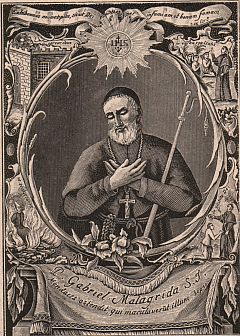
1761: Gabriel Malagrida, Jesuit nutter

On this date in 1761,* the Jesuit Gabriel Malagrida became a late casualty of the Tavora Affair and the Lisbon earthquake when he was garroted for heresy.

Malagrida (English Wikipedia entry | Portuguese) was a 72-year-old Italian with decades of missionary service to the Portuguese New World colonies under his belt.

He had, in his time, been a prominent exponent of the Jesuits missions’ policy in the Amazon, which amounted to asserting their own jurisdiction against the secular government’s attempt to order its overseas territories. (There’s more on that conflict here.)

And this only exacerbated his principal sin of being a Jesuit — an order whose diminution was eagerly sought by the rising statesman of Enlightenment Portugal, the Marquis of Pombal.

The shock of the 1755 Lisbon earthquake would deal Pombal the trump hand he needed to start reshaping both city and society to his liking.

Malagrida, meanwhile, carped that the earthquake’s causes

“are not comets, are not stars, are not vapors or exhalations,** are not phenomena, they are not natural contingencies or causes; but they are solely our intolerable sins … I do not know how a Catholic subject dares to attribute the present calamity of this tragic earthquake to causes and natural contingencies. Do not these Catholics understand this world is not a house without an owner?”

This published pamphlet merely echoed what many of the order were saying in the pulpits, and Pombal was not about to let the backwards, superstitious crowd** own the catastrophe.

Malagrida was banished from Lisbon: and, when the Tavora family was implicated in an attempt to assassinate the Portuguese king, Malagrida, their confessor, found himself clapped in prison.

Though the now-septuagenarian priest did not share the Tavoras’ grisly public butchery, he was left to molder. A couple years in a dungeon saw him go a bit strange, and supposedly he published treatises with such eccentric features as God’s personal instructions to Malagrida, and Malagrida’s fascination with St. Anne’s uterus. Catholic sources, which consider Malagrida a martyr, doubt that he ever published any such thing; if he did, it seems apparent that it was dementia rather than heresy that afflicted the old man.

But Pombal had installed his own brother as judge of the tribunal, so the matter was prearranged. The execution itself was

staged in a dramatic way, even to the point of Malagrida’s appearing on the scaffold in Jesuit habit, to impress upon the Portuguese and the world at large that an old order had come to an end and a new one was to be established … one might say that … symbolism at the cost of one human life was a relatively humane procedure in comparison with the symbolic elimination of whole classes of society in the twentieth century.


Detail view (click for the full image) of Malagrida executed at a Lisbon auto de fe. CC image from Ricardo Mealha, original provenance unknown.

Pitying the superstitious Jesuit at the stake, Enlightenment secularist Voltaire inveighed against Enlightenment secularist Pombal for conducting the execution … just part of Voltaire’s queer ideas about not killing people over their religious beliefs.

“It is all pity and horror,” Voltaire wrote in a private correspondence. “The Inquisition has found the secret to inspire compassion for the Jesuits.”

Voltaire’s appraisal in Candide (already published by this time) of a country in the grip of religious superstition unjustly stands as one of the lasting literary monuments to an event that actually rolled back clerical influence: “the sages of [Portugal] could think of no means more effectual to prevent utter ruin than to give the people a beautiful auto-da-fé; for … the burning of a few people alive by a slow fire, and with great ceremony, is an infallible secret to hinder the earth from quaking.” That the philosophe who penned those words waxed so immoderately outraged at the demonstrative chastisement of a man who preached precisely all that hocus-pocus — that Voltaire ascribed his execution to “the Inquisition” — plants the cherry on the irony sundae.‡

But Pombal’s expedient use of the Inquisition’s medieval machinery to make an example of Father Malagrida would not be the start of a pattern; the Pombaline reforms of the years to come brought the Inquisition sharply to heel, and it was Malagrida himself who was its last victim (pdf) in Portugal in its classical ecclesiastic form.


The house where Malagrida was born in Menaggio, Italy is marked with a plaque. Image (c) kallipyg and used with permission.

* Some sources give September 20 as the date.

** The “God is pissed” hypothesis was posited against theories of earth’s vapors promulgated by the Pombal-sponsored scientist Ribeiro Sanches.

† Anti-Jesuit sentiment was widely abroad in Europe at this time; increasingly resented as political manipulators, the Society would be suppressed by papal order in 1773, only to revive during the post-Napoleonic reaction.

‡ Malagrida was well-known to contemporaries in Europe, but that does not mean sympathy for him was universal. The British pol Lord Shelburne was satirized as “Malagrida” for his putative duplicity.

On this day..

1586: Anthony Babington and fellow plotters, Walsingham’d

The recently completed papal visit to England has summoned many a recollection of that country’s traumatic break from the Church. (As well as more recent embarrassments.)

While we know the schism from the comfort of retrospection, those present for its 16th century inception (and long afterward) had the task of sorting out winners and losers on blood-soaked scaffolds.

So we pause this date to note the extirpation September 20 and 21 of the Babington Plot, a half-baked scheme to re-establish the Old Faith that turned into one of history’s signature achievements of espionage.

Its namesake, young Sir Anthony Babington, was a secret Catholic with more money than sense; like many a Catholic of this time, he bristled under the rule of Elizabeth I, the daughter of the very woman who started all this English Reformation trouble.

Besotted with fellow-Catholic Mary Queen of Scots after having served as her page in his youth, Babington was easy prey for the fellow invariably described as Elizabeth’s “spymaster”Francis Walsingham.

Not one for scruples where his own security or his sovereign’s was concerned, Walsingham had long considered Mary Queen of Scots too dangerous to be left alive: every Catholic plot against Elizabeth intended to replace her on the throne with this Catholic cousin.

Trying to overcome Elizabeth’s reluctance to off fellow royalty — dangerous precedent, in these dangerous times — Walsingham entrapped Babington and a coterie of other Catholics into designing and documenting a scheme to assassinate Elizabeth and support a Spanish invasion.

And most importantly to Walsingham, they got Mary to sign off on it.

Though the design was grandiose, the real danger was pretty much nil — since Walsingham, a Renaissance reconnaissance man famous for his continent-spanning intelligence network, had penetrated the circle months before.* Walsingham let the conspiracy ripen long after he had the goods on the likes of Babington, intending to make it the instrument of Mary’s destruction. He succeeded.

Coded correspondence that Mary thought she was smuggling in and out of her cell was in fact being intercepted and decrypted.

When Babington wrote to her, alluding to his intent with “six noble gentlemen” to murder Queen Elizabeth, Mary doomed herself with a favorable reply:

The affair being thus prepared, and forces in readiness both within and without the realm, then shall it be time to set the six gentlemen to work; taking order upon the accomplishment of their design, I may be suddenly transported out of this place.

Within days, all — Mary, Babington, six gentlemen, and more — were in chains, and the commoners were being tortured into confessions and implications.**

The reckoning for Mary Queen of Scots would not arrive for some months yet.

But those of lesser breeding were dispatched with dispatch. Tried in two bunches, there were 14 in all condemned; on this date, Babington, was hanged, drawn and quartered for treason, along with accomplices John Ballard, Thomas Salisbury, Robert Barnewell, John Savage, Henry Donn and Chidiock Tichborne — the last of these leaving behind this doleful poetic adieu:

Elegy

My prime of youth is but a frost of cares,
My feast of joy is but a dish of pain,
My crop of corn is but a field of tares,
And all my good is but vain hope of gain;
The day is past, and yet I saw no sun,
And now I live, and now my life is done.
The spring is past, and yet it hath not sprung;
The fruit is dead, and yet the leaves be green,
My youth is gone and yet I am but young,
I saw the world and yet I was not seen;
My thread is cut and yet it is not spun,
And now I live, and now my life is done.
I sought my death and found it in my womb,
I looked for life and saw it was a shade,
I trod the earth and knew it was my tomb,
And now I die, and now I am but made;
My glass is full, and now my glass is run,
And now I live, and now my life is done.

-Chidiock Tichborne

(Hear this bummer of a verse read aloud here and here.)

The torture these first seven unfortunates endured as their entrails were ripped from their still-living bodies was so horrible that Elizabeth ordered the seven others awaiting execution the next day simply to be hanged to death before all the disemboweling business.†

A few books about spymaster Francis Walsingham

* Walsingham had plenty of plots to contend with, but did Elizabeth even greater service keeping tabs on the buildup of the Spanish Armada through a spy network in Italy — even using it to delay the invasion by a crucial extra year by drying up Spain’s credit line with Italian bankers. (Source, via (pdf))

Incidentally, and completely off topic: the subversive, forward-thinking philosopher Giordano Bruno — an Italian who was eventually executed by the Inquisition — has been alleged to be one in Walsingham’s employ.

** Luckily for Elizabeth, the treasonous Protestants who supported her back when she was at the mercy of her Catholic half-sister Mary Tudor were better able to hold their tongues under duress.

† One of those executed on September 21, Charles Tilney, has an oblique Shakespeare connection: he’s one possible author of the play Locrine, which Shakespeare might have revised and/or staged; Locrine is in the Shakespeare Apocrypha.

On this day..

1902: Ernest Loveswar, the last hanging in Meade County

From the public-domain (1924) The Black Hills trails : a history of the struggles of the pioneers in the winning of the Black Hills by Jesse Brown and A.M. Willard:

BRUTAL DOUBLE MURDER

In the year of 1902, a couple of young men from Sioux City, Iowa, located on a homestead in eastern Meade county, South Dakota, and there they had built a cabin, fenced their claims and were making great efforts to establish for themselves a home out on the broad prairie. They were fine, industrious and honorable young fellows and at odd times worked among the ranchmen in the neighborhood in order to make the money for their several needed improvements.

In the early days of the west the latch string was hung out and everybody that came to the home of the man on the prairie was welcome whether the hour of coming be day or night.

On the 4th day of June, 1902, William Horlocker came riding into Sturgis upon a foaming horse and reported to the sheriff, John Smith, that the day before upon going to the cabin occupied by the men, George Puck and Henry Ostrander, he noticed that the door was ajar and in walking in he found before his startled eves the evidence of a foul murder and in going to the bed in the room he found it occupied by two forms who were strangely still beneath the covers. He turned the covering down and beheld their faces smeared with blood and crushed in a horrible manner. As investigation by the authorities failed to disclose any immediate clue but on the 6th day of June, 1902, a young half breed Indian had attended a picnic at Whitewood and had passed to one of the merchants in that little town a check for 125.00 drawn upon a Rapid City bank, made payable to Ernest Loveswar and purporting to have been signed by George Puck. The next day the check was returned to Whitewood by the Rapid City bank on the grounds that it was an absolute forgery. The cashier of the Whitewood bank thereupon called up Henry Perkins, cashier of the Meade County Bank at Sturgis, who immediately reported this information to Jesse Brown, acting deputy sheriff. Brown at the time was alone in town as both the sheriff and deputy were absent on other duties and he immediately proceeded to ascertain the whereabouts of the Indian, Loveswar, as he realized the check was an important clue pointing to the Indian as being implicated in the murder. Before he had proceeded very far he was met by Mr. Smith, the sheriff, who was returning from the inquest and who upon learning of the news from Brown decided to rest his horses and proceed out into the country in search of the Indian.

Accordingly Smith and Brown, after a change of teams went to the Smith ranch on the Belle Fourche river, made another change of teams, and then after a night of travelling arrived at the place where they expected to find the man, Loveswar. Here, hiding their team behind some bushes just about sunup they quietly proceeded to the house, each one to take a separate door to prevent the escape of the Indian if any attempt should be made. There happened to be but, one door leading into the kitchen and as they came quietly without warning they greatly frightened the lady who was preparing breakfast. Paying no attention to her screams. Brown quickly moved to an adjoining room where he soon had Mr. Loveswar under arrest as he had left his guns in the kitchen. A close search of the Indian failed to reveal anything that would connect him with the crime. However, the Indian was taken along Avith the two men and a stop was made for a time at the Jewett’s road house where Sheriff Smith, who had not been asleep for two days and nights rested for awhile. While he was resting Mr. Brown did not ask the Indian any direct questions as to his knowledge of the crime but volunteered the information that the party, whoever it was, that had committed the deed made a mistake. The Indian thereupon became interested and asked in what way and Brown replied, “In not burning the cabin.” This had the effect of causing the Indian to appear to be very much occupied in deep study and convinced Brown that he had the right man.

The next day the prisoner was taken to the sheriff’s office in Sturgis and very closely examined and questioned but he denied any knowledge of the crime whatever. He was finally asked where he was on the night of the murder and he replied, “At the Pete Culbertson ranch and that no one had seen him because it was late and he had slept in the barn.” The officers told him that two cowboys slept in the barn that same night and that no one else slept there, and in this way several other excuses volunteered by the Indian were rebutted until finally he weakened, broke down and cried and admitted killing the two men.

In his confession he told that he went to the home of the boys and asked them to permit him to stay all night. They told him to come in and gave him a cot to sleep on and he waited until they were in a deep sleep then he quietly took Puck’s gun from the wall, placed it to Puck’s head and his own gun to Ostrander’s head and then pulled the triggers of both guns at the same time. Then he procured an axe and crushed the skull of Ostrander but spared the head of Puck. After covering the faces of the dead men with the blankets he carried Puck’s gun away, but on the road near a Cottonwood tree he threw it away.

The gun was later picked up by Frank Smith and Doctor McSloy. In due course of time a charge of murder was placed against the Indian to which he entered a plea of guilty but Judge Rice refused to accept the plea and ordered that a regular trial be held. States Attorney McClung introduced the evidence on the part of the State and Michael McMahon appeared for the defendant. The evidence on the part of the State of course was mostly circumstantial and the defendant on the other hand had no witnesses except himself. He took the witness stand and denied everything and claimed that the confession had been obtaind by duress and that he had been annoyed and bothered so that he did not remember what he had confessed to but the fact that he had told where the gun he had taken from Puck might be found and that the gun later was found just where he said it would be, and despite the fact that he explained the possession of the check as being the difference paid to him in a horse trade made with Puck whom he claimed wrote it out in the field, explaining the difference of the check signature and the original signature on file at the bank, the jury after retiring brought in a verdict of ”Guilty” and placed the penalty at death.

Also see this auction lot of Loveswar hanging photos.

Thereafter on the 6th day of August he was sentenced to be hanged on the 19th day of September, 1902.

The sentence was duly carried out on that day before a number of invited officials and within an enclosure erected at the side of the court house. This was the last legal hanging in Meade county.

The Indian made out and delivered to Jesse Brown the following written confession : “I am going to write just what I have done in this matter, just the truth so that you all may know. Well, I had a quarrel with Ostrander. I come pretty near having a fight with him. It was about a girl but I will not tell who the girl was but he said he would take her away from me. I waited to get him alone but they were always together so I had to kill both of them. I had nothing against Puck. Well, I went to that house about dark. They said, ‘Stake out your horse and come in.’ I did just that and went to bed. When they were asleep I get up and take Puck’s gun off the wall, held guns in each hand, placed one to Puck’s head and one to Ostrander’s head and pulled both triggers. The thing was done. I ain’t got time to look things around the house. I looked for money but found none, I get blank checks and gun. Now this is all.”

(Signed) “Ernest Loveswar.”

On this day..

1944: Six Jesuits in Palau

On this date in 1944, six Spanish Jesuit missionaries were executed in Palau by the island’s increasingly desperate Japanese defenders.

Fr. Elias Fernandez Gonzalez, Fr. Marino de la Hoz, and Br. Emilio del Villar were on hand to spread Catholicism in the island, which fell into Japan’s lap at the end of World War I and was therefore incorporated into the Asian hegemon’s economic plans.

Taking no chances with these foreign proselytizers, Japan had them confined when the Pacific War broke out in 1941.

By 1944, with the writing clearly visible on the wall, they were joined by three other Jesuits captured from nearby Yap, now a part of the Federated States of Micronesia, Fr. Luis Blanco Suarez, Fr. Bernardo de Espriella, and Br. Francisco Hernandez.

After a few months’ confinement, all six were summarily executed. Their remains have never been recovered; they were allegedly exhumed and burned shortly before Allied occupation, a bit of evidence-destruction similar to Wake Island.

There was a Japanese officer arrested for these executions and other war crimes, but he committed suicide before he could face judgment.

On this day..

1773: David Reynolds, colonial counterfeiter

On Friday the 17th Instant at Morris Town in East New Jersey, was executed, David Reynolds, a Native of Ireland, about 32 years of age, for counterfeiting the money Bills of Credit of that Colony. He arrived there about ten Years ago, and chiefly followed the farming business, till getting acquainted with one Rosecrans (executed some time ago for the like Crime, but without declaring his Accomplices) he was by him led into the Scheme of making and passing counterfeit Money; after the Execution of Rosecrans, Reynolds accidentally met with Capt. Richardson (of Philadelphia, who is fled) and getting acquainted with each other’s Characters, was by him introduced to Ford, Haynes, Cooper, Budd, King, and the rest of the Gang. Ford the Principal, termed by the Rest, the Treasurer of the three Provinces, had counterfeited the Money Bills of New York, New-Jersey, and Pennsylvania, in so Masterly a manner as not to be distinguished from the true Bills without the nicest Inspection, and also several of the Gold and Silver Coins current in the British Colonies: and in passing these, Reynolds and the Rest of the Accomplices continued, till Ford and King were apprehended and imprisoned in Morris County Gaol, from whence they soon made their escape, as mentioned in the Papers.


Paper currency of colonial New Jersey.

One of the Gang being convicted of aiding them in their Escape and other high Misdemeanors, to mitigate the Punishment, made some Confessions tending to the Discovery of the Rest, which alarmed another, who made an ample confession of the whole, in Consequence of which Reynolds, Haynes, Cooper, and Budd, were tried, confessed their Guilt, and were condemned to be hanged. Their Execution was ordered to be on the 17th Instant; before that Time, Budd and Haynes were respited for a Month, but Reynolds and Cooper were ordered to prepare for Execution at the Time appointed. A few Minutes before the Time, Cooper confessed himself privy to the Robbery of the Treasury at Amboy, and that he received Three Hundred Pounds of the Money; on which he was also respited till he should make further Discoveries. Reynolds was therefore ordered for Execution alone, at which he seemed much affected and burst into Tears, but thro’ the Assistance of a Minister who attended him, he grew Calm, and resigned to his Fate. His Behaviour during his Confinement and after his Sentence, was penitent and submissive; he shewed a proper Sensibility of his unhappy Situation, and earnestly exhorted his Companions in Guilt, to a sincere Repentance. On the fatal Day, he took an affecting Leave of them; and they all discovered the most lively Expressions of that Distress to which their Crimes and Follies had reduced them, which drew Tears from the Eyes of the Spectators. At the Place of Execution, Reynolds sung and prayed very earnestly, and in a short but pathetic Speech, warned the People to avoid the Vices that had undone him, and earnestly requested them not to reflect on his innocent Wife and helpless Infants.

The New-York Gazette; and The Weekly Mercury, September 27, 1773

All the other three reprieved ultimately escaped hanging, owing to influential connections.

On this day..

1870: Jacob Wallace, Henry Coston, and Moses and Peter Newby

The Daily Cleveland Herald, September 22 1870

THE VIRGINIA GALLOWS HORROR.

Tortured by a Bungling Hangman — Half Executed with a Rotten Rope — A Monster under the Gibbet.

The four negroes who were hanged on Friday last at the Court House of Isle of Wight county, Virginia, were convicted of the murder, under most brutal circumstances, of Josiah P. Grey, a citizen of that country, in December last. Six negroes were implicated in the crime, named respectively, Guyanetta Mears, Alfred Bunckley, Moses and Peter Newby, alias Lawrence, Jacob Wallace, and Henry Coston, alias East. The last five were immediately arrested, Mears having either effected his escape in a somewhat miraculous manner, or, as it is rumored, having been lynched by his captors. The five taken were tried at the August term of Isle of Wight county. Bunckley having turned State’s evidence, escaped, but by their own confession of complicity in the killing, four of them were condemned to be hanged. The Norfolk Virginian gives this account of the execution:

About 12 1/2 o’clock the officers entered the cell in which the prisoners were confined, and striking off their iron shackles, tied their hands behind their backs, at the same time telling them they could make any communication which they wished. To this no satisfactory answer was returned, and the condemned continued chanting their prayers for mercy from on high. As soon as the pinioning was performed, the condemned were marched out of the jail on the steps and upon the scaffold.

They walked firmly and undoubtedly, with one exception, Moses Newby, who shook as if in an ague fit, and were ranged in the following order: Peter Newby, Henry Coston, Moses Newby, and Jacob Wallace. The fatal nooses were then adjusted, when the Sheriff read the death warrant and sentence of death. The prisoners were informed that they could have an opportunity of saying a few words each.

The feet of the condemned having been pinioned upon their first taking their stand upon the scaffold, as each one ceased to speak the black cap was drawn over his head, and when all had finished, the scaffold was cleared of all but the condemned and at exactly 1 o’clock, at a signal from Deputy Sheriff Ely, the prop was pulled violently away, and the drop fell.

Then ensued a scene the recital of which we would willingly spare our readers, and a repetition of which we earnestly hope it may never be our lot to witness. As the bodies fell in the drop, the two end men, Peter Newby and Jacob Wallace, both large, athletic men, snapped the rope like pack-thread, and fell heavily to the earth, apparently insensible.

The other two remained suspended; but one was hanging by only one strand of the rope, the other two having been broken by the fall. Moses Newby died instantly, his neck being broken, but Henry Coston lived for nearly ten minutes, gasping for breath, and his limbs working convulsively.

The two men on the ground lay still for a few minutes, when Jacob Wallace rose to a sitting posture and broke into prayers and supplications. Peter Newby lay a while longer, when he also sat up, but kept silent, except groans extorted by pain. Their feet were then untied, when both stood up, Newby leaning heavily against the steps of the gallows, while Wallace walked back and forth, praying intently. New ropes were procured and adjusted to the beam, the two men hanging preventing the drop being raised. At the expiration of seventeen minutes the physicians in attendance, Drs. Jordan and Chapman, examined the bodies and pronounced them both dead, when another horror was enacted which made strong men shudder and turn pale.

Instead of lowering the bodies as is always customary, the ropes were cut, allowing the ghastly corpses to fall with a horrible thud at the very feet of the two half-hanged men standing below. Not content with this, the brutal monster who officiated as hangman, an occupation which he dishonored, and who rejoices in the name of the name of [sic] John J. Murphy, descended from the scaffold, and taking hold of the rope attached to the neck of one of the dead men, drew the body by it across the yard, and tumbled it into the coffin, as if it had been a dead dog. He repeated the operation on the next one, and seemed to think that by his disgusting brutality he had done some meritorious action.

During the whole of the time this disgusting scene was transpiring, Wallace and Peter Newby, although suffering horribly from the effects of the rope around their necks, in their fall, betrayed no emotion, save that Wallace used the time in praying loud and fast. Newby looked on apparently as unconcerned as if he was not an actor in the dreadful drama.

The new ropes, which were of stout cotton cord, having been fixed, the drop was replaced and the miserable men mounted the scaffold the second time, this time never to return alive.

The condemned both spoke to the crowd around in the same strain as before, at the conclusion of which the black caps were again drawn over their heads, and at half past one o’clock the drop again fell, and the ropes proving strong enough, they were left struggling in the air. Neither of their necks were broken, and for several minutes they gave painful evidence of life by their forced breathing and the convulsive jerking of their arms and legs. They were allowed to hang for half an hour, when they too were cut down, placed in their coffins, and taken to the court-house graveyard for interment.

[editor’s note: here’s the perfunctory and much less colorful New York Times report of the incident.]

On this day..