1868: Kondo Isami, Shinsengumi

On this date in 1868, Shinsengumi commander Kondo Isami was beheaded at Itabashi as the civil war between the Tokugawa Shogunate and the rising Meiji government that would replace it unfolded.

A commoner raised to samurai, Kondo is famous for commanding the Shinsengumi, a sort of shogunate paramilitary renowned for hunting pro-imperial samurai.

This, of course, was ultimately a nonstarter, notwithstanding the Shinsengumi’s flair for dramatic success.

Kondo had little power to reverse the Tokugawa Shogunate’s deteriorating position even though his skill earned him progressively higher appointments in its service.

In the event, however, our principal lost the Battle of Koshu-Katsunuma, and was captured shortly thereafter.

From there, nature took its course.

He was brought in a cage to Itabashi, near Yedo, where he was beheaded. His head was put in spirits and sent to Kioto, where it was exposed in the dry bed of the Kamogawa near the fourth bridge. This most shameful of all punishments was inflicted upon Kondo Isami because, as chief adviser of his lord, the prince of Aidru, he had made himself especially hateful to the southern clans. (Source)

As a result, Kondo wouldn’t be around to say “I told you so” when the victorious Meiji scrapped their samurai-friendly xenophobia and replaced their former supporters in the warrior caste with a modernized army.

But he and his doomed band of upwardly-mobile swordsmen in romantic service of a historical dead-end are still with us. Shinsengumi adventures and Kondo Isami characters remain a staple of popular culture.

[flv:https://www.executedtoday.com/video/Shinsengumi_trailer.flv 440 330]

On this day..

1691: Jacob Leisler, “a Walloon who has sett at the head of the Rable”

On this date in 1691, Jacob Leisler was executed in New York, a New World casualty of the Glorious Revolution back in the mother country.

In an era when transatlantic communication moved at the speed of a galleon, the 1688 overthrow of England’s Stuart monarchy initiated an agonizing period of political uncertainty in Albion’s far-flung American provinces.

And to the question of who was really in charge were appended the many local political issues of the colonies — religious, economic, political.

One of the empire’s dominant fault political fault lines in the foregoing years had been the succession to follow England’s last Catholic monarch, James II. For Calvinists whose dynastic champion was the House of Orange, the marriage of their guy William III to James’s daughter raised the prospect of an eventual claim on the English throne. Those hopes seemed dashed when James fathered a son, to the elation of Catholics who now aspired to a lasting Catholic line.

When word reached New York, still a majority-Dutch city thanks to its original mother country, of the ascent of that their countryman William III and England’s Protestant establishment had forcibly disinherited the infant prince and his dad, it did not take long for local Dutch factions to run off the former King James’s plenipotentiaries. (An irony, since New York was named for that very same now-deposed King James: he’d been the Duke of York when it was seized for the Dutch in the 1660s.)

That ex-monarch’s brief reign had seen the establishment of a much-resented Dominion of New England, welding together everything from New Jersey to Maine into a super-colony whose high-handed boss was arrested by a Boston mob. (He sailed for England.) That gentleman’s lieutenant, in New York, likewise absconded as his own authority crumbled … a sort of American Glorious Revolution shadowing the one across the pond.

The Frankfurt-born Leisler was a colonial mercantile magnate, one of the 17th century’s wealthiest New Yorkers, notable for his Orangist sympathies and Calvinist religious inclination. It was to this important private citizen (who was also a militia captain) that de facto executive power fell in the New York colony — and it was indeed the New York colony specifically, since the reassertion of local prerogatives and pre-1685 administrative units had been one of the immediate consequences of the shakeout in America.
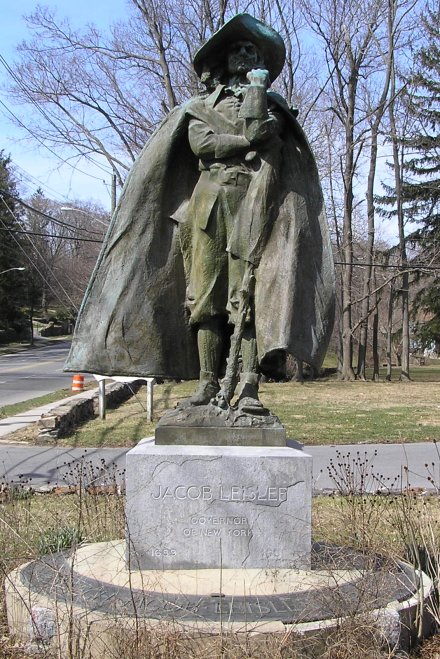

Statue of Jacob Leisler in New Rochelle, N.Y. — which Leisler helped create as a settlement for refugee Huguenots.

And once in the saddle, the Dutch Calvinist Leisler essentially ran a populist administration against the colonial oligarchy, which replied by vilifying him as a “usurper” and “rebel”.

Internal politics in New York and its neighbors during those months make fascinating reading.* Quakers and Catholics aligned against Protestants. Albany aligned against New York, until Leisler brought the former to heel. Clergy chose up sides. Leisler summoned a sort of proto-continental congress of colonial representatives (all the way to the West Indies) to hash out their situation.

And what was that situation? There had been a revolution, after all, and there was no agreed-upon representative of the royal authority present in New York. An assembly of militia leaders had asked Leisler to assume leadership, so was he really outside his rights to treat as his the London dispatches addressed to “such as, for the time being, take care for preserving the public peace and administering the law in New York”?

It’s a moment whose ferment of democratic energy can be read to presage the next century’s (proper) revolution.

Yet it was also not a revolution in the Cromwellian, world-turned-upside-down sense. For the English polity, and certainly for the conduct it preferred in its frontier possessions, continuity was the order of the day. Even in England herself, William and Mary were more than pleased to govern with Tories who could see their way to releasing their fealty to the Stuarts.

There was an empire to run, after all.

From that standpoint, Leisler’s anti-oligarchical policies and fractious disputes with other colonial elites were a bad business. There’s no sense in letting France make inroads because your governors are bickering over predestination or some such.

So formally, the realm’s new rulers continued all non-Catholic personnel in their posts. With the Dominion governors ejected, it was just a matter of dispatching fresh executives to take over. It’s just that this process required months … during which Leisler was managing New York the way he figured it ought to be managed, and his enemies were consequently painting him as a rebel.

Leisler pronounced himself, this whole time, anxious to submit his authority to the new governor upon the production of proper credentials. If he was surprised that the new monarchs tendered appointees of the very same factions recently expelled,** Leisler showed it only in his exactitude for procedure: because of a logistical cock-up, an aide to the new colonial governor arrived first, and when Leisler refused to hand over his fort without the royal warrant, a tense standoff ensued. It was resolved when the real governor, Henry Sloughter of ominous name, finally showed up.

Sloughter had his “predecessor” immediately arrested, along with others of his circle and harshly tried for treason and murder by a court stacked with anti-Leisler political enemies.†

Ultimately Leisler was condemned to die along with his secretary and son-in-law Jacob Milborne, but even Sloughter was loath to enforce the sentence. The story goes that Leisler’s most implacable foes had to get Sloughter drunk to put his signature on the death-warrant. (Sloughter died a couple of months later himself, for maximum operatic effect.)

On Saturday morning, May 16, 1691, the largest crowd ever gathered in New York City stood, rain soaked and weeping, all eyes fixed as a limp body was cut from the gallows and placed on the block. With a clean blow, the executioner’s ax cut off the head of the “halfe dead” Jacob Leisler — loyal lieutenant governor or rebel tyrant, depending on one’s point of view. Amid the “shrieks of the people,” fainting women (some “taken in labour”), and tumultuous jostling for “pieces of his garments” and strands of his hair, as “for a martyr,” the newly arrived and unfortunately named royal governor, Henry Sloughter, worried that his decision to execute Leisler might not, after all, end the “diseases and troubles of this Government.” Indeed, for years afterward New Yorkers bitterly divided over Leisler and the 1689 uprising that, in the wake of England’s Glorious Revolution, had led to his assumption of power in the provincial government.

-David Voorhees, who elsewhere contends that these divisions “continue to inform American politics to the present day.”*

A few years later, a more Leisler-friendly Parliament restored the dead man’s estate to his heirs, a sort of implicit admission that the whole head-chopping thing might have been a bit much.

This character figures to bear more historical consideration than he has heretofore enjoyed; further to that end, there’s a Jacob Leisler Papers Project devoted to marshaling at New York University the primary documents connected with Leisler.

* See, for instance, David Voorhees in “‘to assert our Right before it be quite lost’: The Leisler Rebellion in the Delaware River Valley” in Pennsylvania History, Winter 1997 — and, Voorhees again in “The ‘fervent Zeale’ of Jacob Leisler,” The William and Mary Quarterly, July 1994.

** Literally so: Francis Nicholson, whom Leisler ousted from New York, tried to get himself appointed governor; he was instead sent to Virginia and continued in royal service in the colonies for decades to come.

† e.g., Joseph Dudley, one of Leisler’s judges, whose penchant for authoritarian justice has been noted elsewhere in these pages.

On this day..

1900: Three Algerians in Setif

On this date in 1900, three Algerian criminals called (in the next day’s dispatch in Le Petit Parisien) Bou-Mechada-Saïd-ben-Mohamed, Chabli-Lakdar-ben-Abdallah and Boulakras-Tahad-ben-Saad were guillotined for a murder committed just 11 days before in Setif, Algeria.

On this day..

1766: Thomas Arthur de Lally-Tollendal, undiplomatic

On this date in 1766, a refugee noble with more honor than sense lost his head in Paris.

Thomas Arthur, comte de Lally, baron de Tollendal — more efficiently known as Lally, or as Lally-Tollendal, though he’s not to be confused in this with his son, a French Revolution bit player — entered this world in County Galway, the child of a minor lord.

Since said lord hewed to the Jacobite party favoring restoration of the Stuarts to the English throne, the family found itself relocated with the exiled Pretender to a continental power whose spiritual and temporal interests were similarly inimical to the Hanoverian king.

Our man landed himself, like a proper retainer of his adoptive liege, a gig in the French army in which capacity he actually served at the Jacobites’ last doomed British hurrah, the 1746 Battle of Falkirk.

But his problems came from his Bourbon service much further afield — in India.

There, his expeditionary force suffered reversal after reversal at the hands of the hated Brits, even then in the process of appending India to their dominions.

Our general’s military misadventures were compounded by impolitic high-handedness towards his officers and men, and to the locals whose alliances he needed. He was, in the main, a man ill-suited to the job entrusted to him. As the Memoirs of Sanson remark, “his temper, his obstinacy, and especially his contempt for all means of action except brutal strength, were destined to lead him into mistakes in a position demanding more knowledge of politics than science of war. Sixteen years before Lally-Tollendal’s appointment, Dupleix, with scanty forces, at enmity with the Company, receiving neither help nor subsidies from the mother country, had held in check English power in the Indian peninsula by mere diplomatic proficiency. Lally knew how to conquer; but he was incapable of studying and detecting the secrets of Dupleix’s policy.”

By the time the bad news that established all this hit France, the subcontinent was pretty much Britain’s to command — just another piece of the imperial butt-kicking France suffered in the Seven Years’ War.

And Lally’s enemies were holding him personally responsible as a potential traitor. After all, he was conveniently now in English custody.

Incensed at having his honor impugned, Lally unwisely obtained English parole to return to repel these charges. He proved no more diplomatic with the barristers than he had been with the Hindus:

he was so convinced of his own innocence that he was imprudent enough to impeach the officers who had served under his orders, together with the administrators of the colony. He charged them with such violence that his death and condemnation became indispensable for their justification … When the accused appeared before his judges, he was no more able to control his temper than when he was in India … answering, fuming, retorting, stigmatising the cowardice of some, the cupidity of others, and hinting that the only guilty party was the powerless Government.

Just the sort of vindication liable to appeal more to posterity than to said government. Louis XV, another man unequal to his position, was by this autumn of his reign plumbing the nadir of his unpopularity; for the officer who had risked his life in battle under French colors throughout adulthood, Louis calculated more profit in severity (or expedience) than in clemency. Hey, it had worked for the English.

And really, for a Stuart adherent, sacrificial execution was kind of an apt fate.

We guess it worked.

“The people were pleased with all that made his punishment ignominious: the cart, the handcuffs, and the gag,” recorded aristocrat-of-letters Madame du Deffand (Source) “He was a great rascal, and besides he was very disagreeable.”

Thomas Carlyle, in his The French Revolution, spared in Lally’s defense a few sentences of delicious invective for the rotting regime that did him in.

The Parlement of Paris may count itself an unloved body; mean, not magnanimous, on the political side. Were the King weak, always (as now) has his Parlement barked, cur-like at his heels; with what popular cry there might be. Were he strong, it barked before his face; hunting for him as his alert beagle. An unjust Body; where foul influences have more than once worked shameful perversion of judgment. Does not, in these very days, the blood of murdered Lally cry aloud for vengeance? Baited, circumvented, driven mad like the snared lion, Valour had to sink extinguished under vindictive Chicane. Behold him, that hapless Lally, his wild dark soul looking through his wild dark face; trailed on the ignominious death-hurdle; the voice of his despair choked by a wooden gag! The wild fire-soul that has known only peril and toil; and, for threescore years, has buffeted against Fate’s obstruction and men’s perfidy, like genius and courage amid poltroonery, dishonesty and commonplace; faithfully enduring and endeavouring,–O Parlement of Paris, dost thou reward it with a gibbet and a gag?

There’s a public-domain 19th century lecture on our man’s adventurous career here. And there’s a monument back home near Tuam, Ireland.

On this day..

Feast Day of St. George

This is the feast date, and the traditionally-ascribed execution date in 303, of St. George — legendary dragon-slayer and patron saint of half the world and darn near everything that the original apostles didn’t nail down.

Saint George is supposed to have been a well-favored officer in Diocletian‘s army who suicidally announced his Christian faith during the latter’s persecutions, and refused every sop and entreaty to renounce it. He was martyred at Nicomedia.

Pretty standard persecution fare — and there’s next to nothing that can be reliably verified about his life — but George did well by his future cult to get into the martyr’s game right before Christianity’s official triumph. Still, at the end of the day, it’s one of those unaccountable accidents of history that this particular fellow ended up as perhaps Christendom’s most widely venerated champion.

He’s most immediately recognizable for the story of having slain a dragon, a plain metaphor for paganism (and usable metaphor for anything and everything else) that’s been depicted in all its scaly corporeality by innumerable artists.

England has liked him jolly well ever since his suitability to the chivalric ethos positioned him to supplant Edmund the Martyr as that realm’s patron saint during the Middle Ages. The red cross on the English flag is a St. George’s cross.

And so there he is, too, in one of Shakespeare’s most rousing patriotic monologues:

I see you stand like greyhounds in the slips,
Straining upon the start. The game’s afoot:
Follow your spirit, and upon this charge
Cry ‘God for Harry, England, and Saint George!’

But George gets around, and England has to share him.

That St. George’s Cross also adorns the flag of Georgia (the country, that is: it’s so hard core that it’s named for the guy), and he’s claimed as a sponsor throughout Orthodox Christendom: Serbia (which celebrates a major holiday when April 23 hits on the Julian calendar); Bulgaria; Greece; Ethiopia; the city of Constantinople and its heir, the city of Moscow, and Russia generally. There were two George’s [Yuri’s] Days on Old Russia’s calendar, and the autumn one was marked as the one time in the year that serfs were permitted to change their landlords, at least until Boris Godunov canceled the privilege and left Russian with the idiom “so much for Yuri’s day!” to mark an expectation disappointed.

George is big in Spain, and even bigger in Portugal; through its Portuguese heritage, he’s also venerated in Brazil, where he’s the patron saint of the Corinthians football club. He’s the sponsor (via that dragon connection) of the snaky Hungarian military order that gave Vlad the Impaler the immortal sobriquet of Dracula.

There are other countries and any number of cities who also trust the dragon-slayer’s patronage; George accepts the further devotions of saddle-makers, lepers, animal husbandmen, shepherds, Crusader knights, butchers, the Maltese, gypsies, farmers, archers, syphilis-sufferers, cavalrymen and therefore also armored tankmen, Palestinian Christians, and the Boy Scouts of America. He’s generally got a stupendous worldwide collection of churches, art, legends, and devotional rites dedicated to his name.

On this day..

1943: Elise and Otto Hampel, postcard writers

(Thanks to Meaghan Good of the Charley Project for the guest post. -ed.)

On this day in 1943, a working-class German couple were executed for treason and sedition in Berlin, Germany: Otto and Elise Hampel’s reign of postcard-writing terror had finally come to its conclusion.

On the surface, the Hampels seemed like two very ordinary people. Elise had an elementary school education and worked as a domestic servant before she married Otto in 1935. Otto, a World War I veteran six years older than Elise, was a factory laborer.


Two of the treasonous postcards.

They lived modest, anonymous lives in Berlin and doubtless would have continued to do so if Elise’s brother, a soldier in the German Army, had not been killed in action in France in 1940.

Elise’s brother’s death was the catalyst for the Hampels’ tragically brave and utterly ineffectual two-year campaign of resistance against Hitler’s Germany.

Together the couple hand-wrote over 200 postcards and leaflets speaking out against the Nazi regime. The postcards urged people not to serve in the German Army, to refuse to donate to Nazi organizations, and generally do everything they could to resist the government. Otto and Elise scattered the cards in mailboxes, stairwells and other locations all over Berlin. The idea was that people would find the cards, read them and show them others, and thus the seed of rebellion would take root.

What actually happened was that almost all the cards were delivered to the authorities immediately. Nobody wanted to be caught in possession of such dangerous words.

Because of the sheer number of postcards and the long duration of their distribution, the Gestapo at first thought they were dealing with a much larger group of traitors. Doubtless they were frustrated that this riffraff, who couldn’t even write properly (the postcards were full of grammatical errors and misspellings), were able to evade them for so long. But the Hampels’ resistance activities eventually caught up with them.

They were unrepentant after their arrests in October 1942, and had little to say for themselves, beyond Otto’s statement that he was “happy” about protesting against Hitler. Roland Freisler‘s People’s Court duly condemned them to die for “preparation for high treason” and “demoralizing the troops.” They were executed by guillotine in the Plötzensee Prison.

For some reason, unlike their equally courageous, foolish and doomed counterparts in the White Rose, the Hampels’ story didn’t really catch on with historians.

They were saved from oblivion by the dangerously unstable, drug-addicted author Rudolf Ditzen, aka Hans Fallada, who came upon their Gestapo file after the war.

His 1947 novel, Every Man Dies Alone, written in just 24 days, is closely based on Elise and Otto’s story. This book was Fallada’s swan song; he died weeks before its publication. Titled Jeder stirbt für sich allein in Germany, it was not translated into English until 2009 — but it then became a runaway bestseller in the United States and (under the title Alone in Berlin) in Great Britain.

On this day..

1872: Yoarashi Okinu, geisha

On this date in 1872, geisha Yoarashi (“Night Storm”) Okinu was beheaded at Tokyo’s Kozukappara execution grounds after killing her lover to run away with a kabuki actor.

A notorious dokufu, so-called “poison-women” that captivated that country in the late 19th century, Night Storm (English Wikipedia entry | Japanese) was of humble origins but became a sought-after geisha in Edo.

Her celebrity affairs are treated here (reliability: unknown), but the reason she’s in this here blog is poisoning off the second-last of them with arsenic in order to get free to run off with kabuki actor Arashi Rikaku.

Rikaku himself was up to his eyeballs in this same plot, and was arrested — our source says, during a kabuki performance! — and initially condemned to death. Since Okinu was pregnant, however, her execution was put off pending childbirth; eventually, Rikaku’s sentence was moderated from capital punishment altogether.

Okinu’s head was cut off, and displayed in public for several days. Her lover served three years in prison, then rebuilt his kabuki career as Ichikawa Gonjuro.

* The date was the “20th day of the 2nd month of the fifth year of Meiji”, using Japan’s system of dating years from the start of the current emperor’s reign. Helpful in nailing down the date: Tokyo’s first daily newspaper published its first issue on the very next day.

On this day..

1918: Emile Ferfaille, the last in Belgium

On this date in 1918, Belgium carried out its last execution for ordinary crimes — in fact, its only one since 1863.

Now, that figure excludes a reported 242 people executed from 1944 to 1947, in revenge for the Nazi occupation. (To say nothing of those conducted by the Nazis themselves.) But that’s quite a stunning run, considering that death penalty statutes were on the books until 1996: it’s just that the sentences were routinely commuted.

According to the information in this thread on the lively Francophone guillotine.cultureforum.net (it does what it says in the url), Ferfaille murdered his pregnant girlfriend to further his career tomcatting with his other not-yet-pregnant girls. (This being the fourth year of the Great War, a lot of his competition was fertilizing no-man’s lands.)

And as disreputable as hammering one’s lover to death and stuffing her in the vegetable garden is, we’re comfortable averring that it was probably not the single most villainous act to transpire in Belgium the whole of this past century and a half.

Farfaille’s exceptional fate was a consequence of his committing his particular atrocity during that same Great War that gave him such great odds with Flemish females.

Ferfaille was executed in Veurne, just up the road from Dunkirk in the tiny corner of Belgium not occupied by Germany … and he was executed during Germany’s Spring Offensive on the Western Front, its last desperate (and ultimately unsuccessful) gamble* to secure battlefield victory before the recently-committed Americans threw their corn-fed thumbs on the scale.

Despite the conventionality of the crime, Ferfaille’s capital punishment was decreed by military court, since the perp was a soldier. With shells kerploding in the distance, the rakish junior officer was set up to face a tribunal with a particular shortage of patience for his shenanigans. (Belgium also carried out military executions in World War I — it’s just that the others were for military crimes, like desertion.)

Although what remained of Belgium was not jumpy in the execution of its sentence. Quite the opposite.

Actually conducting this beheading** required requisitioning from France prolific belle epoque headsman Anatole Deibler (French Wikipedia entry), and his assistants, and their portable guillotine. (Belgium had a guillotine of its own, but it would have had to cross the front to get to Emile Ferfaille. War is hell that way.)

This party of death made a hazardous journey skirting the charnel house of the Western front, protected by all the might of two nations’ armies for their mission to kill one man in a season where thousands died namelessly day by day … sort of a Bizarro World Saving Private Ryan.

The train took these rather small-time ministers of doom to Dunkirk, where they transferred to a truck for Veurne, then under direct German bombardment. The execution crew stood in only a little less danger than its client, but it carried out the sentence, “publicly” in the town’s all-but-empty square. Due to German shelling, barely anyone in the public witnessed this milestone event.

* The manpower for a western push was facilitated by the recent removal of Germany’s eastern enemy consequent upon the Russian Revolution.

** The penalty demanded by law. Post-World War II executions all seem to have been firing squad affairs even though the letter of Belgian law still apparently prescribed beheading even then.

On this day..

1669: Anna Ebeler, lying-in maid

On this day in 1669, the Bavarian city of Augsburg executed 67-year-old Anna Ebeler for bewitching a string of infant children and just-delivered mothers.


Detail view of a pictorial history of the “witch” Anna Ebeler: the panels display her mutilated with tongs as she is led to execution; then, beheaded at the scaffold.

Ebeler plied her client with a refreshing bowl of malmsey and brandy soup (I could go for some myself), and the mother fell into a delirium that was bad enough to kill her but not so bad as to impact her credibility when she accused her lying-in maid of culinary devilry.

Once the accusation was “out there,” every other family on Ebeler’s c.v. whose birth experience was less than satisfactory — and there must have been a few of them, since infant mortality was off the charts in the 17th century — came forward with its own tale of woe.

Ebeler confessed when threatened with torture.

According to Lyndal Roper, who uses this affair as the touchstone event in “Witchcraft and Fantasy in Early Modern Germany” (History Workshop, Autumn 1991) — it was one of “just” 18 scattered witchcraft executions in a relatively forward-thinking burg — witchcraft

beliefs rested on a whole economy of bodily fluids. A post menopausal woman, the old witch was in a sense a dry woman who, instead of feeding others well, diverted nourishment to her own selfish ends. Older widows were believed to have the power to ruin young men sexually, and youths were warned against marrying such women because they were sexually ravenous, and would suck out their seed, weakening them with their insatiable hunger for seminal fluid and contaminating them with their own impurities.

I could go for some of that, too.

At any rate, a lying-in maid like Anna Ebeler — a woman hired by the birth mother for a ritualistic period of several post-natal weeks of maternal sequestration — put herself at risk (quoth Roper) of having projected onto her all the delivered mother’s psychological amibiguity about her condition, all her illicit resentment of her progeny, all her own latent fear of death after childbirth. All the ingredients, in short, of post-partum depression … in supernatural form.

[I]nstead of seeking the source of her ills in post-natal depression, within herself, as we [modern people] would, the mother’s anxieties about the child’s fate and her own ability to nourish it were directed outwards, so that harm to either mother or baby was believed to have been caused by another. Here we might make use of what Melanie Klein says about splitting, which allows intolerable feelings of hostility and malice to be projected onto another, so that the mother recognizes only benevolence in herself, projecting the evil feelings about herself onto the ‘other’ mother. The lying-in-maid was thus destined for the role of the evil mother, because she could be seen to use her feminine power to give oral gratification to do the reverse – to suck the infant dry, poison the mother and her milk and, in the most extreme form of witch fantasies, to kill, dismember and eat the child at the witches’ sabbath.

That dish, we’ll pass on.

Roper makes an interesting and nuanced exploration into the psychic space of witchcraft accusations, usually shaped by female-on-female charges. It’s terrain further developed in her Witch Craze: Terror and Fantasy in Baroque Germany.

One last item from Roper, of specific relevance to the lot who haunt these pages:

There is a further collusive dynamic at work in interrogation, that between witch and torturer. Torture was carried out by the town hangman, who would eventually be responsible for the convicted witch’s execution. Justice in the early modern period was not impersonal: the act of execution involved two individuals who, by the time of execution, were well acquainted with each other. Particularly in witch trials, torture and the long period of time it took for a conviction to be secured gave the executioner a unique knowledge of an individual’s capacity to withstand pain, and of their physiological and spiritual reactions to touch. In a society where nakedness was rare, he knew her body better than anyone else. He washed and shaved the witch, searching all the surfaces of her body for the tell-tale diabolic marks – sometimes hidden ‘in her shame’, her genitals. He bound up her wounds after the torture. On the other hand, he was a dishonourable member of society, excluded from civic intercourse, and forced to intermarry amongst his own kind. His touch might pollute; yet his craft involved him in physically investigating the witch, a woman who if innocent was forbidden him. He advised on the mode of execution, assessing how much pain the witch might stand, a function he could potentially exploit to show mercy or practise cruelty. In consequence, a bond of intense personal dependence on the part of the witch on her persecutor might be established. Euphrosina Endriss was greatly agitated when a visiting executioner from nearby Memmingen inspected her. She pleaded that ‘this man should not execute her, she would rather that Hartman should execute her, for she knew him already’.

On this day..

2005: A gay couple in Saudi Arabia

Stay classy, Saudi Arabia.

RIYADH—A gay couple was beaded in a public execution Sunday [March 13, 2005] in Saudi Arabia after being convicted of killing a blackmailer. If they had been exposed as gay they could have been executed anyway.

Homosexuality is punishable by flogging, lengthy prison terms or death under Sharia Islamic law.

The Saudi Interior Ministry issued a statement Sunday announcing the execution. It said that Ahmed al-Enezi and Shahir al-Roubli, both Saudis, ran over Malik Khan in their car, beat him on the head with stones and set fire to his corpse “fearing they would be exposed after the victim witnessed them in a shameful situation”.

The term “shameful situation” is regularly used by the government to refer to homosexual acts.

The ministry said the two men were executed in the northern town of Arar, near the Iraq border.

The Saudi government routinely rounds up people suspected of being gay. All that is needed is a complaint from someone. In some instances men who are not gay who have been arrested were picked up on the complaint of a neighbor following a dispute.

The kingdom also, on a number of occasions, has blocked access to the only gay Arab news and information site on the internet.

On this day..