1886: A day in the death penalty around the U.S. South

From the New Orleans Times-Picayune, June 5, 1886.


Execution of Alfred Taylor at Opelousas.

Opelousas, La., June 4. — [Special.] — In accordance with Gov. McEnery‘s proclamation, Alfred Taylor, colored, was executed at 1:30 o’clock, P.M., to-day, by Sheriff Duson, the condemned man dying of strangulation about fifteen minutes after the springing of the trap.

He preserved a very firm and unconcerned mien until he saw the gallows, not seeming to realize or to believe that he would be hanged. He protested his innocence of the crime to the last. Once when the supreme moment arrived, he lost his usual stolidity and called on God to have mercy upon him and begging [sic] the Sheriff not to hang him.

Taylor was 23 years years old, griff in color, of medium height and weighing about 145 pounds. He was tried at the March term of our District Court, and the jury was composed of nine white and three colored men. He was defended by able counsel, and after an impartial trial was found guilty as charged on the indictment.

On Monday, Feb. 8, 1886, at about 11 o’clock in the morning, Taylor called at the residence of Mrs. Latreuille, a white lady, residing on the old Dr. Moore place, near Moundville, some four miles above Washington, and asked if her husband was at home. Not suspecting anything wrong, she replied that he was not. The negro then told her that some one was trying to steal her chickens in the woods near by and that she had better see about it.

The unfortunate woman went to the place to look after her fowls, when the negro followed her, and drawing a pistol threatened to shoot her if she made any outcry. She fainted away through fright, when he accomplished his diabolical purpose. He fled, and a posse was immediately organized and began searching for him. Had he been caught then he would undoubtedly have been lynched. He evaded arrest, however, until the week before his trial and conviction. The evidence adduced at the trial was crushing, and the jury promptly returned a verdict as above.

Since his conviction he has manifested no sighs of contrition, but, on the contrary, has always affected the most stoical indifference, and constantly indulged in the most revolting profanity.


A Double Execution.

Winchester, Va., June 4. — Wes Honesty and Tabby Banks were hanged at 9:22 A.M., for the murder on the night of Nov. 14, 1884, of Joseph McFaul, a youth of 18 years. A large Democratic procession took place here on that night, and the prisoners walked through the streets making threats that they would crack the skull of some Democrat before morning.

McFaul was a slightly built, peaceable young man, while Honesty and Banks were powerfully grown negroes.

They waylaid McFaul at the mouth of an ally on Main street. He had nothing with which to protect himself but a light walking stick. The negroes pressed upon him and he ran from them, ordering them to keep away. They then rushed upon him. Honesty collared him and pushed him against a house at the mouth of the alley, and Banks cried out, “stick it to him.”

McFaul defended himself as best he could with his walking-stick. Honesty was facing McFaul, and Banks got behind him. Honesty drew back and hurled a rock at McFaul, striking him in the left temple. As he reeled and staggered across the street Banks struck him with some weapon he held in his hands. McFaul went to his boarding-house, and was found dead in his bed next morning, with his skull crushed.

As the criminals marched to the scaffold Banks began to tremble violently, but Honesty stood firm on the trap. The Moody hymn, “There is a Light in the Valley,” was sung by request, both joining in loudly.

Honesty said: “I thank God I am converted. I am going to heaven. No man’s blood rests on my soul. I have not to answer for it. I thank all the officers and ministers for their kindness.”

Banks said I am not guilty of what is put on me. I want to meet all my friends in heaven.

Their arms were then pinioned, the black cap drawn over their heads, and in a loud voice, both cried out “good-bye,” “good-bye.” The trap was then sprung.


John Davis Hanged in Assumption.

Napoleonville, La. — [Special.] — At 12:30 o’clock to-day a colored man, named John Davis, was hung at Napoleonville for the murder of his wife, two years ago, on the Jones plantation, three miles above the town. He confessed the crime, and said he was willing to die for what he had done. The execution was without incident.


Launched from Lebanon.

Lebanon, Tenn., June 4. — Jim Baxter, colored, was hanged at 11:32 this morning. His last utterances were: “I did not kill Mrs. Lane. Dat’s the God’s truth.” His neck was not broken. He was dead in fifteen minutes.

On this day..

1889: Fulgence-Benjamin Geomay, at the Paris Exposition

Attendees at the 1889 Paris Exposition had the opportunity of a dawn side excursion on May 22 to see the French soldier Fulgence-Benjamin Geomay beheaded.

This Exposition was the event that gave Paris its signature landmark, the Eiffel Tower — a design whose defeated counterproposals included, among other things, a giant-sized kitsch guillotine replica. (The fair coincided with the centenary of the French Revolution.)


This could have been the National Razor instead. (cc) image by Alex Lecea.

What an opportunity squandered! Gawkers would have to make do with the real thing instead … although as usual at this late date the scene was staged to expose minimum visible spectacle to onlookers.

Paris was considerably excited by an execution which took place at La Roquette at 20 minutes past four on Wednesday morning. The weather was eminently favourable for the lovers of the gruesome spectacles which M. Deibler directs. The nocturnal and matutinal scenes around the prison were similar to those which were enacted before and during the execution of Pranzini and Prado.

Howling, shouting, gesticulating, eating, drinking, and coarse joking were carried on all over the neighbourhood. The windows of the houses were full of spectators, and the foul nightbirds, male and female, were abroad in scores. Women in light summer costumes and big hats, who had been in the Boulevard cafes until two o’clock in the morning, were there in dozens. They were standing up in hackney carriages, supported by their temporary adorers or permanent protectors, and were craning their necks in order to catch a glimpse of the guillotine.

A still stranger sight was that of a youthful bride in her white dress and orange blossoms, who, with her husband, was having a nocturnal honeymoon on the Place de la Roquette.

The felon who was guillotined that morning was a soldier who made away with an old widow woman — a Madame Roux — who kept a wineshop in the shabby part of the Boulevard St. Germain. He was Corporal Geomay of the Eighty-seventh regiment of the Line, in garrison at St. Quentin, in the North, and while on a short furlough in Paris he entered Madame Roux’s shop at midnight on Jan. 13.

After he had partially closed her shop Geomay seized her, knocked her down, and battered in her skull with a heavy hammer. The murderer then robbed his victim, caroused in the markets during the night, and next day returned to St. Quentin, where he treated his comrades lavishly, and bestowed a watch and gold chain on a woman with whom he kept company.

Geomay was condemned to death on March 27. He met his fate without flinching, and had resolved, he said, to die like a soldier.

When he arrived at the foot of the guillotine he looked calmly at the spectators, and then in a firm voice thanked the governor and warders of the prison for the kindness which they had shown him during the period of suspense preceding his execution.

M. Deibler, the executioner, was less nervous than usual, and pulled down the knife by touching a handle, and not pressing a button.

When the head was severed from the body the remains were taken off for interment, and, in accordance with the last wishes of the deceased, were not handed over to the Faculty of Medicine. After the execution, when the cordon of police and guards was withdrawn, a rush was made by the ribald crowd to the spot, marked by four stones, which was still sprinkled with blood. Men and women exchanged obscene jokes and repartees, until, wearied out at last by their night’s watch, they slunk away to their homes in the slums.

Lloyd’s Weekly Newspaper, May 26, 1889

We have a taste of that obscene repartee in this a scrap of doggerel courtesy of entertainer Aristide Bruant:

Une nuit qu’il était en permission,
V’là qu’i tue la vieille d’un coup d’sion,
C’est ti bête!

L’autre matin Deibler d’un seul coup,
Place de la Roquette,
i a coupé la tête!

On this day..

1887: Charles Smith

(Thanks to Meaghan Good of the Charley Project for the guest post. -ed.)

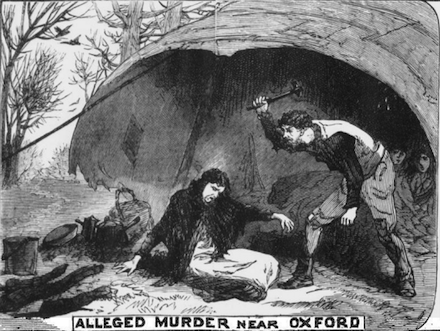
On this date in 1887, 63-year-old Charles Smith was judicially hanged at Oxford Castle Prison by James Berry. He’d brutally murdered his wife in front of their children that February.

The Smith family were Gypsies: Charles, his wife Lucy, their 17-year-old daughter Oceana (known as Oshey) and their 11-year-old son Prince Albert. As Nicola Sly notes in her book Oxfordshire Murders,

The lifestyle of Gypsy families in 1887 was not one to be envied. The traveling people were at the mercy of the weather all year round, whether the heat of summer or the bitter cold of winter. Forced to scratch a living any way they could, many supplemented their meager income with a little poaching or petty theft. Thus they were very rarely welcomed in any area and were always in fear of the local police who almost invariably moved them on wherever they tried to settle.

According to this account, Lucy had borne many children, but only four lived long. By the time of the murder, one of the children had died and one, a daughter named Elizabeth, had grown up and left home.

Charles’s siblings regularly got in trouble with the law, and at least one of his siblings was transported for sheep theft. He and Lucy, however, were somewhat more fortunate: Lucy possessed a valid peddler’s license. In the 1881 censuses, both had their occupations listed as “hawker.” Charles made baskets, skewers, roasting forks, meat stands and pegs which his wife sold.

Throughout their lives Charles and his family traveled around Oxfordshire, pitching a tent wherever they could find a place, and in February 1887, they were camped on public land near Headlington. They’d been there before and were friendly with some of the local residents, including a couple coincidentally also named Smith.

Charles was a violent man who regularly beat his wife and children; Oshey stated he beat his wife every day, and Prince Albert would later testify, “He has been knocking my mother about nearly all his life.”

At one point the domestic violence had gotten so bad that Lucy had gone so far as to take out a formal complaint against her husband for cruelty. She never followed up on it, though.

On the 18th of February, Kate and George Smith, who lived in a nearby cottage, visited the tent and noted Lucy was visibly bruised. They asked Charles why he’d beaten her and he wouldn’t give a reason, but said it was over something that happened thirty years before.

The visitors advised him to forgive and forget, but Charles acted surly and hostile for the rest of the day. Lucy was so frightened of him that for a long time she stayed outside the tent in the bitter cold, and only partially dressed, rather than go inside where her husband was. At bedtime she finally came in.

In the early hours of the next morning, Charles began shouting at his wife, waking the children. As Oshey and Prince Albert watched in horror, their father picked up a hammer and attacked Lucy, beating her on her head, back and legs until he was too tired to do it anymore. Then he laid down and went peacefully asleep.

Mortally wounded, Lucy crawled out of the tent to get some water from a nearby stream. She never returned, and eventually Oshey went out to check on her and found her dead.

When Charles realized what he’d done, he sank to his knees beside Lucy’s battered corpse and sobbed, crying, “My wench, my wench!”

Oshey and Prince Albert ran for help, going to the same neighbors who’d visited the night before. When Kate Smith answered the door, Oshey blurted, “My Mammy’s dead. He’s been and killed her with the hammer.”

Kate and George rushed to the scene of the crime. Charles had dragged Lucy’s body into the tent and lain it out on some straw. He told them Lucy had “fallen down” and died. George told everyone he was going to fetch a doctor, but instead he went to the police, returning with two constables. By then Charles had calmed down and said casually, “Good morning. I have got a dead ‘un this morning.”

One of the constables searched the tent and found the bloodstained hammer concealed under some straw. Charles, whose coat was also bloodstained, was placed under arrest for the willful murder of his wife. The autopsy showed she’d died of a fractured skull; Charles had hit her head with the hammer three or four times.

At the ensuing trial in April, Oshey was the star witness against her father, although Charles kept shouting that she was telling lies and was a “nasty, wicked wretch.” Prince Albert testified also, as did Kate and George Smith.

The defense argued that Charles had no intention of killing his wife and there was no motive, and so it was a case of manslaughter. However, the jury returned a verdict of murder.

After he was condemned to die, Charles turned to religion for solace, praying with the prison chaplain. Some of his relatives came to visit, although Oshey and Prince Albert stayed away. His eldest daughter Elizabeth made the strange observation that “when he was a drunkard there was not a kinder man living, that something or somebody turned him into a teetotaler, and from that time he had been a cruel wretch.”

While walking to the scaffold, Charles fainted on the trapdoor just before James Berry drew the bolt. The hanging went smoothly and it was judged he died quickly and painlessly.

As for the orphaned Oshey and Prince Albert, it was recorded that “through the noble hearted philanthropy, of Miss Skene, of this City, the girl Oceana has been placed in a Home in York, and boy the Prince Albert, through the same thoughtfulness, will also be brought up to acquire the means of earning an honest livelihood.”

On this day..

1883: Milton Yarberry, Marshal of Albuquerque

On this date in 1883,* Albuquerque hanged its Town Marshal.

Milton Yarberry was one of those belt-notching Wild West gunmen badass enough to be worth deputizing for a frontier town with a spiraling crime problem — which Albuquerque was experiencing as the just-completed railroad boomed its population. A number of crimes had been attributed to him in a career that took him from stage-robbing in his native Arkansas, to the Texas Rangers, to a Colorado saloon, to a New Mexico cathouse, a veritable bucket list of spaghetti western tropes packed into 34 roughhewn years with bodies planted at nigh every stop. Yarberry was even reputed to have fought alongside Billy the Kid.

The last of these tropes, of course, was as the bad hombre upon whom the townspeople foist a badge.

It will not surprise that even when minted as a peace officer, Marshal Yarberry continued his manslaying ways. Still, nobody in our present age of impunity could well imagine a lawman standing trial for murder twice in the space of a year.

Yarberry in early 1882 defeated a charge for wasting his lover’s paramour during a row in the street, as witnesses said Harry Brown shot first, just like Greedo.

There was no administrative leave or counseling after that, just straight back on the beat — and barely a month later, the copper gunned down a guy whom he was trying to stop for questioning. It was a confusing encounter in which the Marshal insisted that he fired when the victim, Charles Campbell, wheeled on him with a gun. A single state’s witness was able to establish in the court’s mind that there was no gun in Campbell’s possession.

Our hard-living triggerman would never waver from his self-defense story as his appeals were made;** he had many supporters who believed that he was being railroaded on account of the public relations hit the city was taking for employing a dude who had so liberally populated the Republic’s Boot Hills — and those advocates included the sheriff who recruited Yarberry as a Marshal, Perfecto Armijo, who was also the sheriff detailed to hang Yarberry in the end.

The local Albuquerque podcast City on the Edge has an episode dedicated to Yarberry here.

* In the anarchic game of telephone that was 19th century reporting, some editor somewhere mistakenly understood a story of Yarberry’s condemnation in 1882 as an actual report of his execution; as a result, there were news stories (themselves repeated by multiple papers) announcing Yarberry’s hanging in June 1882. In this business, once one wrong date is out there it’s bound to be echoed into eternity, so it’s still possible to find sources that misdate the execution to June 16, 1882. Past the question of the calendar, the fact that these stories actually expanded with details about the fictitious hanging scene strongly underscores the degree to which the hang-day bulletin had become colorfully but generically abstracted from any save accidental relationship to the actual scene at the gallows.


Cincinnati Daily Gazette, June 17, 1882, vividly peopling an imaginary scene.

** Because New Mexico was still just a territory — it was only admitted to the Union as a state in 1912 — Yarberry’s clemency decision went to the U.S. President, Chester A. Arthur.

On this day..

1884: Not Crow Dog, saved by an ex parte

January 14 was supposed to be the hanging day in 1884 for the Sioux Crow Dog — but instead of being executed he was busy making caselaw.

A sub-chief of the Brule Lakota, Crow Dog on August 5, 1881, met — intentionally? — the tribal chief Spotted Tail on a road in the Rosebud Reservation and shot him dead with a rifle.

The killing was adjudicated the very next day within the Brule community, at a council where the killer and the survivors of his victim agreed together on the appropriate compensation, and paid up.* But the U.S. Indian agent on the scene also arrested Crow Dog a few days later, and had him tried for murder in a non-Indian court in the the frontier town of Deadwood.

Sidney Harring, who would expand this review to book length with Crow Dog’s Murder: American Indian Sovereignty, Tribal Law, and United States Law in the Nineteenth Century, argued in a 1988/1989 paper** that the needless white court’s trial was staged from the outset as a test case by the Bureau of Indian Affairs, angling for new legal tools to break the doctrine of tribal sovereignty which dated back to Worcester v. Georgia (1832). Although that anti-sovereignty cause would suffer a tactical setback in this case, it would very soon carry the day.

Condemned to death early in 1882, Crow Dog had various appeals, respites, and delaying actions that stretched the case out for nearly two years until the U.S. Supreme Court at last stepped in ahead of a scheduled January 14, 1884 execution to adjudicate the question of whether a murder within a tribe, on that tribe’s own reservation, was within the proper jurisdiction of non-Indian courts like the one that tried Crow Dog. Its Ex parte Crow Dog resoundingly answered in the negative, a milestone in the legal framework around Indian sovereignty in the U.S. To execute Crow Dog under the white court’s verdict, the justices ruled, would require Anglo law to be

extended over aliens and strangers; over the members of a community, separated by race, by tradition, by the instincts of a free though savage life, from the authority and power which seeks to impose upon them the restraints of an external and unknown code, and to subject them to the responsibilities of civil conduct, according to rules and penalties of which they could have no previous warning; which judges them by a standard made by others, and not for them, which takes no account of the conditions which should except them from its exactions, and makes no allowance for their inability to understand it. It tries them not by their peers, nor by the customs of their people, nor the law of their land, but by superiors of a different race, according to the law of a social state of which they have an imperfect conception and which is opposed to the traditions of their history, to the habits of their lives, to the strongest prejudices of their savage nature; one which measures the red man’s revenge by the maxims of the white man’s morality.

The legal doctrine at work here holds that although conquered, native tribes still possess internal sovereignty. And with Ex parte Crow Dog it became clear and settled American jurisprudence that one attribute of that remaining sovereignty was plenary — that is, absolute — power over purely internal affairs.

At least, for a year.

White America was discomfited by the abrogation of its morality-maxims over the revengeful red man, and the situation invited moral panic around any malfeasance in Indian country. The Washington D.C. Evening Star would complain months later (June 5, 1884) that Ex parte Crow Dog “has had the effect of creating the idea among the Indians that there is no law to punish an Indian for a crime committed on a reservation.” And the Supreme Court itself had slyly noted that it was obliged to make such rulings absent “a clear expression of the intention of Congress” to take a bite out of Indian sovereignty — an intent “that we have not been able to find.”

So in 1885, the U.S. Congress decided to express that intent and voted the Major Crimes Act placing Indians under federal, not tribal, jurisdiction for seven major types of crimes — including, of course, murder. “We all feel that an Indian, when he commits a crime, should be recognized as a criminal,” Michigan Congressman Byron Cutcheon urged on the legislation’s behalf. “It is an infamy upon our civilization, a disgrace to this nation, that there should be anywhere within its boundaries a body of people who can, with absolute impunity, commit the crime of murder, there being no tribunal before which they can be brought for punishment.”

This briefest interim between Ex parte Crow Dog and the Major Crimes Act was in a sense the high water mark for tribal sovereignty. Following the Major Crimes bill, white politicians began almost systematically reaching onto the reservations to legislate, picking away at tribal sovereignty until another much more infamous case, Lone Wolf v. Hitchcock, disastrously declared that plenary power now resided in Congress.

Crow Dog went on to become a major figure in the ghost dance movement. Present-day American Indian Movement activist Leonard Crow Dog is a descendant; he’s written a book connecting back to his famous ancestor called Crow Dog: Four Generations of Sioux Medicine Men. Meanwhile, South Dakota’s Sinte Gleska University is named for Spotted Tail.

* The price was $600, eight horses, and a blanket.

** Sidney Harring in “Crow Dog’s Case: A Chapter in the Legal History of Tribal Sovereignty,” American Indian Law Review, Vol. 14, No. 2 (1988/1989) — also the source of the preceding footnote.

On this day..

1888: Leong Sing

From the San Francisco Bulletin, Dec. 28 1888:

On this day..

1882: Myles Joyce, Maamtrasna murder miscarriage

Thanks to James Joyce for the guest post on “the ancient tribe of the Joyces”, originally published as “Ireland at the Bar” on September 16, 1907 during Joyce’s Italian exile for nationalist newspaper Il Piccolo della Sera of Austrian-dominated Trieste. As the reader will see, James Joyce is interested here in this case as symbolic,* but readers curious about the particulars of the murders and this still-notorious miscarriage of justice might want to tune into the Irish History Podcast’s three-part series on the case or follow the various links for more. -ed.

The definitive 1992 book on this trial, Maamtrasna: The Murders and the Mystery, is out of print but not difficult to find on the used book market. An earlier volume, The Maamtrasna Massacre: Impeachment of the Trials, is in the public domain.

Several years ago a sensational trial was held in Ireland. In a lonely place in a western province, called Maamtrasna, a murder was committed. Four or five townsmen, all belonging to the ancient tribe of the Joyces, were arrested. The oldest of them, the seventy year old Myles Joyce, was the prime suspect. Public opinion at the time thought him innocent and today considers him a martyr. Neither the old man nor the others accused knew English. The court had to resort to the services of an interpreter. The questioning, conducted through the interpreter, was at times comic and at times tragic. On one side was the excessively ceremonious interpreter, on the other the patriarch of a miserable tribe unused to civilized customs, who seemed stupefied by all the judicial ceremony. The magistrate said:

‘Ask the accused if he saw the lady that night.’

The question was referred to him in Irish, and the old man broke out into an involved explanation, gesticulating, appealing to the others accused and to heaven. Then he quieted down, worn out by his effort, and the interpreter turned to the magistrate and said:

‘He says no, your worship.’

‘Ask him if he was in that neighbourhood at that hour.’

The old man again began to talk, to protest, to shout, almost beside himself with the anguish of being unable to understand or to make himself understood, weeping in anger and terror. And the interpreter, again, dryly:

‘He says no, your worship.’

When the questioning was over, the guilt of the poor old man was declared proved, and he was remanded to a superior court which condemned him to the noose. On the day the sentence was executed, the square in front of the prison was jammed full of kneeling people shouting prayers in Irish for the repose of Myles Joyce’s soul. The story was told that the executioner, unable to make the victim understand him, kicked at the miserable man’s head in anger to shove it into the noose. [The hanging was botched -ed.]

The figure of this dumbfounded old man, a remnant of a civilization not ours, deaf and dumb before his judge, is a symbol of the Irish nation at the bar of public opinion. Like him, she is unable to appeal to the modern conscience of England and other countries. The English journalists act as interpreters between Ireland and the English electorate, which gives them ear from time to time and ends up being vexed by the endless complaints of the Nationalist representatives who have entered her House, as she believes, to disrupt its order and extort money.

Abroad there is no talk of Ireland except when uprisings break out, like those which made the telegraph office hop these last few days. Skimming over the dispatches from London (which, though they lack pungency, have something of the laconic quality of the interpreter mentioned above), the public conceives of the Irish as highwaymen with distorted faces, roaming the night with the object of taking the hide of every Unionist. And by the real sovereign of Ireland, the Pope, such news is received like so many dogs in church. Already weakened by their long journey, the cries are nearly spent when they arrive at the bronze door. The messengers of the people who never in the past have renounced the Holy See, the only Catholic people to whom faith also means the exercise of faith, are rejected in favour of messengers of a monarch, descended from apostates, who solemnly apostasized himself on the day of his coronation, declaring in the presence of his nobles and commons that the rites of the Roman Catholic Church are ‘superstition and idolatry’.


Myles Joyce (leftmost) along with Patrick Joyce (center) and Patrick Casey (right). All three hanged together.

There are twenty million Irishmen scattered all over the world. The Emerald Isle contains only a small part of them. But, reflecting that, while England makes the Irish question the centre of all her internal politics she proceeds with a wealth of good judgment in quickly disposing of the more complex questions of colonial politics, the observer can do no less than ask himself why St. George’s Channel makes an abyss deeper than the ocean between Ireland and her proud dominator. In fact, the Irish question is not solved even today, after six centuries of armed occupation and more than a hundred years of English legislation, which has reduced the population of the unhappy island from eight to four million, quadrupled the taxes, and twisted the agrarian problem into many more knots.

In truth there is no problem more snarled than this one. The Irish themselves understand little about it, the English even less. For other people it is a black plague. But on the other hand the Irish know that it is the cause of all their sufferings, and therefore they often adopt violent methods of solution. For example, twenty-eight years ago, seeing themselves reduced to misery by the brutalities of the large landholders, they refused to pay their land rents and obtained from Gladstone remedies and reforms. Today, seeing pastures full of well fed cattle while an eighth of the population lacks means of subsistence, they drive the cattle from the farms. In irritation, the Liberal government arranges to refurbish the coercive tactics of the Conservatives, and for several weeks the London press dedicates innumerable articles to the agrarian crisis, which, it says, is very serious. It publishes alarming news of agrarian revolts, which is then reproduced by journalists abroad.

I do not propose to make an exegesis of the Irish agrarian question nor to relate what goes on behind the scene in the two faced politics of the government. But I think it useful to make a modest correction of facts. Anyone who has read the telegrams launched from London is sure that Ireland is undergoing a period of unusual crime. An erroneous judgment, very erroneous. There is less crime in Ireland than in any other country in Europe. In Ireland there is no organized underworld. When one of those events which the Parisian journalists, with atrocious irony, call ‘red idylls’ occurs, the whole country is shaken by it. It is true that in recent months there were two violent deaths in Ireland, but at the hands of British troops in Belfast, where the soldiers fired without warning on an unarmed crowd and killed a man and woman. There were attacks on cattle; but not even these were in Ireland, where the crowd was content to open the stalls and chase the cattle through several miles of streets, but at Great Wyrley in England, where for six years bestial, maddened criminals have ravaged the cattle to such an extent that the English companies will no longer insure them. Five years ago an innocent man, now at liberty, was condemned to forced labour to appease public indignation. But even while he was in prison the crimes continued. And last week two horses were found dead with the usual slashes in their lower abdomen and their bowels scattered in the grass.

* Even, Christine O’Neill-Bernhard argues in “Symbol of the Irish Nation, or of a Foulfamed Potheen District: James Joyce on Myles Joyce” (James Joyce Quarterly, Spring-Summer 1995) to the point of indulging “highly tendentious” polemical misrepresentations, such as inflating the middle-aged Myles Joyce into a 70-year-old patriarch. In James Joyce’s defense, his expatriate apartments on the Adriatic did not comprise a strong fact-checking position with regard to Irish criminal annals, and he might have been working entirely from memory.

On this day..

1884: Howard Sullivan, ravisher and murderer

From the New York Times, Dec. 3, 1884:

SALEM, N.J., Dec. 2. — The hanging of Howard Sullivan, the negro, which took place at the county jail this morning, was the closing act of a tragedy that has never been equaled in Salem and rarely in any other county in the State of New-Jersey. Ella Watson, on the night of Aug. 18, while proceeding to her home over a lonely road near Yorktown, a thrifty little village, nine miles north of this place, was waylaid, robbed, ravished, and murdered, and her body concealed in some bushes near by, where it was discovered a few days later.

For a time the murder was enveloped in mystery, but the vigilance of two or three detectives, among them a colored man, who exhibited remarkable skill in working up the case, soon unraveled it, and Sullivan was charged with the murder.

He had not been long in jail before a confession was wormed from him,* and when placed on trial before a Supreme Court and three lay Judges, in the Court of Oyer and Terminer, he pleaded guilty and was sentenced to be hanged. Sullivan stood the prison life bravely, and not once did he display the slightest emotion.

Sullivan did not go to bed until after midnight last night. A great part of the time he spent in singing and praying, and when not engaged in this he was conversing with his death-watchers.

Confined in a cell on the third floor, the one he formerly occupied, and from which he attempted to escape,** is a colored woman named Sallie Fisher, convicted of the larceny of a watch chain, and sentenced to imprisonment in the county jail for 90 days. Nearly all last night she prayed and wept aloud for Sullivan. Her voice could be heard for a long distance from the jail, and her cries were piteous in the extreme. Sullivan’s mother called to see him and remained with him for some time. The scene between them was an affecting one.

The morning opened clear and pleasant, and Sullivan arose at exactly 7:05 A.M., when he was awakened by the Warden. He left his breakfast untouched, saying he would eat “after a while.” When asked if he wished to make any statement for the public, he said: “There is nothing more that I care to say about the case. I have got no complaint at all to make about my trial or my treatment. I have had all I want to eat and Sheriff Kelty and ex-Sheriff Coles have been very kind to me. I hope to go to a better world, and I believe my sins will be forgiven.”

Sullivan added that he had slept quite as well as usual during the night. After making this statement he ate the breakfast that had been prepared for him. His manner was calm, and when talking to his companions he was almost cheerful.

At 9 o’clock the gallows was tested and found to be in good working order. A few minutes later the condemned man’s fater and mother called to see him, and while they were with him in the cell all others, except his spiritual adviser, were excluded. The father is a bright, honest looking man, 65 years of age, though his appearance does not indicate it.

The meeting between Sullivan and his father and mother, together with the Rev. Richard Miles, Pastor of the Mount Pisgah Methodist Episcopal (colored) Church, of this city, one of his spiritual advisers, was a quiet one. They all sat around a stove in an outer room and chatted pleasantly for a few minutes. Sullivan said to his parents: “If you cry I will want to cry, but if you control yourselves I will.” This was all he said regarding his feelings.

While his family were still with him the Rev. William S. Zane, Pastor of the Walnut-Street Church, and the Rev. W.V. Louderbough, Pastor of the First Presbyterian Church, called on him and uttered a few consoling words. They have been regular visitors for some time, but took no part in the execution. The Rev. Wilson Peterson, Pastor of the African Church of Bushtown, also called while Sullivan’s parents were with him, and before taking their final leave all joined in singing “Take the Name of Jesus with you.”

Finally, the prisoner’s sisters entered the jail, and his parting with them was distressing.

His sister Emeline fell in a fainting fit and had to be carried out. This sight proved too much for his mother’s nerves, and, weeping and wailing, she was led into another room. When Emeline was taken to the street, on her way to the railroad station, she again fell in a fainting fit, and was actually dragged to the train. Mrs. Sullivan kept up long enough to reach the house of a friend, where she remained until her departure for Yorktown at noon.

After Sullivan’s cell was cleared of all except his spiritual adviser a final prayer in the jail was offered by the Rev. Mr. Peterson, after which, at 10:20 A.M., Sheriff Kelty, in the presence of Prosecutor Slape, read the death warrant. Sullivan was the coolest man in the party.

At 11:18 the jury appointed by the court filed down stairs to the basement and thence to the yard.

Sullivan, preceded by the two spiritual advisers, and accompanied by his friend, ex-Sheriff Coles, followed immediately after. He was dressed in a neat-fitting black diagonal suit, and wore black cloth gloves.

At the scaffold the Rev. Mr. Miles offered a prayer. Then the prisoner’s ankles were pinioned and his hands were fastened behind him with handcuffs

Ex-Sheriff Coles asked him if he desired to say anything, and he replied: “I hope the Lord will bless you all, and I hope to meet you all in heaven. Good-bye. When I fall from here I will fall into the arms of Jesus. It is a warning for all. It is very sad for my mother, my father, for Mr. Kelty, and for every one, but it is not sad for me. It is a marriage ceremony with me, and I want to be there in time for the feast with all those good men that have gone before me. I want all you gentlemen who have sons to take heed and learn them. Good-bye all.”

As the black cap was being adjusted Sullivan bade his friend Coles good-bye. There was just the slightest tremor in his voice as he spoke.

At exactly 11:29 the drop fell. There was a twitching of the body for a minute, and then it hung withut motion. In three minutes Sullivan was pronounced dead; his neck had been broken. The body was allowed to hang for half an hour, when it was cut down and placed in the coffin. It was buried at Bushtown in the afternoon.

* By a Pinkerton detective infiltrated into his cell for the purpose. According to the Chicago Tribune report of the trial, relating that detective’s gloss on Sullivan’s alleged jailhouse confession,

Sullivan said he sneaked up behind Ella Watson unperceived and struck her three or four terrible blows with a cane had had picked up in the woods. She fell to the ground, and, grasping the prostrate form, he dragged it across the road into the bushes, where he attempted to commit a dastardly assault upon the dying girl. She resisted his attempts, but he accomplished his design. Then the girl raised her head and exclaimed, “O, I know you!” “Then,” said Sullivan, “I clutched her by the throat and choked her with all my might. That killed her. I didn’t stop choking her until a shudder ran through her and I knew she was dead.”

** One important moral of this story is that when you have the opportunity to break out of death row, don’t dawdle.


Philadelphia Inquirer, Dec. 1, 1884

On this day..

1887: Joseph Morley

(Thanks to Meaghan Good of the Charley Project for the guest post. -ed.)

On this day in 1887, a teenager named Joseph Morley was hanged for the brutal murder of his 24-year-old landlady, Martha Bodger. He had been only seventeen at the time of the crime.

Morley, a journeyman blacksmith, lived with a married couple, Martha Bodger and James Mears Bodger, along the Romford Road in Essex. James worked as a gardener at nearby ominous Hainault Lodge.


The Overlook Hotel-esque lodge is no longer extant and its former site has been turned into a nature preserve.

Joseph had been living with them since early in 1887 and had caused no trouble in the household.

James last saw his wife alive on October 11, 1887. He rose at 4:00 a.m. and, at 5:40 a.m., took a cup of tea to his wife. He set off for work at 5:45, reminding Joseph to make sure and shut the front door on his way out.

Just a few minutes later, the neighbors heard screams coming from from the direction of Martha’s bedroom.

The noise was cut off abruptly, and did not resume. One of the witnesses, next-door neighbor Thomas Briant, tried the Bodgers’ front door, but it was locked and no one answered. Briant’s niece, who was present, said she heard the sound of a man’s heavy footsteps coming from the kitchen. Briant also worked at Hainault Lodge and, uncomfortable with the situation, he decided to go there and tell James what had happened, just to be on the safe side.

While Briant was hurrying to the lodge, his niece stayed inside and heard someone leaving through the Bodgers’ front door. She looked out and saw Joseph Morley walking away from the house at an unhurried pace, evidently en route to his job at a blacksmith’s shop 200 yards away.

When Thomas Briant told James Bodger about the noises, the worried husband and father rushed home to see what had happened. The sight that greeted him in the bedroom was something from a horror movie. As Linda Rhodes and Kathryn Abnett describe in their book, Foul Deeds and Suspicious Deaths in Barking, Dagenham and Chadwell Heath:

Martha was lying on her back across the center of the bed. Her nightdress was pulled up towards her waist, leaving her lower body exposed. Her legs hung over the side of the bed facing the door, the feet not quite touching the ground. There was blood everywhere — across her throat, on the floor, and across the walls. The blanket, counterpane and sheet lay on the floor, and were also saturated with blood.

Next to Martha’s body lay the couple’s six-month-old baby, Amy Elizabeth. Little Amy was covered in blood but unharmed, and giggled when she saw her father. The murder weapon, James Bodger’s razor, was under the bed. The killer had wielded it with such force that the blade had snapped off the handle.

Martha was beyond help; she was already dead by the time her husband found her. The doctor counted four long, deep cuts across her throat as well as a gash on her face and defensive wounds on her left hand. She had also suffered a blow to the side of the head. There was no evidence of sexual assault, in spite of the position of her clothes. Her purse was by the bed with no money missing.

James had no doubt who must have killed his wife, and went storming off to Joseph Morley’s place of work. Morley flatly denied having had anything to do with the matter, but his boss noticed some small spots of blood on his coat.

Closer scrutiny revealed additional stains on his coat and pants, as well as on his shirt, which had been turned inside out. Morley claimed the blood was from a cut he’d gotten when he fell off his bicycle the night before, and produced deep cuts on both hands that he said were from yesterday’s accident. But the same doctor who had examined Martha’s body had a look at Joseph’s hands and said the cuts were very recent, an hour or two old at the most.

He was placed under arrest for murder. Morley, with a “dreamy unconcerned manner,” followed the police constable to the station.

At his trial in early November, Morley’s attorney argued the case against him was only circumstantial. Forensics of the 1880s could not have identified the source of the bloodstains on his clothes, or even proven they were human. Nevertheless, he was convicted, and shortly afterwards he confessed his guilt.

Deploying the timeless “blame the media” gambit, Morley claimed he had had lately been obsessed with reading about murders and other crimes in the news, particularly a case in Suffolk where a vicar had been murdered with a razor in his own bed. He said he had yielded to an irresistible impulse to kill Martha and he deeply regretted his actions. He denied any sexual motive for the crime.

He was hanged by executioner James Berry, who told reporters that Morley was the youngest person he’d had to hang so far in his career. After a good night’s sleep, Morley enjoyed a breakfast of fish, bread and butter before mounting the scaffold. He died quickly and easily, and a reporter who viewed his corpse afterwards said it looked as if he had passed away peacefully in bed.

James Bodger remarried two and a half years after his first wife’s murder, and his second marriage produced a son. Unfortunately, Bodger’s life would be a short one: he died of influenza in 1894, aged only 33.

Amy Elizabeth was brought up by her aunt and uncle. She stayed in the local area, married in 1912 and lived a long life, dying at age 90.

On this day..

1886: William Wilson

(Thanks to Meaghan Good of the Charley Project for the guest post. -ed.)

On this date in 1886, 45-year-old William S. Wilson was hanged for murder in Jonesboro, Illinois. He had killed his wife, Margaret.

Wilson was good at producing offspring — he was the father of at least seven children and possibly as many as nine — but not so good at providing for them. At Christmas in 1885, he left his family and went to Kentucky, leaving his destitute wife and kids only $5 in cash (the equivalent of about $130 in modern terms) and very little fuel. When supplies ran out in early January, several neighbors took pity on Margaret Wilson and her brood and banded together to cut enough firewood to get them through the winter.

When William returned home on January 7, however, he was furious when he learned Margaret had shamed him by accepting charity.

Daniel Allen Hearn, in his book Legal Executions in Illinois, Indiana, Iowa, Kentucky and Missouri: A Comprehensive Registry, 1866-1965, records,

Wilson berated his wife for allowing the neighbors to act. He chased the heavily pregnant woman out of their cabin and shot her down in the mud and slush. The sight of her near-term unborn baby vainly kicking against the interior wall of her abdomen appalled witnesses, who could do nothing to save it. Details such as these illustrate the brutality that often characterizes these all-too-common wife-killing cases.

William had shot Margaret twice: once in the chest inside the house, and once again outdoors as she was running away. As she lay dying on the frozen ground he walked away. He didn’t get far before he was arrested.

A contemporary newspaper article speculated that William might be crazy, noting that he had been “affected for a long time with some incurable disease” and “is not regarded by some as sane.” But it wasn’t enough. William paid the ultimate price for his crime eleven months after the murder.

On this day..