1919: Not Joseph Cohen

This day in 1919 was the closest Joseph Cohen came to the electric chair in Sing Sing. His walk may have been 7 minutes, or possibly 11 minutes, away, but Cohen was not to die this day at the hands of the State of New York, nor at the hands of any state on any day. Instead, he would be gunned down 13 years later as a free man.

Cohen was a wealthy, influential poultry merchant in New York City, and he had a bone to pick with fellow poultryman Barnet Baff, also known as the “Poultry King”. Baff had repeatedly rebuffed other poultry merchants in their efforts to fix prices and charge an exorbitant per-truck fee for poultry handling. That was probably because Baff was making this kind of bonus cash by feeding starving chickens sand and gravel immediately before slaughter. His shady practice was great for sale and terrible for resale.

This did him no favors among other poulters of the city.

By 1913, Baff had become the target of the collective ire of several people in the poultry industry, including Cohen, Ippolito Greco, Tony Zaffarano, and Antonio Cardinale — and possibly still more rivals in the New York Live Poultry Dealers’ Association. That year, a cadre of poultry merchants took up a collection to either frighten or kill Baff.*

Initially, a bomb was placed at his home, allegedly only to “frighten” him. In August of the following year, with Baff insufficiently frightened, the group actively sought to kill their target. At least one attempt was foiled, but on November 24, Baff was gunned down at the West Washington Market in Harlem.**

(c.f. this book for information.)

The murder nearly ended in a trio of executions and several long prison sentences. Instead, it cost just two men modest prison terms and uncovered the sordid underbelly of New York poultry sales.

Details about what actually happened are muddled significantly by various parties coaching witnesses in testimony.† As the story unfolded in the press, several investigators were accused of trying to push blame from Italians to Jews. Ultimately, the New York Attorney General managed to build up a case against several major players in the New York poultry scene and the then-lightweight New York mob scene.

The first break came in 1916 when Carmine diPaolo was arrested for an assault in the Bronx. He mentioned to police that he had been approached by Greco about carrying out the murder, but had backed out before it could be finished. DiPaolo then saw Giuseppe Archiello get paid by Greco after the killing. Archiello’s interrogation implicated Frank Ferrara, Cardinale, Zaffarano, Greco, and Greco’s brother, but it did not point to a source of the estimated $4,500 that was dispersed among the participants in the murder. Archiello was tagged as one of the gunmen and sentenced to death.

Ferrara was next on the docket, charged with driving the getaway car for the two killers. This was when Gaetano Reina was fingered as the other gunman. Ferrara’s story changed repeatedly and significantly, though, and he later insisted that Reina’s name had been fed to him. Ferrara’s conviction led to a death sentence that the state hoped to use to get Ferrara to name names at the top of the food chain.

The breakthrough witness was Cardinale, who had joined the Italian Army during World War I but was involved in the plots against Baff from the start. He was taken to New York by way of a somewhat shaky international agreement that circumvented the American/Italian extradition treaty, and his lawyer — not coincidentally the same as the lawyer for Ferrara and Archiello — convinced him to give up the big names: Joseph D. Cohen, brother of Chief Chicken Inspector Harry Cohen (aka “Kid Griffo”); his brother Jacob Cohen; Moses “Chicken Moe” Rosenstein; David Jacobs; William Simon; and Abe Graff. (Cardinale smartly moved back to Italy after giving testimony.)

Ferrara also decided to “come clean”, telling investigators that Ignazio “Jack” Dragna and Ben “Tita” Rizzotta were in his getaway vehicle. He also noted that he had left this duo out of his original story for fear of reprisal, going with the state-fed names of the gunmen instead.

The six conspirators were brought into court, with the court leaning on testimony of Cardinale, Ferrara, and Joseph Sorro, whom Cardinale said was also involved in several attempts to intimidate Baff. Simon’s indictment was thrown out, while Jacob Cohen and Jacobs were acquitted. Rosenstein pled guilty and helped New York gain a death sentence for Cohen and 10-20 years for Graff.

The convicted Cohen went after the state repeatedly, pointing out the massive inconsistencies in the witness testimony that led to his indictment and conviction. Indeed, Cardinale — who dragged Cohen into this in the first place — claimed two gunmen, neither of whom was currently in Sing Sing. Sorro, meanwhile, was brought up on multiple perjury charges.

Cohen’s execution was postponed seven times, then commuted to life in prison on February 4, 1920, by Governor Al Smith. Cohen was released on November 24, 1921. Officially, he could have been retried, but the state refused.

Archiello’s lawyer‡ insisted that, thanks to Sorro’s perjury, it was no longer clear that Archiello was a gunman. The court agreed to a second trial, and Archiello — who had significant connections in the Harlem mob — pled guilty to manslaughter, receiving a suspended sentence instead of death.

Meawhile, Dragna, Rizzotta, and Reina all walked. Dragna moved to Los Angeles and headed the Los Angeles crime family until the 1950s; he may have had a hand in former leader Joseph Ardizzone’s disappearance. Reina became kingpin of the Lucchese crime family in Brooklyn, and got killed by Lucky Luciano.

The Baff murder was atypical in the mob world, in that it featured Italian families doing their dirty work in the traditionally non-Italian field of poultry. The unusual arrangement made the murder an awkward affair that uncomfortably exposed a lot of powerful people. Organized crime was significantly more, well, organized by the time that Prohibition rolled around, and future gangland business murders were handled with a more diligent eye toward shielding bankrollers from blame.

Cohen and Jacob opened up a tailor shop in Manhattan, which put them right in the Italian mafia’s business wheelhouse. He and brother Barney were both shot to death in 1932, and their killers have never been identified.

* In an unusual twist to this already twisted case, Baff may have even partially paid for his own murder.

** Baff was killed just weeks after 18 members of Cohen’s Live Poultry Dealers’ Protective Association were indicted on fraud and racketeering charges.

† The state even employed one Philip Musica, a sort of proto-Barry Minkow with his own zany criminal story. His first foray into business was attempting to sell $250 of human hair to the tune of some $370,000. It’s not clear what the link between “Step 1: Get Hair” and “Step 3: Profit” was, but his misrepresentation of the goods was enough to earn him a federal sentence. Musica spent little time in prison, turning instead into a paid investigator in New York State’s employ during the Baff affair.

He jumped straight to Step 3 for his services and retired around 1916. Musica changed his name to Frank Donald Coster and in 1920 started Girard & Co. — a hair tonic company that was likely a front for a bootlegging operation. Right around the time the old Musica was indicted for perjury in the Baff case, F. Donald Coster bought the pharmaceutical company McKesson & Robbins. Musica expanded its drug enterprise but also did side business of building up paper assets and phantom sales to bolster the company’s apparent value by about $18m. It came crashing down when the company’s treasurer tried to find out why McKesson & Robbins didn’t insure their drug warehouse (turns out “it doesn’t exist” isn’t a good reason to give your accountant).

Musica committed suicide in 1938 as federal agents closed in, and the episode spawned new accounting regulations. McKesson is now the 14th-largest business in the U.S.

‡ The lawyer for Archiello and Cardinale, Walter Rogers Deuel, was brought up by the New York State Bar Association for suborning perjury, but he continued to practice law. And Deputy Attorney General Alfred Becker, who, according to one article, “was conspicuous during the war for uncovering German and Red plots,” was also accused of misconduct, though nothing appears to have come of that charge.

On this day..

1915: The Ghadar Mutineers

Prior to the war certain European nations, and especially those now ranged against us, regarded our Easern Dependency as a country where the great Mutiny would be surpassed in horror by the upheaval that would inevitably follow the entanglement of Britain in a great war, and at the outset of the conflict the German Press confidently relied upon trouble in India as a large factor on their side. Even among a not inconsiderable section of our own countrymen, too, there seemed to be a feeling of doubt. The moment Germany threw down the gauntlet, however, his Majesty’s dusky subjects forgot their little quarrels, closed their ranks, and offered all they possessed in defence of the Empire to which they are all so proud to belong, and with which their future prosperity and advancement are bound up.

Devon and Exeter Daily Gazette, Dec. 31, 1915

One century ago today, seven of his Majesty’s “dusky subjects” submitted to the noose at Lahore Central Gaol in preference to submitting to his Majesty.

These partisans of the two-year-old expatriate Ghadar party — the word means “revolt” — had been cogitating the subcontinent’s independence since its founding two years prior in the United States.

With the onset of World War I, the Ghadarites began returning to India by the thousands with a view towards ejecting the British Raj. For an ambitious objective, an ambitious plot spanning multiple interlocking conspiracies and reaching to the sepoy bunkers of Singapore.

The project was a logistical nightmare: no surprise considering the distances and communications lags involved. German-supplied munitions arrived late or (when intercepted in North America) not at all. The movement was penetrated by counterintelligence, and many of its adherents arrested.

Full of the desperate recklessness of patriotism, the remains of the conspiracy tried to go ahead with a rising in February 1915: this too was compromised, and easily squelched.

The resulting Lahore Conspiracy Case saw nearly 300 who were not quite so proud to belong to the Empire as the crown had hoped — seven of whom hanged on November 16:

The last in particular, only 19 years old when he hanged, has attained wide recognition as a Punjabi martyr.

On this day..

1915: Louis Bundy, “I would like to have shown the world what I could do”

Headline from the Nov. 5, 1915 San Jose Evening News: Two Young Men Are Hanged Today For Murder

One century ago today, California hanged two men at San Quentin: Earl Loomis, who murdered a Sacramento candy store proprietress in the course of a robbery, and Louis Bundy, who slew a Los Angeles messenger boy to steal a few dollars he could use to splurge on his girl.

Loomis, a hardened criminal, attracted the lesser notice; it was Bundy, who was an 18-year-old high schooler when he became a murderer, who drew a torrent of futile clemency appeals because of his youth and naivete. His crime dated to December of 1914, when he rang up the pharmacist and place a bogus order, along with a request to bring change for a $20 coin. The idea was to steal the change and buy his sweetheart a Christmas gift.

When the lackey turned up, it turned out to be a chum of Bundy’s, 15-year-old Harold Ziesche: Bundy bludgeoned him with a rock and an ax handle (sans ax) “because he knew me and would have squealed on me.”

As the San Jose Evening News reported in its hanging-day submission,* those appellants included former lieutenant governor A.J. Wallace among other political figures, numerous name-brand ministers (and even the strange Mormon boy-prophet Archie Inger), plus hundreds of Los Angeles schoolchildren.

All were bound for disappointment.

The Golden State was not averse per se to grants of mercy; a week prior to this date’s hanging, California’s pardons board spared three other condemned men, all murderers — and surely even in spurning Bundy in the same batch, the board’s action gave the young man’s supporters a thrill of hope for the intervention of Progressive Party governor (and death penalty skeptic) Hiram Johnson. Johnson had already reprieved Bundy in June, and then a second time in August.

He did not do it in November.

“I have done a great wrong and am sorry,” Bundy said on the scaffold. “I had hoped the law would see a way to let me have a chance, because I would like to have shown the world what I could do.” (Duluth (Minn.) News Tribune, Nov. 7, 1915.)

* Also the source of the headline image that surmounts this post.

On this day..

1918: Private Harry James Knight, deserter

“Owing to the state of my nerves, I find that I cannot carry on as I should. I’ve tried my best all through but four years has been a little too much.”

-British Private Harry James Knight of the The Queen’s (Royal West Surrey) Regiment 1st Battalion — shot as a deserter on October 6, 1918, five weeks before the armistice.

In honor of the 90th anniversary year of the war’s end back in 2008, the National Archives produced a podcast series titled “Voices of the Armistice”. The episode “Court Martial” dramatizes Knight’s fate via readings of archive records, and can be found here.

On this day..

1915: Peter Sands, home leave

Irish lance corporal Peter Sands was shot as a deserter one hundred years ago today at Fleurbaix, near Armentières.

Sands, a nine-year veteran age 26 or 27, left the Royal Irish Rifles with another soldier on a home leave pass in February 1915 and returned to his family in Belfast.

Sands had a pass for four days. Instead, he stayed for five months — openly living with his wife, and wearing his military uniform, until some unknown busybody turned him in as a deserter that July.

He would tell his court-martial that he had lost his travel documents to return to the horrible front, and had been blown off when he visited a Belfast barracks to see about a replacement. He did not aim to desert, he insisted; “Had I intended to desert I would have worn plain clothes, but up to that time I was arrested I always wore uniform.” It is not so hard to reach Corporal Sands, psychologically — a man perhaps indulging a lethal opiate of denial. Suppose his “desertion” began with a good-faith mishap and thereafter did not last for five months, but just for one day more … day upon day.

He had no pass, so what was he to do next? He stayed in Belfast with his wife and daughter wearing his service duds while he contemplated that question. (Who can say whether he contemplated it in bemusement or terror.) He stayed every day in March, and it became every day in April, and every day in May and June, too. Nobody came for him on any of those days.

Had his war ended, then? Had he somehow slipped the toils of the machine back to a domestic idyll?

Maybe he truly had … but for that anonymous snitch.

Even if it had to be reminded of its prodigal corporal’s absence, His Majesty’s royal meatgrinder expected a little more hustle from its meat than one barracks call in five months: while Sands was at home, his mates had gone out of the trenches in the Battle of Neuve Chapelle (11,000+ British casualties), and the disastrous* Battle of Aubers Ridge (another 11,000+).

His commanding officer “consider[ed] this a bad case of desertion and I recommend that the sentence be carried out.” And it was.

Sands was buried at a nearby churchyard, but his resting-place was lost during the war. He has a marker at Cabaret-Rouge Military Cemetery at Souchez.

* The report of the Times from Aubers Ridge — headlined “Need for shells: British attacks checked: Limited supply the cause: A Lesson From France” — precipitated the “Shell Crisis of 1915”.

On this day..

1915: Leo Frank lynched

One hundred years ago today, Leo M. Frank was lynched to an oak tree at Marietta — one of the most notorious mob murders in American history.

Methodically extracted hours before from the Midgeville State Penitentiary by an Ocean’s Eleven-style team of coordinated professionals, Frank’s murder was as shocking in 1915 as it reads in retrospect.

The well-heeled Jewish Yankee was factory superintendent at the National Pencil Company in Atlanta when a 13-year-old girl in his employ was discovered in the factory’s basement — throttled and apparently raped. That was in 1913; for the ensuing two years, the prosecution of Mary Phagan’s boss as her murderer would play out in sensational press coverage.
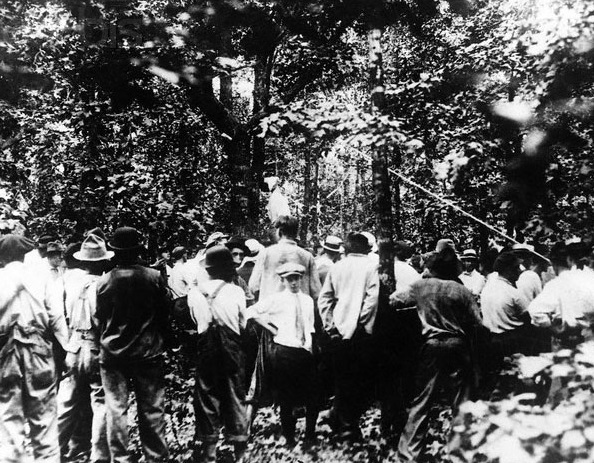
Frank is today widely thought innocent of the crime, although the Georgia Board of Pardons and Paroles has balked at issuing an unconditional pardon since so little of the original evidence survives. (A 1986 pardon came down “without attempting to address the question of guilt or innocence” in recognition of the slanted trial and the failure to protect Frank from lynchers.) But this was much more than a courtroom drama; the Frank affair crackles with the social tensions of early 20th century America. Industry and labor; integration; sexual violation; sectional politics; race and class and power.

Populist Party politician Thomas E. Watson, whose magazines made a dishonorable intervention by openly agitating for (and then celebrating) Frank’s lynching, captures the Zeitgeist for us as he fulminates against the nationwide campaign to grant the convicted murderer a new trial: “Frank belongs to the Jewish aristocracy, and it was determined by the rich Jews that no aristocrat of their race should die for the death of a working-class Gentile.” Frank came to enjoy (if that’s the right word) the editorial support of most of the country’s major papers, but the meddling of northern publishers, and of fellow Jews in solidarity,* arguably led Georgians to circle wagons in response. Present-day Muslims called upon to disavow every bad act by every other Muslim would surely recognize this no-win position.

But then we must also add that Watson himself, a lawyer, had been approached by Frank’s defense team hoping to enlist his bombast to defend their man at trial. The white supremacist demagogue would have been perfect for the job, for the legal battle pitted the credibility of a black janitor named Jim Conley against that of Frank.

Here amid the nadir of American race relations Frank’s team made its own ugly and unsuccessful pitch for racial solidarity with his neighbors. When formulaically asked by the court that had convicted him for any statement to mitigate the impending sentence, Frank replied that

my execution will make the advent of a new era in Georgia, where a good name and stainless honor count for naught against the word of a vile criminal; where the testimony of Southern white women of unimpeachable character is branded as false by the prosecution, disregarded by the jury and the perjured vaporings of a black brute alone accepted as the whole truth.

This violent collision of two vulnerable minorities each with the keen sense that one or the other of them was being outfitted for WASP America’s nooses makes for riveting and sometimes bizarre reading. Newspapers could hardly fail to note that the all-white jury (Leo Frank’s defense team struck all the blacks) had, as Frank complained, privileged the account of just the sort of “black brute” that Southern courts were accustomed to scorn, or railroad. Thus we have the NAACP organ The Crisis taking umbrage that “Atlanta tried to lynch a Negro for the alleged murder of a young white girl” but “a white degenerate has now been indicted for the crime.” It was likewise reasoned by some that since Conley was a young black man with a criminal record who was a potential suspect in the Deep South in the murderous sexual assault of a little white girl, “the mere fact that Conley did not long ago make his exit from this terrestrial sphere, via a chariot of fire is convincing proof that he, at least, is not the man who committed the deed.”** (New York Age, Oct. 29, 1914.)

In the end it was a zero-sum game between Jim Conley and Leo Frank: one of them was the murderer; each accused the other. Their respective desperate interests permeated to their respective communities. After Frank’s lynching, hundreds of Jews left Georgia; many who remained took pains to downplay their Jewishness.

By whatever circumstance police zeroed on Frank and the white community’s passion followed — tunnel vision that would eventually manifest itself in a circus courtroom atmosphere where the prosecuting attorney was cheered and defense witnesses hooted at and the ultimate outcome more demanded than anticipated. The judge feared that an acquittal would result in the summary lynching of not only Frank but his defenders.


Mary Phagan was killed on Confederate Memorial Day, the “holiday” this ballad alludes to.

Unusually for the time, appeals on the case reached the U.S. Supreme Court which declined to intervene — although two justices filed a dissent citing the egregious trial atmosphere.

Mob law does not become due process of law by securing the assent of a terrorized jury …

This is not a matter for polite presumptions; we must look facts in the face. Any judge who has sat with juries knows that in spite of forms they are extremely likely to be impregnated by the environing atmosphere … we think the presumption overwhelming that the jury responded to the passions of the mob …

lynch law [is] as little valid when practiced by a regularly drawn jury as when administered by one elected by a mob intent on death.

But that mob would still have its say. On the eve of Frank’s scheduled June 22, 1915 hanging, outgoing governor John Slaton commuted the sentence.

“Feeling as I do about this case, I would be a murderer if I allowed this man to hang,” the governor said. “It may mean that I must live in obscurity the rest of my days, but I would rather be plowing in a field than feel for the rest of my days that I had this man’s blood on my hands.”†

Frank was spirited away to the penitentiary under cover of darkness; it was hoped that the remote and reinforced edifice would deter any reprisal. It turned out that the furies who hunted Franks could not be dissuaded by mere inconvenience: a committee calling itself the Knights of Mary Phagan formed with the open object of organizing the intended mob vengeance — and indeed it was almost superseded in July of that year by a fellow-prisoner who slashed Frank’s throat as he slept.

Frank survived that murder attempt only to await the next one. Who knows what fancies frequented him in those weeks when he ducked from the shadow of the gallows to that of the lynching-tree, object of pity or hatred. He had time on the last day to savor his impending fate when the Knights methodically cut their way into the penitentiary — snipping the phone wires and disabling the vehicles — and marched their man out with nary a shot fired. Then, a convoy of automobiles “sped” (at 18 miles per hour) all the way back to a prepared execution-site at Marietta. The drive took seven or eight hours over unpaved country lanes, and for every moment of it Frank surely knew how it would end.

* Frank was a chapter president of the Jewish fraternal organization B’nai B’rith; the Anti-Defamation League of B’nai B’rith was founded in 1913 as a direct outgrowth of the Frank campaign.

As a contrasting response, the American Jewish Committee declined to participate in the Frank campaign for fear of lending counterproductive credence to charges such as those voiced by the New York Sun (Oct. 12, 1913):

The anti-Semitic feeling was the natural result of the belief that the Jews had banded to free Frank, innocent or guilty. The supposed solidarity of the Jews for Frank, even if he was guilty, caused a Gentile solidarity against him.

** Maurianne Davis’s Strangers and Neighbors: Relations between Blacks and Jews in the United States has a trove of interesting editorial comment from Frank’s contemporaries in the black press, and the Jewish press. Conley was actually the confessed accessory, and served a year in prison for it: he said that he complied with Frank’s order to hide the body for fear that his “white” boss could easily get Conley lynched for the crime. Conley also wrote (under Frank’s directive, he said) the preposterous “murder notes” found with the body that purported to be Mary Phagan’s dying indictment of Newt Lee, the African-American night watchman.

† The allusion to political suicide suggests Slaton’s mind was on the precedent of Illinois Gov. John Altgeld, whose career was destroyed by pardoning some of the Haymarket anarchists. If so, Slaton was quite correct; he actually had to flee Georgia altogether and could not return to the state for more than a decade.

On this day..

1918: Private David Stevenson, repeat deserter

(Thanks to Meaghan Good of the Charley Project for the guest post. -ed.)

On this dayJuly 18 in 1918, in Bully-Grenay in war-torn France, Private David Stevenson* of the Lowland Field Artillery was shot by the British Army for desertion and insubordination. “His record,” notes Cathryn Corns and John Hughes-Wilson in their book Blindfold and Alone: British Military Executions in the Great War, “is one of the longest amongst all surviving records of courts martial.”

Private Stevenson enlisted on August 17, 1915 and began misbehaving almost immediately. His disciplinary record can be summarized as follows:

September 1, 1915: AWOL, six days
September 13: AWOL, one day
September 18: AWOL, four days
September 30: AWOL, five days
October 5: AWOL, one day
October 7: AWOL, one day
October 11: AWOL, seven days
October 20: Malingering
January 15, 1916: AWOL, twenty-eight days
March 17: Drunk and disorderly
April 2: Drunk and disorderly
April 24: Escaping from a hospital
May 14: AWOL, nine days
May 28: Creating a disturbance, damaging public property
May 30: Noncompliance with an order
May 31: Creating a disturbance, damaging public property
June 7: AWOL, two days
June 14: AWOL, three days
July 15: AWOL, eighteen days
August 19: AWOL, seventy-four (!) days
November 18: AWOL, one day
November 21: Insolence to an NCO
December 1: AWOL, seven days
December 18: AWOL, eighteen days

In 1917, Pte. Stevenson was shipped out to France. Somehow he managed to maintain a clean record for several months, but soon he was back to his old habits again:

August 18, 1917: Lying to an NCO and hestitating to obey an order
August 27: Losing a folding saw by neglect
October 22: Desertion; tried by the Field General Court Martial (FGCM) and sentenced to five years in prison
December 20: Drunk in camp, entering a guard tent without permission, resisting escort.
March 8, 1918: AWOL, fifty-two days.

Apprehended on April 29, Stevenson was locked up at Army headquarters and was admitted to the No. 55 Casualty Clearing Station on May 5. He was supposed to get cleaned up and then returned to headquarters the next day, but instead he flew the coop. He later claimed he had just gone out for a walk and then got afraid he’d get into trouble if he went back, so he just “loitered about” until he was arrested three days later.

At his court martial, David Stevenson pleaded for mercy, saying, “If I could get another transfer to another regiment, I could prove myself a soldier.”

But by then the Army had had quite enough of him. His brigade commander wrote, “To my mind there are no redeeming points in this case.” General Henry Horne, 1st Baron Horne, agreed.

The authors of Blindfold and Alone note that Stevenson’s case left puzzling questions: “With his bad record, Stevenson must have known he was heading for a death sentence, and yet persisted with the behavior which would inevitably lead to his execution.” Why?

Lt. Gen. Sir Aylmer Gould Hunter-Weston summed up his superiors’ take on it nicely when he said Stevenson’s conduct could “only be explained by his obvious and habitual tendency to avoid all authority.”

* Not to be confused with the present-day British historian of the First World War also named David Stevenson.

On this day..

1911: Daniel “Nealy” Duncan, posthumous pardon candidate

On this date in 1911, still professing his innocence, Daniel “Nealy” Duncan hanged in the county jail at Charleston, South Carolina.

“Short, thick set and very black,”* Duncan was, at length, arrested for the murder of a King Street tailor named Max Lubelsky. Poor Mr. Lubelsky had been discovered on June 21, 1910 as he lay dying of a fractured skull — the bloody cudgel rudely enhanced with a nail abandoned beside its victim was the only clue, besides someone in the neighborhood who thought they noticed “a negro, dressed in a blue suit, wearing a derby hat”** who left the store around the time of the midday attack. The attacker’s purpose was robbery.

With very little to go on, police “rounded up a number of characters” and, the papers forthrightly reported, gave these black men “the ‘third degree'”: that is, tortured them.

Granting that we find ourselves at this moment at the nadir of race relations in the Jim Crow south, these officers conceived themselves acting in good faith, torture and all. They were not utterly indiscriminate; several of the beaten-up suspects were able to produce an alibi and were duly released with their newly acquired welts. But in the absence of a witness (or knuckle-assisted self-incrimination) they had little to work with.

And so the assailant remained a mystery.

There matters still stood on July 8 when the widow Mrs. Lubelsky came racing out of her late husband’s store with blood streaming down her own face, crying murder at the top of her lungs.

To take up the narration reported in the next day’s edition of The State,

Just then a negro emerged and two men, Isaac Goodman and Moses Needle, who were passing, gave chase of the negro. He was caught a few blocks distant and promptly turned over to Police Officer Stanley and Detective Levy, who had also taken up the chase. Protesting his innocence and declaring that another negro had attempted to kill the woman, Daniels was taken to the station house amidst great excitement and the patrol wagon did not roll off any too soon from the excited neighborhood …

The State has given us an incriminating narration, but if we begin from our suspect’s denial it is not too difficult to conceive the scene otherwise — a bystander swept into the chaos as the panicked Mrs. Lubelsky barges out of her shop, the sudden attention of a crowd which the newsman gives us to understand was wound up enough for a lynching. You’d run, too.

The traumatized Mrs. Lubelsky insisted that it was Duncan who attacked her; this is one of the few pieces of palpable evidence we have in the case, though eyewitness error is a frequent factor in wrongful convictions. She would have glimpsed her assailant for a moment, dashed out of the store in a panic, then a fleeing man was chased down and hauled back to her — perfect cues for her memory to fix this man with all sincerity as the picture of her assailant.

And whatever the cliche about criminals returning to the scenes of their crimes, few are bold enough to repeat a literally identical attack days apart. It was basically just by analogy that the July 8 assault was held to place Duncan at the scene of the murder 17 days before; the vague description of the blue-suited man who might or might not have had anything to do with the murder could have fit Duncan or numerous other people. A local black man said that Duncan had been in the area on the day Max Lubelsky was killed, which would scarcely rise to the level of circumstantial even were one to discount the possible confirmation bias (or police pressure) introduced by Duncan’s arrest.

One would like to think (forlorn hope!) that a jury in 2015 would demand better than this to stretch a man’s neck … but in Charleston in 1910, it was enough to surpass reasonable doubt.†


The State, Oct. 8, 1910.

Duncan’s insistence on innocence was passed down in his own family and in the Mother Emanuel African Methodist Episcopal Church whose congregation the hanged man once belonged to. In these halls, he is widely understood to have been an innocent man and this conclusion has not wanted for latter-day advocates.‡

The case surfaced to the broader public recently, with a push around the centennial of Duncan’s hanging to have him posthumously exonerated. The measure failed on a 3-3 vote in 19112011.

Left: Dead Weight, a historical novel based on the Duncan case; right: Charleston’s Trial, a nonfiction account.

Duncan was the last person hanged in Charleston, but not the last in South Carolina; there was a double execution in December of 1911 before the Palmetto state adopted electrocution beginning in 1912.

* The State (Columbia, S.C.), June 11, 1911.

** The State, June 22, 1911.

† The supernaturally inclined took notice from the August 1911 hurricane that devastated Charleston as a portend of Duncan’s innocence — and nicknamed it “the Duncan storm”.

‡ 2010-2011 media accounts indicated that the victim’s descendants did not share such confidence in Duncan’s innocence.

On this day..

1915: Kassim Ismail Mansoor, purveyor of coffee and treason

A century ago today, an Indian Muslim named Kassim Ismail Mansoor was hanged by the British in Singapore as a traitor.

The treason in question concerned the dramatic mutiny some months previous of Singapore’s 5th Light Infantry — Muslims who had feared that they would be dispatched to World War I’s European charnel house. (Ironically, the British brass had no such intent: they already considered these troops too unreliable, for some reason.)

Many of the mutineers were shot en masse by summary court-martial.

Our man Mansoor was not a fighter but a civilian coffee-shop proprietor. Having come into the confidence of some of his countrymen enough to know the mutinous thrust of their grievances, he made bold put in writing an appeal to the Rangoon consul of the Ottoman Empire — Britain’s wartime enemy — for the intervention of Turkish warships that could pick up their disaffected Muslim brethren and turn together against the British. Unfortunately for Mansor, that missive fell into British hands.

A 1937 retrospective series in the Straits Times on the distinguished career of Mansoor’s defense counsel, Sir Vincent Devereux Knowles, dives into the case here: 1, 2. Knowles, it says, knew his task was quite hopeless.

On this day..

1912: Rev. Clarence Richeson, minister, madman, and murderer

Minutes after midnight this date in 1912, a desexed preacher’s troubled concupiscence was at last abated by the Massachusetts mercy seat.

Some demon ruled Clarence Virgil Thompson Richeson‘s wayward footsteps through this life, and ere its last immolation saw Richeson alternate a serial pattern of abstinent betrothals with bouts of increasingly severe mental instability.

“Clarence had become deranged,” wrote one of the several theological seminaries he attended to his father, explaining why he couldn’t be kept.

Derangement for Clarence Richeson ranged from the merely embarrassing (wet dreams, three or four times a week) to the positively poltergeistian (bouts of raving, delirious lunacy). These foibles proved no obstacle to the charismatic Richeson’s repeated engagement — six or more young women by my count succumbed to his court — although he would later confess that these relationships, never consummated in matrimony, were almost never consummated in bed either. Richeson claimed to have remained a virgin until age 28, and then for most of the succeeding six years as well, even though a book of that period describes him as a “tall, handsome giant with the classic face of a Gibson hero.” On at least one occasion he besought a doctor to castrate him as he feared he could not keep his self-control around women.

Richeson’s strange proclivities kept interrupting the cursus honorum of Baptist pastorships that comprised his professional life: he had to resign from a church in Kansas City in 1904 after proposing to three different women, and a gig in El Paso was cut short when he fell into a spell of paranoid delusion.

1908 finds him a minister once again, now in Hyannis, Mass., and celebrating the birthday of 17-year-old Avis Linnell with an engagement ring. His “spells” or “fits” of madness were continuing as well, and numerous associates would later produce affidavits testifying to his violent outbursts. A doctor (who only quelled Rev. Richeson this night by morphine) recalled one incident:

I was called to see him at the residence of Mrs. Hallet, with whom he was boarding, and when I arrived I found there were with him two or three men whom I knew to be members of his church; he was acting violently and they were trying to control and quiet him both by words and by attempting to restrain him by physical force. He appeared at times to be partly conscious; then he would go into a state whereby he lost consciousness and was practically unconscious, apparently had no knowledge of what he was doing or saying. During this period of time he talked irrationally, raved incoherently, and physically manifested an abnormal degree of strength.

Parishioners decent enough to stand with their preacher would eventually find these private afflictions played out in lurid public detail. That was after Avis Linnell turned up dead at the Boston YWCA where she boarded while studing at the New England Conservatory of Music. It was 17 days before her scheduled Halloween, 1911 marriage to Clarence Richeson, and Miss Linnell was pregnant.

At first ruled a suicide, the case caught the eye of the Boston Post, whose swarm of reporters soon found a pharmacist who had sold Richeson cyanide days before the death of his betrothed. Richeson’s clemency petitions would eventually focus on his unbalanced mental state, but poison, of course, suggests the calculation of the pastor and not the outbursts of the madman within. (We’re getting ahead of ourselves, but doctors arguing for mercy also viewed Richeson as a prime research subject, whose maintenance behind bars could help to avert dangerous mental illnesses in others in the future.)

Matters went very quickly from this point.

Richeson resigned from his pastorship and, while lying in jail under indictment, slashed himself with a sharp piece of tin. Not his wrists, but his manhood — an attempted emasculation that was near enough successful that the physician responding to his shrieks was obliged to complete it in order to close up the wound. Richeson would later insist that he “shall think to my dying day that two men came in and did it” — apparitions of his mind’s creation.

The dying day was quick in coming. Two weeks after his self-mutilation, on January 5, 1912, Richeson withdrew his pretrial not guilty plea and simply copped to the murder. The death sentence was mandatory, but the plea also prevented any opportunity for a jury to rule on whether the killer’s instability lessened his criminal culpability. It was the opinion of some psychiatrists and not a few laymen that it was not simply a matter of Richeson’s state slipping between lucidity and delirium, but that his deterioration over the years had delivered him into a state of permanent derangement. Even Avis Linnell’s mother forgave her daughter’s killer “this dreadful thing” because “it is my belief he went to the electric chair an insane man and that he has been mentally irresponsible for some time past.”

On Sunday, May 19, a day and a half before he became the 14th client of the Massachusetts electric chair, Rev. Richeson conducted his last service — not in the prison chapel (against regulations) but from his own cell. “This is Sunday my last on earth,” he reflected. “If I had lived a righteous life I should today be delivering a sermon from the pulpit of my church in Cambridge instead of being caged here awaiting a felon’s death.”

It had not been so long ago in those environs that any execution would be a prayerful service, condemned together with the congregation. Matters by now were disposed of behind prison bars, but the electrocution of a clergyman was far too rich a theme not to fill New England’s actual pulpits that same day with topical exhortations; indeed, since the Richeson case made national headlines, these were preached all over. (The Olympia, Wash., Daily Recorder of May 20 notes a Presbyterian baccalaureate address that Sunday touching on Richeson as a cautionary example; the Grand Rapids, Mich. Evening Press of May 27 had a preacher at the Calvary Baptist Church declaiming against Richeson’s execution as an instance of anti-clerical prejudice.)

With the witnesses all gathered in the death chamber and just as the last straps were being adjusted the Rev. Herbert S. Johnson stepped forward and asked Richeson the following questions which he answered in a clear voice:

“Would you like to confess Christ as your Savior before these witnesses?”

“I do confess Christ as my Savior.”

“Have you the peace of God in your heart in this hour?”

“I have the peace of God in this hour.”

“Does Christ give you the strength you need in this hour?”

“Christ gives me the strength I need.”

“Do you repent of your sins?”

“I do.”

“Have you the peace of God in your heart?”

“God will take care of my soul and I pray for all.”

“Are you willing to die for Jesus’ sake?”

“I am willing to die.”

Just as he uttered the word “die,” Warden Bridges tapped the stone floor with his gold headed black cane which had been used so many times as a signal to the executioner who switched on the electric current and at 12:17 Drs. McLaughlin, McGrath and Butler pronounced Richeson legally dead. The penalty exacted by the laws of Massachusetts had been paid and all hope of studying this abnormal man for the purpose of aborting criminal tendencies in others of his kind was wiped out in a few seconds.

On this day..
