1916: Benjamin De Fehr, fragging driver

On this date in 1916, Canadian World War I enlistee Benjamin De Fehr was shot for murder.

De Fehr was one of 25 Canadians to go to the stake for military offenses during the Great War. Twenty-two of those were condemned as deserters; another for cowardice when he refused to advance.

De Fehr, by contrast, picked up his rifle inexplicably on August 19, 1916, and shot his Regimental Sergeant-Major James R. Scott in the back. He was tried three days later, and executed three days after that. His best defense was a disputed claim that he was drunk, probably not a winner under the circumstances even if true.

“Shot at dawn” soldiers have earned a good deal of latter-day sympathy, but suffering from shellshock and fragging your RSM are two different things. De Fehr wasn’t even a front-line soldier himself; he was a driver behind the lines. He was excluded from the 2006 posthumous pardon of 306 British Commonwealth soldiers executed during World War I.

He’s buried in Nord-Pas-de-Calais, France, just three plots away from his victim.

On this day..

1916: Gabrielle Petit, Belgian spy

On this date in 1916, German forces occupying Belgium shot Gabrielle Petit at Schaarbeek for espionage.

Petit, orphaned as a child, was a 21-year-old Brussels saleswoman and governess when the First World War began.

In 1914, she helped her wounded fiance, soldier Maurice Gobert, cross the front lines into the Netherlands to rejoin his unit.

This was already a no-no — just the thing, in fact, that would soon get British nurse Edith Cavell shot by the Hun. But Petit went way beyond into outright espionage.

Having impressed British officers upon her successful delivery of Maurice by relating everything she could remember about the German army’s disposition, she got a crash course in spycraft and returned back over the lines. For a year and a half, she continued funneling information about troop movements as well as distributing the then-underground (but today still-extant) newspaper La Libre Belgique.

Captured in February 1916, she refused to trade her life for the identity of any other operative, and was shot for spying.

Although Gabrielle Petit didn’t get anything like Nurse Cavell’s wartime propaganda play, her story became well-known after the Armistice and resulted in a state funeral, various films and books, and a monument in Brussels’ Place Saint-Jean.


(cc) image from dogfael.

On this day..

1916: Captain Charles Fryatt, illegal combatant

On this date in 1916, Captain Charles Fryatt was shot at Bruges, Belgium as an illegal combatant.

Fryatt was a 42-year-old civilian mariner captaining the SS Brussels on the Harwick-Hook of Holland route when, in March 1915, a German U-Boat ordered him to heave to.

Fryatt wheeled the Brussels around on the submarine and attempted to ram it. The German ship escaped by a whisker only by scrambling an emergency dive. The Admiralty gave Fryatt a gold watch and a pat on the head for bravery.

It was not until the following year that the Germans captured that same vessel with that same captain on board. When they realized who they had, they subjected him to a snap tribunal for violating the laws of war: he’d participated in combat (by trying to ram the U-Boat) whilst being not a member of his country’s armed forces. That made him an illegal combatant, a franc-tireur in the still-current term for a civilian partisan left over from the Franco-Prussian War.

The Germans mightily loathed such terrorists, feared they would bedevil their steps in Belgium and France: people not sporting enough to stay beaten, people with the effrontery to fight back without being a duly enrolled member of a nation-state’s standing army. They did not scruple to push an expansive line on the definition of civilian non-participation.

“Every non-uniformed person,” read the a Moltke directive to the army, “if he is not designated as being justified in participating in fighting by clearly recognizable insignia, is to be treated as someone standing outside international law, if he takes part in the fighting … [or] participates in any way in the act of war without permission. He will be treated as a franc-tireur and immediately shot according to martial law.” (Source.)

So … that’s exactly what happened to Captain Fryatt.

This shooting set off a flurry of international recriminations and rebuttals.

People of normal moral sense can see readily enough that a merchant captain who scares off a submarine has not committed a grave crime any more than has a teen who chucks a grenade at commando firing at his home. The legal question for deliberation in Fryatt’s case was all about whether the merchant mariner had or had not committed an impermissible belligerent act by charging* … and as always, the definition of a war crime turned out to mirror precisely the political interest of the definer.

The British at this point had the Germans handily bottled up in a naval blockade that even seized food as “contraband”. (A tactic angrily denounced as a war crime in Berlin.) The Germans needed to get out of this stranglehold, and lacking anything approaching parity on the high seas, they staked their hopes on the U-boat. So the German interest was for maximum latitude for submarine activity; in fact, early in 1915, it was just in the process of rolling out its unrestricted submarine warfare policy of unannounced attacks on civilian freighters carrying war materiel. This does not seem to be what the U-boat stopping the Brussels did, but it gives you an idea of the scene. German military judges naturally said that German submarines who stopped a British merchant ship were not to be defied.

And the British interest, and by wonderous coincidence also its policy and legal position, naturally maintained maximum restrictions on a U-Boat’s potential targets, and maximum rights for the realm’s Captain Fryatts to resist.**

Fryatt, indeed, had followed the directives laid down by that Lord of the Admiralty, Winston Churchill. Churchill threatened to prosecute any ship captain who surrendered his vessel to a U-boat without opposing it “either with their armament if they possess it, or by ramming”: the theory was that routine resistance would maximize costs to the German navy, and maybe lead slow and vulnerable U-boats to skip the parley stage in favor of sneak attacks on unflagged steamers, which would sooner or later sink an American ship, which would help pull the U.S. into the war. (In May 1915, making no mistake at all about its target, a German U-boat intentionally torpedoed the Lusitania, generating a helpful stateside scandal also attended by dickering over the legality of the attack.)

So, the initial German announcement tersely reported that Fryatt

was condemned to death because, although he was not a member of a combatant force, he made an attempt on the afternoon of March 20, 1915, to ram the German submarine U-33 … One of the many nefarious franc-tireur proceedings of the British merchant marine against our war vessels has thus found a belated but merited expiation.

Britain replied that the captain had exercised only his “undoubted right of resistance,” and pointed out that a different merchant vessel that did obey such an order on the very same day had been sunk before it could evacuate — drowning 104 souls.

[T]he experience of German methods of warfare warned him that surrender would be no guarantee that the lives of his crew would be spared.

He determined therefore to take the best chance of saving his ship, and to steer for the submarine in order to force her to dive, and, if she were not quick enough in diving, to ram her.

This was his undoubted right under international law – to disregard her summons and resist her attack to the best of his power. It was a contest of skill and courage in which each side took their chance.

This led Germany to reiterate, on August 10, its view that Fryatt’s

act was not an act of self-defence, but a cunning attack by hired assassins …

The German War Tribunal sentenced him to death because he had performed an act of war against the German sea forces, although he did not belong to the armed forces of his country. He was not deliberately shot in cold blood without due consideration, as the British Government asserts, but he was shot as a franc-tireur, after calm consideration and thorough investigation …

Germany will continue to use this law of warfare in order to save her submarine crews from becoming the victims of francs-tireurs at sea.

There’s a 1917 monument to Captain Fryatt still displayed at London’s Liverpool Street Station, as well as a mountain in Alberta named in his honor.

Nobody was ever prosecuted for Fryatt’s execution.

* The distinction as parsed by Germany hung on whether the intended merchant prize was armed (allowed to resist) or unarmed (not).

** U-boats were new legal territory in 1915. The 1930 London Naval Treaty — although Germany was not party to it — attempted to clarify the status of these machines.

On this day..

1916: Joseph Hani, abandoned

“Mr Joseph Hani was hanged for treason in the Burj at 5 a.m. At 8 a.m. 40 families deported.

-Diary of Mrs. Harry Dorman, April 5, 1916*

The unfortunate Joseph Hani — Yusuf al-Hani — was among the worthies of Beirut’s Maronite Christian community to petition the French consulate for western aid in detaching Lebanon from the Ottoman Empire.

With the development of World War I, the French ambassador Francois Georges-Picot abandoned the embassy … without removing or destroying this sort of incriminating correspondence. As a result, the Turks ransacked the embassy and identified several dozen of reproachable loyalty to the Porte to put to death.

May 6 — Martyrs’ Day — honors these victims, but Hani was among the very first of them.

While most of the other Maronite signers were able to fly, Hani stuck around to face the music. A British agent was able to contact the implicated characters in Aley Prison, and received the plaintive answer,

‘Where are the English? Where are the French? Why are we left like this?’

* I believe an ancestor of the current president of the American University of Beirut, Peter Dorman. The source of the diary citation is Nicholas Z. Ajay Jr.’s “Political Intrigue and Suppression in Lebanon during World War I” in International Journal of Middle East Studies, Apr., 1974.

On this day..

1916: Sergeant John Robins, before evacuating Gallipoli

On this date in 1916, Sergeant John Robins of the 5th Battalion, Wiltshire Regiment — demoted for the occasion to Private — was shot “at a point on the beach 400 yards North of the mouth of the Gully Ravine” for disobeying orders.

This redundantly named topography was a feature of an ill-starred (for the British) peninsula Robins’s army was quite ready to see the back of: Gallipoli.*

Winston Churchill’s brainchild for a knockout punch in the First World War had long since come to grief — the enduring grief of the British, Australian, and New Zealand troops who died by the thousands under Ottoman guns whilst attempting to seize the Dardanelles, open the Black Sea, knock the Turks out of the war, and expose the Central Powers’ soft underbelly.

It didn’t do any of those things, but it did help Mel Gibson’s career.

The first days of 1916 were the very last days of the Gallipoli campaign, by which time the object was just to get out.

Actually, the invaders’ positions had been steadily, stealthily evacuated over the preceding weeks — successfully slipping away without alerting the Ottomans to the opportunity for a turkey shoot. The evacuation, at least, was a triumph.

Sergeant Robins was a part of this hot mess; he’d once had to flee from his bed when the Turks surprised his camp and overran it. But it didn’t seem to be jangled nerves that did him in so much as the everyday infirmity of the flesh.

By December 1915, a quarter of his unit was laid up on the sick rolls, but when Robins begged off a patrol assignment for unwellness, the powers that be didn’t reckon him among the legions of ill — but court-martialed him for refusing an order. A rather stunned Robins attempted to explain:

On the night in question I was not well enough to go out. I was eight and a half years in India where I suffered a good deal from fever and ague, and I still get fits of this. I had been suffering from this for several days off and on, and the wet weather had greatly affected me. I have been out here for nearly five months and this is the first trouble I have ever been in. I have always done my duty. This would not have happened if I had been quite well. At the time I did not realise the seriousness of what I did.
He realised the seriousness when he was shot at 8 a.m. on January 2, 1916. A week later, his unit — all his countrymen’s units — were out of Gallipoli.

On this day..

1916: Mary the Elephant

On this date in 1916 — true story — this happened.

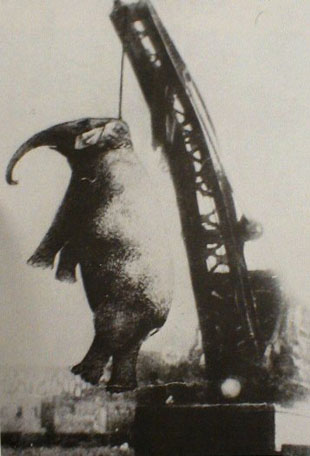
The circus elephant Mary hanged Sep. 13, 1913 in Erwin, Tennessee

Five-ton circus elephant Mary (yes, she has her own Wikipedia page) was in Kingsport, Tennessee on the chintzy fairgrounds touring circuit with Sparks World Famous Circus.

Billed as as “The Largest Living Land Animal on Earth,”* this exotic creature was a prime draw for the circus — and also a beloved pet of the Sparks family.

Unfortunately, this valuable asset was placed in the temporary stewardship of an inexperienced “under keeper” whom the circus had had to scoop up at a recent stop to cover staff turnover. Between shows on September 12, that fellow somehow (accounts conflict) enraged Mary, and (again according to one version among several) she

“collided its trunk vice-like [sic] about [the under keeper’s] body, lifted him 10 feet in the air, then dashed him with fury to the ground … and with the full force of her biestly [sic] fury is said to have sunk her giant tusks entirely through his body. The animal then trampled the dying form of Eldridge as if seeking a murderous triumph, then with a sudden … swing of her massive foot hurled his body into the crowd.”

It’s apparent in this report that the facts of an already-sensational event almost instantly began disappearing into its spectacle. See the largest land animal on earth! See it maul its handler to death! But what happened next lifted Mary all the way to legend.

The owners knew they had to euthanize the “mankiller,” or if they didn’t know they were soon persuaded by mushrooming press attention and towns threatening to ban the Sparks circus.

But how? They couldn’t shoot Mary to death — she apparently survived gunshots from the vengeful crowd in the immediate aftermath of the trampling; firearms just didn’t pack the wallop to put down a pachyderm in 1916. The area didn’t have the sort of electrical juice available that Thomas Edison had once used to drop a circus elephant during his weird campaign for the electric chair.

The choice for the baleful logistical task of killing a 10,000-pound evildoer was hanging, selected over “crushing it between railroad cars.”

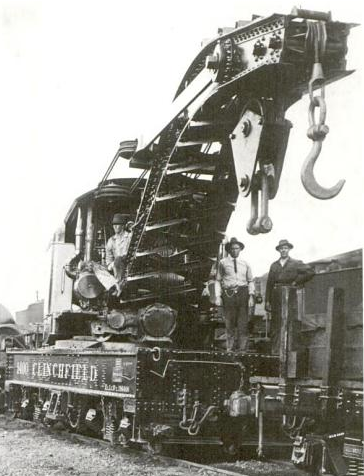
And for stringing up “Murderous Mary”, you need no ordinary gallows. No, for this job, you’re using the hoist on a train derrick and an industrial-strength chain for a noose.


The actual train derrick that hanged Mary the elephant. The leftmost man, seated on the machine, is the “executioner” who worked the controls, according toThe Day They Hung the Elephant.

The railroad was game for the operation, provided the circus would come to it. So on this date, the circus train cars loaded up for the nearest usable train derrickscaffold at Erwin, Tennessee.

There, a procession of all five Sparks elephants — the routine was supposed to keep Mary compliant, and it did the trick even though some observers later remembered the condemned creature behaving unusually skittishly — marched to the railyard.

There Mary was noosed with a 7/8″ chain and hoisted up. The chain broke, and the animal shattered its hip crashing to the ground; another, still larger, chain, did the trick on the second try.

Talk about a spectacle. Talk about scary clowns.

There’s something about this event abidingly piteous, even shameful. It may be for that reason that it’s also abidingly mysterious. The particulars about what happened on the day they hanged the elephant and what became of the body (a steamshovel dug a grave, but the exact location was never marked and there’s a wild story that it was dug up later for ivory) are the topics of conflicting, nth-hand rumors. Some in Erwin don’t to this day want to discuss the matter. Others, just the opposite.


Image (c) John Pugh of SourceToSea.net and used with permission.

* Sparks evidently kept the “largest living land animal” marquee in use for Mary’s successor, as indicated by this 1919 poster (pdf) for the show.

Part of the Themed Set: Americana.

On this day..

1916: Three in the Mexican Revolution

On an uncertain date — approximated only to “about the time of the Columbus affair,” which was Pancho Villa‘s famous (and otherwise unrelated) raid on Columbus, N.M. March 8-9, 1916 — a triple execution took place in Juarez, Mexico.

The who, why, and wherefore appear to be completely lost. Only the image remains:

These images were captured by C. Tucker Barrett, a lawyer and amateur photographer serving with the U.S. Army’s 16th Infantry Regiment then stationed right across the border from Juarez, in El Paso, Texas. (This regiment would be detailed for a punitive expedition into Mexico, which Barrett also photographed.)

The Mexican Revolution may be ancient history, but Juarez and extrajudicial executions are still very much in the news.

On this day..

1916: Private Billy Nelson

On this date in 1916, 19-year-old Durham Private William Nelson was shot for desertion by the British military.

The Pity of It
by Thomas Hardy

I walked in loamy Wessex lanes, afar
From rail-track and from highway, and I heard
In field and farmstead many an ancient word
Of local lineage like “Thu bist,” “Er war,”

“Ich woll,” “Er sholl,” and by-talk similar,
Nigh as they speak who in this month’s moon gird
At England’s very loins, thereunto spurred
By gangs whose glory threats and slaughters are.

Then seemed a Heart crying: “Whosoever they be
At root and bottom of this, who flung this flame
Between folk kin tongued even as are we,

“Sinister, ugly, lurid, be their fame;
May their familiars grow to shun their name,
And their brood perish everlastingly.”

According to the archive capture of the lamentably defunct Shot at Dawn site — which campaigned (successfully) for clearing the names of World War I soldiers who had been executed for military failings like desertion or cowardice — Nelson gave a pitiable account of his situation. It was less the horror of trench warfare and mustard gas than desperation on his own home front that undid Nelson’s “nerves”.

“I have had a lot of trouble at home, and my nerves are badly upset. My father is a prisoner in Germany and is losing his eyesight there through bad treatment. My mother died while I was still in England, leaving my sister aged 13 and my brother aged 10. I am the only one left. I had to leave them in charge of a neighbour. I had no intention of deserting. I did not realise what I was doing when I left the camp. When I did so I went and gave myself up. When I went to the store my object was to get a night’s sleep and then go and surrender in the morning. I thought it was too late to do so that night. I did not know when the battalion was coming out of the trenches.”

Hap
by Thomas Hardy

If but some vengeful god would call to me
From up the sky, and laugh: “Thou suffering thing,
Know that thy sorrow is my ecstasy,
That thy love’s loss is my hate’s profiting!”

Then would I bear it, clench myself, and die,
Steeled by the sense of ire unmerited;
Half-eased in that a Powerfuller than I
Had willed and meted me the tears I shed.

But not so. How arrives it joy lies slain,
And why unblooms the best hope ever sown?
–Crass Casualty obstructs the sun and rain,
And dicing Time for gladness casts a moan. . . .
These purblind Doomsters had as readily strown
Blisses about my pilgrimage as pain.

That 13-year-old sister whom Nelson worried over long suffered her brother’s senseless death. In 2004, that woman’s daughter (Billy Nelson’s niece), Nora High, told the Guardian:

Every Armistice Day, my mother shed buckets of tears. We’ve got Billy’s Bible, I got that when mother died. She used to lay that out on a piece of blue satin cloth, and she would cry. She always said: ‘I won’t cry any more because that only upsets Billy. He doesn’t want me to cry. Everything’s fine for him now.’

In Time of “The Breaking of Nations”*
by Thomas Hardy

Only a man harrowing clods
In a slow silent walk
With an old horse that stumbles and nods
Half asleep as they stalk.

Only thin smoke without flame
From the heaps of couch-grass;
Yet this will go onward the same
Though Dynasties pass.

Yonder a maid and her wight
Come whispering by:
War’s annals will cloud into night
Ere their story die.

* The title is a Biblical allusion to Jeremiah 51:20.

As a slight stretch, part of the Themed Set: Thomas Hardy.

On this day..

1916: Cesare Battisti and Fabio Filzi

On this date in 1916, the Austro-Hungarian empire executed Cesare Battisti and Fabio Filzi for treasonous Italian nationalism.

It was the multiethnic Habsburg state that was itself dying of its constituents’ national aspirations; in little more than two years, the state entity that carried out this day’s sentences would no longer exist at all.

Pre-World War I, Battisti (English Wikipedia entry | Italian) was actually a Socialist representative in the Austrian parliament.

When the unpleasantness broke out, though, he made a break for the peninsula where he agitated* (successfully) for Italian entry into the fray against Austria-Hungary. Irredentists had long coveted Habsburg properties with a heavy Italian population, like the Adriatic port of Trieste and Battisti’s own native Trento; the war offered an opportunity to swipe those territories, notwithstanding Italy’s putative prewar alliance with the Austrians.

Although already 40 years of age when Italy entered the war, the intrepid Battisti enlisted to fight. He was captured along with an otherwise obscure subaltern, Fabio Filzi, on the Alpine slope of Monte Corno (now known as Monte Corno Battisti) repelling the Austrian Strafexpedition.**

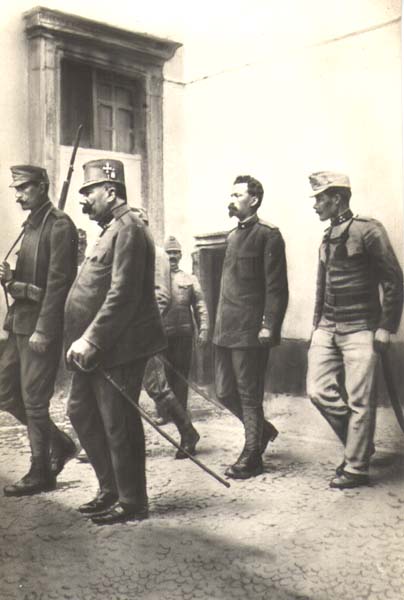
Austria did not stand on ceremony with these men; their capture took place on July 10, their trial on July 12, and their executions at the Castello del Buon Consiglio — an ironic Calvary, for a parliamentarian — later that same day. (To complete the scene, the strangulation-hanging was botched when Battisti’s first rope broke.)

The Austrian writer Karl Kraus would observe that “they thought they were hanging Italy, but it was really Austria on the gallows.”

Whichever one it was, they took a lot of pictures.


Battisti and Filzi as prisoners.


Battisti leaving the courtroom en route to his execution.


Battisti approaches the scaffold.


Battisti waiting at the scaffold as the sentence is read.


The Austrian army offers a prayer and salute to the shrouded body of Cesare Battisti.

* As a socialist who broke against the internationalist position and in favor of violent nationalism, Battisti was an ally of Benito Mussolini. It was Battisti, actually, who pioneered the socialist-nationalist-newspaperman act upon which Mussolini would later raise is own star, to such an extent that Battisti’s paper, Il Popolo — the apparent inspiration behind Mussolini’s own subsequent paper, Il Popolo d’Italia — gave the still-obscure future Duce some of his earliest gigs.

A martyr’s death during World War I fortuitously spares Battisti’s legacy the unpleasant association with his friend’s postwar turn towards fascism, so there are many streets and plazas named for Battisti, as well as a memorial in Trento. He’s also honored by name in the 1918 patriotic tune La Leggenda del Piave (lyrics).

** “Punitive expedition”.

On this day..

1916: Robert Digby in Villeret

On this date in 1916, Private Robert Digby was shot by a German firing squad in the tiny northern France village of Villeret.

Digby was the last of a quartet of English soldiers who had been part of the British Expeditionary Force who met the Hun’s first foray into France in 1914.

Digby and his mates, Thomas Donohoe, David Martin and William Thorpe, were stranded behind lines.

Villeret took them in and changed their uniforms for peasant clothes while they worked the fields and tried to keep their heads down.

“Every inhabitant of Villeret knew of the British soldiers in their midst but none breathed a word, although the Germans had threatened to execute anyone harbouring enemy fugitives,” writes Ben McIntyre, who wrote the book on these men. “Even when food ran low and German troops were billeted on every house, the secret was kept safe. It was an astonishing act of collective bravery.”

To the west, in trenches the men could not pass, the war ground uncounted souls into horsemeat.

Digby became the lover of a village girl, and fathered a daughter by her.

This perilous idyll under the very bowers of hell could not last long. The Brits were mysteriously betrayed, and arrested by the Germans in May 1916 — all save Digby, who escaped out the window of a barn.

Donohoe, Martin and Thorpe were shot as spies on May 27.

After a week on the run in the nearby woods, the mayor of Villeret found Digby, and told him that the Germans were threatening to execute the villagers unless he turned himself in to face his comrades’ fate. Digby did so.

McIntyre’s book, A Foreign Field: A True Story of Love and Betrayal in the Great War, explored the village of Villeret and the life of Digby’s daughter HĂ©lène Cornaille-Digby — an infant when her father was shot; an octogenarian when McIntyre met her.

The enduring mystery of the place, at least to McIntyre as an outsider, was the unanswered question of who betrayed the English. Was it a jealous lover? A disapproving family? A fearful neighbor?

Years after the publication of the book, McIntyre (so he thinks) accidentally solved the mystery.

On this day..