1943: The massacre of Janowa Dolina

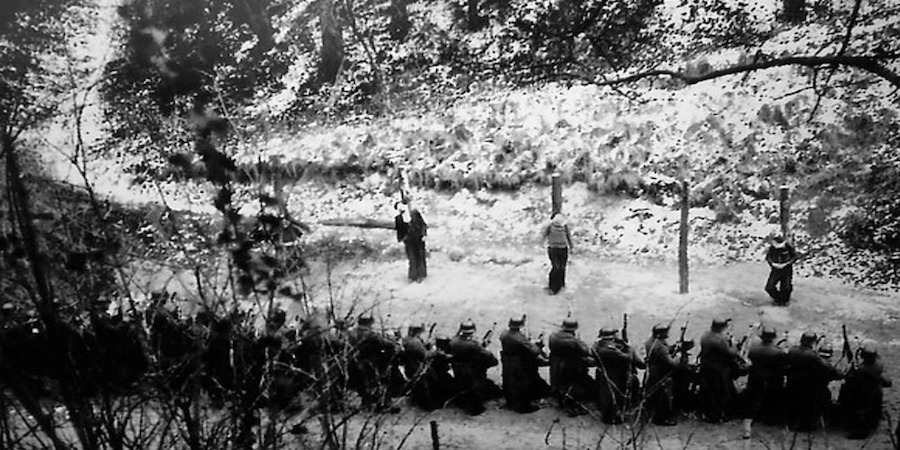
On or very near this date in 1943, a Ukrainian militia massacred the Poles of the village of Janowa Dolina (Yanova Dolina).


Janowa Dolina in the 1930s. The village was a model settlement for workers at the nearby basalt quarry, jobs given at that time by official preferences to Poles. It was created in the 1920s, and featured an orderly plot with running water and electricity throughout.

In World War II, each theater of the war was unhappy in its own way. For the beautiful region of Volhynia long straddling the blood-soaked marches between Poland and Ukraine, it meant a ghastly local war under the umbrella of German occupation.

Mostly Polish in the interwar years, when Ukrainian residents chafed under “Polonization” policies, Volhynia had come fully under Soviet control when Berlin and Moscow carved up Poland in 1939, and then, of course, fully under German control in 1941. In these years of ash and bone, ethnic compositions in Volhynia were redrawn with every desperate ferocity nationalism could muster: pogroms visited neighbor upon neighbor, or ethnic cleansing visited state upon subject. It would be Ukrainian ultras positioned in the end to fantasize about ethnic purity by dint of their collaboration with the conquering Reich.

Come 1943, Poles comprised a shrinking minority in Volhynia. The prospect of purging this borderlands to cinch its place in a Ukrainian homeland made those Poles an inviting target for a campaign of ethnic slaughter that’s remembered now as the Volhynia or Volyn Massacres. And with the German defeat at Stalingrad and the Red Army’s advance on eastern Ukraine, Reich administration further west had become sufficiently distracted by more urgent priorities that genocidaires* perceived their moment to strike.

“We should undertake a great action of extermination of the Polish element,” thundered Dmytro Klyachkivsky, a commander of the Ukrainian Insurgent Army (UPA), military organ of the Organization of Ukrainian Nationalists (OUN-B).** “As the German armies withdraw, we should take advantage of this convenient moment for liquidating the entire male population from the age of 16 up to 60 years. We cannot lose this battle, and it is necessary to diminish Polish forces at all costs. Forest villages and those near forests, should disappear from the face of the earth.”

Many specific atrocities, beginning in February 1943 and continuing well into 1944, comprise this liquidation drive.

The one of interest for this post is the invasion on the night of April 22-23 — the eve and morning of Good Friday — of Janowa Dolina, a predominantly Polish village where 600 were massacred by the UPA and the village put to the torch.†

This horror is commemorated by a monument at the site …


The 1990 monument commemorating Poles murdered by UPA. Here’s a closer view of the stone marker, and here’s the inscription on the adjacent cross.

… but there seems to be a slight difference of opinion: the event is also memorialized by a rival stone erected by Ukrainian nationalists which “gives glory to the Ukrainian heroes” of the UPA for “destroying the fortifications of the Polish-German occupiers.”‡


(Thanks to Sonechka for translation help.)

As anyone holding even passing familiarity with events in present-day Ukraine will surely know this is no mere historiographical quibble; the legacy of the OUN from World War II and of its descendants on the modern far right remain deeply contentious in and out of Ukraine.

* Poland officially (and to the dismay of Ukraine) considers this campaign a genocide. There’s also a Polish film on the horrors of Wolyn.

** The OUN split factionally; the “-B” suffix in this case stands for Stepan Bandera, leader of the most militant faction; his surname is still today a byword and/or slur (“Banderists”) for Ukrainian fascism. Its rival faction was the more moderate OUN-M, led by Andriy Melnyk.

† The territory became Ukrainian — which at the time meant Soviet — after World War II and remains so today, so Janowa Dolina is now the Ukrainian town of Bazaltove. There’s a Flickr album tour of the muddy mining village, including photos of the Polish monument and a separate marker for Soviet POWs, but not the UPA monument, here.

‡ The UPA stone also cites April 21-22 as the date. It appears to me, a distant non-specialist, that the Ukrainian construction on what adherents prefer to more neutrally describe as the “tragedy” of Janowa Valley spreads action over two days and emphasizes alleged guerrilla actions by the UPA against German occupation targets prior to destroying the village.

On this day..

1947: Garlon Mickles, the last hanged in Hawaii


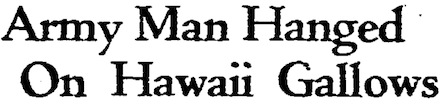
Seattle Times, April 22, 1947.

On this date in 1947, U.S. Army Private Garlon Mickles was hanged at a place called “execution gulch” in Honolulu’s Schofield Barracks.

Mickles had enlisted three years before, the 16-year-old son of a St. Louis laundress. (“Tell my mother I died like a man,” were his reported words to the chaplain.)

According to Associated Press reports, army engineers frustrated peeping eyes by “put[ting] up a smoke screen to shield the gallows from the view of the curious.”

He was convicted of raping and robbing a female War Department employee on Guam, where he was stationed with the Twentieth Air Force — from which staging-point the unit conducted bombing raids on mainland Japan. (The Enola Gay, which dropped the atomic bomb on Hiroshima, was part of the 20th.)

Mickles appears to be the last person ever executed on the Hawaiian islands, and also an unusual overlook by the Espy File of U.S. executions, from which he’s totally absent.

On this day..

1946: Masaharu Homma, for the Bataan Death March

Laid down on the altar I am
Offered as a victim to God
For the sake of
My newly born country

-Verse written by Masaharu Homma awaiting execution (Source)

Imperial Japanese Lt. Gen. Masaharu Homma was shot by a firing squad outside Manila on this date in 1946 for the notorious Bataan Death March.

Homma commanded the 14th Area Army tasked with occupying the Philippines immediately after the attack on Pearl Harbor opened a Pacific War against the U.S.

Retreating from the Philippines in early 1942, U.S. Gen. Douglas MacArthur famously vowed, “I shall return.” To Homma’s grief, he did just that.

While MacArthur cogitated his revenge, Homma was finishing off the remnants of his last great stand in the Battle of Bataan. Bataan was a victory for Japan, but a bloody and protracted one; it cost the lives of some 7,000 Japanese, and the three-month battle has sometimes been credited with slowing the Japanese advance sufficiently to safeguard Australia; it also left the occupiers with an unexpectedly huge complement of POWs.

On April 9, 1942, the very day fighting ended at Bataan, transfers began for these prisoners, who would be driven by train and then marched overland some 60+ miles to Camp O’Donnell. More than 60,000 Filipinos and about 15,000 Americans endured this harrowing five- or six-day slog — the Bataan Death March.

A few books about the Bataah Death March

Early reports of the death march made grist for this wartime propaganda poster in the U.S.

This crucible of endurance, both physical and spiritual, came by its evil repute honestly; in the age of the Internet, numerous appalling testimonials are within easy reach of a web search. They recount battle-wearied men enervated by hunger and thirst, liable to be summarily shot or bayoneted for making themselves the least bit conspicuous to captors who already disdained them for having the weakness to surrender in the first place.

Some were murdered at the outset: having any Japanese “trophies” on one’s person when captured was liable to be worth a summary bullet, or a quick flash of an officer’s katana. An even more certain death sentence was falling behind on the march, and wounded prisoners could expect no quarter: they had to keep up with their compatriots or the Japanese “buzzard squad” trailing a few score meters behind every marching peloton would finish them off with any other stragglers. In different groups POWs might be thrashed or killed over any trifling annoyance; meanwhile, those suffered to live trudged under a wasting sun, nearly unnourished but for fetid handfuls scooped from mud puddles, dying on their feet hour by hour. Dehydrated to the point of madness, some snapped and ran suicidally for the tantalizing nearby village wells that marchers were prohibited from accessing.

Something like a quarter, and maybe nearer to a third, of the souls who set out on the Bataan Death March never reached Camp O’Donnell. Those who did entered new portals of torment: rent by dysentery and crowded cheek to sunken jowl, prisoners died off daily by the dozens until they were finally dispatched — often crammed like sardines into the bowels of “hell ships” — to different Japanese work camps.

The Bataan Death March was a no-question basket of war crimes, egregiously flouting existing POW treatment accords.* It’s far more questionable whether our man Gen. Homma was the right person to answer for it.

Homma had segued directly from the Battle of Bataan to the succeeding Battle of Corregidor after which he had been cashiered for a homeland desk job.

Ironically, it was an excess of leniency that helped earn Homma his enemies among the brass — the opposite of the thing that hanged him. For many who observed the postwar trial slating him with 48 war crimes violations related to the Death March, Homma was a figure more tragic than wicked, prey to returning victor MacArthur’s pique at the defeat Homma had once inflicted upon him.

Little reliable evidence could show that Homma blessed or even knew of the atrocities committed in the march, but he himself allowed during trial that “I am morally responsible for whatever happened in anything under my command.” According to Homma’s American defense attorney Robert Pelz — a biased source to be sure — the general slipped into genuine disgust and remorse during the trial as a parade of witnesses remembered their ordeals. “I am horrified to learn these things happened under my command,” Homma wrote in a note passed to Pelz at one point. “I am ashamed of our troops.”

The hanging verdict was controversial then and remains so now. “If the defendant does not deserve his judicial fate, none in jurisdictional history ever did,” MacArthur complained. He honored the mercy application of Homma’s wife Fujiko only insofar as to permit the general a more honorable execution by musketry, instead of hanging.

The bulk of the U.S. Supreme Court okayed the procedure by which the U.S. military brought that fate about, although Justice Frank Murphy issued a scorching dissent urging that in the haste and partiality of the proceedings against both Homma and General Tomoyuki Yamashita “we abandon all pretense to justice, let the ages slip away and descend to the level of revengeful blood purges.”

One who would share that sentiment was an 18-year-old Navy man who observed the trial, Bob Perske. Perske would remember this his experiences on the Philippines at the end of World War II “sharpened his sensitivies toward vulnerable persons” and influenced a subsequent career advocating for people with disabilities as well as those caught in the toils of the criminal justice system. Executed Today formerly interviewed Mr. Perske in connection with the wrongful execution of a mentally disabled man in Colorado, Joe Arridy.

* It’s worth noting that Japan was not party to the 1929 Geneva Convention on the Treatment of POWs.

On this day..

1945: Eliyahu Bet-Zuri and Eliyahu Hakim, Lord Moyne’s assassins

British-occupied Egypt on this date in 1945 hanged two young Jewish assassins for slaying the British plenipotentiary to the Middle East.

Walter Edward Guinness was heir to the barley beer fortune and a Tory politician of near 40 years’ standing. “Lord Moyne”, to call him (as history does, and as we will henceforward) by his aristocratic honorific, allied with his former rival Winston Churchill in the 1930s as a staunch foe of placating Hitler, eventually serving several roles in Churchill’s wartime government.*

The last and perforce most famous was Resident Minister of State in Cairo from January 1944, where he directed British affairs in North Africa, Persia, and the Middle East, crucially including Mandatory Palestine.

Such a figure must necessarily represent many things to different subjects, but to Zionists he represented the hostility to their project of both his own person and (more importantly) of London. While there is endless nitpicking about the man’s precise degree of disfavor for Jewish people or interests, “Lord Moyne was the highest British official in the Middle East,” in the words of Yitzhak Shamir, the emigre terrorist who orchestrated the hit and would one day become Prime Minister of Israel. “Because we fought against the British in this area, we took him for a target. This was the main reason for his assassination.” Nothing personal. (Maybe a little personal.)

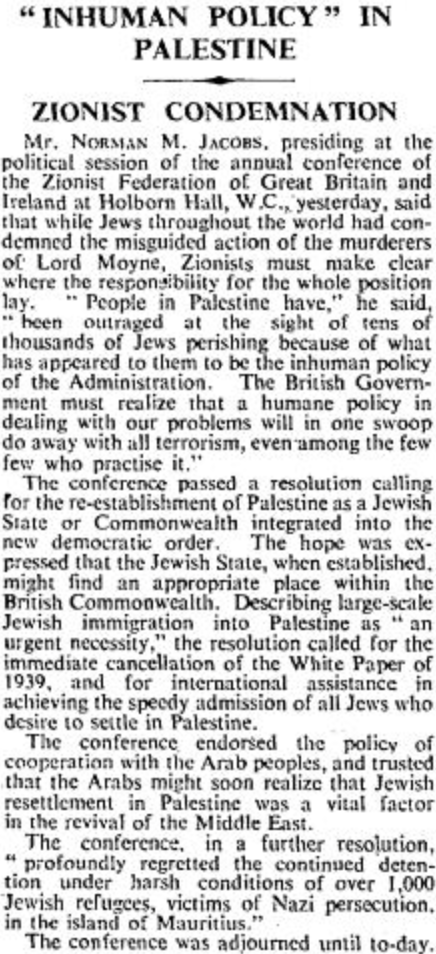
On November 6, 1944, two of Shamir’s young cadres in the late Avraham Stern‘s militantly anti-British Lehi network, Eliyahu Bet-Zuri (Ben Suri) and Eliyahu Hakim, ambushed Moyne as his limousine pulled up at his villa, and shot him dead with pistols. (They also killed Moyne’s driver, a Lance Corporal named Arthur Fuller.) Once their affiliations became apparent it was Jewry’s turn to bask in the collective censorious scowl that minorities everywhere can anticipate given any perceived ethnic affinity to the latest atrocity’s author. These sortings-out from the London Times would do almost word for word for whatever horror tomorrow’s news might bring.


London Times, Nov. 10, 1944


London Times, Jan. 29, 1945

Similarly, Lord Moyne’s killers took every pain to link their martyrdom to Jewish/Zionist patriotism, no matter any moderate rabbi’s attempt to wash his hands of it.

Raised in Mandatory Palestine, both Bet-Zuri and Hakim spoke Arabic but insisted on speaking only Hebrew in the Cairo court. They went to the gallows singing the hymn “Hatikvah” — later to become Israel’s national anthem.

In the near term, their deed hardened hearts: “If our dreams for Zionism are to end in the smoke of an assassin’s pistol, and the labors for its future produce a new set of gangsters worthy of Nazi Germany, then many like myself will have to reconsider the position we have maintained so consistently and so long in the past,” Churchill snarled to Parliament.

But in fact the British reconsideration was soon seen to run counter to the dangerous meddling policing these “gangsters” would have demanded. Within only a few years London struck its colors in the Levant. Bet-Zuri’s and Hakim’s cause triumphed, and they too with it: as Prime Minister, Yitzhak Shamir arranged for the hanged men’s remains to be repatriated from Egypt; today, both rest in honor at Mount Herzl.

* There was a personal side to Lord Moyne’s anti-Naziism: his son, Bryan, had been abandoned by his socialite wife Diana Mitford … who became Diana Mosley in 1936 when she married British Union of Fascists chief Oswald Mosley, in a ceremony held at Joseph Goebbels‘ home no less.

On this day..

1946: Max Blokzijl, voice of Dutch fascism

On this date in 1946, the Dutch journalist/propagandist Max Blokzijl was shot at Scheveningen for wartime Nazi collaboration.

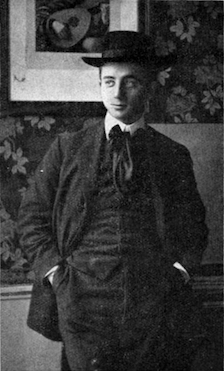
Blokzijl (English Wikipedia entry | Dutch), who had a Jewish grandmother, fought in World War I but had become a war correspondent at Berlin by the end of it, reprising his prewar career.*

From 1918 to 1940 he worked from Germany, and Germany worked on him; in 1935, with National Socialism ascending its zenith in Germany, Blokzijl joined Anton Mussert‘s Dutch knockoff, the Nationaal-Socialistische Beweging party. He also wrote anonymously for the fascist newspaper De Waag.

When Germany occupied the Netherlands in 1940, Blokzijl decloaked as a fascist and accepted a gig as Berlin’s hand for the Dutch press. He was noted for the wartime radio show Brandende kwesties (Burning Issues) which helped make his the calm and measured voice of Dutch national socialism — an identification which soon proved to be a great liability.

The last Nazi redoubts in the Netherlands didn’t surrender until the very end in May, 1945, and that’s when Blokzijl was arrested, too. He stood a half-day trial on September 11, 1945 for his media campaign “aimed at breaking the spiritual resistance of the Dutch people are against the enemy and infidelity of the people to his government and the Allied cause.”

One could argue that the firing squad was a harsh penalty for a guy who had no direct hand in any atrocities. As with the French propagandist Robert Brasillach, the circumstance of facing the nation’s judgment so directly after the war contributed to the severity of Blokzijl’s punishment: indeed, Blokzijl was the very first Dutchman tried for his World War II behavior, which made a death sentence virtually de rigueur. As he wrote to his lawyers in the end, “I fall as the first sacrifice for a political reckoning.”

* One of his prewar careers: he was also a professional singer.

On this day..

1942: The massacre at the Pit

On this date in 1942, the start of Purim,* Nazi forces occupying Minsk massacred approximately 5,000 Jews from the Minsk Ghetto at a site known simply as Yama, “the Pit”.

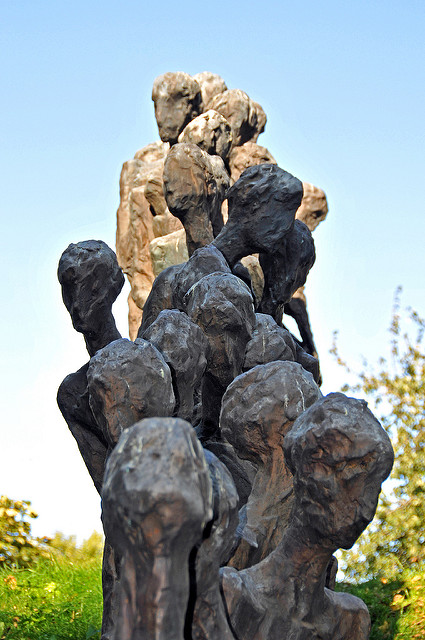
The site, which hosts memorial events every March 2, was marked with a somber obelisk in the immediate postwar years; unusually for a Stalin-era monument, it is overt about the Jewish character of the victims — for Soviet propaganda often obfuscated this with a technically-correct formulation such as “Russian citizens”. In this case, the 1940s memorial obelisk remarkably had a Yiddish inscription to mirror its Russian one. (The sculpture of a column of faceless people tragically descending the slope into the pit was added in the post-Soviet period.)


All images (cc) Dennis Jarvis.

Minsk’s pre-war Jewish population of more than 50,000 was almost entirely annihilated during World War II.

* It was not the only place in the Reich’s occupation to mark Purim with blood.

On this day..

1944: Missak Manouchian and 21 French Resistance members, l’Affiche Rouge

On this date in 1944, 22 members of the anti-Nazi French Resistance’s “immigrant movement” Francs-tireurs et partisans – main-d’œuvre immigrée (FTP-MOI) were executed by firing squad on the outskirts of Paris.

Comprised of foreign communists whose backgrounds amply motivated them to desperate resistance, FTP-MOI was a notably aggressive partisan unit; a few months before this date’s executions, it had stunningly assassinated SS Col. Julius Ritter on the streets of Paris. Risky tactics, including larger-scale operations like the one that claimed Ritter (these required more partisans to know each other) entailed greater risk of penetration, and the November 1943 arrest of the Armenian commander Missak Manouchian and his group devastated FTP-MOI. After the customary interlude of torture, these were subjected to a show trial with 23 condemned to execution.*

As a gaggle of foreign terrorists, heavily Semitic, this clique looked to the occupation like a marvelous tar with which to blacken the Resistance. To that end the Germans produced a scarlet poster denouncing the Resistance as an “Army of Crime,” its soldiery labeled with strange names and alien nationalities converging on the swarthy Manouchian.**

Soon known as l’Affiche Rouge, the poster instead apotheosized its subjects. In the postwar period it became an emblem of the best of the Resistance — its multinational unity, France as an idea powerful enough that men and women of distant birth would give their lives for her. (Not to mention the postwar French Communists’ claim on le parti des fusillés.)

To this day in France, the backfiring propaganda sheet is one of the best-recognized artifacts of the Resistance.

The executions were naturally conducted quietly; the Germans strictly forbade public access to or photography of Resistance heroes in their martyrdoms for obvious reasons.

That made it especially surprising when a few pictures of this execution surfaced recently, surreptitiously snapped from an overlooking vantage by German motorbike officer Clemens Rüter, who kept them hidden for decades. They are to date the only known World War II photos of French Resistance members being executed.

* The 23rd, and the only woman in the group, was Romanian Olga Bancic, also known by the nom de guerre Pierrette; she was not shot on this date but deported to Stuttgart and beheaded there on May 10, 1944. There was also a 24th, a man named Migatulski, who was initially part of the same trial; he was instead remanded to French custody. (See coverage in the collaborationist La Matin from Feb. 19, 1944 and Feb. 22, 1944.)

** We’ve noted before that a Polish Jew named Joseph Epstein who was part of the same cell (and a prime candidate for racist demagoguing) avoided a place on l’Affiche Rouge thanks to his preternatural talent for remaining mum under interrogation.

On this day..

1943: Dora Gerson, cabaret singer

Jewish cabaret singer and silent film actress Dora Gerson was gassed with her family at Auschwitz on this date in 1943.

IMDB credits the Berlin entertainer (English Wikipedia entry | the more detailed German) with two silver screen roles,* both in 1920 and both now believed lost.**

Gerson’s cabaret career was the more robust through the roaring twenties but with benefit of retrospection we admit with Liza Minelli that from cradle to tomb, it isn’t that long a stay.

And the ominous next act would not belong to Weimar Jews.

After being elbowed off German stages by Reich race laws, Gerson recorded several songs in German and Yiddish; her “Vorbei” (“Beyond Recall”) hauntingly commemorates the lost world before fascism — “They’re gone beyond recall / A final glance, a last kiss / And then it’s all over.”

Gerson fled Nazi Germany to the Netherlands; once that country fell under its own harrowing wartime occupation, she tried to escape with her family to neutral Switzerland but was seized transiting Vichy France. Gerson, her second husband Max Sluizer, and their two young children Miriam (age 5) and Abel (age 2) were all deported to Auschwitz and gassed on arrival on Valentine’s Day 1943.

* Her first marriage was to film director Veit Harlan, who would later direct the notorious anti-Semitic propaganda film Jud Süß — based on an executed Jewish financier. From the German-occupied Netherlands, Gerson unsuccessfully appealed to this powerful ex for protection.

** Future horror maven Bela Lugosi also appeared in both Gerson films, Caravan of Death and On the Brink of Paradise. Gerson’s German Wikipedia page also identifies her as the voice of the evil queen in the 1938 German-language dub of Disney’s Snow White and the Seven Dwarves.

On this day..

1943: The five martyrs of the lycee Buffon

On this date in 1943, Nazi guns immortalized five student martyrs of the French Resistance.

The Five Martyrs of the lycee Buffon were Parisian high school students who greeted the fascist occupation of their republic with every form of opposition they could command.

Jean-Marie Arthus (“Marchand” by his nom de guerre), Jacques Baudry (“Andre”), Pierre Benoit (“Francis”), Pierre Grelot (“Paul”) and Lucien Legros (“Jeannot”)* started small with subversive pamphleting and placarding but soon moved on to sabotage and armed opposition in affiliation with the Francs-Tireurs et Partisans.

The arrest of one of their teachers, Raymond Burgard, in 1942 spurred them to lead a student demonstration whose mass arrest they barely escaped. By that time their identities were known, and the boys had to go underground; for their remaining months at liberty they lived on the run and participated in occasional (albeit not very damaging) armed attacks on occupying forces — until that summer, when French intelligence arrested Arthus, Baudry, Grelot and Legros, and French police later caught Benoit.

All five were handed off by their collaborationist countrymen to the eager claws of the Germans, who condemned them as terrorists at a military trial.

A number of public places in France honor their memory, like the 14th arrondissement’s Place des Cinq-Martyrs-du-Lycée-Buffon. Their touching and determinedly optimistic last letters to their families can be read at the Cinq martyrsFrench Wikipedia page.

* A sixth school chum, Michel Agnellet, could easily have joined them at the execution posts and in the martyrologies, but the five who were captured did not permit their interrogators to extract his name.

On this day..

1940: Peter Barnes and James McCormack, the last IRA men hanged

“The two that swung in Birmingham, with ordered step
From off the gallows floor.”

Brendan Behan

On February 7, 1940 — Ash Wednesday, as it happened to be — Peter Barnes and James McCormack became the last Irish Republican Army men executed by the British

They were condemned by the outraged British after a then-shocking terrorist bombing that has largely vanished from the historical memory, subsumed by the simultaneous outbreak of World War II.

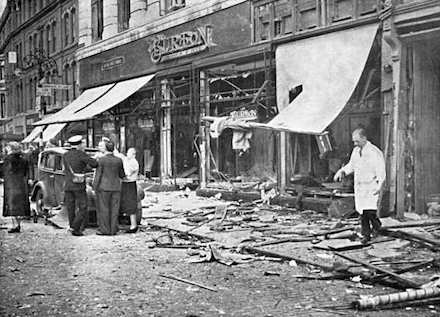
Although it was neither the first nor the last strike in the 1939-1940 campaign of Irish Republican attacks on English soil aimed at forcing London to relinquish control of Northern Ireland, the five-pound bicycle-mounted bomb that ripped apart Broadgate on August 25, 1939, might have been the one that most hardened British hearts against the authors.* Five people were killed in the explosion and some 70 injured; the scene resembled a war zone.**

The resulting investigation — explored in great detail here — never laid hands on the man who actually planted this bomb, eventually revealed to be Joby O’Sullivan.

Many years later and near his death, O’Sullivan claimed that the bomb was supposed to be parked at the Coventry police station; other reports have it destined for an electrical station, and the decision to abandon the ticking bicycle in a crowded street a freelance cock-up by O’Sullivan. Maybe. What is known is that on August 24, London police had busted an IRA plot to place explosives at Westminster Abbey, Scotland Yard, and the Bank of England — all timed to explode at the very same moment as the Coventry package, 2:30 the next afternoon. Had that coordinated fourfold bombing occurred, it would have rated one of the bloodiest and most spectacular terrorist events in history.

But the single blast that did take place was more than enough to bring down the crown’s fury.

Five faced trial for their lives, even though no hand among them had actually set the Coventry bomb. In Ireland and many other places, this latter stipulation made the entire affair an outrageous injustice, especially if one takes as a given that the bomb was not meant to hit civilians. We leave that interesting question of justice to the reader’s consideration, but it must be understood that our hanged men were certainly party to the IRA’s bombing project. The accused, for a trial that December, were:

  • Barnes, an IRA operative in London who had delivered bomb components to Coventry
  • McCormack, part of an IRA cell in Coventry who had rented the house where the bomb was constructed
  • Joseph and Mary Hewitt, and Mary’s mother Brigid O’Hara, Irish immigrants who had taken on McCormack as a lodger

Little evidence could be produced against Hewitt family, who appeared to be quite innocent of their tenant’s intentions. The latter three were cleared of all charges, and then vengefully deported.

McCormack kept stoically silent during the trial, rising only at his sentencing to announce “that the part I took in these explosions since I came to England I have done for a just cause. As a soldier of the Irish Republican Army I am not afraid to die, as I am doing it for a just cause. I say in conclusion, God bless Ireland and God bless the men who have fought and died for her.”

Barnes, whose role on the far end of the supply was even more remote from the final detonation, said as he would maintain to the end, “I am innocent and later I am sure it will all come out that I had neither hand, act or part in it.”

The pair hanged together in Birmingham’s Winson Green Prison. The return of Barnes and McCormack’s remains from that gaol’s unmourned yards to Irish soil soon became a running national demand; the remains were finally repatriated (to great fanfare) in 1969.

Amid the patriotic encomia, civil war veteran Jimmy Steele gave an address on the occasion of the republicans’ reburial critical of the Sinn Fein leadership — an address that is often considered a milepost en route to the imminent (December 1969) splitting-away of the Provisional IRA.

* And in a less justifiable expression, against the Irish generally; Coventry’s Irish immigrant populace faced an immediate racist backlash.

** A chilling preview, for the next year Coventry was devastated by German planes — one of the cities hardest hit by the Reich’s bombing campaign.

On this day..