1945: An unfortunate woman, name and nationality unknown


AP caption: “The expression on the face of this Hun posing for the camera standing by the gallows from which a woman is hanging, Jan. 3, 1945 shows a lack of concern. The name and nationality of the unfortunate woman is unknown. One of the many victims of Nazi terror. The German soldiers seem to be quite used to this kind of sights for them a picture like this is just a souvenir.” (Via)

On this day..

1949: John Wilson and Benjamin Roberts, Syd Dernley’s first(s)

On this date in 1949, two young miners from northern England were hanged together at Durham prison for unrelated crimes of passion: one had ravaged and strangled another man’s wife when his attempts to seduce her were met with a demand for money; the other had murdered a local girl (and then botched his suicide) when he found himself on the third point of a love triangle.

Both crimes happened on the same weekend, just a few miles apart — so they were tried at the same assizes and advanced through the process from murder to hanging-date together. Double executions were already quite rare at this point: this date’s affair was among the last such events in UK history.*

However, it was the very first execution in which Syd Dernley participated.

Dernley was an assistant executioner for 20-odd hangings, and while he’s far from the most noteworthy man to tread the scaffold, his 1989-90 The Hangman’s Tale: Memoirs of a Public Executioner might interest the person who takes up the pen for a labor history of the modern death penalty.

Dernley, a Nottinghamshire pit welder by day, gives an inside look at the recruitment process and on-the-job operations for a minor-league hangman. Bored with his job, he wrote the Prison Commission cold in January 1947 offering his services (“I feel sure that I could do the job”), got a generic polite dismissal, and then was one of several rookie volunteers summoned in October 1948 for a training course — a rationalization of the qualification process to go with the rationalization of hangings themselves.

Dernley had to wait a full year and then some to actually get into the act.** The basic hanging protocol featured a lead executioner and an assistant who would together escort their man to the gallows platform and perform the hanging; since this was a double execution, there are two such pairs involved. Dernley here is the assistant of veteran hangman Steve Wade. The other pair has Henry Kirk as the lead hangman, assisted by Harry Allen.†

Britain didn’t have the volume of executions for anyone to be a full-time hangman, although some hangmen, like Kirk, were also prison officers.

Jobs were farmed out by the Prison Commission among its small roster of active executioners, and would begin for the hangman with the receipt of a package from the Commission with two copies of a Memorandum of Conditions for executioners’ employment — one for the executioner’s records, and one to return to the Commission when formally accepting the assignment.

The day before the hanging, the executioners traveled to the prison where the sentence was to be carried out. The hanging team would not leave the prison’s walls until the execution was complete: after their prep work on execution’s eve, they slept in the jail.

Although prisoners rarely realized this until the last moment, the gallows platform stood just steps outside the condemned cells, the better for the instant performance of the actual hanging. They waited until Wilson and Roberts were safely out of earshot at chapel or in the exercise yard to set up the ropes.

The lead executioner Wade “controlled and double-checked everything from the moment he opened the execution boxes and took out the three ropes. He examined each of them minutely before rejecting one of them which was immediately coiled up and returned to the box. He measured the drop along the rope and marked it with chalk. I was allowed to shackle the rope to one of the chains hanging down from the beam and I had to go up the steps to adjust the chain as we got the chalk mark to the height of the man’s head, but [Wade] went up the steps to check both the shackling and the chain when I had finished.”

Once both ropes had been prepped, they noosed two sandbags approximating the respective weights of the prisoners, summoned the prison governor, and performed an actual test hanging. Everything went off without a hitch.

They dined that night, and breakfasted the next morning, on prison mash — it was invariably eggs and bacon for breakfast, Dernley remembered later in his career. After stealing silently back into the execution chamber, practically in the shadow of the last devotions of their unwitting prey, they repositioned the ropes which had been (intentionally) stretched out by half an inch from being left dangling their sandbags overnight. The ropes, and their supporting chains, needed to be positioned such that the noose dangled at convenient head height — again, the efficiency of the actual hanging was paramount — and so that, when the trap was released, the rope provided a drop of the precise length necessary to break the neck.

The next forty-five minutes as we waited in our quarters for the call were about the worst of my life. Everything that needed to be said had been said and it was clearly no time for social chit-chat, so we sat there and waited. There was fear afoot in the prison; you could almost smell it. The whole place was silent, waiting.

The butterflies in my stomach, which had disappeared when we went to the execution chamber and had something to do, were back with a vengeance. A jumble of thoughts flitted through my mind. Questions: Would we do a good job? Would I put up a good showing? Would we be quick? There were fears too: Will he fight? How will I handle it if he does?

The door opened and a warder took a step into the room. Wade got to his feet. “It’s time,” he said simply. “Are you ready?” I nodded. I don’t think I could have said anything. Kirky looked across at me and smiled. “Make it a good job, young ‘un,” he said quietly.

In those last few moments I was most conscious of faces, faces turned towards us … screws standing quite still at strategic points, all staring at us … the people standing near the doors of the condemned cells watching us approach … the faces of the official party as they glanced over their shoulders … but above all the face of the clock hanging on the wall at the end of the wing. It was a gigantic thing, about three feet across, and the minute hand was now just a fraction away from nine o’clock.

We were halfway to the condemned cells when the silence was broken and my blood froze. The sound was faint to begin with but it rapidly swelled — singing!

I could not believe my ears. “Jesu … lover … of my soul,” croaked the quavering voice.

Another stronger voice joined in: “Let me to thy bosom fly.”

“Who the hell is that?” I asked one of the screws who was walking along beside me.

He looked shattered but he was not going to admit it. “It’s one of them you’re going to top in a minute,” he replied, trying to sound cool.

With that eerie sound ringing round the wing, we arrived outside the condemned cells. The singing was coming from number two cell, and for the next thirty seconds we stood listening to the doomed man and his priest singing in harmony. In other circumstances it might have been lovely. Here, now, it was weird and unreal.

Everyone was in position as the hands of the huge clock moved the last fraction of an inch to nine o’clock: Wade and I outside the number one cell; Harry and Kirky a few steps away across the landing outside the number two cell …

From the instant the cell door cracked open, the prisoner should have just a few seconds left to live — although the prisoner wouldn’t realize that fact since his guards were under strict orders to brush off the doomed fellow’s inevitable questions about procedure. The two executioners would walk to the center of the cell, stand the prisoner up, and each taking an arm, efficiently pinion them behind his back. Then they whisked him out a secondary door which opened directly to the execution chamber, where they’d glide right into the waiting head-height noose. The name of the game for the hangmen was calm and firmness: don’t scare the man unnecessarily, just enter with professional inevitability and have the man on his noose in less time than it would take him to find the wit for panic or swoon or fight.

The double job complicated matters, but only slightly. The plan was for Wade and Dernley to enter cell number one only moments before Kirky and Allen entered cell number two. That way, both Wilson and Roberts would enter the scaffold singly and the respective hanging teams wouldn’t be in one another’s way — but it would only entail an extra second or two on the traps for the dead men as they were positioned in rapid sequence. It didn’t quite work out that way.

Wade moved straight through the door and I followed him into the cell. It seemed quite crowded with the two warders backing clear and the white-faced priest sitting on the other side of the table looking up at us. The condemned man was positioned as per the book, sitting at the table with his back to the door.

By the time I got to him, he was on his feet and Wade was bringing his left arm behind his back. There was no resistance as I caught hold of his right arm. He just let me bring it behind his back and Wade was waiting for it.

Things were moving incredibly quickly, there was hardly time to take anything in. Wade was walking through the yellow doors. Our man had turned to watch him but had not moved so I just put my hand on his shoulder and, with only the gentlest of pressure, he started to follow. A warder either side of him, we walked through and on to the trap. Wade stopped him and I slipped the legstrap out of my pocket, bobbed down and fastened it round his ankles.‡ I doubt I had ever done it so quickly but by the time I stood up and took a pace off the trap, Wade had finished and the man was standing with his head hidden under the bag and the noose round his neck.

Just the way they drew it up … except the Kirky-Allen team was nowhere to be found.

They should have been on the trap by now and there was no sign of them!

They were having some sort of trouble, but what? As the seconds ticked away, I strained to hear what was going on, but there was not a sound coming from the other side of the landing. That at least was reassuring because whatever was going wrong it was not some massive fight. We would have heard that.

I looked around the cell. Wade was staring through the open door, brow creased in a frown, with wide, worried eyes. By God, he looked worried. The governor and the under-sheriff looked as white as a pair of sheets.

In the centre of all this, the hooded and noosed figure of our man — who should have been dead by now — stood waiting patiently without a sound.

I looked back through the door. Still nothing. I felt so helpless; I wanted to run through and help or do something, but I knew I had to stand just where I was.

A double hanging should take around fifteen seconds from start to finish; we had now been standing with our man ready to go for at least forty-five seconds, although it felt like hours.

A sound to my right brought my eyes back from the door into the execution chamber. One of the screws seemed about to take a pace towards our man, a look almost of horror on his face. The hooded figure was starting to sway. He was going to faint!

At that moment Kirky rushed through the door followed by the lover and Harry. Kirky, looking red-faced and flustered, immediately peeled off to the left and Wade in a blur of motion was stopping the man on the chalk T. In what seemed almost one motion, he whipped the white hood over the man’s head and flicked the noose on. I didn’t even see Harry get the legstrap on before Wade was hurling himself off the trap. The lever went over and away the whole lot went with that massive boom.

Allen later told Dernley that their man, the singing one, “just wasn’t ready” and while he didn’t fight the executioners he also didn’t comply with them as they tried to get his arms into their straps. “In the end we just had to force him.”

His nerves none the worse for the off-script debut, Dernley would remain an assistant executioner — he was never the head man — until another one of his hobbies came embarrassingly to light.


From the April 28, 1954 London Times.

Dernley published his book in 1989, by which time the British hangman was almost as archaic as the smut bust. (The poor lech died in 1994, just short of the Internet revolution.) But Dernley, unlike Pierrepoint, never evinced any second thoughts about his career on the gallows and had an unabashed pro-capital punishment position.§

“I have no regrets about what I did and I sleep pretty soundly in my bed,” he sums up. “I do not believe that my career as a hangman has had any ill-effect on me. Not that you ever get away from it so far as people are concerned — once a hangman always a hangman, it seems. Even after all these years I am still pointed out to people and I have a little chuckle to myself when I find somebody in a pub staring at me in that familiar way and I wonder who has been talking to them.” The inference from his lines, and the photos of Dernley jovially showing off his private model gallows, is that the old hangman made it a point to keep the talk going.

* Per the extremely useful Capital Punishment UK page, there was a double execution in 1950, another in 1951, another in 1952, and the last in 1954.

** Dernley did avail himself of an opportunity to witness personally the March 29, 1949, hanging of James Farrell.

† A man named Harry Allen, from Manchester, would one day be dignified Britain’s Last Executioner. In the 1960s, Allen literally did conduct one of the two simultaneous last hangings in England, as well as the last in Scotland and the last in Northern Ireland. However, Dernley’s counterpart in this execution is a different Harry (Herbert) Allen, from Birmingham.

‡ “As assistant your job will be to strap [the prisoner’s] ankles and get yourself off the trap; the number one will do everything else,” Dernley had been told at his training the year before. “If you’re still mucking about when he’s ready, the number one will tap you on the shoulder and then you don’t bugger about … you get off or go down — and it’s a nasty drop even if you haven’t got a rope round your neck.”

§ Dernley was Pierrepoint’s assistant for the hanging of Timothy Evans, for a murder that, three years later, would be imputed to a serial killer living in his building. Dernley’s autobiography credulously backs the government’s whitewash conclusion that Evans was probably guilty too, citing the weak grounds that Evans failed to declare his innocence at his hanging.

On this day..

1948: Hans Karl Möser, for rocketry

In 1943, punishing Allied bombing had chased Germany’s brilliant rocket scientist Wernher von Braun and his team away from the Baltic port of Peenemünde where their pioneering work on the V-2 rocket had taken such a heavy toll on London.

Casting about the Third Reich for a suitable spot to base the missile team, the rocketeers settled on the Kohnstein, a hill in Thuringia already hollowed out by gypsum mines. This tunnel network was readily adapted into a subterranean munitions factory called Mittelwerk — difficult for the Allies to find, and once they found it, difficult to bomb.


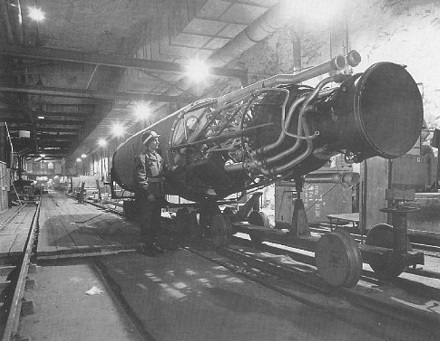
A U.S. Army soldier poses with a half-assembled V-2, one of about 250 such rockets found in the Mittelwerk labyrinth when the facility was captured.

With the facilities and the big brains in place, only one thing was missing: millions of man-hours of labor.

Nazi Germany had that in plentiful supply.

Beginning in late 1943, concentration camp inmates at Buchenwald began to be funneled out to a new facility, Mittelbau-Dora. Initially just a Buchenwald sub-camp, Dora grew over the course of 1944 into an immense facility holding 50,000 prisoners — a handful of German undesirables, but mostly captured foreign nationals: French, Dutch, Polish, Czech, and Russian. Short of food, sleep, and clothing for the 1944-1945 German winter, they were systematically worked to death in the Mittelwerk shafts to build a better bomb.

Our day’s principal, Hans Möser/Moeser (English Wikipedia entry | German) was an SS-Obersturmführer who made a living throughout the war years pulling guard detail in a number of concentration camps.

On May 1, 1944, Möser was transferred from Auschwitz to Mittelbau-Dora. It was the last job he would ever hold, but were Möser on the market today his C.V. would laud his team-player orientation and project management skills on a high-priority initiative. No doubt he was just the sort of reliable agent who understands how things are done that the world’s mad bombers need at their back.

“Ninety percent of the prisoners lived and worked in the tunnel of the mine,” testified one German who worked at Dora as a secretary and doctor’s aide.

As a result of the uninterrupted work in the mines and the absence of any installation for forced draft and ventilation, there prevailed a stuffy cold atmosphere, which made breathing difficult. The prisoners also slept in the subterranean tunnel in big chambers hewed out of the rocks, in five beds on top of each other. Already in 1944 3,500 prisoners used to sleep in such a room. In the tunnel of the mine there was no ater, the prisoners got absolutely insufficient quantities of tea for drinking purposes. But for weeks they were not able to wash themselves. As a result of the heavy work in the mines and of the bad food numerous prisoners died from exhaustion during their work.

According to that same testimony, the camp received a frightful order on Good Friday, which fell on March 30 in 1945: drive every last prisoner into those tunnels and bring down the caves around them. “No prisoner should be allowed to fall into Allied hands alive.”

The speedy arrival of the American 3rd Armored Division and 104th Infantry Division just days later prevented that order from taking effect.

The facilities themselves, too, were to be destroyed as part of Hitler’s scorched-earth “Nero Decree” intended to deny the benefit of German industry and infrastructure to the arriving conquerors. But Hitler’s War Production Minister Albert Speer was intentionally ignoring that order, a decision that might well have helped him avoid hanging at the Nuremberg trials.

Mittelwerk was a valuable capture indeed for the Allies. The Americans who first occupied it, and then the Russians who took it over a few months later, ransacked it for parts and technical specifications. The V-2 was the first man-made object to reach space, blasting at the speed of sound to the edge of orbit before plummeting back with its payload into the heart of London or wherever. It’s the ancestor of the long-range, intercontinental ballistic missiles that would come later, as well as the space programs of the countries who could build such missiles.

And of course, it wasn’t just the parts.

Wernher von Braun himself was the top prize of all — the young genius (he was just 33 when World War II ended) with the weapons of the future in his skull. As Germany collapsed in 1945, von Braun and his team of engineers had resolved to surrender themselves to the Americans rather than the Russians, but they too were subject to an order given the SS to execute the scientists if their capture appeared imminent. The Fuhrerbunker knew as well as the Allies how valuable this asset was.

In the event, von Braun managed to give himself up to a surprised American private. He disappeared into American custody, the crown jewel of “Operation Paperclip” that grabbed some 1,500 scientists from Germany and helpfully whitewashed their past misdeeds — misdeeds like Nazi party affiliation, and participating in slave labor camps.

Firing guided rockets into space was one thing. Unfortunately for our man Möser, his own skill set of bullying subordinates was not in short supply for either of the Cold War antagonists.

Möser was the one defendant (among 15) condemned to death at the resulting trial of Dora camp personnel. Rocket scientists, naturally, were not present for the occasion; Wernher von Braun and his team were hard at work at this time at Fort Bliss, Texas adapting the V-2 to the American Hermes program.

But at Dora, it had been Möser’s job to oversee camp discipline and labor strength for the slaves doing the grunt work manufacturing von Braun’s brainchild. Testimony convinced the court that the SS man had done this far too brutally, and perhaps with sadistic pleasure.

Several witnesses testified Möser frequently beat prisoners and participated in executions, often shooting at the men who were hanged for camp infractions — while they were hanging, or after they were taken off the gallows. (And of the latter, some already dead and some still alive.) “The accused told the twelfth witness that it was a pleasure to give the mercy shots, like shooting a deer.”

Möser for his part countered that he took no joy himself in the beatings and killings that he had to conduct as part of his job — and that the camp commandant had early on reprimanded him for leniency, threatening that “in view of the importance of the V-weapons operation, this could be interpreted as sabotage because it reduced the work efficiency.” How’s that for a hostile work environment?

(There’s a large .pdf of the entire trial summary here. Möser’s section begins on page 36 of the pdf (page 68 per the numbering in the scanned book pages).)

His presence on this here site betrays the outcome. On this date in 1948, Hans Möser was hanged at Landsberg Prison along with several other (unrelated) convicted war criminals.

On this day..

1947: Gyorgy Donath, Hungarian anti-communist

On this date in 1947, Hungarian politician Gyorgy Donath was executed for treason as the Hungarian state came into the hands of the Communists.


Gyorgy Donath awaits hanging in the courtyard of a Budapest prison on October 23, 1947. (Source)

Donath (Hungarian Wikipedia link) stood among the ranks of Eastern European politicians purged by Soviet-directed Communist parties behind the Iron Curtain in the first years of the Cold War — years when Stalin still called the shots for the Communist bloc.

Donath had been a wartime parliamentarian under the banner of Bela Imredy‘s right-wing Party of Hungarian Life.

Had Hungary’s postwar direction been determined by orderly ballot-boxing rather than great power machinations, Donath would have had a voice in it — for it was a conservative party, the Independent Smallholders Party, who won a big hold on government with 57% of the votes in the 1945 elections.

Though the Communists polled just 17% (with a similar tally for the Social Democrats), the General Secretary of the postwar party, Matyas Rakosi,* predicted that the putative defeat would “not play an important role in Communist plans.” And he was right.

Rakosi named his policy in response to the Smallholders “salami tactics” — as in slicing down the opposition piece by piece.

1947 was the knife’s edge.

From their post within the ensuing governing coalition — an outsized foothold relative to their electoral returns, as compelled by the presence of the still-occupying Red Army — the minority Communists in January 1947 announced the discovery of a conspiracy of “small agrarians,” and set about reducing the Smallholders and allies through a series of police raids and show trials.** Donath’s prominence in an irredentist fraternity, the Hungarian Community organization, was denounced the ringleader of the treasonable conspiracy.

He was hanged on October 23 — just eight weeks after a heavily rigged 1947 election put Hungary formally into the Communist camp.

Over the subsequent two years, independent and opposition parties were generally reduced to irrelevance, forced to take the Communist line, or dissolved entirely.

* Rakosi was the man whom Imre Nagy would eventually displace. The more moderate Nagy willingly swept himself up in Hungary’s abortive 1956 revolution against Communist domination. Soviet tanks crushed that revolution; Nagy hanged.

** In neighboring Romania and Bulgaria, similar tragedies were unfolding.

On this day..

1943: Antoni Areny, the last executed in Andorra

For murdering his two brothers, Antoni Areny was executed on this date in 1943 in Andorra — that country’s first and only execution since the 19th century.

The tiny Pyrenees principality, neutral in the continental war raging at that time, had many years before followed its neighbor Spain in adopting the garrote as its execution method. But the method being so long out of practice no satisfactory garrote executioner could be found to administer the punishment, so Areny was instead put to death by firing squad.

Andorra has the incidental distinction of being the last country in the world officially to discard the garrote as an execution method — in 1990, when Andoraa abolished the death penalty full stop.


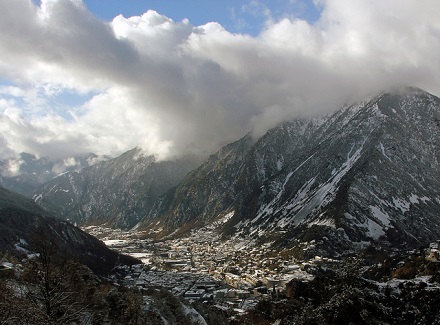
Andorra’s capital city Andorra la Vella. (cc) image from Isaac Torrontera.

On this day..

1942: Coastwatchers on Tarawa

On this date in 1942, the Japanese military occupying the atoll of Tarawa beheaded 17 New Zealand Coastwatchers, along with five civilians.

Tarawa, a fishhook-shaped atoll that belongs to the Republic of Kiribati, was one of many specks of South Pacific land to which Australia and New Zealand deployed World War II Coastwatchers.

These small teams of mixed civilian and service personnel, as well as locals, kept up 24-hour watch for Japanese naval movements.* The tips provided by coastwatchers in the Solomon Islands during the Guadalcanal campaign led Vice Admiral William Halsey to exclaim that “the coastwatchers saved Guadalcanal, and Guadalcanal saved the Pacific.”

But their lonely forward positions also potentially exposed coastwatchers to considerable danger.

Even as Guadalcanal was unfolding in August and September in 1942, Japan was fortifying the occupied Gilbert Islands** (present-day Kiribati) in the wake of the Makin Island raid. Seventeen coastwatchers in the Gilberts were swept up in the process, and transferred to Tarawa along with five civilians (three British, one Australian, and one New Zealander). There they were held at the atoll’s old lunatic asylum, on the islet of Betio.

On Oct. 15, Allied planes bombed Tarawa. One of the captives got loose and ran onto the beach, frantically trying to signal the bombers. Instead, the Japanese — who fretted prisoners on their occupied islands becoming a fifth column in the event of an attack — summarily executed not only the signaler but all their captives.

“I saw the Europeans sitting in line,” one Tarawa local remembered later.

One Japanese started to kill the Europeans. He cut off the head of the first European, then the second, then the third, then I did not see any more because I fainted. When I came to, I saw the Japanese carrying the dead bodies to two pits.

In November 1943, a U.S. amphibious invasion took back the island at the bloody Battle of Tarawa. Twelve hundred Americans, and several times that many of the island’s Japanese defenders and Korean war slaves, were slain.

Old gun emplacements from that battle — as well as a monument to the New Zealand coastwatchers — can still be found on Tarawa.†

Catch these sights while they last. The average height above sea level for Kiribati is two meters, making global climate change liable to send the nation’s scattered islands to Atlantis. Kiribati residents have already begun turning up in Australia and New Zealand as climate change refugees.

* When the occasion arose, coastwatchers also rescued stranded Allied servicemen. After LTJG John F. Kennedy’s torpedo boat was rammed by a Japanese aircraft carrier in August 1942, it was a pair of Solomon Island natives dispatched by an Australian coastwatcher who found the future U.S. President and his surviving crew.

** Seven other coastwatchers besides those beheaded this date had been captured in the Gilberts when Japan first (but lightly) occupied it following Pearl Harbor. They survived the war as POWs in mainland Japan.

† There was a monument to the dead coastwatchers from shortly after the war. The remains of the seventeen, however, were long neglected by the New Zealand government, and have only recently been turned up … by Americans scouring Betio for casualties from the Battle of Tarawa.

On this day..

1944: A Dutch Kapo named Raphaelson

(Thanks to Meaghan Good of the Charley Project for the guest post. -ed.)

On an unspecified Saturday afternoon in September 1944, a Dutch Jew was hanged before a crowd of thousands in Blechhammer, a Nazi forced-labor camp that was a subcamp of Monowitz, which was in turn a subcamp of Auschwitz.

Witness Israel J. Rosengarten, describing the event forty-five years later, identified the executed man as “Raphaelson” and described him as “about twenty-four years old … a very capable carpenter.”

Yad Vashem’s Central Database of Shoah Victims’ Names includes an entry for a Rudolf Israel Raphaelsohn that seems to fit: he was born in Berlin in 1922, spent the war in the Netherlands, and perished in Blechhammer in 1944. His individual page of testimony describes his occupation as “sawmill owner.” This is probably, but not definitely, our man.

Rosengarten wrote about Raphaelson’s execution in his book Survival: The Story of a Sixteen-Year-Old Jewish Boy, published in 1999. According to him, Raphaelson was a Kapo, meaning he had certain privileges and a position of leadership over other Jews in the camp, sort of like a prison trusty.

He met his death through sheer bad luck.

By 1944, Blechhammer was being bombed by the Americans on a regular basis. As Rosengarten records,

Book CoverThis Kapo had seen a bomb lying on the ground, which had not exploded. It was split open, but the mechanism had not detonated. The Kapo saw a yellow powder lying in the middle of the split bomb. He obviously did not realize it was dynamite. Because we had no washing powder in the camp, he got the idea of smuggling some of that yellow powder into the camp in a parcel to see if it could be used as a washing powder.

While he was busy taking the powder in, he was caught by an SS man. He was whipped until he fell down. Next, when he came into the camp he was sent to the Politische Abteilung. The SS of the political department drew up a protocol in which it was stated that Raphaelson … had “plundered” the dynamite and that he had done it with the intention of committing “sabotage.” His deed was stamped as a “terror against the Third Reich.” Raphaelson was then forced to sign the statement.

And then … the SS let him go.

He was not relieved of his position as Kapo. He was not transferred to a punishment detail. A whole four weeks passed by and the incident was never mentioned, and the inmates, who had enough to worry about in their difficult day-to-day existence, forgot all about it.

Raphaelson’s execution took everyone completely by surprise. Everyone came back to camp after a hard day’s work and noticed the SS were all in dress uniform and parading them around as if some important holiday was being celebrated.

The inmates weren’t allowed to go to their barracks as normal. Instead they were assembled in the center of camp, where a gallows had been set up.

It turned out the confession Raphaelson had been signed had been sent all the way up to the leadership of Auschwitz for them to decide what to do about it, and they had taken their time. Only now, a month later, had the SS in Blechhammer gotten their answer, and now the “saboteur” had to pay the price for his “crime.”

“The whole thing,” Rosengarten noted sardonically, “had the appearance of a lawful trial and a truly democratic tribunal.” He happened to be standing in the front row, so had an intimate view of the proceedings:

After a very long wait, the stool was pushed away from under his feet with a firm kick. A panicked chill passed through us as if time were falling away. But then it seemed the rope was not holding. Suddenly, it broke in two. Raphaelson fell unhurt to the ground. Everybody present stood amazed.

We all hoped now that Raphaelson would be given mercy because of that unusual event. But such a thing was, of course, unthinkable for the SS. The rope was repaired and once again the boy was placed on the stool. Again it was kicked away. But the unbelieveable happened again! The rope broke in two a second time!

A sort of providence seemed to have insinuated itself. Everything we saw was so unusual, so unreal! But the Nazis did not give up. For the third time, the Kapo was placed upon the stool, and the noose was put around his neck. Because of what had happened, Raphaelson came more and more to his senses. He seemed to be more clearly aware of what was going on. All of the sudden he yelled, “Friends! Do not lose courage! Those who today want to murder us will themselves soon be kaput!” The two SS who stood next to him could not believe what they were hearing. “Hold your beak, you!” they shouted. Quickly they again kicked the stool away. And then Raphaelson sank down. For a couple of long minutes we had to look him in the eyes. After that, he was no longer among the living.

After Raphaelson finally expired, the six thousand prisoners were required to stand there another fifteen minutes, then march around the scaffold so everyone could see him. “Only after this,” Rosengarten recorded, “were we allowed to crawl quietly and dejectedly to our barracks.”

Israel Rosengarten survived several concentration camps and death marches before he was liberated in Buchenwald on April 11, 1945. By then, he was near death from starvation and exhaustion.

After he recovered his health he went home to Belgium and discovered he was, at eighteen years of age, the sole survivor of his large family.

On this day..

1946: Ernst Lohmeyer, theologian

On this date in 1946, the Soviets occupying East Germany executed Bible scholar Ernst Lohmeyer.

A fifty-five-year-old professor when the NKGB whisked him out of his apartment without explanation to his dumbfounded wife, Lohmeyer (English Wikipedia entry | German) was an important Protestant theologian of the interwar period with a knack for eschewing the opportunistic choice.

By refusing to disavow Jewish associates, his academic career got derailed in the 1930s, despite his producing influential critical commentary on the Gospel of Mark;* by patriotically serving in the Wehrmacht despite his reservations about the Third Reich, he set himself up to profile as an undesirable after World War II.

For a long time, Lohmeyer’s fate was, if not difficult to guess, obscure in its particulars. Not until 1957 was his execution in a forest near Hanshagen officially confirmed; he had been condemned by a military tribunal for participating in the German occupation of Sloviansk even though he wasn’t personally associated with any known atrocities.

The post-Soviet Russian state officially exonerated Lohmeyer in 1996. The University of Greifswald, where Lohmeyer was teaching when arrested, has a theology faculty building named for him.

* Lohmeyer postulated that the Gospel of Mark reflected a contemporary-to-the-evangelist (that is, post-Jesus) conflict between Christian communities in different locales, and that Mark himself was associated with Galilee’s Christians and therefore structured his narrative to exalt this location.

On this day..

1944: Three Soviet infiltrators, the last in Finland

The last executions in Finland occurred on this date in 1944, claiming the lives of three Soviet spies who had been parachuted behind Finnish lines.

I have been unable to locate the names of these men. They’re invariably presented simply in connection with — or as the denouement following — the September 2 execution of Finnish deserter Olavi Laiho.

The next morning (Russian link), Finland announced its disengagement from its problematic German alliance, an arrangement brokered by the western Allies who wanted to keep Finland democratic and non-communist despite sitting in Russia’s back yard and joining the wrong team in World War II. The Soviet Union immediately redeployed its forces away from the Finnish theater; a formal armistice was signed before September was out and prisoner transfers began in October.

Finland abolished the death penalty for all peacetime crimes in 1949, for all crimes full stop in 1972, and wrote the abolition into its constitution in 2000.

On this day..

1944: Olavi Laiho, the last Finn executed in Finland

Olavi Laiho was the last Finn executed in Finland, on September 2, 1944.

Laiho (English Wikipedia entry | Finnish) was conscripted to the Finnish Navy to fight in Finland’s theater of war against the Soviet Union.

As a Communist himself — Laiho had been imprisoned in the 1930s for his labor agitation — Laiho inclined better to the cause of the other side, and fled to the woodlands near Turku where he gathered intelligence to pass to the Soviets and aided other war deserters. He spent the best part of two years winding towards his date with a military police firing detail after being arrested in December 1942.

While Olavi Laiho was the last Finn executed in Finland, on September 2, 1944, a trio of Soviet paratroopers caught behind Finnish lines were shot as spies on September 3, 1944. Those three men are the last ever put to death in Finland.

Laiho doesn’t technically have the distinction of being the last in all of Finnish history, but he’s the one remembered as the milestone moreso than the Russian paratroopers. Laiho is the last one of the Finns’ own, the last who emerges as an individual with a fate that speaks to the fate of his countrymen in those times. “Through Olavi Laiho, we empathize with the with the story of the first half of the 20th century,” this dissertation put it.

Readers with Finnish proficiency might enjoy the Laiho biography En kyyneltä vuodattanut (I Never Shed a Tear).

On this day..