1943: Yitskhok Rudahevski and family

(Thanks to Meaghan Good of the Charley Project for the guest post. -ed.)

Sometime in early October 1943, fifteen-year-old Yitskhok Rudashevski and his entire family were rousted out of their hiding place in the Vilna Ghetto, taken to nearby Ponary, shot to death and buried in a mass grave.

The Rudashevski family were among the last remnants of a once-vibrant Jewish community in the city once known as “the Jerusalem of the north” for its culture and scholarship. People came there from as far away as the United States to study in its highly regarded yeshivas.

After the start of World War II, Vilna was annexed by the Soviet Union. It became a sanctuary to Jews fleeing from the Nazis, who occupied western Poland.

All of that changed on June 22, 1941, when Operation Barbarossa began. On the day Germany invaded the USSR, there were approximately 80,000 Jews living in Vilna, many of them refugees from the Nazi terror. By the time the Red Army arrived and kicked the Nazis out three years later, Vilna’s Jewish population had been reduced –through starvation, disease, deportation and executions — to zero.

Yitskhok (also spelled Yitzhak, Yitzak, etc., or anglicized to Isaac), was thirteen years old at the time his city was occupied by the Germans.

An only child, he was the son of a typesetter and a seamstress. Talented in writing, history and languages, he was also a faithful Communist and a member of the Pioneers, the Communist youth organization.

From June 1941 to April 1943 he kept a diary in Yiddish. Yitskhok had a sense of the significance of his account; at one point he wrote, “I consider that everything must be recorded and noted down, even the most gory, because everything will be taken into account.”

He not only wrote about his own life and his family and friends, but about the wider community events and the devastation the Germans wrought on his people. The historian Allan Gerald Levine called him “an astute and passionate observer of the times,” and compared him to Anne Frank.

Nor was the diary Yitskhok’s only writing project.

When one of his teachers, a beloved figure in the ghetto, died, he wrote a eulogy for the man and read it out before a large audience. He was a member of a literary group and was also attached to the ghetto’s history project, for which he interviewed ghetto residents about their lives:

I got a taste of the historian’s task. I sit at the table and ask questions and record the greatest sufferings with cold objectivity. I write, I probe into details, and I do not realize at all that I am probing into wounds … And this horror, this tragedy is formulated by me … coldly and dryly. I become absorbed in thought, and the words stare out of the paper crimson with blood.

The Vilna Ghetto, whose population initially numbered 40,000, had a rich cultural life, just like prewar Jewish Vilna had. There were theaters, cabarets, the symphony, art exhibits, a library, public lectures, and underground schools for both children and adults.

Vilna Jews saw art, music, literature and the pursuit of knowledge as a form of resistance. As Jacob Gens, head of the “ghetto’s Judenrat, put it, cultural activity gave a person “the opportunity to free himself from the ghetto for a few hours … We are passing through dark and difficult days. Our bodies are in the ghetto, but our spirit has not been enslaved.”

Reality intruded, however, and in the final analysis the Vilna Jews were doomed to extinction.

Yitskhok’s final diary entry was dated April 7, 1943, two days after five thousand Vilna Jews had been rounded up and shot at Ponary. He was understandably in a very grim mood. His prophetic last line was, “We may be fated for the worst.”

On September 23, 1943, the Nazis began the final liquidation of the Vilna Ghetto, which had by then been reduced to about 10,000 people. After a selection, those who could work were sent off to labor camps in Estonia and Latvia, where almost all of them died due to the brutal conditions there.

Children, the elderly, and the sick were shot at Ponary or sent to the extermination camp Sobibor and gassed.

Yitskhok, his parents and his uncle’s family chose to go into hiding rather than take their chances at the selection. In hiding he sank into apathy and said very little. After about two weeks in the hideout, they were discovered and taken to their deaths.

The only surviving member of Yitskhok’s family was his teenage cousin, Sarah “Sore” Voloshin. Somewhere on the route to Ponary she was able to escape. She joined a partisan group in the forest and survived until the Red Army liberated the area in the summer of 1944. After the war was over, she returned to the family’s hiding place and found Yitskhok’s diary. As of 2010, Sore Voloshin was still alive in Israel.

And the diary she retrieved had become one of the major sources on day-to-day life in the Vilna Ghetto.
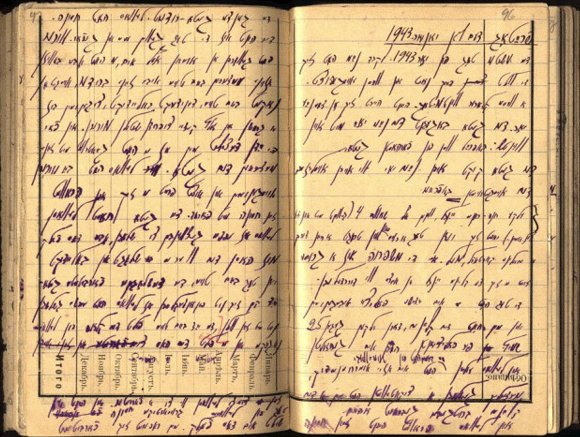
Yitskhok Rudashevski suffered and died in just the same way as hundreds of thousands of others, but unlike them he did not remain anonymous: he is one of the ghetto’s most famous inhabitants. His writings have been published in their original Yiddish and in Hebrew, German and English translations. Extracts of his diary can be found in several anthologies, and it’s available in its entirety under the title The Diary of the Vilna Ghetto.

On this day..

1943: 1,196 Jewish children from Bialystok

(Thanks to Meaghan Good of the Charley Project for the guest post. -ed.)

On this date in 1943, a special transport of 1,196 children and 53 adults arrived at Auschwitz and were gassed shortly thereafter. Thus ended one of the lesser-known tragedies of the Holocaust.

The children were very nearly the last survivors of the Bialystok Ghetto, which had been liquidated in August 1943. Almost all of the inhabitants of the ghetto wound up being sent to the Treblinka Extermination Camp and killed, but over a thousand children were mysteriously separated from their parents and taken away for some as-yet-unknown purpose. (The transport list can be found here.)

At the time, there were tentative negotiations between the Red Cross and the Nazis to trade Jewish children for either German prisoners of war or cold, hard cash. The exact details are unclear, and there’s a great deal of contradictory information about the entire event.

In any case, the Germans selected children from Bialystok, one of the few places in Nazi Europe where there were any Jewish children left alive.

The children, all of them under 16, spoke only Yiddish and Polish. They were in terrible shape, both mentally and physically. One witness later described them:

Suddenly, a column of bedraggled children appeared, hundreds of them … holding each other’s hands. The older ones helped the small ones, their little bodies moving along in the pouring rain. A column of marching ghosts, with wet rags clinging to their emaciated bodies, accompanied by a large number of SS men …

The children, looking like scarecrows, refused to undress. They held on to their dirty clothing, the older stepping in front of the young ones, protecting them with their bodies, clutching their hands and comforting those that were crying. Their clothing permeated with lice, their bodies full of sores, these children refused to wash.

Their first stop was Theresienstadt in Czechoslovakia, the so-called “model ghetto” which was used by the Nazis as a propaganda tool to show that they weren’t mistreating their Jews.

Theresienstadt was in fact a horribly overcrowded, disease-ridden city and its inhabitants were all dying of starvation, but it was the best there was available. There were no gas chambers there, and the Theresienstadters knew nothing about the kinds of horrors the Bialystok children had been through.

To keep knowledge of said horrors from leaking out, once in Theresienstadt the children were placed in isolation and weren’t allowed to leave their barracks. 53 doctors and nurses were recruited from the local population to take care of them, and they were locked up with the children.

In spite of these security measures, some of the adults were able to make contact with people from the outside. Theresienstadt youth leader Fredy Hirsch got caught making an unauthorized visit to the children’s barracks, for example, and as punishment he was sent to Auschwitz on the next train.

A child thought to be Deborah Klementynowska, possibly the only surviving photo of one of these lost Bialystok children.

The adults — one of whom was Franz Kafka‘s sister, Ottilie — didn’t know what to make of the children’s behavior at first.

For instance, why, when they were invited to take a shower, did they start crying and screaming about gas? The children started to talk about their experiences, and their caregivers were horrified by their stories.

The Nazis intended to quite literally fatten up the children before they were sent off into the world, so the group was treated very well. Everyone got enough to eat, and they were given baths, clean clothes, medical treatment and even toys. Anyone who got seriously ill was taken away “to the hospital” and, ahem, never returned.

Slowly, assisted by their kind caregivers, the children got their equilibrium and began to act like normal kids again.

Meanwhile, negotiations continued …

The Allies wanted to send the children to British Mandate Palestine. The Germans, however, were against this plan because they didn’t want the children growing up there, strengthening the Palestinian Jewish community and possibly establishing a Jewish state someday. (The Mufti of Jerusalem, whom the Nazis were quite friendly with, didn’t like the idea either.)

The Germans wanted the children sent to Great Britain instead.

The UK, however, had already accepted many Jewish refugees, including 10,000 German, Austrian and Czech children with the Kindertransport, and were unwilling to take in any more.

And there was another problem, relating to the prospect of exchanging the children for money.

This money would have to be provided by the American Joint Distribution Committee and other Jewish welfare agencies, and they flat-out refused to give anything to the people who had promised to wipe them off the face of the earth.

In the end, the negotiations collapsed, through what one witness later called “an ill-applied sense of ‘correctness'” on the part of the Allies. Of course, given the Nazis’ track record, one wonders if they ever seriously intended to release the children no matter what they were given in return.

The plan was discarded and the Germans were left with 1,196 useless Jewish children on their hands. They dealt with them in the usual manner.

None of the Bialystok group or their caregivers had any idea what was coming up for them when they were sent away from Theresienstadt. They’d been told the negotiations had been successful and they were on their way to Switzerland, and thence to Palestine. They were told to take off their yellow stars and the adults had to sign a statement promising not to say anything bad about the Germans.

The transport set off in high spirits, rejoicing at their upcoming freedom.

But their train went not to Switzerland but to Poland, marked for “special treatment” on arrival at its destination. Apart from a few of the adults who were selected to work, there were no survivors.

On this day..

1942: Henryk Landsberg, Lvov Judenrat

[Adolf Eichmann] did not expect the Jews to share the general enthusiasm over their destruction, but he did expect more than compliance, he expected — and received, to a truly extraordinary degree — their cooperation. This was “of course the very cornerstone” of everything he did … Without Jewish help in administrative and police work — the final rounding up of Jews in Berlin was, as I have mentioned, done entirely by Jewish police — there would have been either complete chaos or an impossibly severe drain on German manpower …

To a Jew this role of the Jewish leaders in the destruction of their own people is undoubtedly the darkest chapter of the whole dark story.

-Hannah Arendt in Eichmann in Jerusalem

Among the many horrors of the Holocaust were the Judenräte, Jewish administrative councils set up under the aegis of Nazi Germany’s occupation of Eastern Europe.

Typically recruited from local elites and granted special privileges by the Germans, these collaborators managed the day-to-day operations of the ghettos, up to and including the horrible sharp end of Final Solution: confiscating Jewish property for the Germans, registering and organizing Jews destined for slave labor or extermination, and even managing deportations with the desperate hope that willingly engaging a sacrifice they could never prevent might enable them to save some others. Once all the deportations were done, the Judenrat itself would be executed or deported: Faust had nothing on this bargain.

Chaim Rumkowski, perhaps the most (in)famous Judenrat administrator, issued posterity the definitive howl of a collaborator’s agony when he was forced by the imminent Lodz Ghetto children’s action to implore Lodz’s families to peaceably surrender their young people to certain death: “I never imagined I would be forced to deliver this sacrifice to the altar with my own hands. In my old age, I must stretch out my hands and beg. Brothers and sisters: Hand them over to me! Fathers and mothers: Give me your children!”

Rumkowski, a deeply checkered figure who fended off liquidation of his ghetto until the very late date of 1944, well knew that Judenrat personnel were entirely disposable. After all, he delivered this plaintive speech on September 4, 1942 — just three days after his counterpart in the Lvov Ghetto had been publicly strung up on a balcony.


Six Jews (including Henryk Landsberg) hanged in the Lvov Ghetto, September 1, 1942 (via). The US Holocaust Memorial Museum also identifies this clearly distinct execution as a picture of Lvov Jewish Council members being hanged in September 1942.

The city of Lwow/Lvov (or to use its present-day Ukrainian spelling, Lviv) had had a centuries-old Jewish population when the Soviet Union seized it from Poland in consequence of the Molotov-Ribbentrop pact. That population almost immediately doubled as Jewish refugees fleeing the half of Poland that Germany got in the deal poured into the city.

Practically on the frontier of the German/Soviet border, Lvov was captured in the opening days of Germany’s June 1941 surprise invasion of the USSR. In November-December 1941, the 100,000-plus Jews* still surviving in Lvov (after several post-conquest massacres) were crammed cheek to jowl into the new Lvov Ghetto. There they endured the usual litany of privations for World War II ghettos: starvation rations, routine humiliation, periodic murders. forced labor at the nearby Janowska concentration camp.

The ghetto’s first chairman, Dr. Josef Parnas, didn’t live to see 1942 before he was killed in prison for non-cooperation. Dr. Adolf Rotfeld followed him, and died of “natural” causes in office a few months later.

Dr. Henryk Landsberg, a lawyer, succeeded Rotfeld. He had been a respected community figure before the war, but was disposable to the Nazis as his predecessors; during a large-scale Aktion to cull the camp and further reduce its boundaries, a Jewish butcher resisting the SS killed one of his persecutors. Landsberg and a number of the Jewish policemen employed by the Judenrat were summarily put to death.

“I have gladly accepted the nomination,” Landsberg’s successor remarked. “Maybe they will shoot me soon.” He was indeed shot (or perhaps committed suicide to avoid that fate) in the first week of January 1943. (All this from Judenrat: The Jewish Councils in Eastern Europe Under Nazi Occupation)

The Lvov Ghetto was liquidated June 1, 1943; a bare handful of its former inmates escaped into the sewers or managed to avoid death in the camps before the war ended. After the Red Army took back the city, a 1945 survey of the Jewish Provisional Committee in Lvov tallied just 823 Jews. Today, there are all of 5,000.

* Among the Lvov Ghetto residents was Simon Wiesenthal.

On this day..

1941: Alexander Svanidze, Stalin’s brother-in-law

On this date in 1941,* Stalin’s own brother-in-law was shot in the gulags.

In 1906, a whole lifetime before, the Georgian Alexander Svanidze introduced young Joseph Dzhugashvili to his, Svanidze’s, sister, Kato. She and Dzhugashvili wed that year, and Kato soon bore her husband’s firstborn, Yakov.

Stalin was already a wanted Bolshevik revolutionary at this time, but so was Svanidze. Kato was a homebody with no known political interest, and sufficient piety to force her communist groom to say his vows in an Orthodox church. Afterwards, his priorities reasserted themselves.

While Stalin agitated, propagandized, and politicked against Menshevism in the wild oil boom city of Baku,** his pretty wife kept an empty apartment tidy and fretted the omnipresent danger of her husband’s arrest. “When he was involved, he forgot everything,” fellow-Bolshevik Mikheil Monoselidze remembered. Many revolutionaries’ wives walked similarly lonely roads.

Kato did not have to walk hers very long: she contracted a horrible stomach/bowel disease and wasted rapidly away late in 1907. Stalin’s own indifference might have been the ultimate cause, for when she was unwell the young cadre took her on a sweltering 13-hour train ride back to Tiflis that greatly worsened her condition — all so that her family could care for her, and free Stalin’s time for his plots. Kato died in Stalin’s arms, but only when he had been urgently summoned back from Baku with word that her condition had become dire.

Whatever his actions said about him as a family man, the future dictator really loved his neglected wife. He “was in such despair that his friends were worried about leaving him with his Mauser,” writes Simon Montefiore in Young Stalin.

“This creature,” [Stalin] gestured at the open coffin [at her funeral], “softened my heart of stone. She died and with her died my last warm feelings for humanity.” He placed his hand over his heart: “It’s all so desolate here, so indescribably desolate.”

At the burial, Soso’s habitual control cracked. He threw himself into the grave with the coffin. The men had to haul him out. Kato was buried — but, just then, revolutionary konspiratsia disrupted family grief. Soso noticed some Okhrana agents sidling towards the funeral. He scarpered towards the back of the graveyard and vaulted over the fence, disappearing from his own wife’s funeral — an ironic comment on his marital negligence.

For two months, Stalin vanishes from the record. “Soso sank into deep grief,” says Monoselidze. “He barely spoke and nobody dared speak to him” … “He cried like a brat, hard as he was.”

Stalin’s deep grief did not change his life’s work. If anything, he would seem in later years almost too aghast by the whole experience (and his uncharacteristic bout of sentiment) to grapple with it. He abandoned little Yakov to the Svanidzes, and would curiously dislike his son so much that he eventually permitted Yakov to die as a German POW during World War II rather than exchange prisoners for his release.

By the time of the great purges, then, being Stalin’s brother-in-law was of little help to Alexander Svanidze. It might have been an outright detriment; certainly Svanidze’s own prominence — he had served as People’s Commissar for Finances of the Georgian SSR, and founded a scholarly journal in his capacity as a historian — were of a kind with Old Bolsheviks who had also attracted denunciations.

In 1937, most of the beloved Kato’s family was arrested: Alexander Svanidze, but also Alexander’s wife Maria, and opera singer, and his sister Mariko. Svanidze defiantly refused NKVD blandishments to confess to spying for Berlin to save himself, perhaps realizing that such a deal would merely sell his pride for a mess of pottage. “Such aristocratic pride!” Stalin is supposed to have tutted upon hearing the way Svanidze went to his execution still insisting he had done nothing wrong. (Svanidze’s ancestors were petty nobility.)

Svanidze’s son, Johnreed† — named for the American radical who chronicled the Bolshevik Revolution in Ten Days That Shook The Worlddenounced his doomed father to save his own skin, but was sent to the gulag just the same. Johnreed was released, and Alexander posthumously rehabilitated, after Stalin’s death in 1953.

* There are some other dates out there for Svanidze’s execution. I’ve had difficulty identifying a primary source for any of them, but am prepared to be corrected if an alternative possibility can be strongly documented.

** They moved to Baku from Tiflis, where Stalin had helped to orchestrate a huge bank robbery.

† Revolutionary Russia produced a number of similarly curious neologisms on birth certificates, such as “Vladlen” (blending “Vladimir Lenin”), and even the outlandish “Electralampochka” (“light bulb”, inspired by the Soviet electrification campaign).

On this day..

1941: 534 Lithuanian Jewish intellectuals

(Thanks to Meaghan Good of the Charley Project for the guest post. -ed.)

On this date in 1941, 534 Jewish intellectuals were lured out of the Nazi ghetto in the city of Kovno, Lithuania (also known as Kaunas), taken to Ninth Fort, and shot to death.

Over 5,000 Jews would die there during the Nazi occupation.

The Nazis had captured these people using a very clever ruse: on August 14, they had advertised for 500 Jews to help sort out the archives at City Hall, which were in disarray due to the chaos that followed the Germans’ conquering the city in June.

The workers had to be intelligent, educated types and fluent in German and Russian. They would be treated well and given three solid meals a day, in order that they could do the work properly and make no mistakes.

Most of the other jobs available for Jews at that moment involved manual labor under brutal conditions, on starvation-level rations.

More than the requested 500 showed up. The Nazis happily took them all.

Vilius “Vulik” Mishelski (later anglicized to William Mishell), who was 22 and had studied engineering in Vytautas Magnus University [Lithuanian link], was nearly victim no. 535. His mother told him about the job offer, because it upset her when he home from working at the airfield, “my clothes torn, my face covered with dust and sweat, my fingers bleeding, and I myself so exhausted I could hardly speak.” The archives job seemed like a gift from heaven to her.

Vulik wasn’t so sure.

Why, he asked, had the archives not been sorted out sooner? After all, the Germans had conquered Kovno a full two months earlier.

And why not get Lithuanians to do the job? It certainly wasn’t necessary to employ Jews.

He debated with himself for the next four days, then finally decided to go. Many of his friends were going, he wrote later on, and “this put me at ease. All of them could not be crazy.”

When he actually arrived at the gate, however, what he saw made him profoundly uneasy. The size of the guard was unusually large, and he witnessed Jewish police and Lithuanian partisans mistreating and beating people. Because it was taking long for the quota of 500 people to arrive, the Lithuanians started dragging people from their homes by force.

This struck me as odd. This was supposed to be a job where we were to be treated in a civilized manner; was this the treatment awaiting us? Oh, no, I would not be caught in this mess! Without hesitation, I turned around and rushed back home.

My mother was astounded. “What happened, why are you back?” she asked.

“Don’t ask questions,” I said, “move the cabinet, I’m going into hiding.”

Vulik was right not to trust the Nazis’ promises. He stayed in his hideout, a little cubbyhole behind the kitchen cabinet, all day.

The chosen 534 didn’t return that night, or the next night either, and no one believed the assurances that the work was taking longer than they thought, and they had spent the night at City Hall. Before long, the truth leaked out.

That same day, the men had been lead away in several smaller groups to an area containing deeply excavated holes in the ground. Then the Lithuanian guard, known as the Third Operational Group, had shot them all. Several men who tried to escape were killed on the run. Almost the entire intelligentsia of Jewish Kovno had thus been liquidated in one mass execution.

Mishelski stayed in the Kovno Ghetto until 1944, when he was sent to Dachau. He survived the war: 95% of the Lithuanian Jews, including most of his family, did not.

Mishelski moved to America, changed his name to William Mishell, got a master’s degree in engineering from New York University, and settled in Chicago. Following his retirement in the 1980s, he wrote a memoir titled Kaddish for Kovno: Life and Death in a Lithuanian Ghetto, 1941 – 1945. Mishelski died in 1994, aged 75.

On this day..

1949: John George Haigh, the Acid Bath Murderer

On this date in 1949, Britain’s “Acid Bath Murderer”* was hanged by Albert Pierrepoint at Wandsworth Prison.

The name really tells you all you need to know about this enduringly infamous serial killer.

John George Haigh drained puddles of deathly sludge into the pipes at 79 Gloucester Road in London and 2 Leopold Road, Crawley, West Sussex.

He wasn’t a criminal mastermind, but he had that one good idea, and the doggedness to keep going with what worked through the latter half of the 1940s. Serving a previous sentence for fraud, Haigh impressed himself with a jailhouse experiment revealing the efficacy of sulfuric acid for completely dissolving the body of an unfortunate mouse. Perhaps he had been motivated to the test by the memory of a notorious trial in France featuring the same disposal-of-remains expedient. Perhaps he thought it up all by himself.

Shortly after obtaining his parole, Haigh put the insight to foul use by whacking his wealthy former employer over the head and stuffing him into a 40-gallon drum in his Gloucester Road basement. William McSwan’s body dissolved over two days in a sulfuric acid bath. Haigh poured the remnant ooze down a manhole and moved into McSwan’s house, telling the victim’s parents that their son had ducked out to avoid World War II conscription. Once the war ended and the questions came, Haigh made slurry of mom and dad, too.

Undoubtedly a sociopath, Haigh didn’t murder out of compulsive love of taking life. He had a cold, pecuniary motive. “I discovered there were easier ways of making a living than to work long hours in an office,” he wrote of the earlier, non-homicidal frauds and thefts that had started his criminal career. “I did not ask myself whether I was doing right or wrong. That seemed to me to be irrelevant. I merely said, ‘That is what I wish to do.’ And as the means lay within my power, that was what I decided.”

Now the means lay within his power to appropriate a fellow’s pension and estate by disappearing him into a vat of chemicals. Why should he ask himself whether that was right or wrong?

Haigh had blown through the McSwan’s fortune by 1948, and started dissolving hand to mouth. In February of that year, the killer lured a doctor and his wife to his new acid bath station in Crawley. These he shot dead, and rendered as per usual into vitriol compote. But he got sloppy the following year by targeting a wealthy widow who actually shared his same apartment block; when she was reported missing, the neighbor with the criminal record went right into the suspect filter. A search of Haigh’s workshops turned up papers tying him to all three sets of murders … as well as a nearby dump whose “yellowish white greyish matter” yielded “28 lb. of melted body fat, part of the left foot eroded by acid, three gallstones, and 18 fragments of human bone eroded by acid.” (London Times, April 2, 1949) Preserved dentures proved a match for the late Olive Durand-Deacon.

Haigh was a pragmatist, as always.

“Tell me, frankly, what are the chances of anybody being released from Broadmoor?” he chattily asked one guard, referring to the high-security psychiatric facility he intended to inhabit. But his problem would be getting into it. Haigh’s jury needed only minutes to dismiss his longshot insanity defense, and condemn the Acid Bath murderer to die.**

Haigh hanged a mere three weeks after sentence, not even six full months from his last murder.

* Not to be confused with the “Brides in the Bath” murderer. Best just to stick to showers.

** Legal oddity: the Daily Mirror described Haigh as a “murderer” during his trial — that is, before his lawful conviction. Haigh was able to land the editor of this paper in the clink himself for this accurate, prejudicial epithet.

On this day..

1949: Jacob Bokai, the first Israeli spy executed

On this day in 1949, Jordan hanged Jacob Bokai. The Syrian Jew was the first Israeli intelligence agent put to death in service of the infant state. (At least, the first that’s been publicly acknowledged.)

The flight of Palestinians displaced by the Arab-Israeli War gave Israel a convenient means to insert its agents into its neighboring countries: just disguise them as refugees.

Posing as a Palestinian named Najib Ibrahim Hamuda, Bokai’s mission to infiltrate Jordan started at a Palestinian refugee camp in Jaffa, where he was abused by the guards to establish his credentials. Those beatings went for naught, however, as Bokai never made it past the checkpoint: he was arrested immediately upon passing the Mandelbaum Gate into Jordan on 4 May 1949. Since he refused to cop to his mission or his Jewish identity, he was given a Muslim burial after hanging for espionage.

That charge was indeed well-founded: Bokai is now openly honored at a memorial to Israeli agents opened in 1985.

According to the story related by a former Mossad chief who gave a tour of this place to Tom Friedman back when the latter was the Times‘ Middle East scribe and not its leading nutter columnist — just mind the source is what I’m saying here — the doomed “Mr. Hamuda” still managed to get a message back to his Israeli handlers reassuring them that the enhanced interrogation he enjoyed in Jordan prior to execution had not compromised whatever operations he was privy to: “I did not commit treason.”

On this day..

1945: Louis Till, father of Emmett

The Aug. 28, 1955 lynching of Emmett Till and the subsequent acquittal of his murderers by an all-white Mississippi jury were among the American civil rights movement’s pivotal events.

For a certain indecent number of people, however, the passion of the 14-year-old youth — alleged to have flirted with a white woman — was to be mourned only insofar as it confirmed the menace that insatiable Negro libidos posed to southern way of life.

Further to that end, the months following Emmett Till’s death brought to the headlines the formerly obscure* July 2, 1945 hanging of an American G.I. in Italy: Emmett’s father, Louis Till.

The violent Louis Till ruined his marriage to Emmett’s mother Mamie shortly after his son’s birth. Repeatedly violating her restraining order eventually landed Till pere before a judge, who gave him a choice between hard time and enlistment. Till joined the U.S. Army.

In 1945, he was court-martialed for murdering an Italian woman and raping two others. His execution near Pisa — he’s buried in Europe in the Oise-Aisne American Cemetery, the same final resting place as Eddie Slovik — was the no-account end of a no-account man for many years thereafter. Mamie Till said that she wasn’t even told what happened to her ex-husband, and was stonewalled when she sought information.

By the end of 1955, everyone knew.

In Jim Crow’s backlash against nationwide condemnation of the Till lynching, Louis Till came back to life in newsprint all that autumn to visit the sins of the father upon his late son: here was the mirror of the young predator all grown up, violating Italian women. Mississippi’s white supremacist senators used their rank to obtain his army file, and leaked it to reporters.

According to Davis Houck and Matthew Grindy’s study of the Mississippi media’s conflicting reactions to the events of 1955, “Louis Till became a most important rhetorical pawn in the high-stakes game of north versus south, black versus white, NAACP versus White Citizens’ Councils.”

The pawn’s sacrifice did not figure in the endgame.

Crude attempts to impose blood guilt for Louis Till’s crimes aside, Clenora Hudson-Weems argues in her Emmett Till: The Sacrificial Lamb of the Civil Rights Movement that it was Emmett Till’s shocking death that catalyzed the civil rights movement — that the horrifyingly mutilated face at his open-casket funeral and the insouciant confession of his killers once they had been acquitted shook southern blacks and northern whites alike so profoundly as to dispel any confidence that legal briefs or political incrementalism could grapple with America’s race problem. Civil rights lion Joyce Ladner was an 11-year-old Mississippi girl when Emmett Till was lynched; she would tell Hudson-Weems of the shock it delivered in her world coming on the heels of the Brown v. Board of Education ruling desegregating schools.

A very important thing is that it followed the Supreme Court decision in 1954. It’s like the Whites said that they don’t care what rights we were given … So when the spark came in Mississippi to sit in the public library, for example, people who participated had been incensed by the Till incident and were just waiting for the spark to come. The Till incident was the catalyst.

On December 1, 1955, Rosa Parks refused to give up her seat to a white man on a Montgomery, Alabama bus, launching the famous bus boycott. “I thought of Emmett Till and I just couldn’t go back,” Parks said later.

Emmett Till’s body was exhumed for autopsy and DNA testing in 2005, in part to dispel the old story first promulgated by the attorneys who defended Till’s murderers — that the body wasn’t Emmett Till’s at all. On the corpse’s finger was a ring inscribed with the initials of his father: L.T.

* Louis Till did have one small claim to fame prior to his son’s murder: the fascist poet Ezra Pound chanced to be imprisoned with Till; he mentions the later-famous execution in his Pisan Cantos:

Till was hung yesterday
for murder and rape with trimmings

On this day..

1943: Willem Arondeus, gay resistance fighter

(Thanks to Meaghan Good of the Charley Project for the guest post. -ed.)

On this day in 1943, Willem Arondeus and eleven other Dutch resistance members were executed for sabotage and treason in connection with their anti-Nazi activities in the Dutch Underground.

Arondeus, an artist, novelist and biographer, was rather old for a resistance fighter; he was 48 at the time of his death.

He was the son of theater costume designers and one of six children, but became estranged from his family after he came out as gay at the age of seventeen. At a time when homosexuality was still illegal and deeply taboo, Arondeus spoke openly about it.

For seven years in the 1930s he lived with his lover and struggled to make a living. In 1940, after the Nazis invaded the Netherlands, he joined the resistance.

Arondeus utilized his artistic skills by forging identity papers for Dutch Jews. (Being himself part of a persecuted minority, perhaps he felt a special kinship with them.) He urged other artists to stand up against the Nazi invaders.

On March 17, 1943, he and other members of his resistance unit set the Amsterdam General Registry Office on fire, trying to destroy all the original records so the false identity papers couldn’t be checked. They successfully destroyed about ten thousand records, but five days later the entire unit was arrested. Their conviction was a foregone conclusion.

Arondeus said he hoped that by his life and death, he could prove that “homosexuals are not cowards.” Yad Vashem has honored him as Righteous Among the Nations. (pdf)

On this day..

1944: A day in mass executions in Axis Europe

June 29, 1944, saw several noteworthy mass executions around Axis western Europe.

France: Seven Jewish hostages for the assassination of Philippe Henriot

Poet and journalist Philippe Henriot (English Wikipedia entry | French), the “French Goebbels”, was the Vichy government’s able chief propagandist.

On June 28, 1944, Henriot was assassinated by Maquis operatives disguised as milice paramlitaries.

Incensed, the real milice this morning gathered seven Jews already held in prison as hostages at Rillieux, drove them to the cemetery, and shot them one by one.

(Paul Touvier, who orchestrated this retaliatory execution, managed to stay underground until 1989. At his 1994 war crimes trial, he claimed that the Germans wanted 30 hostages killed, and therefore what he actually did was “save 23 human lives.” Touvier was convicted on the charge of crimes against humanity.)


Italy: Massacres in San Pancrazio, Cornia, and Civitella

As dawn broke this date, German soldiers retreating from liberated Rome fell upon several Tuscan villages.

German columns had been beset by partisans on the way, and standard operating procedure was to retaliate against partisans indirectly, by killing civilians — as in the notorious massacre in the Ardeatine caves. This vengeance was visited on the three towns: over 200 civilians were summarily executed on June 29, 1944.

“My mother later said she went to speak to my father,” remembered one San Pancrazio man. “A soldier turned her back and told her they were taking him to be tortured. She and my father both cried.” The father and those taken with him were shot in the basement of a farmhouse.

Caution: Graphic video.

The towns themselves have kept this date in remembrance, but the massacres were swept under the rug in the postwar settlement as Italy, Germany, and their former western enemies realigned for the Cold War. Only in the 21st century have they come to wider attention, when the discovery of secret archives documenting the atrocities enabled an Italian court to convict an aged German soldier in absentia.

There’s a CNN documentary on these events focusing particularly on San Pancrazio. Called “Terror in Tuscany”, it may be viewable here or here, depending on your location.


Denmark: The Hvidsten Group

The Danish resistance group named for a Jutland tavern was betrayed by a captured Brit under torture.

S. P. KRISTENSEN * 20. 8. 1887
ALBERT IVERSEN * 28. 9. 1896
NIELS N. KJÆR * 2. 4. 1903
JOH KJÆR HANSEN * 2. 4. 1907
HENNING ANDERSEN * 16. 7. 1917
MARIUS FIIL * 21. 6. 1893
PETER SØRENSEN * 8. 6. 1919
NIELS FIIL * 12. 6. 1920

1944 on the 29 June
They fell before German bullets
Precious is their memory to Denmark

Hvidsten Group stone photo is a (cc) image from Hansjorn.

On this day..