1944: Max Sievers, freethinker

On this date in 1944, German freethinker Max Sievers was beheaded at Brandenburg Prison for “conspiracy to commit high treason along with favouring the enemy.”

A working-class Berliner, Sievers (English Wikipedia entry | German) became a prominent communist and atheist writer in the interwar years. He directed the Association of Freethinkers for Cremation from the early 1920s, and in 1927 became the chair of the German Freethinkers League.

This was not a demographic Adolph Hitler was courting. In the wake of the 1933 Reichstag Fire, the Nazis stamped out atheistic movements, even converting the Freethinkers’ building into a Protestant recruitment venue.

Briefly imprisoned, Sievers fled Germany upon his release later in 1933 and from exile in Belgium — and then, after Belgium was conquered, in hiding in France — he kept up a drumbeat of antifascist propaganda, notably the 1939 book Unser Kampf gegen das Dritte Reich: von der nazistischen Diktatur zur sozialistischen Demokratie.

He was finally arrested by the Gestapo on June 3, 1943, and condemned to death by Roland Freisler.

Sievers was posthumously exonerated in 1996, and is today — and on January 17th in particular — an honored martyr for German humanist, atheist, and freethinker groups.

On this day..

1942: Senitsa Vershovsky, Mayor of Kremenchuk

(Thanks to Meaghan Good of the Charley Project for the guest post. -ed.)

On this date in 1942, Senitsa Vershovsky was shot in the city of Kremenchuk in the Soviet Union, in what is now the Ukraine.

Vershovsky was the mayor of Kremenchuk and was also a major in the Red Army. His executioners were members of Einsatzgruppe A, one of Nazi Germany’s mobile killing squads: they killed Vershovsky for “carry[ing] out his duties in gross defiance of German orders … [and] sabotaging the handling of the Jewish problem by having a great number of Jews baptized in order to remove them from German control.”

Approximately 30,000 Jews lived in Kremenchuk, constituting 40% of the city’s population and they had good cause to remove themselves as far as possible from German control. The Einsatzgruppen, as they did in countless other cities throughout the Soviet Union, rounded up the Jewish population, forced them to dig their own graves, and machine-gunned them by the thousands.

Vershovsky’s attempts to help the Jews under his charge, futile though his efforts may have been, nevertheless deserve a footnote in history. For, as historian Raul Hilberg noted, in all the situation reports filed by the Einsatzgruppen during their 22 months of operation,

This incident appears to be the only one of its kind. The counterpressure was evidently too great. Whoever attempted to aid the Jews acted alone and exposed himself as well as his family to the possibility of a death sentence from a German Kommando. There was no encouragement for a man with an awakened conscience.

In a time of great adversity, Senitsa Vershovsky showed himself to be a courageous and fundamentally decent human being, and he paid for it with his life. The least we can do is remember him.

On this day..

1943: “Native parachutists” in Morocco

LONDON, Jan. 4 (U.P.) — The Morocco radio tonight quoted an announcement from General Henri Honore Giraud’s headquarters that an unspecified number of “native” parachutists, dropped in North Africa from German planes, had been executed for trying to swing local populations to the Axis cause. [Vichy North Africa had only recently gone over to the Allies -ed.]

The “fifth column” chutists found “only rare complicity,” the announcement said.

“The natives and their accomplices have all been arrested and executed immediately after court-martial,” it continued. “Military authorities contributed efficiently to the arrest of these enemy agents.

“Large rewards have been distributed to all those who helped capture the culprits.”

(Source: New York Times, Jan. 5, 1943.)

On this day..

1941: The massacre at Skede in Liepaja

The World War II occupation of the Latvian town of Liepaja (Libau, to the Germans) produced mass executions throughout 1941.

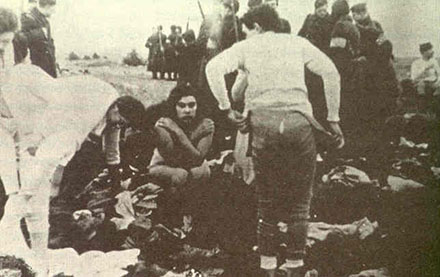
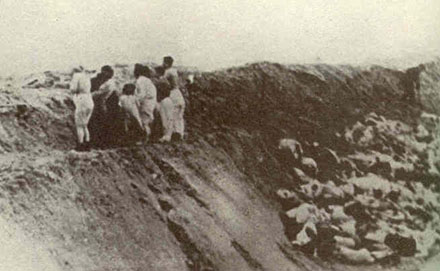
This date in 1941 commenced one of the largest such actions: over 2,700 Jews as well as 23 Communists forced over the course of two-plus days to strip on the freezing Skede dunes overlooking the Baltic and there shot by German and Latvian teams into a vast pit. It’s one of the most recognizable Holocaust atrocities because it was extensively photographed.*

As one can see from the pictures, the victims here were mostly women.


Some of the women in this photographs can be identified by name (pdf). Left to right: (1) Sorella Epstein; (2) presumably Rosa Epstein, her mother; (3) unknown; (4) Mia Epstein; (5) unknown. Alternate identification makes Mia Epstein (5) instead of (4), and (2) Pauline Goldman.

Almost all of Liepaja’s Jews perished during the war.

* Germany’s Bundesarchiv (search on Libau 1941) confirms the precise December 15 dating for these images; it also has some other photographs of atrocities in Liepaja/Libau on other occasions.

On this day..

1942: Eddie Leonski, the Brownout Strangler

(Thanks to Meaghan Good of the Charley Project for the guest post. -ed.)

On this date in 1942, a boyishly handsome G.I. named Edward Joseph “Eddie” Leonski was hanged at Pentridge Prison in Melbourne, Australia.

Although his crimes were committed in Australia and were not war-related, he was court-martialed and sentenced to die under American military law.

This was the first and last time a foreign national who committed crimes in Australia was tried and sentenced under the laws of their own country. Eddie was only the second U.S. serviceman to be executed in World War II. (The first, James Rowe, had been convicted of murdering another soldier and was hanged in Arizona just three weeks earlier.)

Known as the “Brownout Strangler” due to his penchant for attacking women at night on Melbourne’s dimly lit streets, Leonski killed three people and assaulted several others of the course of just over two weeks, from May 3 to May 18, 1942. He said he was fascinated by women’s singing and killed his victims to “get at their voices.”

Leonski was born in New Jersey in 1917, the sixth child of Polish/Russian immigrant parents, and grew up in New York City. Crime historian Harold Schechter notes he had the kind of unstable childhood, dysfunctional family background and mommy issues typical of serial killers:

Both [parents were] confirmed alcoholics. He was seven when his father abandoned the family. Not long afterward, his mother, Amelia, took up with another drunkard. She herself suffered at least two mental breakdowns, severe enough to land her in Bellevue, where she was diagnosed with both manic-depression and incipient schizophrenia. From an early age, three of his brothers were chronic troublemakers, eventually racking up lengthy rap sheets. One of them ended up in a state institution, where he lived out his life.

According to all accounts, Eddie was the apple of his unstable mother’s eye. He, in turn, had the kind of deeply disturbing attachment to her found in other homicidal mama’s boys.

On the surface Eddie seemed to have risen above his origins. He began weight-lifting in adolescence and eventually developed an impressive physique. Following high school he took a three-year stenography course and graduated in the top ten percent of his class. He was a promising employee at a Manhattan supermarket chain before he was drafted into the Army in 1941.

Leonski didn’t do nearly so well in the military: although he was reliable and charming when sober, he drank heavily and was unstable and aggressive when under the influence. As a result, he was always in some minor trouble or another.

But there was a war on and the United States was not in a position to be picky about who would serve. Eddie was sent to Australia in early 1942.

Only weeks after his arrival, he began attacking women and trying to choke them. The first few times, he was interrupted and had to flee before he could accomplish his purpose. Then his crime spree was interrupted in the last week of March after he went AWOL on a six-day bender and was thrown into the brig for a month. As soon as he got out he began stalking women again.

At 2:00 a.m. on May 3, an extremely intoxicated Leonski encountered 40-year-old Ivy Violet McLeod waiting for a streetcar near a dry cleaner’s. He strangled her to death and ripped off her clothing, but was scared away when he heard footsteps.

McLeod’s body was found several hours later: “legs wide apart and feet tucked under her thighs, with genitals exposed.” Her killer had not had time to rape her.

A week later, Eddie was in a restaurant when he struck up a conversation with 31-year-old Pauline Buchan Thompson, a policeman’s wife and mother of two. They went to a bar after dinner and spent several hours talking and drinking.

Close to midnight, Eddie offered to escort her home. On the way, Mrs. Thompson started drunkenly singing.

“She had a nice voice,” he said in his confession. He got angry when she stopped: “I got mad and then tore at her, I tore her apart.”

A few hours later a night watchman found her body on the very steps of her boardinghouse. Like Mrs. McLeod, she was nearly nude with her legs splayed, but had not been raped.

Hours later, a hung-over Eddie Leonski was nursing the hair of the dog that bit him when he told a fellow soldier what he’d done. He made more statements about the two murders over the next few days, but his friend didn’t believe him and told no one what Leonski was saying — time during which Leonski made three more unsuccessful assaults on women.

Eddie’s friend finally took him seriously on the morning of May 19, after the body of 41-year-old Gladys Lillian Hosking was found sprawled in a patch of yellow mud outside Camp Pell, where the American soldiers were stationed.

The previous night, Eddie had come in after midnight, slathered head to toe in the same yellow mud. Too drunk to clean himself up (he’d consumed an incredible thirty beers and seven whiskeys that day), he just shed his soiled clothes and collapsed into bed.

Leonski’s friend finally went to the cops.

When he was arrested, Eddie made no pretense of innocence: he quickly confessed, and various witnesses to his aborted attacks identified him. (That said, Ivan Chapman’s out-of-print book on Leonski makes the point that the evidence against him might not really have held up without those confessions: 1940s forensics techniques would not have yielded a positive match to a victim from his bloodstained trousers, and the yellow mud could easily have been picked up innocently by any drunken G.I. who stumbled traversing the trench.)

Fredric Wertham, a noted forensic psychiatrist who never met Leonski, believed he was insane and the murders were prompted by his twisted relationship with his mother:

That his three victims were all women considerably older than he was is psychiatrically most significant. He unconsciously linked their voices with his mother. The whole psychological explosion occurred in a period of deprivation when he was away from home and separated from his mother — but not from her dominating image. The deeds constituted symbolic matricide.

Very Norman Batesian.

Army psychiatrists, however, believed that while Eddie Leonski was certainly a psychopath, he was not psychotic and was fully aware of the wrongfulness of his acts. Douglas MacArthur personally signed the death warrant.

Eddie maintained a positive, chipper attitude awaiting execution. He spent his time memorizing Oscar Wilde’s Ballad of Reading Gaol, and converted to Catholicism, and went to the gallows singing a popular song that was called, ironically, “It’s a Lovely Day Tomorrow.”

His remains were moved several times before finally finding a permanent grave in a military cemetery in Hawaii. The Australian modernist artist Albert Tucker made a painting titled “Memory of Leonski.” The film Death of a Soldier is based on his crimes.

On this day..

1941: Alfredo Castoldi, German spy in Vichy Algiers

Simon Kitson‘s engrossing The Hunt for Nazi Spies: Fighting Espionage in Vichy France makes the case that Vichy France — and in particular, 1940-42 Vichy, before Operation Torch triggered the outright German occupation of Vichy France — had an active counterespionage program working against German spies.

Once recruitment in the German secret services was suspected, evidence was needed to carry out an arrest. The general rule was to delay arresting suspects so as to be able to tail them to find out who their contacts were and the exact nature of their activities. This is what happened with Alfredo Castoldi, an Italian working for the Germans. Castoldi made the acquaintance of someone named Perez in a bar and tried to convince him to provide military information. Perez pretended to accept but the next day he went to tell all to the local police chief. The police did not arrest Castoldi right away but asked Perez to maintain contact with him and to earn his trust and find out the nature of his intentions and his network. The evidence acquired in this way was so convincing that on 3 November 1941, at 7:30 in the morning, Castoldi was executed by a French army firing squad in Algiers.

Castoldi was not an outlier. Several dozen German spies may have been shot by Vichy France in the 1940-42 period. Kitson notes that it is

difficult to ascertain the exact number of German spies sentenced by Vichy military courts who were actually executed by the firing squads of the French army. [Paul] Paillole claims there were forty-two of them. In research for the present study, I found formal proof of eight such executions, but Paillole’s figure seems credible for two reasons. Firstly, during the postwar trial of Marshal Philippe Petain, Ernest Lagarde, the former director of political affairs in the Foreign Affairs Ministry, claimed there were about thirty such executions in 1941, which does not exclude a total of forty-two for the years 1940-42. Secondly, there is a register of Petain’s decisions concerning appeals for clemency from individuals condemned to death for activities ranging from Communism to army mutinies to espionage. In espionage cases, the registry does not specify for which country a particular spy was working, but it would seem that, after cross-checking the names listed with other sources used for the present study, there were twenty-seven confirmed cases of Axis spies having their appeal for clemency refused. A further twenty-three cases in which clemency was refused also appear to involve Axis spies. Of course, in a handful of instances where the appeal for clemency was rejected, executions may still not have been carried out as a result of the invasion of the southern zone by the Germans, which brought a sudden end to official executions. This registry nevertheless adds credibility to Paillole’s estimate.

On this day..

1940: Hans Vollenweider, the last guillotined in Switzerland

On this date in 1940, Hans Vollenweider became the last person executed in Switzerland.

The Swiss had long experience with executions by beheading and, of course, with mechanical refinements, so adoption of the guillotine was a natural fit … especially after Napoleon overran Switzerland.

Actually, Switzerland had experimented with guillotine-like machines centuries before the French introduced the device, but in the 19th century its Jacobin associations led to a running tug-of-war that saw some cantons abolish the guillotine (German link) in favor of a return to public beheading with a sword. At the same time, the pan-European move away from capital punishment saw a precipitous decline in actual executions, culminating with outright abolition in Switzerland’s 1874 constitution.

Although the death penalty was narrowly reinstated by referendum* (more German) in 1879, its use thereafter was sparing and often contested. In 1938, Switzerland adopted by referendum a new, federal criminal code abolishing the death penalty.

But that code did not take legal effect until January 1, 1942 … and in the intervening years, two people would be controversially guillotined under the outgoing statutes.

Hans Vollenweider (German link) “enjoys” the distinction of being the last of these.

He was a triple murderer, although formally condemned only for one of these homicides — and condemned by an Obwalden court not even a month before, on September 19. Vollenweider’s last legal appeal and his application mercy were disposed of in the week before he lost his head.

There’s a 2004 German-language documentary film about this milestone execution, Vollenweider – Die Geschichte eines Mörders (Vollenweider – The Story of a Murderer).

Vollenweider was the last person executed in Switzerland for an “ordinary” crime, but the death penalty did remain on the books for treason until 1992. Seventeen additional people were executed for that crime during World War II — executed by shooting, not beheading.

Switzerland today has abolished the death penalty at the constitutional level for all crimes. It does retain one single guillotine left in a warehouse somewhere as its last keepsake from an increasingly distant era.

* More precisely, the individual cantons were granted the right to introduce the death penalty in their own territories.

On this day..

1946: Neville Heath, torture-killer

(Thanks to Meaghan Good of the Charley Project for the guest post. -ed.)

On this date in 1946, 29-year-old torture-murderer Neville George Clevely Heath was hanged at Pentonville Prison for the murder of Margery Aimee Brownell Gardner, 32, an aspiring film actress.

Heath was one of the most notorious British killers of the mid-twentieth century. Although his victims numbered only two (the other being 21-year-old Doreen Margaret Marshall), he stood out from the pack by his brutality and sheer sadism. The Murders of the Black Museum, 1870-1970 provides this graphic description of the terrible injuries he inflicted on Doreen:

She had been struck several times on the back of her head. There were also abrasions on her back, a bruise on her right shoulder and an area of redness around the left collar-bone, as if someone had knelt on her. The left side of her chest was bruised and a rib had fractured, piercing the left lung. Her left arm was bruised, as were both wrists, which appeared to have been tightly tied; they also bore finger-nail imprints of her assailant. The fingers of both her hands were badly cut on the inside, as if she had seized a knife in self-defence. All these injuries had been inflicted before she died, her death itself having been caused by a haemorrhage resulting from two deep knife-cuts across her throat.

After death a nipple had been bitten off and her body had been mutilated. A jagged series of slashes reached from her vagina vertically up to her chest, where they were joined by a deep diagonal cut from each nipple to the centre of her body, forming a Y. A rough instrument, possibly a branch, had also perforated and torn her vagina and anus.

Heath came from a respectable, lower-middle-class background. His parents scraped together enough money for him to attend a private Catholic school, where early on he developed as a reputation as a bully.

As an adult he fell into crime, but there was nothing on his record to suggest he was capable of such gruesome acts; his previous convictions had been for offenses such as fraud, forgery, burglary and deserting the military.

In between stints in jail, he married a woman from a wealthy, prominent family and they had a son. By 1945, however, they were divorced.

Margery, Heath’s first victim, was separated from her husband at the time of her death. She had a masochistic predilection for bondage and flagellation, but even so, Heath was too much for her. In May 1946, they checked into a hotel together and he was so violent that she got scared and had to be rescued by hotel security.

Incredibly, however, when Heath called her to ask her out on another date, she agreed and they met again on June 20. They got drunk at a nightclub and took a cab to a hotel. No one heard any unusual noises during the night, but the next morning Margery’s bound, gagged and mutilated corpse was found in her fourth-floor room.

She had horrific injuries, all inflicted while she still lived, including cuts on her face, arms and back in an unusual criss-cross pattern. The cause of death was suffocation.

There was no sign of Heath, but within a day or two he’d been identified as a possible suspect and was sought for questioning.

Heath’s fiancee read about the murder in the papers and asked him about it. He told her he’d stumbled across the scene after Mrs. Gardner was already dead, and promised to go to the police and make a statement. He never did, but he did send a letter to the chief inspector, saying he’d lent his hotel key to Mrs. Gardner because she had nowhere else to sleep. She went to bed with a man named “Jack” but told Heath to come to her room after 2:00 a.m. to spend the rest of the night with her.

When he did, he wrote, “I found her in the condition of which you are aware. I realized that I was in an invidious position, and rather than notify the police, I packed my belongings and left.” Heath said he had the murder weapon and was mailing it to the police station in a separate package. He never did.

Instead, he went to Bournemouth and checked into the Tolland Royal Hotel under the name Rupert Brooke, after one of Britain’s most famous poets.

There he met Doreen Marshall.

Doreen Marshall.

Heath encountered Doreen on July 3 and asked her to have tea with him. She agreed. Tea turned into dinner, and the date didn’t end until almost midnight. At this time Heath said he would walk Doreen home, although she wanted to take a taxi instead. She was never seen alive again.

On July 5 she was reported missing and the Tolland Royal Hotel staff, knowing she’d dined with Heath, asked him to get in touch with the police. He did so, identifying himself by his alias Rupert Brooke. He told the story about their date and saying he’d left her on the pier and walked back to the Tolland Royal alone.

One of the police officers interviewing him about Doreen Marshall recognized Heath as the man wanted for questioning about Margery’s murder and confronted him, saying, “Isn’t your real name Heath?”

“Rupert Brooke” denied this, and when the police said they were detaining him for further questioning, he asked to be allowed to go to the hotel and get his coat. He’d come back right away, he said.

The cops were not that stupid and sent one of their own officers to fetch the coat. Inside was half a train ticket in Doreen Marshall’s name, as well as a cloakroom ticket issued at a train station on June 23. The police went to the train station to fetch what their prisoner had stored there: it turned out to be a suitcase containing several incriminating items, including clothing monogrammed with Heath’s real name, a bloodstained scarf and handkerchief, and a bloodstained riding crop woven in a criss-cross pattern that, it turned out, matched the marks on Margery’s body.

On July 8, Heath was formally charged with Margery’s murder. At around the same time, Doreen’s body turned up: she’d been dumped, naked, in a clump of bushes about a mile from the Tolland Royal Hotel.

At his trial, none of Heath’s friends or family members came to testify on his behalf. Given the evidence against him, his defense attorney could hardly argue that their client was innocent. Instead they claimed he was insane: only a madman could have committed such acts.

But Heath’s calm, composed manner, and his obvious efforts to cover up his crimes, went against the insanity defense and the jury had no trouble convicting him.

In his final letter to his parents, he wrote, “My only regret at leaving the world is that I have been damned unworthy of you both.” Just before his hanging, he was offered the customary drink of whiskey. He agreed and added, “Better make it a double.”

On this day..

1940: Lluis Companys, Catalan president

“Above all, there was a belief in the revolution and the future, a feeling of having suddenly emerged into an era of equality and freedom. Human beings were trying to behave as human beings and not as cogs in the capitalist machine.

-George Orwell, Homage to Catalonia

On this date in 1940, Catalan president Lluis Companys was shot by the Spanish fascists.

Companys had held that notional office for mere hours six years before — but he’s still the last to hold it in any form at all.

Political exile was no unfamiliar terrain for Companys. As a young lawyer, his activism in the first two decades of the century had seen him incarcerated over a dozen times; in fact, his path to political respectability had entailed getting out of a Menorca prison in 1920 courtesy of the parliamentary immunity conferred by winning an election.

And he’d drawn a long sentence for an attempted 1934 rising against a center-right government — the occasion when he had become the President of the Catalan Republic on October 6, and been dispossessed of both office and state by the very next day.

That prison sentence’s reversal by the new republican government in 1936 was a bit of Pyrrhic victory for Companys’s left-wing politics — inasmuch as said republicans’ ascent was also the trigger for the nationalist revolt that resulted in the Spanish Civil War and a military dictatorship lasting until the 1970s.

As the virtual personification of Catalan national aspirations, Companys remained head of the Generalitat de Catalunya from 1933 until his death — in prison, in exile, wherever Companys went he bore along the Catalan cause.

As such, he was in the thick of the civil war’s scrap for control of Barcelona: not only against the fascists but among the left parties whose fractious alliance tore apart in 1937.

It was truly a case of riding the tiger. Companys struggled to maintain the cooperation of his alliance even while the republicans’ Soviet sponsors excommunicated anarchist and anti-Stalinist elements internally. The dreadful spectacle of internecine street fighting among the anti-fascists in May 1937 fills the final tragic pages of Orwell’s Homage, decided by the inescapable materialist circumstances: “the Government could not afford to offend the Communist Party while the Russians were supplying arms.”

Few sources direct much personal blame at Companys for what followed. Under Soviet pressure, he accepted the Communist police raids that had set off the street fighting, accepted the purges and the press censorsip, sacked anti-Stalinist minister Andres Nin from the government. (Nin was later “disappeared” and murdered.)

Who knows but that even these evil days were not still the best that could be made of a bad circumstance: whatever they were, they were not enough for republican Spain or for Catalonia.

When those dreams fell under the fascist advance little more than a year later, Companys couldn’t flee Franco far enough for safety. Soon after his 1939 escape to France, that country was overrun by militaristic rightists from the other direction — and the German occupiers happily handed Companys back to Spain as soon as they got their hands on him.

Condemned after the formality of a perfunctory trial for “military rebellion” conducted on October 14, 1940, Companys was shot the very next morning Montjuic Castle. (See Franco: A Biography)

Spain, where questions of Catalan sovereignty and the Franco years are both sensitive subjects, has never reversed the judgment (Spanish link) against Companys. However, a Barcelona promenade is named in Companys’s honor, as is a major stadium — actually the arena where the anti-fascist 1936 People’s Olympiad in opposition to the notorious master race spectacle of Berlin was to have taken place, before that whole Civil War unpleasantness.

On this day..

1944: Six German POWs, for Stalingrad’s Dulag-205

On this date in 1944, Wehrmacht Oberst Rudolf Körpert, his deputy Hauptmann Carl Frister, and officers Fritz Müsenthin, Otto Mäder, Richard Seidlitz and Kurt Wohlfarth, were shot in the Soviet Union for their treatment of Russian prisoners of war at Stalingrad.

This was nearly two years on since the Germans had surrendered the eastern front’s horrific signature battle.

The six captured men were principals at the little-known Dulag-205, a transit camp the Wehrmacht erected at Stalingrad for Soviet prisoners of war pending westward deportation to less extemporaneous prisons. (And less extemporaneous mistreatment.)

A minuscule 10 acres, the camp was eventually crammed with up to 3,400 prisoners, triple its anticipated capacity. There was nowhere to send them once the Germans were fatally encircled, and as supplies failed in the last terrible weeks of the besieged Kessel (“cauldron”), the subsistence prisoner rations of putrefying-horseflesh soup were cut off entirely.

Several dozen dropped dead of starvation, overwork, and summary execution each day thence until the merciful end. When the Red Army finally took control of the camp on Jan. 22, 1943, it discovered corpses with obvious signs of cannibalism.

Frank Ellis has the definitive treatment of this affair in “Dulag-205: The German Army’s Death Camp for Soviet Prisoners at Stalingrad” (Journal of Slavic Military Studies, March 2006), and the facts in this posts are drawn from Ellis’s examination of the Dulag-205 interrogation and trial records.*

Our captured men enjoyed the company of NKVD and SMERSH interrogators for a number of months, under what duresses one shudders to imagine.

The rescued Soviet soldiers — who were themselves suspect in the eyes of Stalinist authorities merely for having been captured — provided ample firsthand corroboration of Dulag-205’s miserable conditions.

“The guards were allowed to shoot without any warning at prisoners who approached the barbed wire barrier, who tried to jump the queue for food and at prisoners who tried to have a piss in the wrong place,” one POW told his Soviet interrogators. “Hardly any water or bread was given to the prisoners. The prisoners slept in the dugouts without any bedding, jammed tight. The prisoners were never able to rest since they had to sleep standing and sitting. … There were no baths in the camp. During my whole time in the camp — about 5 months — I did not wash once.”

Moscow had by this time already begun rolling out war crimes trials relating to the German invasion. The guys who were captured with starving Red Army prisoners cannibalizing one another were going to be a prime target.

The subaltern officers, according to Ellis, generally tried to put the blame on Körpert and further up the chain of command, and understandably so. Mäder was a mere adjutant. Siedlitz was the director of camp construction. They weren’t the ones who got the Sixth Army encircled or cut prisoner rations or even made camp-specific decisions like when to set the dogs on a disobedient captive. They had no ability to transfer the prisoners back to the Soviets or to any less horrible detention on their side of the lines. Otto Mäder:

My service in the Dulag was a great spiritual torment for me. It was dreadful to see the terrible condition of Russian prisoners.

I stand before the court at that time when the main culprits responsible for the death of 3,000 Soviet prisoners — Field Marshall Paulus, the army’s chief-of-staff, General Schmidt, Lieutenant-Colonel Kunowski and the army quartermaster — do not stand before the court. They are not only guilty of the death of Soviet prisoners-of-war, but have put us on the accused’s bench!

You’d expect the guy to say that to a Soviet tribunal, certainly — especially a lawyer, which Mäder was also — but that doesn’t make it untrue. This case was actually evaluated in post-Soviet Russia for possible posthumous rehabilitation. (No dice.)

Intriguingly, the Wehrmacht officers were not tried for violations of the Geneva Conventions; indeed, the USSR had not ratified all of the Geneva Conventions, and this put Germany (which had ratified them) in an ambiguous position relative to its non-ratifying belligerent. (A less kind way to say it might be that the difference served to rationalize dreadfully inhumane treatment.)

Rather, Körpert et al were charged under Soviet laws promulgated only after the Battle of Stalingrad, a sketchy maneuver which Ellis thinks suggests that prosecutors hoped to avoid setting a precedent that could be cited by Germany relative to the USSR’s none-too-gentle treatment of its own prisoners of war.

* Ellis also has a topical recent book out, The Stalingrad Cauldron: Inside the Encirclement and Destruction of the 6th Army.

On this day..