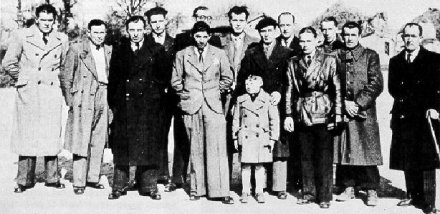
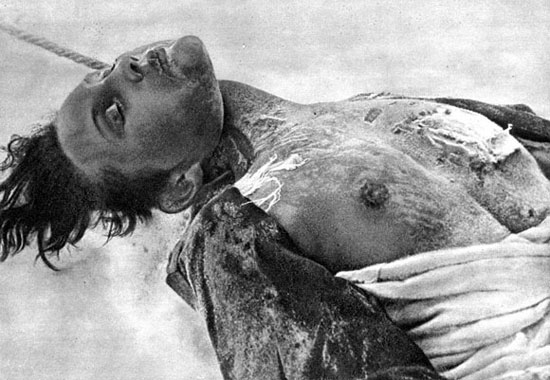
1944: Jakob Edelstein and family

(Thanks to Meaghan Good of the Charley Project for the guest post. -ed.)

On this date in 1944, Jakob Edelstein, his wife Miriam, their twelve-year-son Arieh and his mother-in-law Mrs. Olliner were shot to death at the Auschwitz Concentration Camp in Poland. They had been inmates in Auschwitz since the previous December; Jakob had been in an isolation cell the whole time while the others stayed in the so-called “Family Camp.”

For two years prior they’d lived in Theresienstadt (also known by its Czech name, Terezin), a the former Czech fortress town that had been turned into a city just for Jews. Jakob Edelstein was named Eldest of the Jews and was nominally in charge of the place, but in practice he had no choice but to cater to the whims of the Nazis. He was assisted by a deputy and a council of twelve.

Edelstein, a Czech Jew born in 1903, had been a leader within the Jewish community in Prague and had had papers for himself and his family to emigrate to Palestine. But when the Nazis took over Czechoslovakia, Edelstein and the other Zionist leaders decided it was their duty to stay and do what they could for the community during this time of crisis.

He became a liaison between the Germans the Jewish community and tried to facilitate immigration to Palestine. From 1939 to 1941 he made several trips back and forth between Czechoslovakia and Palestine, with permission from the Germans, trying to find ways for more Jews to emigrate.

Theresienstadt was a strange place: neither concentration camp nor ghetto but something in-between, it was billed as a “paradise” and a “gift” from Hitler to the Jewish people.

Elderly Jews were sent there, as well as Jews who were “prominent” for some reason or had Aryan connections (such as Jews who had a non-Jewish spouse). It was advertised as a luxurious resort community where they could live out the rest of their lives in ease and plenty.

Residents were allowed to receive food packages from the outside, and send postcards (one per month, limited to 30 words, and censored).

Many people believed the propaganda and were persuaded to go there voluntarily, signing all their possessions and assets to the German government in exchange for what they thought would be a comfortable and peaceful retirement.

The 500-ish Danish Jews who weren’t evacuated to Sweden by the Danish Underground right after the Nazi invasion of Denmark were ultimately sent to Theresienstadt. Many talented artists, actors, musicians and scholars lived there. The Nazis would ultimately make a propaganda film about how wonderful life was in Theresienstadt, and a Red Cross delegation toured the place and came away satisfied.

As you might have guessed, living conditions within the fortress city didn’t exactly live up to what it said in the brochures.

It’s true that it was possible to survive in Theresienstadt for an extended time period, even for the duration of the war. There were no gas chambers and relatively few executions. Certainly it was worlds apart from, say, Auschwitz or Treblinka. But that was as close to “paradise” as it got.

Theresienstadt was, as George E. Berkley says in his book Hitler’s Gift: The Story of Theresienstadt, “a joke hatched in hell.”

Yes, there were stores, more than a dozen of them, but their stock consisted of “goods the Nazis had originally confiscated from the residents and later found they didn’t need or want.”

Theresienstadt, like the Lodz Ghetto, had a bank and its own money, but there was nothing to spend it on. “The ghetto crowns,” Berkley says, “were used mostly like Monopoly money in playing cards and other games. Still, the bank staff kept themselves busy balancing their books, and auditors arrived regularly from Berlin to ensure the accuracy of the bank’s essentially fictitious accounts.”

Theresienstadt’s population, at its peak, was 58,497, in a town which before the war had a population of less than 10,000. Nearly everyone had lice, toilets and taps were scarce, and disease was rampant.

Families were separated, with husbands, wives and children each residing in different barracks.

“Horrendous as Theresienstadt housing conditions may have been,” Berkley says, “they were not the residents’ chief source of daily suffering. Food, or rather, the lack of it, weighed on them much more heavily.” The menu, he explains,

consisted chiefly of bread, potatoes, and a watery soup. Some margarine and sugar — about two ounces a week of the former and less than one and one-half ounces of the latter — were sometimes included. The residents were also to receive up to four ounces of meat, mostly horseflesh, and up to eight ounces of skim milk a week, though many a week would see less or none of those foodstuffs available. No fruits were ever officially distributed, and turnips were the only vegetable to show up with any regularity.

Estimates of total per capita calories provided daily ranged from 1300 or less, to 1800, with the lower figure being more frequently mentioned. This should be compared with the “Special Regime” given the worst offenders in the Soviet labor camps which provided about 2,000 calories.

According to modern nutritional guidelines, to maintain a healthy weight, the average adult with an average level of physical activity needs 2,000 to 2,500 calories a day. At Theresienstadt all inmates between age 14 and 70 had to work long hours, many of them at strenuous jobs. In addition to being calorie-deficient, the Theresienstadt rations lacked essential vitamins and minerals. It’s no wonder that one survivor later recalled, “After three months in Theresienstadt, there was only one feeling left in my body: hunger.”

Six months after his arrival, Edelstein and the Council of Elders made a difficult decision about the food problem, as Berkley records:

It became apparent that an even distribution of the food supply would not allow the ghetto to survive. Those doing heavy work needed more than those doing normal work, and the latter needed more than nonworkers. In addition, children required extra rations, for they represented the Jewish future…

Thus, heavy workers … began to receive a little over 2,000 calories of food a day. Children were to get 1,800 and regular workers a little over 1,500. But the daily intake for nonworkers, which included most of the elderly, fell to less than 1,000 calories.

This terrible choice, however necessary to the population’s long-term survival, consigned thousands of people to death.

But even though starvation and disease took many lives, the most deadly aspect of life in Theresienstadt was deportation.

Contrary to what the propaganda messages said about people living out their lives in Theresienstadt, it was largely a transit camp. Most people who arrived would be sent on “to the east” sooner or later; some of them lasted only a few days in the fortress city before being deported.

Although certain classes of people, such as decorated World War I veterans, “prominent” people and those over 65, were in theory exempted from deportation, in practice anyone could be sent away and just about everyone ultimately was.

Approximately 145,000 denizens passed through Theresienstadt during the course of its existence, most of them from Czechoslovakia, Germany, and Austria. About a quarter of these inmates died within Theresienstadt itself. Another 88,000 were deported to Auschwitz and other camps in the East, almost all of them dying there. Out of about 15,000 children who passed through Theresienstadt, less than 2,000 survived, and some estimates put the number in the low hundreds.

When the camp was liberated, it had a population of about 17,000, and most of those had arrived in the during the final months of the war.

Jakob Edelstein didn’t know about the gas chambers when he became Eldest of the Jews at Theresienstadt in December 1941, but he knew that conditions in the East were very bad and realized that, in order for the community to sustain itself, as many people as possible had to remain within Czechoslovakia.

As a committed Zionist, he hoped that the young people in the camp would survive and go on to colonize Israel. Like most other leaders of Jewish communities throughout Nazi-occupied Europe, he made the decision to cooperate with the occupiers in hopes of saving lives.

And as far as that goes, he failed, as the numbers quoted above indicate. But if he failed, so did everyone else.

Unlike many Jewish officials in the Nazi ghettos, he wasn’t corrupt and he wasn’t a toady to the Germans. It’s worth noting that he had many opportunities to flee the country with his family, even after the war started: all he had to do was not come back to Europe after one of his trips overseas.

But he stayed, because he felt he had a responsibility to his beleaguered people.

Edelstein did the best he could with what he had to work with, which is all you can say for anybody. He worked tirelessly, making himself available at all hours, and under his leadership the camp developed a welfare system as well as many cultural and sports activities.

His job as Eldest of the Jews in Theresienstadt, trying to play the balancing act between advocating for his people and not pissing off the Germans, was always extremely stressful, difficult and dangerous.

But things really started to go downhill for him after the city’s first commandant, Siegfried Siedl, got reassigned to Bergen-Belsen in July 1943.

Siedl’s replacement, Anton Burger, hated Czechs and took an immediate dislike to Edelstein as a result. He replaced Edelstein with Paul Eppstein [German language link, as is the next], a German, and demoted Edelstein to first deputy to Eppstein. Benjamin Murmelstein, an Austrian, became second deputy.

This wasn’t enough for Burger, however, as George Berkley records:

As leader of the Czech Jews, [Edelstein] naturally bore the brunt of Burger’s hatred for them. The new commandant had not only deported many of his countrymen and his chief aide … but had also moved Germans and Austrians into key positions formerly held by Czechs. Burger had apparently also stirred up his own superiors against him for during the fall some bakery workers, looking out the window, saw and heard Eichmann sharply dressing down Edelstein and even threatening to have him shot.

The incident alarmed Edelstein’s many loyal followers and the next day the leaders of Hechalutz, the largest Zionist organization in the camp, met with him to urge him to flee. They said they could help him escape … But though he suspected a Nazi scheme to get rid of him, Edelstein refused to run away.

In the end, the Nazis didn’t need to trump up any charges of insubordination or sabotage against their former Eldest of the Jews: they found some real “crimes.” It seems that Edelstein had been saving people from deportation by allowing them to remain in Theresienstadt, off the books, and adding the names of dead people to the transport lists to make the numbers match up.

He was immediately arrested. It was November 9, 1943, the fifth anniversary of Kristallnacht.

Edelstein was kept in custody in Theresienstadt until December 18, when he and his mother-in-law, his wife, and his young son were sent to Auschwitz with a transport of 2,500 others. The transport became part of the Auschwitz “Family Camp”, joining 5,000 Czech Jews who’d arrived there from Theresienstadt in September.

Edelstein’s family was allowed to join the Family Camp. Edelstein himself was put in the punishment block and subjected to interrogation although not, apparently, tortured. He gave nothing away.

In March 1944, the residents of the Family Camp who’d arrived in September were gassed. The December group was allowed to stay alive for the time being.

On June 20, an SS officer went to Edelstein’s cell and told him he’d been sentenced to death. While the condemned man (who’d become quite popular in jail) was taking leave of his fellow inmates, the SS officer got impatient and snapped, “quickly, quickly.”

Edelstein replied, “I am the master of my last movements.”

He was driven to the execution site and then the car went away to fetch Miriam, Ariah and Mrs. Olliner. Miriam had measles and had to be brought on a stretcher. The Nazis forced Jakob Edelstein to watch as his wife, child and mother-in-law were shot to death. He was the last of them to die.

The remaining residents of the family camp were gassed in early July 1944.

Paul Eppstein was executed in Theresienstadt in September. Murmelstein became Eldest of the Jews in his place and actually managed to survive the war. Because he had lived, he spent the rest of his life under a cloud of distrust and suspicion as a possible collaborator.

Siegfried Siedl was hanged for war crimes in 1947. Anton Burger escaped Allied custody (twice) after the war, assumed a new identity and died of natural causes in Essen in 1991. His true identity wasn’t discovered for years after his death.

After the war, the city of Theresienstadt reverted to its former name of Terezin, and the fortress became an internment camp for ethnic Germans, who found themselves quite unpopular in the newly liberated Czechoslovakia and were expelled from the country in droves. The internment camp closed in 1948.

The modern town of Terezin has a population of 3,500 and is noted for its manufacture of knitwork and furniture. Tourists from all over the world come to learn about its important role in one of the most tragic events in modern history.

On this day..

1944: Massacre at Oradour-sur-Glane


(cc) image from fintbo.

(Thanks to Meaghan Good of the Charley Project for the guest post. -ed.)

On this date in 1944, four days after the Allied invasion of Normandy, an SS battalion from the 2nd SS Panzer Division massacred almost the entire village of Oradour-sur-Glane in west central France, slaughtering in all 642 people.

You can read all about this hecatomb and its aftermath on this very thorough and impressive website dedicated to the atrocity, from which much of the information in this account is drawn.

The tiny village, which you could walk through in all of ten minutes, had been the victim of mistaken identity.

Twenty miles away was a somewhat larger town with a similar name, Oradour-sur-Vayres, which was known for its Resistance activity. Adolf Diekmann, commander of the SS battalion, had been informed that the French Resistance had captured an SS officer (possibly the kidnapped Waffen-SS Sturmbahnfuhrer Helmut Kampfe, who had been executed by the Resistance earlier that same day) in Oradour-sur-Vayres and decided reprisals were needed, but he got the two villages mixed up and went to Oradour-sur-Glane instead.

When the SS arrived in the village at lunchtime, they ordered all the inhabitants to assemble in the fairground to have their papers checked. Everyone had to come, including children and the sick. Six people who were not residents but happened to be in the village at the time were also sent to the fairground.

Twenty villagers who had some compelling reason to avoid the Nazis, or merely had a bad feeling about the whole thing, hid or left the village as soon as the SS division showed up. These twenty survived. One seven-year-old boy, Roger Godfrin, was spotted and shot at, but survived by playing dead. He was the only survivor in his family, and the youngest survivor from the town.

The women and children were locked in the village church, and the men were lead to barns and sheds where the machine guns were set up. They were shot in their lower bodies and legs, in order to prolong their deaths. One of the men, who’d lost a leg in World War I, supposedly cried out, “Those bastards! They have cut my other leg off!”

After the shooting, as the men of Oradour-sur-Glane lay helpless, the SS men locked the sheds and set them on fire.

Only six men were able to escape. They hid in some rabbit hutches for several hours before attempting to escape the village. Five of them made it, but Pierre-Henri Poutaraud was spotted later that day and shot dead. The SS man who shot him then tethered a horse to Poutaraud’s outstretched hand.

In all, 190 men were killed.

The SS division then went back to the church, set off a smoke bomb inside it, and set the building on fire. Anyone who tried to get out of the church was machine-gunned. One woman cried out that she was German, not French, and begged to be released, but the SS shoved her back into the flames.

47-year-old Marguerite Rouffanche was able to slip out the back window, and another woman followed her with her seven-month-old baby, but all three of them were shot and only Marguerite survived, hiding in a garden for more than 24 hours until help arrived. Her two daughters were killed. (Marguerite refused to leave Oradour after the massacre. She remained there for the rest of her ninety-one years and is now buried in the village cemetery.)

The church fire and shootings claimed the lives of 247 children and 205 women.


Children from the village’s girl’s school, in the 1942-1943 school year. All of these girls were killed in the massacre.

Unbeknownst to the Nazis, there were several Jews living in the village, among them five children between the ages of eight and fifteen. Twelve of them were killed. In the case of a Jewish family called Pinede, the parents decided to present themselves for inspection but told their three children to hide. The children survived; their parents did not. One of those three Jewish survivors was still alive as of 2004.

Several days passed for the 26 survivors were permitted to bury their dead. Only 52 of the bodies could be identified; the other ones were burned too badly to be recognizable.

Collective punishment in reprisal for the actions of others was par for the course in Nazi-occupied Europe, and Adolf Diekmann had directed his unit to commit a number of mass shootings. Even so, he didn’t have authorization for the bloody events at Oradour-sur-Glane and his commanding officer requested for a court-martial, saying, “I cannot allow the regiment to be charged with something like this.” Field Marshal Erwin Rommel supposedly volunteered to preside over the court-martial himself.

But before that could happen, the war took care of Diekmann: he was killed on the Normandy front on June 19, hit in the head with shrapnel, a mere nine days after his last atrocity. The front, in fact, took care of most of his unit: only 65 of the 200 members survived the war.

In 1953 in Bordeaux, a military tribunal convened to hear the case against the surviving members of the 2nd Panzer Division. Only 22 of them were present in the courtroom; the others were in East Germany, which refused to extradite them. All but one said they’d been conscripted into the SS; one of them admitted he’d joined voluntarily to fight Communism.

To further complicate matters, 15 of the defendants present were actually French nationals of German descent, from Alsace-Moselle, and 14 of them claimed they’d been drafted against their wishes.

(After they conquered France, Germany declared inhabitants of Alsace to be German citizens whether they wanted to be or not, and drafted the region’s men. The conscripts were known in France as Malgre-nous, meaning literally “despite ourselves.”)

In addition, eight of the French defendants had been under the age of 18 when they were drafted into the SS, making them minors under French law. Many French people, including some of the survivors of Oradour-sur-Glane, viewed the Alsatian conscripts as fellow-victims of Nazi Germany and didn’t believe they should be held responsible for their actions.

Most of the defendants were cagey.

They implicated each other, but not themselves, admitting to some specific offenses but denying other, far more serious ones. One man, for example, said he’d been part of an execution squad that shot 20 men, but insisted he’d only helped load the machine guns and hadn’t personally shot anyone. Another said he hadn’t been in Oradour-sur-Glane at all, but was stationed as a sentry outside the village to prevent escapes. Only one of the defendants had admitted to killing anyone at all prior to the trial.

Twelve members of the victims’ families came to watch the trial proceedings, including an eight-year-old girl whose father and grandfather had been killed. Marguerite Rouffanche was ill at the time of the trial and very weak, but she showed up anyway and testify about her experience. Roger Godfrin, the little boy who played dead, also testified.

The tribunal’s judge demanded the defendants view photographs of the charred corpses of the victims, saying, “Let them look at the glorious work of the valiant Third Company of Der Führer Regiment.”

When the prosecutor summed up the case, he referred to the defendants’ evasive statements and said, “You might as well say despite the heaps of ashes and ruins, that the massacre never took place. But the people of Oradour are dead.”

The tribunal deliberated for thirty-two hours before returning its verdicts. One of the defendants was able to prove he hadn’t been in Oradour-sur-Glane the day of the killings, and was acquitted. The rest were convicted.

The 46 members of the SS unit who hadn’t shown up for trial were sentenced to death in absentia, as was one of the German nationals and one of the French. The others got various prison sentences, mostly between five and eight years, none exceeding twelve years. The Germans tended to get longer prison terms than the French. In addition, the Germans were prohibited from residing in France for at least twenty years.


Survivors of the Oradour-sur-Glane massacre.

No one in France was happy with the tribunal’s ruling: some said the sentences were too harsh, others, too lenient. In the face of widespread protests from the Alsace area and threats to secede from France, the French National Assembly passed a bill granting amnesty to all Malgre-nous (at a vote of 319 to 211, with a whopping 83 abstentions) and 13 of the 14 Frenchmen were released only eight days after the verdict was rendered. (One of them, the one who had volunteered for the SS, got no sympathy from anyone and no such leniency.)

Germany was upset, saying it was unfair to pardon the French SS but not the Germans. But within five years, everyone had been freed. No one was actually executed.

In 1981, East German authorities tracked down Heinz Barth, a second lieutenant in the 2nd Panzer Division, and put him on trial in their country for his role in the Oradour-sur-Glane Massacre.

He never tried to deny his participation in the attack, and used the old “just following orders” defense, saying, “In war one acts harshly and with the means available.” Barth admitted he helped round up the village men and personally shot fifteen times into the crowd. He also acknowledged responsibility for the deaths of nearly 100 people in Czechoslovakia.

Barth was convicted in 1983 and sentenced to life in prison. In 1991, still behind bars, he was awarded a pension as a “war victim” because he’d been wounded in Normandy in August 1944 and lost a leg. The resulting howls of protest led the government of a newly reunited Germany to pass a law stripping convicted war criminals of their pensions.

Barth was released from prison in 1997, and managed to finagle his war pension back somehow. He died of cancer ten years later, at the age of 86.

Marguerite Rouffanche died in 1988. Her fellow-survivor Roger Godfrin died in 2004.

The survivors of Oradour-sur-Glane created a new village after the war, but the burned-out ruins of the old village remain, with rusted cars, sewing machines, bicycles and other personal items lying in plain sight on the street, a grim testimony to what happened there nearly seventy years ago.


The ruins of the village of Oradour-sur-Glane today. (cc) image from Olivier Lepicier.

On this day..

1942: Stjepan Filipovic, “death to fascism, freedom to the people!”

On this date in 1942, this happened:

The young man striking the dramatic pose is Stjepan Filipovic, an anti-fascist partisan hanged in the city of Valjevo by the Serbian State Guard, a collaborationist force working with the Axis occupation of Yugoslavia.

Filipovic is shouting “Death to fascism, freedom to the people!” — a pre-existing Communist slogan that Filipovic’s martyrdom would help to popularize. Smrt fašizmu, sloboda narodu! … or you can just abbreviate it SFSN!

In the city where Filipovic died, which is in present-day Serbia, there’s a monumental statue in his honor replicating that Y-shaped pose — an artistically classic look just like our favorite Goya painting, poised between death and victory.


(cc) image from Maduixa.

Filipovic was a Communist so we’re guessing that he would not have had a lot of truck with the ethnic particularism that’s latterly consumed the Balkans. Times being what they are, however, the national hero to Tito’s Yugoslavia has become a post-Communist nationalist football.

That Valjevo monument — it’s in Serbia, remember — calls him Stevan Filipovic, which is the Serbian variant of his given name. But as Serbia is the heir to Yugoslavia, he at least remains there a legitimate subject for a public memorial. Filipovic himself was Croatian, but his legacy in that present-day state is a bit more problematic: in his native town outside Dubrovnik, a statue that once commemorated Filipovic was torn down in 1991 by Croat nationalists; its vacant plinth still stands sadly in Opuzen. (Opuzen’s film festival, however, awards its honorees a statuette replicating the destroyed monument.)

On this day..

1940: Cayetano Redondo, former mayor of Madrid

On this date in 1940, Cayetano Redondo was shot at Madrid’s largest cemetery.

Cayetano Redondo (English Wikipedia page | Spanish | Esperanto), a former journalist and editor, was the socialist onetime mayor of Madrid — having ascended that position during the Spanish Civil War when the previous mayor fled for Valencia as Franco attacked Madrid. Redondo was the guy with his name on the letterhead during the bloody November 1936 Battle of Madrid, when the Luftwaffe tried out terror bombing (Guernica followed in April 1937).

This “hombre de una bondad inagotable” (Manuel Albar, quoted here) was also a leading esperantist — an advocate of building international solidarity through the extension of the constructed language Esperanto.

Disdaining escape as the war ended, he was arrested when Franco’s forces finally took Madrid in 1939 and shot a year later as a rebel. (His tombstone evidently records the wrong date.)

Though Redondo was long a neglected figure, the Madrid city council recently named a street for him. So he’s got that going for him.

On this day..

1945: Bruno Dorfer and Rainer Beck, Wehrmacht deserters

On this date in 1945, five days after the Germans had surrendered to the Allies in World War II, two deserting sailors were shot at Amsterdam.


Dorfer (top) and Beck.

The strangest thing: Bruno Dorfer and Rainer Beck were deserters of the Wehrmacht’s Kriegsmarine … and they were shot by a court-martial conducted by the Wehrmacht itself.

This surprising and shameful story is told in full by Chris Madsen in “Victims of Circumstance: The Execution of German Deserters by Surrendered German Troops Under Canadian Control in Amsterdam, May 1945,” a 1993 Canadian Military History journal article available online in pdf form.

Basically, a pocket of fortified German resistance remained hunkered down in the Netherlands as the war approached its close. That force of 150,000 surrendered to a much smaller number of Canadians on May 5 on terms that maintained German responsibility for administering its armed forces and the civilian areas under its control — a highly anomalous situation in an occupied country as the Third Reich winked out of existence altogether.

Canadians and Germans, according to Madsen, enjoyed a collegial relationship as the Canadians gradually took German forces into custody … or received German forces who helpfully marched themselves into custody. But even under guard, these “imprisoned” Germans still retained significant autonomy and a German command structure that Canadians were loath to interfere with — an arrangement so expedient that it severely tested the bounds of propriety. So invested were the Canadians in maintaining their opposite numbers’ unit cohesion* that they handed some deserters (and plenty of men were deserting the German army) back over to the nominal prisoners!

Rainer Beck had been deserted for the best part of a year: the son of a Social Democratic father and a Jewish mother, he’d ditched harbor defense the previous September and had been laying low with his sister in Amsterdam. Bruno Dorfer was a more recent deserter. They naturally assumed that with the Canadian takeover, they’d be good to go: they turned themselves in to Canadian soldiers with an eye towards regularizing their status.

They were in for quite a surprise, as Madsen relates:

Major Oliver Mace, acting commanding officer of the Canadian regiment, ordered Major J. Dennis Pierce, the company commander in charge of the former factory [where the German prisoners were being held], to place the two deserters inside the compound because “they were certainly Germans and we had no other place to put them.” …

At 1005 hours on 13 May 1945, Pierce informed 2 Canadian Infantry Brigade of the intended German course of action: “German Marine deserters being tried this morning. German Commander intends [to] shoot them.” The German camp leadership established a Standgericht or a court martial within the camp … [and] brought Dorfer and Beck before three officers, a team of military lawyers “whom Pierce himself had ‘put in the bag’ in the streets of Amsterdam earlier in the week.” [Fregattenkapitan Alexander] Stein regarded the proceedings as a show trial for his authority. At the insistence of the German naval commander, the entire camp population witnessed the event. A parade state, taken earlier that morning, counted 1,817 German marines inside the camp. The two accused, represented by a German military lawyer, underwent rigorous cross-examination before this large staring crowd … Oberleutnantnginieur Frank Trmal, a young German officer present at the fifteen-minute trial, remembered Beck’s defense:

For some reason Beck, who was older, decided to defend himself and told the court that we (the Germans) all knew several weeks ago the war was all over for us and that it was a matter of time before we surrendered. He told the captain and the court that any further fighting by us against the Canadians would be senseless bloodshed. With this the captain jumped to his feet in a rage, screaming at Beck that he was calling all of us, his comrades, and his officers, murderers. It is something that I will never forget.

After the inevitable-yet-incredible conviction, Stein appealed to his Canadian guards for a bit of comradely assistance in carrying out the court-martial’s order.

The Seaforth Highlanders obligingly delivered up eight captured German rifles with ammunition, plus a heavy truck to help their “prisoners” execute their deserters. A Canadian military cable testifies in its clipped and plaintive language to the egregious moral vacuum afflicting the chummy occupation: “German marines in Amsterdam have picked up some of their own deserters. They have been tried by military law and sentenced to be shot. May they do this.”

The answer was determined not by any senior Canadian officer, but by the German high commander who had surrendered the Dutch pocket the week before, Johannes Blaskowitz. It was on his approval that Dorfer and Beck were shot against an air raid shelter wall at 1740, not eight hours after their bizarre public trial.

When the story surfaced publicly in 1966 as a result of Der Spiegel investigations, Stein was unrepentant. “Beck would never have been a credit to Germany anyway,” he told the Globe and Mail (Oct. 28, 1966). “Deserters only turn into criminals in civil life too.”

This execution is dramatized in the 1969 Italian-Yugoslav film Dio è con noi (The Fifth Day of Peace, also released as Gott mit Uns and The Firing Squad).

* Conceivably as part of a policy to have Wehrmacht troops in readiness in case the western allies segued directly into war with the Soviet Union. Jacques Pauwels writes in The Myth of the Good War: America in the Second World War:

it is a fact that many captured German units were secretly kept in readiness for possible use against the Red Army. Churchill, who not without reason had a high opinion of the fighting quality of the German soldiers, gave Field Marshall Montgomery an order to that effect during the last days of the war, as he was to acknowledge publicly much later in November 1954. He arranged for Wehrmacht troops who had surrendered in northwest Germany and in Norway to retain their uniforms and even their weapons, and to remain under the command of their own officers, because he thought of their potential use in hostilities against the Soviets. In the Netherlands, German units that had surrendered to the Canadians were even allowed to use their own weapons on May 13, 1945, to execute two of their own deserters!

On this day..

1946: Anton Mussert, Dutch collaborator

On this date in 1946, the Dutch fascist leader Anton Mussert was shot

Mussert was a young engineer who came to the fore in the interwar period as a strident right-wing populist. He co-founded in 1931 the Netherlands’ homegrown Nazi knockoff, the Nationaal-Socialistische Beweging; by 1935, it was polling 300,000 votes.

Mussert of course welcomed the German incursion into the Netherlands on the way to someplace else. That put the Dutch under wartime Nazi administration, but Mussert didn’t score a Quislingesque head-of-state plum out of the arrangement.

Instead, Mussert found himself brusquely shut out of any real power; the Austrian Arthur Seyss-Inquart ran the country instead, and would eventually hang via the Numremberg trial for his occupation atrocities, such as the wholesale deportation of the Dutch Jewish population that swept up diarist Anne Frank. Plum or no, however, what Mussert had done was more than enough to elevate him to the most conspicuous Nazi collaborator in the postwar Netherlands.

Mussert was captured after the war and shot at the open-air location near The Hague where over 250 people had been put to death during the war years.

On this day..

1940: Wilhelm Kusserow, Jehovah’s Witness

(Thanks to Meaghan Good of the Charley Project for the guest post. -ed.)

On this date in 1940, 25-year-old Wilhelm Kusserow was executed by firing squad at Münster Prison in Germany.

A Jehovah’s Witness, he interpreted God’s command “thou shalt not kill” literally and refused to serve in the German army — a big no-no in Hitler’s Third Reich.

Kusserow had actually been born Lutheran, but his parents became Jehovah’s Witnesses after World War I and raised their eleven children in the faith. Jehovah’s Witnesses, in addition to not serving in the army, also refused to Heil Hitler, since the tenets of their religion required them to make obeisance only to Jehovah.

They were persecuted by the Nazis from the beginning of Hitler’s regime, and by 1935 the religion was banned altogether. The Kusserows, and many others, continued to practice their faith in secret.

During the Nazi era, some 10,000 Jehovah’s Witnesses did time in prisons and concentration camps (where they were required to wear a purple triangle), Wilhelm’s parents and siblings among them. 2,500 to 5,000 died.

The children in Jehovah’s Witness families were taken from their parents and sent to orphanages, foster families or reform schools.

(French Witness Simone Arnold Liebster would write a memoir about the years she spent in institutions as a child because she and her parents refused to renounce their beliefs.)

At Wilhelm Kusserow’s trial, the judge and the prosecutor were apparently reluctant to condemn this young man. They pleaded with him to back down, promising to spare his life if he did so, but Wilhelm refused. Some things were more important to him than life itself.

In his final letter to his family he wrote,

Dear parents, brothers, and sisters:

All of you know how much you mean to me, and I am repeatedly reminded of this every time I look at our family photo. How harmonious things always were at home. Nevertheless, above all we must love God, as our Leader Jesus Christ commanded. If we stand up for him, he will reward us.

Hitler later decided the firing squad was too honorable a death for Jehovah’s Witnesses and ordered that they be decapitated instead. Wilhelm’s younger brother Wolfgang, who had also refused to serve in the army, was executed in this manner in 1942.

On this day..

1945: The children of Bullenhuser Damm

On this date in 1945, as Adolf Hitler celebrated his 56th birthday within a Red Army cordon, one of the Second World War’s more tear-jerking little crimes against humanity happened in Hamburg.

Bullenhuser Dammstill to be found today — was a former Hamburg school which fell out of use as World War II progressed, owing to the devastation Allied bombings wrought on the surrounding area.

The school itself sustained little damage, however, which eventually facilitated its appropriation as a satellite building for the nearby Neuengamme concentration camp.

Over at Neuengamme, the SS doctor Kurt Heissmeyer had been conducting a litany of horror medical experiments on 20 Jewish children — mostly from Poland — culled from the concentration camps, seeking medical evidence for Nazi racial theories further to a cushy professorship. But as April 1945 was obviously endgame for the Third Reich, thoughts naturally turned to disposing of evidence of indictable offenses.


Photos of the eventual Bullenhuser Damm victims showing their surgical scars after Heissmeyer injected them with tuberculosis.

Bullenhuser Damm was just the place for disposal.

On April 20, the 20 kids were loaded up on trucks with their four adult caretakers — two French, two Dutch — plus six Soviet prisoners of war.

At Bullenhuser Damm, the kids were parked in a room and hung out, blissfully ignorant of their danger. “They had all their things with them — some food, some toys they had made themselves, etc,” physician Alfred Trzebinski later recalled at his own trial. “They sat on the benches and were happy that they had gotten out. They didn’t suspect a thing.”

In the next room, the 10 adults were being hanged.

According to Admitting the Holocaust, Trzebinski was impressed with his own compassionate use of this bit of down time: he generously gave the children morphine shots to sedate them before their own executions. Or rather, their murders … since the doctor could not but agree that “you cannot execute children, you can only murder them.”

I must say that in general the children’s condition was very good, except for one twelve-year-old boy who was in bad shape; he therefore fell asleep very quickly. Six or eight of the children were still awake — the others were already sleeping … Frahm [an orderly] lifted the twelve-year-old boy and said to the others that he was taking him to bed. He took him to a room that was maybe six or eight yards away, and there I saw a rope already attached to a hook. Frahm put the sleeping boy into the noose and with all his weight pulled down on the body of the boy so that the noose would tighten. (Trzebinski, again)

The other 19 children were disposed of in like manner, and then all 30 corpses cremated overnight … just in time for what must have been a much-needed 5 a.m. coffee.

After the war, the facility went back to use as an actual (creepy!) school, but it was eventually renamed Janusz Korczak School, for a Polish-Jewish educator gassed with his young charges at Treblinka. There’s a permanent exhibition (German) at the site, as well as a memorial rose garden with a variety of plaques commemorating the victims of Bullenhuser Damm.

Trzebinski’s take on his conduct this horrible night might have been good enough for his conscience, but it didn’t pass muster with his judges: he was hanged on a war crimes rap prominently including Bullenhuser Damm on October 8, 1946. Kurt Heissmeyer, however, avoided detection until 1959 and only received a long prison sentence in 1966, shortly before his death.

On this day..

1942: Vasily Klubkov, Zoya Kosmodemyanskaya’s betrayer

We’ve touched in these pages — one of our earliest posts, in fact — on Soviet war heroine Zoya Kosmodemyanskaya, a teenager executed by the advancing German army in November 1941 for conducting partisan attacks behind enemy lines.

Zoya’s story became known after the Red Army recaptured village of Petrishchevo, where she was hanged. A January 27, 1942 Pravda article recounted the gallows defiance of the young guerrilla, whom villagers knew only by her nom de guerre, “Tanya”. She had withstood German torture, refused to give them any information, and at her hanging incited her countrymen and -women to resist the invaders. She’s still to this day a beloved national martyr in Russia, which is why she’s also an Ace in our execution playing cards.

The young woman on the gallows, and in the ghastly post-mortem pictures with her left breast mutilated swiftly became propaganda grist for Moscow.

Zoya’s instant Joan of Arc-like legend invited investigation of the precise circumstances of her capture and death … and this in turn meant extremely dangerous scrutiny for any Soviet citizen in her environs whose behavior in those last days could be held to be in any way sub-heroic.

This brings us to today’s unfortunate entry, Vasily Klubkov, a humble mail-sorter before the war whose picture belongs in the dictionary next to “poor luckless sod.” Just him, Zoya, and everyone else on the terrible Eastern Front.

It was on this date* in 1942 that Klubkov paid the penalty for Zoya’s sacrifice.

Vasily Klubkov and Boris Krainov were other partisans who had been detailed along with Zoya Kosmodemyanskaya to torch some enemy assets on the same mission around Petrishchevo. Practically children all, they each acted independently from the others; long story short, Zoya and Vasily Klubkov were both captured.

Zoya fiercely endured every torture the Germans could throw at her, but Klubkov was made of softer stuff. When an officer pointed a gun at his head and demanded some answers, Klubkov started talking.

“I was a coward,” he later admitted. “I was scared I would be shot.”

Now, this admission very much against his own safety was made to the NKVD in March 1942, and since we already know that Vasily Klubkov was the sort to fold under torture, we can well imagine that the NKVD also got whatever it wanted out of the misfortunate young man. Considering the politicized quality of the trial and the circumstances of the “confession,” it has to be treated with caveats.

Under NKVD pressure, Klubkov signed off on a version of events that just so happened to mesh beautifully with the iconography already forming around the hanged “Tanya”: namely, that he was brought face-to-face with his fellow-prisoner and confirmed her identity, whereas she refused to breathe a word to her captors; that he saw her stripped naked and bashed with truncheons for hours and still summon the fortitude to refuse her interrogators the least satisfaction. Pavel Klubkov gave posterity firsthand evidence of Zoya Kosmodemyanskaya’s heroism in captivity.

“Klubkov may have been telling the truth, since it’s easy to imagine a terrified teenager on his first mission agreeing to his German captors’ demands,” notes Andrew Nagorski in The Greatest Battle: Stalin, Hitler, and the Desperate Struggle for Moscow That Changed the Course of World War II. “But there’s no way of knowing for sure how he really behaved, since he surely was just as terrified when he was interrogated by the NKVD. Or how much of what he said about Zoya was accurate, since the NKVD may already have been preparing the transcript with the idea of her elevation to mythic status.”

Heck, the reason the NKVD even had Klubkov to interrogate was that he escaped German custody, another big character red flag as far as the Soviets were concerned. That he escaped from the same custody that martyred Zoya Kosmodemyanskaya probably sealed his fate before he received his first pistol-whipping. NKVD records paint a kid who has already given up.

Well he might have. The verdict of the court was surely ordained from the start, but it was formally delivered on April 3: “Execution by shooting, without confiscation of property due to its absence.”

* Though there are some cites for April 3 out there, it appears that April 3 was the date of his conviction by a military tribunal and April 16 his execution date. This is a bit of a protracted delay by wartime Soviet tribunal standards, but then, Klubkov would have been a person of relevance to the state itself. The highest-ranking official who thought he could approve Klubkov’s execution without asking anyone else might have been a little further up the food chain than for your run-of-the-mill deserter.

On this day..

1942: Four Jews from Bedzin and Sosnowiec

(Thanks to Meaghan Good of the Charley Project for the guest post. -ed.)

On this date in 1942, two Jewish men were hanged in the city of Sosnowiec (pronounced sos-no-vitz) in Nazi-occupied Poland, and two more were hanged in the nearby city of Bedzin (pronounced ben-jin).

These executions were witnessed by thousands of people and carefully choreographed, as historian Mary Fulbrook records in her book A Small Town Near Auschwitz:*

The hangings in Bedzin and Sosnowiec had been orchestrated in advance, in meticulous detail, by the Police President in Sosnowiec. The execution in Bedzin was to take place one hour later than the one in Sosnowiec. As much thought was given by the police authorities to questions of security and seating arrangements as might be appropriate for a modern open-air musical concert: this was not to be a simple punishment for an individual offense, as had happened innumerable times, but rather a mass spectacle, intended to have a major impact on the audience…

The identities of the executed Jews in Bedzin have been lost to history. (Correction: Per Yad Vashem, they were Jehuda Warman and “Feffer” (no first name).) They were hanged at the old Jewish cemetery on the corner of Zawale Street, before a crowd of about 5,000, at 5:00 p.m. Jewish workers in the Bedzin Ghetto had their work identity cards confiscated that day and were let out of work early, at 4:00 p.m., and ordered to watch the hangings. Only after they witnessed the executions did they get their work cards back. The bodies remained hanging on the scaffold until 7:30 p.m.

The condemned men in Sosnowiec were 30-year-old Mayer Kohn and his father, Nachun or Nahum.

Nachun (left, with wife) and Mayer.

They’d been caught trading on the black market, probably trying to feed their families, as no one could live long on the official rations. But as Fulbrook points out, the actual offense didn’t matter much to the Nazis:

These coordinated public spectacles of mass hangings do not seem … to have been in direct response to a particular crime; it seems there was a policy of ‘any Jew will do’, although infringements of German rules (including not only black market dealings but also very trivial ‘offenses’) were adduced as the ostensible ‘reason’ for these executions.

Thousands of people, both Jews and Germans, watched Mayer and Nachun Kohn die, then quietly went home.

Although virtually the entire Kohn family perished at the hands of the Nazis, Mayer and Nachun Kohn can claim a bit of immortality by virtue of being mentioned in Maus, Art Spiegelman’s famous graphic novel about the Holocaust: the author’s father, Vladek, hailed from Sosnowiec.

* The author of A Small Town Near Auschwitz is interviewed in this New Books In History podcast.

On this day..