1943: Amos Pampaloni, Captain Corelli’s Mandolin inspiration

Italian artillerist Amos Pampaloni, the real-life model for the title character of the novel and film Captain Corelli’s Mandolin, miraculously survived execution on this date in 1943.

It occurred at the outset of the Cephalonia Massacre on September 21, 1943, which began a dayslong slaughter on that Greek island by German soldiers of their former Italian comrades. With some 5,000 victims, it’s one of the largest POW massacres of the Second World War.

Captain Pampaloni was among 500-odd officers deployed with the 12,000-strong Acqui Infantry Division. This formation had been part of fascist Italy’s invasion of Greece in 1940-41; after victory in that campaign, the Acqui Division occupied several Greek islands over the succeeding years, where German troops were also stationed.

The Pact of Steel uniting these powers melted abruptly in early September of 1943, when the Allies forced Italy into an armistice. For Italian forces standing in the field cheek-by-fascist epaulette, this forced a sudden and dangerous reckoning. Some units had barely even heard of the new situation before they were under German guns; in a best-case scenario, they had to decide within a few hours or days between radically different attitudes towards their up-to-now comrades-in-arms.

The Acqui on the Ionian island of Cephalonia (Kefalonia) was a case in point. In the days following the Italian armistice, the much larger German force presented its commanders an ultimatum to decide among three alternatives:

  1. Continue fighting alongside the Germans
  2. Fight against the Germans
  3. Surrender, disarm, and repatriate

While the last of these might seem the obvious course, disarming was contrary to the Italian high command’s ambiguous order neither to initiate hostilities with Germans, nor to cooperate with them. Moreover, the Cephalonia division got some reports in those confused days that the Germans weren’t always repatriating units that surrendered. The soldiery was polled on the options, and went for resistance.

Unfortunately the Italians were thoroughly outgunned in this fight, and the Allies refused to permit dispatching reinforcements from Italy that might easily be captured by the Germans. Within days the Acqui had been roughly brought to heel.

Outnumbered and suffering under accurate mortar fire, Pampaloni decided to surrender. The captain protested that it was against the rules of war when his men were systematically robbed of their wallets and watches, only to be told by the German commanding officer that those rules applied to prisoners, not to traitors.

The officer then shot the captain through the back of the neck, and the rest of his men, including the wounded, were mown down with machine gun fire. Miraculously still alive, Pampaloni remained conscious as a German soldier removed his own watch from his apparently lifeless body.

Captain Pampaloni was not, in fact, the only soldier from his company to survive. “The mule handlers were spared, because every mule responds best to his own master,” he said. “Ten minutes after the massacre the German soldiers left, singing.”

Captain Pampaloni went on to fight for a year with the Greek resistance on the mainland. Having witnessed the brutality of the conflict on Cephalonia, he was still shocked by the sight of partisans slitting the throats of German prisoners with their daggers — ammunition was too precious to be wasted on executions.

Cefalonia – crimine di guerra 1 from Va.Le. Cinematografica 78 on Vimeo.

Cefalonia – crimine di guerra 2 from Va.Le. Cinematografica 78 on Vimeo.

Numerous summary executions disgraced the German victory. (There’s a monument to the victims in Verona.) Our man Amos Pampaloni faced his on the first day of the general massacre; according to a 2001 profile in the Guardian,

Outnumbered and suffering under accurate mortar fire, Pampaloni decided to surrender. The captain protested that it was against the rules of war when his men were systematically robbed of their wallets and watches, only to be told by the German commanding officer that those rules applied to prisoners, not to traitors.*

The officer then shot the captain through the back of the neck, and the rest of his men, including the wounded, were mown down with machine gun fire. Miraculously still alive, Pampaloni remained conscious as a German soldier removed his own watch from his apparently lifeless body.

Captain Pampaloni was not, in fact, the only soldier from his company to survive. “The mule handlers were spared, because every mule responds best to his own master,” he said. “Ten minutes after the massacre the German soldiers left, singing.”

Captain Pampaloni went on to fight for a year with the Greek resistance on the mainland. Having witnessed the brutality of the conflict on Cephalonia, he was still shocked by the sight of partisans slitting the throats of German prisoners with their daggers — ammunition was too precious to be wasted on executions.

In the novel Captain Corelli’s Mandolin, Pampaloni’s fictional imitator survives thanks to a noble comrade who hurls his body in front of the fusillade.

Pampaloni didn’t appreciate Mandolin all that much, owing to its hostile depiction of the Communist partisan movement that he joined after surviving his execution. For those seeking alternative literatures, there’s also a 1960s novelization of the Greek resistance on Cephalonia by Marcello Venturi; written in Italian (as Bandiera bianca a Cefalonia), it’s long out of print in English as The White Flag.

* Prior to the Italian armistice, the Italian forces on the island were working on an arrangement to obey German command structures; hence, the brutal treatment of Italian prisoners who could be conceived as not merely prisoners of war, but traitors or rebels unprotected by any law of war. A German directive had explicitly demanded as much: “because of the perfidious and treacherous behaviour on Kefalonia, no prisoners are to be taken.”

On this day..

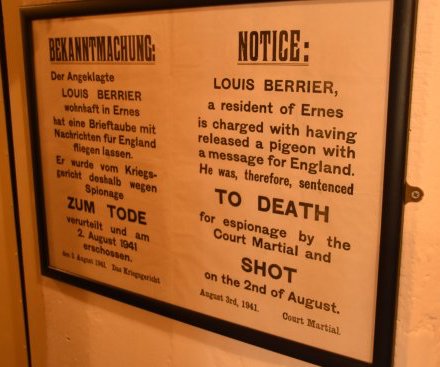
1941: Louis Berrier, messenger pigeoner

Notice: Louis Berrier, a resident of Ernes is charged with having released a pigeon with a message for England. He was, therefore, sentenced to death for espionage by the court martial and shot on the 2nd of August.
From the Channel Island Military Museum on the Channel island of Jersey; image courtesy of Trip Advisor.

On this day..

1948: Ruth Closius-Neudeck

A notoriously brutal guard at the Ravensbrück women’s concentration camp named Ruth Closius-Neudeck was hanged on this date in 1948.

With impeccable timing she exited a life of proletarian obscurity by applying for a gig as a camp warden in July 1944, right when the Third Reich’s prospects for surviving the war went terminal.

That left her scant few months to stack up fodder for the eventual war crimes tribunals but Neudeck had a knack for making hay in the twilight.

Almost immediately earning promotion to barracks overseer, she earned a reputation as one of the cruelest guards at the camp that once cultivated Irma Grese. (They didn’t overlap.) One prisoner would later describe seeing her “cut the throat of an inmate with the sharp edge of her shovel.”

She was subsequently detailed to the nearby Uckermark satellite camp, smaller and more lethal — as it was converted for the Third Reich’s final weeks into a killing center for inmates whose bodies had been broken at slave labor in Ravensbrück or elsewhere. She acknowledged sending 3,000 women to the gas chambers as Uckermark Aufseherin.

She was one of five camp guards charged in the Uckermark trial (also known as the Third Ravensbrück trial) in 1948, and the only one of those five executed.

On this day..

1941: Alexandru Bessarab, fascist artist

On this date in 1941, the fascist artist Alexandru Bassarab was killed in World War II — generally believed to be among captured Romanian prisoners of war summarily executed by Soviet troops.

A woodcut/linocut specialist — as evidenced by his gaunt self-portrait to the right — Bassarab was an early adherent of the Iron Guard and became one of its outstanding propagandists.

His very Deus Vult-vibing work Arhangel, for example, was used by the Guard as a banner at the 1940 state funeral it threw for far-right martyr Corneliu Codreanu. (The Iron Guard was shorthand nomenclature for an organ formally named the Legion of the Archangel Michael — and its members hence known as Legionnaires.)

But the Iron Guard’s moment at the political apex was a brief one, and when it was sidelined by a different right-wing strongman, Ian Antonescu, Bessarab found himself arrested and forced into a front-line army unit recapturing (appropriately) Bessarabia. He disappeared into presumed Soviet custody and execution near Tiganca, in present-day Moldova.

His work, including apolitical pieces, was taboo in postwar Communist Romania, but has enjoyed a bit of rediscovery since the end of the Cold War

On this day..

1942: Michael Kitzelmann

On this date in 1942, Wehrmacht lieutenant Michael Kitzelmann was executed for his stubborn conscience. The last diary entry in this post is going to show a June 12 date which I would ordinarily take as a preeminent source. Because June 11 is so universally described as the execution date, including in a public memorial plaque, I’m warily bowing to that date myself and putting the diary translation down to a botch of some kind. Whether or not this is correctly adjudicated on my part, it’s another reminder that everyone is aggravatingly slipshod when it comes to dates.

An aspiring Catholic priest, Kitzelmann (English Wikipedia entry | German) embarked his mandatory military service in 1937, foreseeing two boring years.

“For two years I must endure this terrible yoke of dreary, ridiculous military drills,” he wrote to a friend. The yoke would grow more terrible, and less ridiculous: Germany was at war before Kitzelmann’s conscription expired. Holy Orders would have to wait.

The young man proved a capable soldier (Iron Cross, second class) as well as a dutiful correspondent to parents and friends — his letters showing proud his own advancement in the ranks but also anguished by the horrors of war. Over time, he was increasingly troubled by the atrocities his own side inflicted.

By the last months of 1941, his conscience and his piety could no longer reconcile with the evil eastern front, and he made bold in both letters home and loose talk with comrades to voice his disgust with his own side. “At home they tear the crosses from the schools,” he mused of the regime’s contempt for earnest Christianity. “Here we are made to fight against godless Bolshevism.”

While convalescing from an illness in March 1942, Kitzelmann was denounced for his seditious opinions by a zealous fellow troop. He had seen enough that he should have known that his fulfillment of military obligation would not protect him.

On 11 April 1942, I walked into the military prison of the fortress of Orel. The fortress, a huge squat building, distempered pink, with massive round turrets at each corner, lies to the north of the town on the steep banks of the river Oka. There is a dark stone passage on the upper floor where the air is dank and chill; and here I was handed over to the prison guards.

My cell is in the north-east turret and is about 14 feet wide and the same height. It has a wooden floor and a vaulted brick ceiling. To the west an arched window pierces the wall, which is over three feet thick, and across the window there are strong iron bars, let into the wall. In the evening and then only, a few golden sunrays briefly penetrate to my dreary solitude. A massive oak door, reinforced by heavy iron-work, shuts out the world. Darkness and terror paralyse my being. The stillness is unbearable. Helpless and abandoned I am left to myself, alone, sentenced to death. . .! Now I know the full fury of these Military Laws. Overnight I was branded as a criminal just for making a few derogatory remarks about the government. And for that apparently I must lose my life, my honour, my friends and my place in human society. How could all this happen? I had a good enough reputation up to now, and so far as I know I was regarded as a decent man with a normal sense of duty. What are right and justice in this world? Haven’t I served my country honourably for four years? I was at the front for two years, took part in three campaigns and proved my loyalty often enough. Is this the thanks I get from my country?

Apart from all that I am beginning to be afraid for my family at home. Letters have been taken from my trunk, and others from the post, and confiscated by the Court, letters from my father and mother and from friends. What will happen to them? Will the law get on to them too? That would be terrible. But I suppose there is nothing to be done and . . . events must take their course. I am so much afraid: my fears follow me day and night like horrifying ghosts, and all the time this awful loneliness, this claustrophobia, this oppressive silence. For hours on end I pace up and down my cell, just to hear my own footsteps. I light a fire in the stove just to hear it’s crackling. I pray aloud to hear my own voice; and I call upon Heaven, asking God to help me in my agony.

He sought comfort in his faith:

I pray to Jesus the Crucified, who has led the way through the most bitter pain. And He answers me: “If you will be My disciple, take up your cross and follow me!”

But I appeal to Him: “Lord, I am still so young, too young for such a heavy cross; I have not lived my life, all my hopes, plans and aims are unfulfilled.” And he says: “Behold, I too was young, I had yet to live my life, and as a young man I carried the cross and sacrificed my young life.”

Again my soul complains: “Behold my bitter home-sickness, the sufferings of my family. Let me return to life and let me not hurt their love.”

But Jesus replies: “If you cannot leave your belongings and all your earthly love, you cannot be my disciple. Follow me!”

Again my soul rebels: “O Lord, the burden is too heavy; relieve me of this terrible yoke; shorten my sufferings and dry my tears!”

Lovingly He speaks: “My son, be brave and do not despair! I have suffered so greatly for humanity, and for you too; I have opened Heaven for you. And I shall remain with you until the end.”

I answer my Saviour: “Thank you a thousand times for your endless love, my Redeemer! I shall be your disciple and I will carry your cross after you. So take me by the hand and lead me to my blessed end in all eternity.”

And at last — here’s that date — he closed his diary with this momentous note:

On 11 June 1942, at 5 p.m., I was told that my petition for mercy had been rejected and that the sentence would be carried out on 12 June 1942 at 8 a.m. Lord, Thy will be done. In the evening I knew great joy. Dear, good Pastor Schmitter has come back and wants to stay with me during my last hours on earth. He was here till after midnight. I told him my final wishes, asked him to give my love to my people at home and talked over with him what would happen at the end. He has promised to return punctually at 6 a.m. Then I will confess once more, for my whole life. We shall celebrate Mass and take Communion together. . . .

God has granted me great joy, for the hour of my death is a merciful one

On this day..

1948: Johannes Rasmussen, Danish Resistance betrayer

Anti-Nazi Danish Resistance turncoat Johannes Rasmussen was shot at Viborg on this date in 1948.

Arrested by the Gestapo in December 1943, Rasmussen (Danish link) broke under torture and informed on his former comrades, but he also extended his collaboration far beyond (more Danish) mere capitulation and became their henchman and collaborator. Rasmussen befriended his captors and working as an interpreter and interrogator until someone from the Resistance shot him in February 1945 and left him bedridden.

Arrested on the day after the German occupation ended, he unsurprisingly got no mercy from the countrymen he had betrayed.

On this day..

1942: Julius “Babe” Hoffmeister, alcoholic POW

An American Morris-Knudsen civilian contractor captured when the Japanese forces seized Wake Island during World War II was executed on this date in 1942.

Julius “Babe” Hoffmeister’s essential offense was alcoholism; this indeed was the reason for his presence on Wake in the first place, as he’d signed up for this remote hitch in an effort to force himself to cold-turkey detox. Thereafter finding himself in a war zone did no favors for his illness.

During the December 1941 Japanese bombardment of Wake, Hoffmeister looted alcohol from the hospital and stashed it around the atoll, stealing back to them periodically in the subsequent months of slave labor for the occupiers to self-medicate against the misery of his situation. By May those stockpiles had been exhausted, forcing Hoffmeister to more desperate ventures.

We catch a glimpse of this unfortunate man his countrymen’s diaries.

One of those observers was an officer named Leal Henderson Russell, whose rank entitled him to milder treatment and a degree of cordiality with his Japanese opposite numbers. On May 8th, Russell’s journal (self-published in 1987 and hard to come by) recorded

Wakened by guards on coming into the barracks. They went inside and I could hear them questioning someone. After breakfast I found that they had arrested Babe Hoffmeister who was out of the compound during the night. Okazaki told me later he had broken into the canteen. They called several of the men in to question them concerning it but I think he was alone at the time. I also heard he was drunk. It is apt to go very hard on Babe as he had been repeatedly warned.

Two days afterwards, it did go very hard.

May 10th — Julius ‘Babe’ Hoffmeister was murdered this morning. Nearly all foremen and dept. superintendents were called to witness it. Possibly it will serve as a warning to some who still feel that they have some rights here.

A different prisoner, Logan Kay, noted well the warning

The Japs made Hoffmeister crouch on his hands and knees. A Jap officer took his sword, laid the blade on his neck, brought it back like a golf club and then down on his neck, severing his head with a single blow.

Far more extensive horrors awaited the prisoners of Wake as the war progressed.

On this day..

1949: Li Bai, PLA spy

Red spy Li Bai was executed in the Pudong district of Shanghai on this date in 1949.

Li Bai and his circuitry immortalized in stone in Shanghai’s Century Park. (cc) image from (checks notes) “Kgbkgbkgb”

A survivor of the Party’s epic Long March Li Bai (English Wikipedia entry | Chinese) was a Party-trained wireless operator who was detailed to Shanghai with the 1937 outbreak of the Sino-Japanese War.

He was fortunate to survive arrest by the Japanese while transmitting from occupied Shanghai in 1942. (The Japanese took him for a mere enthusiast.) Even more fortunate from his handlers’ standpoint was the interest his radio skills subsequently attracted from the nationalist Kuomintang, which recruited him into service that Li Bai was only too happy to accept.

For the next several years, he sent to the Communists voluminous inside information about the disposition of their opponents in the endgame stage of the Chinese Civil War. He was detected in the last days of 1948, sending to the People’s Liberation Army the troop dispositions that would enable it to overrun the capitals in the subsequent months. Not three weeks after Li Bai’s execution in Shanghai that city fell to the Communists; by year’s end, the Kuomintang had evacuated the mainland for its so-far permanent Formosan redoubt.

There’s a 1958 Chinese biopic about him, titled The Unfailing Radio Wave; the embed below is one of many subsequent readaptations:

On this day..

1947: Karel Čurda and Viliam Gerik, Czechoslovakia resistance betrayers

Turncoat Czechoslovakian resistance fighters Karel Čurda and Viliam Gerik were hanged for traitors on this date in 1947.


Čurda (left) and Gerik

Both were special operatives trained in England and parachuted into Nazi-occupied Czechoslovakia. Gerik (Czech Wikipedia entry) became separated from his compatriots and couldn’t re-establish contact. Seemingly panicked as he contemplated his lonely situation in Prague, he turned himself in in early April 1942 and became a Gestapo collaborator, informing on his underground compatriots. Among other things, he identified the body of his onetime companion on his parachute jump, Arnošt Mikš — who had committed a well-timed suicide to avoid capture after killing a gendarme in a shootout. Gerik’s helpful ID enabled the Gestapo to shoot Mikš’s brothers by way of collective punishment.

This man did not greatly prosper by his betrayal even during the war years, for after later attempting to break free from his masters and re-establish contact with the resistance he was tossed in Dachau and only released when that camp was liberated by the U.S. Army, going in his case from frying pan to fire.

Far more notorious was the Judas act of Čurda (English Wikipedia entry | Czech), whose proximity to the operation that killed Reichsprotektor Reinhard Heydrich enabled him to give up the assassins hiding out in the basement of Prague’s St. Cyril and Methodius Cathedral.

Čurda’s reward was a half-million Reichsmarks and a German wife with whom he had a child, prior to his postwar arrest; such payoffs obviously make him a ready target of vilification, although more sympathetic interpretations exist suggesting that Čurda acted days after the demonstrative eradication of the village of Lidice because he feared that his own family or town might suffer the same fate.

On this day..

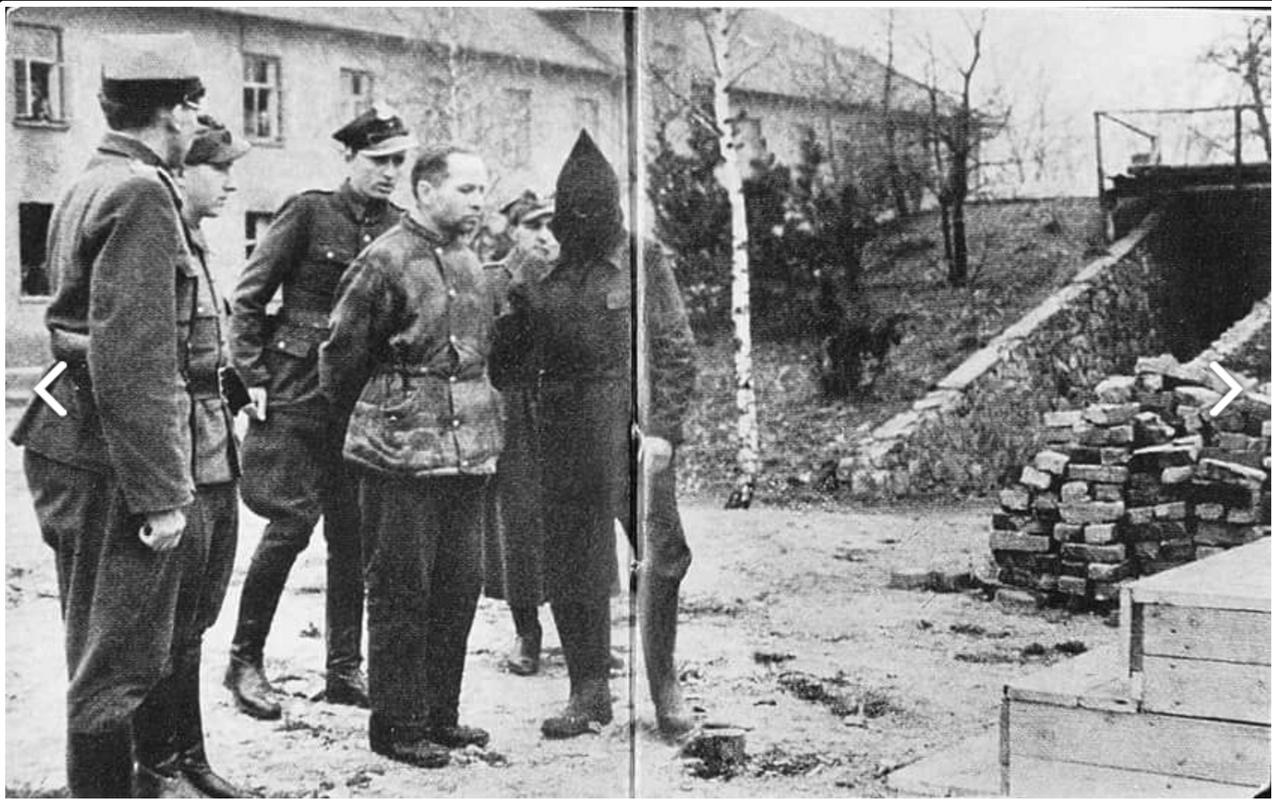
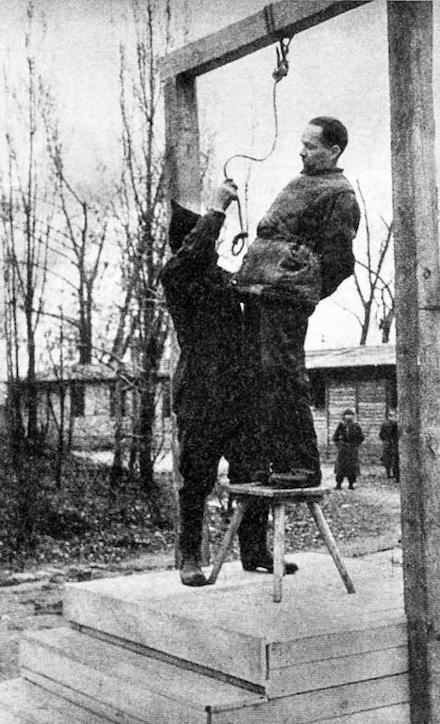
1947: Rudolf Höss, Auschwitz commandant

April 16, 1947, was the hanging-date of Auschwitz commandant Rudolf Höss.

Not to be confused with the Rudolf Hess, the Nazi party defector held by the British in lonely confinement in Spandau until 1987, Höss was true to the swastika from beginning to end.

A World War I survivor, our guy joined the right-wing Freikorps paramilitaries and scored NSDAP party number no. 3240 in 1922 — soon thereafter proving a willingness to shed blood for the cause by murdering a teacher suspected of betraying to the French the Nazi martyr figure Albert Leo Schlageter. Höss served only a year in prison for the crime.

Come the time of the Reich, he joined the SS and was “constantly associated” (his words) with the camp networks — beginning in the very first concentration camp, Dachau, followed by a two-year turn at Sachsenhausen.

In May 1940, he was appointed to direct the brand-new Auschwitz concentration camp in occupied Poland, a position that, excluding a few months when he was relieved of duties for having an affair with a camp inmate, he held until the Red Army liberated Auschwitz in January 1945.

Initially “just” a standard Reich prison camp with a mix of regular criminals, political prisoners, and Soviet POWs, Auschwitz earned its place as the Holocaust’s preeminent metonym in the subsequent years as it evolved into one of the primary killing sites of the Final Solution.

Höss himself is even “honored” as the namesake of Operation Höss, a deportation and extermination project targeting Hungarian Jewry that claimed 420,000 souls just in the last months of the war. It was one of the most efficient slaughters orchestrated by Nazi Germany, though even these were only a small portion of the crimes that stained Höss’s soul. In his postwar testimony at Nuremberg, Höss

estimate[d] that at least 2,500,000* victims were executed and exterminated there [at Auschwitz] by gassing and burning, and at least another half million succumbed to starvation and disease, making a total dead of about 3,000,000. This figure represents about 70% or 80% of all persons sent to Auschwitz as prisoners, the remainder having been selected and used for slave labor in the concentration camp industries. Included among the executed and burnt were approximately 20,000 Russian prisoners of war (previously screened out of Prisoner of War cages by the Gestapo) who were delivered at Auschwitz in Wehrmacht transports operated by regular Wehrmacht officers and men. The remainder of the total number of victims included about 100,000 German Jews, and great numbers of citizens (mostly Jewish) from Holland, France, Belgium, Poland, Hungary, Czechoslovakia, Greece, or other countries.

It wasn’t the Nuremberg court that noosed him, however; that duty fell to Poland’s Supreme National Tribunal. It had him executed on a gallows set up adjacent to Auschwitz’s Crematorium 1.

Höss’s grandson, Rainer Höss, has been an outspoken voice for atoning his family’s role in the Holocaust.

* Höss later revised this “2.5 million” estimate down, claiming that he had that figure from Adolf Eichmann but “I myself never knew the total number, and I have nothing to help me arrive at an estimate.” After tabulating the larger extermination actions that he could recall (including the 400,000+ from Hungary), Höss came up with the lower and still incredibly monstrous figure of 1.1 million: “Even Auschwitz had limits to its destructive capabilities.”

On this day..