2007: Michael Richard, whose time ran out

Two years ago today, the U.S. Supreme Court unexpectedly accepted a case, Baze v. Rees, challenging the constitutionality of lethal injection — the supposedly humane execution method that seemed less and less so.
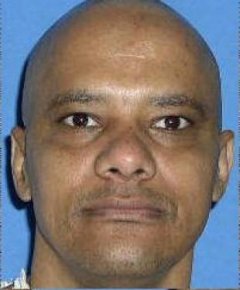
Texas inmate Michael Richard, condemned for raping and murdering Marguerite Dixon in 1986, was slated to die that very evening, also by lethal injection.

As Richard’s Texas Defender Service lawyers scrambled to prepare a last-minute legal challenge based on the pending Supreme Court case — for how could Texas carry out a procedure whose constitutionality was in question? — they tripped over an unexpected stretch of red tape that ultimately claimed their client’s life:

The Texas Court of Criminal Appeals closed at 5 p.m. on the day of the scheduled 6 p.m. execution, and refused to accept an appeal filed a few minutes after 5.

Or more specifically, Judge Sharon Keller refused to accept the appeal, for which she came under immediate fire — and launched campaigns like the website SharonKiller.com.

This bizarre situation, complicated by the fact that the Lone Star State did not have written rules for handling last-minute appeals (it does now), has a thicket of procedural detail best appreciated by lawyers.

But it caught worldwide attention as an illustration of Texas’s cavalier approach to its numerous death penalty cases.

Keller, who has what you might say is an inordinate regard for “finality” (and for prosecutors), has herself been forced to defend her conduct in hearings of the State Commission on Judicial Conduct. Those hearings could result in her removal from the bench over this incident; a decision is expected soon. (Update: She skated.)

Though it was not completely clear for a few more weeks, it was in fact true that the pending Baze decision suspended the death penalty in the United States. As a result, Michael Richard — whose execution would have been stayed had the appeal entered the judicial system — was the last American put to death until May of 2008.

On this day..

2006: Three Sulawesi Christians

On this date in 2006, Catholics Fabianus Tibo, Marianus Riwu and Dominggus da Silva were shot in the Central Sulawesi capital of Palu for inciting murderous anti-Muslim riots six years before.

The riots in question occurred in Poso, a hotspot of Christian-Muslim conflict that over 1,000 lives from 1999-2001. According to the Jakarta Post (September 25, 2006),

Tibo, Marinus and Dominggus were convicted of leading a Christian militia that carried out a series of attacks in May 2000 in Sulawesi, including a machete and gun assault on an Islamic school where dozens of men were seeking shelter.

Though a 2001 treaty stabilized the situation, tension remained, occasionally flaring into violence.

The 2001 death sentences of Christian activists also remained, a legacy of the open conflict. Small wonder that their execution triggered further unrest, not only in Poso but in Silva’s hometown in predominantly-Christian West Timor. And aftershocks for months to come — the murder a month later of a prominent Christian cleric, for instance — quelled by security forces sweetened with a bit of goodwill rebuilding.

Jakarta ignored international as well as domestic clemency appeals in carrying out the executions, including from the European Union and the the Vatican. The latter’s argument may have been somewhat compromised under the circumstances by Pope Benedict XVI’s impolitic citation just days before of a 14th-century Muslim-bashing text.

Apart from the humanitarian objections, others more specific to the case were raised in vain: that the trio executed had not been witnessed killing anyone personally, and that the sentences were disproportionate to that received by anyone else convicted in that era’s violence.

But such contentions were easily outweighed by the simultaneous progress of the Bali Bombers case, with the imminent likelihood of a triple-execution of Muslim militants … and the prospect of political fallout if only one faith’s martyrs were let off the hook.

On this day..

2006: 27 at Abu Ghraib Prison

On this date in 2006, 27 hanged in Baghdad’s notorious Abu Ghraib Prison.

It was just days after the American occupation forces handed back to the Iraqi government control of Abu Ghraib, scene of such iconic contributions to the annals of human rights abuse as this:

Iraqi prisoners would soon miss the old boss.

In the first (known) mass execution since the reign of Saddam Hussein — whose own turn at the gallows was just a few months away — 26 men and one woman were hanged on a variety of terrorism, murder and kidnapping charges.

“This is the message I have for the terrorists,” Prime Minister Nouri al-Maliki said in announcing the executions. “We will see that you get great punishment wherever you are. There is nothing for you but prison and punishment.”

On this day..

2007: Duan Yihe, mistress-murderer

On this date in 2007, former senior Chinese lawmaker Duan Yihe was executed in Jinan along with the policeman nephew who had helped him spectacularly assassinate Duan’s mistress just two months before.

Taking up with a teenager 30 years his junior must have been an appealing perk of the job when Duan Yihe was a rising official in the early 1990’s.
Fast forward 14 years, and he’s in for several cars, a couple of apartments, and tired of the now 31-year-old Liu Haiping, who’s blackmailing him for more. Much less appealing.

Solution?

Why, detonate a remote-controlled explosive in her car.

“The blast was so powerful that her Honda sedan was ripped apart, her lower body was destroyed and her torso landed 30 metres away,” reported The Times.

The case helped crystallize growing official concern with the corrupting potential of senior officials’ ubiquitous mistresses. The day before the car-bombing, the Chinese Supreme Court issued a ruling extending anti-graft laws to mistresses.

The method of execution (either gunshot or — more likely — lethal injection) was not publicized.

On this day..

2004: Dhananjoy Chatterjee, the last hanged in India … for now

On this date in 2004, Dhananjoy Chatterjee hanged at Calcutta’s Alipore Central Jail for the 1990 rape-murder of 14-year-old Hetal Parekh.

Chatterjee’s hanging also brought into the limelight the garrulous, publicity-hounding 84-year-old executioner Nata Mallick, who conducted the hanging with his son and grandson and told anyone with a microphone stories of the hangman’s glory days.

Those days are long past on the subcontinent.

Among death penalty countries, India is the anti-Singapore: despite its billion-plus population, death sentences are vanishingly rare. Chatterjee is not only the most recent person hanged in India as of this writing, but the only one hanged there since 1995.

One actual hanging in fourteen years for a billion-person country? The only lower execution rate would be actual abolition.

Chatterjee may be relieved of his milestone distinctions in the not-too-distant future, however. (Where “not-too-distant” by the standards of the Indian death penalty might still mean years away.)

Mohammad Afzal, condemned for the 2001 terrorist attack on the Indian Parliament, has become a political lightning rod; India’s conservative Hindu party Bharatiya Janata Party (BJP) has made political hay pushing for Afzal’s execution.

Update: A different Pakistani terrorist, Ajmal Kasab, became the next hanged after Chatterjee in 2012. Afzal Guru got his in February 2013.

On this day..

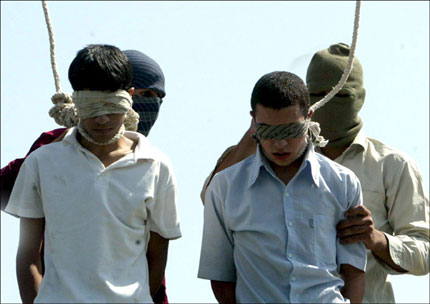
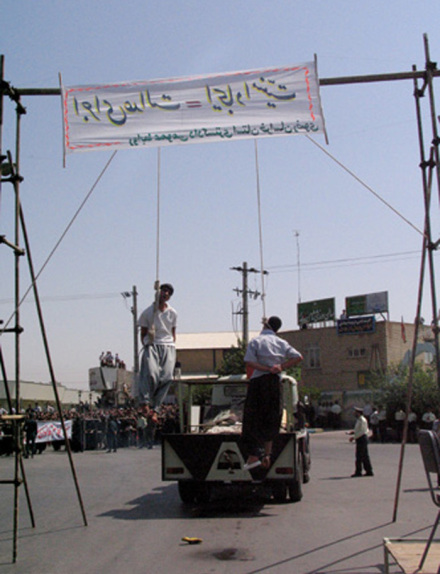
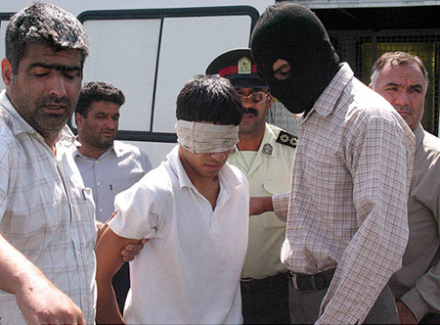
2005: Mahmoud Asgari and Ayaz Marhoni, gay teens

On this date in 2005, two teenagers were hanged in Mashhad, Iran.

Affecting photos of these two youths, their faces etched in fright and grief, their 16- and 18-year-old bodies pitifully boyish next to their executioners, became an immediate worldwide sensation.

These shocking images were quickly followed by a storm of controversy. The crime for which Asgari and Marhoni swung was the rape of a 13-year-old while both the offenders were themselves minors; gay organizations and human rights groups subsequently became mired in contentious dispute over whether (as a factual, legal, or tactical matter) they could be said to have succumbed to a “lethal reign of terror targeting Iranian gays”. For instance, was the conviction reliable, or a pretext? Would these boys actually have self-identified as “gay”?

To that were added charges and countercharges among western campaigners of racism, imperial lickspittle-ism, objective-pro-Islamic-fascism, and the like. Like, awfully convenient that Iran’s longtime dim view of homosexuality has everyone exercised at just the moment bombing Tehran was being openly mooted.

But whatever the text: those pictures. Still, those pictures.

It is certain that both Mahmoud Asgari and Ayaz Marhoni were juvenile offenders, whose execution is anathema almost everywhere in the world but Iran — just one of that country’s unique characteristics.

On this day..

2000: Dmitry Chikunov, secretly

On this day in 2000, Russian national Dmitry (or Dmitri) Chikunov was secretly put to death* in Tashkent, Uzbekistan for the murder of two men.

A symbolic grave for Dmitry Chikunov; his actual resting place is unknown.

His mother, who had been shooed away from the prison on a previous visit with a demand that she come back later, only learned of the execution when she attempted to visit him two days later.** She has never learned where he was buried.

However, Tamara Chikunova turned out to be the type to turn grief into action.

She became a prominent human rights and anti-death penalty activist in Uzbekistan (and globally); her Mothers Against the Death Penalty and Torture organization was troublesome enough that the government blocked one of its conferences in 2003.

Well, Gandhi said it — “First they ignore you, then they laugh at you, then they fight you, then you win.” On January 1, 2008, Uzbekistan abolished the death penalty.

Tamara Chikunova discusses the rampant official corruption and malfeasance endemic in Uzbekistan’s (former) death penalty, and the issues still ahead for her organization, in this interview.

* Dmitry Chikunov’s execution by gunshot took place only nine months after trial; it’s hardly a surprise that Dmitry claimed to have been tortured into confession.

** In this French article, Chikunova says her son was actually shot while she herself was in the prison attempting to visit him.

On this day..

2008: Tseng Fu-wen, drug dealer

June 26 is U.N. Anti-Drug Day, and if this year follows the recent trend, China will be marking the run-up with the salutary execution of consumers and/or vendors of chemical compounds disapproved by the state. (Update: Yes indeed it did.)

On June 24, 2008, for instance, Tseng Fu-wen, “a Taiwanese citizen who was convicted of producing or selling methamphetamine, heroin and other drugs,” was put to death in the eastern province of Fujian.

Two accomplices drew a prison sentence and a suspended death sentence (typically commuted to a prison sentence after two years).

Prosecutors said the Taiwanese trio started making drugs in October 2006.

Police arrested them one month later in Xiamen after they bought 50 kilograms of ephedrine to make methamphetamine, commonly known as “ice.”

The police also recovered 63.8 kilograms of ice, plus “varying quantities of other drugs such as heroin, and equipment and raw material in a workshop,” the agency said.

The method of execution does not appear to have been reported by the state media; China uses both lethal injection and gunshot, but I have not been able to document which method prevails in Fujian.

On this day..

2008: Anandrao Sainu Koram, Naxalite informer

Last year on this date, India’s Maoist “Naxalites” publicly beheaded a former comrade who had surrendered and collaborated with police.

Naxalites.

The incident that occurred in village Murgaon of Dhanora sub district has the entire Maoist-affected region in the grip of tension because of the manner in which the reprisal has been carried out.

A group of 40 to 50 Maoists went to the village Saturday night, called out Anandrao Sainu Koram from his house, tied him to a tree and beheaded him in full view of the villagers who had gathered at the spot, deputy superintendent of police Anant Rokde said Sunday.

“They also warned Anandrao’s colleague Shantaram Gawde, who too had surrendered to the police in April this year along with three others, that he would meet the same fate if he did not desist from acting as an informer,” Rokde told IANS on the basis of the complaint lodged by Anandrao’s wife.

The 23-year-old Koram was reportedly the fourth surrendered Naxalite slain by insurgents in as many months of the long-running and escalating conflict … which, needless to say, has been dire for civilians.

On this day..

2000: Fu Xinrong, involuntary organ donor

One Fu Xinrong was shot in the back of the head this day in China’s Jiangxi province. The previous fall, he had raped his girlfriend, murdered their newborn son, and turned himself in to police.

His death, just one no-account criminal among China’s thousands of practically anonymous execution victims, attracted no particular notice.

But quite against all odds, Fu Xinrong posthumously became the subject of a scandal: the hook for a story in the Chinese press piquantly titled, “Where Did My Brother’s Body Go?”

For the answer — that Fu Xinrong’s corpse had been driven to a Nanchang hospital and its kidneys transplanted to unidentified recipients — unveiled the shadowy post-execution operations even more unseemly than China’s industrial-scale death penalty.

According to a Washington Post report of July 31, 2001,

After Fu was shot in the back of the head, four attendants got out of the van and picked up his corpse … A government prosecutor attempted to stop them, but they explained that they were from Nanchang and that they had a deal with the court …

“We found the hospital’s director and confronted him with the evidence,” one reporter said. “In the beginning, he refused to say anything about it, but when he saw what we had, he had to admit it on the condition that we did not release the hospital’s name in our report.”

Further investigation indicated that a senior court official, whose surname is Yang, had sold the body to the hospital, the report said.

Fu’s father committed suicide. The family sued the court in 2001; I have not been able to establish whether or how that suit was resolved. However, according to a 2003 U.S. Congress report (pdf) the editor who green-lighted the story’s publication was sacked.*

Fu’s case, in any event, is far from unusual.

On the contrary, his kidneys entered a veritable souk** of transplanted organs that’s been openly pitched at westerners willing to part with five figures and their decency in exchange for a life-giving replacement part from a shot-to-order prisoner.

* This would have been around the same time that a similar fate befell journalists indiscreet enough to explore the unflattering-to-the-People’s-Republic social environment of an executed gangster.

** Finally officially acknowledged in 2005.

On this day..