2010: An Iranian crack trafficker

According to an AFP report, Iran hanged a drug trafficker in Sari, Mazandran province, on December 25, 2010 — “after being convicted of keeping, carrying and selling the narcotic drug ‘crack’,” in the words of prosecutor Assadollah Jafari.

On this day..

2011: Reginald Brooks, flipping the bird

(Thanks to Meaghan Good of the Charley Project for the guest post. -ed.)

On this day in 2011, multi-filicide Reginald Brooks was executed in the Southern Ohio Correctional Facility in Lucasville, Ohio.* He was the fifth man executed that year and, at 66, the oldest since 1999.


Brooks (top) and the children he murdered.

Although his guilt was never in question, he had spent close to thirty years on death row while his appeals wound their way through the system.

On March 6, 1982, just days after his wife filed for divorce, Brooks shot their three sleeping sons: Reginald Jr., 17, Vaughn, 15, and Niarchos, 11. He then bought a bus ticket to Las Vegas, taking the gun with him in his suitcase, as well as his birth certificate and high school diploma. The police caught up with him in Utah.

Brooks had some history of domestic violence, but his only prior arrest had been for grand theft. His aunt, when asking the appeals board for clemency, said he had a normal, loving relationship with his children. Before shooting them all in their sleep, that is.

His attorneys argued that his crimes were motivated by mental illness, namely paranoid schizophrenia. Brooks had a normal childhood and young adulthood, but started to fall apart in the years prior to the murders. He quit his job in the 1970s because he thought his coworkers were trying to poison him. (He never worked again and his wife had to support their family.)

Beginning around 1980, he began isolating himself from friends and family, and accused his wife of committing incest with Reginald Jr. The family tried to get psychiatric help for him, to no avail.

In spite of overwhelming evidence, Brooks never admitted to his crime and suggested various bizarre theories as to what had really happened. A psychiatrist who evaluated him in 2010 and 2011 believed Brooks genuinely could not remember shooting his sons.

There was, however, clear evidence of premeditation: Brooks had purchased the murder weapon nine days before the murders, lying on his application form where it asked if he’d ever been convicted of a felony. He also turned on the stereo in his apartment and left the music blaring loudly, presumably to drown out the sound of the gunshots. Then, after the murders, Brooks immediately left town, taking documents he would need to start a new life — clearly suggesting cognizance of guilt.

The prosecution conceded Brooks did have schizophrenia, but argued that his illness was not so severe as to make him incompetent or legally insane, and that he was lying when he said he couldn’t remember committing the murders. Attorneys for the state suggested he murdered his children to spite his wife, “through a twisted sense of jealousy, hatred, or despair.”

Brooks’s ex-wife, Beverly, witnessed his execution. He had no last words, but he did give a message: glaring at the glass behind which the witnesses were standing, he stuck out the middle fingers of both hands. And as he slowly lost consciousness and breathed his last, his middle fingers still stood erect.

* The Texas of the North when it comes to capital punishment.

On this day..

2010: Farid Baghlani, womanslayer

On this date in 2010, Farid Baghlani was hanged in Ahvaz for a 2004-2008 serial murder spree that claimed the lives of six women.

At trial, Baghlani openly attributed his crimes to his hatred for women, probably not a defense calculated to maximize his prospects of acquittal. Those who lost loved ones to Baghlani returned the sentiment, and celebrated his execution by handing out sweets.

On this day..

2013: Xia Junfeng, chengguan slayer

China has announced the execution this day of “homicide criminal” Xia Junfeng, a kebab vendor from Shenyang.

This case has been in the public eye for several years, and the predominant sentiment has been sympathetic towards the condemned man.

Xia and his wife Zhang Jing were part of China’s vast population of working urban poor, Xia having found his way into job insecurity by virtue of a layoff from the state electricity company. In the entrepreneurial spirit of the age, Xia started up an unlicensed business selling sausages and the like.

These denizens of the gray economy are, as a class, afflicted by the attentions of the City Urban Administrative and Law Enforcement Bureau, better known as the chengguan. Their benign job description entails administering municipal regulations, but this much-loathed force’s relationship to everyday citizens is perhaps best illustrated by the word chengguan‘s status as a shorthand neologism for bullying and abuse. Too many people know this goon squad firsthand, and too many stories of their worst excesses have circulated. Just this past July, the chengguan made headlines by killing a watermelon vendor.

“Chengguan abuses are an open scandal in China,” said Human Rights Watch’s China director. “The chengguan’s ability to flout China’s laws and inflict harm on members of the public is a recipe for greater public resentment and more violent confrontations.”

In the violent confrontation at issue in today’s execution, the chengguan chengguanned Xia Junfeng in May 2009. Xia fought back with his meat-carving knife, and slew two of his tormenters.

Death penalty cases redolent of the social stratification and institutional corruption that ordinary Chinese people experience have proven to be lightning rods in recent years.

Xia Junfeng’s turned, legally, on his claim that he killed protecting himself from the chengguan‘s beating.*

“Extralegal violence, thus employed to compensate for inadequate regulation and an absence of authority and legal deterrence, is no longer individual behavior. Such violence exists everywhere with the permission of the authorities. It is needed because of an overriding concern for “city image” and “urban management.” Finally, when extralegal violence is not monitored by the people and the media, and not punished by the law, it is only natural for Chengguan members to feel justified. Using violence with impunity enables the Chengguans to see violence psychologically as their “privilege,” a sign of status and pride. Since the legal and political status of Chengguan is unclear, it is only natural for its members to seek personal gain, vent their anger, and prey on the citizens they were intended to protect.”

-from the closing argument of Xia’s defense attorney

This allegation didn’t fly in court, where brother chengguan denied that they’d been abusing the shishkebaber, but it’s won in a rout when it comes to the court of public opinion. “His life and death are more than just a legal matter, but a bellwether of the era, with the tsunami-like public opinion firmly on the side of Xia Junfeng,” wrote author Yi Chen today.

Particularly galling for many is the disparity in treatment between Xia Junfeng and the likes of Gu Kailai, the latter a powerful business and political figure who was able to avoid execution despite being convicted of a scandalous contract murder. And Chengguan themselves never seem to be at risk of harsh punishment for any misbehavior; had Xia Junfeng been the one to leave that confrontation in a body bag, there certainly wouldn’t have been a death penalty case.


Anonymous cartoon circulated on Weibo criticizing Xia Junfeng’s condemnation. (Via) The drawing of the boy in the background was done by Xia’s son, whose art school fees were earned by his father’s roadside business.

Chinese speakers might want to peruse the Weibo feed of Xia’s widow.

* Several years ago, self-defense helped a Beijing migrat worker avoid execution for killing a chengguan who attempted to confiscate his bicycle cart.

On this day..

2013: Naw Kham, Mekong drug lord

Today in Kunming, China, Burmese drug lord Naw Kham was executed by lethal injection along with three of his associates.

Naw Kham (or Nor Kham), a Burmese Shan, ran a sizable gang of drug traffickers/paramilitaries/pirates, the Hawngleuk Militia, in the Golden Triangle.

In addition to heroin smuggling, this gang also shook down for protection money the many Chinese commercial shippers coming down the Mekong River, and wantonly raided shippers that held out on them. He was untouchable in his lawless zone (with the possible protection of Burmese military to boot) for more than a decade.

Times may have started passing Naw Kham by in the 2000s.*

China’s economic boom has driven more shipping, and a search for investment outlets for Chinese capital, both inevitably increasing its presence on the economically developing Mekong. Ultimately this had to come at Naw Kham’s expense.

He had hit Chinese shippers before to the annoyance of Beijing, but matters came to a head when the kingpin allegedly retaliated against the flouting of his “taxes” by massacring 13 Chinese sailors in 2011 on board two tightfisted merchantmen. (“Allegedly” because Naw Kham blamed the Thai military for this slaughter, and some people believe him.)

At any rate, China put the screws to the drug lord, not only pressuring Southeast Asian governments for his capture but directly hunting him with special forces. Early in 2012, Naw Kham was arrested and his gang broken up after a multinational manhunt; the leader was extradited from Laos to face Chinese justice with five of his associates.** The accused had little recourse but to throw themselves on the mercy of the court.

Executed with Naw Kham — and underscoring the multinational complexion of his outfit — were Hsang Kham (a Thai), Zha Xika (a Lao), and Yi Lai (stateless). The other two defendants received a suspended (reprieved) death sentence, and an eight-year prison term.


Naw Kham being led to an execution van on March 1, 2013. Two hours of footage of the “Mekong River murderers” walking their green mile was broadcast on CCTV News, although not the executions themselves.

The case isn’t entirely closed with his date’s executions, however. China is still pressuring Thailand to bring to book Thai troops whom China says colluded (at the very least) in the Mekong murders. The future direction of that investigation is quite unclear.

* China, Burma, Thailand, and Laos, inked a 2001 pact to regularize shipping on the Mekong. It contained no provision allowing for stateless narco-buccaneers.

** It’s noteworthy that this is a non-Chinese citizen being extradited to China for a crime not on Chinese soil.

On this day..

2012: Three drone strike spies in Yemen

It was reported that a year ago today, Islamic militants beheaded three in the South Yemen towns of Ja’ar (in the Abyan Governorate) and ‘Azzan (in the adjacent Shabwa Governorate) on charges of providing intelligence to help the U.S. to conduct drone strikes.

The executions were announced to the media by text message.

The ongoing shadow drone war in Yemen has steadily drummed that fractious Arabian peninsula state with missiles from flying death robots, piloted from afar (under separate command structures, little difference though that makes to those on the receiving end) by the CIA or the U.S. military’s Joint Special Operations Command.

The deaths one year ago took place in the sunset of President Ali Abdullah Saleh‘s government, when much of southern Yemen was functionally controlled by militants for several months. The Obama administration significantly ramped up drone strikes in south Yemen from late 2011, and kept right on ramping throughout 2012.

The stated target of all this remote-controlled ordnance is Al Qaeda in the Arabian Peninsula, but it’s more than clear that many of the nameless casualties are not militants.

For instance (and this was obviously not the strike being avenged by our February 12 execution in that same city), a May 2012 drone raid on Ja’ar was decried by locals who insisted that not one militant was among the dead.* “Our lives are valueless in the eyes of our government, and that is why civilians are being killed without a crime,” one man told CNN.

Then again, as this post goes to press, Americans have themselves had a bracing reminder of their own killability, courtesy of a leaked memo giving a partial glimpse of the Obama administration’s startlingly expansive assertion of the right to murder American citizens or whomever else on the unilateral say-so of somebody sufficiently senior.

A generation ago, the U.S. had explicit state policies abjuring assassination. Today, there are routine “Terror Tuesdays” at which the chief executive reviews proposed additions to an official kill list.** All of this is claimed as a power of a planetwide war that can never end, but in practice bears an uncomfortable resemblance to something our militants in Ja’ar and ‘Azzan would surely appreciate — extrajudicial execution.†

* Official story: two terrorists dead, “only” eight civilians; locals said around 17 to 26 killed, none of whom were terrorists. The U.S. has been accused of using Vietnam-era “body count” rules and claiming every military-aged male killed by a drone counts as a “militant.” (Contra Vietnam, Washington depresses rather than exaggerates the overall casualty counts.)

** Many drone attacks target not named individuals, but unknown people whose activities from drone or satellite surveillance are held to match a terrorist’s pattern.

† There’s even been a Congressional proposal for a secret court to decide who goes on the secret kill list.

On this day..

2013: Afzal Guru, India parliament attack terrorist

This morning at New Delhi’s Tihar Jail, India hanged the Jaish-e-Mohammad terrorist Mohammad Afzal Guru for the deadly attack on India’s parliament building eleven-plus years before.

In that December 13, 2001 strike, a team of five gunmen infiltrated the New Delhi government building and went to work. No government ministers were killed, but several police officers and a gardener died in the ensuing shootout before the militants were themselves shot dead. Some eighteen others were wounded.

The subsequent investigation led back to Kashmiri separatists, coordinating with the Pakistani Lashkar-e-Toiba.

Afzal Guru, a fruit seller and Jammu and Kashmir native, had found his way into that struggle years before via the Liberation Front founded by Kashmir separatist martyr Maqbool Bhat.

He was condemned for having conspired in the attacks, arranging the attackers’ weapons, and procuring the New Delhi safehouse where the gunmen organized.* (When searched, the place was found stocked with explosives.) Afzal Guru claimed that he was tortured into confessing and denied taking part in the conspiracy.

Though there’s been criticism of the trial’s fairness given the raw aftermath of the shocking attack, India’s Supreme Court confirmed the death sentence years ago:

The incident, which resulted in heavy casualties, has shaken the entire nation and the collective conscience of the society will be satisfied if the capital punishment is awarded to the offender. The challenge to the unity, integrity and sovereignty of India by these acts of terrorists and conspirators can only be compensated by giving the maximum punishment to the person who is proved to be a conspirator in this treacherous act. The appellant, who is a surrendered militant and who was bent upon repeating the acts of treason against the nation, is a menace to the society should become extinct. Accordingly we uphold the death sentence. (from the judgment upholding Guru’s hanging, via this anti-execution pdf pamphlet)

However, actual execution of the death sentence stalled out during the condemned man’s post-appeals clemency petition. It was a sensitive political case, for Kashmir itself (whose towns are reported today to be fortified with added security details), and as a potential irritant to Hindu-Muslim relations and India’s own tense border with Pakistan. (In the weeks following the parliament attack, India and Pakistan had a dangerous military standoff which could easily have become a nuclear war.)

Plus, at the time, actual executions were an extreme rarity in India.

Those times might be changing. While it’s conceivable that Afzal Guru might have lived out his natural life in prison under an empty death sentence, the even more devastating “26/11” plot in Mumbai in 2008 advanced an even more notorious Pakistan-backed terrorist incident to the front pages — and the front of the hanging queue. India broke an eight-year death penalty moratorium on November 21, 2012 when it hanged the Mumbai plot’s lone survivor, Ajmal Kasab.

To judge by nothing but the visible public clues, that execution might have pulled Afzal Guru to the gallows in its train, inasmuch as it ratcheted up the profile, and the perceived stakes, of Islamic terrorism in India. Guru’s hanging was being publicly demanded almost as a logical consequence as soon as Ajmal Kasab’s execution went public.

Kasab’s death also provided a logistical game plan for this date’s hanging: the entire operation arranged in secret, set up to go into immediate motion upon rejection of that long-neglected clemency brief, and the wider public to find out only after the fact.

Kasab and Guru were implicated in extraordinary crimes; it will be interesting to discover whether either the fact of their actual executions or the stealth with which they were conducted will pattern to the more humdrum common-criminal murderers and rapists also lying under sentences of death.

* Three others, SAR Geelani, Shaukat Hussain, and Afsan Guru (no relation), also stood trial for the conspiracy; the former two were condemned, but the sentences vacated on appeal, while Afsan Guru was acquitted outright. All three are free today, or at least are free of of legal jeopardy in this case.

On this day..

2010: Chemical Ali

On this date in 2010, American-occupied Iraq hanged Ali Hassan al-Majid — Saddam Hussein‘s cousin and longtime aide, better known as Chemical Ali.

Ali Hassan al-Majid as the King of Spades in the U.S. invasion force’s playing-card deck of wanted Iraqis.

Al-Majid acquired his chilling nickname for the notorious March 1988 attack on the Kurdish city of Halabja.

That day, after an appetizer of conventional bombing, Iraqi jets dropped a cocktail of multiple chemical weapons — mustard gas, sarin, tabun, and VX, give or take — killing up to 5,000 people.

“It was life frozen. Life had stopped, like watching a film and suddenly it hangs on one frame,” wrote the ethnically Iranian BBC correspondent Kaveh Golestan,* who arrived on the scene after the bombardment.

“It was a new kind of death to me. You went into a room, a kitchen and you saw the body of a woman holding a knife where she had been cutting a carrot. (…) The aftermath was worse. Victims were still being brought in. Some villagers came to our chopper. They had 15 or 16 beautiful children, begging us to take them to hospital. So all the press sat there and we were each handed a child to carry. As we took off, fluid came out of my little girl’s mouth and she died in my arms.”

It was the most emblematically ghastly event in a running ethnic cleansing campaign of the late 1980s, also headed by al-Majid.

The Halabja attack was the last of four separate death sentences Chemical Ali racked up after the U.S. invasion of Iraq, and it was handed down just a week before he stood on the gallows. The larger Kurdish genocide campaign as a whole was a separate death sentence from Halabja; there were also two others for his brutal suppressions of Shia uprisings in the 1990s.

He met all his tribunals defiantly, refusing to enter a plea and then openly embracing the atrocities imputed him. “I am the one who gave orders to the army to demolish villages and relocate villagers,” he once spat in court. “I am not defending myself, I am not apologizing. I did not make a mistake.”

* Himself a casualty of the Iraq War: Golestan was killed when he stepped on a landmine in 2003.

On this day..

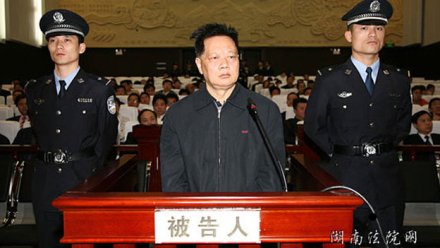
2010: Zeng Jinchun, corrupt anti-corruption official

On this date in 2010, a former Communist Party of China (CPC) anti-corruption official was shot … for corruption.

Zeng, former secretary of the Chenzhou Municipal Commission for Discipline Inspection of the CPC and vice secretary of the CPC Chenzhou Municipal Committee, gorged on 31 million yuan ($4.7 million) in bribes from 1997 to 2006, doling out lucrative mining contracts and sinecures in exchange.

Although known in the Hunan coal-mining city as “a modern-day Heshen” — Chenzhou residents whose businesses had been widely subject to Zeng’s crude protection-racket shakedowns set off fireworks to celebrate his arrest — Zeng was all but impossible to dislodge.

Zeng bribed up to higher officials for protection as effectively as he squeezed those below. It’s just another piece of the graft so endemic in China that it’s frankly represented in popular literature. (And has often appeared on the execution grounds, too.)

“Officials, especially high-ranking ones, are basically not held accountable for paying bribes,” a journalist who wrote a book about Zeng told NPR. “This is because China’s judiciary is not independent enough.” Zeng wasn’t even charged with this crime — just extortion.

Zeng’s well-placed protectors defeated at least three investigations. He was only overcome by an order from the very top: President and Party Chairman Hu Jintao, who scribbled onto a secret report of Zeng’s antics,

“To Comrade Wu Guanzheng: Put more effort into investigating corruption in Chenzhou. Signed, Hu Jintao, July 19, 2006.”

Three months later, Zeng was under arrest.

The effects of power, corruption, privilege, and cutthroat economies did not go with him. After all, on the same date Zeng was put to death, officials elsewhere in Hunan province also announced the execution of one Chen Haitao for torching an airport shuttle bus. The blaze killed two and seriously injured three others.

Chen committed the arson to revenge society as he had “blamed his business failure on social injustice,” the court said in a statement.

On this day..

2012: Richard Stokley, while his accomplice goes free

On a summer’s day in 1991, Richard Stokley and Randy Brazeal picked up two 13-year-old girls from a fair in Cochise County, Arizona and drove them to the desert. There they raped them, then stomped, strangled and stabbed the two to death and dumped their naked bodies in a flooded mineshaft.

Today, Richard Stokley is set to bewas executed for that double homicide.

His accomplice Randy Brazeal is a free man living in Arkansas.

And little but the chance progress of justice and the human judgment calls that officers of the court make every day will distinguish the fate of two men, even though their trial judge has said that he “didn’t have a feeling that one was less culpable than the other.”

Brazeal, a 19-year-old troublemaker new to the area, and Stokley, a local brute twice his age, would spin different stories about exactly what happened in the desert that night to Mandy Meyers and Mary Snyder: about how the attacks began, and who particpated in what.

Long story short: Stokley’s version had both men as full participants, raping at least one girl apiece and each strangling a different victim. Brazeal’s version had him basically just giving people a ride and Stokley committing the crimes. (It’s not clear whether the victims were abducted from the fair, or went along willingly only to be attacked later.)

Forensic DNA testing was only just emerging in 1991, and it required months to process … months that the state did not have before Brazeal’s murder trial was set to begin. Even then, the state’s attorney worried that “the status of the law is in some question as to whether the DNA evidence would be admissible.”

This uncertainty set the parameters for a plea deal in which prosecutors took the guaranteed conviction and Brazeal dodged the needle. He was released in 2011 after serving concurrent 20-year sentences for second-degree murder.

But weeks after that deal was sealed (and before Stokley’s trial) DNA tests on semen retrieved from Mandy Meyers showed that both men had indeed raped her.

The DNA evidence helped seal Stokley’s conviction, even though it and other forensic evidence around the scene also tended to buttress Stokley’s “equal partners in the crime” story to the detriment of Brazeal’s version.

The net outcome* doesn’t necessarily look like justice. Mandy’s devastated mother, Patty Hancock, has been vocal in the run-up to Stokley’s execution about her disgust with the sentencing disproportion.

“With the evidence that they did have, Randy Brazeal should be sitting right next to Richard Dale Stokley,” she told one reporter. “And I will say that until the day I die.”

Stokley, for his part, filed a similar appeal in the courts as grounds for reducing his own sentence. But even though he’s availed every legal avenue possible, he didn’t bother trying the long odds at a gubernatorial reprieve — instead writing the Arizona Board of Executive Clemency:

I am also sorry I was mixed up in those awful events that brought me to this. I have been sorry for the victims and the victims’ families. But no one wants to hear of my miserable sorrow, they just want for me to get dead, which is vengeance. They think it will bring ‘closure.’ But there is no healing in that. Ever.

I have decided to decline a clemency hearing. I don’t want to put anyone through that, especially since I’m convinced that, as things stand now, it’s pointless. I reckon I know how to die, and if it’s my time, I’ll go without fanfare. And if it ain’t, I won’t. God’s will be done.

God’s will is scheduled for 10 a.m. Mountain time today. (Update: Stokley was executed as scheduled.)

* It’s particularly striking that the man who was more forthcoming and cooperative with investigators ended up with the heavier sentence.

On this day..