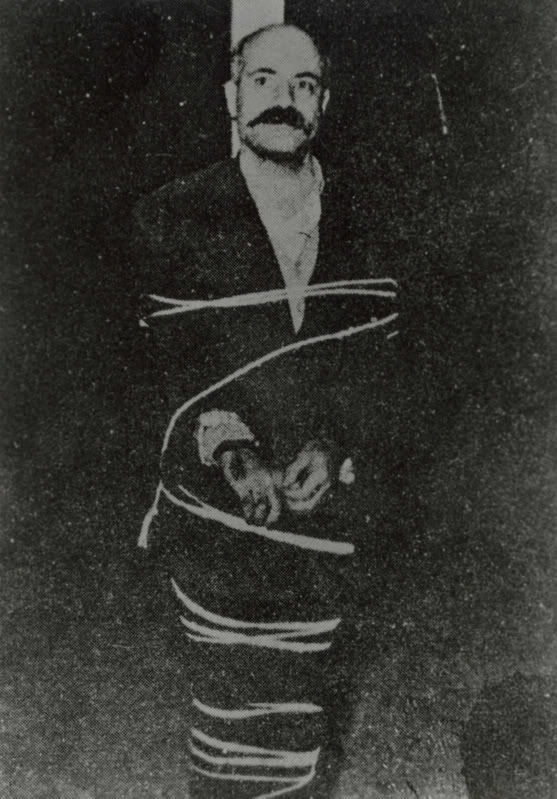
1960: Manfred Smolka, East German border guard

On this date in 1960, Manfred Smolka was guillotined in Leipzig.

Smolka was among three million East Germans or more who escaped over the border to West Germany in the 16 years after the defeat of the Nazis divided the country.

In the earliest years, people sluiced over the long border just anywhere. By Smolka’s time, that perimeter was buffered by an “internal border” that made it difficult for ordinary people to approach near enough to West Germany to escape. Consequently, most emigration by the the late 1950s occurred in the divided city of Berlin — a flow that East Germany would finally stanch in 1961 with the ultimate in immigration reform, the Berlin Wall.


One of the Cold War’s iconic photographs: East Berlin border guard Conrad Schumann leaps over the barbed-wire barrier into West Berlin on Aug. 15, 1961, just days after construction of the Berlin Wall began.

Like that more famous later escapee, Manfred Smolka (German link, as are most that follow) was a border guard; indeed, he was an officer. That gave him the ability, in 1958, to be far enough within the “internal border” to defect into West Germany

The very next year, he arranged to meet his abandoned wife and daughter on the Bavaria-Thuringia frontier to smuggle them over, too. Alas, it was a trap (pdf) laid by the feared East German secret police, the Stasi.
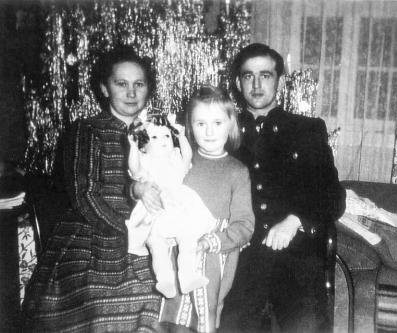

Happier times: Manfred Smolka with his wife and child.

According to press reports, Smolka was actually on West German soil when the Stasi men captured him.* (The Stasi were often up for a bit of kidnapping.)

West Germans were outraged by Smolka’s capture and subsequent death sentence for “military espionage,” but the case was deemed an apt one for the education of East Germany’s border security agents.

Only with post-Cold War German reunification could his family examine his file. “I am innocent, I can prove it a hundred times,” they read in the last letter the onetime defector wrote to his family — a letter which had never been delivered. “You need not be ashamed of me.” In 1993, a reunified, post-Cold War Germany officially agreed and posthumously rehabilitated Manfred Smolka.

There’s a few minutes of documentary video about him, in German, here.

* By a July 5, 1960 account in the London Times, Smolka was shot at and wounded as he crossed into East Germany but still managed to “crawl” back to West Germany — where his pursuers did not fear to follow him.

On this day..

1969: Lee Soogeun, North Korean defector

On this date in 1969, alleged North Korean operative Lee Soogeun (other transliterations exist for his given name, such as Soo Keun or Soo-geun) was hanged at a Seoul prison for espionage.

A North Korean party elite, Lee was the Vice President of the North Korean Central News Agency.

On March 22, at the Military Armistice Commission meetings at the border outpost of Panmunjom, Lee suddenly leapt into a UN official’s vehicle and escaped over the frontier.

The high-profile defector got a hero’s welcome in the South. (A U.S. Army captain also copped a medal for helping him escape.)

Lee hit the lecture circuit critically discussing the situation north of the 38th parallel, and worked as an analyst for South Korean intelligence.

However, the KCIA also had Lee under surveillance, and came to believe that he was actually gathering intelligence to send to the north. Realizing his predicament, Lee fled with his niece for Cambodia. They were captured en route in Vietnam.

South Korea’s Truth and Reconciliation Commission has, while stopping short of exonerating Lee, ruled his confinement illegal, and the self-incriminating statements he made in that environment insufficient evidence, and urged his case be re-tried. Lee’s niece served 20 years of a life sentence as his accomplice, but was released in 1989 and eventually won a 6.8 billion won wrongful imprisonment suit.

On this day..

1963: Oleg Penkovsky, Cuban Missile Crisis spy

It is 50 years today since Soviet military intelligence officer Oleg Penkovsky was executed for spying for the Americans.

Penkovsky, whose father died fighting for the anti-communist Whites during the Russian Civil War, lived up to his western handlers’ HERO codename by tipping the Soviets’ operational plans for missile deployment in Cuba — helping precipitate the Cuban Missile Crisis.

This speech inaugurated some of the darkest days of the Cold War … but they were probably even worse for Oleg Penkovsky, who was arrested just hours before Kennedy delivered it. He might have been shopped by a U.S. intelligence mole working for Moscow.

Penkovsky and his British contact, businessman Greville Wynne, faced a public show trial in May 1963 — resulting in the spy’s prompt execution. (Wynne got a prison sentence, and was later exchanged back to the West for Portland Spy Ring principal Gordon Lonsdale.)

The late spy’s journal was published in 1965 as The Penkovsky Papers. A variety of documents from Penkovsky’s CIA case file are available on the spy agency’s own site.

As befits the shadow world of espionage, Penkovsky’s activities and motivations are still disputed to this day. While some consider him among the most valuable/damaging spies in the Cold War, former MI5 officer Peter Wright claimed that Penkovsky was a loyal Moscow agent all along actually trafficking disinformation — and that he was not executed at all but cashiered to a comfortable secret retirement after his show trial “condemnation.”

But here’s the conventional take:

On this day..

1985: Vladimir Vetrov, Farewell

This date in 1985 spelled farewell for the KGB agent Vladimir Vetrov … code-named Farewell by the western handlers to whom he passed Soviet secrets.

Vladimir Vetrov was a career officer in Soviet intelligence who grew disgruntled* and in 1980 went to work for the West.

And he was no ordinary spy. Think Aldrich Ames, to the power of ten.

Vladimir Vetrov oversaw the entire KGB directorate charged with a critical program: Line X, which surveilled western R&D and passed its fruits back to Mother Russia. In the 1960s and 1970s, Line X stole jaw-dropping volumes of military, computer, and industrial advances.

And by 1980, all that information passed through Vetrov’s hands for distribution within the USSR. His betrayal blew the entire thing to smithereens.

When he turned, Vetrov gave 3,000 pages of top-secret documents to his French handlers, information which also made its way to the CIA. “The Soviet military and civil sectors were in large measure running their research on that of the West, particularly the United States,” recalls the gobsmacked American defense advisor who reviewed the file. “Our science was supporting their national defense.”

Book CoverSergei Kostin calls his book about the man Farewell: The Greatest Spy Story of the Twentieth Century, and Vetrov has surely got a claim on that title. (It’s either Vetrov or Sorge when it comes to the annals of Soviet espionage.)

The Farewell dossier exposed the entirety of the Soviet technology-stealing infrastructure, with a couple of enormous consequences.

One, it influenced Cold War strategy in the West, supporting the Reagan administration’s view that the Soviet economy (absent its stolen technological advances) could be pushed into collapse.

And two, it facilitated Langley’s most spectacular counterespionage coup, brainchild of Gus Weiss. Rather than smashing up the Line X network, the CIA turned the enormous (and in Moscow, trusted) apparatus against its creators.

By feeding Soviet agents promising but subtly flawed technology, the Americans infiltrated sabotage points into the USSR — a Trojan Horse for the information age. In 1982, software running the Soviet Trans-Siberian Pipeline allegedly escalated gas pressure fatally on the Urengoy-Surgut-Chelyabinsk pipeline, triggering an explosion so large (three kilotons) that some foreign monitoring stations initially suspected a nuclear detonation. Weiss just told them not to worry.

Meanwhile, goes the story (and one must discount appropriately here for triumphalist spin), other crapware started failing elsewhere in the Soviet Union. “Pseudo-software disrupted factory output. Flawed but convincing ideas on stealth, attack aircraft and space defense made their way into Soviet ministries.” Suddenly, the Russians couldn’t know which Line X acquisitions were dependable and which were time bombs.


From Farewell, a 2009 film.

Vetrov’s candle burned bright, but brief: he stabbed his mistress (non-fatally) during a drunken argument in 1982, then stabbed to death the man who knocked on his window to intervene. Vetrov got a trip to Siberia, but while serving his time, he casually revealed that he’d authored maybe the most spectacular inside betrayal of Russian intelligence in the 20th century. He was duly recalled for a new trial and, eventually, a bullet in the head in Moscow’s Lefortovo Prison. Even in the post-communist state, he’s still considered a villain in his homeland.

More about Vladimir Vetrov and the Farewell dossier in this BBC Witness podcast.

[audio:http://downloads.bbc.co.uk/podcasts/worldservice/witness/witness_20120726-0900a.mp3]

* Vetrov didn’t betray the Kremlin for money. Sergei Kostin believes it was professional frustration — the revenge of the underappreciated nebbish whose merits couldn’t break through the nepotism ceiling at the clubby KGB. However — though the explanations are not necessarily inconsistent — Vetrov also wrote a pre-execution “Confession of a Traitor” savaging the Soviet system: “My only regret is that I was not able to cause more damage to the Soviet Union and render more service to France.”

On this day..

1964: Preap In, Khmer Serei operative

“It was at that point that I began to hate Sihanouk.”

-Khmer writer Soth Polin on Preap In’s treatment

On this date in 1964, Cambodian dissident Preap In was shot in Trapeang Kraleung … an execution so public that every cinema-goer in the country would witness it.

This is the Cambodia of Narodom Sihanouk — “a libertine and a francophile, a filmmaker and a painter, a serial husband and father and philanderer, a cherubic but ruthless god-king,” in the words of one obituary when he died late last year.

Plucked from the distant branches of the royal family tree and set up on the throne as an 18-year-old French puppet in 1941, Sihanouk cast a long shadow over his country for the balance of his long life. He surprised his colonial overseers by agitating, successfully, for independence, adding to his regal stature the laurels of national patrimony.

He would in 1955 abdicate the throne — settling for “Prince Sihanouk” — to operate as a conventional politician. One who was the father of his country and the shadow-king. Needless to say, Sihanouk dominated the ensuing era of Cambodian politics.

That politics makes for dizzying reading. At one level, Sihanouk was basically an autocrat with a fairly corrupt developing state. But his statecrafting finesse elevated him far above the bog-standard Cold War dictator. Sihanouk dextrously played the French off against the Americans, East off against West, and shifted the tone of his domestic governance from socialism to Buddhism to nationalism with everything in between. He was a consummate survivor steering a small state on an independent course through the dangers of Cold War ideologies and allegiances.

In 1963-64, Sihanouk’s relations with the United States were on the outs.* Although Sihanouk was also a rival of the late Vietnamese ruler Ngo Dinh Diem, he can’t have welcomed that man’s ouster and execution with the blessing of the superpower sitting right next door with so much megatonnage.

A natural suspicion, only heightened by known CIA patronage of the Khmer Serei (“Free Khmer”), right-wing but anti-monarchist guerrillas led by a longtime Sihanouk foe named Son Ngoc Thanh.

Long story short, Sihanouk as part of his geopolitical machinations had been firing demands at the Americans that they prevail upon their Southeast Asian clientele to put the screws to the Khmer Serei — who used extraterritorial bases to send radio broadcasts into Cambodia. In late 1963, the young engineering student Preap In, who had become a Khmer Serei operative, slipped back into Cambodia with a safe conduct from his uncle In Tam.

Though he would later help to overthrow it, In Tam was a powerful political figure in Sihanouk’s state, at this time governor of Takeo. But he was setting up his nephew or else someone else was, and the “safe conduct” proved an utter sham.

On November 19, at a special national congress, Sihanouk announced the arrest of the two Khmer Serei operatives, Saing San and Preap In … After several conversations with officials in Takeo, In and Saing San had been arrested peremptorily, brought to Phnom Penh under guard, and put on display in cages at the national congress. Facing the prisoners and surrounded by thousands of supporters, Sihanouk denied making any special arrangements with them, and the congress soon became an impromptu judicial hearing. Sihanouk asked both men to admit that the Americans were aiding Son Ngoc Thanh and providing the Khmer Serei with radio transmitters. Saing San said yes to both questions and was immediately released. Preap In, apparently in shock, stared straight to the front, refusing to answer. Sihanouk then demanded that he be subjected to the “will of the congress.” Hundreds of spectators stormed the cage where Preap In stood in silence, bombarding him with rubber sandals, debris, and abuse until he was hustled away to face trial at the hands of a military court. (Source)

Sihanouk’s official version: Preap In “spontaneously confessed” to treason.

Sihanouk not only advanced the public shooting of the young Khmer Serei, but he ordered it filmed; the graphic 15-minute newsreel was played before feature attractions in cinemas throughout Cambodia for weeks to come, while still shots of the execution were distributed on propaganda posters.

Authoritarian Sihanouk may have been, but theatrical bloodletting wasn’t otherwise known as his style. Preap In’s lasciviously rough treatment stood out for its novelty and revolted many Cambodians; David Chandler would remark that this event “frequently surfaced in the 1980s when informants sought to date the beginning of Sihanouk’s decline.” Despite that onetime multimedia exposure, if the video or still images from it are accessible online I have not found them. This still image from a (I believe) Sihanouk-era firing squad execution is the best I’ve got, but as my Khmer is a little rusty, I’m at a loss to identify the unfortunate fellow on the post.

* For the view from Washington, see this contemporaneous CIA analysis, a FOIA’ed pdf.

On this day..

1946: Public Execution in Debica

On this date in 1946, market day in the southeastern Polish town of Debica, three captured fighters* from the anti-communist Freedom and Independence (WiN) movement were publicly hanged.

This salutary, and surprise, hanging was a nasty public message during the dirty post-war war to consolidate communist authority in Poland.

The message, however, was not exactly meant for a world wider than Poland itself, so the fact that it was captured in a grainy photograph snapped by WiN agent Józef Stec and subsequently smuggled out to the West was not at all to the liking of Polish authorities.

According to a WiN eyewitness report also presumed to have been filed by Stec,

First the MO [local militia], the UB, and the military occupied the execution square holding their machine guns ready to fire. Then, a car came with uniformed individuals who placed the noose on the hook. After a short time the same car brought three condemned men in white shirts. Their hands and legs were tied with barbed wire. A Jewish prosecutor read the sentence and passed the condemned into the hands of the executioner. Before the execution, one of the condemned yelled: “Long live the Home Army. Long live General Anders and General Bor-Komorowski. Down with the commies. Brothers persevere or you’ll die like us. I swear before God that I have never been a bandit [as communist authorities designated them]. I am dying for the Motherland. Lord forgive them [the executioners] because they know not what they are doing.

* The victims were Józef Grebosz, Józef Kozlowski, and Franciszek Noster, according to the 2003 monograph After the Holocaust: Polish-Jewish conflict in the wake of World War II, by Marek Jan Chodakiewicz. This monograph is also the source for Stec’s quoted report on the hanging.

On this day..

1958: Khosrow Roozbeh

On this date in 1958, Iranian communist Khosro(w) Roozbeh was shot in Qezel Qal’eh prison.

“A popular teacher at the Military Academy, Rouzbeh was the author of a number of pamphlets on chess, artillery warfare, and, together with Ovanessian, the country’s first political lexicon,” blurbs Tortured Confessions: Prisons and Public Recantations in Modern Iran.

He was also not only a communist, but a radical within the context of Iran’s communist Tudeh Party.

After the 1953 CIA-backed coup restored the Shah of Iran, his government persecuted Tudeh activists as a fifth column.

Thousands were arrested, and brutally tortured into betraying their comrades. While most weren’t put to death, Roozbeh was both a true militant — he opposed moderates’ attempt to make common cause with the liberal Mossadegh government that the Shah had deposed — and the organizer of a network of military infiltrators. The British embassy called him the “Red Pimpernel” for his uncanny talent for slipping traps and getting about in disguise. But that act never has a long shelf-life.

Roozbeh was finally winged in a 1957 shootout and taken into custody, where he was tortured into his own confessions (e.g., that he had assassinated Tudeh members who were too willing about their police collaboration). After spending his last night on this planet putting NaNoWriMo to shame by cranking out a 70-page political manifesto, he’s supposed to have met his executioners defiant to the last, refusing a blindfold and crying “Long Live the Tudeh Party of Iran! Long Live Communism! Fire!”

But the volley that silenced Roozbeh’s cry can be seen in retrospect to mark the definitive elimination of communism from Iran’s political stage, the piece de resistance for SAVAK’s campaign of suppression.

After Roozbeh, Tudeh slipped into irrelevancy (Spanish link) … leaving little but the outsized myth of its most renowned martyr.

On this day..

1949: Traycho Kostov, Bulgarian purgee

On this date in 1949, leading Bulgarian communist Traycho (Traitcho, Traicho) Kostov was hanged in Sofia.

A journalist and agitator from way back, Kostov was a casualty of the postwar political chasm between east and west.

He’d been the number three man in Bulgaria’s communist hierarchy at the time of his fall in January of 1949, but had also been considered close to Yugoslavia’s independent socialist leader Josip Broz Tito. Like Tito, Kostov was a little too into his own country’s national economic sovereignty as against the purported greater good of a Soviet-dominated eastern bloc.

Stalin had overtly split with Tito in 1948. Over the next few years, Soviet satellites in eastern Europe would systematically eliminate perceived Titoist elements — and submit to economic integration on Moscow’s terms.

So a propagandist could write, comparing Kostov to the Hungarian minister who had swung for Titoism just weeks before, that

[i]f Laszlo Rajk could be regarded as the right arm of Tito’s plans for Eastern Europe, Traicho Kostov, member of the Bulgarian Politburo and Deputy Premier, was certainly his left arm. I sat in a crowded court in Sofia in December, 1949, heard and watched Traicho Kostov and ten other accused and dozens of witnesses testify to a Yugoslav plan for Bulgaria every whit as diabolical and bloodthirsty as that for Hungary. In reality there was only one overall strategic plan with “Operation Rajk” and “Operation Kostov” as tactical moves.

Specifically, “Operation Kostov” entailed spying for western (plus Yugoslavian) powers and plotting to overthrow the People’s Republic.

Although his enemies had browbeaten Kostov into political self-denunciation at party summits, the man stoutly repudiated guilt at trial — which was not necessarily the norm in the show trial genre.

Kostov’s ten fellow defendants received prison terms rather than the rope, and some of them were alive to enjoy the official rehabilitation that followed Stalin’s death.

On this day..

1961: Four for the assassination of Rafael Trujillo

Fifty years ago today, four men were shot for the ajusticiamiento — “execution” — of longtime Dominican Republic dictator Rafael Trujillo.

El Jefe had run his half of Hispaniola for more than thirty years, mirroring his contemporary Stalin for creepy personality cult — giant signs reading “God and Trujillo”; the capital city renamed after him — and dictatorial ruthlessness. Except, of course, that Trujillo was violently anti-communist. He’s the very man for whom U.S. Secretary of State Cordell Hull coined the memorable (and endlessly recyclable) quip, “He may be a son-of-a-bitch, but he is our son-of-a-bitch.” The guy could even get away with disappearing people from New York City.

The Mario Vargas Llosa novel Feast of the Goat revolves around the Trujillo assassination.

But by the last decade of Trujillo’s reign, Dominicans were increasingly tired of his being their son-of-a-bitch.

An abortive 1959 invasion by Dominican exiles was defeated militarily but helped spawn the dissident 14th of June movement — which naturally met with state repression, most emblematically the 1960 murder of the Mirabal sisters. World opinion turned against Trujillo, and even Washington, chastened by the recent Cuban Revolution, feared that their son-of-a-bitch was becoming counterproductive.

So the CIA had actually collaborated with the plot against him hatched among other Dominican elites, providing guns, money, and its all-important blessing. “From a purely practical standpoint, it will be best for us … if the Dominicans put an end to Trujillo before he leaves this island,” the spy agency’s local station chief reported to his superiors late in 1960,

If I were a Dominican, which thank heaven I am not, I would favor destroying Trujillo as being the first necessary step in the salvation of my country and I would regard this, in fact, as my Christian duty. If you recall Dracula, you will remember it was necessary to drive a stake through his heart to prevent a continuation of his crimes. I believe sudden death would be more humane than the solution of the Nuncio who once told me he thought he should pray that Trujillo would have a long and lingering illness.

On May 30, 1961 (Spanish link), Trujillo’s car was ambushed on Avenida George Washington outside “Ciudad Trujillo” by members of his own armed forces, and riddled with gunfire. When the bullets stopped flying, Rafael Trujillo’s body was a bloody heap on the asphalt. Today, the spot is marked by a memorial plaque — commemorating not Trujillo, but the men who killed him.

That did for the dictator, but the larger aspiration of regime change experienced a little blowback.

Rather than a new dawn of liberalism and human rights, Trujillo’s son Ramfis seized power and vengefully went after his father’s killers. The Dominican Republic became prey thereafter to that familiar cycle of military coups and unstable juntas, leading a few years later to outright American occupation.

But before Trujillo fils was pushed out of the job, he had six of the assassins hunted down: two were killed resisting capture, and the other four put to death by firing squad on this date — their remains allegedly thrown to the sharks (pdf) after their executions.

There’s a BBC interview from spring 2011 with a surviving co-conspirator, Gen. Antonio Imbert, here.

On this day..

1635: Domingos Fernandes Calabar, traitor?

On this date in 1635, Domingos Fernandes Calabar was garroted at Porto Calvo.

A mulatto plantation owner, Calabar (Portuguese Wikipedia page) did his patriotic duty according to the dictates of Brazil’s Portuguese colonizers when an expansionist Netherlands showed up hungry for a bite of Brazil.

But after rounding up a volunteer militia and helping repel Dutch incursions in 1630 and 1632, Calabar switched sides and joined Holland.

Why he switched sides remains permanently obscure. Popular explanations include: the seductions of Netherlander lucre (Calabar’s detractors like this one); a politically mature calculation that the Dutch would make more progressive colonizers than the Portuguese (this was Calabar’s own defense: “I spilled my blood for … the slavery of my homeland … With its actions, the Dutch have proven better than the Portuguese and Spanish”);* or … somewhere in between

He was rewarded for his devotion [to the Portuguese] by the contempt of his countrymen, who were envious of his prowess. Wounded by this conduct, he left the Portuguese and joined the Dutch.

Whatever the reason(s) for it, Calabar’s switch was efficacious: he knew the lay of the land, and he was vigorous in helping the Dutch foothold of “New Holland” expand. The Dutch commissioned him a Major, and he gained a reputation for his ambushes.

I never met a man so well-adapted to our purposes … the greatest damage he could cause to his countrymen, was his greatest joy.

-English mercenary in the Dutch service

The Portuguese official Matias de Albuquerque eventually turned the tables and captured Calabar in a Portuguese ambush. He not only had the disloyal subject strangled, but quartered the body for public display.

This gruesome warning against collaboration did not prevent New Holland from growing to around half the Brazilian territory … but since Brazilians don’t speak Dutch today, you might have an idea how this is going to end.

After “New Holland” was re-conquered and re-re-conquered, the Dutch Republic under Johan de Witt — preferring a commercial empire to a territorial one — gave up its untenable position in exchange for 63 tons of gold.

As the (eventual) winners of this imperial affray, the Portuguese wrote a distinctly unflattering history of Domingos Fernandes Calabar, the disreputable traitor. He’s a sort of Benedict Arnold character synonymous with disloyalty for any Brazilian schoolchild.

But other interpretations are available.

During Brazil’s Cold War military dictatorship, when traitorousness might seem downright reputable after all, the “official version” was slyly subverted in several different stage productions, the best-known of which is a musical called Calabar: In Praise of Treason.**

Most of the information about Calabar online is in Portuguese; for instance, biographies here and here.

* Let it not be implied that the Dutch were out for anything other than the plunder of empire themselves: Calabar’s own home region of Pernambuco was desirable precisely because of its sugar cane cultivation.

Incidentally, the vicissitudes of war enabled many African slaves to escape to Maroon communities like Palmares — just a few miles away from Porto Calvo.

** See Severino Jaão Albuquerque, “In Praise of Treason: Three Contemporary Versions of Calabar,” Hispania, Sept. 1991. “Less interested in settling the issue of Calabar’s martyrdom than in provoking serious debate about the meaning of loyalty and national identity in times of political repression and in the context of a dependent culture, these plays … bring to the fore the manifold ambiguities the colonized face reacting to the hegemonic rule of the colonizer.”

On this day..