On this date in 1937, the Soviet economist Alexander Chayanov was shot during Stalin’s purges.
“Our present capitalist form of economy represents only one particular instance of economic life and the validity of the scientific discipline of the national economics as we understand it today, based on the capitalist form and meant for its scientific investigation, cannot and should not be extended to other organizational forms of economic life.” (via)
A specialist in the rural economy, Chayanov was noted for his forward thinking about Russia’s backwards peasantry.
Prevailing Marxist orthodoxy envisioned this class hurtling inevitably towards capitalism as its members sought their own advantage;* against this, Chayanov emphasized the resilience of the peasantry. And not only that, he postulated that the unwaged peasantry operated in an economic constellation alien to the classical model of value maximization — and would rather tend to relax labor once it reached subsistence production, rather than working ever onwards to attain surplus value and Five-Year Plan quotas.
This theory accurately anticipated difficulty for Soviet agricultural policies like collectivization and grain confiscation.
Denounced as an apologist for the refractory kulaks — official agrarian bogeymen of the early Soviet state — Chayanov was arrested in 1930 and found himself shipped to a labor camp in Kazakhstan. He was re-arrested in 1937, tried, condemned, and shot in a single day; his wife Olga also disappeared into the gulag only to be released in 1955, after Stalin’s death. They were officially rehabilitated in 1987 under Mikhail Gorbachev.
Though Chayanov’s own work was cut short by his suppression, his ideas would resurface in the postwar period and find exponents among western economists and social scientists. Nor have those ideas been exclusively of interest to academics studying peasant societies; Chayanov’s emphasis on the family as an essential economic unit found an echo in the New Home Economics field launched in the 1960s by classical economists like Gary Becker, while his appreciation for maintaining a harmonious relationship to the land has been revived in contemporary Russia by Vladimir Megre‘s “Ringing Cedars” eco-cult.
* Marx wrote in Theories of Surplus Value that the “peasant who produces with his own means of production will either gradually be transformed into a small capitalist who also exploits the labor of others, or he will suffer the loss of his means of production … and be transformed into a wage worker.”
On November 19, 1720, Edward Hunt was hanged in Philadelphia. He was the only Pennsylvanian executed for treason prior to the American Revolution — that treason being not the betrayal of the state (in the sense we might think of it today), but counterfeiting.
In the bitterness of his scaffold speech, which disdains the customary acknowledge-my-guilt, pray-for-my-soul form of the genre to complain about his case, Hunt made plain that he was not reconciled to the justice men had rendered him.
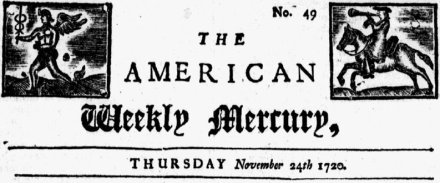
The American Weekly Mercury of Thursday, November 24 published “this extraordinary Piece” only with a preface complaining that “it is evident, that the following Speech was intended to misrepresent the Administration and Justice of this Government, as well as to infuse both ill Principles and Practices into the Minds of the People.”
The Dying Speech of Edward Hunt, formerly taken in Rebellion at Preston, and transported a bound Servant to the Island of Antigua, before his Execution upon the 19th Instant, at Philadelphia, where he had been legally convicted of High Treason, and most justly condemn’d for his Counterfeiting Spanish Silver Coin, made current* by Act of Parliament within all his Majesties Colonies in America.
It may be expected, that I should say some thing now concerning my Life and Conversation, which i must with Sorrow own to God and the Word has not been according to the Precepts and Principles of the Church, in which I was bred and educated: But with a sincere repentance and hearty Sorrow I do lament all the Errors of my past Life, firmly believing in my Saviour Jesus Christ, in whose Merits and ever flowing Mercy I do only trust for Salvation and Pardon, who has promised Eternal Life on no other Terms to the most Righteous upon Earth.
As to the Crime that now I suffer for in particular, I must own it is an Offence against the Laws, which I hope God will pardon me since he knows that I did not do it with any Design to cheat or defraud any one, or to make a Practice of Coining; but being ignorant of the Breach of any Laws of God or Man, I thought I might cut those Impressions as innocently as any other, or the Stamps that the Gentlemen of this place imploy’d me about, to make Farthings.** I am an English Subject, and desired to have the Privilege of the Laws of England, but it was not granted in any Point, except in Condemning me.
I am the first unhappy Instance of this kind that ever suffered in the King’s Dominions, pray God it may be a Warning to all, not to offend wilfully in the same that I did through Ignorance: For if I had known it, I would not have taken all the World to have done it. God give me a patient Resignation to submit to his blessed Will, in whatsoever he please.
I do heartily ask Forgiveness of all that I have offended in any manner of way, and do sincerely forgive all that have injured or offended me; particularly Mr. John Moore and Morris Birchfield, and the Evidence that swore against me in that Tryal. I do solemnly declare, That I know not any thing, or have been guilty of any one thing laid to my Charge in that Matter, or any of the other things laid to my Charge, by John Butler, either in England or Ireland.
I did petition the Honourable Governor for a Reprieve, until the King’s Pleasure was known concerning me, being I could not be tried by the Laws of England in all Points, as a Church of England Man ought to be: But it was a Privilege too great for me to obtain. Pray God to forgive them all, and every one that has a hand in taking away my Life any manner of way, and that my Blood be not required at their Hands, for they know not what they do. I am on Earth judged and condemned to die for the Breach of a Law of Man that was not duly published, which for that Reason I transgress’d it ignorantly, though the first that suffers for the Transgression of unknown Laws, or that was sentenced according to the Laws of England, without the Privilege of a Subject, which I desired of the Judge, which I know was not qualified by the same Laws to try me.
I do not know what Advantage there can be to any in my Death, and that I could not appeal to my King, neither before nor after my Tryal. I do not speak this because I am not in Charity with all the World, I do, from the Bottom of my Heart, forgive all in Obedience to my Saviour’s Command and Example, who suffered more for me, being innocent, and had not only done no Harm, but Good, and pray’d even for is cruel Persecutors and Murderers, and promised, That those that follow his Examples in this World by patiently enduring the Cross, shall reign with him to all Eternity: To Him therefore I commit all, an my poor Wife, beseeching him to help her, and be her Support and Comfort, and preserve her poor Soul free from the Polutions [sic] of the World, that through his precious Merits we may meet where we shall be both happy to all Eternity, in the merciful Arms of our dear Lord and Saviour Jesus, who I do beseech to receive my poor Soul.
* Early colonial American commerce was severely hampered by a shortage of English/British currency. As a result, coins minted in Spain’s lucrative southern territories served as the colonies’ primary currency in the 17th and 18th centuries, particularly the iconic eight-real silver “pieces of eight”.
This is the reason why the currency of the present-day U.S. isn’t an “American pound sterling” but the almighty dollar: Dutch colonists had brought a coin called the leeuwendaalder to their former New Amsterdam (New York) province, the name deriving from the German thaler. As the pieces of eight corresponded to the thaler/daalder, it inherited the same name. Indeed, the “Spanish Dollar” remained legal tender in the post-colonial United States until 1857.
This is also the reason for reckoning of the eight constituent bits that comprised the dollar, and hence of the American colloquialism “two bits” to denote $0.25 … and, later, the adjective “two-bit” to man something cheap, mean, or small-time.
** They may have been Spain’s coins, but it’s wildly implausible that any Englishman could think he could counterfeit “innocently.”
On this date in 1656, an Istanbul mutiny against debasing coinage resulted in thirty-odd high officials hanged at the gates of the Blue Mosque.
In Ottoman periodization, 1656 is the end point of the Sultanate of Women — a century-plus span stretching all the way back to Roxelana when powerful harem women consistently defined Topkapi Palace intrigue, often alongside shaky male executives.
Many of the sultans in that span were minors, as was the the putative head of state for our scene, 14-year-old Mehmed IV. Their succession was invariably achieved by the skillful maneuvering of their mothers, who then figured to graduate to Valide Sultan, “Mother Sultan” and wield considerable power in their own right. In Mehmed’s case, Mother Sultan was a Ukrainian former slave named Turhan Hatice … but you can just call her the power behind the throne.
(Actually, Turhan was initially aced out of the powerful Valide Sultan gig by Mehmed’s paternal grandmother when Mehmed inherited the throne at the age of six; Turhan herself was only about 20 years old at that time. Turhan had that woman assassinated in 1651 to swipe the position.)
Come the 1650s, the Ottomans were mired in a long war with Venice over control of Crete — ultimately a Pyrrhic victory for the Ottomans in view of the enormous cost.
One of the ongoing costs of that conflict was currency depreciation; silver coins were so hard to come by that European traders made tidy money hauling debased silver-coated copper coins to sell in Istanbul — and had no shortage of buyers who knew exactly what they were getting and were happy to have it. According to Caroline Finkel, “1000 aspers of [official coinage] was valued at less than one hundred aspers in the market-place.”
Janissaries* aggrieved at being paid in rubbish “marched to the Hippodrome, vociferously demanding that those who had deceived Sultan Mehmed by implementing the debasement be killed.”
That’s an experience to drop your gonads when you’re 14 years old. The Janissaries, the capital’s elite warrior clique, had the sultanate by the short and curlies and were known to enforce their whims to the detriment of the empire’s interests. They had, indeed, revolted over currency depreciation in the 1580s; they also deposed Mehmed’s uncle, 17-year-old Sultan Osman II, when that young man tried to curb Janissaries’ dangerous power.
Undoubtedly these mutinous Janissaries would have enforced their demands with similar desperation. Jenkins says that the execution of the Mother Sultan was one of those demands, but at least the teen sultan was able to cross her name off the hit list. The various attendants, aghas, and eunuchs who irritated the Janissaries were not so fortunate.
We’ve titled our post with the most titillating of this date’s targets of Janissary wrath. Ottoman Eunuchs** came in the “Black” and “White” varieties, as in black and white races; because Islam prohibited castration, they were obtained by slavers in Africa or in the Balkans, where Christians and Jews did the dirty work.
European “White Eunuchs” from the Balkans had their testicles removed; these were sought by the hundreds as palace bureaucrats in Istanbul. African “Black Eunuchs” from Egypt or Ethiopia typically had their entire genitalia cut off, and had the more powerful position of serving the royal persons. (They had usurped that role in the late 16th century from the formerly preeminent white eunuchs.)
Each racial set had its own hierarchy and its own chief. The Chief Black Eunuch was the master of the harem and a powerful, trusted emissary of the Valide Sultan: it was her black eunuch that Turhan Hatice had sent to murder Mehmed’s original Valide Sultan.
A black eunuch — I think? — looms over a new concubine in Alexander Russov’s 1891 Bought for the Harem. Lest one think this sort of lascivious Orientalism is solely the relic of a bygone age, check out the Harlequin bodice-ripper of the same title.
These chief eunuchs, and especially the chief black eunuchs, were among the sacrificial executions the Janissaries required for their obedience. Mehmed did not attempt to protect them; one doubts that he could have done so.
The sultan’s acquiescence in these executions set him up for a 39-year reign, the longest since Suleiman the Magnificent. But it was also under Mehmed that the Sultanate of Women gave way to the civil administration. Later that same year of 1656, continuing crisis forced the appointment of Koprulu Mehmed Pasha as Grand Vizier.
The Albanian Koprulu wielded virtually dictatorial powers and founded a whole dynasty of Ottoman Grand Viziers† that dominated Ottoman politics into the 18th century.
* The Janissaries were infantry; their less-(in)famous cavalry counterpart, the Sipahis, also participated in this 1656 mutiny.
** Eunuchs persisted in the Ottoman sultanate right up until the end of World War I, and ex-eunuchs (well, still eunuchs) of the ex-Sublime Porte were still to be found in Turkey as late as the 1970s. One of them recounted the experience of being kidnapped and castrated in Ethiopia for export to the Ottoman palace.
While often understood casually as a sort of mindless technophobia, wreckers — Luddites and otherwise — actually had material labor grievances. New more efficient power looms reduced skilled workers to the ranks of unskilled subsistence labor, or to those of the superfluous unemployed.
With trade unionism illegal (and severely repressed), their means of resistance were of a desperate character. Lord Byron, almost alone in Parliament, rose to defend them: “These men were willing to dig, but the spade was in other hands; they were not ashamed to beg, but there was none to relieve them. Their own means of subsistence were cut off; all other employments pre-occupied; and their excesses, however to be deplored and condemned, can hardly be the subject of surprise.”
Hence, Byron sarcastically remarked, “new capital punishments must be devised, new snares of death must be spread, for the wretched mechanic who is famished into guilt.” Parliament did indeed extend its capital statutes to the protection of these new looms.
“Wrecking,” in the analysis of the late Eric Hobsbawm, “was simply a technique of trade unionism in the period before, and during the early phases of, the industrial revolution.”
Hobsbawm quotes a Nottingham town clerk describing the way textile manufacturers “acquire entire control of their workmen” by putting them to work on the owners’ power looms rather than hiring out workers who use their own looms. “Perhaps the most effectual manner in which the combination [read: proto-union] could coerce them was their former manner of carrying on war by destroying their frames.”
And the descriptor “war” was not far off.
The Luddites — so named for legendary loom-smasher Ned Ludd — proliferated in 1811-1812. Beginning in Nottingham with a protest against falling wages signed by General Ned Ludd and the Army of Redressers, they tapped a wellspring of discontent.
It was a time of war, of economic crisis, of spiking wheat prices whose rise to an 1812 record peak further immiserated those who scraped to earn a living by the sweat of their brow. A generation after the French Revolution, with Napoleon rampant on the continent, English elites had reason to fear their own legitimacy stood on unstable ground.* In 1811, the king even went mad.
And they thrive well who from the poor
Have snatched the bread of penury,
And heap the houseless wanderer’s store
On the rank pile of luxury.
From their birthplace in Nottingham, Luddite societies spread out through textile country, conspiring by moonlight to break into factories and smash up frames or commit other acts of industrial sabotage. (There’s a pdf timeline here) Byron, the Luddites’ defender, owned that the night before he departed a recent visit to Nottingham, “forty frames had been broken the preceding evening as usual, without resistance and without detection.”
Terrified manufacturers — some were known to have armored their establishments with what amount to siege fortifications; others, to outfit homes with early panic rooms as bolt-holes in the event of a Luddite attack — met this mob action violently. Westminster put 12,000 troops into Luddite country to fight the wreckers.
And the wreckers fought back.
William Horsfall, owner of a Marsden wool mill with 400 employees, had vowed to “ride up to his saddle in Luddite blood” … which promise gave a poetic twist to his actual fate: while riding on Huddersfield‘s Crosland Moor** in April 1812, a group of Luddites lying in wait opened fire on him and shot Horsfall through the groin.
“As soon as he fell after being wounded the inhuman populace surrounding him reproached him with having been the oppressor of the poor — they did not offer assistance,” an officer later reported. “Nor did any one attempt to pursue or secure the assassins who were seen to retire to an adjoining wood.” A fellow-manufacturer helped Horsfall to an inn, where he expired painfully 38 hours later.
It was several months before the powers that be were able to crack it.
Eventually, the energetic Huddersfield magistrate Joseph Radcliffe† was able to exploit the threat of hanging to force a Luddite cropper‡ into impeaching his confederates in the plot. This investigation is covered in marvelous detail at the Luddite Bicentenary blog, an outstanding resource on the period in general, but for our purposes we’ll sum up to say that the hunt for Horsfall’s killers wound up zeroing in on George Mellor, Thomas Smith, and William Thorpe.
They were tried over 11 hours on a single day, January 6, 1813 (summary: 1, 2, 3, 4).
That was a Wednesday.
That Friday, the three hanged in their manacles behind York Castle under heavy military guard to forestall any possible rescue, having never admitted any part in the murder. The authorities judiciously eschewed a more demonstrative (and potentially riot-inducing) execution at the scene of the crime.
“The number of people assembled was much greater than is usual in York, on those melancholy occasions; but not the slightest indication of tumult prevailed, and the greatest silence reigned during the whole of this solemn and painful scene,” the Leeds Mercury reported§ — and darkly explicated the intended lesson of the scene for other machine-wreckers.
all those who may have been so far infatuated as to become members of such societies should, from this moment, and by one common consent, desist from taking another step in furtherance of their objects. They must now see that they have stood on the brink of a frightful precipice, and that another step might have plunged them into that gulph which has overwhelmed their less fortunate associates.
The mailed fist deployed against wreckers in 1812-1813 did indeed smash the movement. Still, sporadic Luddite attacks would continue as late as 1816, and Luddite veterans went at the fore of the 1817 Pentrich Rising … just outside the place it all began, Nottingham.
* It was in just this period — in fact, only a few days after William Horsfall’s murder — that Prime Minister Spencer Perceval was assassinated. Given the conditions abroad in the land, many an elite feared upon first notice of this event a revolutionary rising … although Perceval’s killer turned out to be a deranged merchant whose confused private grievance had nothing to do with Britain’s social tensions.
† Radcliffe’s exertions in the war against the Luddites secured for his family a still-extant baronetcy.
‡ Benjamin Walker, the Luddite informer who sent Mellor, Smith, and Thorpe to the gallows, was denied the advertised £2000 reward and wound up a beggar in London.
§ Leeds Mercury report via a reprint in the London Times of Jan. 12, 1813. (Also see this excerpt.)
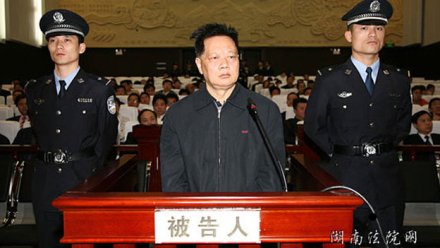
On this date in 2010, a former Communist Party of China (CPC) anti-corruption official was shot … for corruption.
Zeng, former secretary of the Chenzhou Municipal Commission for Discipline Inspection of the CPC and vice secretary of the CPC Chenzhou Municipal Committee, gorged on 31 million yuan ($4.7 million) in bribes from 1997 to 2006, doling out lucrative mining contracts and sinecures in exchange.
Although known in the Hunan coal-mining city as “a modern-day Heshen” — Chenzhou residents whose businesses had been widely subject to Zeng’s crude protection-racket shakedowns set off fireworks to celebrate his arrest — Zeng was all but impossible to dislodge.
Zeng bribed up to higher officials for protection as effectively as he squeezed those below. It’s just another piece of the graft so endemic in China that it’s frankly represented in popular literature. (And has often appeared on the execution grounds, too.)
“Officials, especially high-ranking ones, are basically not held accountable for paying bribes,” a journalist who wrote a book about Zeng told NPR. “This is because China’s judiciary is not independent enough.” Zeng wasn’t even charged with this crime — just extortion.
Zeng’s well-placed protectors defeated at least three investigations. He was only overcome by an order from the very top: President and Party Chairman Hu Jintao, who scribbled onto a secret report of Zeng’s antics,
“To Comrade Wu Guanzheng: Put more effort into investigating corruption in Chenzhou. Signed, Hu Jintao, July 19, 2006.”
Three months later, Zeng was under arrest.
The effects of power, corruption, privilege, and cutthroat economies did not go with him. After all, on the same date Zeng was put to death, officials elsewhere in Hunan province also announced the execution of one Chen Haitao for torching an airport shuttle bus. The blaze killed two and seriously injured three others.
Chen committed the arson to revenge society as he had “blamed his business failure on social injustice,” the court said in a statement.
On this date in 1769, two weavers hanged in East London in a bitter fight over wages and labor power.
Spitalfields, the East London district also known as the stomping-ground of legendary jailbreaker Jack Sheppard, was the capital of a thriving English silk-weaving industry. It had attained 18th century prosperity thanks in large measure to the decision of William and Mary to invite Lyons Huguenots being hard-pressed by the French crown to relocate their talents across the channel. This now-domestic industry* quickly began supplanting formerly dominant French imports.
In 1713 it was stated that silks, gold and silver stuffs and ribbon made here were as good as those from France, and that £300,000 worth of black silk for hoods and scarves was made annually. In 1721 the value of the silk manufactured in England amounted to £700,000 more than in 1688, when wrought silks were imported from France to the annual value of half a million sterling. (Source)
In this roaring and prestigious business, William Hogarth situated his 1747 Industry & Idleness plates: both the Industrious Prentice (eventually destined to become Lord Mayor of London) and the Idle Prentice (eventually executed at Tyburn) start off shoulder to shoulder at the Spitalfields looms.
But as the 18th century unfolded, even the most industrious Spitalfield weavers came under increasing competitive pressure especially from Chinese and Indian imports.
Although Parliament attempted to ban textile imports to preserve the domestic industries, Spitalfield workers were known to enforce their prerogatives directly by attacking people in the street thought to be wearing foreign prints. This simmering tension came to a rapid boil after settlement of the Seven Years’ War enabled England and France to resume trading — and a glut of French textiles to undermine weavers’ price controls.
Conflicts were no less fierce within the weavers’ community, between masters and laborers. Workers combined to maintain wages by attacking those thought to be undercutting prices.
In September 1769, one such action punished a wealthy anti-“combination” (for “combination”, read “labor union”) manufacturer named Lewis Chauvet, and cut the silk handkerchiefs right out of his looms.
From Season 3, Episode 2 of the BBC drama Garrow’s Law, which is directly based on this case. As of this writing, the entire episode can be found on YouTube.
Cutting silk from the loom was a rough method of enforcement by the labor combination. It had also been made a capital crime a few years before. And it turned out that Chauvet was ready to make his the test case.
Richly paying off a couple of independent artisan weavers for their questionable testimony, he secured the conviction of John Valloine or Valline (other alternate spellings are possible; the name clearly denotes the district’s Huguenot heritage) and John Doyle, two weavers allegedly part of the loom-smashing action. The accused denied it, Doyle reported to have fulminated at the gallows, “I am as innocent of the fact I am now to die for as the child unborn. Let my blood lie to that wicked man who has purchased it with gold, and them notorious wretches who swore it falsely away.”**
Manufacturers’ purposes were served just as well whether innocent or guilty. The point was labor discipline, not a few lost hankies.
Accordingly fixing “to strike Terror into the Rioters”, the crown ordered the execution to occur not at the Tyburn gallows, but right in the weavers’ backyard, adjacent Spitalfields at Bethnal Green.
This order actually delayed the sentence for the judiciary’s consideration of the minor point of whether this was allowed at all — since the actual boilerplate sentence read from the bench had specified “the usual place.” The wisest magistrates of the land considered the matter and in time agreed that “the time and place of execution was no part of the sentence” and therefore subject to His Majesty’s discretion. Bethnal Green it was.
They were therefore this morning taken in a cart from Newgate through the City to Whitechapel, and thence up the road to Bethnal Green, attended by the Sheriffs &c, with the gallows, made for the purpose, in another cart; it was fixed in the cross road, near the Salmon and Ball.
There was an inconceivable number of people assembled, and many bricks, tiles, stones &c thrown while the gallows was fixing, and a great apprehension of a general tumult, notwithstanding the persuasion and endeavours of several gentlemen to appease the same. The unhappy sufferers were therefore obliged to be turned off before the usual time allowed on such occasions, which was about 11 o’clock; when, after hanging about fifty minutes they were cut down and delivered to their friends. (cited here)
Vengeful weavers having their noses rubbed in their comrades’ executions smashed up Chauvet’s house in the riots on this date, and the powers that be decided that one hanging-day at Bethnal Green was plenty. A few other rioters convicted as confederates of Doyle and Valline were put to death at Tybun later in December 1769.
Years of violent labor conflict were finally quelled with the 1773 Spitalfield Weavers Act, a political compromise which protected the domestic industry from foreign competition and enabled magistrates to set wages.
Though this act stabilized a tense domestic situation, its effect over several decades was seriously problematic: a protected monopoly with wage-controlled workers maintained an increasingly obsolete system of labor-intensive manufacture that fell behind power looms coming online elsewhere.
As late as 1851 — mechanization wouldn’t fully take over until Britain’s trade liberalization of the 1860s — Charles Dickens visited Spitalfields, and saw a weaver
doing now, exactly what his grandfather did. Nothing would induce him to use a simple improvement (the ‘fly shuttle’) to prevent the contraction of the chest of which he complains. Nothing would turn him aside from his old ways. It is the old custom to work at home, in a crowded room, instead of in a factory.
Disallowed from taking lower wages even in bad times (or when cheaper cotton started displacing silk), many weavers sat completely unemployed instead — gradually sinking into a proletarianization they had fought to avoid. Spitalfield weavers eventually became one of the classic case studies in the laissez faire economics canon.
* Just to be clear, Huguenots weren’t the first silk weavers in Spitalfields; it’s just that their arrival let the industry take off.
** The hanged man’s comrades made good his gallows menace. Peter Linebaugh, whose The London Hanged is an outstanding resource on the economic pressures that brought these weavers and many others to the gallows, relates:
At noon upon a cold and snowy day, 16 April 1771, [Chauvet’s paid witness against the weavers] Daniel Clarke … went walking in Spitalfields. It had been sixteen months since the hangings of the cutters whom Clarke had sworn against, and he must have thought the people cowed or forgetful. He was recognized. ‘There goes Clarke, that blood-selling rascal,’ was the shout, and instantly a small crowd gathered to badger and pester him. He took to his heels and found temporary refuge in the house of Mary Snee. The currents of popular memory run deep; now they flooded to the surface. A hundred people beset the house hurling maledictions. ‘They would hang him, or burn him, or stone him,’ said Mary Snee. He was cornered, stripped and dragged by his feet into the street, where he was led by the neck on a parade of humiliation. The crowds grew. Widow Horsford [wife of one of the weavers hanged later in December 1769 at Tyburn] was seen to ‘jump out of the loom’ at the news Clarke was cursed and dragged to the brick-fields. Children pelted him with dirt. Bespattered with muck, he was thrown into a pond where he was ducked within a breath of drowning. He was removed to a sandheap, buried, dug up and returned to the freezing water. It was estimated that the crowd numbered 3,000. While he could speak, he taunted his tormentors, saying ‘he would take twenty of them’. Widow Horsford said, ‘Clarke, Clarke, I am left a widow, my children is fatherless on account of you.’ Clarke answered, ‘Chauvet is worse than me,’ and then he expired. A grim ending that would be remembered for generations.
On this date in 1992, 42* Baghdad merchants who were among several hundred rounded up over the preceding 48 hours were executed at Saddam Hussein‘s command at Abu Ghraib prison and the Interior Ministry compound.
The merchants were accused of profiteering by manipulating food prices — a chilling threat to businessmen, but one that had little power to arrest the wreck of Iraq’s economy. Prices for food, and everything else, were spiking under the blockade.
“Hardly any Iraqi trader sent anything to his country from our warehouse” after the executions, according to a Jordanian exporter quoted by Reuters.** “They tell us even if the goods are given to them for free, they are not ready to risk their lives.”
These executions have put some former Iraqi officials at risk of their lives in American-occupied Iraq.
The country’s longtime Deputy Prime Minister, Tariq Aziz, was tried for his life in 2008-2009 for ordering these executions; Aziz received a 15-year sentence.†
Just days ago as of this writing, those two gentlemen were transferred from American to Iraqi custody, where they figure to be put to death very soon — though this is a matter of ongoing political wrangling.
* It’s not completely unambiguous to me that the “42 merchants” at issue in several post-Saddam trials were all executed on July 26 (though Amnesty International seems to think so); the roundup and execution process was less than orderly. But it’s certainly the case that at least many died this date.
Some testimony and trial documents related to the incident are available in pdf form here.
On this date in 1381, a mob’s summary execution on Tower Hill of some nobby English lords marked the acme of that country’s most noteworthy peasant revolt.
The trigger for the revolt was an onerous poll tax levied to finance the realm’s escapades in the Hundred Years’ War, but as Barbara Tuchman notes,
the fundamental grievance was the bonds of villeinage and the lack of legal and political rights. Villeins could not plead in court against their lord, no one spoke for them in Parliament, they were bound by duties of servitude which they had no way to break except by forcibly obtaining a change of the rules. That was the object of the insurrection, and of the march on the capital that began from Canterbury.
Late medieval England was in the throes of economic, and therefore social transformation.
Manorial lords’ traditional power over their peasants had become untenable for a labor pool depleted by the Black Death, survivors of which found themselves consequently in-demand and suddenly blessed with leverage. As one chronicler recorded,
There was so marked a shortage of labourers and workmen of every kind in that period that more than a third of the land in the whole realm was left idle. All the labourers, skilled or unskilled, were so carried away by the spirit of revolt that neither King, nor law, nor justice, could restrain them. … The entire population, or the greater part of it, has become even more depraved… more ready to indulge in evil and sinfulness.
Rentiers put a forceful kibosh on “sinfulness” like rising wages and labor mobility, legislating backwards feudal rights and pre-plague wage levels.
Who Then Was The Gentleman?
It was a ground fertile for insurrectionary sentiment, like the class-warfare sermon of subversive Lollard preacher John Ball:
When Adam delved and Eve span, Who was then the gentleman? From the beginning all men by nature were created alike, and our bondage or servitude came in by the unjust oppression of naughty men. For if God would have had any bondmen from the beginning, he would have appointed who should be bond, and who free. And therefore I exhort you to consider that now the time is come, appointed to us by God, in which ye may (if ye will) cast off the yoke of bondage, and recover liberty.
This cry for justice anticipated the Levellers by almost three centuries.
Poll Position
But these 14th century downtrodden had some rough levelling of their own in mind, and when the poll tax set spark to tinder, the conflagration spread with terrifying rapidity.
[T]here were some that desired nothing but riches and the utter destruction of the noblemen and to have London robbed and pilled; that was the principal matter of their beginning, the which they well shewed; for as soon as the Tower gate opened and that the king was issued out with his two brethren and the earl of Salisbury, the earl of Warwick, the earl of Oxford, sir Robert of Namur, the lord of Vertaing, the lord Gommegnies and divers other, then Wat Tyler, Jack Straw and John Ball and more than four hundred entered into the Tower and brake up chamber after chamber …
These guys were after, above all, John of Gaunt,* the Dick Cheney of 14th century England right down to the malevolent name and underwhelming military achievements: the throne at this time held the posterior of 14-year-old (in 1381) Richard II, and the widely reviled uncle John ran (and freely looted) the realm with a council of loathsome optimates.
London Calling
Luckily for John, he happened to be off at the Scottish frontier when the Peasants’ Revolt rolled into London; the mob settled for destroying his opulent Savoy Palace on June 13.
The next day, it rampaged through the Tower of London
… and at last found the archbishop of Canterbury, called Simon, a valiant man and a wise, and chief chancellor of England, and a little before he had said mass before the king. These gluttons took him and strake off his head, and also they beheaded the lord of Saint John’s and a friar minor, master in medicine, pertaining to the duke of Lancaster, they slew him in despite of his master, and a sergeant at arms called John Leg; and these four heads were set on four long spears and they made them to be borne before them through the streets of London and at last set them a-high on London bridge, as though they had been traitors to the king and to the realm.
Simon’s severed, and incredibly well-preserved, skull has been resident in a cubby at St. Gregory’s Church of Sudbury for lo these six hundred years. It made news recently when it was retrieved for a CT scan to (among other things) reconstruct Simon’s real-life appearance.
Right, these executed-today guys.
Simon of Sudbury, Archbishop of Canterbury and Lord Chancellor of England, and Robert Hailes, Lord High Treasurer, neatly concentrated in their persons the political, financial, and religious power exercised by “the unjust oppression of naughty men.”
Still better, they were the advisors most directly connected to the poll tax. As a reward, they got their polls axed.
This was no mere provincial riot. A lower-class revolt had massed an overwhelming force in the very capital of the kingdom, with most of the main government ministers trapped therein — holed up and inconclusively debating one another about how to get out of this jam. And the movement aimed itself at the conquest of power: Tuchman (citing Benedictine chronicler Thomas Walsingham) says that rebel leader Wat Tyler was anticipated that “in four days’ time all the laws of England would be issuing from his mouth.”
In the end, the last thing between history and King Wat — and, if you’re willing to dream an anachronistic dream, a Commune of London — was the peasantry’s foolhardy reverence for the person of the pimply king.
Foreshadowing a later era’s “if only the tsar knew” naivete, the rebels who thirsted for the blood of Richard’s advisors fancied the king their champion. Young and handsome; regal; charismatic; and plausibly not implicated in the villeins’ grievances … you can understand why they thought that. But disarmed thereby of the ruthlessness necessary to strike him, Wat Tyler’s band instead went the way of the typical peasant rising.
Richard the Lionheart
The king’s own nerves were steel in this moment, when a lesser adolescent would have quailed from the perilous task of safeguarding the divinely ordained oligarchy with his own person. Richard was, at this point, still in his minority: other men took the country’s decisions in their own hands. Richard would one day have to fight them for his own kingly rights; but, on the evidence of this crisis, he had already grown up, and fast.
Perhaps reasoning that royalty is the best shroud, Richard invited the rebels out to Smithfield the very next day, June 15. When the royal teenager was in personal parley with Tyler, the king’s buddy William Walworth got into a scrape with the peasant and
gave him a deep cut on the neck, and then a great cut on the head. And during this scuffle one of the King’s household drew his sword, and ran Watt two or three times through the body, mortally wounding him. And he spurred his horse, crying to the commons to avenge him, and the horse carried him some four score paces, and then he fell to the ground half dead. …
when the commons saw that their chieftain, Watt Tyler, was dead in such a manner, they fell to the ground there among the wheat, like beaten men, imploring the King for mercy for their misdeeds.
(This source says that Tyler was retrieved from hospital for a summary execution of his own that same day. Others, such as Froissart, indicate that he died straightway from the wounds he suffered in the fray.)
Brazenly wielding the dread sovereign power over the minds of his subjects, Richard braved death by riding unprotected towards their lines, styling himself their “captain,” commanding their obedience. Peasant archers and pikemen who on that day might have turned English history on its head instead lowered their weapons and submitted themselves.
Though the ensuing bloodbath was a bit less wholesale than the one attending France’s recent Jacquerie, it went rough for the leaders, and concessions the king had made the rank and file vanished along with the danger to his crown. “Villeins ye are,” he would later tell a delegation of petitioners imploring him to effect his pledge to abolish serfdom, “and villeins ye shall remain.”
* John of Gaunt also kind of got the last laugh out of those tumultuous years: though John brokered compromises between the king and his rival nobles, John’s son was one of those rival nobles. After dad’s death, that young man overthrew Richard and established the Lancastrian dynasty as King Henry IV.
On this date in 1705, another century’s supposed terrorist was hanged on Leith Sands with two of his “pirate” crew by a Scottish court “drunk with patriotic prejudice.”*
This execution took place in the feverish run-up to England and Scotland’s Acts of Union welding the neighboring realms into Great Britain in 1707.
Arising as it did from the same causes that animated that national marriage of convenience, Green’s execution also endangered it: Daniel Defoe, who was at this time a pro-Unionist mole (and prolific pamphleteer) for English pol Robert Harley, described this hanging as one of the six crises that had to be overcome en route to the Union.
A Man, A Plan, A Calamity
Panama.
That’s where it all started, for Green and Union alike.
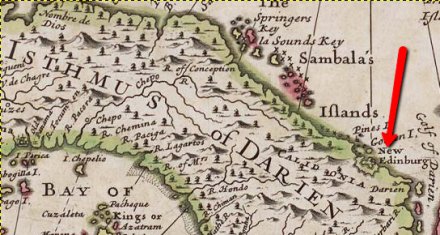
Mired in economic backwardness as neighboring European states carved up the world, Scotland made a bold, doomed bid for a chit in the empire game: the Darien scheme. One part visionary and (at least) two parts daft, this venture attempted to establish a Scottish colony on the Isthmus of Panama (aka the Isthmus of Darien) with a view to porting freight across the narrow strip of land separating Atlantic and Pacific, and dominating the dramatically more efficient east-west trade route that would result.
Students of the Panama Canal project will be aware that this malarial tropic would not be described as especially hospitable; to the natural disadvantages of the climate were added the political interpositions of England herself, whose hostility to the advent of her Caledonian neighbor as a New World rival was expressed in legislation choking the Darien adventure of foreign aid.
(Also a problem: Spain. The colony was abandoned at last under Spanish siege.)
So Scotland went it intrepidly, injudiciously alone in this last bid for real independent muscle in Europe. The hyperbole of the Isthmus’s publicists eventually sucked in 20 percent or more of the capital circulating in Scotland. And when Darien-dot-com went bust by 1700 at the cost of a couple thousand lives, it cratered the Scottish economy too. That set the stage for Edinburgh’s partnership in a different scheme: Great Britain.
Green with Envy
In the years following the Darien catastrophe, the Scottish corporation chartered to undertake it was still throwing stuff against the wall in the world trade game, trying to get something to stick to at least take the edge off the losses.
This company (theoretically a potential rival of England’s own East India Company) had suffered the further national indignity of having one of its ships, the Annandale, seized in the Thames for infringing the East India Company’s royal monopoly. Its appeals for redress falling on deaf ears, the Darien company apparently induced Scottish authorities to undertake the retaliatory seizure of an English merchant ship, the Worcester, that had the ill luck to weather a storm at the Firth of Forth.
Rumor soon connected this ship to another vanished Darien company vessel overdue from its return trip from the East Indies … and, as it quickly became understood by all right-thinking Scots, overtaken in the Indian Ocean by this same Worcester and its crew butchered.
Captain Thomas Green and his English crew were hailed before an Admiralty court** on piracy charges on this extremely fantastical connection in a virtual mob atmosphere.
It never was clearly established that an act of piracy had been committed as a distinct fact, but by putting certain circumstances together it was inferred that Green was guilty of piracy. The very shape in which the accusation is set forth, shows that the accusers could not point to the specific act of piracy which had been committed …
[There] was no specification as to the vessel taken, which might enable the accused to prove that it had not been taken; no names of parties murdered, who might be shown still to be alive; no ownership of cargo, which might admit of proof that the owner’s goods had arrived safe. As Green himself is made justly to say in the document published as his dying speech, “We are condemned as pirates and murderers on a coast far distant from this place — is there any of you who wants either a friend whom we have murdered, or whose goods we have taken?”
Worcester Sauce
The Worcester‘s Malabari cook provided a highly dubious charge — dubious, for he was not yet among the crew when it last called at the location he claimed the crime took place — of Green and crew hatchet-murdering approximately ten English-speaking mariners on an unnamed vessel off the Indian coast.
Upon this evidence, 14 or more members (the ready sources are a little loose on the total number) of the Worcester crew were condemned for piracy, and initially slated for three batches of hangings. Queen Anne‘s personal intervention managed a stay,
The Scottish Privy Council unto the very last hours debated what to do with the diplomatic appeals, with evidence forwarded from London to the effect that the crew these Worcester men had supposedly slaughtered were alive, their vessel having been hijacked in another place, by another man.
But a surging Scottish mob aggrieved by the preceding years’ misadventures and the impending shotgun marriage to Westminster rather than anything Green himself had really done was already engorged on the blood of the supposed English corsairs. Most of the Council thought better than to deny them their sacrifice.†
The Streets fill’d with Incredible Numbers of Men, Women and Children, calling for Justice upon those ENGLISH Murtherers. The Lord Chancellor Seafield‘s Coach happening to pass by, they stop’d it, broket he Sashes, haul’d him out, and oblig’d him to promise Execution should speedily be done before he could get from ’em … According to the Chancellors promise, soon after, on the same Day, being Wednesday, Captain Green, Madder [the mate], and Sympson [the gunner] were brought out, and convey’d to Execution, which was at Leith Road upon the Sands, and all the way was Huzza’d in Triumph as it were, and insulted with the sharpest and most bitter Invectives. Being come to the place of Execution, Good God! what a moving sight was it to see those Men stand upon the very Varge of Life, just launching in to Eternity, and at the same time see the whole Multitudet ransported with Joy!”
-From an anonymous Letter From Scotland To a Friend in London, quoted by James Kelly, “The Worcester Affair,” The Review of English Studies, Feb. 2000
In the event, these three were the only ones actually hanged; passions cooled enough for the other “pirates” to be quietly released.
But the wider, national passions unleashed by this date’s executions would long provide fodder for intemperate patriotic recrimination, and specifically anti-Unionist propaganda — on both sides of the border.
Competing propagandisticbroadsides framed and re-framed the events, as the affair of unscrupulous English buccaneers or perfidious highland barbarians. (Defoe, maneuvering for Union, wrote to chill such bad-for-business hostility: “Nothing could be more horrid, than that the Scots should Execute these Men on a meer Pique at the English Nation. Nothing can be more like it, than to conclude rashly, that it is so, and improve it on purpose to Exasperate our People against the Scots.” (Kelly))
And that, of course, is precisely the viewpoint that prevailed.
While the hemp neckties issued to Green et al this date threatened to (ahem) scotch the Union project, that very danger might have ultimately hastened its completion — as elites recognized, in Defoe’s words, that Union represented “the only way to preserve the publick Tranquillity, and prevent the certain Mischiefs that threatened the whole Body,” (Kelly, again) and rammed it through with dispatch.‡
‡ The ebb and flow of national resentment continued long after the Acts of Union, of course; continuing Scottish support for the restoration of the Stuart monarchy was one expression of Scottish nationalism and anti-Union sentiment.
Possibly England’s last medieval peasant rising, and possibly its first modern revolt, Kett’s Rebellion pitted the agrarian feudal commons against the proto-capitalist world taking shape.
Impelled by the profitable wool export business, landlords began “enclosing” formerly open arable land for pasture, thereby destroying the communal and quasi-communal agricultural models of the middle ages.
Karl Marx
For Marx, among many others, this revolution in agricultural production — and the attendant proletarianization of the former peasantry — marks the dawn of the capitalist epoch, when
great masses of men are suddenly and forcibly torn from their means of subsistence, and hurled as free and “unattached” proletarians on the labour-market. The expropriation of the agricultural producer, of the peasant, from the soil, is the basis of the whole process …
Although, therefore, the English land, after the Norman Conquest, was distributed in gigantic baronies, one of which often included some 900 of the old Anglo-Saxon lordships, it was bestrewn with small peasant properties, only here and there interspersed with great seignorial domains. Such conditions, together with the prosperity of the towns so characteristic of the 15th century, allowed of that wealth of the people which Chancellor Fortescue so eloquently paints in his “Laudes legum Angliae;” but it excluded the possibility of capitalistic wealth.
The prelude of the revolution that laid the foundation of the capitalist mode of production, was played in the last third of the 15th, and the first decade of the 16th century. A mass of free proletarians was hurled on the labour-market by the breaking-up of the bands of feudal retainers, who, as Sir James Steuart well says, “everywhere uselessly filled house and castle.” … In insolent conflict with king and parliament, the great feudal lords created an incomparably larger proletariat by the forcible driving of the peasantry from the land, to which the latter had the same feudal right as the lord himself, and by the usurpation of the common lands. The rapid rise of the Flemish wool manufactures, and the corresponding rise in the price of wool in England, gave the direct impulse to these evictions. The old nobility had been devoured by the great feudal wars. The new nobility was the child of its time, for which money was the power of all powers. Transformation of arable land into sheep-walks was, therefore, its cry … As Thornton rightly has it, the English working-class was precipitated without any transition from its golden into its iron age. (Capital, volume I, chapters 26–27)
It did not suffer its precipitation quietly.
Thomas More
Enclosures were a predominant social problem in England throughout the century, and if contemporaries could hardly descry the shape of the economic revolution taking shape, they worriedly noticed the poverty, the vagabondage, and the depopulated villages.
your sheep, which are naturally mild, and easily kept in order, may be said now to devour men and unpeople, not only villages, but towns; for wherever it is found that the sheep of any soil yield a softer and richer wool than ordinary, there the nobility and gentry, and even those holy men, the abbots! not contented with the old rents which their farms yielded, nor thinking it enough that they, living at their ease, do no good to the public, resolve to do it hurt instead of good. They stop the course of agriculture, destroying houses and towns, reserving only the churches, and enclose grounds that they may lodge their sheep in them. As if forests and parks had swallowed up too little of the land, those worthy countrymen turn the best inhabited places into solitudes; for when an insatiable wretch, who is a plague to his country, resolves to enclose many thousand acres of ground, the owners, as well as tenants, are turned out of their possessions by trick or by main force, or, being wearied out by ill usage, they are forced to sell them; by which means those miserable people, both men and women, married and unmarried, old and young, with their poor but numerous families (since country business requires many hands), are all forced to change their seats, not knowing whither to go; and they must sell, almost for nothing, their household stuff
Commissions studied enclosure; edicts forbade and reversed them; commentators denounced them — all to no effect.
Robert Kett
Robert Kett, from a larger painting (click to see it) by Samuel Wale.
Henrician England had plenty of violent social transformation on its plate, of course, and plenty of violent tools to manage it. When the philandering tyrant kicked the bucket in 1547, he left the unfolding social catastrophe to the weakened protectorate government of his sickly nine-year-old heir.
In East Anglia in the summer of 1549, a peasant riot against an enclosure caught a spark. Unexpectedly, when the mob moved to throw down the enclosures put up by Robert Kett (another small landowner), he committed himself to the peasant cause and ably steered the rebellion for six heady weeks.
Kett was the man for his time and place: proving a natural leader, he marshaled the inchoate rage of his countrymen into an orderly, disciplined force.
Kett’s peasant army marched on Norwich, and stunningly captured England’s second city, thereupon petitioning the crown upon a variety of economic grievances (the petition is available on Wikipedia).
And Kett meant business, as this fiery (perhaps slightly fatalistic) oration suggests; he well knew that he had committed his own person to glory or destruction.
Now are ye overtopped and trodden down by gentlemen, and put out of possibility ever to recover foot. Rivers of riches ran into the coffers of your landlords, while you are pair’d to the quick, and fed upon pease and oats like beasts. You are fleeced by these landlords for their private benefit, and as well kept under by the public burdens of State wherein while the richer sort favour themselves, ye are gnawn to the very bones. You tyrannous masters often implead, arrest, and cast you into prison, so that they may the more terrify and torture you in your minds, and wind our necks more surely under their arms. And then they palliate these pillories with the fair pretence of law and authority! Fine workmen, I warrant you, are this law and authority, who can do their dealings so closely that men can only discover them for your undoing. Harmless counsels are fit for tame fools; for you who have already stirred there is no hope but in adventuring boldly.
Alas, like the enclosures themselves, the matter was to be resolved against the peasantry by main force. [bits and bobs on the daily progress of skirmishes and battles in this pdf] Though the rebels actually defeated the first force sent against them, they were decisively beaten at Dussindale on Aug. 27.
“We were promised ynoughe and more then ynoughe. But the more was an hawlter.”*
Promises of clemency induced the survivors to surrender peacably; though wholesale punitive bloodletting seems not to have been imposed, the leaders, of course, had to be made an example of.
Robert Kett and his brother, William, were convicted of treason and hanged.
Smoothly leveraging his dispatch in handling the rebellion, John Dudley, Duke of Northumberland, overturned the national political leadership of the Lord Protector the Duke of Somerset, who was accused of having triggered the rising with an excess of sympathy for the dispossessed peasant class. (Both Somerset and Northumberland would end up on the chopping block themselves.)
* Quote from a survivor of the rebellion, cited by Diarmaid MacCulloch in “Kett’s Rebellion in Context,” Past & Present, No. 84 (Aug., 1979).