On the night of April 21, 1945 (possibly verging into April 22), 12 women political prisoners were hanged at Hamburg’s Neuengamme concentration camp.
This forced labor camp had its own nasty history during the war, including medical experiments on children that would get the camp doctor hanged after the war. Those unfortunates had just been disposed of the day before.
It was in the spirit of disposing that Neuengamme on April 21 received 71 political prisoners from the Fühlsbüttel prison/satellite camp. This site, one of the very first concentration camps in Germany, was being emptied out (as Neuengamme also soon would be) with the approach of Allied forces from the west: many Fühlsbüttel prisoners were released outright, while several hundred were sent on a death march to another camp.
These special 71, who weren’t especially major antifascists and hadn’t been convicted of anything, thought their transfer to Neuengamme was just a halfway house to their own release — whether directly by the Germans, or via the imminent arrival of Germany’s foes.
All were elated. They showed each other pictures of their husbands and children (Erika Etter did not know that her husband had been executed), made their clothes as nice as possible. Erika, the youngest, wore white knee socks and borrowed lipstick, with her pretty hair down. (From the German Wikipedia page about these killings)
They were in for an unpleasant surprise: although Nazi Germany was going down, there were elements within it still looking to cripple the Left of whatever would emerge postwar. These 71 people — 58 men and 13 women — were communists, or White Rose activists, or other ideological foes whom the camp bureaucracy had tagged as “non-transferrable” elements.
Annemarie Ladewig, a young artist who’d been booted from the academy due to a partial Jewish ancestry, painted this watercolor of a dancer. (More.) Ladewig’s brother and father were among the 58 male political prisoners killed at Neuengamme over the next few days.
They were eliminated over the period from April 21 through April 24.
The women were the first to be put to death on this night, hanged naked in two groups of six. Either the aforementioned Erika Etter or else the actress Hanne Mertens (German link) was killed separately; the other was hanged, along with these eleven (all links below are to German Wikipedia pages):
On this date in 1945, in the dying days of the Third Reich, 42-year-old Johann Georg Elser was executed by gunshot in the German concentration camp Dachau. He died for a failed attempt on Adolf Hitler’s life more than five years before.
It goes without saying that, had he been successful, he would have changed history immeasurably.
Elser, who went by his middle name, didn’t fit the profile of someone who would try to kill Hitler.
He wasn’t a Jew, a Communist or a member of any of the other minority groups the Nazis persecuted. He wasn’t political at all, in fact.
A carpenter by trade, with one illegitimate son, his hobbies included playing the zither and the double bass.
He was the kind of ordinary, working-class German the National Socialists tried to reach out to. But from the very start, he made it clear how much he despised them and all that they stood for.
He was a practical man at heart and was not interested in political discussions. He had no desire to change other people’s minds, but he steadfastly refused to make any accommodation to the new regime. When Hitler’s speeches were broadcast, he would silently leave the room… In May 1938, a Nazi parade threaded its way through his hometown of Königsbronn. Elser, like many others, turned out to watch, but as those around him gave the Hitler salute, he refused to do likewise. When a colleague reminded him that it might be sensible to conform, he replied curtly, “You can kiss my ass.” He then ostentatiously turned about and started whistling to himself.
How Elser’s silent, passive resistance turned into action is unclear, but by the autumn of 1938 he had made up his mind to kill the Führer.
Unsure how to accomplish this, he traveled to Munich to get some ideas. Every year on “Die Neunte Elfte”, the November 8-9 anniversary of the Beer Hall Putsch, Hitler came to the Bürgerbräukeller and gave a speech to the old guard.
That day in 1938, actually just hours before another would-be assassin tried to kill Hitler, Elser slipped into the beer hall pretending to be an ordinary customer and “noted the layout of the room, the position of the lectern and the patent lack of effective security measures.”
He had found his place and his time: he decided that the following year, he would plant a bomb in the Bürgerbräukeller, timed to go off right in the middle of Hitler’s big anniversary speech and kill him and as many Nazis as possble.
Elser’s meticulous planning and preparations over the next twelve months were nothing short of amazing. He stole a fuse and some gunpowder, and got a job at a quarry specifically so he could acquire some explosives. Knowing nothing about bombs, he made countless prototypes and tested them in empty fields in the countryside.
In the spring of 1939, he went back to Munich and the Bürgerbräukeller to make some detailed sketches of the building and find an appropriate place to hide the bomb. He chose a thick stone pillar behind the lectern, which supported a balcony. In August, he brought his tools and bomb-making materals to Munich to set about with his final phase of the plan.
The fastidious assassin’s modus operandi was shockingly simple, and shockingly bold.
He would visit the Bürgerbräukeller every night at around 9:00 to take his evening meal. An hour or so later, he would sneak up to the gallery of the function room, where he would hide in a storeroom until the bar closed and the building was locked.
Thereafter, he was free to work by flashlight until the bar staff returned at around 7:30 a.m., when he could sneak out of a back entrance.
His first priority was to chip out a cavity in the stone pillar to hold the bomb. But, finding the pillar was now dressed with wooden cladding, Elser was forced to spend three nights sawing a hole in the wooden surround.
Every sound had to be muffled, every speck of sawdust collected and disposed of: he could afford to leave no evidence of his presence. Even the sawn wooden panel was fashioned into a flush-fitting secret door.
Good thing he was a carpenter.
Having accessed the pillar, he could now begin to dig out a recess for the bomb. Using a hand drill and a hammer and chisel, he spent most of the following month loosening mortar and prising out bricks — all of which, of course, had to be meticulously tied and removed from the scene in a cloth sack.
Progress was painfully slow.
In the cavernous hall, every hammer blow he struck echoed like a gunshot, and to escape detection he had to time his blows to coincide with external sounds, such as the passing of a tram or the automatic flush of toilets. Working by night preparing the pillar in the Bürgerbräukeller, he labored by day putting the finishing touches to his bomb and, of course, the elaborate timing mechanism.
It all took two months.
On November 2, six days before the Big Day, Elser finally concealed his bomb, which had been put in a wooden box lined with cork to muffle the ticking sound of the timing mechanism, in its hidey-hole. Hitler’s speech was scheduled to start at 9:00 p.m. on November 8 and would last for an hour. The bomb was set to go off at 9:20.
It did so, right on time, with a spectacular explosion that smashed the stone pillar, brought down the overhead balcony and ceiling, shattered windows, blasted out doors, killed eight people and injured 67 more.
The only problem was, Hitler wasn’t among the dead or wounded. In fact, he wasn’t even there.
He had pressing business in Berlin and wanted to get back that same night, so he had rescheduled his speech for 8:00 p.m. instead of nine. He finished and left the building at 9:07, thirteen minutes before the big reception Elser had prepared for him. By the time the bomb went off, Hitler was already on the train back to Berlin.
That Elser failed was through no fault of his own: it was just sheer, terrible, rotten luck.
British Prime Minister Benjamin Disraeli once said, “Assassination has never changed the history of the world.” Perhaps he is right in most cases, but it’s hard to believe that statement is true when it comes to Hitler. In this case, thirteen minutes substantially altered the history of Europe for the rest of the century.
Getting back to Elser: ever the careful planner, he knew what to do to protect himself once the bomb went off. He was miles away from Munich at the time, trying to sneak over the border into Switzerland. Unfortunately, he was caught by German border guards.
At first they thought it was a routine arrest, but then they saw the contents of his pockets, which included a postcard of the Bürgerbräukeller and sketches of his bomb design. The guards didn’t yet know about the assassination attempt, of course, but what they saw made them suspicious and they turned him over to the Gestapo.
On November 13, Elser confessed everything. When a flabbergasted Hitler read the preliminary investigative report which supported Elser’s lone-bomber story, he demanded, “What idiot conducted this investigation?”
He couldn’t wrap his mind around it, and neither could anyone else.
In the wake of the assassination, mass arrests were made: anyone who seemed unusually interested in the Munich speech, or didn’t express sufficient enthusiasm for the Nazi Party, could fall under suspicion of being part of the plot.
At Munich’s Feldherrnhalle on Nov. 11, Hitler conducts a memorial ceremony for the victims of Elser’s assassination bid.
As Moorhouse explains,
To many Nazis, Elser was simply an enigma. He was an ordinary German. He exhibited none of the typical signs of “degeneracy” that they claimed to be combating: apart from his brief flirtation with Communism, he was a virtual teetotaler, not promiscuous, did not consort with Jews, and was not close to the Church. In fact, he was exactly the sort of solid, upstanding, working-class German that they thought they had won over — and, indeed, that had become the backbone of the Nazi Party.
Unable to believe Elser’s claims of full responsibility, the Nazis concluded he must have been “led astray” at the very least, perhaps by agents of British intelligence. In spite of beatings, torture, and other coercion, however, Elser stuck to his story, even building another bomb, identical to the first, right in front of his interrogators to prove he could do it by himself.
He never managed to fully convince them; in fact, for decades after the war, historians and other scholars theorized about who else was in on his plan. Some speculated that the attack was even engineered by Hitler himself, to gain support for his cause and to create an excuse to crack down on dissidents.
It wasn’t until 1970 that two German historians who studied the matter announced there was no evidence that Elser had acted in concert with anyone else or even told anyone about his plans.
It may seem surprising that Elser managed to live for four and a half years after his attempt on Hitler’s life, but there was a explanation perfectly reasonable from the standpoint of a totalitarian bureaucracy.
After his confession, Elser was sent to the the Sachsenhausen Concentration Camp. He was given enough to eat, and two rooms, and even allowed to play the zither again, but he was kept in solitary confinement all those years. The Nazis — still operating on the theory that the British were ultimately behind the assassination attempt — stashed Elser away as a witness in a show trial against British leaders after the German invasion of the British Isles. Talk about hubris.
Of course, this invasion never happened, and as the tide of war turned against the Germans it became clear that Elser had outlived whatever usefulness he might have had. In February 1945, he was transferred from Sachsenhausen to Dachau.
He met his end quietly, taken outside his cell by a young SS officer and shot in the back of the neck. A week later, it was reported that he had been killed in an Allied bombing. By the end of the month, Dachau was in Allied hands.
At least six cities in Germany, including Königsbronn and Stuttgart, have places named after him, or monuments or plaques erected in his memory.
On this date in 1946, fascist Hungarian politicians Laszlo Baky and Laszlo Endre were executed by hanging in Budapest for their role in the decimation of Hungarian Jewry.
These two charmers were major figures in Hungary’s horrible final months of World War II.
This occupation lifted the virulent anti-semites Baky and Endre into national power, because along with keeping Hungary in the Axis coalition, the Nazis also forcibly overcame its junior partner’s former reticence about Jewish genocide.
Adolf Eichmann arrived into Nazified Hungary and used our day’s two principals (along with another executed collaborator, Andor Jaross, they’re known as the “deportation trio”) as his instruments. Within months, hundreds of thousands of Hungarian Jews were being shipped to the gas chambers. This period is one of the waypoints of pernicious Nazi race theory, when the collapsing German regime spent military resources urgently needed at the front to organize the mass slaughter of Jews.*
And they had to work fast, because by that next winter the Red Army was seizing Budapest. These enthusiastic fascist operators did not fare well by the postwar government.
* To do justice to the breadth of the human capacity, this is also the time and place where we find Raoul Wallenberg minting lifesaving Swedish passports by the thousands.
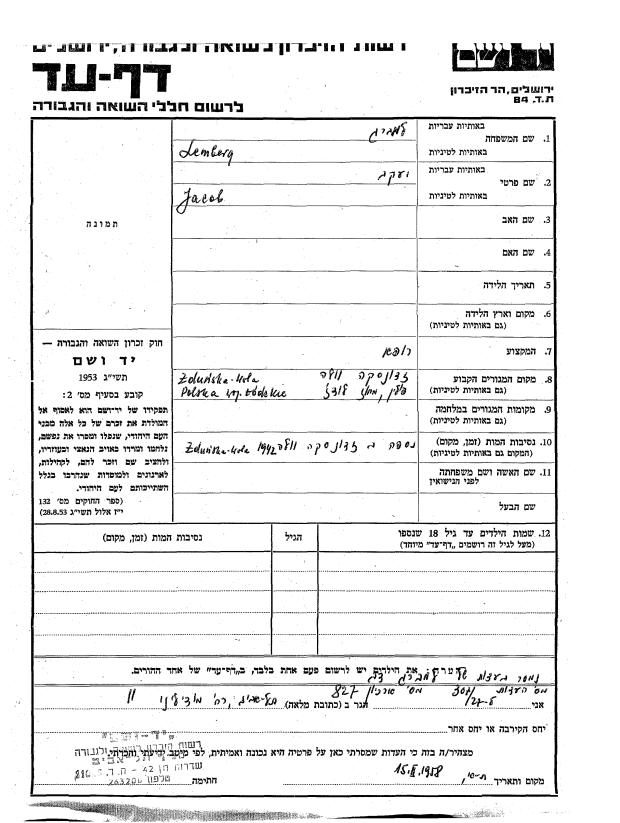
On this date in 1942, on the first day of Purim, Jakub Lemberg was executed together with his family in the Nazi ghetto in Zdunska Wola, Poland.
Lemburg, a 43-year-old internist and pediatrician, was head of the Judenrat in Zdunska Wola and thus it was his task to do the Nazis’ dirty work, such as putting together lists of his fellow-Jews for deportation.
He revealed himself to be a man of exceptional character and courage, and the circumstances of his death, as recorded in Louis Falstein’s The Martyrdom of Jewish Physicians in Poland, should not be forgotten:
The Gestapo chief ordered Dr. Lemberg to deliver ten Jews to be hanged for the ten hanged sons of Haman. Dr. Lemberg replied that he could deliver only four Jews: himself, his wife and their two children. Hans Biebow, “the Butcher of Lodz,” seized Dr. Lemberg and turned him over to the executioners, who killed him in the cemetery.
The Zdunska Wola ghetto was liquidated five months later. And in 1947, Biebow got his.
Here’s an image of Lemberg testimony (in Hebrew) from the Yad Vashem database.
When the Nazis attacked the house at 29 Kupiecka Street, rounding up all of its residents into the street, a bold young man, Izchok Malmed, whipped out a jar of acid from his pocket, hurling it in the face of a Nazi soldier, who was blinded at once. Seeking revenge, the sightless Nazi fired his revolver several times, hitting another Nazi soldier and instantly killing him. In the melee, Malmed vanished.
Commandant Friedl, after learning what had happened, ordered that one hundred men, women and children living in the area where the incident occurred be rounded up and force-marched to a nearby garden, where they were lined up against the wall of an adjacent bet hamidrash and shot with machine guns.
Afterward Nazi soldiers captured another group of Jews, forcing them to dig a large pit for the bodies of the one hundred martyrs. A thin layer of earth covered them. Some were still alive, their hands groping upward through the earth.
The Nazi soldier accidentally shot by his colleague whom Malmed had blinded was carried to the Judenrat building, and his body was placed on [Judenrat Chairman Efraim] Barasz’s desk. Friedl then proclaimed to Barasz, “See what your Jewish criminals have done. Now we shall take revenge. You shall see what we can do.” Friedl issued an ultimatum for the perpetrator of the crime to surrender within twenty-four hours. Failing that, the entire ghetto would be destroyed with everyone in it.
Barasz knew the Nazis meant what they said. He sent word to Malmed to give himself up and thereby save thousands of Jewish lives. As soon as Malmed heard, he surrendered himself to the Nazis.
Tamarof’s diary described in detail Malmed’s courage. Asked why he killed the Nazi soldier, he replied: “I hate you. I regret I only killed one. Before my eyes my parents were murdered. Ten thousand Jews in Slonim were liquidated before me. I have no regrets.” Tamarof tried to slip poison to Malmed but failed. Even the police could not get near the prisoner.
The next morning, Izchok Malmed, a hero of the ghetto, was hanged in the square where he had performed his act of courage. Despite the horrible torture to which he had been subjected, Malmed cursed the Nazi murderers. After several minutes of hanging on the gallows, the rope broke and the body fell to the earth. Instantaneously, the Nazis riddled Malmed’s corpse with bullets and re-hanged the body for another forty-eight hours.
Kupiecka Street was renamed Malmed Street after the war. Near the site of Malmed’s execution is a plaque reading, in Polish and in Hebrew, “Icchok Malmed, the hero and fighter of the Bialystok Ghetto, was killed here by the Nazi murderers on 8 February 1943. In his honor.”
* The Zchor account spells his name “Izchok” but on the memorial plaque it says “Icchok”. It’s a form of the name Isaac.
“In place of the weak and beaten man who bends with every breeze, a man who is all too common in politics and other fields, we must create for this nation a man who does not bend, who is inflexible.”
-Corneliu Codreanu
On this date in 1938, 14 political prisoners of the Romanian Legionary movement were extrajudicially executed — including Corneliu Codreanu, one of the Romanian right’s leading spirits.
The son of a Bukovina schoolteacher in what was then Austria-Hungary, Codreanu came to political maturity in the interwar heyday of Greater Romania. It was a moment of national aspiration — the Romanian state had never before grown so large — but it was abutted by the great threats of Germany and Russia, and haunted by nationalism, economic crisis, shaken political authority, and all the other spooks conjured by the first World War.
For Codreanu as for many at that time it was the stage for a blood-and-soil death struggle against Communist agitators and sinister Jewish financiers.
But his vision was an intensely positive one as well: a valiant new Romania founded by a courageous new man, honorable and true to the virtues of the nation’s noble peasant stock. “We shall create,” Codreanu declared, “a spiritual atmosphere, a moral atmosphere, in which the heroic man may be born and on which he can thrive.”
Codreanu’s vehicle for stamping out these heroic countrymen was the Legion of the Archangel Michael* which our principal founded in 1927. Named for God’s ass-kickingest enforcer, this movement/militia was not above creating its spiritual atmosphere with political assassinations by adherents widely noted for a willingness to die for the cause.
Later known as the Iron Guard, the Legion, in the view of German historian Ernst Nolte, “plainly appears to be the most interesting and the most complex fascist movement, because like geological formations of superimposed layers it presents at once both prefascist and radically fascist characteristics.” (Qutoed here.)
As his Legion’s name suggested, Codreanu was intently religious — virtually a mystic, and a messianic Romanian Orthodox Christianity was essential to his new Romania. His movement took root in a peasant society, not an industrial state with a revolutionary working class to crush or co-opt. Rather, it organized in opposition to a mediocre king and a feckless, heavily non-Romanian oligarchy which maintained its enervating grip on the nation with “endless appeals to the Fatherland which it does not love, to God in whom it does not believe, to the Church where it never sets foot, to the Army which it sends to war with empty hands.”*
And also to the police, which clapped Codreanu and his confederates in prison after the revolutionaries declined the elite incumbents’ offer of political collaboration.
In 1938, Codreanu was hit with a long prison sentence for sedition. Uncowed, the Legion grew ever more overtly aggressive when Nazi Germany successfully dismembered Czechoslovakia; Berlin made the Legions plainly aware that it saw their movement as Romania’s future, German-allied government. Futilely maneuvering for his own scope of action, Carol attempted to decapitate the Iron Guard by having its imprisoned leadership “shot while trying to escape” on this date.
The contemporary Romanian right aggressively reclaimedCapitanul, “the Captain”, after the fall of communism. Codreanu is now revered among not only among Romanian nationalists but in fascism’s wider populist Strasserite tradition. (Gregor Strasser, who liked the socialist part of national socialism too much for Hitler’s taste, was among those murdered on Nazi Germany’s Night of the Long Knives.)
* Eugen Weber in Varieties of Fascism, quoted by Anthony James Joes in “Fascism: The Past and the Future,” Comparative Political Studies, April 1974
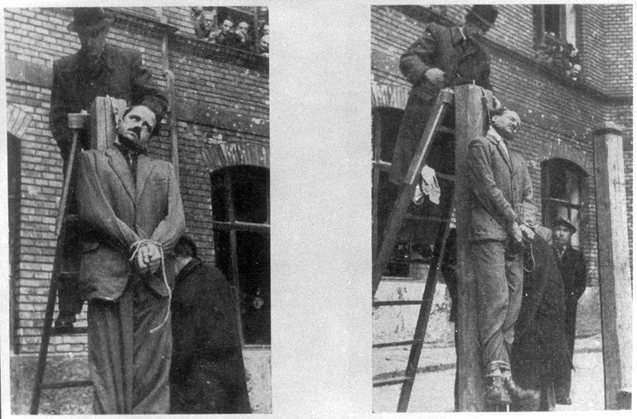
This U.S. Army photo from a few months after D-Day is filed simply thus:
“Photo taken at the instant bullets from a French firing squad hit a Frenchman who collaborated with the Germans. This execution took place in Rennes, France.” Himes, November 21, 1944.
Click to see a larger image of this stunning photo — or, take in this huge copy.
On November 1, 1943, a fourteen-year-old boy named Anatoly Kuznetsov came within seconds of execution in his hometown of Kiev in Nazi-Occupied Ukraine. As he admitted decades later, his crimes were numerous and all were worthy of the death penalty, according to the laws of the Germans. They included such grave sins as stealing beets, breaking curfew and sticking up an anti-Nazi leaflet.
By the time I reached the age of fourteen, I had committed so many crimes on this earth that I should have been shot many times over. […] Moreover, I was not a member of the Party or the Komsomol, nor a member of the underground; I was not a Jew or a gypsy; I did not keep pigeons or have a radio set; I did not commit any crimes openly; and I did not get taken as a hostage. I was in fact a most ORDINARY, unexceptional, insignificant little chap in a peaked cap.
But if the regulations drawn up by the authorities had been observed scrupulously, according to the principle of ‘If you did it you pay the penalty,’ then I had LOST THE RIGHT TO BE ALIVE twenty times over.
I persist stubbornly in remaining alive, while the number of my crimes increases in a catastrophic manner, so that I have stopped counting them. All I know is that I am a terrible criminal who has still not been caught.
The closest young Kuznetsov actually came to being killed was on November 1, 1943.
His very existence in Kiev had become a capital offense by then: all the civilians were supposed to have followed the German Army as it retreated from the city ahead of the advancing Russians, on pain of instant death.
Yet Kutznetsov stayed, hiding in abandoned buildings and bombed-out ruins, drinking rainwater, eating whatever he could find. By November 1 he had been dodging the evacuation order for over a month. And so he was called to account:
At that moment I heard a noise. I started, raised my head and saw a German soldier carrying a rifle; then I caught sight of another one on the street outside … When I thought they were not looking in my direction I dodged round the corner of the house, again cowering down rather stupidly, not looking round and averting my eyes from them in a sort of superstitious belief that they would not see me. I heard someone shout, “Hey! … Hey!” and I straightened up and stopped.
The soldier eyed me very sternly. He was a dark-haired, stocky fellow of about thirty, rather awkward in his movements, wearing old, muddy boots. His was a very ordinary, everyday type of face … In German he said:
“Come here.”
I took a few steps along the wall.
“You’ll be shot,” he said sternly, and started to raise his rifle.
It was, apparently, loaded, since he did not shoot the bolt. Another German came up, took him by the arm and said something in a very calm and indifferent tone, which sounded roughly like: “Don’t do it, there’s no point.” (That’s what I thought he said.)
The second soldier was rather older, quite an elderly man, with sunken cheeks. The dark-haired one answered him back and turned his head away for a moment. In that brief moment—I realized—I ought to have jumped up and dashed away… The dark one simply raised his rifle, turned his head for a moment, said something to the elder one, and that was the last moment of my life. […]
Right in front of my face — not in the cinema, or in a picture or in a dream — I saw the black hole at the end of the barrel, and had in my nose the unpleasant smell of gunpowder (meanwhile the elder German apparently went on saying something, but the dark one — alas! — wouldn’t listen); ages seemed to pass and there was no shot.
Then the end of the barrel dropped from my face to my chest and I realized at once in amazement that that, apparently, was how I was to be killed — shot in the chest!
Then he lowered the gun altogether. […]
He had only to squeeze his finger. I suppose on November 1st every year I ought to remember and thank that finger, the forefinger on his right hand, which let me live.
Five days later, the Red Army arrived and Kiev was liberated.
Kuznetsov would grow up to write a memoir and documentary history of his experiences during the occupation, including his aforementioned brush with death. The book, Babi Yar: A Document in the Form of a Novel, is considered a classic in the literature of World War II and the Holocaust. Parts of it have already been quoted on Executed Today.
Kutznetsov died in London in 1979. He was forty-nine years old.
On “a beautiful autumn day” this date in 1941, four dozen French leftists were executed by that country’s occupiers as punishment for the murder of a German officer.
On October 20, 1941 — sixteen months into the German occupation — a pair of Communist commandos assassinated the Feldkommandant of Nantes, Lt. Col. Karl Hotz (French link).
News of this crime went straight to Adolf Hitler himself, who personally ordered a fearful reprisal.
The list of the executed hostages as published Oct. 23 in L’oeuvre
Accordingly, the collaborationist Petain government was induced to select 50 persons from among the ranks of detained German political prisoners. Pierre Pucheu, who would later be executed himself,* intentionally selected Communist types in an effort to confine the retaliation to fellow-travelers.
On this date, those 50 — well, 48, but who’s counting?; the numbering can get dodgy in these mass-execution scenarios — were put to death at three different locations: five at Fort Mont-Valerien; sixteen at Nantes; and most notoriously, 27 internees of Choisel (French link) at Chateaubriant.**
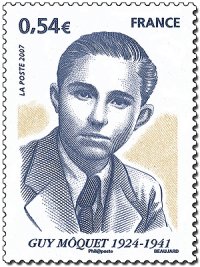
In three different batches of nine, the 27 reds and trade unionists were fusilladed into the ranks of Gallic martyrdom. They remain among the most emblematic French martyrs of the occupation; there’s a cours des 50-Otages named for them in Nantes, and various streets that bear individual victims’ names — such as Rue Jean-Pierre Timbaud in Paris. (Timbaud was a Communist steelworker.)
Monument to the martyrs of Chateaubriant. Image (c) Renaud Camus and used with permission.
He made headlines in 2009 when current French President Nicolas Sarkozy had added to the educational curriculum the reading of Moquet’s brave-but-sad last letter to his family: the decision drew some rather mean-tempered fire because of Moquet’s political persuasion. In the end, the text bore a fairly universal reading that could play inoffensively to posterity — like its postscript injunction,
“You who remain, be worthy of the 27 of us who are going to die!”
There’s a thorough roundup of the Oct. 22 executions (including poetic tribute) here.
* Vindicating Winston Churchill’s prophecy to the Times upon receiving news that “These cold-blooded executions of inocent people will only recoil upon the savages who order and execute them.” (Oct. 25, 1941, as cited in the The Churchill War Papers, vol. 3)
** Fifty more were supposed to be executed if the assassins weren’t promptly turned in, but that second batch never took place. (There was, however, a different batch of 50 executed on October 24 in retaliation for a different political assassination. Maybe they just all ran together.)
Graf was a conscientious Catholic whose disaffinity for Naziism manifested in an early refusal to join the Hitler Youth: he did a short stint in prison in 1938 for having continued associating with a banned Catholic youth league.
This subversive fellow might have been destined for the chop regardless in the black years to come, but for a thoroughgoing radicalization, he was drafted into the army as a medic and got a front-row seat on the Holocaust and the horrors of the eastern front.
He was arrested within months and condemned on April 19, 1943 to die as a traitor — though actual execution of the sentence waited several months on the Gestapo’s vain exertions to extract from their prey actionable information on other collaborators.
A number of schools around Germany are named in Graf’s honor.


 It goes without saying that, had he been successful, he would have changed history immeasurably.




 The son of a
 By the time I reached the age of fourteen, I had committed so many crimes on this earth that I should have been shot many times over. […] Moreover, I was not a member of the Party or the Komsomol, nor a member of the underground; I was not a Jew or a gypsy; I did not keep pigeons or have a radio set; I did not commit any crimes openly; and I did not get taken as a hostage. I was in fact a most ORDINARY, unexceptional, insignificant little chap in a peaked cap.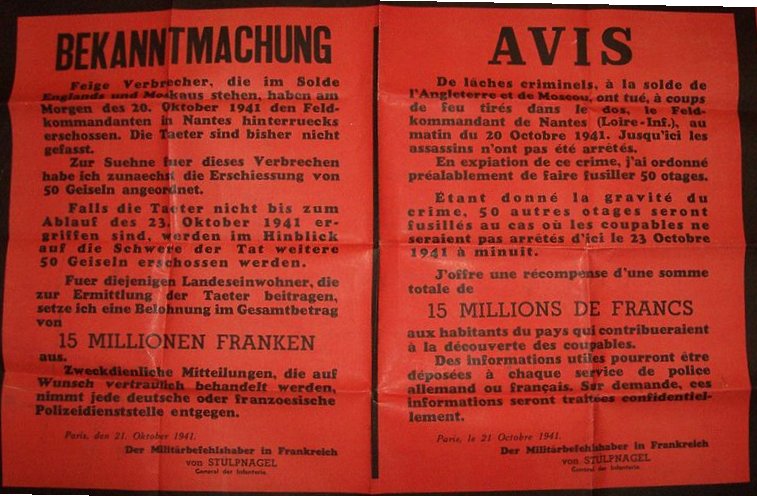


 The youngest, 17-year-old
  Graf was a conscientious Catholic whose disaffinity for Naziism manifested in an early refusal to join the