1678: William Staley, “the prologue to the bloody tragedy”

David’s mildness managed it so well,
The bad found no occasion to rebel.
But when to sin our biassed nature leans,
The careful devil is still at hand with means, [80]
And providently pimps for ill desires;
The good old cause, revived, a plot requires.
Plots, true or false, are necessary things,
To raise up commonwealths, and ruin kings.

-John Dryden’s Absalom and Achitophel, a Biblical allegory of the English political/religious scene in which the Popish Plot (“plots, true or false”) took place

On this date in 1678, a Catholic goldsmith was hanged and quartered for treason … a preposterous case that would preview the tragic main acts of the “Popish Plot”.

This 17th century anti-Catholic witch hunt traced to weird and unprincipled Anglican divine Titus Oates.

With his friend Israel Tonge, Oates in 1678 ginned up a fantastical Jesuit plot against the life of Charles II — which supposed conspiracy played insidiously to the realm’s age-old religious divisions, in a moment when a Catholic royal sibling stood next in line to the throne.

Indeed, Oates’s “revelations” would trigger the Exclusion Crisis, an unsuccessful parliamentary bid to balk the heir presumptive James (eventually James II) of his throne. Parliament, argued Henry Capell, “must quiet the minds of the people, as to their fears of Popery and the Succession.”

In Queen Elizabeth’s time there were conspiracies against her, when Mary Queen of Scots was taken off. In King James’s time, the Gunpowder-Treason. In the last King’s time, a horrid Rebellion, that ended in his murder; but here the Crown is under such a character as is more dangerous than all those; and from Popery came the notion of a standing Army and arbitrary power.

Oh, and London had just burned down within everyone’s living memory, an event popularly ascribed to a French Catholic conspiracy even into the 19th century.

There was an awful lot of latent (and not-so-latent) anti-Popery around for Oates to stir up, and he proved to have a gift for this demagoguery. (pdf) In late 1678, a magistrate investigating Oates’s claims, Edmund Berry Godfrey, was mysteriously murdered, and all hell broke loose: a political assassination could now be hung on the alleged Catholic conspiracy. In short order, alleged Catholic conspirators would themselves hang for it.

It was a full 9/12 mentality: people going about armed, loyalty oaths, rumors of French invasion or Guy Fawkes tunneling.

Oates, when feeling his, would have the juice to put peers of the realm on the scaffold … so what chance did poor William Staley have?

This patsy, no great ornament of the “plot”, was more an incidental (and expedient) casualty of the swelling paranoia. Overheard at a tavern chatting about the Protestant freak-out, in French (quelle horreur!), a couple of unscrupulous eavesdroppers shopped for treason when they couldn’t blackmail him.

The sovereign was supposed to have been characterized in this chat as “a great Persecutor or Tormentor of the people of God … And ([Staley] stretching forth his Arm, and then clapping his Hand on his Breast), speaking of His Sacred Majesty, said, I my self will kill him.” (Source) Whether a frustrated Catholic into his cups incautiously popping off, an innocent naif set up by reprobates, or a case of lost in translation, it seems safe to say that William Staley was no danger to the monarchy.

Staley, at any rate, denied having said anything of the sort all the few hours that remained to draw breath, which wasn’t many. It was a mere 12 days from the “treasonable” conversation on Nov. 14 to Staley’s execution.


Image from William Faithorne‘s 1681 (misdated) engraving depicting William Staley being drawn to execution.

With this hanging, and another (that of Edward Coleman) a week later, the Popish Plot persecutions were into full swing … three years of Stuart England McCarthyism that would claim at least 15 lives and end with Titus Oates imprisoned, whipped, and pilloried.

After the Orange Revolution chased the Catholic monarch out of England, Oates was released and pensioned: the incident long remained an ideological litmus test between proto-Whigs (pro-Oates, as he was a club wielded against the absolutist aspirations of Charles II and James II) and Tories (anti-Oates, for the same reason). Centuries later, one commenter could still remark, “There are three events in our history that may be regarded as the touchstone of party men: an English whig who asserts the reality of the Popish plot, an Irish Catholic who denies the massacre of 1641, a Scotch Jacobite who maintains the innocence of Queen Mary, must be considered as men beyond the reach of argument or reason.”

On this day..

1749: Bosavern Penlez, whorehouse expropriator

To the memory of the unfortunate
BOSAVERN PEN LEZ
Who finished a Life, generall well reported of,
By a violent and ignominious Death.
He was the Son of a Clergyman,
To whom he was indebted for an Education, which he so wisely improv’d
As to merit the Love and Esteem of all that knew him.
But actuated by Principles, in themselves truly laudable
(When rightly directed, and properly restrain’d)
He was hurried by a Zeal for his countrymen,
And an honest Detestation of Public Stews
(The most certain Bane of Youth, and the Disgrace of Government)
To engage in an Undertaking, which the most Partial cannot defend,
And yet the least Candid must excuse.
For thus indeliberately mixing with Rioters, whom he accidentally met with,
He was condemn’d to die:
And of 400 Persons concerned in the same Attempt, he only suffer’d,
Tho’ neither Principal, nor Contriver.

How well he deserved Life, appears
From his generous Contempt of it, in forbidding a Rescue of himself;
And what Returns he would have made to Royal Clemency,
Had it been extended to him, may fairly be presumed
From his noble Endeavours to prevent the least Affront to that Power,
Which, tho greatly importun’d, refused to save him.

What was denied to his Person, was paid to his Ashes,
By the Inhabitants of St. Clement Danes,
Who order’d him to be interr’d among their Brethren,
Defray’d the Charges of his Funeral,
And thought no Mark of Pity or Respect too much
For this Unhappy Youth,
Whose Death was occasioned by no other Fault
But a too warm Indignation for their Sufferings.

By his sad Example, Reader be admonish’d
Of the many ill Consequences that attend an intemperate Zeal.
Learn hence to respect the Laws — even the most oppressive;
And think thyself happy under that Government
‘That doth truly and indifferently administer Justice,
‘To the Punishment of Wickedness and Vice,
‘And to the Maintenance of God’s True Religion and Virtue.’

On this date in 1749, Bosavern Penlez — surely one of the all-time great names to hang on a gibbet — was put to death to the sorrow of all of England. You know how they say that horse thieves are not hanged for stealing horses, but that horses might not be stolen? Bosavern Penlez was hanged that whorehouses might not be torn down by mobs of angry sailors.

(Fourteen other less remarkable folk were hanged for less remarkable crimes at the same time. Just another mass execution day at Tyburn.)

A petition of over 300 St. Clement Danes residents for sparing the two men condemned in the riots. (From the General Advertiser, Oct. 11, 1749.) John Wilson received the solicited pardon; Bosavern Penlez did not.

On the first three days of July in 1749, the Strand in London saw a running series of riots after a mob of angry sailors descended on a whorehouse where some of their brethren had been robbed and abused. Those sailors pulled down that bordello and then moved on to the nearby bawdy-houses, eventually also ransacking the Star Tavern owned by a character named Peter Wood.

Gendarmes had to be called out to control the situation (and this done without proper legal authorization), but somehow not the mob’s ringleaders nor its inciters nor its most enthusiastic wreckers wound up in legal jeopardy.

Only two faced death: John Wilson, a journeyman shoemaker. And Bosavern Penlez, a young wig-maker who’d been out drinking in the neighborhood. And both of these seemed to have just been caught up accidentally or opportunistically in events.

They were comprehensively damned by the testimony of Peter Wood, the aggrieved procurer of Star Tavern, and his wife — disreputable people of whom a neighbor remarked, “I would not hang a dog or a cat upon their evidence.” But then, besides the eyewitness testimony, Bosavern Penlez was also apprehended with a bundle of linens he had evidently liberated from the Wood’s devastated cathouse, linens whose source he unconvincingly claimed not to remember. So the picture one has is that Wilson was perhaps little more than a passerby … but Penlez was a distinct, if minor, participant who could more or less be shown to have got himself tanked and treated the mayhem like it was a gift certificate to Bed, Bath & Beyond.

Not exactly saintly but also not a cardinal sin. Public sentiment for these fellows’ clemency was intense, starting right with the jury that convicted them but also recommended mercy.

Only Wilson was spared, however.

According to the Newgate Calendar, George II was mightily disposed to pardon both, but justice John Willes, who heard the case personally, vigorously opposed the royal mercy for “no regard would be paid to the laws except one of them was made an example of.”

Penlez, in the end, was the one made example of.

His hanging this date in 1749 would bleed into an election held later that same autumn, almost dealing a serious setback to the sitting Pelham government. Those events are detailed in Malvin Zirker’s introduction to this out-of-print volume.

And the resultant fusillade of pamphlets and public protests asserting a maximalist take on Penlez’s purity induced novelist Henry Fielding to enter the fray with a manifesto of his own strongly supporting the young man’s execution.

Readers of Fielding’s fiction might start at the rigidity of his editorial line.

Penlez’s defenders couldn’t really argue that he was completely innocent. Still, they contested the justice of the death penalty for such a character whose involvement in the whole thing was so tertiary and happenstance, not to mention influenced by drink. Doubly so that it was attested by the word of such a villain as Peter Wood. In the words of one pro-Penlez polemic, Wood would “run at every one, like a mad Dog, … indifferent who it was he hang’d by his Oath.”

Fanny Hill author John Cleland entered the fray on the side of the accused; his The Case of the Unfortunate Bosavern Penlez is aghast at “shedding the Blood of this young Man for the Example-sake … such a Severity being too much for the Nature of the Guilt actually chargeable on him, [and] will serve rather to confound and destroy all Ideas of Right and Wrong.”

Penlez was convicted not as a thief — which charge would have given the jury leave to find that the value of his linens amounted to less than the threshold necessary to hang him — but under the Riot Act which directly mandated death for “unlawfully, riotously, and tumultuously assembled together, to the disturbance of the publick peace.” Wood’s eyewitness testimony to the effect that Penlez (and Wilson, too) smashed up windows and furniture in his house and threatened him was essential to establishing a part in the tumultuous assembly.*

As this level of guilt was popularly doubted, our friend Henry Fielding — himself the very magistrate** who had engineered the suppression of the disturbance, having returned on the third day of it from a weekend away from London — took up his pen post-hanging to support the government’s handling of Penlez from arrest all the way to the scaffold. His A True State of the Case of Bosavern Penlez produces the witness accounts sworn before him as magistrate during the riots themselves, and reproves those Penlez supporters whose anger at his execution made the “malefactor” into “an object of sedition, when he is transformed into a hero, and the most merciful prince who ever sat on any throne is arraigned of blameable severity, if not of downright cruelty, for suffering justice to take place.”

If, after perusing the evidence which I have here produced, there should remain any private compassion in the breast of the reader, far be it from me to endeavour to remove it. I hope I have said enough to prove that this was such a riot as called for some example, and that the man [Penlez] who was made that example deserved his fate. Which, if he did, I think it will follow, that more hath been said and done in his favour than ought to have been; and that the clamour of severity against the government hath been in the highest degree unjustifiable.

* The Ordinary of Newgate reported that Penlez, who long remained cagey on the point, admitted in the end entering the bawdy-house during the riot, but disavowed any attack upon its owner. Wilson, for what it’s worth, always denied having entered the house and insisted Wood had misidentified him.

** Henry Fielding was the half-brother of magistrate and policing pioneer John Fielding. The Fieldings’ mutual roles in the creation of London’s first professional investigators to supplant the problematic “thief-taking” system of private, rewards-driven prosecution, is the subject of The First English Detectives: The Bow Street Runners and the Policing of London, 1750-1840.

On this day..

1772: John Jones, John Sunderland, John Chapman, and John Creamer

The Old Bailey Online site — “A fully searchable edition of the largest body of texts detailing the lives of non-elite people ever published, containing 197,745 criminal trials held at London’s central criminal court” — is one of the scaffold-chaser’s most outstanding resources and well worth perusing by anyone whose interests even remotely touch English crime and law from the Bloody Code to the eve of World War I.

Today’s post touches four such men, very distinctly non-elite fellows all sharing the same common Christian name, all hanged together at Tyburn for burglary. (Technically, John Creamer was hanged for returning from transportation, but he was transported in the first place for burglary.)

We begin as is our wont at the unhappy end. Here the Ordinary of Newgate — that “great Bishop of the Cells”, whose business was salvaging the souls of men whose flesh was forfeit — details the last hours of the doomed. Theirs is typical, even forgettable among scores of such accounts.

The condemned array themselves in various cuts of pathos, contrition, resignation. (Only Creamer somewhat objects to his sentence; this is almost beside the point.)

The clock ticks inexorably.

They’re turned off in the passive voice — who turned them? — crying out to God.

The prisoners were brought down from their cells about a quarter before seven. Their behaviour was every way becoming their unhappy situation.

The appearance of Sunderland and Jones was really moving and affecting by reason of their late illness of a bad fever, of which Sunderland was never expected to have recovered: He was so weak and low that he could scarcely support himself.

Chapman, while his irons were unloosing, said, ‘Ah! these will soon fall to the lot of some poor unhappy fellow!’ Sunderland and Jones were not fettered, the low and sickly condition they were in not requiring it.

Being now ready they went up to chapel, except Creamer, who was of the Catholic persuasion: Sunderland went up first: it was a few minutes before Jones and Chapman followed. In this short interval of time Sunderland said, ‘O how cold am I! I am now as cold as I have been lately hot and distracted with a fever, when I was so light-headed, that nothing run in my mind but a respite was come down, and wondered at their keeping me in my cells. Once upon a time little did I think of coming to this untimely end!’

When Jones came up (who had occasion to wait a little behind) he, with a very decent and christian-like behaviour, fell on his knees to ask God’s blessing.

After being severalty spoken to and prayed with, they were admitted to the Lord’s table, of which they partook, ’tis hoped, to their everlasting comfort.

They were then again recommended in prayer to the mercy of Christ; desiring them stedfastly to look to him as crucified for them, and to be sensible that their sentence was just, but that he, the innocent and immaculate Lamb of God, suffered, the Just for the unjust, and was treated with the greatest shame and ignominy, to take away their curse. They were once more reminded to look unto him, and to let nothing, that might pass on their way, divert their attention from him.

The clock striking eight, Sunderland listed up his hands and said, “We have not three hours more to live in this world.”

Service being ended, they went down from chapel to be made ready. Creamer, while the halter was fixing about him, wrung his hands and wept bitterly, and said, at going out, “God forgive them that have taken away my life for returning back to my own country!”

They arrived at the place of execution at half past ten; and when tied up, I went to perform the last office to them. They behaved with decency. And having again acknowledged that their sentence was just, except Creamer, who thought it rather hard, as he had committed no robbery since his return; but he was told to remember, that he had deserved to die before, and had received mercy: “True, says he, it is so; well, God forgive every one.”

They were once more recommended in prayer to the mercy of God, and then soon were turned off, crying out, Lord, receive our spirits.

Four burglars gone to the Tyburn tree.

In the period after the Seven Years’ War, housebreaking was a boom industry — there was a jaw-dropping eightfold increase in documented burglaries in London from 1766 to 1770. “The material civilization of the urban bourgeoisie became more refined, its belongings — ever increasing in variety and number — became arranged with a view to display and security.” (Linebaugh) Said period also corresponded to the demobilization of some 100,000 soldiers, blithely dumped from the late global war into an economy destitute of social welfare buttressing.

Each veteran “must return to some vocation which he has forgot, or which is engrossed by others in his absence,” lamented The Gentleman’s Magazine. “He must sue for hard labour, or he may starve. If human nature cannot submit to that, cannot he lie down in a ditch and die. If this disbanded brave man should vainly think he has some right to share in the wealth of his country which he defended, secured, or increased, he may seize a small portion of it by force — and to be hanged.”

For the enterprising criminal, the growing quantities of plunder available from a domestic raid exceeded by orders of magnitude the coppers one might riskily expropriate in the streets by main force or dextrous digits.

Entrepreneurial thieves accordingly developed an astonishing felicity for breaking and entering, often (as was the case with all this day’s hanged Johns) penetrating occupied domiciles where the soon-to-be-dispossessed owners dozed.

The blind magistrate and police reformer Sir John Fielding was at this time leading the uphill struggle to control the breaking-and-entering epidemic. (His testimony to Parliament is the source of those “octupling burglary rate” figures.)

Fielding’s anti-burglary agenda included strengthening the city’s embryonic policing, as well as killjoy social measures like shuttering taverns and suppressing the Beggar’s Opera; that very year of 1772, he debuted a (still-extant) magazine to circulate the descriptions of wanted fugitives. And trying to force pawnbrokers and other potential fences into monitoring their inventory sources, Fielding successfully prevailed on Parliament to expose the receivers of stolen goods to the same criminal sanctions as the thieves themselves. (See The First English Detectives: The Bow Street Runners and the Policing of London, 1750-1840)

All these would have limited effect against London’s ingenious burglars. But our four Johns were the kind of men Fielding meant to put out of business.

John Jones and John Sunderland were a team. Six weeks before their hanging, they broke into a home and bent their backs under an entire wardrobe’s worth of booty: “one silver saucepan, value 10 s. one pair of silver knee buckles, value 4 s. and one pair of silver-garter buckles, value 2 s. the property of the said Aaron Franks, Esq; one gold watch-chain, value 20 s. two seals set in gold, value 10 s. six linen stocks, value 3 s. eight pair of silk stockings, value 30 s. two silk pocket handkerchiefs, value 4 s. five other pocket handkerchiefs, value 5 s. five linen-shirts, value 40 s. one pair of pocket pistols, value 40 s. one flannel waistcoat, value 5 s. and one pair of laced ruffles, value 40 s. the property of Jacob Franks, Esq; one cloth coat, value 20 s. one cloth waistcoat, value 5 s. two other linen shirts, value 4 s. one cornelian seal set in silver, value 2 s. one pair of silk stockings, value 1 s. and one pair of thread stockings, value 6 d. the property of Joseph Grover; four other shirts, value 16 s. two pair of worsted stockings, value 3 s. the property of Phineas Ghent, and one thickset frock, value 15 s. the property of Richard Varley , in the dwelling house of the said Aaron Franks, Esq.” (Grover and Ghent were servants. Everyone got cleaned out … and nobody woke up.)

The tricky and essential part of the burglary business, as Sir John Fielding recognized, was getting rid of the loot. Jones and Sunderland were shopped by a suspicious man to whom they attempted to sell some of the clothes.

John Chapman jimmied open the shuttered and barred window of a St. George in the East residence while its owner slept upstairs and emptying the place of “a silk handkerchief, and two linen handkerchiefs, value 2 s. four China bowls, value 20 s. one earthen bowl, value 6 d. one pair of gold weights and scales, value 1 s. one leather box, value 1 s. and thirty-six half-pence.” The theft was only discovered in the morning when a neighbor noticed the broken window and raised the alarm; Chapman was traced when one of the China bowls later turned up, but by that time he’d already notched another successful midnight home invasion. He drew death sentences in both cases.

His 17-year-old accomplice turned crown’s evidence, and described the method in that latter instance:

John Chapman had a chissel in his pocket, a long chissel, a rusly one; he bid me look out that no-body came by; I stood within a yard or two of him; he put his shoulder to the bolt, and pulled very hard, and broke it open; after we had broke it open, the watchman came by to call the hour, past one; we put the shutters to and went a little further down a turning, till he went to his box again. When the watchman went to his box we got in; John Chapman struck a light; we both went in, and shoved the window up; we pulled the window shutter to again, and he had a key that he pulled out of his pocket, or was in the bureau; he pulled the door open; he had a candle in his pocket, wrapped up in a bit of paper, and a tinder box and matches, and pulled the drawers open, one at a time, and took out what was in them; there was a blackish gown, and some cotton to make shirts of, some striped cotton, and a great large table cloth flowered; there were a great many more things I cannot justly mention.

Bonanza.

we went on three or four steps the same side of the room, where there was a good deal of china; we saw the pepper castor with some pepper in it, and a silver spoon; one spoon bigger than a tea spoon; there were two bottles with liquor, one wine I believe; Chapman drank, and then said to me drink; I did; we laid the things upon the ground. I went backwards and searched where the coppers were, there I found half a dozen of tea spoons, in a cupboard where was victuals; the handles of the spoons did not turn up, they went downwards.

We looked down upon the ground, there was a great deal of copper saucepans and some shoes; I took some of the buckles of …

We tied them up in bundles, and brought them over the fields; he carried me down Old Gravel-lane, to (I believe the place is) Broad-street where Mrs. Nimmy lives; he carried them up stairs, and I lay with him all night … Chapman carried the things away in the morning; I got the cotton to make some shirts of; I brought it to Mrs. Nimmy; I knew her very well; she asked me whose they were; I said my brother bought them for me; I said I was going apprentice, and my mother would pay her, when they were made; I cannot tell where any of the other things were carried; Chapman gave me 12 s. for my share; he sold the things.

John Creamer‘s hanging crime was returning from transportation, but that transportation had been imposed in 1769 for yet another burglary.

Creamer’s was the least impressive heist of the bunch, perhaps little more than a crime of opportunity. Short on cash to pay for a pot of beer late one night at his lodging-house, he went upstairs, broke into a fellow-lodger’s room while the fellow-lodger slept, and absconded with 8 3/4 guineas. He not only paid for the beer, he went right out that night carousing and spending freely in the sight of many witnesses. He was traced because one of the coins he parted with had a distinctive “white spot like silver”; the victim, who suspected Creamer to begin with, was able the next day to track down that coin where it had been spent and tie it back to the miscreant.

On this day..

1783: Mutinous prisoners of the Swift

On this date in 1783, six men were hanged at Tyburn for “returning before expiry” from convict transportation.

This was a neat little euphemism covering a very desperate act at the sundering of the American colonies from their mother country.

We’ve previously covered in these pages the underappreciated extent of convict transportation from the British Isles in populating the future United States. Anthony Vaver, who blogs at Early American Crime, in his recent book Bound With An Iron Chain pegs convicts as the second-largest bloc of American “immigrants,” (after African slaves) to the tune of 50,000 souls in the 18th century.

The American Revolution put a halt to that human traffic.

In time, London would transition to dumping its criminal cargo on Australia.

But at the moment the colonies broke free, the Down Under wasn’t yet fulfilling that role, and policymakers faced a conundrum. The judicial machinery continued to sentence thieves to transportation; without an outlet, those unfortunates accumulated cheek to jowl aboard stinking prison hulks on the Thames.

What to do? In 1785, a Parliamentary committee looked back wistfully on the good old days:

That the old system of transporting to America answered every good purpose that could be expected from it; that it tended directly to reclaim the objects on which it was inflicted, and to render them good citizens; that the climate being temperate, and the means of gaining a livelihood easy, it was safe to entrust country magistrates with the discretionary power of inflicting it … that it tended to break, in their infancy, those gangs and combinations which have since proved so injurious to the community; that it was not attended with much expense to the public …

(cited in Botany Bay: The Real Story)

Well, it so happened that this effective and affordable solution, though interrupted by war, was not legally barred in the new United States.

So Britain did what any cost-conscious imperial power would do: sent out a ship with some convicts to see if they couldn’t still be gifted to labor-hungry America. “Perhaps a greater insult to any Nation could hardly have been offered,” griped one Founding Father afterwards.

The gallows held little terror for some prisoners sentenced to convict transportation, who might even have preferred execution. London’s Public Advertiser reported this never-implemented threat on March 24, 1785:

We hear that one of the respited capital convicts, who received sentence of transportation at the adjourned session at the Old Bailey, told the Recorder, in his own name and those of his companions, that they did not esteem the being pardoned, on condition of transportation to Africa, as an act of mercy, but had much rather be hanged at home; and that they were determined to endeavour to sink either the lighter which is to convey them to Gravesend (to which place they are to be guarded by 30 of the militia) or the ship which is to carry them over.

Alright, America. You don’t have to be that way about it.

The ship detailed for this insulting mission was the Swift, and its passage was troubled long before it sighted the Chesapeake. The “cargo” of the Swift mutinied and ran the ship aground in England.

Thirty-nine escapees were recaptured and most sentenced once again to transportation, but six swung at Tyburn on this date. They really were at the end of an era, and not only of North American convict transportation: Tyburn itself hosted its last public execution just a few weeks later.

Nothing daunted, the owners of the Swift reassembled a slate of captives and made another run, reaching Annapolis, Md. on Christmas eve: fortuitous timing, because irritated state legislators weren’t in session and therefore couldn’t block the ship’s unwanted merchandising. The problem was, it was little better wanted by its intended market. According to Vaver, “[o]nly 30 of those on board were sold by mid-January … [the shippers] managed to sell most of the convicts by the spring, but they incurred serious losses after having to provide food, clothing, and medicine for those who languished on board the ship until they could be unloaded.”

They were the last British convicts sold in her rebellious colonies. One last ship made another voyage in 1784 and was turned away flat by every U.S. port, finally managing to offload in British Honduras.

Ere the decade was out, London had established a new penal colony at Botany Bay and set about transferring this particular “special relationship” from the United States to Australia.

On this day..

1486: Humphrey Stafford of Grafton, no sanctuary

On this date in 1486,* the knight Humphrey Stafford was executed at Tyburn.

Stafford had backed the wrong horse at the Battle of Bosworth Field that settled the Wars of the Roses, and fled thence to the Quasimodo-like sanctuary of a parish.

He had a couple of years to cool his heels and work his rosary while the new king, Henry VII, set about securing a reign of dubious legitimacy. One cunning strategem: Henry had his late rival’s supporters (like our friend Stafford) attainted of treason without actually taking action on those attainders, maintaining continuity with the ancien regime while dangling a Damoclean sword over the head of any lord who might step out of line again in the future.

Nevertheless, in the spring of 1486, the already-attainted Stafford emerged from his holy confines to throw the dice on a minor rebellion that never got off the ground. As the whole thing descended into fiasco, Stafford fled back to sanctuary at Culham.


A cozy but ill-fortified sanctuary: St. Paul’s at Culham. Image (c) Rex Harris and used with permission. (Mr. Harris says the church as pictured is a Victorian-era rebuild.)

Henry broke the asserted sanctuary to haul his man off consecrated grounds.

This was a bit of a sticky wicket, juridically, and Henry’s own judges proceeded very cautiously with it — ultimately holding that sanctuaries proceeded from the common-law grant of the king, and specifically that sanctuary may not be pleaded for instances of treason. There’s more about all this in this Google books freebie, which adds the interesting detail that the Pope himself did not fight this interpretation — assenting in a papal bull later that year to a much-circumscribed view of ecclesiastical refuge:

  1. Where a sanctuary man got out of sanctuary and committed mischief and trespass, he lost the benefit of sanctuary although he returned to it.
  2. The goods of no sanctuary men were to be protected from their Creditors.
  3. If any man took sanctuary for case of treason, the King might appoint keepers to look after him in sanctuary.

“The Rebellion of Humphrey Stafford in 1486” by C. H. Williams in The English Historical Review, April 1928 — a JSTOR article that seems like it must be in the public domain even if it’s not yet covered by that institution’s free content bloc — is virtually the only semi-detailed source on this affair that’s readily available. Williams’s pithy conclusion: “Henry’s policy towards Stafford and his party was definite enough. Like all problems of statecraft of that period the rebellion ‘was so handled that neither prerogative nor profit went to diminution.'”

* The date is asserted here and here, among other places, although upon what primary authority I have not been able to determine.

On this day..

1691: Jack Collet, sacrilegious burglar

On this date in 1691, Jack Collet was hanged for “sacrilegious burglary.”

This little-known highwayman ditched an apprenticeship with a Cheapside upholsterer to take the road, and carved a niche as the guy what robbed while dressed up as a bishop. (Once having lost his ecclesiastical garb at dice, he re-robed by sticking up a churchman on the road and forcing his victim to dis-.)

“As if he had been determined to live by the Church,” clucks the Newgate calndar, “he was at last apprehended for sacrilege and burglary, in breaking open the vestry of Great St Bartholomew’s, in London, in company with one Christopher Ashley, alias Brown, and stealing from thence the pulpit cloth and all the communion plate.”

For this bid to render un-from God, Caesar rendered Collet unto Tyburn.

On this day..

1896: Amelia Dyer, baby farmer

(Thanks to Meaghan Good of the Charley Project for the guest post. -ed.)

On this date in 1896, Amelia Elizabeth Dyer was hanged at Newgate Prison in London. At 58 years old, she was the oldest woman hung in Great Britain between 1844 and 1955.

Amelia was a baby farmer, one of many from that time and place. Baby farmers would, for a fee, take an infant or toddler if its mother was unable or unwilling to care for it. The idea was that the baby farmer would either become the baby’s foster parent, or find someone else to foster or adopt the child.

In the days when illegitimacy carried a heavy social stigma, this was an attractive option — indeed, often the only option — for single or impoverished mothers, and likewise for communities facing the burden of an orphaned newborn. Young Oliver in Charles Dickens’s novel Oliver Twist grew up on a baby farm after his mother died in childbirth and his father disappeared.

In many cases, everyone benefited from the transaction: the mother would go back to her life knowing her baby was all right, a childless couple would have a baby to love, and the baby itself would grow up in a secure home.

Unhappily, however, many other cases produced horrendous results: the baby was not necessarily safe once the mother had handed it over and paid money in advance for its care. Unscrupulous and greedy women realized that, once they got the lump sum payment, they could make a profit if the baby died, the sooner the better.

Victorian Britain was rife with baby farmers who would quietly do away with their helpless charges, or simply starve and neglect the infants until they expired. Authorities made unavailing, ill-enforced attempts to control the problem by, for example, requiring women who adopted or fostered more than one infant at a time to register. (And by doling out a few sporadic, but high-profile, executions.)

It was a widespread and well-known problem, as Alison Rattle and Allison Vale note in their biography, Amelia Dyer: Angel Maker:

It was impossible for newspapers of the day to keep count of the numbers of bodies found strewn about the towns and cities. Scarcely a day passed without yet another report of the corpse of some young innocent being found abandoned beneath the seat of a railway carriage, under an archway, in a sewer grating or just carelessly dumped in one of the open spaces of a city suburb. Many cases were not even reported …

Amelia Dyer was the worst of the worst.

She was convicted of a single murder, but they’d found the bodies of half a dozen more, and by the time she was caught she’d been operating for for twenty years or more. Her victims may well have numbered in the hundreds, making her a mass killer of Harold Shipman-like proportions.

Amelia was born in Bristol to a respectable working-class family. Unlike most children of the time, she was able to attend school until age fourteen, and her four siblings. But there was tragedy in her family: her mother went insane (apparently brain-damaged by the effects of typhus), and died when Amelia was eleven years old.

In 1861, at age 24, Amelia married George Thomas, a 57-year-old widower. They had a daughter together before his death in 1869. Three years later, she married William Dyer and they had a daughter and a son, as well as several children who didn’t survive infancy. Eventually she left him.

She was a qualified nurse and did work in that field off and on for several years, but for most of her life after her first husband’s death, her primary occupation was baby farming. At first, Amelia acted only as an intermediary, taking babies from their mothers for a fee and, for another fee, handing them over to other baby farmers who, often as not, let them die. She also kept pregnant women in her home and nursed them until delivery, and the newborns were reported stillborn as often as they survived.

It isn’t known just when she started murdering the infants herself, but by 1879 she came to the attention of the authorities: four nurse-children in her care had died within two weeks of each other.

They wanted to get her for manslaughter, but there was insufficient evidence. Amelia was found guilty of criminal neglect and served the maximum, six months at hard labor. She tried to go straight, working a variety of low-paying jobs.

Inevitably, however, she returned to what she was best at.

She had learned an important lesson from her previous brush with the law: don’t bring in a doctor to sign the death certificate, don’t leave a paper trail. Instead, she started disposing of the bodies herself.

Like her colleagues she put out notices in the newspapers, advertising herself as a respectable married woman who wanted to adopt or foster a baby in exchange for money. Sometimes there was an understanding that the mother would be permitted to visit the child, or take it back once she was in a position to care for it.

However, a mother usually never saw either Amelia or child again after handing over her infant.

Amelia kept herself constantly on the move and used a number of alias names to avoid attention. At times she was receiving as many as six babies a day. Her youngest daughter, Polly, grew up helping her mother take care of the babies; for her, it was a way of life.

When she married and moved away from home, she and her husband, Arthur Palmer, ultimately set themselves up as baby farmers too, sometimes working alongside Amelia. The Palmers habitually neglected and abandoned their charges, and at least two of their babies died.

Amelia started showing signs of mental illness after her release from prison: she had violent fits, claimed to hear voices, made at least one serious suicide attempt and ultimately was admitted four times to three different asylums. Her mental illness may have genuine, possibly caused or exacerbated by her substance abuse (she was addicted to both laudanum and alcohol), or she may have been malingering: her breakdowns tended to happen after the authorities or parents seeking to reclaim their babies started poking their noses around in her business.

The end came on March 30, 1896, when a bargeman pulled the body of fifteen-month-old Helena Fry out of the River Thames. She’d been strangled with dressmaking tape, which was still tied around her neck. When the police closely examined the paper she was wrapped in, they were able to make out an address: 26 Piggotts Road, Reading.

When the authorities searched that home, they found numerous items of interest including more dressmaking tape, piles of baby clothes and pawn tickets for more clothes, and letters from mothers asking about their children. The house reeked of human decomposition.

The police set up a sting to catch Dyer, using a young woman to act as a decoy. But on April 4, the day they were supposed to meet to talk business, she found herself arrested instead and charged with the murder of Helena Fry. Shortly thereafter, her daughter and son-in-law, Arthur and Polly Palmer, were charged as accessories.

Investigators dragged the Thames and found four more bodies, three boys and one girl. All of them had white dressmaking tape knotted around their throats. Two of the victims were later identified as Harry Simmons, thirteen months, and Doris Marmon, four months. They had been killed only a few days before Amelia’s arrest, stuffed into a carpetbag together and thrown off a dock. Later, two more bodies turned up: another girl and another boy.

The investigation determined that at least 20 children had been given over to Amelia Dyer’s care in the few months prior to her being caught. During the previous year, between thirty and forty bodies had been pulled from the Thames. Almost all of them were of infants and authorities suspected most of the deaths were the work of one person.

Within a few days, Amelia had confessed everything, but denied that Polly and Arthur had any guilty knowledge of the murders, and the Palmers also maintained their innocence. Amelia confirmed that she’d dumped most of the babies’ bodies in the river. “You’ll know mine,” she said, “by the tape around their necks.”

The charges against Arthur Palmer were dropped for lack of evidence just before Amelia went to trial. Polly, anxious to save herself, became the main witness against her mother and claimed she had had no inkling of the murders of Doris Harmon and Harry Simmons, although they’d been killed in her house within a day of each other and she’d been present at the time. Her statements were contradicted by other witnesses.

Amelia was first tried for the murder of little Doris; the idea was that if she was acquitted, they could try her in the other cases one by one. She pleaded insanity, emphasizing her own mother’s madness and her own stays in insane asylums — but two of the three doctors who examined Amelia did not believe she was mentally unsound.

The jury deliberated four and a half minutes before finding her guilty.

Polly’s trial was supposed to take place on June 16, and her mother was summonsed to testify, in spite of the fact that she was due to be executed a week beforehand. Amelia appears to have really loved her daughter and was focused solely on saving her from suffering the same fate. In a letter she wrote on June 5, she said,

I was glad to see her looking so well dear child. God only knows how grieved I am to know she is suffering for no fault of her own. She did nothing, she knew nothing.

If only Amelia’s concern for her own child had extended to other people’s, too.

On the eve of her mother’s execution, the case against Polly was dropped. Amelia expressed great relief about this in her final letter to her daughter. But Polly and Arthur didn’t give up baby farming and in 1898 they were caught after they abandoned a (living) baby girl on a train.

On the scaffold, when asked for a last statement, Amelia answered, “I have nothing to say.” She was hanged at 9:00 a.m.

In the aftermath of her trial and execution, Parliament enacted more laws in order to protect helpless infants from suffering the same fate as Amelia’s nurse-children. Nevertheless, during the next ten years, three more baby farmers would suffer the ultimate penalty for infanticide.

On this day..

1686: Paskah Rose, Jack Ketch interregnum

On this date in 1686, the English executioner Paskah (or Pascha) Rose was hanged at Tyburn for burglary — by his predecessor and his successor, the famed hangman Jack Ketch.

(c) image from Peter Herring, used with permission. Also see this illustration

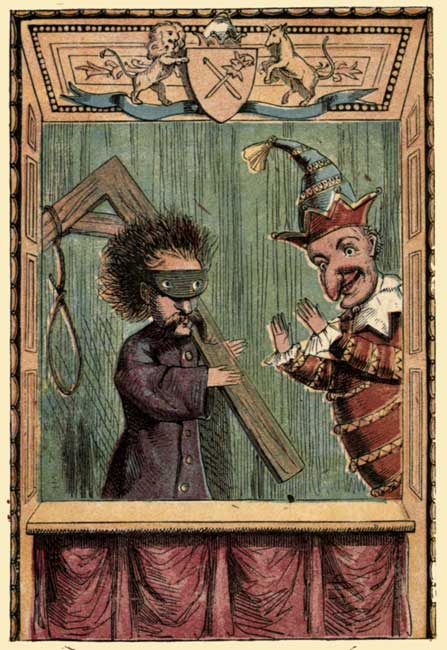
The “Jack Ketch” character from a Punch and Judy puppet show: traditionally, Punch gets the better of their meeting and hangs Jack Ketch.

The Irish immigrant Ketch is the first name in English executioners. Indeed, you can call any of his successors right down to Pierrepoint a “Jack Ketch” and be perfectly understood.

The immediate successor, however, was Ketch’s own assistant — who inherited top billing after Ketch went to jail for “affronting” a sheriff.

Jack Ketch had been trodding the scaffold-boards, hanging, beheading, and drawing-and-quartering for two-plus decades at that point: he’s thought to have been appointed in 1663, and he’d inserted himself into those performances rather more prominently than an executioner ought by botching some of Restoration England’s most high-profile executions.

There’s little reliable information about these early executioners, but it seems Ketch’s reputation for clumsiness had forced him to issue an “Apologie” justifying himself.

But the man unquestionably had longevity in his favor, which is more than Paskah Rose could say.

Within months of becoming the chief London executioner, Rose and another man were chased down in the act of burgling clothes from a house, “the Goods found in Rose’s Breeches.”

Rose and his co-defendant Edward Smith accordingly hanged along with three others at Tyburn this date — by Jack Ketch, now returned from his carceral retirement for one last tour.

Ketch died late that same year of 1686, but has lived on in any number of ballads, doggerels and broadsides immortalizing the name. He was surely aided in this by the less impressive caliber of many who succeeded him: it wasn’t long after Ketch dispatched Pascha Rose that another “Jack Ketch” — an ignoble profession that wouldn’t until centuries hence be drawn from the country’s respectable classes — also met Pascha Rose’s same fate.

There’s a now-public-domain Autobiography of Jack Ketch by 19th century English writer Charles Whitehead.

On this day..

1776: Benjamin Harley and Thomas Henman, Smugglerius?

On this date in 1776, smugglers Benjamin Harley and Thomas Henman were hanged at Tyburn for murdering a customs-house officer who had intercepted them trafficking tea on the Deptford turnpike.

One of these two gentleman might well be the flesh-and-bones person behind the ghoulish ecorche sculpture known as “Smugglerius”.

This beautifully ghastly item was commissioned of sculptor Agostino Carlini by the anatomist William Hunter: it is the cast of a hanged man, meticulously flayed of his skin to reveal the musculature for the convenience of future students’ sketches. Those students gave their subject the jocular nickname, since in life it was thought to be a smuggler.

For good measure, Carlini posed the corpse in the manner of the Hellenistic marble Dying Gaul.


Dying Gaul (known in the 18th century as Dying Gladiator), one of the world’s best-known classical sculptures. (cc) image from Tom Magliery.

Of the “Dying Gladiator”, Byron wrote:

He recked not of the life he lost, nor prize,
But where his rude hut by the Danube lay,
There were his young barbarians all at play,
There was their Dacian mother, — he their sire,
Butchered to make a Roman holiday; —
All this rushed with his blood; — Shall he expire,
And unavenged? — Arise! ye Goths, and glut your ire!


A copy of Agostino Carlini‘s bronze cast of “Smugglerius”, displayed in Edinburgh. (cc) image from Chris Hill.

So that is Smugglerius, an astonishing artifact. For decades, it (actually a copy of Carlini’s original, which is long lost) has been parked at the Edinburgh College of Art, translating thence into countless students’ anatomical sketch pads.


William Linnell‘s 1840 drawing of Smugglerius.

To trace the ecorche‘s origin, we have, to start with, this letter from John Deare … not the tractor guy, but a noteworthy Liverpool sculptor. At time of writing in 1776, he was a 15-year-old matriculating art student:

One of the men bid me tell you, that Mr. Carter would give me half-a-guinea, at least, a week, for the first part of my time, and fifteen shillings for the latter part; but you will write to him, and ask him what he proposes: he is, just as they say, a blustering fellow, but a good man. I have seen two men hanged, and one with his breast cut open at Surgeons’ Hall. The other being a fine subject, they took him to the Royal Academy, and covered him with plaster of Paris, after they had put him in the position of the Dying Gladiator. In this Hall there are some casts from Nature that are cut from the middle of the forehead down to the lower part of the body, one part excoriated, and the other whole.

With the direct reference to the Dying Gladiator/Dying Gaul pose, we seem very clearly to have a bead on the creation of Smugglerius, and the letter suggests that it was one man taken from a pair of hanging subjects. Conveniently (or inconveniently) there were just two such pairs of executions at Tyburn in the spring of 1776: those of Benjamin Harley and Thomas Henman on May 27; and, those of Samuel Whitlow and James Langar on April 12.

Now, artist Joan Smith and anthropologist Jeanne Cannizzo have recently, and very publicly, argued that Smugglerius is not Harley or Henman, but James Langar — a man from the earlier hanging pair. This claim even teased an exhibition carrying the perhaps unfortunate title Smugglerius Unveiled.

The case for Langar basically has two components:

  1. Deare dated his letter about the “Dying Gladiator” on May 1, so the executions must precede that date — which means that it’s one of Langar or Whitlow.
  2. It’s more likely that Langar, a soldier, would have had the outstanding physique to attract Hunter’s interest. (Whitlow was a domestic servant who robbed his master in an unrelated crime.)

Headlines aside, this sleuthing obviously falls well shot of airtightness.

Historian Tim Hitchcock, incidentally a moving spirit behind the creation of the invaluable Old Bailey Online database, doesn’t find James Langar a persuasive candidate. In private communication with this site (4 April 2012), he remained “still very much of the opinion that [Smugglerius] is either Thomas Henman or Benjamin Harley … I am even more convinced now than before.” Here’s the case for one of the Harley/Henman pair:

  1. Harley and Henman were smugglers. You know … like Smugglerius?
  2. Trial records indicate death-sentenced prisoners also condemned to anatomization, and they do not say that about Whitlow and Langar, who were merely thieves
  3. Harley and Henman, by contrast, had killed; they were therefore subject to the Murder Act, and accordingly sentenced “to be afterwards dissected and anatomized; which sentence was executed upon them”*

All things equal outside of the date on Deare’s letter, Harley and Henman look much the likelier source of Smugglerius. (If so, we seem to lack any good reason to prefer Harley as the Smugglerius model as against Henman, or vice versa. Flip a coin.)

The historiography for Langar depends inordinately upon the present-day interlocutor’s confidence in the “1 May” date a Georgian-era teenager slapped onto a bit of personal correspondence with, one can be sure, nothing resembling academic gravity. May 1 could be mistaken outright (maybe it was June 1, and he wrote “May” out of the previous 31 days’ habit); or, it could be only a reference to when Deare began a letter that he might have composed over several weeks; or, it could be that the author had some trivial reason of personal expediency to backdate.

Maybe so, maybe not. But who would have thought anyone would be interested in Harley or Henman (or Langar) going on two and a half centuries after their deaths.

Executed Today had occasion to discuss this fascinating object d’art and its discomfiting origin with one of Hitchcock’s collaborators, IUPUI Professor of British History Jason M. Kelly.

ET: What’s the background? Why is Smugglerius being produced at all in 1770s Britain?

JK: Well, 1768 marked the establishment of the Royal Academy of Arts. It took over 20 years to create.

The idea was to give Britain a school of art — of painting, sculpture, and architecture — to rival its continental peers. The French had established art academies in the previous century; they were among the premier art schools in Europe, if not the premier schools.

The British didn’t have anything comparable. And, in an age of rivalries, both political and cultural, artists and patrons alike saw the Royal Academy as central to British national identity.

The Academy hired William Hunter to be the professor of anatomy. He was an anatomist — a doctor — by training, not an artist, so he was very interested in teaching things like musculature, skeletal structure, and the circulatory system.

Smugglerius was not William Hunter’s only ecorche. He had made at least one other as a teaching aid, and he was proud to associate himself with it. He even poses for a portrait with a miniature version of it.


Miniature portrait of William Hunter holding a miniature bronze from Michael Henry Spang‘s reduction of an earlier ecorched figure. (The full-sized figure can be seen in the background of this sketch.)

What actually goes into producing an ecorche?

They had to get the body from the gallows to the art academy. Then they flayed it. In this case, somebody decided to pose the corpse as the Dying Gladiator.

They had some time prior to rigor mortis to get everything situated. in this case, they flayed him, posed him, then let him dry out, possibly overnight, so that they could make a mold of his body.

Beyond its immediate use as a teaching device, it’s also an art object for appreciation in its own right. How do you read that phenomenon?

This is very much a representation of the power of the state, the unrestrained power.

The execution itself is a display of power, but the government went further when in 1752 it passed the Murder Act allowing the College of Surgeons to get six bodies a year to dissect.

Ordinary people had no desire to have their remains used in this way. In the example of Smugglerius, the criminal was executed. Then, the body was desecrated — transformed into an art object for elite connoisseurs.

The sculpture was meant to represent ideal beauty as well as the terrifying strength of the state. The very people who were meant to appreciate the model of the Dying Gaul were the same people holding the reigns of power. In a sense, this image reinforced the elites’ view of the world, both aesthetically and politically.

Why pose the figure in this way, as the Dying Gaul or Dying Gladiator?

There’s one reading of Smugglerius to the effect that it was very subversive because the Dying Gladiator was seen as emblematic of the decline of Rome: the sculpture represented Rome’s decadence and corruption.

an inveterate abuse, which degraded a civilised nation below the condition of savage cannibals. Several hundred, perhaps several thousand, victims were annually slaughtered in the great cities of the empire; and the month of December, more peculiarly devoted to the combats of gladiators, still [in the early 5th century] exhibited to the eyes of the Roman people a grateful spectacle of blood and cruelty … which had so long resisted the voice of humanity and religion.

-Edward Gibbon in The Decline and Fall of the Roman Empire

So, you could speculate that this pose slyly represented contemporary executions under the Bloody Code in the same critical way.

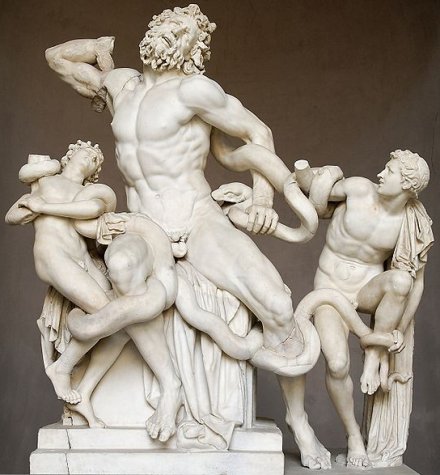
The Gladiator was also one of the best-known and -admired classical sculptures in all of Europe, along with the Laocoön.

In the 18th century they were compared as two examples of dignified dying. Contemporaries saw a certain stoicism in the sculptures — even though Virgil wrote that Laocoön cried out.

Ultimately, Smugglerius reminds us what happens when power is unrestrained. In a world where most people don’t have a voice, the state can ignore the rights and dignity of individuals. The real story here is the story of arbitrary authority and the importance of an enfranchised citizenry with the ability to put limits on those wielding power.

* Hanged felons not sentenced to anatomization could still wind up being taken apart in an operating theater, either as a result of their striking a direct bargain with the surgeons, or involuntarily via London’s growing trade in illicit corpses.

On this day..

1760: Laurence Shirley, 4th Earl Ferrers

On this date in 1760, Laurence Shirley, 4th Earl Ferrers became the last member of the House of Lords to hang.

A violent-tempered man — madness was said to run in the family, and this was in fact the Earl’s defense at this trial — Ferrers’ nastiness ran his wife right out of the house. Consider this was the 18th century, he must have been some kind of intolerable.

Though it was directed at another member of the household, this anecdote from the Newgate Calendar may prove illustrative of the sort of fellow we’re dealing with:

Some oysters had been sent from London, which not proving good, his lordship directed one of the servants to swear that the carrier had changed them; but the servant declining to take such an oath, the earl flew on him in a rage, stabbed him in the breast with a knife, cut his head with a candlestick and kicked him on the groin with such severity, that he was incapable of a retention of urine for several years afterwards.

Right.

We’ve seen in these pages how a certain sort of ill-humored man would sooner go to the scaffold than subsidize his ex. Ferrers was this sort.

The arrangement for the Ferrers spouses (they weren’t divorced, just separated) was that Ferrers would pay her support via his old household steward. Chafing at the payments and resenting the middleman, Ferrers one day in January summoned him to his, theatrically accused him of breaking faith, and shot him through the chest.

The Earl was tried before the House of Lords (a jury of his peers, and Peers!),* but his sentence was straight from the Old Bailey: not just hanging, but anatomization.

However, his exalted rank did draw a few odd perquisites.

Most noticeably, perhaps, was the fact that Ferrers was allegedly hanged with a rope of silk, rather than hemp. For only the softest coiling around noble throats, you see.

The other, and in hindsight more consequential, was that he didn’t get the low-rent treatment of being shoved off a cart. Instead, the scaffold was surmounted with a small platform supporting a set of trap doors whose opening would suspend the malefactor for his asphyxiatory journey to the hereafter.

This, one of many illustrations of the hanging, suggests this novel feature:

This innovation presents us an obvious forebear of the now-familiar “drop” method of hanging which evolved over the subsequent centuries. Though the drop was not repeated at Tyburn, it became wholesale practice when hangings moved to Newgate Gaol; the drop itself thereafter became the very art of the hanging when it was lengthened and scientifically measured to snap the neck of the condemned on the fall instead of strangling him or her.

And you could trace it all back to May 5, 1760.

To judge from other engravings, this red-letter day did not want for witnesses.

Perhaps stage-frightened by all these eyeballs on their noteworthy prey, the executioners put on an amateur-hour show. They openly fought over the £5 tip Ferrers gave (he accidentally handed it to an assistant), and likewise again over the rope that conducted the sentence.

When next in London, wet your whistle at Streatham’s The Earl Ferrers, a local pub.

* Ferrers defended himself: a norm for the time, but to latter-day eyes rather hard to square with his insanity defense. You’ve got a lucid defendant relying upon his wits to save him in a juridical proceeding inquiring of his own witnesses, “Was I generally reputed a Madman?” (Ferrers’s defense, specifically, was “I’m periodically insane.” But when the wind is southerly, he knows a hawk from a handsaw.)

On this day..