On this date in 1673 ended the adventures of “German princess” and early modern celebrity Mary Carleton.
Mary vaulted into the ranks of famous-for-being-famous in 1663, when the pamphleteering forerunners of Perez Hilton caught wind of a bigamy scandal wherein Mary, presenting herself as a mysterious German noble, had hitched with 18-year-old law student John Carleton and run through his money.
Once the public made her acquaintance … well, there was just something about Mary.
Over two dozen pamphlets are known sensationalizing her subsequent trial and acquittal for hubby-hopping, including post-acquittal volleys by both John and Mary.
(These pamphlets don’t currently appear to be available in their original forms online, but substantial excerpts from the most famous of them can be found in the public domain 1914 book The Mary Carleton narratives, 1663-1673: a missing chapter in the history of literature. This volume argues the Carleton publications are a stylistic progenitor of the English novel as it emerged in the hands of, for instance, Defoe. We certainly would be remiss not to notice here our real-life anti-heroine’s parallels (pdf) with Moll Flanders.)
Actually the daughter of a Canterbury fiddler, Moll Carleton was accused of having ditched her first spouse (a shoemaker) for a surgeon, then ditched the surgeon for John Carleton.
Having adroitly beat that rap in a court of law (if not exactly in the court of public opinion) “the German Princess” went into show business; that ubiquitous diarist Samuel Pepys caught her on stage, playing herself, remarking
I’ve passed one trial, but it is my fear
I shall receive a rigid sentence here:
You think me a bold cheat, put case ’twere so,
Which of you are not? Now you’d swear I know.
But do not, lest that you deserve to be
Censur’d worse than you can censure me:,
The world’s a cheat, and we that move in it,
In our degrees, do exercise our wit;
And better ’tis to get a glorious name,
However got, than live by common fame.
Well, why not?
In a time with scant social mobility for women, Carleton — which is the name by which she’s been remembered although she was born “Mary Moders” — carved it out with the tools at her disposal, which makes her an irresistible academic subject.*
Carleton/Moders is nearly the anti-Martin Guerre: whereas the male Arnaud du Tilh subsumed his own identity to insinuate himself into the existing social part of “Martin Guerre”, Mary Carleton’s shifty identity excised her from the social circumstances that would otherwise define her. (She was even reported to have taking to masculine cross-dressing.) Paradoxically, her fictitious biography enabled her to be taken for her own self, which explains why she stuck with her blank-slate “German origins” backstory after it had been publicly discredited.
And after the stage gig had run its course and her identity become disposable once again, she easily resumed her marital perambulations.
Mary Jo Kietzman called Carleton’s life “self-serialization.” The Newgate Calendar sanctimoniously records some of her adventures.
After a few years below the Restoration radar, Carleton was caught up for petty larceny and given a death sentence commuted to penal transportation to Jamaica. (England had just seized it from Spain during Cromwell‘s Protectorate.)
Two years later, she returned to England — not the only one to prefer the danger of Tyburn to the rigors (and obscurity) of the colonies.
She could only live as herself at the peril of her life. And on this day, she clinched her lasting fame at the end of a rope.
* e.g., Mihoko Suzuki, “The Case of Mary Carleton: Representing the Female Subject, 1663-73,” Tulsa Studies in Women’s Literature, Vol. 12, No. 1 (Spring, 1993).
On this date in 1645 — one day after the same fate befell his son — Sir John Hotham was beheaded by the English Parliamentarians for attempting to betray Hull to the Cavaliers in the English Civil War.
On this date in 1645, John Hotham the Younger — former M.P., and (too) briefly an adherent of Parliament in the English Civil War, was beheaded as a traitor.
On this date in 1777, crying out “Stand clear! Look to yourselves! I am the first hypocrite in Sion!”, a clerical schoolmaster was hanged at Tyburn for raping one of his charges.
Ann (or Anne) Mayne testified that the reverend had raped her when she was 9 and 10 years old (the girl was only 10 at the time of the trial). Russen ducked similar charges leveled by three other girls. Rachael Davis, for instance,
said, he lay upon her; but she did not declare, that he entered her body: I told the parties, that no one need be bound over, for it did not appear capital, as she did not say her body was entered.
Result: acquittal. (I’m sure you’ll feel good about entrusting your Bethnal-Green charity school child to Rev. Russen after that.)
Three acquittals out of four ain’t bad.
But it only took one conviction to hang him.
The Old Bailey Online record of Russen’s trial is full of dickering over penetration degrees, and of course, hymen breakage (or lack thereof).
According to thisTreatise of the Pleas of the Crown,* the judge in the Mayne case
left it to the jury whether any penetration were proved; for if there were any, however small, the rape was complete in law. The jury found him guilty, and he received judgment of death. But before the time of execution, the matter being much discussed, the learned Judge reported the case to the other judges for their opinions, whether his direction were proper. And upon a conference it was unanimously agreed … that the direction of the Judge was perfectly right. They held, that in such cases the least degree of penetration is sufficient, though it may not be attended with the deprivation of the marks of virginity. It was therefore properly left to the jury by the Judge, and accordingly the prisoner was executed.
* Part of Edward Hyde East’s project in this Treatise is to argue against a standard still used in some jurisdictions that ejaculation was required to constitute a rape. See Passion and Power: Sexuality in History.
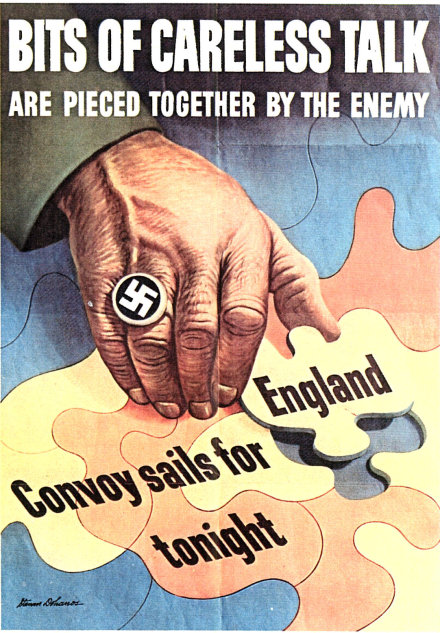
On this date in 1942, British merchant sailor Duncan Scott-Ford was hanged at London’s Wandsworth Prison for giving German agents sensitive information about ship movements.
This, of course, was just the sort of thing everyone was trying to discourage.
… and a version to keep young soldiers on the pull Mata Hari-conscious:
For a case that so handily underscored the posters, the Scott-Ford affair made great copy … but not until a day after the hanging itself. Having kept everything secret, the papers were finally allowed on Nov. 4 to announce
that a British subject was executed for treachery at Wandsworth Prison yesterday morning.
…
Scott-Ford was paid 1,800 escudos by the enemy. This sum, which in English currency is equivalent only to about £18, was all that Scott-Ford in fact received from the enemy, though promises were held out to him which lured him deeper and deeper into the blackmailing clutches of the enemy. Thus when Scott-Ford returned on his second visit to Lisbon with the information which he had collected the Germans, instead of honouring their promises, threatened that they would expose him to the British authorities unless he continued to perform further services, to collect more valuable information and to undergo greater risks in their interest.
Some of the information which Scott-Ford gave to the enemy related to his own ship, and thus imperilled the lives of his own shipmates.
…
The moral to be drawn from this case is that British and allied seamen when visiting neutral ports should be constantly on their guard against strangers who may frequently approach them for apparently innocent purposes. Such strangers are apt to be enemy agents … (London Times, Nov. 4, 1942)
On this date in 1666, a hapless French watchmaker was hanged at Tyburn for starting the Great Fire of London — his obstinate confession in the face of all other evidence making him the convenient fall guy for an accidental cataclysm.
though the Chief Justice told the King, ‘that all his discourse was so disjointed that he did not believe him guilty;’ nor was there one man who prosecuted or accused him: yet upon his own confession … the jury found him guilty, and he was executed accordingly. And though no man could imagine any reason why a man should so desperately throw away his life, which he might have saved, though he had been guilty, since he was only accused upon his own confession; yet neither the judges, nor any present at the trial, did believe him guilty, but that he was a poor distracted wretch weary of his life, and chose to part with it this way. Certain it is, that upon the strictest examination that could be afterwards made by the King’s command, and then by the diligence of Parliament, that upon the jealousy and rumour made a Committee, who were very diligent and solicitous to make that discovery, there was never any probable evidence, (that poor creature’s only excepted,) that there was any other cause of that woeful Fire, than the displeasure of God Almighty.
More Great Fire images, including a map of the destroyed area, here.
Was London lucky to have the Great Fire?
Yes, I suppose so. Lots of people have sort of argued that London missed an opportunity to make more changes, but they just didn’t have the money to do them at the time.
There were a lot of improvements made. They widened the streets. The city was rebuilt in brick instead of wood, although that rule was in place from before 1666. The regulations were restated and extra ones were added in; a lot of people think that it was because of the Great Fire that people started building in brick, but that regulation already existed from earlier in the 17th century.
You’ve got acres and acres and acres of land that have been reduced to rubble during the Great Fire, and en masse, all these new buildings are going up. But yes, it made life more healthy & more pleasant in the city. You had pavement put in for the first time. All these little things you wouldn’t think of, like the houses had to have gassers for the first time, as opposed to just spouts that would spray water on you if you walked down the street. The Great Fire gave people the opportunity to get rid of all those inconveniences.
And they were able to do other things, like the slope down to the River Thames was quite steep, and they were able because of all the rubble to ease the slope.
How did it reshape London? What might have been different about the subsequent life of the city if it had never occurred?
Within days of the fire going out, various architects like Christopher Wren were supplying architectural plans to rebuild London, perhaps around an American grid plan, or European-looking piazzas.
What they really wanted to do was get people moving back into London and rebuilding their houses as quickly as possible, so they kept the medieval street plan and instituted new regulations, like the streets had to be widened, and they could no longer build the houses hanging into the street. The size of the house you could build was proportional to the size of the street you were on, so if you lived on a main boulevard instead of a small lane
Where’s the best place in London to catch a glimpse of that world, as it looked then?
It’s kind of a hidden thing because of course we were bombed in the Second World War, but there are places, like behind St. Paul’s Cathedral, in Amen Court.
So who is Robert Hubert?
He’s a French watchmaker from Rouen, and he was seized in Essex apparently attempting to flee the country. There were various other foreign people who were seized as well, but Hubert confessed to starting the fire.
But his evidence* was very conflicting; he kept changing his mind of what he’d done. He said he’d been part of 23 conspirators and put a fireball through the window of the bakery where the fire started. The baker himself said there wasn’t a window there.
The jury really thought that Robert Hubert was mad, but he was so insistent that he’d done it.
The following year, they discovered that he hadn’t actually arrived in London until two days after the fire started.
Lucky for the baker! He didn’t end up catching any blame for burning down the city?
Hubert was a very convenient scapegoat, and Thomas Farynor** of the bakery was incredibly relieved. Right from the start, Farynor had said “I put my oven out that night, it can’t possibly be me, it must be arson.”
I’ve had a little look at the records of Pudding Lane to see whether he rebuilt his house, and he did.
One of the interesting resources on your site deals with the going fear of “Catholic incendiarism” (pdf), and the use of the Great Fire as a touchstone for the succession conflicts of the 1680’s. Would it have been conventional wisdom by that time, a generation or so after the event, that the Great Fire was a Catholic plot?
It becomes all caught up in the contemporary politics of the time, so it’s really got nothing to do with the fire. It’s people not liking James II for being a Catholic. It’s the fictional Popish Plot, completely fabricated. It’s probably not a coincidence that at the height of the Popish plot that they put up the plaque on the side of the bakery saying that the Fire came from “the malicious hearts of barbarous Papists.”†
Given the combustible material all about, why wasn’t something like the Great Fire a more regular occurrence?
There were six serious fires in the 17th century before the Great Fire happened; one of them was a great explosion of gunpowder.
Fires were sort of a common hazard. The thing about the Great Fire was that there was sort of a whole load of circumstances. There was a drought, so it was dry; there were storm winds coming in from the east, so it blew the fire on faster than it would have; it started at 1 o’clock in the morning, so people were in bed. I think the problem is that it’s all these circumstances combining together. Maybe if it happened at 3 o’clock on Monday when it was raining, it wouldn’t have gone beyond the block.
Logistically, how did the society and the state handle the mass homelessness and unemployment that followed? Where did all these people live right after the fire, and how smoothly were they reintegrated?
People were camping out in the fields outside of London; others were moving into areas that were unburnt but having to pay hugely inflated rents. Some people had to move into other towns. There was evidence that people were still living in shantytown tented accommodations up to eight years after the fire, because there’s another rebuilding regulation in the 1670s that addresses that.
In the first year after the fire, only 150 houses are rebuilt; the rebuilding happens over 10 years, though some houses took up to 30 years. Some people were in very desperate circumstances, so formerly very wealthy people who had lived off their rents might now be working as servants. People coped, a lot of times in reduced circumstances from what they were used to.
There was a particular man you can read about in Samuel Pepys’ diary, and he threw himself into a pond in an attempt to commit suicide because he was so indebted.‡
As curator of an exhibit, what do you hope visitors take away from London’s Burning?
One thing that I really wanted people to understand as they go around the exhibition is the effect on people. You learn about it at school, but you don’t really focus on how people cope and how they rebuild.
There’s also a lot of urban myths about the Great Fire, like the ‘fact’ that the fire is supposed to have ended the Great Plague, which is not the case (pdf); those are things we wanted to dispel.
* There’s some original documentation from the examination of Hubert and others after the Fire here.
** Also spelled Thomas Farriner — or Faryner, or Farryner.
Christopher Wren’s monument to the Great Fire of London.
† An inscription on the base of the Great Fire monument itself (only chiseled out in 1830), once read:
This pillar was set up in perpetual remembrance of the most dreadful burning of this protestant city, begun and carried on by the treachery and malice of the popish faction, in the beginning of September, in the year of our Lord, 1666, in order to the carrying on their horrid plot for extirpating the protestant religion, and old English liberty, and introducing popery and slavery. (Source)
Alexander Pope savaged this civic pamphleteering with the couplet,
Where London’s column, pointing at the skies,
Like a tall bully, lifts the head and lies.
Poets and elites might think what they like, but Lord Clarendon recorded a popular anti-foreigner freakout as England reached
a universal conclusion, that this Fire came not by chance … the wicked authors … were concluded to be all the Dutch and all the French in the town, though they had inhabited the same places above twenty years. All of that kind, or, if they were strangers, of what nation soever, were laid hold of; and after all the ill usage that can consist in words, and some blows and kicks, they were thrown into prison. And shortly after, the same conclusion comprehended all the Roman Catholics, who were in the same predicament of guilt and danger … In the mean time, even they [the King’s Privy Councilors], or any other person, thought it not safe to declare ‘that they believed that the Fire came by accident, or that it was not a plot of the Dutch and the French and Papists, to burn the City;’ which was so generally believed, and in the best company, that he who said the contrary was suspected for a conspirator, or at best a favourer of them. (Source)
the story is that it seems on Thursday last he went sober and quiet out of doors in the morning to Islington, and behind one of the inns, the White Lion, did fling himself into a pond, was spied by a poor woman and got out by some people binding up hay in a barn there, and set on his head and got to life, and known by a woman coming that way; and so his wife and friends sent for. He confessed his doing the thing, being led by the Devil; and do declare his reason to be, his trouble that he found in having forgot to serve God as he ought, since he come to this new employment: and I believe that, and the sense of his great loss by the fire, did bring him to it, and so everybody concludes.
Although the man survived the drowning, he caught his death from the attempt and died in bed; Pepys intervened to see that the desperate suicide’s remaining estate would not be confiscated from his widow for his “self-murder.”
On this date in 1870, Margaret Waters became the first woman in England to hang for baby-farming.
Waters was condemned for murdering an infant she had taken in as a contractual temporary adoption; there is the matter in the dry language of the law.
But Waters’ import — and in fact, since press outrage that her ward’s death had initially been ruled only manslaughter by the coroner, the extremity of her legal straits as well — derived from her milestone symbolism in a burgeoning Victorian-era moral panic.
Margaret Waters’ case dominates the cover of the Oct. 15, 1870 Illustrated Police News, with a central illustration of Margaret Waters hanged … surrounded, appropriately, by men.
“Baby farming” hit the papers in the 1860’s with sensational exposes of a gray market business whose model was:
Relieve unwilling mother of her newborn infant for a fee
???
Profit!
It’s the “???” that’s up for grabs.
To the newspapermen, and the day’s elite crusaders for reform, and especially to the nascent medical industry whose British Medical Journal was instrumental in fomenting public alarm,* it signified nothing short of infanticide, a sort of post-partum abortion.
Thus, the Times of London’s sermonizing post-hanging editorial (Oct. 12, 1870):
A most just sentence has thus been executed, and the law has conspicuously fulfilled its appointed office of being a terror to evil-doers. A more terrible case, with respect both to the heinousness of the offence and to the unexpected vengeance which has overtaken it, has never occurred … The wretched woman and her sister were proved to have systematically published advertisements offering to “adopt” children for a remuneration which no one in his senses could believe to be adequate. In other words, they offered to the parents of illegitimate children a means of getting rid of charges at once burdensome and shameful to them … For the sake of a paltry and precarious gain MARGARET WATERS and her sister had the heart to make away with the helpless little creatures … nothing can palliate the hideous spectacle thus brought to light. A murder in hot blood, the deliberate gratification of revenge, or even a premeditated act of violence in the pursuit of some selfish object, fall short in some respects to the heinousness of this offence. The deepest instincts of a woman’s heart must have been deadened, and the most ordinary feelings of human nature extinguished, before such slow murder could be perpetrated upon piteous little innocents.
… MARGARET WATERS confesses to receiving children for purposes of profit, whom she, at least, knew she could not support. She confesses to receiving them for 5 l. or 10 l., and finding other people who would receive them for a fortnight’s expenses paid in advance, and would then let her hear no more of them. She confesses to taking them into the streets, placing them in the hands of children, and then running away and leaving them to their fate. She confessed to all this, and yet she professed to see in it nothing but “falsehood and deceit.” It was not murder, and nothing seems to have astonished her so much as the sudden vengeance which overtook her … while admitting the most damning facts, she extenuates their criminality. It is well that the stern sentence of the law has pronounced a terrible condemnation of these heartless excuses. “Baby Farming” as practiced by MARGARET WATERS was ruthless and systematic murder, and her doom will indelibly stamp this brand upon her infamous trade.
We wish it could be thought this unhappy woman was a solitary instance of such wilful blindness. It is to be feared she has expiated the sins of others who have actually perpetrated similar crimes, and it is certain there are many who are direct accomplices in her guilt. When she says that “the parents of illegitimate children who seek to get rid of them are more culpable than persons like herself, and that if there were no such parents there would be no ‘Baby Farmers,'” she does but exaggerate a just charge. When MARGARET WATERS abandoned children in the streets to the casual care of passers-by, she did but repeat what had been done by those who had first abandoned them to her in the dark of the night at obscure railway stations. It cannot be too strongly asserted that this execution reflects more or less the brand of murder upon all who contributed to the offence — upon the parents who only sought to get rid of their children, and upon those who allowed their journals to be the instruments of what they might have known to be an infamous traffic. It must be acknowledged that the justice of the law is but brought justice, and spares many who deserve punishment. That is inevitable. But one of the great uses of the law is to depict in true colours the real meaning of common offences. Selfish and licentious men and women will know for the future what is the natural issue of the offences against morality and society which they lightly commit. It is murder, and nothing less, that is the ultimate meaning of these social evils, and this is the contamination incurred by those who facilitate such offences.
Sounds pretty bad.
But then … all those other “selfish and licentious men and women”: had Waters somehow been the bad apple to spoil an entire bushel? (Reformers of the time write often of illicit behavior as a contagion whose example inspires a wider moral deadening.) Or was there something else going on?
Even the Times agrees that our culprit “never entertained the intention of becoming a ‘Baby Farmer’ and a Murderess. She drifted into it under the pressure of want and temptation. … It is, according to her statement, only six years since she was a married woman in good circumstances.”
According to Waters’ own account, summarized third-hand in the Times a few days prior to the hanging, (Oct. 7, 1870) her fall from respectable wedlock to public enemy number one began with the 1864 death of her husband, leaving the woman
with 300 l. in her possession. Intending to turn her capital to account, she took a house in Addington-square, Camberwell, and put into it a number of sewing-machines. Her plan was to make collars and other such articles, and sell them to the city houses. She knew little or nothing of the business, however, and, partly owing to that circumstance and partly to the miserable prices which were paid for such goods, she was at the end of the year a loser of 250 l. She then resolved to save herself by letting lodgings, and that step led her imperceptibly into her career of baby farming. … she was steadily going down-hill, and she found herself obliged to leave Addington-square and go to Bournemouth-terrace, Peckham, where she commenced baby farming as a system. She advertised for children, and she had answers from persons in all stations … She drifted along in this course, getting from bad to worse. But she protested that she had no idea of injuring the children, though she did some things she was very sorry for, owing to the difficulties of her position … She took the Clerkenwell News, and there she used to find a whole string of advertisements — three of them were put in for a shilling — from women who wanted children to nurse. She advertised herself for children to adopt, and she generally got 10 l. with one. When she got the child and the money she went to one of the other advertisers in the Clerkenwell News and arranged to put the baby out to nurse. Upon paying two weeks in advance she was hardly ever asked even for her address, and when she went away of course she never heard anything more of the child. She gained the difference between the 10 l. given her for adopting the child and the fortnight’s payment for nursing it. This was, after all, a very precarious resource, and she fell into great distress … The time came soon when she was unable to pay the money-lender his instalments, and he threatened to strip her of everything under her bill of sale … When she went to Brixton five children died, some from diarrhoea and wasting, and others from convulsions. She was very poor, and determined to save the price of burial by leaving them about. She wrapped the bodies in brown paper and took them out at night, and left them where they were found by people afterwards. She maintains that she did what she could for these children, and attended to them to the best of her power. There were also four other children whom she got rid of in a way for which she is now very sorry. She took them, one at a time, into the streets, and when she saw little boys and girls at play she called one of them and said, “Oh, I am so tired! Here, hold my baby, and here is sixpence for you to go into the sweetstuff-shop and get something nice.” While the boy or girl went into the shop she made off. The babies, she believes, were generally taken to the workhouse.
The slide into the vast but shadow world of poverty, in short … a timeless story.
While intentional infanticide undoubtedly formed some part of the baby farming picture, its nature and extent is also nothing to presume. In an era of staggering child mortality, dead infants were a norm, sometimes the norm. In the context of desperate penury, it was all the more likely. Middle-class authorities who raided Waters’ “farm” saw (and testified to) a slum purposely structured to kill off children. They may simply have beheld indigence.
Waters herself always rejected any notion that she had intentionally killed any of her charges.
Summing up the doomed woman’s testimonial, the doctor who took it underscored the point with an entirely plausible counter-narrative.
Dr. Edmunds, in concluding the recital of the remarkable and instructive statement Margaret Waters made to him a few hours before, said that when children, even under the best conditions, were taken from the breast and brought up by hand, the chances were all against them. What, then, was the chance of infants taken out in the open air the moment they were born and brought up with only such appliances as Mrs. Waters, at her wits’ end for money, flying from money-lenders and dodging landlords, had at her disposal? From what he could judge she had no intention of murdering any of the children, but they died off, as they might have been expected to die off, from diarrhoea, thrush, and convulsions, and when they died she callously got rid of their bodies as best she could when she became poor.
If Waters’ story holds water, her fees so inadequate to the long-term maintenance of children represent much the same calculated gamble involved in insurance: foul play or no, she had no reason to expect to maintain children long-term.** Cold … but hardly incomprehensible.
(It should also be observed babies to adopt actually were in demand.)
Interestingly, one of the key antecedents of the baby farming scandals in the 1860s and 70s was the codification of prim sexual mores for which the Victorian era is a byword.
Earlier in the 19th century, financial responsibility for illegitimate children had shifted from the (putative) father to the mother, and government Poor Relief to single mothers had been slashed — a bit of abstinence-only social engineering meant to stigmatize single motherhood to the greater good of the softer sex: “We trust that as soon as it has become … burdensome and disgraceful, it will soon become … rare.”
Surprisingly, welfare reform did not stop Victorians having sex. Given a milieu where birth control and abortion are illicit and single motherhood severely stigmatized, the policy implied a swath of single mothers powerfully incentivized to have burdensome and death-prone children taken off their hands … and an industry of entrepreneurs ready to meet the demand.
Waters was the first of eight women in England, Scotland and Wales hanged as baby farmers from 1870 to 1909. Her execution would help lead to the 1872 adoption of the Infant Life Protection Act, which introduced a regimen of license and registration in the heretofore libertarian economy of freelance child-brokering.
Books about Baby Farming and its Context
* In “Wolves in Women’s Clothing: Baby-Farming and the British Medical Journal, 1860-1872” (Journal of Family History, vol. 26, no. 3, July 2001), Ruth Ellen Homrighaus argues that
[b]y using their ‘expertise’ to stake a claim on infanticide and to relegate female reformers to the ranks of amateurs, writers for the BMJ made one of many moves to professionalize medicine … [and] establish a monopoly over health care by improving and standardizing medical education and restricting competition from untrained ‘charlatans.’
Infanticide writ large being a complex social problem, it found in baby farming a specific target amenable to outraged public mobilization, with a “subtext … [that] denied that working-class women were fit to manage childbirth and infant care.”
Margaret Waters had the ill luck to be discovered just as this campaign was in need of a potent emblematic villain. Despite the pestering of the moralistic set, police interest in hounding the persons who attended England’s considerable produce of disposable children rapidly waned in the 1870’s.
** Reviewing the still-lively baby farming scene in early 20th century America, Lawrence Friedman notes that
baby farms made a profit from a “grisly calculus”: most babies, in the days before reliable bottle-feeding, simply died when separated from their mothers. Add to this filthy conditions and poor care, and it is no surprise that most babies in baby farms did not survive. Allegedly, up to 80 percent of all babies admitted to one Baltimore baby farm died within weeks.
A century ago today, the first Indian revolutionary martyr to be hanged in England was put to death at Pentonville Prison.
Madanlal Dhingra (or Madan Lal Dhingra) was a bright young scion of a loyalist Indian family that disowned him when he took to radical politics.
As an engineering student in London, Dhingra quaffed the martyr’s cup by assassinating Sir William Curzon Wyllie, a career imperial official spending his golden years keeping tabs on nationalist types among England’s Indian students. (Evidently, he could have been doing his job better.)
Dhingra rejected the legitimacy of the British court, disdained a defense, and was sentenced to death on the first day of trial. His martyrdom being the shared object of both the prosecutors and the offender, he was not long for the world — supposedly checking out with the well-turned last words,
My only prayer to God is that I may be re-born of the same mother and I may re-die in the same sacred cause till the cause is successful.
Dhingra is a noteworthymartyr to the cause of Indian independence now, but like anything else things weren’t so black and white at the time. Gandhi was not down with Dhingra — Gandhi’s own differences with Hindu extremists would eventually cost him his life — and plenty of Indian liberal types shared his abhorrence.
On the other hand, a subversive Brit like poet Wilfrid Scawen Blunt filled his blog-like diary with admiration for the assassin during the weeks of his celebrity — writing of this date, for instance:
They have done me the honour of choosing [my birthday] for Dingra’s execution, thus making of it an anniversary which will be regarded as one of martyrdom in India for generations.
And reflecting later, after the hanging:
People talk about political assassination as defeating its own end, but that is nonsense; it is just the shock needed to convince selfish rulers that selfishness has its limits of imprudence.
On this date in 1540, two days after disposing of his former Vicegerent of Spirituals Thomas Cromwell, the just-wedded Henry VIII wrote a terrifying message of religious conformity in blood and smoke at Smithfield.
The thirtie daie of July, were drawen on herdelles out of the Tower to Smithfield, Robert Barnes Doctor in Diuinitee, Thomas Garard, and Wyllyam Jerome Bachelers in Diuinitee, Powell, Fetherston and Abell. The firste three were drawen to a stake, there before set up, and were hanged, hedded, and quartered. Here ye must note, that the first three, wer menne that professed the Gospell of Jesu Christ, and were Preachers thereof … [the first three] were detestable and abhominable Heretickes, and … had taught many heresies, the nomber whereof was to greate in the atteindor to be recited, so that there is not one alleged … in deede at their deathe, they asked the Sherifes, wherefore they were condempned, who answered, thei could not tell: but if I maie saie the truthe, moste menne said it was for Preachyng, against the Doctryne of Stephen Gardiner Bishoppe of Wynchester, who chiefly procured this their death … but greate pitie it was, that suche learned menne should bee cast awaie, without examinaction, neither knowyng what was laied to their charge, nor never called to answere.
The laste three … were put to death for Treason, and in their attaindor, is speciall mencion made of their offences, whiche was for the deniyng of the kynge ssupremacie, and affirmyng that his Mariage with the Lady Katheryne was good: These with other were the treasons, that thei wer attainted of, and suffered death for.
Terrifying and confusing: here were burnt three Protestants (Barnes, Gerrard and Jerome) for heresy under the Six Articles, essentially for excess radicalism; beside them were hanged, drawn and quartered three Catholics (Powell, Fetherston and Abel) for treasonably refusing the Oath of Succession, that is, for refusing to admit the King of England as the head of the Church of England. It was that old dispute about Anne Boleyn, who was three queens ago by now. (All three Catholic theologians were advisors to Anne’s predecessor and rival Catherine of Aragon, back in the day.)
The one thing that couldn’t possibly be confused in the day’s proceedings was that matters of the faith were matters of state, and in them Henry would brook heterodoxy of neither the liberal nor conservative variety.
“Good Lord! How do these people live?” exclaimed a foreign observer (cited here). “Here are the papists hanged, there are the anti-papists burnt!”
“Who cannot be sorrowful and amazed that he should be a traitor against your majesty? He that was so advanced by your majesty, he whose surety was only by your majesty, he who loved your majesty, as I ever thought, no less than God; he who studied always to set forward whatsoever was your majesty’s will and pleasure; he that cared for no man’s displeasure to serve your majesty; he that was such a servant, in my judgment, in wisdom, diligence, faithfulness, and experience, as no prince in this realm ever had …
If he be a Traitor, I am sorry that ever I loved him, or trusted him, and I am very glad that his treason is discovered in time; but yet again I am very sorrowful; for who shall your grace trust hereafter, if you might not trust him? Alas!”
It was on this date in 1540 that the Machiavellian minister of Henry VIII fell by the instrument he had wielded so ably against so many others.
While Henry strove to get his end away, Thomas Cromwell made the Reformation, setting his energetic hand to the needfully violent reordering of England.
In almost a decade as the king’s chief minister, he had dissolved so many monasteries, annulled so many noble prerogatives, backstabbed so many courtiers, and sent so many of every class to the scaffold that most at court had some reason to hate him. (Cranmer was the only one to (cautiously) object to his old partner’s arrest.)
Hilary Mantel’s acclaimed Man-Booker Prize-winning 2009 novel Wolf Hall humanizes Cromwell’s side of his clash with Thomas More. (Review)
Though it may be, as Edward Hall recorded, that “many lamented but more rejoiced” at Cromwell’s fall from the very height of his power — “and specially such as either had been religious men, or favoured religious persons; for they banqueted and triumphed together that night [of his execution], many wishing that that day had been seven year before” — the reasons for it are murky enough to invite recourse to the royal person’s irrationality.
The bedroom politics get all the press: Cromwell’s bit of marital statecraft arranging Henry’s marriage to Anne of Cleves was a famous dud, but negotiations to end it were well on their way by the time of Cromwell’s arrest.
Why, too, should the minister have been ennobled Duke of Essex in April 1540, months after the disastrous union? That Cromwell, whose own security rested upon the stability of the realm, was a radical Protestant promulgating inflammatory religious ideas — and he was condemned for both treason and heresy, incidentally giving the king wide latitude for just how painfully to kill his former servant — seems to beggar belief.
Once fallen, Cromwell was kept alive long enough to add testimony to the Cleves divorce; that much is clear. But then why keep him alive still three weeks more?
In the end, maybe it was inevitable that one in his position, at his time and place, had to follow to the scaffold the many he had sent thither, just the Tudor version of that familiar “bad advisors” trope: it were not treason to murmur against the aide whose ill counsel did wrong by His Majesty, and so Cromwell stood to accumulate the share of hostility that properly belonged to his sovereign. As an expert practitioner of the game of power politics, Thomas Cromwell could hardly be in a position to complain.
Oh, and by the by: with the German princess on the outs, the king’s wandering eye had fallen upon a niece of Cromwell’s enemy. On the day that Cromwell lost his head, Henry married Catherine Howard. No matter your brilliance, in Henrican England you only had to lose at court politics once, even if the king would be lamenting this injudicious trade within months.
Henry gave his loyal servant the easiest death, beheading on Tower Hill (although it turned out to be a botched job) — alongside a distinctly undercard attraction, Walter Hungerford, the first person executed under the Buggery Act.
Hall records Cromwell playing ball with a fine entry in the scaffold-speech genre that kept his son in the peerage.
I am come hether to dye, and not to purge my self, as maie happen, some thynke that I will, for if I should do so, I wer a very wretche and miser: I am by the Lawe comdempned to die, and thanke my lorde God that hath appoynted me this deathe, for myne offence: For sithence the tyme that I have had yeres of discrecion, I have lived a synner, and offended my Lorde God, for the whiche I aske hym hartely forgevenes. And it is not unknowne to many of you, that I have been a great traveler in this worlde, and beyng but of a base degree, was called to high estate, and sithes the tyme I came thereunto, I have offended my prince, for the whiche I aske hym hartely forgevenes, and beseche you all to praie to God with me, that he will forgeve me. O father forgeve me. O sonne forgeve me, O holy Ghost forgeve me: O thre persons in one God forgeve me. And now I praie you that be here, to beare me record, I die in the Catholicke faithe, not doubtyng in any article of my faith, no nor doubtyng in any Sacrament of the Churche.* Many hath sclaundered me, and reported that I have been a bearer, of suche as hath mainteigned evill opinions, whiche is untrue, but I confesse that like as God by his holy spirite, doth instruct us in the truthe, so the devill is redy to seduce us, and I have been seduced: but beare me witnes that I dye in the Catholicke faithe of the holy Churche. And I hartely desire you to praie for the Kynges grace, that he maie long live with you, maie long reigne over you. And once again I desire you to pray for me, that so long as life remaigneth in this fleshe, I waver nothyng in my faithe.
And then made he his praier, whiche was long, but not so long, as bothe Godly and learned, and after committed his soule, into the handes of God, and so paciently suffered the stroke of the axe, by a ragged and Boocherly miser, whiche very ungoodly perfourmed the Office.
If Cromwell’s dying sentiment concealed any lasting bitterness for the crown, maybe his spirit would take some satisfaction a century later when another of his name and family rose high enough to behead a king.
* Cromwell’s bit about the “Catholic faith” in his dying confession is to be carefully handled; it’s sometimes rendered “the traditional faith,” and occasionally treated by later Protestant polemicists as a phony addition made by Roman apologists. It’s not, appearances aside, walking back the Reformation; according to Charles Carlton’s “Thomas Cromwell: A Study in Interrogation” (Albion: A Quarterly Journal Concerned with British Studies, Vol. 5, No. 2 (Summer, 1973)) our day’s victim “did not see himself as a Catholic separate from the Church, but as a Christian, who, with his King, had escaped the Pope’s usurped authority.” Cromwell is also explicit in this passage about rejecting sacramentarianism, which was part of the heresy accusation against him.




 So who is Robert Hubert?


