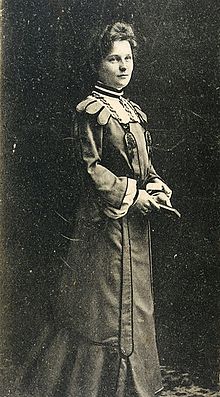
1834: Eliza Joyce, confessed poisoner

(Thanks to Meaghan Good of the Charley Project for the guest post. -ed.)

On this date in 1844, Eliza Joyce was hanged on the roof of Cobb Hall at Lincoln Castle for the murders by poison of her two daughters and her stepson.

She was the fifth and last woman to be publicly hanged at the castle during the 19th century, and she remains the last woman in England to be hanged for a crime she’s pleaded guilty to.

Eliza had married William Joyce, a gardener, in 1840. He had two children by his prior marriage, Emma and William Jr., and he and Eliza went on to have a daughter together, Ann.

However, Emma died suddenly in October 1841 and William took sick the following year. In September 1842 he was visited by a doctor, who prescribed medicine for him. Eliza went to the chemist’s … where she picked not that medication, but arsenic.

Her husband found out and took the poison back to the chemist’s, where they realized some of it was missing. By then William Jr.’s condition had worsened considerably and he was showing symptoms of arsenic poisoning. Before his death at Christmastime he gave a statement, confirming his stepmother had given him the arsenic. He was fifteen years old.

Early in 1843, Eliza’s baby daughter Ann also died. Eliza was charged with William Jr.’s murder, but the indictment was thrown out on a technicality. She was then re-charged with attempted murder, which at the time carried the same penalty: death. But at her trial she claimed William Jr.’s poisoning was accidental: she’d spilled some of the arsenic powder on the floor, she said, and picked it up with a spoon, and later without washing it she used the same spoon to give William his medication.

The jury bought the story and Eliza was freed in the summer of 1843.

However, in light of what had happened, her husband cast her out and she had to move into the workhouse.

Eventually, her conscience began to trouble her and she confessed she’d been guilty all along of William Jr.’s murder, and that she had also poisoned both Emma and Ann with laudanum.

When asked why she’d done such terrible things, she plaintively replied, “I don’t know, except I thought it was such a troublesome thing to bring a family of children into this troublesome world.”

By now fully resigned to her punishment, she offered no defense to the court and pleaded guilty to both girls’ murders. (She couldn’t be charged with her stepson’s murder a second time.) William Calcraft handled her execution, and (for once) he didn’t botch it; she died quickly and quietly.

The prisoner walked with tolerable firmness, being only occasionally supported; and once, when about midway on the platform, she paused for a second, and turned to take a parting glance at the sunny scenery by which she was surrounded, and, as if to bed a lingering farewell to the bright and glorious world which she had sacrificed: her face and features wore an aspect of ghastly agony which none can forget who gazed upon her. Having ascended to the top of the tower on which the scaffold was erected, her bonnet was removed, her arms pinioned, and the cap placed over her face. She then ascended the step of the gallows. The effect of her appearance on the immense crowd was awfully striking. In an instant, the hootings, bellowings, and imprecations, which ever distinguish such enormous assemblages, were hushed, and a profound stillness reigned throughout the living mass.

The Hull Packet and East Riding Times, Aug. 9, 1844

On this day..

1815: Eliza Fenning, for the dumplings

Two hundred years ago today, an Irish serving-girl named Eliza Fenning hanged for poisoning her master’s family. The reliability of the judgment against her was widely questioned in 1815 and has not improved with age.

Robert Turner’s family, along with one of his apprentice stationers all sat down to a meal of dumplings that Eliza, a cook, had prepared for dinner on March 21 of that same year. Within minutes, all were in agony. As Charlotte Turner, who was the mistress of the house even though only a few months older than Ms. Fenning, told the Old Bailey:

I was taken ill myself in less than three minutes afterwards; the effect was so violent, that I had hardly time to get into the yard before my dinner came up. I felt considerable heat across my stomach and chest, and pain.

Q. Was the vomitting of a common kind?

I never experienced any thing before like it for violence; I was terribly irritated; it was not more than a quarter of an hour my apprentice Roger Gadsell was taken very ill in a similar way to myself.

It appeared from the symptoms — and from the blackened dough of the dumplings — that the meal had been laced with arsenic, that cunningly ubiquitous terror of the 19th century. The inference of family, Crown, and eventually court was that Eliza had availed the opportunity of preparing the food to revenge herself on the Turners because Charlotte Turner had caught her some days before sneaking into the apprentices’ room for a snog.

It’s a sure thing that homo sapiens has murdered for feebler reasons than this, but the insufficiency of the provocation, the vociferous denials of the condemned, and the puzzling fact that she too ate the noxious dumplings — all these things militated against confidence in the verdict which was hotly disputed in the public at large. Methods of establishing the presence and quantity of arsenic in a sample were extremely primitive in general, and painfully specious as applied by the surgeon who came to that verdict in the Fenning case.

The court inconclusively pursued the various ingredients in the dish: the same flour had been used for a meat pie that had brought up nobody’s dinner, so that was out; Eliza suggested the milk might be to blame, or a new yeast the house obtained on the eve of the dinner party. There is a wide-ranging effort in the transcript to establish the young woman’s access to an arsenic packet that Robert Turner kept in a desk drawer to poison mice, but this seems little relevant; it was an unlocked desk drawer in a busy household, plus arsenic was widely available in town. Everyone had effective access to arsenic, should she or he have a mind to find it.

As friend of the site (and occasional guest blogger) Richard Clark puts it in his overview, “it is difficult to be sure whether Eliza was guilty or not” even all these years later. But it’s a certainty that what was developed against her in 1815 would fall leagues short of any present-day standard for a confident conviction. Was she really unbalanced enough to try to murder the entire household over a tongue-lashing, yet steely enough to eat the poisoned dish herself to dispel suspicion, yet incautious enough not to have readied any other alibi for the moment when attention would turn to the cook? What possible basis could she have had for believing that she could salt in enough of the toxin to kill everyone else but eat a safely sub-lethal dose herself?

And maybe, as with Cameron Willingham, we might best begin with the premise: was there actually a dose of arsenic, laid in by a sinister hand — or might some contaminant carelessly proximate to the food supply of an unruly metropolis have been the true and undetected culprit?*

The case dissolves under even mild scrutiny into a tissue of social and medical quackery: the uppity servant, the sexually precocious Irishwoman, the assassin infiltrating the dumplings. (See Judith Flanders’s The Invention of Murder: How the Victorians Revelled in Death and Detection and Created Modern Crime for a scathing defense of Fenning.)

Whatever it was that the family puked up, everyone did so speedily enough to remain among the living. Attempted murder, however, was still a capital crime in England, and would remain so until 1861.

Though her case would attract widespread sympathy and public controversy, Eliza Fenning’s defense before the bar was all but nonexistent: four good-character witnesses, plus this statement:

My lord, I am truly innocent of all the charge, as God is my witness; I am innocent, indeed I am; I liked my place, I was very comfortable; as to my master saying I did not assist him, I was too ill. I had no concern with the drawer at all; when I wanted a piece of paper I always asked for it.

That’s the whole of it — complete and unabridged. It is a pathetic thought to consider this helpless plea in light of the idea that the food might have been poisoned accidentally; tunnel vision had already settled on a semi-coherent story of the embittered serving-girl’s revenge,** and without the art to draw out some different interpretation of the few facts available, Eliza found her place fixed by the self-validating suspicions cast upon her.

She held to her innocence all the way to the end; it was put about that a Newgate screw had overheard her father bid her do so no matter what lest he lose all honor after she died. One last character assassination for the road.

Supporters — and she has had many, down to the present day — flocked to Eliza’s Irish wake in the days after her hanging (the body “being placed in the kitchen of the house, and dressed out in ribbons, flowers, &c.”†) and then thronged a funerary procession from Red Lion Square to the tombs of St. George Bloomsbury.

* In 1900, to the consternation of brewers, around 6,000 pub-fanciers in northern England fell ill from beer that turned out to be contaminated with arsenic present in an ingredient (sulphuric acid) that made a different ingredient (glucose) that went into the beer.

** As Fenning was condemned just a few weeks before Waterloo, the paranoia that England’s burghers nurtured over the prospect of incipient Jacobinism must be presumed a relevant part of the scenario … doubly so, considering the young lady’s nationality.

The Lincoln, Rutland and Stamford Mercury, Aug. 4, 1815. Reports that the family had the effrontery to accept 40 quid worth of gifts from well-wishers were also lamely represented by Fenning’s persecutors as black marks on the family name.

On this day..

1908: Grete Beier, who wanted the fairy tale

Marie Margarethe (Grete) Beier, the daughter of the late Mayor of Brand-Erbisdorf, was beheaded on the fallbeil on this date in 1908 for murdering her fiance. While her crime was banal, the consequent spectacle lit up newswires all the globe ’round.


Despite the marquee half of this contradictory headline in the Adelaide, Australia Advertiser (Aug. 26, 1908), the execution occurred behind prison walls. About two hundred tickets were distributed to members of the public (all men), but thousands of applicants (which included many women) were denied them. These “ticket holders rushed in pell mell in their eagerness to get the best places. Men fell and fought wildly.”

Secretly carrying on with a lover named Johannes Merker, Beier (German Wikipedia link) was forced by her parents — a working-class couple made good — into pledging her troth to a respectable engineer named Heinrich Pressler.

With “the face of an angel and the heart of a fiend”* the charming Beier contrived a plan to truly have it all: on May 13, 1907, she visited her would-be husband and spiked his drink with potassium cyanide — then to be sure of her project, had him close his eyes and open his mouth on her flirty promise of a sweet surprise. Then she shoved his own revolver between his lips and fired, abandoning at the scene of her crime a forged will to her benefit, a forged suicide note lamenting a purported affair with a vengeful Italian woman, and forged love letters corroborating the latter, fictional, relationship.

She was some weeks on towards her way to getting away with it — the coroner did indeed take Herr Pressler for a suicide — before suspicions as to the dead man’s testament led police to set a watch on her and unravel the web. Grete Beier confessed, in an unsuccessful gambit to secure mercy.

She reportedly died bravely, albeit slightly appalled by the size of the audience that had been admitted to gawk at her disgraceful finale.


Detail view (click for the full image) of the courthouse yard at Freiburg being readied for Grete Beier’s beheading. Image via the invaluable Bois de Justice.

* Her feminine fiendishness was greatly exacerbated to contemporaries by stories that she had also aborted three bastard children.

On this day..

1936: Charlotte Bryant

(Thanks to Meaghan Good of the Charley Project for the guest post. -ed.)

At around 8:00 a.m. on this day in 1936, Charlotte Bryant was hanged at Teeter Prison by Thomas Pierrepoint for poisoning her husband with arsenic the previous year.

“Dying of arsenical poisoning,” writes Stephen Wade in his book Notorious Murders of the Twentieth Century: Famous and Forgotten British Cases,

…has got to be one of the most agonizing exits from the world we can imagine… Its effects are horrific… The sensations experienced have been described as the sense of having a burning ball of hot metal in the gut; on top of that, the victim has vicious diarrhea, vomiting and spasms in the joints, dizziness and consequent depression.

Frederick Bryant was to die that way.

Charlotte was born and raised in Ireland. She and Frederick met there in 1922, where he was serving with the military police. Charlotte, who was only about nineteen at the time, had the reputation as a girl who would sleep with anyone. Frederick didn’t seem to mind her reputation, though, and they so they married and moved to a tiny, rural village in Dorset, and he sought work as a farm laborer.

Charlotte’s open promiscuity continued, and soon evolved into prostitution. Everyone in the neighborhood knew her for her gallantries. It was said that, when someone asked Frederick how he felt about this, he pointed out he was earning less than said £2 a week as a cowman and said, “Four pounds a week is better than thirty bob [shillings]. I don’t care a damn what she does.”

Charlotte ultimately bore five children, some of whom may have been Frederick’s.

This situation continued until 1933, when Charlotte met Leonard Edward Parsons, a man who was himself married, and fell in love. Not only did the easygoing Frederick accept this relationship, he actually invited Parsons to live with them. Parsons did, and things actually went quite well for some time. Parsons paid the Bryants room and board, which made Frederick happy. Parsons and Charlotte got to have sex all the time, which made them happy. Win-win.

But finally Frederick asked Parsons to move out.

Frederick Bryant became inexplicably ill in May 1935 after drinking tea Charlotte had prepared for him. He recovered within a few days and he and his doctor shrugged and passed it off as gastroenteritis. In August he got sick again with the same symptoms as before, and as before, he soon recovered.

In November, Leonard Parsons told Charlotte he was going to leave her and find another job somewhere else. She was devastated.

By the time the Christmas season rolled around, Frederick was sick again. This time his symptoms were serious and he writhed in agony, “saying there was something inside him like a red-hot poker that was driving him mad.” He was sent to Sherbourne Hospital for treatment, but died a few days before Christmas.

Frederick’s doctor, who had treated him through these mysterious bouts of gastric illness, was suspicious: the symptoms the dead man had complained of corresponded exactly to arsenic poisoning, and like everyone else in the area he knew Charlotte as something less than the good wife. The doctor refused to sign a death certificate and notified the police of his suspicions.

A very thorough investigation began. A chemistry expert from Scotland Yard was given

complete organs, including the stomach and contents, small and large intestines, urine in the bladder, vomit and excreta, complete lungs, portions of skin and hair, brain and nails. In addition, these were taken from the area around the body: samples of soil from above the coffin, below the coffin and from the adjacent ground, sawdust from the coffin, and a portion of the shroud.

Sure enough: the results showed that Frederick’s flesh and the environs of his corpse were positively dripping with arsensic. Altogether 4.09 grains were discovered. Anywhere between 2 and 4 grains comprises a fatal dose.

While the chemist was at work analyzing his myriad of evidence, the police were questioning Charlotte. She denied having harmed her husband and said she had not recently purchased arsenic or anything containing it. However, a friend of the couple had some interesting things to say: Charlotte had a tin of arsenic-laced Eureka brand weed killer and said “I must get rid of this … If nothing is found, they can’t put a rope round your neck!”

After a search, the police found a partially burned tin of Eureka weed killer. Dirt and ash samples from the rubbish heap where it had been discarded tested positive for elevated levels of arsenic.

But they still had to prove Charlotte bought that tin of weed killer.

The Scotland Yard analyst had a look at Charlotte’s coat and found arsenic dust in the right-hand pocket at a staggering 58,000 parts per million. (By comparison, the average amount of arsenic found in ordinary soil is about 18 parts per million.)

Records showed that someone had purchased Eureka weed killer from a local chemist’s shop at around the right date, signing their name on the poison register with only an X. Charlotte was illiterate and could not have signed her name, but would have used her mark instead. The chemist said he knew the woman who came in to buy the poison but claimed that in spite of this, he would be unable to identify her now. He was probably trying cover his own tracks: it was illegal for a chemist to sell arsenic to anyone they didn’t know.

Parsons was questioned about Frederick’s murder. He had an alibi and was cleared of suspicion, but the police decided they’d accumulated enough against Charlotte, and arrested her for murder.

At her trial in May 1936, her attorney stressed the circumstantial nature of the evidence and warned the jury not to take Charlotte’s promiscuity into account. After all, she was on trial for murder, not for sleeping around. No one had seen Charlotte poison any food or give poisoned food to her husband, and the chemist still couldn’t or wouldn’t identify her as the woman who bought the weed killer at his shop.

Nonetheless, the verdict was guilty. Desperate efforts were made on her behalf to get her a new trial; some people believed the chemistry expert’s evidence had been faulty. These efforts came to nothing. Charlotte wrote a letter to the King, begging for a royal pardon, but this was ignored. She died protesting her innocence.

A footnote to this sad and sordid story: Charlotte left a pitiful estate worth 5 shillings, 8½ pence and willed it all to her five children. (She’d learned to write her name in jail; her will was the first legal document she signed with her name rather than her mark.) Her children were trucked off to an orphanage. Mrs. Violet van der Elst, a noted anti-death penalty activist, heard of their plight and vowed to make sure they were cared for. (Van der Elst featured this case among numerous others in her 1937 tract On the Gallows.)

She also started a charitable fund for the children of executed convicts. The first donation to the fund, from van der Elst herself, was £50,000. As for the Bryant children, nothing further is known of them.

On this day..

1772: Mary Hilton

On this date in 1772, Mary Hilton was burned at the stake in Lancaster for “petty treason”: poisoning with arsenic her husband, John, a blacksmith.

She was drawn on a sledge to the execution site, hanged to death as a mercy, and her body burnt to ashes.

On this day..

1745: Eve, her smoke visible throughout the country

On this date in 1745, Orange County, Virginia was darkened by the smoke from a stake where a slave named Eve died for poisoning her master, Peter Montague.

As accused, Eve, “not having God before her eyes nor considering the obedience to the said Peter Montague, her master, but led and seduced by the instigation of the Devil … with force of arms and her malice forethought, feloniously and traitorously did mingle and poison milk … did give it to the said Peter Montague, which he did taste, eat, drink and swallow down … and did languish until the 27th day of December. Eve falsely, traitorously and feloniously of her malice forethought with the poison … did kill, poison and murder.” (Quoted here.)

Eve asserted her innocence to no avail at her trial on January 23. The court condemned her to “be drawn upon a hurdle to the place of execution and there to be burnt.”

Upon the execution of that sentence — “the smoke of the burning of Eve was visible over a large extent of the country” — the Montague estate was compensated £50 by the Commonwealth of Virginia for the destruction of its human property.

On this day..

1785: John Winship, family planner

On this date in 1785, a Sunderland-area farmer named John Winship was hanged for killing his maidservant Grace Smith with a poisonous draught of corrosive mercury sublimate which Winship had intended to induce an abortion.

His body was delivered to a local surgeon, who autopsied it and “in the presence of many gentlemen of the faculty” lectured on Winship’s organs as he dug them out (and extracted two intestinal worms).

the doctrine of the late Mr. Hewson, F.R.S. was demonstrated, that, in executions of this kind, death is not produced, as has been generally supposed, by an extravation of blood, occasioned by the rupture of the vessels of the brain, but by suffocation: as in the case of drowning, etc. (Newcastle Courant, July 30, 1785, quoted in this anti-abortion tract)

Grace Smith, who died four agonizing days after she ingested the toxin, perhaps did not sympathize overmuch with her killer’s unpleasant strangulation.

On this day..

1517: Cardinal Alfonso Petrucci, plotter

On this date in 1517, the Italian cardinal Alfonso Petrucci was put to death for a conspiracy to murder Pope Leo X.

Leo had been acclaimed pope in 1513 at a conclave noted for nearly electing the worst possible pontiff when cardinals hedging their first-ballot votes while they took the temperature of the room all happened to vote alike for the feeblest candidate on the expectation that nobody else was voting for that guy.

Chastened by the near-miss, the leading candidate Giovanni de’ Medici promptly cut a deal with his chief legitimate rival for St. Peter’s seat, Raffaele Riario.*

This arrangement boosted to St. Peter’s throne the first of four popes from the Medici, intriguingly done with the acquiescence of Riario, who was kin to one of the prime movers of the anti-Medici Pazzi Conspiracy from many years before. Both Giovanni de’ Medici and Raffaele Riario were too young to have played a part in those events, but the lingering familial animosity might well bear on what transpired in the papacy of Giovanni de’ Medici — or rather, as we shall know him henceforth, Pope Leo X.

Leo was an entirely worldly character, whose enthusiasm for the peninsular politics that shaped his native habitat would help lead a German cleric to nail 95 theses to the door of a church in Wittenberg later this same year of 1517. “Why does the pope, whose wealth today is greater than the wealth of the richest Crassus, build the basilica of Saint Peter with the money of poor believers rather than with his own money?” Martin Luther demanded (thesis 86) of Leo’s increasingly shameless indulgences racket.

Acting more the Medici than the Vicar of Christ, Leo in 1516 deposed the tyrant of Florence’s neighbor and rival, Siena. The declining Sienese Republic was a prime target of Florence’s expansionist ambitions, and indeed it would be gobbled up in the mid-16th century by the Florence-based and Medici-led Grand Duchy of Tuscany.

In Leo’s time, his coup shattered Siena’s ruling Petrucci family** to the injury of one of Leo’s fellow churchmen, Cardinal Alfonso Petrucci English Wikipedia entry | the much more detailed Italian). Alfonso now had cause to use his office for the agenda of his family and his city, and sought a countervailing anti-Medici arrangement with the condottiero Francesco Maria I della Rovere, whom Leo was even then fighting a war against.

The arrangement came to nothing and Leo assured Alfonso of safe conduct for his return to Rome. It was just a lot of scheming Italian oligarchs doing what they always did, some of them while wearing cassocks.

Except upon Alfonso’s return, Leo had the Petrucci cardinal and another cardinal friendly to him clapped in prison for an alleged plot to poison the pontiff.

Cossetted court cardinals suddenly found themselves accused papicides under the threat (and, for some, the reality) of torture. Hard-to-credit “confessions” duly ensued with Leo enlivening the spring and summer of 1517 with preposterous security theatrics.

On June 8 they assembled in Consistory, when the Pope burst out into complaints. He had evidence, he said, that two other Cardinals whom he had trusted had joined in the conspiracy against him; if they would but come forward and confess he would pardon them freely; if they refused to confess he would have them carried to prison and would treat them like the other [accused]. The Cardinals gazed on one another in alarm, and no one moved. The Pope asked them to speak, and each in turn denied … Leo X’s dramatic stroke was a failure; he could not succeed in his unworthy attempt to induce some unsuspected person to criminate himself. (Source)

It’s hardly past thinking that rival factions would poison off a pope, and there’s been some latter-day research suggesting that something really was afoot. For that matter, Leo’s actual death in 1521 has often been suspected of being aided by an apothecary’s philter.

But outside the dramatics, Leo scarcely handled his prisoners in 1517 as if he were much in genuine fear for his life.

Instead, the practical pontifex maximus used it as a shakedown opportunity against anyone who could be denounced a confederate of the hotheaded young Petrucci. The Genoese Cardinal Sauli, arrested together with his friend Petrucci, was forced to buy his liberty for 50,000 ducats; Cardinal Riario, Leo’s old opposite number from the 1513 conclave, was implicated by Petrucci and Sauli as knowing himself the prospective beneficiary of the plot, and Riario was forced to retire to Naples upon payment of an exit tariff of 150,000 ducats plus his Roman palace. (It remains papal property to this day as the Palazzo della Cancelleria.) Further downmarket, Cardinals Soderini and Adrian fled Rome in despair of discharging the 25,000-ducat fines affixed upon each of them.

Money, however, would not suffice for Cardinal Petrucci, the active center of whatever conspiracy existed. Petrucci probably did murmur something one could construct as treason against his Holy Father, if one regarded them in their ecclesiastical rather than their dynastic positions, and he evidently engaged the Pope’s surgeon Giovanni Battista da Vercelli as an instrument of the proposed assassination or at least made loose talk to that effect.

While the doctor, along with Petrucci’s private secretary, were hauled through the streets to a demonstrative gibbeting, Petrucci was strangled privately in his cell on July 16, 1517. It was done by a Moor out of consideration for the impropriety of a Christian slaying a father of the Holy Church.

Beyond the rent-seeking and the rival-eradicating, Leo leveraged the purported plot to appoint 31 new cardinals in July 1517, basically doubling the College of Cardinals at one stroke while stocking the ranks with men who could offer him political support or timely bribes.

* Riario’s legacy can still be seen around the Vatican to this day: he’s the guy who brought Michelangelo to Rome.

** Leo’s coup deposed one Petrucci and raised up a different, more compliant Petrucci.

On this day..

1913: Henry Lovell William Clark, Raj poisoner

This date in 1913 saw the hanging of Henry Lovell William Clark for a sensational pair of domestic murders in the British Raj.

The half-Indian Lieutenant Henry Lovell William Clark of the Indian Subordinate Medical Department struck up a sweltering affair in colonial Agra with the bored memsahib Augusta Fullam.

Their trysts over three-odd years from 1909 would become the scandal of British India — the specifically British part — after Clark’s wife Louisa was sabered to death in her home in November 1912 by a quartet of native assailants* who turned out to have been hired by her faithless husband.

The police inquiry soon uncovered a much deeper passion and depravity.

A trunk full of adulterous correspondence incautiously retained by Fullam documented months of her frustrated attempts to poison off her husband over the course of 1911.

The plan had simply been to infiltrate arsenic doses into Edward Fullam’s food. Arsenic poisoning was so popular precisely because the symptoms were so difficult to isolate from natural causes of death; off in India, it could easily be passed off as heat stroke or cholera.

“I give him half a tonic powder every day in his Sanatogen, lovie darling, because it lays on the top of the white powder quite unsuspiciously,” Augusta cooed to her doctor-lover in one letter.

Despite Augusta’s best efforts, lovie darling, Edward’s constitution proved to be as tenacious of his life as it was unsuspecting of his wife.

For month after harrowing month, his helpmate tried to kill him at dinner and teatime and anywhere else she got the opportunity to administer a packet of the “tonic powders” Dr. Clark supplied. He would often vomit and fall ill — Fullam recorded one occasion in June where her husband puked ten times in a single evening — but it wasn’t until October that Edward finally succumbed. Clark himself topped the arsenic wallop for that fading patient with a lethal dose of gelsemine just to make sure, then put his professional signature to the death certificate.

One spouse down. One to go.

It might have been wise for the lovers to stick with this potentially subtle method of homicide for Louisa Clark. While “murdered by swarthy intruders” is a classic, it can’t be signed off quietly by some random member of the medical profession. Neighbors had figured out the love affair, and when police pursued that line of inquiry, everyone’s alibis fell apart. Not to mention that trunk full of lovey-dovey bloodthirst.

Though Henry Clark hanged for the murder on March 26, 1913, he left his mistress pregnant — and this sufficed to save Augusta Fullam from the gallows. She died in Naini prison in 1914.

* According to this book, three of the four hired assassins were also executed.

Part of the Themed Set: Arsenic.

On this day..

1851: Sarah Chesham, poisoner

(Thanks to Meaghan Good of the Charley Project for the guest post. -ed.)

On this date in 1851, 41-year-old Sarah Chesham was hanged before a crowd of six to seven thousand people in Chelmsford, England. She’d been convicted of a single count of attempted murder, but the evidence indicates, and the public certainly believed, that she was responsible for several deaths and had perhaps even taught her deadly craft to other women.

Sarah lived in the village of Clavering in Essex. In January 1845, two of her six children died suddenly, one after the other, and were buried in a single coffin. Their deaths were written off as cholera, a common and deadly disease in those times. Yet, according to later accounts, just about everyone in Clavering knew the boys had been murdered.

In fact, Sarah’s reputation as a poisoner had been well known long before her sons’ untimely deaths.

In spite of the rumors, no action was taken until later that year — when Sarah was arrested on the charge of poisoning a friend’s illegitimate baby, a boy named Solomon Taylor. Solomon had been born healthy and thrived for the first few months of his life, but in late June 1845 he became sick, rapidly wasted away and died. His mother accused Sarah of murder.

Suspicious, the authorities exhumed the bodies of ten-year-old Joseph and eight-year-old James Chesham.

The boys’ corpses turned out to be saturated with arsenic.

James C. Whorton, in his book The Arsenic Century: How Victorian Britain was Poisoned at Home, Work and Play, describes what happened next:

An inquest quickly led to Chesham being indicted for murder, and she was brought to trial in the spring of 1847. The evidence against her seemed conclusive: her sons had arsenic in their bodies, police had found “an assortment of poisons” in her house, and during the trial there were clear attempts to coerce witnesses not to testify against her. Sarah Chesham was nevertheless acquitted of all charges.

The jury’s foreman for Joseph’s case explained, “We have no doubt of the child having been poisoned, but we do not see any proof who administered it.” After all, no one had actually seen Sarah giving arsenic to her sons.

After her trials for the murders of James and Joseph Chesham, Sarah was tried for Solomon Taylor’s murder. Again she was acquitted; there was no evidence of poison in the infant’s body. Whorton records,

The verdict struck most observers as outrageous, but even if it was correct, something very disturbing was going on. The woman’s neighbors had believed her to be spreading poison for years, yet had uttered not a word to authorities. “What is to be said,” a newspaper asked, “of a district where cold-blooded murder meets with all the popular favor which is shown to smuggling in Sussex?”

One can’t help but think of the many incidents in modern times when “everyone knew” about the child abuse going on in some local household, but nobody bothered to report it until after a tragedy occurred.

Chesham was released from custody, went home and resumed her life. Then, in 1849, her husband died. He had much the same symptoms his dead sons had, but suffered a great deal longer: it took months for him to die.

During his illness, the solicitous Sarah was constantly by his side. She gave him milk thickened with rice or flour and wouldn’t let anyone else feed him anything.

After Richard Chesham’s death, authorities seized a sack of rice from Sarah’s kitchen. It was contaminated with sixteen grains of arsenic. (Two or three grains can kill a healthy adult.) Richard had arsenic in his body as well, but only in traces.

Although her latest alleged victim had died, Sarah was charged only with attempted murder: Richard suffered from pulmonary tuberculosis and it was unclear whether it was the arsenic or the lung disease that caused him to die. (It’s theorized that Sarah, having learned something from her earlier trials, had poisoned her husband slowly in small doses rather than in one dose all at once, as she allegedly did with her children.)

The punishment was the same either way: death. Sarah would be the last woman in Britain to be hanged for attempted murder.

Sarah Chesham may have wanted to rid herself of an inconvenient husband, perhaps reasoning that he would die of consumption anyway so she might as well speed him along. In some other fatal poisonings in Essex during that time period, however, it appears the motive was the deceased’s burial club money.

Club Dead

Many of England’s poor and working-class subscribed to burial clubs for themselves and their families. These were a form of life insurance and meant to provide money for the funeral if a member died, thus sparing the person from a pauper’s grave or worse, the anatomist’s dissecting table.

Some people, however, subscribed for different reasons, as Whorton noted:

Yet there were, inevitably, some subscribers who were not at all averse to a child or spouse receiving a pauper’s send-off, and if sufficient economies were adopted in their disposal, there would be enough money left over to make murder worthwhile … If done right, profits were not inconsiderable. First of all, club dues were affordable for virtually anyone … Second, benefits were relatively generous. Manchester clubs, for example, paid out £3 as a rule, but some paid £4 or even £5; a basic funeral for a child could be financed for only £1 or £2.

Provided they came up with the money for subscription fees, there was nothing stopping people from joining multiple burial clubs at the same time and getting a big fat payout upon their relative’s untimely death. Wharton mentions one child from Manchester who belonged to nineteen burial clubs at once.

Poisoner Mary May, who was convicted of killing her half-brother and hanged in 1849, had subscribed to multiple burial clubs without her victim’s knowledge. After she poisoned him she got £10 in all. Some people got double or triple that sum. And this at a time when an unskilled laborer could expect to earn only about £27 annually.

Cases like Sarah Chesham’s and Mary May’s set off a moral panic about poisonings in the 1840s and 1850s. As the London Medical Gazette noted, twopence could buy enough arsenic to kill one hundred people.

The press had everyone convinced that hundreds, perhaps thousands, of people were poisoning others for profit. Newspapers devoted a great deal of space to poisoning trials and speculated that these cases were only a few of a “multitude” of murders that went unpunished — and that this multitude was growing. Jill Ainsley wrote about this at length and says,

According to the press, the bodies subjected to forensic examination represented the tip of the iceberg of poisoned corpses. Poison narratives routinely assumed that poisoners were caught only once their lethal practice was well established. Once a particular individual was suspected in one death, their pool of alleged victims automatically expanded to include anyone else they had contact with who subsequently died. The implications of references to large families “all of whom were dead” were clear to regular readers of crime reports.

Women in particular were liable to suspicion.

In fact, the papers alleged that in Essex there was a “secret society” of female poisoners who conspired together to murder people with arsenic, and that the general public was aware of the situation and accepted it. There is no actual evidence that such a conspiracy existed, never mind that it was condoned by the locals.

It is true that the number of prosecutions in poisoning cases rose during this time period, but that was probably because of the application of the Marsh test, invented in 1836 by chemist James Marsh.

The Marsh test was the first reliable test for arsenic in the human body and it was extremely sensitive. Before that, just about the only way to figure out if something was poisoned was to give some of the suspect substance to a dog and see if it died.

Arsenic during the nineteenth century was cheap, plentiful and used in a myriad of things, from wallpaper coloring to makeup to sheep dip. In small amounts it made a good rat poison, and that’s usually what it was used for.

Since it came in the form of a grainy white powder that could easily be mistaken for flour, salt or sugar, a lot of people got poisoned — not all of them intentionally, either.

There were not a few suicides and many, many accidents. Ainsley, who studied the Essex poisonings at length, believes it’s entirely on the cards that the arsenic that killed James and Joseph Chesham got into their systems accidentally.

It was partly due to the notoriety of Sarah Chesham’s crimes that the British parliament passed the Sale of Arsenic Regulation Bill in 1851. The law required arsenic sellers to record the name of each buyer and to sell it only to people they knew personally. It also required arsenic to by dyed some other color so people would no longer mistake it for food.

Getting back to Sarah: after her execution, her family was permitted to claim her body for burial in the local churchyard. But before the internment could take place, the body was stolen, probably for dissection, by a person or persons unknown. It was never recovered.

Part of the Themed Set: Arsenic.

On this day..