1808: Sultan Mustafa IV, by his brother

On this date in 1808, the former, and now deposed, Ottoman Sultan Mustafa IV was strangled at the command of his successor and brother.

The Ottoman Empire, once the very terror of western Christendom, entered the 19th century in a stagnation that had it well on its way to its way to “sick man of Europe” status.

Its fate would be defined by the political — and sometimes literal — battle between its entrenched interests and forward-looking reformers who struggled to restructure the empire for the challenges that lay ahead.

And at this point, it wasn’t only the Ottoman polity that had to fret for its survival. Its very namesake dynasty was in danger of extinguishing itself. There hadn’t been a male born to the House of Osman in twenty years, and in the events herein narrated, internecine conflict would winnow the Osmans down to their very last man.

Aggressive Progressive

Reform was the project of our principal’s predecessor, Selim. In the years around the turn of the century, Selim endeavored to get Turkey out of its wasteful foreign conflicts to gain maneuvering room for more urgent domestic projects.*

Chief among the many oxes Selim proposed to gore were the Janissaries, the Ottomans’ powerful and increasingly archaic military elite, much given to destructive use of their martial prowess in various factional conflicts within the Empire.

Possessive Regressive

The Janissaries deposed Selim in 1807, elevating his cousin — our man, Mustafa, a mere handmaiden of the hidebound. (His contemporaries in Europe more commonly transliterated the name “Mustapha”)

They didn’t kill Selim … just left him alive within the palace where armed men could find him in a pinch.

That pinch arrived in June in the form of Mustafa Bayrakdar, a reformist official who marched on Istanbul to overthrow the reactionary elements. As Bayrakdar took the city in hand, Mustafa desperately ordered the executions of Selim and of Mustafa’s own brother, Mahmud.

Selim was disposed of. Mahmud got tipped off, and the servants — most famously, a Georgian harem girl named Cevri Kalfa — helped him escape to the roof. Mustafa Bayrakdar ousted the ousters before anyone who meant Mahmud ill could find him.

Impressive Successive

That left Mahmud the only choice for Sultan, and he followed his brother’s own questionable policy of consanguinary clemency. Mustafa’s demotion back to crown prince after having once ordered the now-sultan’s death must have made for some awkward chit-chat around the family table.

It didn’t last long. The London Times of January 16, 1809 reported** that

[o]n the 14th of November, at day-break, the Janissaries were seen assembling from all quarters, and being reinforced by those who were in the vicinity of Constantinople, they … massacred all the partisans of the Grand Vizier that came in their way. The contest spread to eveyr street in Constantinople … On the 15th, the Janissaries assaulted the high walls of the Seraglio; and it was at this moment that the Grand Vizier, after causing the unfortunate Mustapha IV, who was a prisoner there, to be strangled, blew himself up in his own Palace with gunpowder, of which he purposely provided a large quantity before-hand, to prevent his falling alive into the hands of his enemies.

Sauce for the goose was sauce for Mustafa, and on this same desperate day when he lost Bayrakdar to a vault of gunpowder, Mahmud had his brother put to death. This maneuver left Mahmud the last surviving male Osman.

Passive Aggressive?

The legacies of this date were varied and ambiguous.

Mahmud II remained on the Ottoman throne for the next three decades, ample time to secure the Osman line.

The Janissaries returned to their barracks, chastened; Mahmud would destroy them after an attempted revolt in 1826.

But Mahmud too was chastened by the experience — or else, too encumbered by the apparatus of the state, or too cautious of his legacy before that heir appeared (it took years), or simply too unskillful — and his reformist vision proceeded haltingly until the very end of his life, even as breakaway nations continued to erode the Porte’s influence.

In his The Decline and Fall of the Ottoman Empire, Alan Palmer says of Mahmud,

Over a century and a half after his death, Mahmud II remains the most puzzling of the thirty-six Ottoman Sultans … Was he a despot or a reformer, a capricious betrayer of trust or a dedicated ruler of a vision, a muddler who plunged into disastrous wars or a shrewd statesman who preserved his Empire from rapacious neighbors? Should we think of him as the ‘Infidel Sultan’ who imposed European ways on the Islamic faithful, or as Mahmud Adli (‘Mahmud the Just’), like Turks today? The contrasts seem endless. Mahmud is one of history’s most enigmatic figures …

* Selim was sucked back into armed conflict by the Napoleonic wars.

** Though two months after the fact, the report is in media res, since it was transcribing German papers from mail dispatched out of the Ottoman capital on Nov. 16 when “the utmost confusion still prevailed there.”

On this day..

1793: Philippe Egalite, hoisted on his own petard

On this date in 1793, Philippe Egalite was hoisted on his own petard.

To hoist with one’s own petard actually has an older derivation, dating to siege warfare engineers whose primitive bombs, petards, were liable to detonate unexpectedly and gave their makers a “hoist.”

Still, the phrase sounds like something that ought to come right out of the French Revolution, redolent (as are petards themselves: the explosive word is from the French “to fart”) of angry mobs hoisting aristocrats, as was their wont, up on pikestaffs and lampposts and … petards. Whatever those are.

Philippe Egalite — the Duke of Orleans, as he was known for most of his life — was such an aristocrat: in fact he was royalty, the First Prince of the Blood and a cousin to Louis XVI.

And he was the member of the royal house who most vibed on the revolutionary spirit of the times, literally bankrolling the Jacobins before the Revolution. Hilary Mantel* notes that Orleans made the Palais Royal “into a sort of demagogue’s shopping centre — Paris’s most volatile public space, crammed with cafés and bookshops, a gathering place for the disaffected. In July 1789, three days of orchestrated violence began there, and culminated in the taking of the Bastille.”

Now that is a petard.

Philippe’s class-traitor politics obviously exposed him to the wrath of the monarchists — a particular irony since the man’s son Louis-Philippe, was France’s last king from 1830 to 1848 — but as usual in Paris during the Terror, it was the the Revolution devouring its children that did him in.

Despite taking up during the Revolution the very Republican name Egalite by which we know him, and despite Egalite‘s vote in the Convention in favor of guillotining Louis XVI (this is sometimes described with more melodrama than accuracy as the “decisive” vote), and despite his many years’ prior revolutionary sympathy, the Duke of Orleans was rounded up with the rest of the available Bourbons when the French General Dumouriez‘s spring 1793 defection prompted a panicky revolutionary purge in Paris. Philippe’s own son, the future king, had gone over with Dumouriez to the Austrians.

Rosebud

The Duc d’Orleans employed Choderlos de Laclos, author of the notoriously delicious Dangerous Liaisons.

As an individual citizen turned politician turned guillotinee, Egalite doesn’t much stand out in those perilous years: one more vulnerable Convention delegate outmaneuvered by Robespierre et al.

As the Daddy Warbucks of the Rights of Man, however, Egalite was a titanic figure for his contemporaries. Not many held him in high personal esteem, but movements need moneybags, and the Prince of the Blood bankrolled his from the bottomless revenues he earned on estates that would dwarf entire departements.

The Duke of Orleans and those around him, according to George Armstrong Kelly in “The Machine of the Duc D’Orléans and the New Politics” (The Journal of Modern History, Dec. 1979)

invented something novel in the history of French politics: the massive use of wealth, research, and propaganda** for the purpose of forming public opinion and swaying public policy. No doubt there are analogues among the Romans and the eighteenth-century English; but here we are almost reminded of the Rockefellers and Kennedys.

Orleans was accused of generating all this mayhem to make his own bid for the throne; those accusations may even hold a bit of truth. Such machinations remain for the conspiratorial among posterity a shadow-play upon the wall; one is left to guess at their potential dimensions from shreds of evidence and the vying vituperations of various contemporary revolutionary factions.

But if extant, such schemes were fatally compromised by the mediocrity of the figurehead who lost his head this day. Though a revolutionary in his philosophy, he was still a doughy Bourbon scion in his soul, and heir to the many shortcomings that characterized that dynasty in its decadence.

Dissolute in the enjoyment of privilege; irresolute in the conquest of power; blithely rearing wolves to his own destruction. That was some petard.


Philippe Egalite and his onetime lover Grace Elliott are the titular characters of the 2001 Eric Rohmer movie The Lady and the Duke.

* Hilary Mantel is the same author who penned the acclaimed historical novel Wolf Hall, about Thomas Cromwell.

** Kelly claims that Egalite funded Marat.

On this day..

1268: Conradin of Swabia

On this date in 1268, 16-year-old boy-king Conradin was beheaded in Naples with his best friend.

This short-lived son of German king Conrad IV inherited his call on the purple at the age of 26. 26 months.

While the infant king worked on his ABC’s in Swabia, different regents tried to keep his Sicily and Jerusalem thrones warm in the far-flung empire.

Knowing an opportunity when he saw it, Conradin’s uncle and “regent” Manfred usurped him in Sicily, tipping over the first domino in a peninsular political chain that would fell both relatives. With Manfred’s accession, the rival power of the papacy now faced an active military strongman at its doorstep — and it, in turn, sponsored French noble Charles of Anjou to oppose, and eventually overthrow, Manfred.

By the time all this played out, Conradin was, if not exactly a seasoned man of the world, at least old enough to hear his voice cracking and start noticing girls. By the standards of medieval Europe, that was plenty old enough to press his injured rights in battle.

Accordingly, Conradin — Corradino, to the Italians — led Hohenstaufen boots down the boot to reclaim Sicily. No dice.

His captor’s attitude was summed up in the sentiment, Conradi vita, Caroli mors — “Conrad’s life is Charles’s death,” somewhat doubtfully ascribed to the counsel of Pope Clement IV — so when you think about it, it was no more than self-defense to cut short that vita. And his buddy’s, too, since the scaffold was already hired for the day.


Conradin of Swabia and Frederick of Baden Being Informed of Their Execution in Prison in Naples, by Goethe buddy Johann Heinrich Wilhelm Tischbein. Did either try the Sicilian Defence?

He turns to clasp with longing arms his friend,
And turning, sees the fatal blow descend,
Then presses with his lips the severed head,
Last greeting of the dying to the dead.
One quivering flash, a shock that is not pain,
And those he parted death unites again.
So perished Conradin, but legends tell
That as the trenchant blade descending fell,
An eagle, that, unseen by human eyes,
Had poised aloft, down swooping from the skies,
For one short instant hovered o’er the slain,
And dyed his pinions with a crimson stain,
Then wildly shrieked, and upward soaring sped
To witness for the blood unjustly shed.

-Tribute in purple poetry by William John Rous (Here’s a more prose-y review of Conradin’s campaign and demise)

This upward-soaring, crimson-pinioned raptor saw off the Hohenstaufen dynasty of the Holy Roman Empire.

In the unstable years that followed, as rival princes and factions jockeyed for influence, there’d be some serious nostalgia for the bygone Hohenstaufens. But there is opportunity as well as peril in change, and though it may be that this fractious realm was neither Holy, nor Roman, nor an Empire, it emerged from its interregnum with its first Habsburg ruler — of many.

What’s left of Corradino di Svevia (and Frederick of Baden) lies entombed at a Neapolitan church, watched over by a monumental 19th century marble sculpture of the youth.

On this day..

1470: John Tiptoft, Butcher of England

On this date in 1470, cultured and bloodthirsty* English noble John Tiptoft, Earl of Worcester was beheaded at Tower Hill during the War of the Roses.

Tiptoft’s calling card says he’s one of England’s first Renaissance men — literally so, because after cutting his teeth at Oxford, he spent several years in Padua, Ferrara, Rome and Florence, brushing up on Latin and law.

Besides culture and erudition, Tiptoft is supposed to have picked up from his Italianate exposure a taste for that fragmented peninsula’s barbarous political jockeying.*

Back in Britain from the start of the 1460s, Worcester aligned with the Yorkists during the War of the Roses, and made liberal use in both England and Ireland of his continental savvy in matters of torture, earning that unflattering sobriquet Butcher.

Tiptoft gave them the material, exercising,” in his constabulary post, “more extreme crueltie (as the fame wet) then princely pity.” For instance, when putting down one revolt,

the Kynge Edwarde came to Southamptone, and commawndede the Erle of Worcetere to sitt and juge suche menne as were taken … and so xx. persones of gentylmen and yomenne were hangede, drawne, and quartered, and hedede; and after that thei hanged uppe by the leggys, and a stake made scharpe at bothe endes, whereof one ende was putt in att bottokys, and the other ende ther heddes were putt uppe one; for whiche the peple of the londe were gretely displesyd; and evere afterwarde the Erle of Worcestre was gretely behatede emonge the peple, for ther dysordinate dethe that he used, contrarye to the lawe of the londe.

Too bad for the gretely behatede Erle of Worcestre that this was an era when anyone‘s uppance could be coming at any time.

This last, well, butchery was effected against supporters of the Earl of Warwick, the “kingmaker” whose fluid alliances shaped the royal jostle in the mid-15th century.

And the trouble for Tiptoft was that Warwick’s 1470 revolt against Tiptoft’s ally and kin Edward IVworked. Okay, only temporarily, but it was long enough to do in John Tiptoft.

For a brief moment, the Yorkist cause waned and the Lancastrian waxed; during the brief moment, the Butcher of England was haled before the Lancastrian Earl of Oxford, a man who occupied that office because Tiptoft had executed his father and elder brother.

The wheel of fortune had turned. A massive, jeering crowd turned out to see Tiptoft de-topfed. He asked the executioner to do it in three strokes rather than one, in honor of the Trinity.


Prayerful: John Tiptoft’s tomb at Ely Cathedral. (He’s flanked by two of his three wives, one of whom is in the foreground.) Image used with permission.

Tiptoft [wrote Henry Pancoast] was the most learned man among the English nobility of his time … [he] reflects his age at its best and worst. He was set at a confluence of evil influences, when civil strife following the Hundred years War [sic] had debauched the English nobility. Abroad he came close to that Italy which Machiavelli called “the corrupter of the world.” Yet a new intellectual life was growing, and Tiptoft’s career alternates between scholarship and political intrigues. He shows us how early the new spirit was astir in England, and how it was retarded; is is the “butcher” and “the first fruits of the Italian Renaissance.”

You can explore a bit more about John Tiptoft in the first third of this BBC radio 4 program, with author Alison Weir. (Her Tudor books burn up the bestseller lists, but she’s also written about the War of the Roses.) Or, look up the Household of Worcester, a medieval re-enactment society that takes name and inspiration from our day’s butchered butcher.

* This supposed southern influence on our friend the Earl might well be true, but it also strikes this author as an answer in search of a question. It’s hardly necessary to posit foreign influence to explain brutality in 15th century England, nor to explain educated men with a taste for cruelty.

But Tiptoft’s “wanton ferocity,” says Pancoast, “brings to mind the Italian proverb, quoted by Ascham in proof of the brutalizing effect of Italy upon the English nature: Inglese Itilianato e un diabolo incarnato.”

Since oiled stakes up buttocks were no more characteristic of Italian jurisprudence than English, the obvious place one might inquire for an outside influence would be that better-known diabolo incarnato, Vlad the Impaler: stories of Vlad Dracula’s then-contemporary skewerings were even then circulating and magnifying in the 15th century’s fresh new media channel, the printing press.

On this day..

1800: Prosser’s Gabriel, slave rebel

On this date* in 1800,** the Virginia slave Gabriel — sometimes remembered as Gabriel Prosser after his owner’s surname, although that wasn’t what his contemporaries called him — was hanged in Richmond, along with a number of his confederates in a planned slave rising.

Decades before Virginia’s more famed Nat Turner rebellion, Gabriel was plenty frightening for the growing little burg of Richmond in 1800. (The incident would result in a clampdown on education and mobility for slave and free blacks alike.)

Gabriel and company conceived a daring revolution to seize the city of Richmond, take hostage Governor (and future U.S. President) James Monroe, and rearrange the state’s power structure.

This scheme, in which the rebels actually stay in Virginia, depended on an optimistic assessment for the prospects of a multiracial alliance — with Richmond’s own poor whites, and also, according to testimony given by conspirators, with Indians and with the French in opposition to a pro-British American policy tilt.

But if ever the time might have been right for such a plot, it was in 1800. A bitter presidential contest adjudicating the Republic’s most fundamental issues was unfolding; there were rumors that the governing Federalists would not voluntarily relinquish power, and the matter might fall to civil war between by the factions.

Gabriel unabashedly attempted to leverage this division between whites; working as he and many other urban blacks did side-by-side with white Republican laborers — whose own interests vis-a-vis Federalist merchants were being so bitterly contested — he must have had a good vibe about the situation on the ground to gamble his life on it. Though the hope was that the white working class would join the revolt after it broke out, there were at least a few whites already initiated into the conspiracy beforehand.

Alas, what broke out was not rebellion but a storm: a downpour that rained out the first planned rising, washing out bridges and roads that the conspirators were counting on to assemble. Before the makeup date could be scheduled, some slaves taking a care for their own necks had betrayed it.

The public mind has been much involved in dangerous apprehensions, concerning an insurrection of the negroes in several of the adjacent counties. Such a thing has been in agitation among the blacks, principally instigated by an ambitious and insidious fellow, a slave, by the name of GABRIEL, the property of Mr. Thomas Prosser, of the county of Henrico. This villain, assuming to himself the appellation of General, through his artfulness, has caused some disturbance, having induced many poor, ignorant, and unfortunate creatures to share in his nefarious and horrid design.

The plot has been entirely exploded, which was shallow; and had the attempt even been made to carry it into execution, but little resistance would have been required, to render their scheme entirely abortive. Thirty or forty of the party have been arrested and confined in jail for trial. Yesterday a called court was held for that purpose, at the court house in this city when six of them were convicted and condemned to suffer death this day at 12 o’clock. It is said that the evidence which has been procured, will go to prove nearly this whole of them guilty. To-day the court will proceed to go thro’ with the rest of the trials.

[The Governor has issued his Proclamation, offering a reward of THREE HUNDRED DOLLARS† for the apprehension of the above “GENERAL,” who has thought proper to take himself off. Exclusive of this sum, he likewise promises “to any number not exceeding five of the said accomplices, who shall apprehend the said GABRIEL, and deliver him up so that he be brought to justice, a FULL PARDON for their offences.” ]

Columbian Mirror, Tuesday, Sep. 16, 1800, quoting “a Richmond paper”

It would be interesting counterfactual history to know the world in which the insurrection was actually launched — whether “but little resistance” would have sufficed to put it down. Gabriel might have reckoned naively on the prospective balance of forces,‡ but his read of the fractious alliance against him was spot-on. Maybe with a modern communications infrastructure, the affair could have become a full-blown October Surprise.

The Jeffersonian party, desperate not to give its plantation supporters cause to rethink its partisan alignment, took pains to downplay what was really quite a bold conspiracy. Not for the last time, wealthy merchants (here backing the Federalists) sought their own advantage pressing the racial wedge issue — for the slaves’ prospective lower-class white allies were also part of Jefferson’s coalition.

“If any thing will correct & bring to repentance old hardened sinners in Jacobinism, it must be an insurrection of their slaves,” editorialized the Boston Gazetteex cathedra, as it were, from 18th century America’s very temple of Mammon. (The quote comes from this tome.)

One thing all right-thinking whites could agree on was a heaping serving of scorn for “General” Gabriel.


Columbian Mirror, Saturday, October 4, 1800.

But then, that personal interview with Monroe also gives a lie to Gabriel’s insignificance. (Gabriel told Monroe nothing of any use to the latter; Monroe sent him away with orders to keep him nearly incommunicado from the sort of working stiffs who would figure to be his jailers.)

A few years later, an English visitor captured at second hand this indefatigable portrait of the doomed slave in his masters’ courts.

I passed by a field in which several poor slaves had lately been executed, on the charge of having an intention to rise against their masters. A lawyer who was present at their trials at Richmond, informed me that on one of them being asked, what he had to say to the court in his defence, he replied, in a manly tone of voice: “I have nothing more to offer than what General Washington would have had to offer, had he been taken by the British and put to trial by them. I have adventured my life in endeavouring to obtain the liberty of my countrymen, and am a willing sacrifice to their cause: and I beg, as a favour, that I may be immediately led to execution. I know that you have pre-determined to shed my blood, why then all this mockery of a trial?”

In 2007, James Monroe’s (distant) successor as governor of the Old Dominion (informally) posthumously pardoned Prosser’s Gabriel. Gov. Tim Kaine’s statement on the occasion validated Gabriel’s own defense of himself.

“Gabriel and his colleagues were freedom fighters and deserve their rightful place in history as women and men of integrity who fought for freedom.”

And the site of his martyrdom? Well, it’s … a good place to park.

* Some sources give Oct. 7 as the date of execution; this apparently was the initial sentence of the court but delayed a few days to hang the ringleader along with others in a variety of spots around town.


Virginia Argus, Tuesday, Oct. 14, 1800.

** A pregnant year in the history of slave rebellion: Denmark Vesey bought his freedom in 1800; Nat Turner and John Brown were both born in 1800. (Noted here.)

† It was a slave who eventually turned in Prosser’s Gabriel … but Virginia stiffed him on the reward, handing over only $50 instead of the promised $300.

‡ Or maybe that’s just hindsight talking. In 1800, the Haitian Revolution was underway — so who could blame slaves for thinking big?

On this day..

1553: Prince Mustafa, heir to Suleiman the Magnificent

On this date in 1553, the capable heir apparent to Ottoman Emperor Suleiman the Magnificent was strangled at dad’s order — casualty of the the realm’s lethal harem politics.

If ’tis state thou seekest like the world-adorning sun’s array,
Lowly e’en as water rub thy face in earth’s dust every day.
Fair to see, but short enduring is this picture bright, the world;
‘Tis a proverb: Fleeting like the realm of dreams is earth’s display.
Through the needle of its eyelash never hath the heart’s thread past;
Like unto the Lord Messiah bide I half-road on the way.
Athlete of the Universe through self-reliance grows the Heart,
With the ball, the Sphere—Time, Fortune—like an apple doth it play.
Mukhlisi, thy frame was formed from but one drop, yet, wonder great!
When thou verses sing’st, thy spirit like the ocean swells, they say.

-Prince Mustafa, about himself

Suleiman’s first-born son by his first concubine, Mustafa seemed well-positioned to emerge in the Ottomans’ fratricidal succession.

The racket: when the current sultan dies, all his sons by his various concubines make a rush from their provincial outposts for the capital and fight it out, the winner killing off his half-brothers to consolidate his rule.

This disorderly ascension made, while dad still lived, for fraught internal politicking among the sons for the inside track: the most prestigious positions, and the assignments closest to Istanbul. The various mothers of the contenders jockeyed just as aggressively on behalf of their various entrants in the imperial sweepstakes.

Mustafa was the capable eldest son in a kingdom at its very acme,* but to his misfortune, and the empire’s too, he found himself pitted against one of the ablest women ever to call the Ottoman harem home: Hürrem Sultan, also known as Roxelana (or Roxolana).

A Ukrainian woman kidnapped to the harem by Tartar slavers, Roxelana enchanted Suleiman and soon became his favorite. Therefore, Roxelana also became the rival, with her son and her own potential heir, to Mustafa and his mother.

As the story is told, Roxelana at length contrived to convince Suleiman that Mustafa was in cahoots with the rival Safavid Empire to supplant Suleiman on the throne; Suleiman had his firstborn summoned to his tent on campaign in Anatolia, and straightaway put to death. He’s supposed to have sat by the body in grief for days afterwards, and barely averted a revolt by his elite Janissaries, who much favored the talented Mustafa.

“This terrible tragedy exercised an effect on Ottoman affairs resembling that which the Massacre of St. Bartholomew had on the history of France,” according to The Cambridge Modern History (vol. 3). Roxelana’s unimpressive son “Prince Selim, in whose favour the crime was committed, was the first of a series of degenerate Sultans, sunk in pleasure-seeking or stricken with Imperial mania, under whose sway the Empire went to ruin.”

Consequently, Mustafa is still mourned in Turkey as a tragic turning-point; visitors pay homage to his tomb at Bursa.

Westerners had word of this fascinating palace intrigue through diplomatic correspondents who were not privy to the actual harem, and adopted the story themselves while imaginatively filling in the orientalizing details. Inevitably these imaginings have helped shape the story as it comes to us.

The scenario blending the familiar and the exotic — a European in the court of the Turk; a slave woman dominating the conqueror; fratricidal princes and the alluring seraglio — all set in the heart of the feared Muslim state proved irresistible to literary interlocutors. These made of Suleiman, Mustafa (Mustapha), and Roxelana moral fables, theater (endorsed by Samuel Pepys!), symphony

… and opera (many librettos, this by Hasse):

Not to mention, of course, more titillating fare.

* The PBS documentary Islam, The Empire of Faith does engrossing coverage of Suleiman (including his relationship with Roxelana and the execution of Mustafa) in these video segments: 3, 4, 5.

On this day..

1998: Cao Haixin, unwelcome meddler

On this date in 1998, the execution grounds settled a local political rivalry in China.

According to an upsetting 1999 Los Angeles Times feature, Cao Haixin had lately governed a small village that was being swallowed up by the sprawling Zhengzhou metropolis.

The previous village chief, Cao Xinbao, had profiteered gleefully from his run at the top with sweetheart deals on rapidly appreciating real estate for himself and his connections.

Cao Haixin, a reformist farmer, beat Cao Xinbao at the polls in 1995 and set about making unwelcome inquiries into the whereabouts of millions of yuan … at which point a goon squad of the ancien regime led by Cao Xinbao’s own brother actually invaded Cao Haixin’s home looking to intimidate or murder him. No subtlety needed.

Instead, the mayor grabbed a hunting rifle and killed his predecessor’s brother in the affray.

Astonishingly, Cao Haixin was the man arrested for this incident, and sentenced to death in a provincial court seemingly stacked with Cao Xinbao allies. A Zhengzhou municipal judge reportedly told one of the condemned man’s many supporters that local village officials had on a full-court press for execution as the case worked its way through the system.

Eventually — after a few cycles of appeals to the Supreme Court, which in turn fruitlessly referred inquiries back to those very village officials who wanted him dead — Cao Haixin was executed in secret. The next day’s news announcement reported nine executions, but listed only eight names.

The problem, analysts say, is that the national and provincial governments are dependent on local strongmen such as Cao Xinbao to implement the state’s basic rural policies concerning land, grain and taxes. Local cadres’ control of these policies affords them ample opportunities to line their own pockets.

These strongmen often wear the multiple hats of local clan leader, village chief and party boss. They often have a corrosive influence on China’s fledgling village election system, leaving peasants with little recourse to justice.

Today, the faith of many of the villagers–faith in the law, in China’s future and in themselves–lies shattered.

Cao Haixin’s widow and 14-year-old daughter struggle to survive. Many of the villagers, lawyers and journalists who fought for more than two years to stop Cao’s execution remain depressed and cowed.

“I feel powerless and frustrated,” said one of Cao’s lawyers. “I ask myself, did I help to deceive the masses by even participating in this sham trial?”

Los Angeles Times, Oct. 17, 1999

On this day..

1672: Cornelis and Johan de Witt lynched

Chapter 1. A Grateful People

On the 20th of August, 1672, the city of the Hague, always so lively, so neat, and so trim that one might believe every day to be Sunday, with its shady park, with its tall trees, spreading over its Gothic houses, with its canals like large mirrors, in which its steeples and its almost Eastern cupolas are reflected,–the city of the Hague, the capital of the Seven United Provinces, was swelling in all its arteries with a black and red stream of hurried, panting, and restless citizens, who, with their knives in their girdles, muskets on their shoulders, or sticks in their hands, were pushing on to the Buytenhof, a terrible prison, the grated windows of which are still shown, where, on the charge of attempted murder preferred against him by the surgeon Tyckelaer, Cornelius de Witt, the brother of the Grand Pensionary of Holland was confined.

the whole town was crowding towards the Buytenhof, to witness the departure of Cornelius de Witt from prison, as he was going to exile; and to see what traces the torture of the rack had left on the noble frame of the man who knew his Horace so well.

Yet all this multitude was not crowding to the Buytenhof with the innocent view of merely feasting their eyes with the spectacle; there were many who went there to play an active part in it, and to take upon themselves an office which they conceived had been badly filled,–that of the executioner.

There were, indeed, others with less hostile intentions. All that they cared for was the spectacle, always so attractive to the mob, whose instinctive pride is flattered by it,–the sight of greatness hurled down into the dust.

-Alexandre Dumas, pere, The Black Tulip

That ominous mob got its spectacle this date in 1672, lynching the Dutch Republic’s longtime de facto head of state, Johan de Witt along with his brother Cornelis/Cornelius.


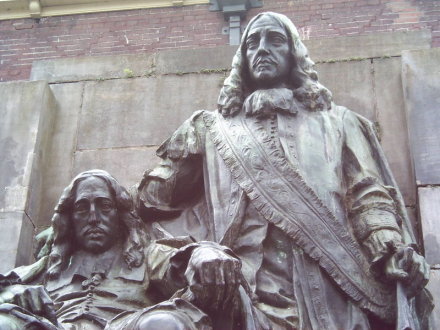
A statue of Johan (standing) and Cornelis de Witt in their native Dordrecht.

The mercantile powerhouse that was the 17th century Dutch Republic was the stage for a long-running conflict between the Orange monarchists (hence the soccer uniforms) and the Republican merchant class.

With the sudden death of the young William II, Prince of Orange in 1650, leaving the (non-hereditary) executive office of stadtholder vacant, the Republicans became ascendant.

And the outstanding figure of the First Stadtholderless Period was Johan de Witt, scion of a Dordrecht merchant family powerful enough that William II had imprisoned de Witt’s own father during a power struggle.

Elevated in 1653 and at the tender age of 28 to the leadership position of Grand Pensionary, Johan de Witt’s “eloquence, sagacity and business talents” guided the Dutch ship of state for essentially the remainder of his life.

This was the apex of the Dutch Golden Age. The Dutch East India Company dominated Asian trade routes,* and the Low Countries’ culture thrived on the wealth: Rembrandt and Vermeer were at the height of their talents; Spinoza revolutionized philosophy; van Leeuwenhoek invented the microscope.

While all these guys were landing themselves in their respective canons, Johan de Witt was trying to keep the age Golden.

Having only relatively recently broken free of Spain, the small country was an up-and-comer on the horns of a serious security dilemma: its leading commercial position put it into maritime competition with England, while its continental location made it vulnerable to the enormous army of the neighboring continental hegemon, France. Ultimately, even with its trade wealth, it did not have the resources to keep up with both of western Europe’s leading powers.

For a generation, de Witt’s statecraft kept the men of the Low Countries out of that predicament, while his brother Cornelis chipped in with a couple of timely naval victories. (Actually authored by Michiel de Ruyter, but Cornelis rode shotgun.)

In 1654, Johan brought the First Anglo-Dutch War to a close, making with Oliver Cromwell a secret pact he was only too happy to enforce never to allow William II’s son, the eventual William III, to be named stadtholder. Reason being: William III was the grandson of the Stuart king Cromwell beheaded, Charles I, and thus a potential claimant to the English throne. Both Protestant Republics had a distinct interest in keeping this monarchist well away from power. (Both would be sorely disappointed.)

A decade and a Stuart Restoration later, de Witt maintained (mostly) Dutch dominance of the seas in the Second Anglo-Dutch War, then held off France (with the help of a timely alliance with the recent adversary, England) in the War of Devolution.

In each case, he kept at least one of England or France on the sideline, or in his own camp.

But the Third Anglo-Dutch War was the charm — as it was also the Franco-Dutch War, and therefore 1672 was Rampjaar: disaster year. While the Dutch were aces on the waves, a massive French invasion easily overwhelmed them on terra firma.

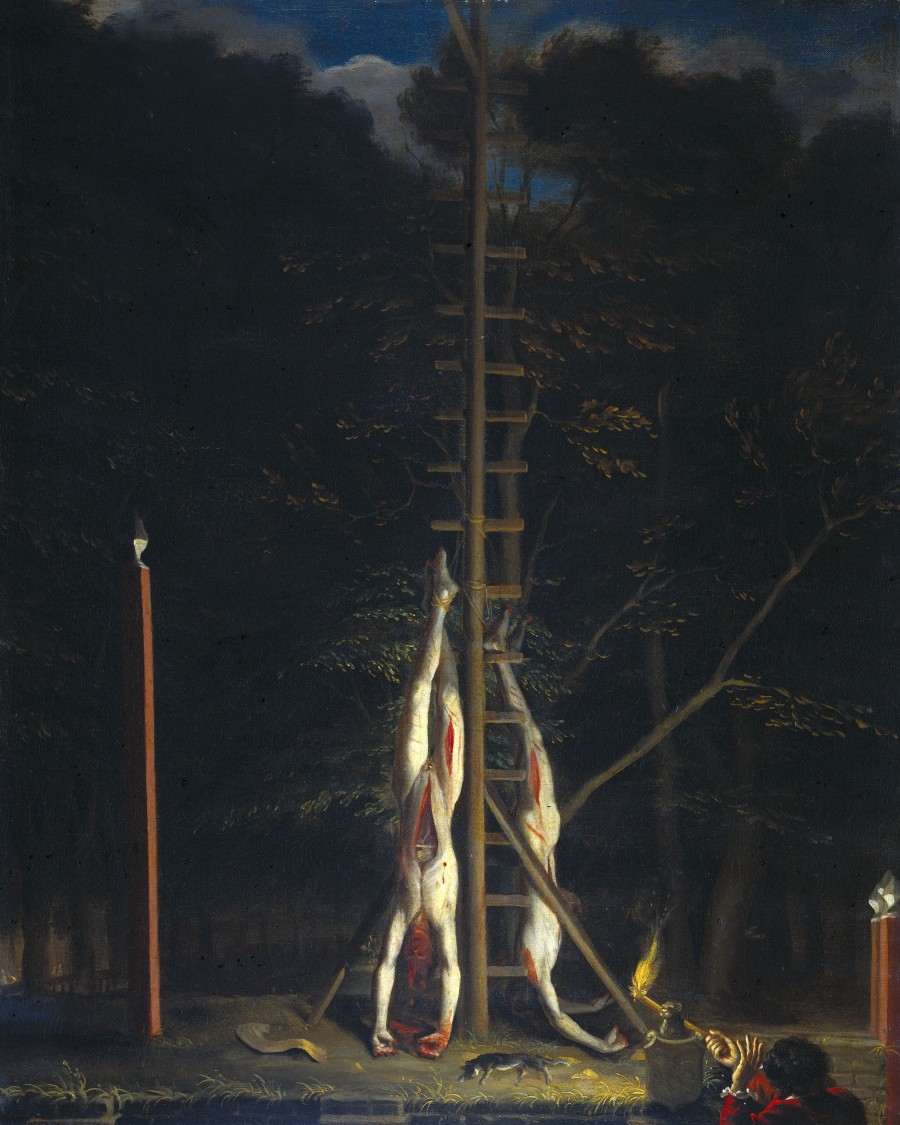
Detail view (click for the full image) of a grisly painting of the mutilated de Witt brothers strung up at The Hague. It’s attributed to Jan de Baen, who in better times took Johan de Witt’s portrait.

De Witt’s never-beloved mercantile oligarchy speedily collapsed with the military reverses, and the now all-grown-up William III was there to pick up the pieces to popular acclaim. Arrested for treason, Cornelis sustained torture without confessing, but when Johan visited him in prison — and William III incriminatingly withdrew the cavalry protecting the brothers — the mob quenched its fury with the de Witts’ blood.

every one of the miscreants, emboldened by his [Johan’s] fall, wanted to fire his gun at him, or strike him with blows of the sledge-hammer, or stab him with a knife or swords, every one wanted to draw a drop of blood from the fallen hero, and tear off a shred from his garments.

And after having mangled, and torn, and completely stripped the two brothers, the mob dragged their naked and bloody bodies to an extemporised gibbet, where amateur executioners hung them up by the feet.

Then came the most dastardly scoundrels of all, who not having dared to strike the living flesh, cut the dead in pieces, and then went about the town selling small slices of the bodies of John and Cornelius at ten sous a piece.

-Dumas

The word “ungrateful” comes to mind.

De Witt stood altogether on a lower plane than Cromwell. We regard him rather as a man of rare and singular talent, than as one of the chosen great ones of the earth, which Cromwell was. He stands far above the common run of men; and he was head and shoulders above nearly all the notable men of his time. He would have been greater if the movement of his limbs had been less burdened with the Dutch governing apparatus … He is not one whom the world can ever greatly admire or love.

History of the administration of John De Witt, grand pensionary of Holland, a Google books freebie.

(Here’s another, and here’s a 17th century volume de Witt himself coauthored.)

The rise of William III came with the decline of that Dutch Golden Age: the country fended off the immediate military threat, but it increasingly slipped behind its larger neighbors. Costly as was the Franco-Dutch War, it is a step on the path towards the present-day Europe, and this gives us enough excuse to notice that the Eurovision lead-in tune is actually from a Te Deum composed to mark its end.

But William’s own ascent to this wealthy sovereignty was just the beginning for him. Sixteen years later, the House of Orange’s champion vindicated Cromwell’s trepidation about him and gained a far more satisfactory position from which to do battle with his Gallic rival Louis XIV by stunningly overthrowing the Stuart dynasty and becoming King of England in the Glorious Revolution.**

* The Dutch remained the sole western contact of closed Japan until 1854, which is why Japan’s eventual period of scientific advancement became known as ‘Dutch Learning’.

** Albion did not forget the de Witts, either: according to this 1785 cant dictionary, the term “dewitted” had a 17th-18th century run in English to denote — well, exactly what happened to Cornelis and Johan.

On this day..

2009: Hiroshi Maeue, suicide website murderer

One year ago today, Japan hanged three men, among whom the most notorious was Internet suicide-club serial sex killer (you can see why he made the headlines) Hiroshi Maeue.

After a couple brushes with the law over asphyxiation-oriented assaults in the 1990s, Maeue found his medium in hypertext.

Trolling a Japanese “cyber-suicide” site — they’re notoriously popular in Japan — the late-30s Maeue lured two young women and a 14-year-old schoolgirl to separate meetings for the ostensible purpose of committing joint suicides.

M.O.: get the “partner”/victim into a car on the pretext of doing the carbon monoxide poisoning thing together, then tie her up and throttle her. Rape doesn’t seem to have been a part of it, but word was that Maeue “confessed to deriving sexual pleasure from seeing people suffocate.”

He got that treatment himself little more than two years after he was sentenced. Hanged along with Maeue in Osaka this date was Yukio Yamaji, who raped and murdered two sisters in 2005. On the same day in Tokyo, Chinese national Chen Detong got the rope for a 1999 triple homicide.

Perhaps not coincidentally, these high-profile executions occurred just weeks before national elections that were looking bad (and turned out worse) for the then-governing Liberal Democratic Party.

Update: Japan observed the one-year anniversary by hanging two more people this same date in 2010, executions personally witnessed by anti-death penalty Justice Minister.

“It made me again think deeply about the death penalty,” said Keiko Chiba. “and I once again strongly felt that there is a need for a fundamental discussion about the death penalty.”

They were the first executions under the Democratic Party government elected shortly after Maeue’s hanging.

On this day..

1582: Philippe Strozzi, corsair

On this date in 1582, Philippe Strozzi, the Florentine-born commander of a French naval expedition against the Spanish was summarily executed as a pirate.

The Strozzi were long one of Florence’s wealthy and powerful families, as evidenced by, say, the Strozzi Palace, or the Strozzi coat of arms on Michelangelo’s Doni Tondo.

That made the Strozzi sometime-allies, sometime-rivals* of Florence’s more famous powerbrokers, the Medici. It is in both capacities that we meet Philippe (English Wikipedia entry | Italian | French).

To cut a centuries-long story short, the Strozzi had basically come out on the wrong side of the power struggle in the 16th century.

Philippe’s father, Piero Strozzi, was the child of a Strozzi-Medici union, and Piero too married a Medici. He also fought the Medici for power and ended up in exile whereupon he gravitated to the French court of … Catherine de’ Medici. (Catherine had been educated at the home of Philippe’s grandfather, Filippo Strozzi.) Catherine then turned around and used Piero as a French Marshal, including sending him to back Tuscan city-state Siena in opposition to its (and France’s) rival, Florence.**

Your basic tangled geopolitical-genealogical web.

Bottom line, Piero’s son Philippe was born in Florence but grew up Gallic, and fought in the French army all over the continent from the time he was a teenager.

When France got involved in the War of Portuguese Succession, they put this warlike fellow aboard a boat and sent him to dispute Spanish King Philip II‘s attempt to claim the Portuguese throne and unify the Iberian peninsula.

Strozzi’s armada got its clock cleaned at the naval Battle of Ponta Delgada near the Azores, with devastating loss of life.


The Spanish galleon San Mateo, which did yeoman service at this battle.

Since Spain and France were putatively at peace, Spain treated its captives not as prisoners of war but as pirates, and proceeded to execute several hundred in Vila Franca do Campo. Strozzi didn’t even get that much ceremony, however; the day after the battle, he was mortally stabbed, then tossed into the waves.

Happily, the name and the fame of the Strozzi outlived Spanish justice. In the next century, a distant relative by the handle of Barbara Strozzi became one of the most renowned composers of Baroque vocal music. (As befits wealthy Italians of the Renaissance, the Strozzi were big on the arts; Philippe was supposed to be a fine musician himself.)

* The Strozzi-Medici conflict frames the action in the play Lorenzaccio, in which the titular Brutus-like character mulls assassinating the Medici dictator in order to restore the Republic, only to find no such restoration in the offing once he actually does the deed; the father and grandfather of our day’s protagonists are both principal characters.

** That didn’t work. Strozzi was trounced at the Battle of Marciano, which signaled the permanent demise of the ancient city-state‘s independence.

On this day..