1529: Adolf Clarenbach, Lower Rhine evangelist

On this date in 1529, the city of Cologne burnt Protestant evangelist Adolf Clarenbach at the stake.

Clarenbach (English Wikipedia entry | German) was a humanist-trained teacher who caught the Reformation spirit when he read Martin Luther’s On the Freedom of a Christian in about 1523.

The ears of our generation have been made so delicate by the senseless multitude of flatterers, that, so soon as we perceive that anything of ours is not approved of, we cry out that we are being bitterly assailed …

-Luther in the dedicatory preface* to On the Freedom of a Christian (Source)

Adolf Clarenbach in statuary on present-day Cologne’s city hall. (cc) image from Raimond Spekking

Luther’s words would kindle many a fagot in the years to come. Clarenbach got an early start assailing orthodox delicacies; he was dismissed from teaching posts and harried from city to city (German link, a handy little biography). Munster ran him out for agitating against idolatrous images of saints in 1523; Duke Johann III** personally ordered his expulsion from Jülich-Cleves-Berg; Osnabrück, Büderich and Elberfeld all gave him the boot before Cologne finally arrested him in April 1528.

Clarenbach’s condemnation would only be secured by an arduous process stretching well over a year and contested by the heretic and his friends not only in theology but in law (Clarenbach, a layperson, disputed the ecclesiastical court’s right to try him and appealed successfully to an Imperial court against Cologne, dragging out the process) and in public opinion (Clarenbach’s supporters in Cologne published defenses of him). Even the actual death sentence took half a year to enact after it was issued in March 1529 while authorities loath to conduct it negotiated with their prisoner to moderate his heresy.

He was finally put to death together with another Lutheran, Peter Fliesteden; they are among the first Protestants to die for their confession in the Lower Rhine.

Given the Lutheran movement’s strong run in Germany, it’s no surprise to find this seminal martyr honored in many places in present-day Germany — and his name ornamenting a street in his hometown, a seminary, and a primary school.

* On the Freedom of a Christian was dedicated to the sitting pope. While Luther’s dedication inveighed furiously against the Roman curia, it took the politic and preposterous rhetorical angle that the Medici Leo X was a helpless ingenue undone by his scheming court, “like Daniel in the midst of lions”: “I have always grieved that you, most excellent Leo, who were worthy of a better age, have been made Pontiff in this. For the Roman Court is not worthy of you and those like you, but of Satan himself, who in truth is more the ruler in that Babylon than you are.”

Luther signed that dedication on September 6, 1520. He had not been excommunicated at that point.

Just a few weeks later, he received the papacy’s official (and none too polite) rebuttal to Luther’s 95 theses. Luther answered this missive much less temperately, and his breach with Rome was complete by January 1521.

† Cologne at this time was under the bishopric of Hermann of Wied, a humanist with the germ of reform curiosity. Many years later, he would actually convert to Lutheranism which naturally led to his excommunication and deposition. (But not execution.)

** That’s Duke Johann of Cleves, the father of the Anne of Cleves whose unsatisfactory betrothal to Henry VIII precipitated the downfall of Thomas Cromwell.

On this day..

1548: Seraphin d’Argences

On this date in 1548, the Calvinist evangelist Robert de Lievre — better known by his nom de prosélytisme Seraphin d’Argences, or as Antoine Deschamps — was burned at Paris’s Place Maubert.

According to their hagiographies, the martyrs’ steadiness caused their assigned Catholic hector Francois Le Picart to lay off the browbeating and comfort them in their last pains.

This neat trick was achieved by the dread Chambre Ardente, really earning its name in this instance, which wanted the example made of this itinerant preacher to match the scope of his roving heresy. Seraphin d’Argences had even had the temerity to administer reformed Lord’s Suppers, leading the judgment against them to cite not only the obvious heresy stuff but “acts repugnant to the holy Catholic faith and the sight of the Holy Church, outraging the Blessed Sacrament of the altar.”

The show began with the minister’s collaborators, Jean Thuillier, Michel Mareschal and Jean Camus, piled into a cart for the ride to the stakes. Seraphin d’Argences trailed right behind them, drug on a sledge pulled by the tumbril.

At the Place Maubert, they all burned the same, but the heresiarch’s stake was consciously elevated above the other three — a sure nod to the developing age of spectacular capital punishment.

Following his bodily execution, Seraphin d’Argences was re-executed in effigy in various towns where he had been active: Langres, Sens, Blois, Bourges, Angers, and others all hosted ceremonial “executions” of lifelike likenesses of the lifeless schismatic.

On this day..

1554: Guillaume Dalencon, defrocked priest

Felix Platter is our narrator for Guillaume Dalencon’s death at the stake on this date in 1554.

This book portrays the 16th century through the remarkable Platter family.

Platter (English Wikipedia entry | German) was a 16-year-old Swiss student, and we find him on the midpoint of his family’s upward arc in the world. His father, Thomas, had as a child been put out of the house by his impoverished mother and made his way for a time as a beggar; by dint of lifelong struggle and application, he had gained a precarious foothold among the bourgeoisie of Basel. Thomas Platter nurtured still greater ambitions for his son.

Accordingly, the very genial Felix, who had never before traveled, set out in 1552 on the 400-mile journey to the city of Montpellier in southern France. Young Platter was an energetic diarist, and his impressions of the journey and of Montpellier were published in English as Beloved Son Felix. (That’s how Felix’s father addressed him in letters.) Though the book is out of print, it’s available online at archive.org.

One of its immediately striking features is the omnipresence of danger and death. Platter luckily left Basel just ahead of a plague outbreak, but he nearly lost his life in the frightening Jurthen forest. Taking shelter from the rain there in “a wretched inn” at a squalid hamlet called Mezieres, Platter and his companion found the place full of aggressive Savoyard peasants, and having no choice but to stay overnight they blockaded their door with a bed and kept a waking vigil all night with weapons at the ready. Three hours before dawn, they crept through the snoring mass of drunken thugs and slipped away, and a good thing it was too: the boys’ French guide told them as they set out that he had overheard the brutes plotting to murder the hapless travelers that morning.

The bandit “Long Peter”, who was then active in this forest, was eventually caught and executed on the breaking-wheel in Berne. Only in his old age did Platter learn that the brigand’s confession included a declaration that he had planned, but failed, to kill some students in Mezieres.

They had escaped by the skin of the teeth, but seemingly every page of the journal finds others who succumbed to the many paths to abrupt death the 16th century had to offer. (Not a few of them are corpses that Platter stole from their graves with fellow-students in order to anatomize.) This was, too, the age of spectacular public execution: the travelers’ road on October 18th, 1552, passed numerous “bodies of men hanging from the trees” and as darkness fell Platter gave himself a fright when he nearly rode into one. By the 20th they approached Lyons, where they beheld “several men hanging from gibbets and others exposed on wheels.” As they entered that city, they passed a Protestant “being led out to be burnt outside the gate; he was in his shirt with a truss of straw fastened on his back.”

Platter makes no further comment on this sight, but it must have touched him with pity — if not fear. Platter had been born in Basel about the same time that John Calvin, fleeing French persecution, arrived there; it was in Basel that Calvin first published his seminal theology Institutio Christianae religionis. To this faith, predominant in Swiss cities but illicit in France, Platter too subscribed. The French Wars of Religion loomed around the corner in the next decade, and Montpellier would become a Huguenot stronghold during that conflict. While Platter was there, an uneasy peace prevailed between growing ranks of Protestants and the official religion. The University of Montpellier attracted numerous Protestant students (the city lay in the heart of the Languedoc, a center of resistance to the papacy from long before the Reformation), and Platter’s own mentor, the brilliant doctor Guillaume Rondelet, had ambiguous religious affiliations.

Day to day, these students kept their heads down in matters religious and went about mostly unmolested. Taking a vocal stand on theological controversies here would be to embark upon a different path than Thomas Platter had in mind for his son, for heretics were among the many executions Platter recounts in his journal.

Guillaume Dalencon, the boy learned, was a former priest of Mountauban, “unfrocked on the 16th of October” when it was discovered that he had gone Protestant and brought back heretical books from Geneva. “Dressed in his priestly robes, he was brought on to a platform before the bishop” for his defrocking. “After protracted ceremonies in Latin he was divested of his chasuble and the rest, and given secular clothing. Hishead was then shaved, and two fingers were cut off his hand. After this he was delivered to the civil justice and once more thrown into prison.” The secular power took it from there.

On the 6th of January Guillaume Dalencon, unfrocked eleven weeks before, and since then held in prison, was condemned to death. In the afternoon a man carried him on his shoulders out of the town towards the monastery, to the place of execution. A pyre had already been built there. Beind the condemned man two other prisoners walked, one a cloth shearer, in his shirt, with a bale of straw fastened to his back; the other of good appearance, and well dressed. Both of them had recanted and denied the true faith. [i.e., both had recanted Protestantism under the threat of execution. -ed.] Dalencon, however, sang psalms all the way. At he pyre, he sat down on a log and himself took off his clothes as far as his shirt, and arranged them beside him tidily, as though he would be putting them on again. He exhorted the other two, who were about to apostasize, so touchingly that the sweat stood out in great drops, as big as peas, on the forehead of the man in the shirt. When the monks, formed in a curve around him, and mounted on horseback, told him that it was time to make an end, he leapt joyously on to the pyre and sat down at the foot of the stake that rose in the center of it. This stake was pierced by a hole, through which ran a cord with a running noose. The executioner put the cord round Dalencon’s neck, tied his hands across his breast, and placed near him the religious books he had brought from Geneva. Then he set fire to the pyre. The martyr remained seated, calm and resigned, with his eyes raised towards heaven. When the fire reached the books the executioner pulled on the cord and strangled him; his head dropped to his breast and he made no further movement. Little by little the body was reduced to cinders. His two companions stood at the foot of the fire, where they were made to watch his sufferings, and could feel the heat of the flame.

After the execution they were both taken to the Hotel de Ville. Near there, in front of the church of Notre-Dame, a platform had been set up, with a statue of the Virgin on it, before which they would have to recant. The crowd had to wait for them for a long time. At last only one of the two men was brought out. The cloth shearer had refused to abjure and demanded that he should be executed without mercy for having failed his beliefs. He was therefore taken back to prison. The other man, who seemed to be a man of substance, was placed on his knees before the statue of the Virgin, with a lighted candle in his hand. A clerk read out various charges, to which he had to reply. In this way he saved his life, but he was sent to the galleys and there put in chains.

On the following Tuesday, the 9th of January, it was the turn of the cloth shearer again. He was strangled and burnt as the priest had been. He showed great courage, and no less repentance for having come so near to denying his faith. It had rained on that day, and the fire would not burn. The victim, who was not completely strangled, endured great suffering. At last the monks of the neighbouring monastery brought some straw, and the executioner took it and sent for oil of terebinth from my master’s pharmacy to ignite the fire. Afterwards I reproached the assistants who had given it to him, but they advised me to hold my tongue, for the same fate could befall me also, as a heretic.

During these affairs an extraordinary phenomenon occurred. On the 6th of January, immediately after the execution of the first man, it began to thunder violently. I heard it plainly and so did many others with me; but the priests deried us and said that it was the smoke from the burning of heretics that produced that effect.

On this day..

1571: Hans Haslibacher, Bern Anabaptist

On this date in 1571, Anabaptist Hans Haslibacher was martyred in Bern, Switzerland.

Haslibacher (German link) joined the oft-suppressed movement in 1532 and quickly established himself as one of the most energetic proselytizers in the Emmental in Bern canton.

Condemned at last in 1571 after a lifetime of arrests, he was honored in a 32-stanza anonymous poem “Das Haslibacherlied” (German) alleging that Haslibacher prophesied that his death would be marked with three signs:

  1. His head when struck off would spring into a hat and laugh aloud;
  2. The sun would turn blood-red;
  3. The town fountain would spew blood.

According to the poem, all three prophesies came to pass … and “the hangman too was heard to say: / ‘Tis guiltless blood I’ve shed today.”

The Swiss Anabaptists are noteworthy as the confessional ancestors of the present-day Amish: the latter sect is named for 17th century Bern canton Anabaptist Jakob Ammann, who was the leader of one faction in a 1693 schism within the Swiss Anabaptist community.

Fortunately (though not for this here site) that schism emerged too late in the day for a classic religious martyrdom. Hans Haslibacher, in fact, was the last Anabaptist put to death for his faith in Bern.

On this day..

1583: Elisabeth Plainacher, Vienna’s only witchcraft execution

The city of Vienna only has one documented execution for witchcraft to its illustrious history. It occurred on this date in 1583.

Elisabeth Plainacher (English Wikipedia entry | German) was a miller’s daughter from Mank who had lived most of her 70 or so years during the Protestant Reformation and the Catholic Counter-Reformation, that social conflict so productive of witchcraft accusations.

It would factor very specifically in Elsa’s case, since she herself was a Protestant in a very Catholic place.

Elsa’s daughter Margaret died in childbirth, and Elsa took all four of the surviving children into her own care while Margaret’s widower went his own way. Three of these children would die in her care; the fourth became an epileptic in her teens, finally leading Margaret’s (Catholic) former husband to accuse his mother-in-law of bewitching everybody.

The accusation was ill-timed for the “witch”: Jesuit zealot Georg Scherer got hold of the case and put the epileptic teenager through a gantlet of exorcisms that he claimed expunged 12,652 infernal spirits. Scherer’s accounting must have been as rigorous as his faith.

“Scholars and men of understanding know that devils have neither flesh nor limbs, but are spirits, and therefore need no place or space as do our bodies,” Scherer later wrote by way of explaining the crowded tenancy. “A hundred thousand legions of spirits could all be collected together on the point of a needle.” Scherer preached, and later published, a sermon this holy combat, titled “A Christian remembrance of the most recent deliverance of a young woman who was possessed by 12,652 devils.”

This was a relentlessness which Elsa Plainacher was not formed to resist. She was a humble miller with some family drama, and then suddenly she was under torture (German link) in the imperial capital with the day’s headline pulpit-basher at her throat. She soon admitted whatever devilries her torturers demanded of her: giving the epileptic over to the devil, desecrating the Host, all that sort of thing.

On September 27, 1583, she was drug by a horse to an open field where she was burned at the stake. Her ashes were consigned to the Danube. Plainacherin even persisted (more German) in the local vernacular for a time as a dirty word.

Posterity’s apology for this horrible fate comes in the form of a small Vienna street, Elsa-Plainacher-Gasse, named after her. (There’s also a Plainachergasse in her native Mank.)

On this day..

1537: Jurgen Wullenwever, Burgermeister of Lubeck

On this date in 1537, Jürgen Wullenwever was decapitated and quartered at Wolfenbüttel.

Photo by Agnete (Own work) [GFDL (http://www.gnu.org/copyleft/fdl.html) or CC-BY-SA-3.0 (http://creativecommons.org/licenses/by-sa/3.0)], via Wikimedia Commons

Wullenwever (English Wikipedia entry | German) was a merchant from Hamburg who came to the fore of a popular Lutheran movement in the Hanseatic port of Lübeck that claimed the power of its old aristocratic council for the city’s burghers.

In this capacity, Wullenwever maneuvered — vainly as it turned out — to arrest the century-long wane of the city’s influence. Lubeck in its day had been “the Queen of the Hanseatic League”. Come 16th century, it was struggling to maintain its trading preeminence against the inroads of Dutch merchants and the fragmentation of the once-mighty Hanse.

This project was doomed in its conception — there was nothing Lubeck could really have done to hold back the historical developments happening around it — and bungled in its execution. The merchant magnates of Wullenwever’s democratic coalition grew suspicious of (too-)popular religiosity.

And Wullenwever’s political high-wire act involved arrangements of convenience with the Anabaptist commune of Münster — spurring rumors of his own radical baptist conversion* — and fomenting Catholic peasant uprisings to meddle in the succession of the Danish-Swedish crown. Whatever else one could say of him, one can’t fault him for a want of daring, a quality that stood him in good stead with romantic era writers.

But Wullenwever’s allies lost their fights, and the political coalition that supported his municipal leadership soon broke up under the pressure of events.

The aristocratic party re-took power in 1535 and didn’t immediately persecute Wullenwever. But the hostile Archbishop of Bremen eventually seized the man on his territory and turned him over to a Catholic Saxon duke for punishment.

* I’m certainly not a specialist, but I’m skeptical of the claim in some sources that Wullenwever was an Anabaptist Manchurian candidate type. Wullenwever confessed to a great Anabaptist scheme … but that was under torture of enemies determined to do him to death, and it was retracted before his execution. The claim implies that all of northern Germany might have gone over to a radically democratic Anabaptism had not the ancien regime overthrown the Burgermeister, and for that reason it’s gained Wullenwever the surprising latter-day embrace of nationalists and revolutionaries.

On this day..

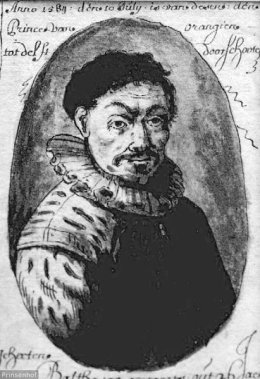
1584: Balthasar Gerard, assassin of William the Silent

“If you succeed in your enterprise, the King will fulfill all his promises, and you will gain an immortal name besides.”

Christoffel d’Assonleville, to Balthasar Gérard

After 4 days of torture, on this date in 1584, Balthasar Gérard (Geeraerts) finally met his end by beheading on the wheel.

Gérard managed to be both historically important and wholly forgettable: an assassin working for Spain against the Netherlands, his regicide was met with a predictably stiff punishment. Then, no fault of his own, the subsequent course of history** pushed the assassin into obscurity while elevating his prey.
A lawyer by trade, Gérard was a fervent Catholic and supporter of the Spanish crown, which controlled the territory up the coast through the present-day Netherlands. At the peak of its power, Spain’s monarchy — led by King Philip II — had significant cause for concern at the rise in Protestantism.

The Spanish were Europe’s paladins of staunch Catholicism, and the sight of her troops did little to endear Spain to her colonized neighbors to the North.

For both religious reasons and political ones, the Dutch were looking for a way out from under the Spanish thumb, and a former noble named William, Duke of Orange, was a major instigator in the struggle. In his collected letters and addresses from the period, An apology or defence of William the First of Nassau, William states that, starting in 1559, he became increasingly concerned with plans against Protestants by the Spanish monarchy.

That also happens to be the year William was bestowed with stadtholdership of Holland, Zeeland, and Utrecht; in effect, he controlled the Dutch coast.

Though he was known as William the Silent, the Duke was endowed with both financial resources and widespread popularity, and he didn’t keep his mouth shut when it came to Inquisition courts in his realms.†

When the head enforcer of that policy, Cardinal Antoine Perrenot de Granvelle, left town, William got even noisier — declaring before the Council of State that Spanish policies were squelching religious freedom.

In 1566, the nobleman signed onto the Compromise of Nobles and began funding insurgencies across the northern provinces. As religious unrest grew, Calvinists and Protestants in the French and Germanic portions of Spain’s holdings quickly formed up behind William. An early attempt in 1568 to invade the Netherlands using German mercenaries and French Huguenots failed, but the resultant executions of Egmont and Hoorn put Spain on a long and winding road toward defeat.

The Dutch War was afoot, with William leading the way.

It would take and dozens of small-scale military victories over the next 15 years (during which William declared himself a Calvinist and fully broke his Spanish ties) for the Dutch to move to independence. The 1580 Union of Utrecht and 1581 Act of Abjuration officially ousted King Phillip II from the Netherlands and installed a new government.

Needless to say, Phillip reciprocated William’s love.

In 1580, Spain’s top man put a price on William’s head. Juan de Jáuregui tried to collect two years later by shooting the stadtholder, but the man holding the new title of Prince William I of Nassau recovered, while de Jáuregui was killed on the spot.

With 25,000 crowns at stake, there were bound to be other takers.

Our man Balthasar Gérard started looking for a close encounter with William the Target. At first, he joined the army in Luxembourg, which didn’t get him very far. It was time to gin up a real plot, which Gérard shopped to the Duke of Parma, Alessandro Farnese, in April 1584. Though the Duke offered no funding for the operation — Gérard ponied up the startup money he needed for the trip — and held out little hope that the lawyer would be successful, he gave Gérard assurances that his family would be taken care of in case of disaster.

Gérard first presented himself to William in June as the son of a martyred Calvinist from France. On 8 July, he returned and, badly in need of new clothes, managed to beg 50 crowns for a new set.

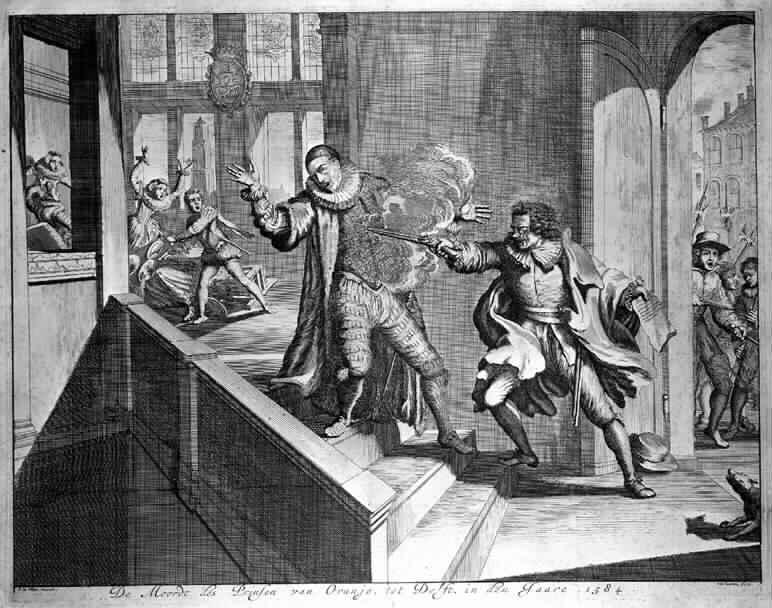
Instead, he bought a pair of pistols and, on 10 July, made history with a point-blank shot to William’s chest.


Detail view (click for the full image) of William the Silent’s 1585 assassination at the hands of Balthasar Gerard.

This assassination attempt didn’t fail. William became the second head of state to be killed by an assassin’s bullet,† — and his shooter the first such man to be juridically punished for the deed.

And, oh, how he was punished.

The regicide was beaten immediately after his capture, then subjected to a variety of cruelties, from wet leather boots which, when heated, both crushed and burned the feet, to daily floggings while hanging on a post outside the jail.

But on this day, his time of torture was up, and Gérard was finally put to death. You know, the usual:

It was decreed the right hand of Gerard should be burned off with a red-hot iron, that his flesh should be torn from his bones with pincers in six different places, that he should be quartered and disembowelled alive, that his heart should be torn from his bosom and flung in his face, and that, finally, his head should be taken off.


Gerard’s execution.

For all that he suffered as a regicide, Gérard left his family an impressive inheritance. Making good Parma’s assurances, King Phillip II gave them William’s former lands in three French provinces and took his siblings and their issue into his peerage.

Gérard’s cause carried on for another 60 years, until it was finally extinguished by the signing of the Peace of Münster by the Republic of the Seven United Netherlands and Spain.

* Foucault mistakenly identifies the torture as lasting 18 days, and the additional details he lays down for Gérard’s time on death row may be less-than-believable. However, all sources indicate that the tortures Gérard endured were quite spectacular, even by the standards of the day.

** See Dissident identities in the early modern Low Countries for a complete treatment of this period in The Netherlands and Belgium.

† For example, the city of Antwerp (Belgium), then under possession of the Spanish crown and considered the mercantile center of Europe for its vast sugar trade, featured over 100 executions for heresy from 1557-1562, twice as many as in all of Spain during that time.

‡ The first was James Stewart, 1st Earl of Moray, then Regent of Scotland. Stewart’s shooter, James Hamilton, escaped into exile, though others of the Hamilton clan answered for the murder.

On this day..

1535: Six Protestants for the Affair of the Placards

The Affair of the Placards was the September 11 of the early French Reformation when the overnight posting of anti-Catholic placards sent the polity off the rails, claimed six victims on this date in 1535.

The formerly indulgent Renaissance-king Francis I was obliged by this late-1534 effusion of propagandizing to dissociate violently from heretical tolerance.

And maybe that would have been that. But the first placard incident was repeated by a follow-up posting on the night of Jan. 12-13 of an anti-sacramental pamphlet by Antoine Marcourt — the anthrax mailings to the hijacked planes, as it were — charging (French) that the Catholic “Mass has plunged half the world into an abyss of public idolatry.”

Francis flipped out. He closed bookstores and suppressed publishing. “One does not argue with heretics,” the Sorbonne agreed. What, do you want the terrorists to win?

So on this date in 1535, a grand Catholic procession — representing all the city’s guilds, all its religious orders, all its holy relics, and all its princes of the blood, with Francis himself modestly carrying a penitential taper to absolve his capital — wound through the city, punctuated by the torching of six accused Protestants.

At the ensuing feast, the king announced his intention to destroy heresy.

The procession of January 1535, with the inclusion of the sacrament, the number of holy objects transported, and the involvement of so many notables, was unprecedented. The elaborate character of the ritual is a good indication of the seriousness with which the authorities viewed this most recent evidence of the inclusion of heresy into French territory. The posting of the placards was regarded as a pollution of the king’s realm, the perceived danger being that the disease contaminating and “infecting some of his subjects” would multiply, undermining the very constitution of the social body … An attack upon the holy sacrament, according to the logic of the symbolism employed in the procession, presents a direct threat to the sacral character of the community, to the nation’s well-being, and hence amounts to an oblique attack on the person of the sovereign. Given the close association established between the sacrament and the monarch, it is no wonder that those implicated in the affair of the placards were regarded as being guilty not only of heresy but also of lese-majeste. (Source)

And maybe early modern France had a point with that weird old sacred-monarch stuff. The very same date two and a half centuries later saw a Parisian mob which had clearly lost any sense of the sacral sovereign behead the king himself.

On this day..

1527: Leonhard Kaiser, Lutheran

On this date in 1527, Lutheran evangelist Leonhard Kaiser burned for his heresy at the Bavarian (today, Austrian) city of Scharding.

Kaiser (German link) was a middle-aged vicar hailing from a comfortable Bavarian family when Luther’s reformation fired a new evangelical zeal; he relocated to Wittenberg to absorb the new doctrines and became not only Luther’s exponent, but his friend.

In 1527, however, our man returned to his native Raab to nurse his ailing father — a calculated risk but a reasonable one, since Bavaria had not been killing its heretics.

Unfortunately for Kaiser, the region had a fresh new anti-Lutheran authority, and Kaiser’s continued preaching while he was in town set him up to be made an example of. Lutheran nemesis Johann Eck personally participated in the investigation.

According to Martin Luther as Comforter: Writings on Death, Luther personally wrote Kaiser a short letter of comfort in May of 1527, exhorting him to “patiently endure with the strength of Christ” his imminent martyrdom.

The great Reformer seems to have been profoundly affected by the death of his fellow-traveler, even (says this) questioning his own ministry relative to the sacrifice of flesh made by Leonard Kaiser. “I daily expect the death of a heretic,” Luther had written a friend a few years before … yet those martyrs’ laurels were not for him.

Instead, Luther did his proselytizing with his pen, and he found in Leonhard Kaiser a powerful subject indeed.

Luther took an early martyr’s hagiography written by Michael Stifel and greatly expanded it into a tribute, Concerning Leonhard Kaiser, Burned in Bavaria For the Sake of the Gospel that remained continuously in print in the 16th century. In that volume (I have not found a public link to it available online) Luther uses the burned man’s suggestive name: Leonard, “Lion-Hearted”, and Kaiser, “King”, to exalt the martyr’s courage and ultimate triumph.

It was also about this period — 1527 to 1529 — that Luther composed the hymn A Mighty Fortress Is Our God. Based on the Bible’s Psalm 46, this enduringly popular (even with Catholics) piece has been thought (though it’s just one speculative hypothesis among several) to be Luther’s tribute to his lion-hearted friend.

On this day..

1536: The Münster Rebellion leaders

On this date in 1536, Bernhard Krechting, Bernhard Knipperdolling, and Jan van Leiden were chained to stakes in the Münster public square, tortured with flesh-ripping tongs for more than an hour, killed with daggers thrust into their hearts, and their remains hoisted in cages in the city cathedral as a warning against any kindred misbehavior in the future.


Detail view (click for the full image) of Jan van Leiden et al being put to death in Münster. In the background, the Lambertuskirche spire shows the three cages in which the victims’ remains were gibbeted.

And the point was taken: the appalling deaths of these men also marked the death of early Anabaptism’s pretensions to secular political power.

These three unfortunates were the top surviving leaders of the Münster Rebellion, a revolution that turned that city into an Anabaptist commune for more than a year.

Just a few years before, southern Germany had been shaken by an apocalyptic peasant rebellion led by Thomas Muntzer, a sort of proto-Anabaptist.*

Though northern Germany was spared that particular maelstrom, that same religious tension and social discontent soon blew a hyperborean wind.

In the early 1530s, “Melchiorites” — Anabaptist followers of radical preacher Melchior Hoffman — proliferated rapidly among workers of the long-prosperous but now-waning Hanseatic territories in northern Germany and the Low Countries.

And these converts did not intend the meek example of evangelical martyrdom. They meant to rule.

In 1535, Democratic-Anabaptist types stormed the Amsterdam city hall; in a separate action, others seized and fortified a Friesland monastery before being overrun. An allied movement, less theologically distinct, won temporary control of Lübeck in 1533, before being expelled by force of arms.

Only in Münster did the Anabaptists realize the full flower of their project, albeit for a very brief period of time. Winning power over the course of the year 1533 by dint of internal politicking, energetic recruitment, and fortuitous imperial distraction, Münster Anabaptists booted out the 1% and started turning the place into a visionary “New Jerusalem.”

Among those visions, the most notorious was polygamy (pdf), introduced by Jan van Leiden when he inherited leadership after the charismatic firebrand Jan Matthys died in a sortie against a siege in April 1534. The story has it that van Leiden wanted to marry Matthys’s attractive widow Divara, though whether motivated by considerations of the loins or legitimacy is up to the reader’s good conscience.

There’s quite a controversial historiography surrounding their polygamous turn: while contemporary enemies were pleased to ascribe it to libertine devilries, German Communist intellectual Karl Kautsky vociferously defended the Münster Anabaptists — arguing that they resorted to polygamy for social stability when the gender disparity in the city had fallen past 3:1 owing to the vicissitudes of war.

And war, as Kautsky noted, was the commune of Münster’s essential condition, just like that of Paris.

Community of goods was the basis of the whole Baptist movement. For its sake the great fight was waged at Münster. It was not, however, the chief factor in determining the character of the Münster Baptist government, that factor being the siege. The town was a great war-camp; the demands of war took precedence of all other matters, and sentiments of freedom and equality were active only in so far as they were compatible with military dictatorship.

After a year and more under siege, Munster finally succumbed to Prince-Bishop Franz von Waldeck.

Jan van Leiden, by this time dignified the “King of Jerusalem”, was taken along with two of his chief aides and designated for this superlative punishment (many others less exalted faced less exalted executions, too).


For decades after the execution, the Anabaptists’ remains rotted publicly in cages on the tower of St. Lambert’s — like these still displayed there to this day. (cc) image from Rüdiger Wölk, Münster.

For Anabaptists as a whole this catastrophe commenced a long period of persecution and reckoning. But from such travails would the movement leave its mark. Indeed, it was also in January 1536 that a young Dutch priest named Menno Simons accepted adult baptism … and began a religious career that would make him the founding namesake of the Mennonites.

Dan Carlin’s “Hardcore History” podcast treats the Münster rebellion here.

On this day..