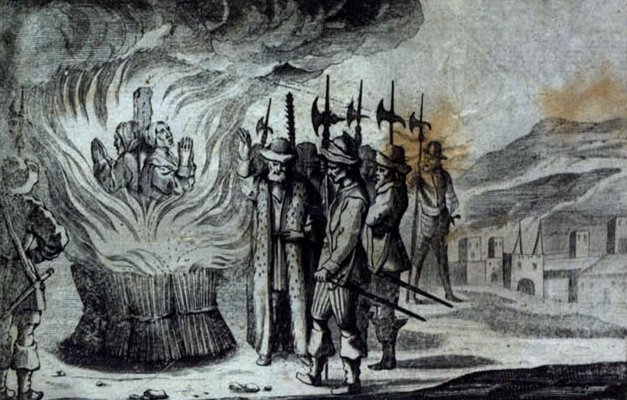
On this date in 1523, a Norman hermit named Jean Vallière was burned at the stake at a Paris pig market, while the books of the humanistic nobleman Louis de Berquin were burned in front of Notre Dame by the Paris parlement.
Berquin would follow Valliere’s fate ere that first decade of Lutheranism was out, but the obscurity who died on this date seems to have been an Augustinian preacher whose zany idea that Jesus was the son of Joseph and not God would have been no more welcomed by Luther than by Rome.
Friend and foe alike tended to project onto Luther any old subversive project that wanted either the imprimatur of theological credibility or the brand of the heresiarch and his “pestilential doctrine full of execrable errors.” (That’s how the Sorbonne condemned Luther in 1521.)
In this case, guilt by association was intended to intimidate with Valliere’s example scholars like Berquin. A most particular threat was a clique of reform-oriented intellectuals at Meaux under the leadership of Jacques Lefevre d’Etaples; d’Etaples that very year of 1523 completed a French translation of the New Testament.
These folk in Meaux persisted only under the personal protection of the French King Francis I and his reformist sister Marguerite of Navarre. Their project of reform within the church never really took, and neither did the Meaux circle commit itself to martyrdom for the new faith(s). But Marguerite of Navarre’s grandson would be the man to settle this century’s French Wars of Religion by conquering as a Huguenot, converting to Catholicism, and ruling illustriously as Henri IV.
The fourth Duke of Norfolk, he inherited the title from the third Duke of Norfolk — his eponymous grandfather, the scheming courtier who had maneuvered nieces Anne Boleyn and Catherine Howard into disastrous matrimony with Henry VIII.
Having run afoul of his ruthless sovereign, this elder Howard then had the distinction of dodging execution only because the king himself dropped dead the very day before Howard was to have been beheaded.
The Norfolk title, however, did skip a generation, because grandpa Howard’s son Henry Howard was not so lucky, and abdicated his birthright at the block.*
That left our day’s principal, a mere boy of 10 when his father got axed, as his lucky grandfather’s heir apparent — to carry on the Howard scheming against his second cousin, Anne Boleyn’s lucky daughter Queen Elizabeth.
And young Thomas Howard would prove to be a chop off the old block.
Howard’s sympathies for Catholicism and for swinging an ever-bigger dick led him into a machination to wed Elizabeth’s northern rival Mary, Queen of Scots.
Lucky to get off with just a slap on the codpiece, Howard went right back at it with an unabashed Spanish-supported conspiracy to depose Elizabeth, again in favor of Mary — the Ridolfi Plot.
This chicanery was sniffed out by Elizabeth’s pervasive spy network, and while Mary’s royal status enabled her to survive the revelation, Norfolk had already got down to his last chance.
The conflict between Elizabeth and Norfolk, heavily fictionalized and climaxing in the Ridolfi Plot, is essentially the plot of of the 1998 movie Elizabeth.
Having endured so much trouble from these nettlesome Howards, the crown left the Duke of Norfolk title vacant for nearly a century after this date’s beheading. It was finally restored to a mentally deficient Howard descendant with the post-Cromwell Stuart restoration.
* And that’s just on the dad’s side. His maternal grandfather and great-grandfather from the Stafford family also met their ends on the scaffold.
On this date in 1655, Catholic forces under the Duke of Savoy carried out a notorious massacre of Waldensians* in the Piedmont.
This interesting, excommunicate sect had persisted for centuries in those hard-to-reach places in Alpine foothills, intermittently ignored and hunted. After Martin Luther, many Protestants inclined to see them as a proto-Reformation movement, or even a counter-papal apostolic succession reaching back to ancient Christianity.
At any rate, they sure weren’t Catholic.
And our friend the Duke decided — perhaps piqued by the murder of a missionary Catholic priest, or for whatever other reason — to mount one of those heresy-extirpating sorties and make them Catholic in 1655.
On April 17, the Marquis of Pianezza appeared with an overwhelming force of mixed Piedmontese, French, and Irish** troops. They conducted a few skirmishes, then made nice with the Waldensian civic leaders and induced them to quartering their troops temporarily further to some expedient pretext.
Alas! alas! these poor people were undone. They had received under their roof the executioners of themselves and their families. The first two days, the 22d and 23d of April, passed in peace, the soldiers sitting at the same table, sleeping under the same roof, and conversing freely with their destined victims …
At last the blow fell like a thunderbolt. At four of the clock on the morning of the 24th April the signal was given from the Castle of La Torre. But who shall describe the scenes that followed? On the instant a thousand assassins began the work of death …
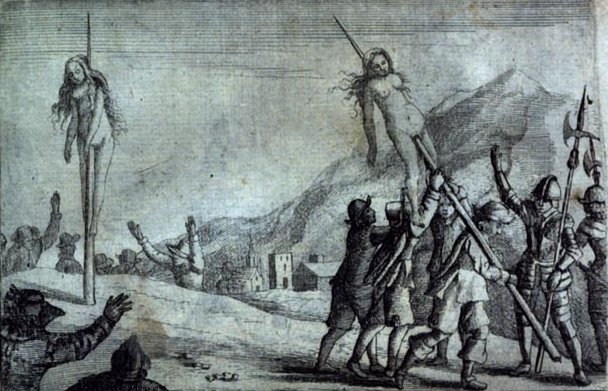
Little children were torn from the arms of their mothers, and dashed against the rocks; or, more horrible still, they were held betwixt two soldiers, who, unmoved by their piteous cries and the sight of their quivering limbs, tore them up into two halves. Their bodies were then thrown on the highways and the fields. Sick persons and old people, men and women, were burned alive in their own houses; some were hacked in pieces; some were bound up in the form of a ball, and precipitated over the rocks or rolled down the mountains … Some were slowly dismembered, and fire applied to the wounds to staunch the bleeding and prolong their sufferings; some were flayed alive; some roasted alive; others were disembowelled; some were horribly and shamefully mutilated, and of others the flesh and brains were boiled and actually eaten by these cannibals.
Without doubting the capacity of man’s inhumanity to man, the cannibalism charge reminds that we’re dealing with propaganda alongside historiography. And what great propaganda — like, babies-torn-from-incubators great.
Thumbnails (click for a larger, disturbing view) of selected images of this date’s atrocities from Samuel Morland’s The History of the Evangelical Churches of the Valleys of Piedmont
And there’s little doubt as to the overall savagery of the affair, which could well have become the opening salvo in a full-scale sectarian cleansing campaign. (A later addendum to Foxe’s Book of Martyrsnarrates the ensuing Piedmontese armed struggle, petering out before any definitive resolution in the field.)
Outrage at this hecatomb spread in Protestant Europe — which would also refer to the day’s doings as the “Bloody Easter,” since it corresponded with the eve of that celebration as reckoned by the Julian Calendar (source).
It was felt especially in Protectorate England, which intervened diplomatically.
A “day of solemn fasting and humiliation” was promulgated in Albion, along with collections for the relief of the survivors. Oliver Cromwell personally put £2,000 into the kitty.
More importantly, he dispatched diplomat Samuel Morland† to force the House of Savoy to lay off the persecution; in fact, he threatened to disrupt high statecraft between England and France unless the French twisted arms on behalf of the Waldensians.
Written correspondence for Morland’s diplomatic tour addressed to Louis XIV of France and various other continental potentates, as well as a fiery bit of oratory that Morland delivered to Savoy, all seem to have originated from the pen of Republican scribbler John Milton — the future author of Paradise Lost.‡
Milton, for whom the whole thing was more than just a day job, was further moved to put his umbrage at the slaughter into sonnet form:
Avenge O Lord thy slaughter’d Saints, whose bones
Lie scatter’d on the Alpine mountains cold,
Ev’n them who kept thy truth so pure of old
When all our Fathers worship’t Stocks and Stones,
Forget not: in thy book record their groanes
Who were thy Sheep and in their antient Fold
Slayn by the bloody Piemontese that roll’d
Mother with Infant down the Rocks. Their moans
The Vales redoubl’d to the Hills, and they
To Heav’n. Their martyr’d blood and ashes sow
O’re all th’ Italian fields where still doth sway
The triple Tyrant: that from these may grow
A hunder’d-fold, who having learnt thy way
Early may fly the Babylonian wo.
* The Waldensians in question here are interchangeably known as the Vaudois for their geographic region, actually above the Piedmont and abutting the Swiss region also known as Vaud. (These pages have visited the latter.)
In the year 1554, there was imprisoned at Ghent, in Flanders, for following Christ and living according to God’s commandments, a young brother named David, who, when examined, freely confessed his faith. Being asked what he thought of the sacrament, David said, that he considered it nothing else than idolatry. Then a priest said to him, “Friend, you err greatly, that you so readily confess your faith, for it will cost you your life, if you do not change your mind in time.” Thereupon David sweetly replied, “I am ready to shed my blood for the name of Christ, even though it should be here in this place; for God is my salvation, who will keep me, and preserve me from all evil.” The priest said, “It will not be as good as though you were put to death secretly here in this place; but you will be burnt publicly at the stake, for an everlasting reproach.” He was then brought into the court, where he was condemned to death, and his sentence was read, namely, that he had fallen from the true faith into heresy, and was therefore, according to the imperial edict, sentenced to be strangled and burned. David said, “No one will ever be able to prove by the Scriptures, that the faith for which I must now die is heresy.”
There was also sentenced to death with him a woman named Levina, who rather forsook, not only her six dear children, but also her temporal life, than her dear Lord and Bridegroom Jesus Christ. Arriving on the scaffold, David attempted to kneel down in order to offer up his prayer to God, but he was prevented, and they were immediately driven away to the stakes, standing at which, David said to Levina, “Rejoice, dear sister; for what we suffer here is not to be compared with the eternal good that awaits us.” (Rom. 8:18) When about to offer up their sacrifice, both exclaimed, “Father, into thy hands do we commend our spirits.” A little bag of gunpowder was tied to each of them, whereupon they were strangled and burned. But there happened a manifest miracle of God; for though they were completely burned, and the fire was as good as extinguished, David was seen to move his head, so that the people exclaimed, “He still lives.” The executioner seized the fork, and thrust it three times into his bowels, so that the blood flowed out; yet even after this he was still seen to move, hence, the executioner threw a chain around his neck, and bound him to the stake, and thus broke his neck.
Thus these two valiantly fought their way through, firmly trusting in God, who did not let them be confounded, since they had firmly built their building upon the only foundation; wherefore they shall never perish, but abide forever.
On this date in 1550, the leaders of England’s Prayer Book Rebellion were hanged, drawn, and quartered at Tyburn.
When Henry VIII dropped dead in 1547 and pitched his contentious realm and dubious progeny into the mid-Tudor crisis, Henry’s old theological henchman Thomas Cranmer really got to work.
During the unsteady regency of Henry’s sickly heir, Cranmer would push frenetically to make the religious reformation that his former boss never completely backed. The Archbishop sent to the continent for Protestant theologians like Peter Martyr who could help him “do away with doctrinal controversies and establish an entire system of true doctrine.”
The piece de resistance of Cranmer’s project was his Book of Common Prayer — a reformed liturgy, and in English, to go with the new English Bible. Many centuries — and revisions — later, it’s still the basis of Anglican services and of rites in many other Protestant denominations.
In 1549, it debuted to decidedly mixed reviews.
Enforced by Parliament’s Act of Uniformity, the Book of Common Prayer replaced all Latin liturgies on Whitsunday 1549, and for many of England’s Catholics, it was one affront too many. (The country’s bumpy economic realignment couldn’t have helped matters.)
On Whitmonday, traditionally-minded parishioners in West Devon unimpressed* with this newfangled vernacular service forced their local cleric to break out the old vestments and say Mass in Latin. State attempts to enforce the ban soon produced a martyr for the cause — one William Hellyons, melodramatically impaled on a pitchfork — and a march to Exeter that spiraled into outright revolt, heavy with suppressed Cornish nationalism.
We, the Cornishmen, whereof certain of us understand no English, utterly refuse this new English.
Religion, theology, the liturgy, the text of the Scripture … these were things that early modern Europeans were ready to fight and die for.
Since this considerable plunder of Church wealth had been widely redistributed to the English gentry, talk about repossessing it really emptied the pews of potential allies.
At any rate, neither Latin nor monastic restoration would be provided as carrots; London under Lord Protector Edward Seymour instead put down the rising with the more customary stick.
Such principals as remained were reserved a more awful fate: drawing and quartering at Tyburn. These seem to be the chaps who endured it:
Henry Bray, Mayor of Bodmin
Landowner and military leader Humphrey Arundell
Landowner John Wynslade
Thomas Holmes
John Bury
Bill Ind, Anglican Bishop of Truro, made news in 2007 acknowledging “that the English government behaved brutally and stupidly” in crushing the rebellion.
We wyll haue the Sacrament hang Oller the hyeghe aulter, and there to be worshypped as it was wount to be, and they whiche will not thereto consent, we wyll haue them dye lyke heretykes against the Holy Catholyque fayth.
We wyll haue . . . images to be set vp again in euery church, and all other auncient olde Ceremonyes vsed heretofore, by our mother the holy Church.
We wyll not receyue the newe seruyce because it is but lyke a Christmas game, but we wyll haue oure old seruice of Mattens, masse, Euensong and procession in Latten as it was before.
Dutch schoolchildren learn the occasion with the punny rhyme — bril, “glasses”, is a near-homophone for Brielle —
“Op 1 april verloor Alva zijn bril”
On April 1st, the Duke of Alva lost his glasses
The mailed fist of imperial Spain in the Low Countries, the Duke of Alva (or Alba) would be forced by Calvinist gains this year onto the back foot; despite a vigorous counterattack that regained some lost territory in 1573, he was soon forced into retirement.
So, small surprise that weeks after nicking the Duke of Alva’s glasses, Dutch rebels conquering other towns started making prisoners of Catholic clergy whose loyalties were suspiciously Habsburgish. Our day’s principals (here are their names; a batch of Franciscans taken are the largest contingent, to which various lay brothers, parish priests, and others were appended) were seized at and around Gorkum (Gorinchem).
The author of this intrepid iconoclastic incursion, William II de la Marck, was likewise the author of these Catholic martyrs’ doom once they had been removed back to Brielle. They were hanged without benefit of trial at an abandoned monastery.
Every sectarian propagandist of 16th century Europe made lurid heroes of his own side’s martyrs, and these were no exception to the pattern; we read in this Catholic source (perhaps while contemplating this devotional image) that
[i]t was on the 9th July 1572 when the execution of the pious sufferers began. On their side they had fully prepared themselves for it by confession and prayer. The executioner went so slowly to work that two hours had elapsed ere the last of the martyrs had taken his place on the gallows, and many of them still lived when morning broke. But the fury of the soldiers was not yet satisfied. They mutilated the dead bodies, cut off their noses and ears, and other limbs, and, alas, shame seems to touch the pen with which we write, bound them to their hats, and returned with these melancholy trophies in triumph into the city!
The location where this day’s unfortunates suffered became a pilgrimage destination, and they were formally enrolled in the minor leagues of Rome’s competitive hagiography circuit in the 19th century.
This date in 1533 saw John Frith and Andrew Hewet burned to ashes at Smithfield for Protestantism … just a week before Henry VIII himself was excommunicated from the Catholic Church.
A Cambridge man who’d picked up some heresy in Lutheran Germany, Frith was a friend of William Tyndale and did a couple of turns in English prisons for his various transgressions of orthodoxy.
He was finally nabbed by a warrant of then-Chancellor Thomas More before he could escape to the continent, and hailed before a doctrinal court for sacramentarianism.
During his examination by the bishops, Frith stated that he could not agree with them that it was an article of faith that he must believe, under pain of damnation, that when a priest prayed during the mass, the substance of the bread and wine were changed into the actual body and blood of our Savior Jesus Christ, even though their appearance remained the same. And even if this was so, which he did not believe it was, it should not be an article of faith.
(Said transubstantiation hypothesis remains Catholic doctrine to this day, but at least it’s no longer worth your life to dispute it.)
All the pieces were in place for this radical theology to become orthodoxy over the succeeding generation. The newly-designated Archbishop of Canterbury — still for the moment within the Catholic fold — was reformer Thomas Cranmer. Despite his sympathy for a shared evangelical cause, Cranmer passed a guilty verdict after trying to talk Frith out of his belief. In the event, however, it was the Inquisitor who was converted: Cranmer over the course of the 1530s adopted Frith’s own view. He would eventually enshrine it in the Book of Common Prayer.
All of which, of course, was made possible by Henry’s insistence on ditching his first wife in favor of Anne Boleyn, and Cranmer’s support for that action. On July 11, both the king and his pliant prelate were excommunicated by Pope Clement VII.
Still, it must be allowed that this fact scarcely gave carte blanche to Protestant reformers in England. Maybe Frith was made for the flames regardless: as timing goes, the 1530s were great for religious martyrdom.
Andrew Hewet, our poor footnote, had no part in these august affairs save the victim’s. Hewet was a tailor’s apprentice who was just caught up with an anti-heretical accusation at the wrong time. In prison, he too refused to acknowledge transubstantiation — saying, “I believe as John Frith believes.” For so believing, he burned as Frith burned.
On this date in 1535, as a 25-year-old religious dissident named John Calvin fled Paris, the merchant who had hosted his circle’s Protestant salons was reduced to ashes in Paris.
Though France would ultimately remain Catholic, the Protestant Reformation found rich soil and enjoyed a measure of early official tolerance for reasons of statecraft.
But a sharp crackdown was provoked when Protestants engineered the placement of anti-Catholic posters in several towns during a single night in October 1534 — the so-called Affair of the Placards.
This spelled the end of the circle of dissidents who met at the Rue Saint-Martin.* Young Calvin high-tailed it out of town — a period of wandering and living incognito that would wash him up on the shores of Lake Geneva — but the owner of that Rue Saint-Martin house, Etienne de la Forge (aka Stephanus Forgeus) was denounced to the authorities.
* Calvin apparently had an appointment during this period in Paris to meet a scholar he would later execute, Michael Servetus, but the tete-a-tete never came off.
February 12 is the anniversary of Lady Jane Grey‘s beheading at the Tower of London. The Protestant teenager was the designated successor of sickly boy-king Edward VI, but popular and aristocratic support went for Mary Tudor in a landslide.
The Nine Days’ Queen landed in the Tower and copped to a treason charge on a tenuous deal for mercy (not applicable to her sponsors and allies, many of whom went to the block). But a January 1554 Protestant rebellion that had Protestant restoration as part of its programme made it a dangerous indulgence for Mary to keep her cousin’s neck attached to its shoulders.
On this auspicious anniversary, Executed Today is pleased to welcome Jane Grey expert J. Stephan Edwards, Ph.D. Dr. Edwards runs the Some Grey Matter site, and is working on a forthcoming book about our day’s famous beheadee.
ET: The conventional wisdom on Jane Grey is that she was basically destroyed by the machinations of the men around her. Is that a misapprehension? Was she more involved in events than she’s given credit for? Can one take seriously the notion that she didn’t want to be queen?
JSE: Having spent almost ten years researching the life of Lady Jane Grey Dudley and her very brief reign as Queen of England in July 1553, I am confident that she was not directly involved in the plans to make her Edward VI’s successor to the throne. At the same time, however, I am completely convinced that she was well aware of those plans at least six weeks before she actually became queen. And it is beyond question that she knew of the plan at least a week before her accession. Thus the standard mythology that portrays Jane as utterly unaware and totally innocent until the last possible second is just that … a myth.
I am similarly convinced that Jane accepted the crown after offering little more than perfunctory resistance. The crown offered a degree of personal independence that would otherwise have been unavailable to her. It also offered power. Despite Victorian-era storytelling to the contrary, Jane Grey Dudley was very much a product of her own age, and that was an age of widespread personal ambition, of duty to both family and God to advance one’s self and one’s family. It would have been a deep betrayal of her family and of social norms actually to refuse such an exalted position.
In the act of accepting, she is recorded to have asked God for some sign that she should refuse, paused for a moment, and receiving no such sign, she accepted. Further, Jane was apparently an adherent to the Calvinist doctrine of predestination, the idea that all things, including our daily lives, are preordained and known to God, and as humans we are powerless to alter God’s plan. Having prayed to God for a sign that she should refuse the crown and receiving none was no doubt to her an indication that her God’s preordained plan was for her to be Queen of England. She therefore accepted without offering further resistance of any kind.
Further, there is ample evidence to show that Jane fully embraced her new status. She signed dozens, perhaps hundreds, of documents with her own hand rather than relying on a privy secretary to sign in her stead (common practice in the reigns of Henry VIII and Edward VI before her). This indicates active and positive involvement in affairs. And on more than one occasion, she countermanded the orders of her council, imposing her own will upon them, again evidence of an intent to rule.
Was she “destroyed by the machinations of the men around her”? I think perhaps there is a better way to phrase it. Jane Grey Dudley lived in an era when women were second class citizens with few legal rights and virtually barred from public affairs. Yet the circumstances of July 1553 mandated that a woman must assume the throne, however much that contradicted 400 years of established English practice. If anything, Jane Grey Dudley was a pawn in a political chess game in which the players, all male, searched desperately for a male king, yet all they had at hand were potential queens. The male players at the chess board were simply struggling with the pieces they had available and trying to make the best of an unfamiliar and even frightening situation. They failed, and Queen Jane was one of the unfortunate pieces swept from the board.
Jane is obviously a romantic figure — small r, big R — in part because she didn’t ever have the chance to start doing the un-romantic things that rulers have to do. How has her image changed over the years? What about her would most surprise people today?
Actually, Jane did “do some of the unromantic things that rulers have to do.” She sat in daily on meetings of the Privy Council. She helped to plan military maneuvers against her cousin, the future Queen Mary … maneuvers intended to bring about the latter’s death. She sent thousands of men off to die in battle. The nine short days of the reign of Queen Jane were packed with unromantic and burdensome activity unfamiliar to a woman of not quite eighteen years of age.
If anything, the years have served to erase much of that non-romantic material and replaced it with the image of an obedient girl-child secluded in study or prayer, uninvolved in the affairs of the world. Indeed, one biographer writing in the 19th century referred to her existence as one of “splendid isolation.”
Yet she was anything but isolated. The historical evidence makes it clear that she was socially active, participating in many of the public celebrations held by her kingly cousin’s court. She traveled a great deal, visiting with relatives and friends of the family scattered across the entire realm. And she had a love of music that was intense enough to give her tutor concern that she was becoming too distracted from her intellectual studies. The picture that has emerged from my own research is of a girl who was quite “normal” for those of her social and economic status in that era, with the possible exception of a gift for languages.
Had Jane, in fact, ruled, how different might events in England been? (and elsewhere, since this was also a key period of imperial competition?)
I am not myself a huge fan of “counterfactual history,” of speculating about “what might have been.” But since a lot of people do ask this question, I will say this: Had Jane remained queen, and had Mary remained on the political periphery (or been executed), it seems to me that the British Isles would be a very different place today. Just in basic political terms, Elizabeth also would likely not have become queen, so the great Elizabethan “Golden Age” would never have happened. Also, Jane would likely have had children, so there would not have been any need to reach outside the realm in 1603 to find an heir. James VI of Scotland would never have become James I of England, and Scotland may have remained forever a separate kingdom and nation. Without a King James of England, there would not have been a Charles I of England, and thus perhaps no religious civil wars in the mid 17th century. Carried still further, James II would never have become king, and no Act of Settlement would have been necessary. The Hanoverians would never have succeeded to the English throne … no George III and perhaps no American revolution. Certainly no Queen Victoria. And the current queen would instead be a German housewife.
All of this would likely have left England as a relatively small nation. It probably would never have become “Great Britain,” either geo-politically or symbolically. It might well have remained a minor actor on the international political stage. The great “British Empire” and the modern Commonwealth might never have existed.
Religiously, England might also have been very different. The more radical strain of evangelical reformism (later called “Puritanism”) espoused by Edward VI and Jane may well have prevailed. The moderate Elizabethan religious settlement of the 1560s likely would not have happened. Thus the Church of England might have looked today more like a Presbyterian or Lutheran church, both doctrinally and physically. Anglicanism today would have been based on simple preaching, with most ritual and liturgy pared down to a bare minimum. No vestments, no decorated churches, and perhaps no bishops and archbishops. All of that would, in turn, have had a huge impact on English culture, art, literature, etc.
In short, had Jane reigned long, the world would be a very different place today, in ways that we probably cannot even begin to imagine.
How did Jane herself change over the course of her experiences in proximity to power, and then as the queen, and then in the Tower?
This is a very difficult question to answer, if not an impossible one, because we have so very little evidence about Jane herself, her character, and her personality. We know next to nothing of her innermost thoughts and attitudes during this period, especially the period during her imprisonment in the Tower. The one thing that we can perhaps say is that religion became Jane’s chief comfort during the last six months of her life, and she clung to her faith with tenacity. The evidence suggests that she was accepting of her death in the belief that she was serving her God and her faith. In fact, she seems to have carried out the activities of her last days with great care and deliberateness so as to leave a carefully constructed final impression on others. She wrote a judiciously worded letter to her sister and penned a brief note to her father, almost certainly conscious that both would be published after her death. She engaged in a semi-public theological debate with Queen Mary’s own Roman Catholic chaplain and hand signed a transcript of that debate in order to authenticate her words. And lastly, she delivered an ambiguously worded speech from the execution scaffold that declared herself simultaneously innocent and guilty. Jane was a relatively unknown private figure when she became queen, and a very public one by the time she died, well aware that she would soon be known across Europe. That transformation from private to public figure must surely have changed her profoundly, in ways we can only guess.
As a researcher, how do you deal with the sketchy documentary trail on Lady Jane?
Historians and researchers deal every day with people and groups of people for whom few written records or other evidence exists. To compensate, many modern historians take pieces of evidence from here and bits of data from there and compile them, then use that compilation to construct snapshots of groups rather than of individuals. For example, we can reconstruct from written records the amount of charity that was dispensed in certain specific regions (e.g., a single parish in London). From that amount, we can gain some idea of how extensive poverty may have been in that region. And from the list of names and ages of those to whom charity was dispensed, we can deduce what percentage of the poor were male or female, young or old … even if we know nothing more than their names and ages.
With Jane, I have reversed the process. Historians have done a great deal of work to describe aristocratic young women in England in the sixteenth century … their education, their religious beliefs and practices, their domestic lives, etc. If that group composite picture is valid, we should also be able to say that if a certain person is a member of that group of young female aristocrats, she is likely to have had similar characteristics. Thus I have proposed that in the absence of any written evidence to the contrary, Jane was probably very much like her social and economic peers in many ways. She was different only in those ways for which we have clear evidence, such as her proficiency in as many as five to seven languages.
How was her execution carried out? Was it typical for its time, place, and circumstances?
Dying was an active process in the Tudor era. It was something a person did, not something that happened to a person. Those facing death were expected to carry out certain predetermined actions and to behave in certain specific ways as demonstrations that they were destined to go to heaven. Dying was to be done with dignity, with a measure of planning (if the death was anticipated far enough in advance), and with particular tasks to be performed by the dying before they took their leave of the earthly world and moved on to the spiritual world. A large body of literature and advice books on how to die, or “the art of dying” (ars moriendi in Latin), emerged during the period. Jane Grey Dudley played her part so well that she was held up as an example to all in later years of “how to die well.”
The condemned were always afforded the opportunity to prepare themselves spiritually, with the method of preparation dependent upon the form of religion then in place. Jane was executed after Roman Catholicism had been re-instituted in England, so she was given the opportunity to confess to a Catholic priest, to be absolved, and to take final communion. Holding firm to her Protestant beliefs that confession was a private matter between penitent and God alone and not necessitating a priest’s hearing, that absolution was given only by God and not mediated by priests, and that the Roman Catholic Mass was erroneous, she instead engaged in a public theological debate with John de Feckenham. During this debate, Jane professed her faith to a sizable audience, outlining its central tenets, an action that itself served as a kind of “Protestant confession” without directly involving a priest in the process.
She then wrote letters to her sister and father bidding them farewell and offering spiritual counsel to them as well. She probably wrote letters to others, especially her mother, but they have not survived. Taking leave of the world and offering consolation to those to be left behind was part of the ars moriendi. Jane’s letter to her sister, in particular, was reproduced repeatedly over the next century as a near-perfect example of how to bid farewell to loved ones. [Available here, the last of several Jane Grey letters reproduced in this public-domain book.]
On the morning of the execution, she would have dressed appropriately in a simple gown of somber color, usually gray or black (certainly not the angelically virginal white depicted in Paul Delaroche’s famous histrionic painting of her execution). Many carried some type of religious text with them to the place of execution, often a Missal or Book of Hours (for Catholics) or a New Testament or copies of the Four Gospels (for Protestants). Jane carried a book of prayers copied from the works of St Jerome, St Ambrose, and St Austin, each a father of the early Christian church of the fourth century (Tudor-era Protestants recognized the value of the writings of these men though they denied their status as saints and intercessors in heaven). That morning, she carefully inscribed the book to her jailer in preparation for presenting it to him in her last moments. Small gifts to jailers, and even to executioners, were considered signs of humility and Christian forgiveness.
Jane was to be executed within the relatively private walls of the Tower of London rather than in the full glare of the crowds outside the walls on Tower Hill. Executions were large public spectacles that often drew huge audiences, so a private execution was considered a great favor to the condemned.
There was no permanent execution scaffold within the Tower. Scaffolds were built specifically for each execution, then immediately dismantled. The eye-witness accounts indicate that the scaffold for Jane’s execution was built against the wall of the central White Tower, at its northwest corner … the corner closest to the Chapel of St Peter-ad-Vincula. Since Jane was housed in the upper storey of the Gentleman Gaoler’s (Jailer’s) quarters, which still stands today, she would have seen the scaffold being built just a few yards across Tower Green. She would also have had a very short walk from her quarters to the scaffold, though she would have been in full view of the many permanent residents, workers, and official visitors within the Tower that busy Monday morning. She is said by eyewitnesses to have made the walk with great dignity and without any outward signs of distress.
Jane was accompanied to the scaffold by at least two of her ladies-in-waiting and by John de Feckenham, her debate opponent of the previous days. Feckenham served two purposes. Firstly, he was available should Jane wish to convert to Roman Catholicism in her final moments, and to offer whatever spiritual comfort he could should she chose not to convert. No Protestant preacher or pastor was allowed. Secondly, Feckenham served as the personal representative of Queen Mary, ready to witness the proceedings and to recount them to his mistress.
Upon reaching the scaffold, Jane, like all those condemned to die, was allowed to make a final speech. Such speeches were customarily written and memorized in advance with great care, as it was common practice for the witnesses present to write down the dying person’s last words. Scaffold speeches were often published within days of the execution and circulated widely, sometimes as political propaganda, sometimes as educational tools or warnings to others, and sometimes simply as “news of the day.” Jane would have been well aware of this practice, and her final speech, as it was published barely more than a month later, reflects a careful choice of words. She stated that she was guilty of having broken the law by accepting the crown, but that she was innocent of having sought it. She acknowledged the justice of her execution, as all condemned were expected to do. Protestations of innocence at the moment of execution were paradoxically considered signs of guilt, of lack of humility, and transgressions of God’s will.
Jane also asked those in the small audience to pray for her soul “while yet I live.” Her choice of words reflected her disagreement with the Catholic practice of saying masses for the dead. She then kneeled and asked the audience to recite along with her as she spoke the words of Psalm 51, the Miserere, which begins, “Have mercy upon me, O God.”
Those of noble or royal status who were convicted of treason were often beheaded, whereas men of lower birth were hung, drawn and quartered and women of lower birth were often burned at the stake (considered more “humane” for the “weaker sex” than hanging, drawing and quartering). The monarch’s consent was required for beheading, but it was seldom withheld. Thus Mary consented to Jane being executed by beheading with an axe. Therefore, following her recitation of Psalm 51, Jane stood again to make final preparations to meet the axe. She handed her gloves and handkerchief to one of her ladies, and gave her small prayer-book to Thomas Bridges, the brother of the Lieutenant of the Tower. The prayerbook has survived and is sometimes displayed as part of the permanent “Treasures of the Library” exhibition at the British Library in London.
After her attendants assisted her to loosen the neck of her gown, the executioner knelt in the customary request for forgiveness from the condemned. The executioner then asked her to stand upon the straw spread around the block to soak up the blood. As she began to kneel, she asked the executioner whether he would take her by surprise and strike before she was ready. Assured that he would not, she tied a cloth around her head to block her eyesight. Then, in one of the most poignant of scenes, she felt blindly for the block, and not finding it because of the cloth over her eyes, she asked, “What shall I do? Where is it?” It was against custom to assist the condemned to find the block, lest the person offering aid be accused of having an unjust part in a death. However, someone -– usually reported as Feckenham –- apparently did reach down and guide her hands to the block. (This instant is the scene depicted in Delaroche’s near-life-sized painting, though most of the details of that painting are quite inaccurate.)
Detail view of Hippolyte (Paul) Delaroche’s The Execution of Lady Jane Grey. (Click for full-size image.)
According to the gallery’s advance publicity, “For the first time, Painting History examines this iconic masterpiece in the context of Delaroche’s great historical paintings, particularly the poignant scenes from English history which made his reputation. The exhibition features seven major international loans of paintings by Delaroche including The Princes in the Tower, 1830 and Young Christian Martyr, 1854–5 (both Louvre) and Strafford on his way to Execution, 1835 (private collection). Displayed alongside are Delaroche’s expressive preparatory drawings for Lady Jane and a selection of comparative paintings and prints by his contemporaries, including Eugène Lami, Claude Jacquand and François-Marius Granet.”
The guy sure had a thingforexecutions. If this blog had a patron artist, it would be Paul Delaroche.
Finally finding the block, she laid her neck upon it and repeated Jesus’s words on the cross, “Lord, into thy hands I commend my spirit.” At those words, the executioner swung his axe and she was dead.
There is a previously unchallenged tradition that Lady Jane Grey Dudley was buried in the Chapel of St Peter-ad-Vincula (St Peter-in-Chains) within the Tower, supposedly beneath the floor just in front of the left-hand side of the altar. A plaque to that effect was placed there in the 1870s, and the modern tour guides of the Tower usually regale tourists with heavily embellished stories of the events.
My own research, however, suggests that Jane may have been buried outside the Tower. Several circumstances of the day support my conclusion. First, the chapel had been restored to service in the Roman Catholic faith by mid-February 1554. The Roman Catholic Church explicitly prohibits the burial of heretics in consecrated ground, and Jane was considered a heretic by that Church. Additionally, there is a contemporary account that tells of the bodies of Jane and her husband Guildford, who was executed the same day on Tower Hill, lying in a cart outside the chapel for several hours. The reason for the delay is given as a need to seek special permission to bury them within. None of the eyewitness accounts of the day go on to speak of the burial itself. Whether this is because none of those eyewitnesses saw the burial take place or because it was considered by them to be not worth the mentioning is unclear. However, Jane’s father Henry Grey was executed on Tower Hill two weeks later for his part in a rebellion in late January 1554, and he is reported to have been buried in the Church of Holy Trinity Minories just yards from Tower Hill. That church was a former abbey of the Order of St Clare that had been closed by Henry VIII during the Dissolution of the 1530s. Henry Grey had purchased the former abbey, together with its church, from the crown in the 1540s. During renovation work in 1851, a workman discovered a carefully preserved severed head that was later identified as the head of Henry Grey. It therefore seems probable that Henry Grey was indeed buried inside Holy Trinity Minories, one of his own properties conveniently nearest the place of his execution. It is equally possible that his daughter Jane Grey Dudley and his son-in-law Guildford Dudley were buried at Holy Trinity just days before Henry.
Holy Trinity was closed as a place of worship in 1899 and merged with the nearby Church of St Botolph’s-without-Aldgate. Henry Grey’s preserved head is now kept in a secret location somewhere on the grounds of St Botolph’s, but the remains of the Church of Holy Trinity Minories were destroyed during the London Blitz of 1940. All that remains is a small public garden in Tower Hill Terrace over the road from the north outer curtain wall of the Tower, a mere 150 yards from the site of Jane’s execution.
Pleaseth it your lordship to be advertised, that … the same 15th day [of November] the late abbot of Glastonbury went from Wells to Glastonbury, and there was drawn through the town upon a hurdle to the hill called the Torre, where he was put to execution; at which time he asked God mercy and the king for his great offences towards his highness, and also desired my servants then being there present to see the execution done, that they would be meane [communicate] to my lord president and to me that we should desire the king’s highness of his merciful goodness and in the way of charity to forgive him his great offences by him committed and done against his grace, and thereupon took his death very patiently, and his head and body bestowed in like manner as I certified your lordship in my last letter. And likewise the other two monks [John Thorne and Roger James, executed with Richard Whiting] desired like forgiveness, and took their death very patiently, whose souls God pardon.
And whereas I at my last being with your lordship at London moved your lordship for my brother Paulett, desiring your lordship to be a mean that he might have the surveyorship of Glastonbury, which I doubt not but he will use and exercise the said office to the king’s most profit and advantage, and your lordship’s goodness herein to him to be shown he shall recompense to his little power, I assure your lordship he hath been very diligent, and divers others by his means, to serve the king at this time, according to his duty and right…
the late abbot of Glastonbury, afore his execution, was examined upon divers articles and interrogatories to him ministered by me, but he could accuse no man but himself of any offence against the king’s highness, nor he would confess no more gold nor silver nor any other thing more than he did before your lordship in the Tower …
Once one of the greatest religious houses in England (and the legendary burial place of King Arthur), Glastonbury Abbey today is a picturesque ruin. Cornell University has published some 19th century photos of the abbey’s remains in a less manicured, more gorgeously overgrown situation.
Pollard had just a few weeks before exonerated the monastery of any profligacy, and the abbot seems perhaps not to have even been properly charged or attainted … but as one can discern in Pollard’s cloying appeal to keep the surveying position in the family, the practical henchman had no qualms as events unfolded about taking a commercial position on the end of the Abbot of Glastonbury.