Sometime in early October 1943, fifteen-year-old Yitskhok Rudashevski and his entire family were rousted out of their hiding place in the Vilna Ghetto, taken to nearby Ponary, shot to death and buried in a mass grave.
The Rudashevski family were among the last remnants of a once-vibrant Jewish community in the city once known as “the Jerusalem of the north” for its culture and scholarship. People came there from as far away as the United States to study in its highly regarded yeshivas.
After the start of World War II, Vilna was annexed by the Soviet Union. It became a sanctuary to Jews fleeing from the Nazis, who occupied western Poland.
All of that changed on June 22, 1941, when Operation Barbarossa began. On the day Germany invaded the USSR, there were approximately 80,000 Jews living in Vilna, many of them refugees from the Nazi terror. By the time the Red Army arrived and kicked the Nazis out three years later, Vilna’s Jewish population had been reduced –through starvation, disease, deportation and executions — to zero.
Yitskhok (also spelled Yitzhak, Yitzak, etc., or anglicized to Isaac), was thirteen years old at the time his city was occupied by the Germans.
An only child, he was the son of a typesetter and a seamstress. Talented in writing, history and languages, he was also a faithful Communist and a member of the Pioneers, the Communist youth organization.
From June 1941 to April 1943 he kept a diary in Yiddish. Yitskhok had a sense of the significance of his account; at one point he wrote, “I consider that everything must be recorded and noted down, even the most gory, because everything will be taken into account.”
He not only wrote about his own life and his family and friends, but about the wider community events and the devastation the Germans wrought on his people. The historian Allan Gerald Levine called him “an astute and passionate observer of the times,” and compared him to Anne Frank.
Nor was the diary Yitskhok’s only writing project.
When one of his teachers, a beloved figure in the ghetto, died, he wrote a eulogy for the man and read it out before a large audience. He was a member of a literary group and was also attached to the ghetto’s history project, for which he interviewed ghetto residents about their lives:
I got a taste of the historian’s task. I sit at the table and ask questions and record the greatest sufferings with cold objectivity. I write, I probe into details, and I do not realize at all that I am probing into wounds … And this horror, this tragedy is formulated by me … coldly and dryly. I become absorbed in thought, and the words stare out of the paper crimson with blood.
The Vilna Ghetto, whose population initially numbered 40,000, had a rich cultural life, just like prewar Jewish Vilna had. There were theaters, cabarets, the symphony, art exhibits, a library, public lectures, and underground schools for both children and adults.
Vilna Jews saw art, music, literature and the pursuit of knowledge as a form of resistance. As Jacob Gens, head of the “ghetto’s Judenrat, put it, cultural activity gave a person “the opportunity to free himself from the ghetto for a few hours … We are passing through dark and difficult days. Our bodies are in the ghetto, but our spirit has not been enslaved.”
Reality intruded, however, and in the final analysis the Vilna Jews were doomed to extinction.
Yitskhok’s final diary entry was dated April 7, 1943, two days after five thousand Vilna Jews had been rounded up and shot at Ponary. He was understandably in a very grim mood. His prophetic last line was, “We may be fated for the worst.”
On September 23, 1943, the Nazis began the final liquidation of the Vilna Ghetto, which had by then been reduced to about 10,000 people. After a selection, those who could work were sent off to labor camps in Estonia and Latvia, where almost all of them died due to the brutal conditions there.
Children, the elderly, and the sick were shot at Ponary or sent to the extermination camp Sobibor and gassed.
Yitskhok, his parents and his uncle’s family chose to go into hiding rather than take their chances at the selection. In hiding he sank into apathy and said very little. After about two weeks in the hideout, they were discovered and taken to their deaths.
The only surviving member of Yitskhok’s family was his teenage cousin, Sarah “Sore” Voloshin. Somewhere on the route to Ponary she was able to escape. She joined a partisan group in the forest and survived until the Red Army liberated the area in the summer of 1944. After the war was over, she returned to the family’s hiding place and found Yitskhok’s diary. As of 2010, Sore Voloshin was still alive in Israel.
And the diary she retrieved had become one of the major sources on day-to-day life in the Vilna Ghetto.
Yitskhok Rudashevski suffered and died in just the same way as hundreds of thousands of others, but unlike them he did not remain anonymous: he is one of the ghetto’s most famous inhabitants. His writings have been published in their original Yiddish and in Hebrew, German and English translations. Extracts of his diary can be found in several anthologies, and it’s available in its entirety under the title The Diary of the Vilna Ghetto.
On this date in 1943, a special transport of 1,196 children and 53 adults arrived at Auschwitz and were gassed shortly thereafter. Thus ended one of the lesser-known tragedies of the Holocaust.
The children were very nearly the last survivors of the Bialystok Ghetto, which had been liquidated in August 1943. Almost all of the inhabitants of the ghetto wound up being sent to the Treblinka Extermination Camp and killed, but over a thousand children were mysteriously separated from their parents and taken away for some as-yet-unknown purpose. (The transport list can be found here.)
At the time, there were tentative negotiations between the Red Cross and the Nazis to trade Jewish children for either German prisoners of war or cold, hard cash. The exact details are unclear, and there’s a great deal of contradictory information about the entire event.
In any case, the Germans selected children from Bialystok, one of the few places in Nazi Europe where there were any Jewish children left alive.
The children, all of them under 16, spoke only Yiddish and Polish. They were in terrible shape, both mentally and physically. One witness later described them:
Suddenly, a column of bedraggled children appeared, hundreds of them … holding each other’s hands. The older ones helped the small ones, their little bodies moving along in the pouring rain. A column of marching ghosts, with wet rags clinging to their emaciated bodies, accompanied by a large number of SS men …
The children, looking like scarecrows, refused to undress. They held on to their dirty clothing, the older stepping in front of the young ones, protecting them with their bodies, clutching their hands and comforting those that were crying. Their clothing permeated with lice, their bodies full of sores, these children refused to wash.
Their first stop was Theresienstadt in Czechoslovakia, the so-called “model ghetto” which was used by the Nazis as a propaganda tool to show that they weren’t mistreating their Jews.
Theresienstadt was in fact a horribly overcrowded, disease-ridden city and its inhabitants were all dying of starvation, but it was the best there was available. There were no gas chambers there, and the Theresienstadters knew nothing about the kinds of horrors the Bialystok children had been through.
To keep knowledge of said horrors from leaking out, once in Theresienstadt the children were placed in isolation and weren’t allowed to leave their barracks. 53 doctors and nurses were recruited from the local population to take care of them, and they were locked up with the children.
In spite of these security measures, some of the adults were able to make contact with people from the outside. Theresienstadt youth leader Fredy Hirsch got caught making an unauthorized visit to the children’s barracks, for example, and as punishment he was sent to Auschwitz on the next train.
A child thought to be Deborah Klementynowska, possibly the only surviving photo of one of these lost Bialystok children.
The adults — one of whom was Franz Kafka‘s sister, Ottilie — didn’t know what to make of the children’s behavior at first.
For instance, why, when they were invited to take a shower, did they start crying and screaming about gas? The children started to talk about their experiences, and their caregivers were horrified by their stories.
The Nazis intended to quite literally fatten up the children before they were sent off into the world, so the group was treated very well. Everyone got enough to eat, and they were given baths, clean clothes, medical treatment and even toys. Anyone who got seriously ill was taken away “to the hospital” and, ahem, never returned.
Slowly, assisted by their kind caregivers, the children got their equilibrium and began to act like normal kids again.
Meanwhile, negotiations continued …
The Allies wanted to send the children to British Mandate Palestine. The Germans, however, were against this plan because they didn’t want the children growing up there, strengthening the Palestinian Jewish community and possibly establishing a Jewish state someday. (The Mufti of Jerusalem, whom the Nazis were quite friendly with, didn’t like the idea either.)
The Germans wanted the children sent to Great Britain instead.
The UK, however, had already accepted many Jewish refugees, including 10,000 German, Austrian and Czech children with the Kindertransport, and were unwilling to take in any more.
And there was another problem, relating to the prospect of exchanging the children for money.
This money would have to be provided by the American Joint Distribution Committee and other Jewish welfare agencies, and they flat-out refused to give anything to the people who had promised to wipe them off the face of the earth.
In the end, the negotiations collapsed, through what one witness later called “an ill-applied sense of ‘correctness'” on the part of the Allies. Of course, given the Nazis’ track record, one wonders if they ever seriously intended to release the children no matter what they were given in return.
The plan was discarded and the Germans were left with 1,196 useless Jewish children on their hands. They dealt with them in the usual manner.
None of the Bialystok group or their caregivers had any idea what was coming up for them when they were sent away from Theresienstadt. They’d been told the negotiations had been successful and they were on their way to Switzerland, and thence to Palestine. They were told to take off their yellow stars and the adults had to sign a statement promising not to say anything bad about the Germans.
The transport set off in high spirits, rejoicing at their upcoming freedom.
But their train went not to Switzerland but to Poland, marked for “special treatment” on arrival at its destination. Apart from a few of the adults who were selected to work, there were no survivors.
[Adolf Eichmann] did not expect the Jews to share the general enthusiasm over their destruction, but he did expect more than compliance, he expected — and received, to a truly extraordinary degree — their cooperation. This was “of course the very cornerstone” of everything he did … Without Jewish help in administrative and police work — the final rounding up of Jews in Berlin was, as I have mentioned, done entirely by Jewish police — there would have been either complete chaos or an impossibly severe drain on German manpower …
To a Jew this role of the Jewish leaders in the destruction of their own people is undoubtedly the darkest chapter of the whole dark story.
Among the many horrors of the Holocaust were the Judenräte, Jewish administrative councils set up under the aegis of Nazi Germany’s occupation of Eastern Europe.
Typically recruited from local elites and granted special privileges by the Germans, these collaborators managed the day-to-day operations of the ghettos, up to and including the horrible sharp end of Final Solution: confiscating Jewish property for the Germans, registering and organizing Jews destined for slave labor or extermination, and even managing deportations with the desperate hope that willingly engaging a sacrifice they could never prevent might enable them to save some others. Once all the deportations were done, the Judenrat itself would be executed or deported: Faust had nothing on this bargain.
Chaim Rumkowski, perhaps the most (in)famous Judenrat administrator, issued posterity the definitive howl of a collaborator’s agony when he was forced by the imminent Lodz Ghetto children’s action to implore Lodz’s families to peaceably surrender their young people to certain death: “I never imagined I would be forced to deliver this sacrifice to the altar with my own hands. In my old age, I must stretch out my hands and beg. Brothers and sisters: Hand them over to me! Fathers and mothers: Give me your children!”
Rumkowski, a deeply checkered figure who fended off liquidation of his ghetto until the very late date of 1944, well knew that Judenrat personnel were entirely disposable. After all, he delivered this plaintive speech on September 4, 1942 — just three days after his counterpart in the Lvov Ghetto had been publicly strung up on a balcony.
Six Jews (including Henryk Landsberg) hanged in the Lvov Ghetto, September 1, 1942 (via). The US Holocaust Memorial Museum also identifies this clearly distinct execution as a picture of Lvov Jewish Council members being hanged in September 1942.
The city of Lwow/Lvov (or to use its present-day Ukrainian spelling, Lviv) had had a centuries-old Jewish population when the Soviet Union seized it from Poland in consequence of the Molotov-Ribbentrop pact. That population almost immediately doubled as Jewish refugees fleeing the half of Poland that Germany got in the deal poured into the city.
Practically on the frontier of the German/Soviet border, Lvov was captured in the opening days of Germany’s June 1941 surprise invasion of the USSR. In November-December 1941, the 100,000-plus Jews* still surviving in Lvov (after several post-conquest massacres) were crammed cheek to jowl into the new Lvov Ghetto. There they endured the usual litany of privations for World War II ghettos: starvation rations, routine humiliation, periodic murders. forced labor at the nearby Janowska concentration camp.
The ghetto’s first chairman, Dr. Josef Parnas, didn’t live to see 1942 before he was killed in prison for non-cooperation. Dr. Adolf Rotfeld followed him, and died of “natural” causes in office a few months later.
Dr. Henryk Landsberg, a lawyer, succeeded Rotfeld. He had been a respected community figure before the war, but was disposable to the Nazis as his predecessors; during a large-scale Aktion to cull the camp and further reduce its boundaries, a Jewish butcher resisting the SS killed one of his persecutors. Landsberg and a number of the Jewish policemen employed by the Judenrat were summarily put to death.
“I have gladly accepted the nomination,” Landsberg’s successor remarked. “Maybe they will shoot me soon.” He was indeed shot (or perhaps committed suicide to avoid that fate) in the first week of January 1943. (All this from Judenrat: The Jewish Councils in Eastern Europe Under Nazi Occupation)
The Lvov Ghetto was liquidated June 1, 1943; a bare handful of its former inmates escaped into the sewers or managed to avoid death in the camps before the war ended. After the Red Army took back the city, a 1945 survey of the Jewish Provisional Committee in Lvov tallied just 823 Jews. Today, there are all of 5,000.
On this date in 1941, 534 Jewish intellectuals were lured out of the Nazi ghetto in the city of Kovno, Lithuania (also known as Kaunas), taken to Ninth Fort, and shot to death.
Over 5,000 Jews would die there during the Nazi occupation.
The Nazis had captured these people using a very clever ruse: on August 14, they had advertised for 500 Jews to help sort out the archives at City Hall, which were in disarray due to the chaos that followed the Germans’ conquering the city in June.
The workers had to be intelligent, educated types and fluent in German and Russian. They would be treated well and given three solid meals a day, in order that they could do the work properly and make no mistakes.
Most of the other jobs available for Jews at that moment involved manual labor under brutal conditions, on starvation-level rations.
More than the requested 500 showed up. The Nazis happily took them all.
Vilius “Vulik” Mishelski (later anglicized to William Mishell), who was 22 and had studied engineering in Vytautas Magnus University [Lithuanian link], was nearly victim no. 535. His mother told him about the job offer, because it upset her when he home from working at the airfield, “my clothes torn, my face covered with dust and sweat, my fingers bleeding, and I myself so exhausted I could hardly speak.” The archives job seemed like a gift from heaven to her.
Vulik wasn’t so sure.
Why, he asked, had the archives not been sorted out sooner? After all, the Germans had conquered Kovno a full two months earlier.
And why not get Lithuanians to do the job? It certainly wasn’t necessary to employ Jews.
He debated with himself for the next four days, then finally decided to go. Many of his friends were going, he wrote later on, and “this put me at ease. All of them could not be crazy.”
When he actually arrived at the gate, however, what he saw made him profoundly uneasy. The size of the guard was unusually large, and he witnessed Jewish police and Lithuanian partisans mistreating and beating people. Because it was taking long for the quota of 500 people to arrive, the Lithuanians started dragging people from their homes by force.
This struck me as odd. This was supposed to be a job where we were to be treated in a civilized manner; was this the treatment awaiting us? Oh, no, I would not be caught in this mess! Without hesitation, I turned around and rushed back home.
My mother was astounded. “What happened, why are you back?” she asked.
“Don’t ask questions,” I said, “move the cabinet, I’m going into hiding.”
Vulik was right not to trust the Nazis’ promises. He stayed in his hideout, a little cubbyhole behind the kitchen cabinet, all day.
The chosen 534 didn’t return that night, or the next night either, and no one believed the assurances that the work was taking longer than they thought, and they had spent the night at City Hall. Before long, the truth leaked out.
That same day, the men had been lead away in several smaller groups to an area containing deeply excavated holes in the ground. Then the Lithuanian guard, known as the Third Operational Group, had shot them all. Several men who tried to escape were killed on the run. Almost the entire intelligentsia of Jewish Kovno had thus been liquidated in one mass execution.
Mishelski stayed in the Kovno Ghetto until 1944, when he was sent to Dachau. He survived the war: 95% of the Lithuanian Jews, including most of his family, did not.
The Aug. 28, 1955 lynching of Emmett Till and the subsequent acquittal of his murderers by an all-white Mississippi jury were among the American civil rights movement’s pivotal events.
For a certain indecent number of people, however, the passion of the 14-year-old youth — alleged to have flirted with a white woman — was to be mourned only insofar as it confirmed the menace that insatiable Negro libidos posed to southern way of life.
Further to that end, the months following Emmett Till’s death brought to the headlines the formerly obscure* July 2, 1945 hanging of an American G.I. in Italy: Emmett’s father, Louis Till.
The violent Louis Till ruined his marriage to Emmett’s mother Mamie shortly after his son’s birth. Repeatedly violating her restraining order eventually landed Till pere before a judge, who gave him a choice between hard time and enlistment. Till joined the U.S. Army.
In 1945, he was court-martialed for murdering an Italian woman and raping two others. His execution near Pisa — he’s buried in Europe in the Oise-Aisne American Cemetery, the same final resting place as Eddie Slovik — was the no-account end of a no-account man for many years thereafter. Mamie Till said that she wasn’t even told what happened to her ex-husband, and was stonewalled when she sought information.
By the end of 1955, everyone knew.
In Jim Crow’s backlash against nationwide condemnation of the Till lynching, Louis Till came back to life in newsprint all that autumn to visit the sins of the father upon his late son: here was the mirror of the young predator all grown up, violating Italian women. Mississippi’s white supremacistsenators used their rank to obtain his army file, and leaked it to reporters.
According to Davis Houck and Matthew Grindy’s study of the Mississippi media’s conflicting reactions to the events of 1955, “Louis Till became a most important rhetorical pawn in the high-stakes game of north versus south, black versus white, NAACP versus White Citizens’ Councils.”
The pawn’s sacrifice did not figure in the endgame.
Crude attempts to impose blood guilt for Louis Till’s crimes aside, Clenora Hudson-Weems argues in her Emmett Till: The Sacrificial Lamb of the Civil Rights Movement that it was Emmett Till’s shocking death that catalyzed the civil rights movement — that the horrifyingly mutilated face at his open-casket funeral and the insouciant confession of his killers once they had been acquitted shook southern blacks and northern whites alike so profoundly as to dispel any confidence that legal briefs or political incrementalism could grapple with America’s race problem. Civil rights lion Joyce Ladner was an 11-year-old Mississippi girl when Emmett Till was lynched; she would tell Hudson-Weems of the shock it delivered in her world coming on the heels of the Brown v. Board of Education ruling desegregating schools.
A very important thing is that it followed the Supreme Court decision in 1954. It’s like the Whites said that they don’t care what rights we were given … So when the spark came in Mississippi to sit in the public library, for example, people who participated had been incensed by the Till incident and were just waiting for the spark to come. The Till incident was the catalyst.
Emmett Till’s body was exhumed for autopsy and DNA testing in 2005, in part to dispel the old story first promulgated by the attorneys who defended Till’s murderers — that the body wasn’t Emmett Till’s at all. On the corpse’s finger was a ring inscribed with the initials of his father: L.T.
* Louis Till did have one small claim to fame prior to his son’s murder: the fascist poet Ezra Pound chanced to be imprisoned with Till; he mentions the later-famous execution in his Pisan Cantos:
Till was hung yesterday
for murder and rape with trimmings
On this day in 1943, Willem Arondeus and eleven other Dutch resistance members were executed for sabotage and treason in connection with their anti-Nazi activities in the Dutch Underground.
Arondeus, an artist, novelist and biographer, was rather old for a resistance fighter; he was 48 at the time of his death.
He was the son of theater costume designers and one of six children, but became estranged from his family after he came out as gay at the age of seventeen. At a time when homosexuality was still illegal and deeply taboo, Arondeus spoke openly about it.
For seven years in the 1930s he lived with his lover and struggled to make a living. In 1940, after the Nazis invaded the Netherlands, he joined the resistance.
Arondeus utilized his artistic skills by forging identity papers for Dutch Jews. (Being himself part of a persecuted minority, perhaps he felt a special kinship with them.) He urged other artists to stand up against the Nazi invaders.
On March 17, 1943, he and other members of his resistance unit set the Amsterdam General Registry Office on fire, trying to destroy all the original records so the false identity papers couldn’t be checked. They successfully destroyed about ten thousand records, but five days later the entire unit was arrested. Their conviction was a foregone conclusion.
Arondeus said he hoped that by his life and death, he could prove that “homosexuals are not cowards.” Yad Vashem has honored him as Righteous Among the Nations. (pdf)
June 29, 1944, saw several noteworthy mass executions around Axis western Europe.
France: Seven Jewish hostages for the assassination of Philippe Henriot
Poet and journalist Philippe Henriot (English Wikipedia entry | French), the “French Goebbels”, was the Vichy government’s able chief propagandist.
On June 28, 1944, Henriot was assassinated by Maquis operatives disguised as milice paramlitaries.
Incensed, the real milice this morning gathered seven Jews already held in prison as hostages at Rillieux, drove them to the cemetery, and shot them one by one.
(Paul Touvier, who orchestrated this retaliatory execution, managed to stay underground until 1989. At his 1994 war crimes trial, he claimed that the Germans wanted 30 hostages killed, and therefore what he actually did was “save 23 human lives.” Touvier was convicted on the charge of crimes against humanity.)
Italy: Massacres in San Pancrazio, Cornia, and Civitella
As dawn broke this date, German soldiers retreating from liberated Rome fell upon several Tuscan villages.
German columns had been beset by partisans on the way, and standard operating procedure was to retaliate against partisans indirectly, by killing civilians — as in the notorious massacre in the Ardeatine caves. This vengeance was visited on the three towns: over 200 civilians were summarily executed on June 29, 1944.
“My mother later said she went to speak to my father,” remembered one San Pancrazio man. “A soldier turned her back and told her they were taking him to be tortured. She and my father both cried.” The father and those taken with him were shot in the basement of a farmhouse.
Caution: Graphic video.
The towns themselves have kept this date in remembrance, but the massacres were swept under the rug in the postwar settlement as Italy, Germany, and their former western enemies realigned for the Cold War. Only in the 21st century have they come to wider attention, when the discovery of secret archives documenting the atrocities enabled an Italian court to convict an aged German soldier in absentia.
There’s a CNN documentary on these events focusing particularly on San Pancrazio. Called “Terror in Tuscany”, it may be viewable here or here, depending on your location.
On this date in 1944, Jakob Edelstein, his wife Miriam, their twelve-year-son Arieh and his mother-in-law Mrs. Olliner were shot to death at the Auschwitz Concentration Camp in Poland. They had been inmates in Auschwitz since the previous December; Jakob had been in an isolation cell the whole time while the others stayed in the so-called “Family Camp.”
For two years prior they’d lived in Theresienstadt (also known by its Czech name, Terezin), a the former Czech fortress town that had been turned into a city just for Jews. Jakob Edelstein was named Eldest of the Jews and was nominally in charge of the place, but in practice he had no choice but to cater to the whims of the Nazis. He was assisted by a deputy and a council of twelve.
Edelstein, a Czech Jew born in 1903, had been a leader within the Jewish community in Prague and had had papers for himself and his family to emigrate to Palestine. But when the Nazis took over Czechoslovakia, Edelstein and the other Zionist leaders decided it was their duty to stay and do what they could for the community during this time of crisis.
He became a liaison between the Germans the Jewish community and tried to facilitate immigration to Palestine. From 1939 to 1941 he made several trips back and forth between Czechoslovakia and Palestine, with permission from the Germans, trying to find ways for more Jews to emigrate.
Theresienstadt was a strange place: neither concentration camp nor ghetto but something in-between, it was billed as a “paradise” and a “gift” from Hitler to the Jewish people.
Elderly Jews were sent there, as well as Jews who were “prominent” for some reason or had Aryan connections (such as Jews who had a non-Jewish spouse). It was advertised as a luxurious resort community where they could live out the rest of their lives in ease and plenty.
Residents were allowed to receive food packages from the outside, and send postcards (one per month, limited to 30 words, and censored).
Many people believed the propaganda and were persuaded to go there voluntarily, signing all their possessions and assets to the German government in exchange for what they thought would be a comfortable and peaceful retirement.
The 500-ish Danish Jews who weren’t evacuated to Sweden by the Danish Underground right after the Nazi invasion of Denmark were ultimately sent to Theresienstadt. Many talented artists, actors, musicians and scholars lived there. The Nazis would ultimately make a propaganda film about how wonderful life was in Theresienstadt, and a Red Cross delegation toured the place and came away satisfied.
As you might have guessed, living conditions within the fortress city didn’t exactly live up to what it said in the brochures.
It’s true that it was possible to survive in Theresienstadt for an extended time period, even for the duration of the war. There were no gas chambers and relatively few executions. Certainly it was worlds apart from, say, Auschwitz or Treblinka. But that was as close to “paradise” as it got.
Yes, there were stores, more than a dozen of them, but their stock consisted of “goods the Nazis had originally confiscated from the residents and later found they didn’t need or want.”
Theresienstadt, like the Lodz Ghetto, had a bank and its own money, but there was nothing to spend it on. “The ghetto crowns,” Berkley says, “were used mostly like Monopoly money in playing cards and other games. Still, the bank staff kept themselves busy balancing their books, and auditors arrived regularly from Berlin to ensure the accuracy of the bank’s essentially fictitious accounts.”
Theresienstadt’s population, at its peak, was 58,497, in a town which before the war had a population of less than 10,000. Nearly everyone had lice, toilets and taps were scarce, and disease was rampant.
Families were separated, with husbands, wives and children each residing in different barracks.
“Horrendous as Theresienstadt housing conditions may have been,” Berkley says, “they were not the residents’ chief source of daily suffering. Food, or rather, the lack of it, weighed on them much more heavily.” The menu, he explains,
consisted chiefly of bread, potatoes, and a watery soup. Some margarine and sugar — about two ounces a week of the former and less than one and one-half ounces of the latter — were sometimes included. The residents were also to receive up to four ounces of meat, mostly horseflesh, and up to eight ounces of skim milk a week, though many a week would see less or none of those foodstuffs available. No fruits were ever officially distributed, and turnips were the only vegetable to show up with any regularity.
Estimates of total per capita calories provided daily ranged from 1300 or less, to 1800, with the lower figure being more frequently mentioned. This should be compared with the “Special Regime” given the worst offenders in the Soviet labor camps which provided about 2,000 calories.
According to modern nutritional guidelines, to maintain a healthy weight, the average adult with an average level of physical activity needs 2,000 to 2,500 calories a day. At Theresienstadt all inmates between age 14 and 70 had to work long hours, many of them at strenuous jobs. In addition to being calorie-deficient, the Theresienstadt rations lacked essential vitamins and minerals. It’s no wonder that one survivor later recalled, “After three months in Theresienstadt, there was only one feeling left in my body: hunger.”
Six months after his arrival, Edelstein and the Council of Elders made a difficult decision about the food problem, as Berkley records:
It became apparent that an even distribution of the food supply would not allow the ghetto to survive. Those doing heavy work needed more than those doing normal work, and the latter needed more than nonworkers. In addition, children required extra rations, for they represented the Jewish future…
Thus, heavy workers … began to receive a little over 2,000 calories of food a day. Children were to get 1,800 and regular workers a little over 1,500. But the daily intake for nonworkers, which included most of the elderly, fell to less than 1,000 calories.
This terrible choice, however necessary to the population’s long-term survival, consigned thousands of people to death.
But even though starvation and disease took many lives, the most deadly aspect of life in Theresienstadt was deportation.
Contrary to what the propaganda messages said about people living out their lives in Theresienstadt, it was largely a transit camp. Most people who arrived would be sent on “to the east” sooner or later; some of them lasted only a few days in the fortress city before being deported.
Although certain classes of people, such as decorated World War I veterans, “prominent” people and those over 65, were in theory exempted from deportation, in practice anyone could be sent away and just about everyone ultimately was.
Approximately 145,000 denizens passed through Theresienstadt during the course of its existence, most of them from Czechoslovakia, Germany, and Austria. About a quarter of these inmates died within Theresienstadt itself. Another 88,000 were deported to Auschwitz and other camps in the East, almost all of them dying there. Out of about 15,000 children who passed through Theresienstadt, less than 2,000 survived, and some estimates put the number in the low hundreds.
When the camp was liberated, it had a population of about 17,000, and most of those had arrived in the during the final months of the war.
Jakob Edelstein didn’t know about the gas chambers when he became Eldest of the Jews at Theresienstadt in December 1941, but he knew that conditions in the East were very bad and realized that, in order for the community to sustain itself, as many people as possible had to remain within Czechoslovakia.
As a committed Zionist, he hoped that the young people in the camp would survive and go on to colonize Israel. Like most otherleaders of Jewish communities throughout Nazi-occupied Europe, he made the decision to cooperate with the occupiers in hopes of saving lives.
And as far as that goes, he failed, as the numbers quoted above indicate. But if he failed, so did everyone else.
Unlike many Jewish officials in the Nazi ghettos, he wasn’t corrupt and he wasn’t a toady to the Germans. It’s worth noting that he had many opportunities to flee the country with his family, even after the war started: all he had to do was not come back to Europe after one of his trips overseas.
But he stayed, because he felt he had a responsibility to his beleaguered people.
Edelstein did the best he could with what he had to work with, which is all you can say for anybody. He worked tirelessly, making himself available at all hours, and under his leadership the camp developed a welfare system as well as many cultural and sports activities.
His job as Eldest of the Jews in Theresienstadt, trying to play the balancing act between advocating for his people and not pissing off the Germans, was always extremely stressful, difficult and dangerous.
But things really started to go downhill for him after the city’s first commandant, Siegfried Siedl, got reassigned to Bergen-Belsen in July 1943.
Siedl’s replacement, Anton Burger, hated Czechs and took an immediate dislike to Edelstein as a result. He replaced Edelstein with Paul Eppstein [German language link, as is the next], a German, and demoted Edelstein to first deputy to Eppstein. Benjamin Murmelstein, an Austrian, became second deputy.
This wasn’t enough for Burger, however, as George Berkley records:
As leader of the Czech Jews, [Edelstein] naturally bore the brunt of Burger’s hatred for them. The new commandant had not only deported many of his countrymen and his chief aide … but had also moved Germans and Austrians into key positions formerly held by Czechs. Burger had apparently also stirred up his own superiors against him for during the fall some bakery workers, looking out the window, saw and heard Eichmann sharply dressing down Edelstein and even threatening to have him shot.
The incident alarmed Edelstein’s many loyal followers and the next day the leaders of Hechalutz, the largest Zionist organization in the camp, met with him to urge him to flee. They said they could help him escape … But though he suspected a Nazi scheme to get rid of him, Edelstein refused to run away.
In the end, the Nazis didn’t need to trump up any charges of insubordination or sabotage against their former Eldest of the Jews: they found some real “crimes.” It seems that Edelstein had been saving people from deportation by allowing them to remain in Theresienstadt, off the books, and adding the names of dead people to the transport lists to make the numbers match up.
He was immediately arrested. It was November 9, 1943, the fifth anniversary of Kristallnacht.
Edelstein was kept in custody in Theresienstadt until December 18, when he and his mother-in-law, his wife, and his young son were sent to Auschwitz with a transport of 2,500 others. The transport became part of the Auschwitz “Family Camp”, joining 5,000 Czech Jews who’d arrived there from Theresienstadt in September.
Edelstein’s family was allowed to join the Family Camp. Edelstein himself was put in the punishment block and subjected to interrogation although not, apparently, tortured. He gave nothing away.
In March 1944, the residents of the Family Camp who’d arrived in September were gassed. The December group was allowed to stay alive for the time being.
On June 20, an SS officer went to Edelstein’s cell and told him he’d been sentenced to death. While the condemned man (who’d become quite popular in jail) was taking leave of his fellow inmates, the SS officer got impatient and snapped, “quickly, quickly.”
Edelstein replied, “I am the master of my last movements.”
He was driven to the execution site and then the car went away to fetch Miriam, Ariah and Mrs. Olliner. Miriam had measles and had to be brought on a stretcher. The Nazis forced Jakob Edelstein to watch as his wife, child and mother-in-law were shot to death. He was the last of them to die.
The remaining residents of the family camp were gassed in early July 1944.
Paul Eppstein was executed in Theresienstadt in September. Murmelstein became Eldest of the Jews in his place and actually managed to survive the war. Because he had lived, he spent the rest of his life under a cloud of distrust and suspicion as a possible collaborator.
Siegfried Siedl was hanged for war crimes in 1947. Anton Burger escaped Allied custody (twice) after the war, assumed a new identity and died of natural causes in Essen in 1991. His true identity wasn’t discovered for years after his death.
After the war, the city of Theresienstadt reverted to its former name of Terezin, and the fortress became an internment camp for ethnic Germans, who found themselves quite unpopular in the newly liberated Czechoslovakia and were expelled from the country in droves. The internment camp closed in 1948.
The modern town of Terezin has a population of 3,500 and is noted for its manufacture of knitwork and furniture. Tourists from all over the world come to learn about its important role in one of the most tragic events in modern history.
The young man striking the dramatic pose is Stjepan Filipovic, an anti-fascist partisan hanged in the city of Valjevo by the Serbian State Guard, a collaborationist force working with the Axis occupation of Yugoslavia.
Filipovic is shouting “Death to fascism, freedom to the people!” — a pre-existing Communist slogan that Filipovic’s martyrdom would help to popularize. Smrt fašizmu, sloboda narodu! … or you can just abbreviate it SFSN!
In the city where Filipovic died, which is in present-day Serbia, there’s a monumental statue in his honor replicating that Y-shaped pose — an artistically classic look just like our favorite Goya painting, poised between death and victory.
Filipovic was a Communist so we’re guessing that he would not have had a lot of truck with the ethnic particularism that’s latterly consumed the Balkans. Times being what they are, however, the national hero to Tito’s Yugoslavia has become a post-Communist nationalist football.
That Valjevo monument — it’s in Serbia, remember — calls him Stevan Filipovic, which is the Serbian variant of his given name. But as Serbia is the heir to Yugoslavia, he at least remains there a legitimate subject for a public memorial. Filipovic himself was Croatian, but his legacy in that present-day state is a bit more problematic: in his native town outside Dubrovnik, a statue that once commemorated Filipovic was torn down in 1991 by Croat nationalists; its vacant plinth still stands sadly in Opuzen. (Opuzen’s film festival, however, awards its honorees a statuette replicating the destroyed monument.)
On this date in 1945, five days after the Germans had surrendered to the Allies in World War II, two deserting sailors were shot at Amsterdam.
Dorfer (top) and Beck.
The strangest thing: Bruno Dorfer and Rainer Beck were deserters of the Wehrmacht’s Kriegsmarine … and they were shot by a court-martial conducted by the Wehrmacht itself.
This surprising and shameful story is told in full by Chris Madsen in “Victims of Circumstance: The Execution of German Deserters by Surrendered German Troops Under Canadian Control in Amsterdam, May 1945,” a 1993 Canadian Military History journal article available online in pdf form.
Basically, a pocket of fortified German resistance remained hunkered down in the Netherlands as the war approached its close. That force of 150,000 surrendered to a much smaller number of Canadians on May 5 on terms that maintained German responsibility for administering its armed forces and the civilian areas under its control — a highly anomalous situation in an occupied country as the Third Reich winked out of existence altogether.
Canadians and Germans, according to Madsen, enjoyed a collegial relationship as the Canadians gradually took German forces into custody … or received German forces who helpfully marched themselves into custody. But even under guard, these “imprisoned” Germans still retained significant autonomy and a German command structure that Canadians were loath to interfere with — an arrangement so expedient that it severely tested the bounds of propriety. So invested were the Canadians in maintaining their opposite numbers’ unit cohesion* that they handed some deserters (and plenty of men were deserting the German army) back over to the nominal prisoners!
Rainer Beck had been deserted for the best part of a year: the son of a Social Democratic father and a Jewish mother, he’d ditched harbor defense the previous September and had been laying low with his sister in Amsterdam. Bruno Dorfer was a more recent deserter. They naturally assumed that with the Canadian takeover, they’d be good to go: they turned themselves in to Canadian soldiers with an eye towards regularizing their status.
They were in for quite a surprise, as Madsen relates:
Major Oliver Mace, acting commanding officer of the Canadian regiment, ordered Major J. Dennis Pierce, the company commander in charge of the former factory [where the German prisoners were being held], to place the two deserters inside the compound because “they were certainly Germans and we had no other place to put them.” …
At 1005 hours on 13 May 1945, Pierce informed 2 Canadian Infantry Brigade of the intended German course of action: “German Marine deserters being tried this morning. German Commander intends [to] shoot them.” The German camp leadership established a Standgericht or a court martial within the camp … [and] brought Dorfer and Beck before three officers, a team of military lawyers “whom Pierce himself had ‘put in the bag’ in the streets of Amsterdam earlier in the week.” [Fregattenkapitan Alexander] Stein regarded the proceedings as a show trial for his authority. At the insistence of the German naval commander, the entire camp population witnessed the event. A parade state, taken earlier that morning, counted 1,817 German marines inside the camp. The two accused, represented by a German military lawyer, underwent rigorous cross-examination before this large staring crowd … Oberleutnantnginieur Frank Trmal, a young German officer present at the fifteen-minute trial, remembered Beck’s defense:
For some reason Beck, who was older, decided to defend himself and told the court that we (the Germans) all knew several weeks ago the war was all over for us and that it was a matter of time before we surrendered. He told the captain and the court that any further fighting by us against the Canadians would be senseless bloodshed. With this the captain jumped to his feet in a rage, screaming at Beck that he was calling all of us, his comrades, and his officers, murderers. It is something that I will never forget.
After the inevitable-yet-incredible conviction, Stein appealed to his Canadian guards for a bit of comradely assistance in carrying out the court-martial’s order.
The Seaforth Highlanders obligingly delivered up eight captured German rifles with ammunition, plus a heavy truck to help their “prisoners” execute their deserters. A Canadian military cable testifies in its clipped and plaintive language to the egregious moral vacuum afflicting the chummy occupation: “German marines in Amsterdam have picked up some of their own deserters. They have been tried by military law and sentenced to be shot. May they do this.”
The answer was determined not by any senior Canadian officer, but by the German high commander who had surrendered the Dutch pocket the week before, Johannes Blaskowitz. It was on his approval that Dorfer and Beck were shot against an air raid shelter wall at 1740, not eight hours after their bizarre public trial.
When the story surfaced publicly in 1966 as a result of Der Spiegel investigations, Stein was unrepentant. “Beck would never have been a credit to Germany anyway,” he told the Globe and Mail (Oct. 28, 1966). “Deserters only turn into criminals in civil life too.”
This execution is dramatized in the 1969 Italian-Yugoslav film Dio è con noi (The Fifth Day of Peace, also released as Gott mit Uns and The Firing Squad).
* Conceivably as part of a policy to have Wehrmacht troops in readiness in case the western allies segued directly into war with the Soviet Union. Jacques Pauwels writes in The Myth of the Good War: America in the Second World War:
it is a fact that many captured German units were secretly kept in readiness for possible use against the Red Army. Churchill, who not without reason had a high opinion of the fighting quality of the German soldiers, gave Field Marshall Montgomery an order to that effect during the last days of the war, as he was to acknowledge publicly much later in November 1954. He arranged for Wehrmacht troops who had surrendered in northwest Germany and in Norway to retain their uniforms and even their weapons, and to remain under the command of their own officers, because he thought of their potential use in hostilities against the Soviets. In the Netherlands, German units that had surrendered to the Canadians were even allowed to use their own weapons on May 13, 1945, to execute two of their own deserters!

 The Rudashevski family were among the last remnants of a once-vibrant Jewish community in the city once known as “the Jerusalem of the north” for its culture and scholarship. People came there from as far away as the United States to study in its highly regarded yeshivas.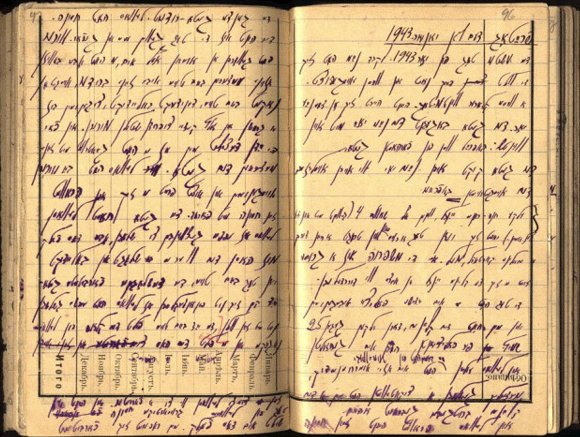


 For two years prior they’d lived in


