On this date in 1946, the Dutch fascist leader Anton Mussert was shot
Mussert was a young engineer who came to the fore in the interwar period as a strident right-wing populist. He co-founded in 1931 the Netherlands’ homegrown Nazi knockoff, the Nationaal-Socialistische Beweging; by 1935, it was polling 300,000 votes.
Mussert of course welcomed the German incursion into the Netherlands on the way to someplace else. That put the Dutch under wartime Nazi administration, but Mussert didn’t score a Quislingesque head-of-state plum out of the arrangement.
Instead, Mussert found himself brusquely shut out of any real power; the Austrian Arthur Seyss-Inquart ran the country instead, and would eventually hang via the Numremberg trial for his occupation atrocities, such as the wholesale deportation of the Dutch Jewish population that swept up diarist Anne Frank. Plum or no, however, what Mussert had done was more than enough to elevate him to the most conspicuous Nazi collaborator in the postwar Netherlands.
Mussert was captured after the war and shot at the open-air location near The Hague where over 250 people had been put to death during the war years.
Kusserow had actually been born Lutheran, but his parents became Jehovah’s Witnesses after World War I and raised their eleven children in the faith. Jehovah’s Witnesses, in addition to not serving in the army, also refused to Heil Hitler, since the tenets of their religion required them to make obeisance only to Jehovah.
They were persecuted by the Nazis from the beginning of Hitler’s regime, and by 1935 the religion was banned altogether. The Kusserows, and many others, continued to practice their faith in secret.
During the Nazi era, some 10,000 Jehovah’s Witnesses did time in prisons and concentration camps (where they were required to wear a purple triangle), Wilhelm’s parents and siblings among them. 2,500 to 5,000 died.
The children in Jehovah’s Witness families were taken from their parents and sent to orphanages, foster families or reform schools.
(French Witness Simone Arnold Liebster would write a memoir about the years she spent in institutions as a child because she and her parents refused to renounce their beliefs.)
At Wilhelm Kusserow’s trial, the judge and the prosecutor were apparently reluctant to condemn this young man. They pleaded with him to back down, promising to spare his life if he did so, but Wilhelm refused. Some things were more important to him than life itself.
In his final letter to his family he wrote,
Dear parents, brothers, and sisters:
All of you know how much you mean to me, and I am repeatedly reminded of this every time I look at our family photo. How harmonious things always were at home. Nevertheless, above all we must love God, as our Leader Jesus Christ commanded. If we stand up for him, he will reward us.
Hitler later decided the firing squad was too honorable a death for Jehovah’s Witnesses and ordered that they be decapitated instead. Wilhelm’s younger brother Wolfgang, who had also refused to serve in the army, was executed in this manner in 1942.
On this date in 1945, as Adolf Hitler celebrated his 56th birthday within a Red Army cordon, one of the Second World War’s more tear-jerking little crimes against humanity happened in Hamburg.
Bullenhuser Damm — still to be found today — was a former Hamburg school which fell out of use as World War II progressed, owing to the devastation Allied bombings wrought on the surrounding area.
The school itself sustained little damage, however, which eventually facilitated its appropriation as a satellite building for the nearby Neuengamme concentration camp.
Over at Neuengamme, the SS doctor Kurt Heissmeyer had been conducting a litany of horror medical experiments on 20 Jewish children — mostly from Poland — culled from the concentration camps, seeking medical evidence for Nazi racial theories further to a cushy professorship. But as April 1945 was obviously endgame for the Third Reich, thoughts naturally turned to disposing of evidence of indictable offenses.
Photos of the eventual Bullenhuser Damm victims showing their surgical scars after Heissmeyer injected them with tuberculosis.
Bullenhuser Damm was just the place for disposal.
On April 20, the 20 kids were loaded up on trucks with their four adult caretakers — two French, two Dutch — plus six Soviet prisoners of war.
At Bullenhuser Damm, the kids were parked in a room and hung out, blissfully ignorant of their danger. “They had all their things with them — some food, some toys they had made themselves, etc,” physician Alfred Trzebinski later recalled at his own trial. “They sat on the benches and were happy that they had gotten out. They didn’t suspect a thing.”
In the next room, the 10 adults were being hanged.
According to Admitting the Holocaust, Trzebinski was impressed with his own compassionate use of this bit of down time: he generously gave the children morphine shots to sedate them before their own executions. Or rather, their murders … since the doctor could not but agree that “you cannot execute children, you can only murder them.”
I must say that in general the children’s condition was very good, except for one twelve-year-old boy who was in bad shape; he therefore fell asleep very quickly. Six or eight of the children were still awake — the others were already sleeping … Frahm [an orderly] lifted the twelve-year-old boy and said to the others that he was taking him to bed. He took him to a room that was maybe six or eight yards away, and there I saw a rope already attached to a hook. Frahm put the sleeping boy into the noose and with all his weight pulled down on the body of the boy so that the noose would tighten. (Trzebinski, again)
The other 19 children were disposed of in like manner, and then all 30 corpses cremated overnight … just in time for what must have been a much-needed 5 a.m. coffee.
After the war, the facility went back to use as an actual (creepy!) school, but it was eventually renamed Janusz Korczak School, for a Polish-Jewish educator gassed with his young charges at Treblinka. There’s a permanent exhibition (German) at the site, as well as a memorial rose garden with a variety of plaques commemorating the victims of Bullenhuser Damm.
Trzebinski’s take on his conduct this horrible night might have been good enough for his conscience, but it didn’t pass muster with his judges: he was hanged on a war crimes rap prominently including Bullenhuser Damm on October 8, 1946. Kurt Heissmeyer, however, avoided detection until 1959 and only received a long prison sentence in 1966, shortly before his death.
We’ve touched in these pages — one of our earliest posts, in fact — on Soviet war heroine Zoya Kosmodemyanskaya, a teenager executed by the advancing German army in November 1941 for conducting partisan attacks behind enemy lines.
Zoya’s story became known after the Red Army recaptured village of Petrishchevo, where she was hanged. A January 27, 1942 Pravda article recounted the gallows defiance of the young guerrilla, whom villagers knew only by her nom de guerre, “Tanya”. She had withstood German torture, refused to give them any information, and at her hanging incited her countrymen and -women to resist the invaders. She’s still to this day a beloved national martyr in Russia, which is why she’s also an Ace in our execution playing cards.
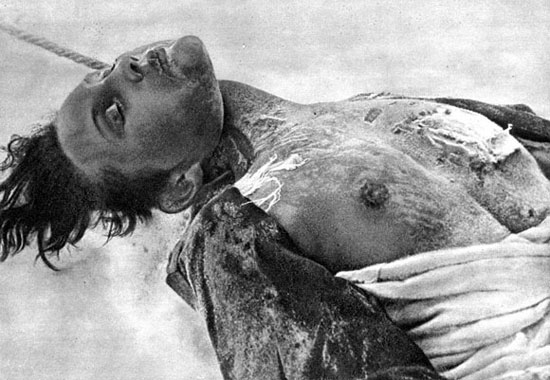
The young woman on the gallows, and in the ghastly post-mortem pictures with her left breast mutilated swiftly became propaganda grist for Moscow.
Zoya’s instant Joan of Arc-like legend invited investigation of the precise circumstances of her capture and death … and this in turn meant extremely dangerous scrutiny for any Soviet citizen in her environs whose behavior in those last days could be held to be in any way sub-heroic.
This brings us to today’s unfortunate entry, Vasily Klubkov, a humble mail-sorter before the war whose picture belongs in the dictionary next to “poor luckless sod.” Just him, Zoya, and everyone else on the terrible Eastern Front.
It was on this date* in 1942 that Klubkov paid the penalty for Zoya’s sacrifice.
Vasily Klubkov and Boris Krainov were other partisans who had been detailed along with Zoya Kosmodemyanskaya to torch some enemy assets on the same mission around Petrishchevo. Practically children all, they each acted independently from the others; long story short, Zoya and Vasily Klubkov were both captured.
Zoya fiercely endured every torture the Germans could throw at her, but Klubkov was made of softer stuff. When an officer pointed a gun at his head and demanded some answers, Klubkov started talking.
“I was a coward,” he later admitted. “I was scared I would be shot.”
Now, this admission very much against his own safety was made to the NKVD in March 1942, and since we already know that Vasily Klubkov was the sort to fold under torture, we can well imagine that the NKVD also got whatever it wanted out of the misfortunate young man. Considering the politicized quality of the trial and the circumstances of the “confession,” it has to be treated with caveats.
Under NKVD pressure, Klubkov signed off on a version of events that just so happened to mesh beautifully with the iconography already forming around the hanged “Tanya”: namely, that he was brought face-to-face with his fellow-prisoner and confirmed her identity, whereas she refused to breathe a word to her captors; that he saw her stripped naked and bashed with truncheons for hours and still summon the fortitude to refuse her interrogators the least satisfaction. Pavel Klubkov gave posterity firsthand evidence of Zoya Kosmodemyanskaya’s heroism in captivity.
“Klubkov may have been telling the truth, since it’s easy to imagine a terrified teenager on his first mission agreeing to his German captors’ demands,” notes Andrew Nagorski in The Greatest Battle: Stalin, Hitler, and the Desperate Struggle for Moscow That Changed the Course of World War II. “But there’s no way of knowing for sure how he really behaved, since he surely was just as terrified when he was interrogated by the NKVD. Or how much of what he said about Zoya was accurate, since the NKVD may already have been preparing the transcript with the idea of her elevation to mythic status.”
Heck, the reason the NKVD even had Klubkov to interrogate was that he escaped German custody, another big character red flag as far as the Soviets were concerned. That he escaped from the same custody that martyred Zoya Kosmodemyanskaya probably sealed his fate before he received his first pistol-whipping. NKVD records paint a kid who has already given up.
Well he might have. The verdict of the court was surely ordained from the start, but it was formally delivered on April 3: “Execution by shooting, without confiscation of property due to its absence.”
* Though there are some cites for April 3 out there, it appears that April 3 was the date of his conviction by a military tribunal and April 16 his execution date. This is a bit of a protracted delay by wartime Soviet tribunal standards, but then, Klubkov would have been a person of relevance to the state itself. The highest-ranking official who thought he could approve Klubkov’s execution without asking anyone else might have been a little further up the food chain than for your run-of-the-mill deserter.
On this date in 1942, two Jewish men were hanged in the city of Sosnowiec (pronounced sos-no-vitz) in Nazi-occupied Poland, and two more were hanged in the nearby city of Bedzin (pronounced ben-jin).
These executions were witnessed by thousands of people and carefully choreographed, as historian Mary Fulbrook records in her book A Small Town Near Auschwitz:*
The hangings in Bedzin and Sosnowiec had been orchestrated in advance, in meticulous detail, by the Police President in Sosnowiec. The execution in Bedzin was to take place one hour later than the one in Sosnowiec. As much thought was given by the police authorities to questions of security and seating arrangements as might be appropriate for a modern open-air musical concert: this was not to be a simple punishment for an individual offense, as had happened innumerable times, but rather a mass spectacle, intended to have a major impact on the audience…
The identities of the executed Jews in Bedzin have been lost to history. (Correction: Per Yad Vashem, they were Jehuda Warman and “Feffer” (no first name).) They were hanged at the old Jewish cemetery on the corner of Zawale Street, before a crowd of about 5,000, at 5:00 p.m. Jewish workers in the Bedzin Ghetto had their work identity cards confiscated that day and were let out of work early, at 4:00 p.m., and ordered to watch the hangings. Only after they witnessed the executions did they get their work cards back. The bodies remained hanging on the scaffold until 7:30 p.m.
The condemned men in Sosnowiec were 30-year-old Mayer Kohn and his father, Nachun or Nahum.
Nachun (left, with wife) and Mayer.
They’d been caught trading on the black market, probably trying to feed their families, as no one could live long on the official rations. But as Fulbrook points out, the actual offense didn’t matter much to the Nazis:
These coordinated public spectacles of mass hangings do not seem … to have been in direct response to a particular crime; it seems there was a policy of ‘any Jew will do’, although infringements of German rules (including not only black market dealings but also very trivial ‘offenses’) were adduced as the ostensible ‘reason’ for these executions.
Thousands of people, both Jews and Germans, watched Mayer and Nachun Kohn die, then quietly went home.
Although virtually the entire Kohn family perished at the hands of the Nazis, Mayer and Nachun Kohn can claim a bit of immortality by virtue of being mentioned in Maus, Art Spiegelman’s famous graphic novel about the Holocaust: the author’s father, Vladek, hailed from Sosnowiec.
On this date in 1944, Joseph Epstein* was shot with 18 others at Mont-Valerien outside Paris for their parts in the World War II French Resistance.
Joseph — “Jurek”, really — was born in Poland, but his communist politics got him harried out of Poland and Czechoslovakia and onward to France in the early 1930s.
There he completed his law studies, but was unable practice since he wasn’t a Frenchman.
But he was a perfect recruit for the international republican brigades of the imminent Spanish Civil War (he commanded an artillery battery named in honor of Tudor Vladimirescu).
War would drive Joseph Epstein hither and yon for his remaining years. After a spell in a French POW camp for Spanish Civil War refugees, Epstein signed up for the Foreign Legion, got captured and sent to a German POW camp, escaped to Switzerland, and returned to France.
There as “Colonel Gilles” of the communist resistance organization Francs-Tireurs et Partisans, he became the commissionaire of military operations for the capital and pioneered a shift in tactics towards guerrilla strikes using larger teams. Resistance fighter (and later, historian of the Resistance) Henri Nogueresexplained:
Most of the comrades adopted the three comrades system. But in Paris there were policemen and German soldiers everywhere: Joseph Epstein preferred to engage fifteen to twenty fighters per operation … [because] if in Paris during daylight, three persons only had to attack a military unit, there will always be a danger to be arrested that could lead to a partial or complete failure. By contrast, with a larger group, it was possible to gain a superiority if adopting a discrete strategy. The operations in Paris conducted in 1943 were placed under Colonel Gilles’ authority.
Epstein was arrested in the autumn of 1943 at a meeting with Missak Manouchian, and withstood months of brutal torture without so much as revealing his real name or national origin.
While this is a standard accomplishment in a Resistance martyrology, the proof of it in this case was that the ensuing “Manouchian Group” show trial, and the resulting famed “Affiche Rouge” poster, took great pains to depict Resistance members as foreigners and criminals.
As a Polish Jew who regularly ordered assassinations, Epstein would have made a fine exhibit … if the Nazis had known who he was. Instead, he’s conspicuous only by his absence.
The ironic consequence, according toanother Resistance veteran, was that “The man who, by far, was the greatest officer in all of France, the greatest tactician of the People’s War, is unknown to the general public. Of all military leaders, he was the most audacious, the most capable, the one who gave the French Resistance its originality compared to other European countries.”
On this date in 1944, the dashing Royal Air Force adventurer and prisoner of war Roger Bushell was shot for his key role orchestrating World War II’s most famous prison break — the Great Escape.
Richard Attenborough plays the Bushell-based character “Roger Bartlett” in The Great Escape, the film based on the story.
South African-born, Cambridge-educated, a pitch-perfect speaker of German and French, Bushell turned in his barristers’ briefs for fighter wings when World War II got underway.
But he was not meant to add Knight of the Air to his c.v., for his Spitfire was downed in its first engagement in May 1940. Bushell wound up in German custody, where he proved to possess a preternatural aptitude for escape.
He slipped German custody in June 1941 and made it within steps of Switzerland before a border guard nabbed him.
Nothing daunted, Bushell escaped again in October 1941 and successfully laid low in Czechoslovakia for months … long enough to finally get swept up in the reprisal roundups following the 1942 assassination of Reinhard Heydrich.
By now he’d wound up in Stalag Luft III, a POW camp adjacent the Silesian town of Sagan (today, Zagan, Poland). Here Bushell would author his breakout masterpiece.
In truth it was a collaborative effort of astonishing scale. Captured soldiers characteristically fled custody, as Bushell himself had before, in ones or twos, or in small groups.
In this camp, Bushell conceived and rigorously managed an industrial-scale operation aiming to bust out more than 200 inmates. “Only” 76 ultimately got out, more than enough for the utter consternation of the Third Reich.
Bushell was going to go big to go home; in fact, his alpha-male code-name among the escape plan’s initiates was “Big X”. Big X mobilized some 600 prisoners to work on three simultaneous escape tunnels, nicknamed “Tom”, “Dick” and “Harry”. Sunk 9 meters underground to stymie German anti-digging seismographs, the tunnels entailed a complex, months-long logistical operation for disposing of dirt, buttressing walls, pumping air. Nor did the escape plans end at the camp wire: teams prepared clothing, papers, maps, money. Every escaping prisoner had a plan and a cover story.
We had a mapping section which turned out 400 maps of the area. Forged passes, they worked day and night turning out some brilliant passes which passed stringent Gestapo checks later on. They were mostly artists, led by an artist called Tim Whelan who was later shot. The clothing department made very good clothes and suits. Compasses, food, you name it, intelligence of course. And train times, we knew all the train times.
One of the tunnels was found, and one was abandoned, but “Harry” was completed. 102 meters long, it stretched just beyond Stalag Luft III’s outer perimeter, and agonizingly shy of the nearby tree line. On the night of March 24-25 1944, 76 men (Bushell included) slipped out of “Harry” at intervals minutes apart, and into the freezing dark, scurrying into the woods with silent prayers that the nearby guard tower would not throw a spotlight in their direction. The 77th escapee was finally spotted emerging by camp sentries and captured, shutting down the whole operation.
Despite their prepared plans, the runners were very deep within German territory, and in the dead of a moonless night. Successfully completing their escapes would require crossing land on foot in the snow, navigating multiple Reich train platforms without catching the eye of now-hyper-vigilant inspectors, crossing hundreds of kilometers of territory, and passing off accents and forged papers with credible aplomb.
Not many could really manage this: the honor — the duty, as Bushell and many others thought — was in the attempt.
In all, 73 of the 76 escapees in this caper were recaptured within days. (Click here for the stories of the three who actually got away.)
A furious Adolf Hitler personally ordered everyone concerned executed when news broke of the escape, a flagrant violation of the laws of war. His advisors, concerned at triggering possible reprisals, managed to talk the boss down to the nice round number of 50 executions, a … 31.5% less extensive flagrant violation of the laws of war? Germans too suffered the regime’s fury; Hitler was talked off executing the camp commandant, but that guy lost his job. Some workmen from whom the escapees had stolen electrical cable for work on the tunnel were shot for having failed to report the theft.
And the 50 whom the Reich’s leadership had decided to kill* were shot out of hand at various times and places from March 29 to April 12.**
Their somewhat reduced ranks did not much lessen the ferocity of the Allies’ postwar manhunt for the parties involved in conducting it; the “Stalag Luft III murders” were announced in Parliament as soon as May 1944 and became the subject of a dedicated trial in 1947. The convictions in that case led to a mass hanging for war crimes in Hameln, Germany on February 27, 1948.
For his part, Bushell takes his final rest in Posnan, Poland. Although the men shot on this and succeeding nights for the Great Escape are interred at various spots, a monument near the old camp site at Sagan/Zagan permanently honors “the 50”.
* The specific 50 were chosen by Artur Nebe, who would later be executed by the Nazis himself. The selections were heavy on happenstance; while eastern Europeans and the escape leadership were predictably included, many others were in or out by the feeblest of reasons. For example, the Germans are thought to have passed on shooting escapees named “Nelson” and “Churchill” for no better cause than their conceivable relationship to the famous Britons of those names.
On this date in 1946, Bela Imredy, the fascist former prime minister of Hungary, was shot in Budapest.
Imredy was a Catholic financier who steered Hungarian economic policy in a succession of state posts during the chaotic 1930s.
When one of those governments fell in 1938, regent Miklos Horthy appointed Imredy prime minister. He was forced out of office the next year on revelations that he had Jewish ancestry.
This did nothing to moderate Imredy’s anti-Semitic views; he returned at the head of a new fascist party and nearly became Prime Minister under the German occupation in 1944.
Horthy demurred, and another future gallows-bird got the job instead. Imredy took the Minister of Economic Coordination as his last political gig.
A “People’s Tribunal” condemned Imredy after the war for war crimes and Nazi collaboration.
On this date in 1946, ten* Spanish Republicans were shot — most famously including Cristino Garcia.
Garcia, a Communist veteran of the Spanish Civil War, had put his guerrilla skills to good use by joining the French Resistance during World War II.
Garcia ultimately held the rank of Lieutenant Colonel in the Resistance, and was perhaps the most individually famous of the numerous Spaniards** who fought as maquisards. His unit broke out hundreds of people before potential deportation to German death camps, and Garcia helped orchestrate the guerrilla-led liberation of Foix in August 1944. (There’s a lengthier roundup of Garcia’s career in the field in Spanish, here.)
The French had nothing but good feelings for this guy, but Garcia wasn’t looking to take a pension from De Gaulle and settle down in a vineyard. As France fell to Allies, Garcia — going on ten years a professional leftist revolutionary — headed back to Spain (Spanish link) to carry on the fight against fascism closer to home.
His tasks over a few months in 1945 ran to the less legendary: bank attacks and the like, blurring the line between “ordinary” and “political” crimes. Garcia was also detailed as a result of intra-party politicking to murder fellow-Communist Gabriel Leon Trilla (Spanish link).†
As an agent of the Spanish Communist Party, which was backed by a French Communist Party riding high on its World War II heroics, Garcia’s situation became a national cause celebre. French left parties uniformly protested the planned execution, and the government made repeated diplomatic overtures to Madrid to stay the sentence. Editorialists protested floridly.
Have we forgotten that fascism exists at our border; Was it not against all fascisms that Cristino Garcia and thousands of our Spanish brothers fought with us on our soil? Did they not fall beside us, as at the Eysses prisons, under the same Nazi bullets, for France? And today will we disown their sacrifice, their blood and their martyrdom because the fight against fascism has moved to the other side of the Pyrenees? (from the Franc-Tireur, quoted here
Incensed when Franco ignore their appeals and shot the men anyway, France retaliated by closing its border with Spain on March 1, 1946. Spain did not neglect to point out the irony that, during the war years, innumerable resistance fighters and others fleeing Naziism or the Vichy regime had taken refuge by crossing that very border. (Less stress was understandably laid on the Francoists’ onetime demand — not honored by Paris — that France close its border against escaping Republicans in 1939.)
* I believe from press reports that there were 12 total executions of Republicans Feb. 21-22, 10 of which took place on Feb. 21. However, I might be mistaken about the overall numbers or their distribution by dates. Garcia’s, certainly, took place on Thursday the 21st.
† Garcia delegated this task to two subalterns, one of whom (Francisco Esteban Carranque) was shot with him on this date. The other man, Jose Olmedo, was arrested in 1947 and executed in 1948.
Information about this courageous outdoorsman is difficult to come by; try this Norwegian page for a bit of background.
The Gestapo captured him in August 1942, tortured him horribly, and had him shot. Later, Berg’s torture and execution would be one of numerous World War II brutalities charged in the war crimes indictment (PDF | HTML) against German ObersturmbannführerGerhard Flesch.
Flesch was himself executed on these charges on February 28, 1948.

 Mussert was a young engineer who came to the fore in the interwar period as a strident right-wing populist. He co-founded in 1931 the Netherlands’ homegrown Nazi knockoff, the Nationaal-Socialistische Beweging; by 1935, it was polling 300,000 votes.
 A
A 

 This brings us to today’s unfortunate entry, Vasily Klubkov, a humble mail-sorter before the war whose picture belongs in the dictionary next to “poor luckless sod.” Just him, Zoya, and everyone else on the terrible Eastern Front.


 Garcia, a Communist veteran of the Spanish Civil War, had put his guerrilla skills to good use by joining the French Resistance during World War II.