1949: Dr. Chisato Ueno, because life protracted is protracted woe

The Truk Atoll, in Micronesia, is more commonly known today as Chuuk. It’s a hot diving location notable for the many sunken World War II Japanese hulks to be explored there — the legacy of its once-pivotal position in the Pacific War.

Japan used Truk as forward naval base in the South Pacific, and armored up its little islands like an armadillo.

Rather than capture it outright, the U.S. Navy bombed Truk right out of the war in February 1944, leaving that enormous warship graveyard and a stranded stronghold of starving soldiers who were left to wither on the vine. At war’s end, it was just a matter of circling back to collect 50,000 surrenders.

Unfortunately, the castaway Truk garrison did not pass the last months of the war with sufficient care for its foreseeable postwar situation.

According to testimony given the postwar Guam war crimes tribunal, 10 American prisoners were murdered on Truk in 1944 “through injections, dynamiting, tourniquet applications, strangling and spearing.” (Source) Hiroshi Iwanami was executed for these gruesome experiments/murders in January of 1949.

Ueno, a lieutenant surgical commander, hanged for two other killings that read quite a bit murkier.

Five American POWs were being held in a temporary stockade that was hit by an American bombing raid in June 1944 — killing three of those prisoners.

The surviving two were severely injured, eventually leading Dr. Ueno on June 20, 1944, to perform what he characterized as a legitimate exploratory surgery on one of those men. His prosecutors framed it instead as a fiendishly gratuitous vivisection.

During that procedure, an order arrived for the execution of both the prisoners. The other guy, the one Dr. Ueno wasn’t operating upon, he never had in his care at all; that unfortunate fellow ended up being bayoneted to death. The man on the table (both men’s names were unknown to the prosecuting court) Dr. Ueno stitched back together well enough that subalterns could stretcher him out to a swamp and chop off his head.

Here’s the difficult part: Ueno actually gave the immediate order to execute his ex-patient.

As described in the National Archives’ Navy JAG Case Files of Pacific Area War Crimes Trials, 1944-1949, the physician’s barrister mounted a quixotic philosophical defense of this deeply indefensible order, noting the principled acceptability of euthanasia in Japanese hospitals (so he said), the inevitability of the prisoner’s approaching execution via superior orders, and the agony the man was already in from his wounds.

[Dr. Ueno] had expected that some other person would dispose of this prisoner. But he could not find anyone who looked like the person to carry this out … the thought dominated his mind that all hope is lost to save this prisoner. His fater has been determined. Yet the prisoner is in pain …

He was faced with the predicament of killing by his order the prisoner which he had treated as hiw [sic] own patient. What sarcastic fate was this that he had to face? As the Napoleon, described by George Bernard SHAW, and as McBeth [sic] described by William SHAKESPEARE, the accused, UENO was also “a man of destiny.”

A certain English poet wrote, “Life protracted is protracted woe.” If the life of the prisoner in the present case was protracted one second, he would have so much more suffering to endure. Should it be condemed [sic] so severely to shorten one’s life under such circumstances and shorten his last woe in this world?

There were in all either 10 or 13 official executions of Japanese war criminals on Guam from 1947 to 1949. It’s devilishly difficult to find those 13 enumerated by name and date, but it appears to me that Ueno and his boss Admiral Shimpei Asano were the very last to achieve that distinction.**

The readable little history on Truk island and the U.S. Navy operations against it, Ghost fleet of the Truk Lagoon, Japanese mandated islands”, captures the scene.

Shortly after eight o’clock on the humid, tropical evening of March 31, 1949, according to War Department Pamphlet #27-4 Procedure For Military Executions, the 5’6″ Japanese surgeon with extremely strong neck muscles was escorted up the nine steps to the gallows. The handcuffs were removed by a Marine guard and a strap placed to secure his arms to his side and another placed around his legs. A black hood was placed over his head and at 8:26 p.m. the floor panel on which he was standing fell from under his feet and Ueno dropped 94 inches to eternity. He was the last to die, as Rear Admiral Shimpei Asano* had preceded him only moments before. Under the dubious honor that rank has its privileges — the Admiral went first.

* Executed for these same two murders on Truk, as well as two other POWs killed at Kwajalein, in the nearby Marshall Islands.

** Angered by Naval administration of the island, Guam’s Congress had staged a walkout earlier in March 1949. This action did successfully force an end to Naval government.

On this day..

1947: Ernst Kundt, Sudeten German

On this date in 1947, Ernst Kundt was hanged in Prague’s Pankrac Prison.


Kundt (right) is honored at Prague Castle by Hans Frank. (Frank was hanged through the Nuremberg Trial.)

Kundt co-founded the Sudeten German Party, a nationalist-fascist party that would play a leading role as one of Nazi Germany’s stalking-horses as the latter maneuvered in the 1930s towards the takeover of Czechoslovakia.

The leaders of this movement were amply rewarded by Czechoslovakia’s new masters; for Kundt, this meant a transition from an MP in Prague to a seat in the Reichstag, a gig in the Luftwaffe, and various state posts around the Third Reich.

And of course, many of these Sudeten big wheels collected a different sort of reward after 1945. He was arrested in Czechoslovakia after the war and tried with a number of other Sudeten German leaders.

On this day..

1943: France Bloch-Serazin, bombmaker

On this date in 1943, French resistance heroine France Bloch-Serazin was executed by the Germans in Hamburg.

Bloch-Serazin English Wikipedia entry | French) was a Jewish Communist who had supported the Spanish Republican cause, so she was right in line for some official persecution after the Germans blitzed France.

No longer employable as a chemist, she put her training to good use manufacturing explosives in her apartment. (Today, a plaque in the 19th arrondissement marks the building.)

Arrested by French police on May 16, 1942, she was condemned to death by a German military court but deported to Germany to suffer that punishment. Her husband, Fredo Serazin, was subsequently murdered by the Gestapo in prison.

As France Bloch-Serazin was born in 1913, she has recently enjoyed a renewed appreciation around the centennial of her birth, including the homage (French link) of her native city of Poitiers.

On this day..

1947: Henry Rinnan, Norwegian collaborator

On this date in 1947, a firing squad shot Henry Rinnan for treason at Trondheim’s Kristiansten Fortress.

Standing just 5′ 3″ on tippytoe, Rinnan (English Wikipedia entry | Norwegian) stands tall as Norway’s most notorious World War II collaborator this side of Vidkun Quisling.

That physique got him turned away when he tried to volunteer to fight the Soviets in the Winter War, but it didn’t put the Gestapo off him after Germany occupied Norway in 1940. He formed an informants’ network known as the Rinnanbanden which infiltrated the resistance movement and entrapped anti-occupation Norwegians — a “game in the negative sector,” as Rinnan described it.

The “game” got more than a thousand people arrested and something like 100 killed, including one of the more notorious episodes of the occupation, the Majavatn affair. (Norwegian link) It also eventually got Rinnan a German rank and the opportunity to kill some people personally.

Twelve people in all from the Rinnanbanden were sentenced to death after the war, counting Rinnan. Ten of those did indeed pay the penalty.

There’s a Norwegian page about the Rinnanbanden here.

On this day..

1942: Senitsa Vershovsky, Mayor of Kremenchuk

(Thanks to Meaghan Good of the Charley Project for the guest post. -ed.)

On this date in 1942, Senitsa Vershovsky was shot in the city of Kremenchuk in the Soviet Union, in what is now the Ukraine.

Vershovsky was the mayor of Kremenchuk and was also a major in the Red Army. His executioners were members of Einsatzgruppe A, one of Nazi Germany’s mobile killing squads: they killed Vershovsky for “carry[ing] out his duties in gross defiance of German orders … [and] sabotaging the handling of the Jewish problem by having a great number of Jews baptized in order to remove them from German control.”

Approximately 30,000 Jews lived in Kremenchuk, constituting 40% of the city’s population and they had good cause to remove themselves as far as possible from German control. The Einsatzgruppen, as they did in countless other cities throughout the Soviet Union, rounded up the Jewish population, forced them to dig their own graves, and machine-gunned them by the thousands.

Vershovsky’s attempts to help the Jews under his charge, futile though his efforts may have been, nevertheless deserve a footnote in history. For, as historian Raul Hilberg noted, in all the situation reports filed by the Einsatzgruppen during their 22 months of operation,

This incident appears to be the only one of its kind. The counterpressure was evidently too great. Whoever attempted to aid the Jews acted alone and exposed himself as well as his family to the possibility of a death sentence from a German Kommando. There was no encouragement for a man with an awakened conscience.

In a time of great adversity, Senitsa Vershovsky showed himself to be a courageous and fundamentally decent human being, and he paid for it with his life. The least we can do is remember him.

On this day..

1943: “Native parachutists” in Morocco

LONDON, Jan. 4 (U.P.) — The Morocco radio tonight quoted an announcement from General Henri Honore Giraud’s headquarters that an unspecified number of “native” parachutists, dropped in North Africa from German planes, had been executed for trying to swing local populations to the Axis cause. [Vichy North Africa had only recently gone over to the Allies -ed.]

The “fifth column” chutists found “only rare complicity,” the announcement said.

“The natives and their accomplices have all been arrested and executed immediately after court-martial,” it continued. “Military authorities contributed efficiently to the arrest of these enemy agents.

“Large rewards have been distributed to all those who helped capture the culprits.”

(Source: New York Times, Jan. 5, 1943.)

On this day..

1941: The massacre at Skede in Liepaja

The World War II occupation of the Latvian town of Liepaja (Libau, to the Germans) produced mass executions throughout 1941.

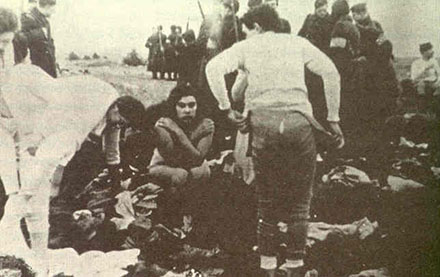
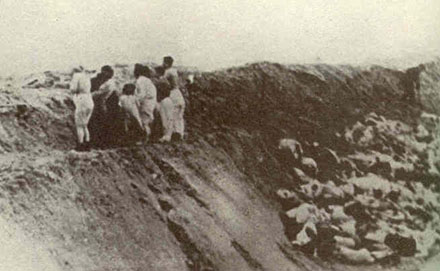
This date in 1941 commenced one of the largest such actions: over 2,700 Jews as well as 23 Communists forced over the course of two-plus days to strip on the freezing Skede dunes overlooking the Baltic and there shot by German and Latvian teams into a vast pit. It’s one of the most recognizable Holocaust atrocities because it was extensively photographed.*

As one can see from the pictures, the victims here were mostly women.


Some of the women in this photographs can be identified by name (pdf). Left to right: (1) Sorella Epstein; (2) presumably Rosa Epstein, her mother; (3) unknown; (4) Mia Epstein; (5) unknown. Alternate identification makes Mia Epstein (5) instead of (4), and (2) Pauline Goldman.

Almost all of Liepaja’s Jews perished during the war.

* Germany’s Bundesarchiv (search on Libau 1941) confirms the precise December 15 dating for these images; it also has some other photographs of atrocities in Liepaja/Libau on other occasions.

On this day..

1942: Eddie Leonski, the Brownout Strangler

(Thanks to Meaghan Good of the Charley Project for the guest post. -ed.)

On this date in 1942, a boyishly handsome G.I. named Edward Joseph “Eddie” Leonski was hanged at Pentridge Prison in Melbourne, Australia.

Although his crimes were committed in Australia and were not war-related, he was court-martialed and sentenced to die under American military law.

This was the first and last time a foreign national who committed crimes in Australia was tried and sentenced under the laws of their own country. Eddie was only the second U.S. serviceman to be executed in World War II. (The first, James Rowe, had been convicted of murdering another soldier and was hanged in Arizona just three weeks earlier.)

Known as the “Brownout Strangler” due to his penchant for attacking women at night on Melbourne’s dimly lit streets, Leonski killed three people and assaulted several others of the course of just over two weeks, from May 3 to May 18, 1942. He said he was fascinated by women’s singing and killed his victims to “get at their voices.”

Leonski was born in New Jersey in 1917, the sixth child of Polish/Russian immigrant parents, and grew up in New York City. Crime historian Harold Schechter notes he had the kind of unstable childhood, dysfunctional family background and mommy issues typical of serial killers:

Both [parents were] confirmed alcoholics. He was seven when his father abandoned the family. Not long afterward, his mother, Amelia, took up with another drunkard. She herself suffered at least two mental breakdowns, severe enough to land her in Bellevue, where she was diagnosed with both manic-depression and incipient schizophrenia. From an early age, three of his brothers were chronic troublemakers, eventually racking up lengthy rap sheets. One of them ended up in a state institution, where he lived out his life.

According to all accounts, Eddie was the apple of his unstable mother’s eye. He, in turn, had the kind of deeply disturbing attachment to her found in other homicidal mama’s boys.

On the surface Eddie seemed to have risen above his origins. He began weight-lifting in adolescence and eventually developed an impressive physique. Following high school he took a three-year stenography course and graduated in the top ten percent of his class. He was a promising employee at a Manhattan supermarket chain before he was drafted into the Army in 1941.

Leonski didn’t do nearly so well in the military: although he was reliable and charming when sober, he drank heavily and was unstable and aggressive when under the influence. As a result, he was always in some minor trouble or another.

But there was a war on and the United States was not in a position to be picky about who would serve. Eddie was sent to Australia in early 1942.

Only weeks after his arrival, he began attacking women and trying to choke them. The first few times, he was interrupted and had to flee before he could accomplish his purpose. Then his crime spree was interrupted in the last week of March after he went AWOL on a six-day bender and was thrown into the brig for a month. As soon as he got out he began stalking women again.

At 2:00 a.m. on May 3, an extremely intoxicated Leonski encountered 40-year-old Ivy Violet McLeod waiting for a streetcar near a dry cleaner’s. He strangled her to death and ripped off her clothing, but was scared away when he heard footsteps.

McLeod’s body was found several hours later: “legs wide apart and feet tucked under her thighs, with genitals exposed.” Her killer had not had time to rape her.

A week later, Eddie was in a restaurant when he struck up a conversation with 31-year-old Pauline Buchan Thompson, a policeman’s wife and mother of two. They went to a bar after dinner and spent several hours talking and drinking.

Close to midnight, Eddie offered to escort her home. On the way, Mrs. Thompson started drunkenly singing.

“She had a nice voice,” he said in his confession. He got angry when she stopped: “I got mad and then tore at her, I tore her apart.”

A few hours later a night watchman found her body on the very steps of her boardinghouse. Like Mrs. McLeod, she was nearly nude with her legs splayed, but had not been raped.

Hours later, a hung-over Eddie Leonski was nursing the hair of the dog that bit him when he told a fellow soldier what he’d done. He made more statements about the two murders over the next few days, but his friend didn’t believe him and told no one what Leonski was saying — time during which Leonski made three more unsuccessful assaults on women.

Eddie’s friend finally took him seriously on the morning of May 19, after the body of 41-year-old Gladys Lillian Hosking was found sprawled in a patch of yellow mud outside Camp Pell, where the American soldiers were stationed.

The previous night, Eddie had come in after midnight, slathered head to toe in the same yellow mud. Too drunk to clean himself up (he’d consumed an incredible thirty beers and seven whiskeys that day), he just shed his soiled clothes and collapsed into bed.

Leonski’s friend finally went to the cops.

When he was arrested, Eddie made no pretense of innocence: he quickly confessed, and various witnesses to his aborted attacks identified him. (That said, Ivan Chapman’s out-of-print book on Leonski makes the point that the evidence against him might not really have held up without those confessions: 1940s forensics techniques would not have yielded a positive match to a victim from his bloodstained trousers, and the yellow mud could easily have been picked up innocently by any drunken G.I. who stumbled traversing the trench.)

Fredric Wertham, a noted forensic psychiatrist who never met Leonski, believed he was insane and the murders were prompted by his twisted relationship with his mother:

That his three victims were all women considerably older than he was is psychiatrically most significant. He unconsciously linked their voices with his mother. The whole psychological explosion occurred in a period of deprivation when he was away from home and separated from his mother — but not from her dominating image. The deeds constituted symbolic matricide.

Very Norman Batesian.

Army psychiatrists, however, believed that while Eddie Leonski was certainly a psychopath, he was not psychotic and was fully aware of the wrongfulness of his acts. Douglas MacArthur personally signed the death warrant.

Eddie maintained a positive, chipper attitude awaiting execution. He spent his time memorizing Oscar Wilde’s Ballad of Reading Gaol, and converted to Catholicism, and went to the gallows singing a popular song that was called, ironically, “It’s a Lovely Day Tomorrow.”

His remains were moved several times before finally finding a permanent grave in a military cemetery in Hawaii. The Australian modernist artist Albert Tucker made a painting titled “Memory of Leonski.” The film Death of a Soldier is based on his crimes.

On this day..

1941: Alfredo Castoldi, German spy in Vichy Algiers

Simon Kitson‘s engrossing The Hunt for Nazi Spies: Fighting Espionage in Vichy France makes the case that Vichy France — and in particular, 1940-42 Vichy, before Operation Torch triggered the outright German occupation of Vichy France — had an active counterespionage program working against German spies.

Once recruitment in the German secret services was suspected, evidence was needed to carry out an arrest. The general rule was to delay arresting suspects so as to be able to tail them to find out who their contacts were and the exact nature of their activities. This is what happened with Alfredo Castoldi, an Italian working for the Germans. Castoldi made the acquaintance of someone named Perez in a bar and tried to convince him to provide military information. Perez pretended to accept but the next day he went to tell all to the local police chief. The police did not arrest Castoldi right away but asked Perez to maintain contact with him and to earn his trust and find out the nature of his intentions and his network. The evidence acquired in this way was so convincing that on 3 November 1941, at 7:30 in the morning, Castoldi was executed by a French army firing squad in Algiers.

Castoldi was not an outlier. Several dozen German spies may have been shot by Vichy France in the 1940-42 period. Kitson notes that it is

difficult to ascertain the exact number of German spies sentenced by Vichy military courts who were actually executed by the firing squads of the French army. [Paul] Paillole claims there were forty-two of them. In research for the present study, I found formal proof of eight such executions, but Paillole’s figure seems credible for two reasons. Firstly, during the postwar trial of Marshal Philippe Petain, Ernest Lagarde, the former director of political affairs in the Foreign Affairs Ministry, claimed there were about thirty such executions in 1941, which does not exclude a total of forty-two for the years 1940-42. Secondly, there is a register of Petain’s decisions concerning appeals for clemency from individuals condemned to death for activities ranging from Communism to army mutinies to espionage. In espionage cases, the registry does not specify for which country a particular spy was working, but it would seem that, after cross-checking the names listed with other sources used for the present study, there were twenty-seven confirmed cases of Axis spies having their appeal for clemency refused. A further twenty-three cases in which clemency was refused also appear to involve Axis spies. Of course, in a handful of instances where the appeal for clemency was rejected, executions may still not have been carried out as a result of the invasion of the southern zone by the Germans, which brought a sudden end to official executions. This registry nevertheless adds credibility to Paillole’s estimate.

On this day..

1940: Lluis Companys, Catalan president

“Above all, there was a belief in the revolution and the future, a feeling of having suddenly emerged into an era of equality and freedom. Human beings were trying to behave as human beings and not as cogs in the capitalist machine.

-George Orwell, Homage to Catalonia

On this date in 1940, Catalan president Lluis Companys was shot by the Spanish fascists.

Companys had held that notional office for mere hours six years before — but he’s still the last to hold it in any form at all.

Political exile was no unfamiliar terrain for Companys. As a young lawyer, his activism in the first two decades of the century had seen him incarcerated over a dozen times; in fact, his path to political respectability had entailed getting out of a Menorca prison in 1920 courtesy of the parliamentary immunity conferred by winning an election.

And he’d drawn a long sentence for an attempted 1934 rising against a center-right government — the occasion when he had become the President of the Catalan Republic on October 6, and been dispossessed of both office and state by the very next day.

That prison sentence’s reversal by the new republican government in 1936 was a bit of Pyrrhic victory for Companys’s left-wing politics — inasmuch as said republicans’ ascent was also the trigger for the nationalist revolt that resulted in the Spanish Civil War and a military dictatorship lasting until the 1970s.

As the virtual personification of Catalan national aspirations, Companys remained head of the Generalitat de Catalunya from 1933 until his death — in prison, in exile, wherever Companys went he bore along the Catalan cause.

As such, he was in the thick of the civil war’s scrap for control of Barcelona: not only against the fascists but among the left parties whose fractious alliance tore apart in 1937.

It was truly a case of riding the tiger. Companys struggled to maintain the cooperation of his alliance even while the republicans’ Soviet sponsors excommunicated anarchist and anti-Stalinist elements internally. The dreadful spectacle of internecine street fighting among the anti-fascists in May 1937 fills the final tragic pages of Orwell’s Homage, decided by the inescapable materialist circumstances: “the Government could not afford to offend the Communist Party while the Russians were supplying arms.”

Few sources direct much personal blame at Companys for what followed. Under Soviet pressure, he accepted the Communist police raids that had set off the street fighting, accepted the purges and the press censorsip, sacked anti-Stalinist minister Andres Nin from the government. (Nin was later “disappeared” and murdered.)

Who knows but that even these evil days were not still the best that could be made of a bad circumstance: whatever they were, they were not enough for republican Spain or for Catalonia.

When those dreams fell under the fascist advance little more than a year later, Companys couldn’t flee Franco far enough for safety. Soon after his 1939 escape to France, that country was overrun by militaristic rightists from the other direction — and the German occupiers happily handed Companys back to Spain as soon as they got their hands on him.

Condemned after the formality of a perfunctory trial for “military rebellion” conducted on October 14, 1940, Companys was shot the very next morning Montjuic Castle. (See Franco: A Biography)

Spain, where questions of Catalan sovereignty and the Franco years are both sensitive subjects, has never reversed the judgment (Spanish link) against Companys. However, a Barcelona promenade is named in Companys’s honor, as is a major stadium — actually the arena where the anti-fascist 1936 People’s Olympiad in opposition to the notorious master race spectacle of Berlin was to have taken place, before that whole Civil War unpleasantness.

On this day..