1917: Thirteen black soldiers of the 24th U.S. Infantry Regiment

On this date in 1917, thirteen black soldiers were secretly hanged at dawn at a military camp outside San Antonio for their parts in a Houston race riot four months earlier.

During the nadir of American race relations and just months after America’s entry into World War I, the soldiers of this historic all-black unit had been dispatched to build military facilities in Harris County, where they met animosity from whites beyond the everyday insults of Jim Crow law. Here, the service of “arrogant, strutting representatives of black soldiery” was hated and feared.

When white police arrested a black infantryman who tried to prevent their detaining a drunk black woman, then beat up and shot at a black corporal sent to inquire after him, hostility boiled over. Over one hundred soldiers marched through the city — confronting a mob of white citizens and police who had likewise armed themselves. Fifteen whites and four blacks were killed in the ensuing confrontation.

This documentary segment is from Mutiny on the Bayou:

The next day’s Houston Chronicle knew just what to do about it.

Their lenient treatment has led negro soldiers to believe that the government is in sympathy with their arrogance and impudence toward white people …

A COURT MARTIAL, A HOLLOW SQUARE AND A FIRING SQUAD WILL SETTLE THE MATTER FOR ONCE AND FOR ALL.

No white Houstonian was ever prosecuted for the day’s events, but the largest court-martial in U.S. military history tried 63 black soldiers and condemned 13 to die:

Sgt. William C. Nesbitt
Corp. Larsen J. Brown
Corp. James Wheatley
Corp. Jesse Moore
Corp. Charles W. Baltimore*
Pvt. William Brackenridge
Pvt. Thomas C. Hawkins
Pvt. Carlos Snodgrass
Pvt. Ira B. Davis
Pvt. James Divine
Pvt. Frank Johnson
Pvt. Rosley W. Young
Pvt. Pat MacWharter

The sentence was carried out without appeal, the time and place only announced after the men had already hanged but evidently witnessed by the New York Times reporter who wrote that “the negroes, dressed in their regular uniforms, displayed neither bravado nor fear. They rode to the execution singing a hymn, but the singing was as that of soldiers on the march.”

Two more mass courts-martial would follow, resulting in six more hangings the following year.

For years afterward, the incident clouded and complicated race relations, especially in the War Department.

Some blacks openly applauded the mutiny as a justified resistance against racist provocation. This inflammatory opinion piece, quoted in Mark Ellis’ Race, War and Surveillance, landed the editor who agreed to run it in federal prison:

We would rather see you shot by the highest tribunal of the United States Army because you dared to protect a Negro woman from the insult of a southern brute in the form of a policeman, than to have you forced to go to Europe to fight for a liberty you cannot enjoy. Negro women regret that you mutinied, and we are sorry that you spilt innocent blood, but we are not sorry that five southern policemen’s bones now bleech [sic] in the graves of Houston, Tex.

Meanwhile, the Army noted “the tendency of the Negro soldier, with fire arms in his possession … to become arrogant, overbearing, abusive and a menace to the community in which he happens to be stationed.” It held down its black enlistment throughout the interwar period.

Sympathizers with the policy would continue — until the raw manpower requirements of World War II trumped the discussion — to cite the Houston riots both as evidence of the dangers of arming blacks, and the disloyalty of a populace willing to register open disgust with lynch law during wartime.

* Baltimore was the soldier who had come after the missing men; his altercation with a white policeman who answered, “I don’t report to any negro” and pistol-whipped him — and, it was incorrectly rumored among the 24th Infantry that night, killed him — triggered the riot.

Baltimore’s role is developed in a fascinating study of primary documentation on the case in Edgar A. Schuler’s “The Houston Race Riot, 1917” published in The Journal of Negro History, Vol. 29, No. 3 (July, 1944). Schuler also treats the interesting tensions between the Houston black community and the black regiment, and the emergence of a white narrative of uppity, out-of-control Negroes rather than ones responding (however wrongly) to specific provocations … which conveniently turned Jim Crow law from the problem into the solution.

On this day..

1796: Jose Leonardo Chirino, Venezuelan slave revolt leader

On this date in 1796, insurrectionary Jose Leonardo Chirino was hanged in Caracas for leading a slave revolt in Spain’s oppressive New World sugar plantations.

Nearly all the information readily available online about Chirino is in Spanish, and all the links in this post are to Spanish pages.

The influence of the Haitian Revolution, and the philosophical precepts of the French Revolution that had helped spawn it, sent waves through the Caribbean washing up on every shore it touched.

Most of those lands had a ready audience under the lash of European colonial masters; the eastern Venezuelan city of Coro, home to the sugar aristocracy and the groaning underclass that crop implied, must have had one of the readiest.

On May 10, 1795, Chirino — a Zambo of mixed African and Amerindian blood who was himself a free farmer — led an uprising of the Congolese slaves in the area who worked the sugarcane and declared a Republic under the “Law of the French,” with slavery and white privilege abolished.

Forcibly.

The rebellion’s attempt on Coro itself failed, and it was swiftly put down by the colonial authorities. Though many involved were killed summarily, the Spanish took their sweet time after capturing Chirino in August 1795: only the following year was he transferred to Caracas for execution, after which his body was dismembered and his head set in an iron cage displayed on the road to Coro. (For good measure, they sold his family into slavery.)

[flv:https://www.executedtoday.com/video/Jose_Leonardo_Chirino.flv 440 330]

(Video from here)

Of course, Chirino was on the right side of history. The city square in Caracas where Chirino hung is now Plaza Bolivar, named for Latin America’s eponymous liberator.

Coro itself is today served by Jose Leonardo Chirino airport, and for the African diaspora in Venezuela, Chirino is a special inspiration.

[audio:Jose_Leonardo.mp3]

Like any worthwhile symbol, he’s also contested territory — claimed as a forerunner (if a questionable one) of socialism by the “Bolivarian Republic” now governed by Hugo Chavez.

On this day..

1783: The first hangings at Newgate Prison

On this date in 1783, London’s colorful penal history moved across town.

For centuries, public executions had been carried out at the storied Tyburn gallows, a ribald, rambunctious affair that involved carting the doomed from Newgate Prison through teeming city streets, by way of ale house pit stops.

The Tyburn era drew to a close late in the 18th century. Five weeks before, its last victim swung there.


The former hanging grounds of Tyburn, sketched by William Capon in 1785. The gallery still standing was privately erected, to sell tickets to spectators eager for a view.

Little more than a month later, the curtain raised and the trap fell on a new chapter for the London hanged.

Henceforth, the processional would be dispensed with, and the condemned simply walked across a courtyard and up a flight of stairs to a public gallows just outside the prison.

These were still public executions, and hardly eliminated the carnival atmosphere as this c. 1789 sketch will attest:

But it marked a move towards, if not altogether to, a version of the death penalty more familiar to modern eyes. For one thing, the prison itself became the site of punishment, absent the elaborate and occasionally dangerous theater of the trip to Tyburn; at Newgate, they were regularized, an extension of the frightful dungeon, and as the crowd itself was controlled and separated from the elevated platform, the natural next step would be at last to withdraw inside the prison’s walls.

At the same time, there is a technological advance towards “scientific” hangings geared to minimize suffering: the ‘New Drop’.

This system, whereby a trap sprung beneath the prisoner’s feet suspended him on the gallows, was not strictly new — a form of it had been used at Tyburn as early as 1760, though not repeated.* But the new drop (still just a variety of short drop, where strangulation is likely) marks a distinct shift towards a mechanistic punishment, clearly removed from the sometimes fraught physical confrontation between a prisoner and a hangman attempting to force him or her from the cart, and an antechamber into the grim 19th century science of reckoning hangman’s drops for the precise effect of snapping (without severing) the neck.

Of course, progress always has its detractors.

74-year-old Samuel Johnson groused at the “innovation” of leaving Tyburn:

[T]hey object that the old method drew together too many spectators. Sir, executions are intended to draw spectators; If they do not draw spectators, they don’t answer their purpose. The old method was most satisfactory to all parties; the public were gratified by a procession and the criminal was supported by it.

Approaching the matter from a very different perspective, Lord Byron found the Italian beheadings of Mastro Titta “altogether more impressive than the vulgar and ungentlemanly dirty ‘new drop’, and dog-like agony of infliction upon the sufferers of the English sentence.”

* In the correspondence of an early 19th century Secretary of the Admiralty, we have confirmation of this in a letter of Sir Peter Laurie, available from Google Books here and here. Laurie reports that “something like a drop in hanging criminals”

was not adopted as the general mode of execution till 1783, when ten felons were executed on the 9th of December in that year for the first time in front of Newgate, on a new drop or scaffold hung with black … The gallows used at Tyburn was purchased by a carpenter who, having no sentiment in his composition, converted it into stands for beer butts in the cellars of a public house called the “Carpenter’s Arms” in Adam Street.

On this day..

1793: Madame du Barry, who hated to go

On this date in 1793, Madame du Barry — shrieking pitiably in terror — was guillotined in Paris.

Versaille costume dramas have made great hay with the courtesan who became the mistress of Louis XV, and her catty court rivalry with Marie Antoinette. (Madame Tussaud’s still-on-display Sleeping Beauty figure was also created way back in 1763 in her likeness.)

More portraits of Madame du Barry here.

The sovereign’s bed implied a station of wealth and extravagance, but the low birth that caused Marie to turn up her nose didn’t much help this day’s victim standing with the Jacobins.

Poor Madame du Barry, at 50 years of age, had not lost an ounce of her considerable zest for life … and her apparently ingenuous joie de vivre while the Revolution raged looks somewhere between innocent and daft.

While nobles were scrambling to get out of France, the Comtesse born Jeanne Bécu shuttled back and forth over the English Channel in 1792 to settle her jewelry accounts … and decided to stay in France, returning after the September Massacres no less. Later, she would detail to her gaolers where she had stashed her baubles around her estate, in the delusion that they could buy her life — or at least, “did not each word give her a second of time?”*

She’s remembered for the uncommon scene she made being hauled to the guillotine this date — in a time when the scaffold’s pageantry demanded a stoic public dignity from the guillotine’s victims, the Comtesse came apart, and begged the crowd for her life so frantically and heart-wrenchingly that the executioners felt hurried to dispatch her lest the scene turn against them.

Even to the last, hopeless second she implored Sanson,

Encore un moment, monsieur le bourreau, un petit moment.**

One could make the case that if more clients of the national razor had displayed such naked humanity to onlookers, the guillotine‘s technical and social capacity for mass butchery might have been lessened.

Whether true or not, she gives us a glimpse, oddly unusual in these pages, of unadulterated fright — of that visceral instinct to cling to life, even under the blade, even for one little moment more.

Dostoyevsky, who knew whereof he spoke would write in The Idiot,

After all this honour and glory, after having been almost a Queen, she was guillotined by that butcher, Samson. She was quite innocent, but it had to be done, for the satisfaction of the fishwives of Paris. She was so terrified, that she did not understand what was happening. But when Samson seized her head, and pushed her under the knife with his foot, she cried out: ‘Wait a moment! wait a moment, monsieur!’ Well, because of that moment of bitter suffering, perhaps the Saviour will pardon her other faults, for one cannot imagine a greater agony.

Spare a thought for that moment of bitter suffering, next time you … uh, dine on cauliflower?

* This line, obviously in the vein of her famous last request to the headsman, is from Memoirs of the Comtesse Du Barry, actually a 19th century work of historical fiction by Baron Etienne Leon Lamothe-Langon.

** “One moment more, executioner, one little moment!”

On this day..

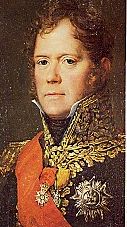
1815: Michel Ney, the bravest of the brave

On this date in 1815, Napoleonic Marshal Michel Ney faced a squad of French troops un-blindfolded and gave them the last order of his wild career:

Soldiers, when I give the command to fire, fire straight at my heart. Wait for the order. It will be my last to you. I protest against my condemnation. I have fought a hundred battles for France, and not one against her… Soldiers Fire!

The carrot-topped commander, just seven months Napoleon’s senior, had like the Corsican distinguished himself at arms during the French Revolution.

He shone thereafter as a ballsy* cavalry officer in the Napoleonic Wars — Bonaparte called him le Brave des Braves (“the bravest of the brave”).

Hitching your star to Napoleon’s was a good career move, for sure.

Until right about …


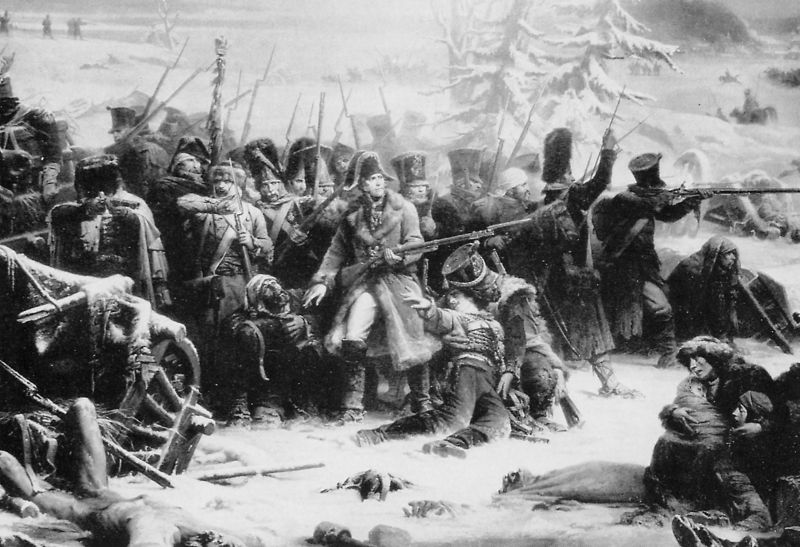
Michel Ney was named Prince de la Moskowa after the Battle of Borodino 1812. Things kind of went downhill from there.

“[W]e are told of the greatness of soul of the marshals, especially of Ney — a greatness of soul consisting in this: that he … escaped to Orsha abandoning standards, artillery, and nine-tenths of his men.” -Leo Tolstoy, War and Peace

Ney was able to keep things cool with Louis XVIII, but when Napoleon returned from Elba and Ney marched out to capture him, both Marshal and army deserted to the old emperor.

Ney often takes a rap for fouling up the reunion tour with a characteristically reckless cavalry charge during the Battle of Waterloo.

But his real problem was that he couldn’t make up his mind or stir his spirit or just plain read the writing on the wall well enough to get out while the getting was good. Though the Bourbons gave him every opportunity to blow town and spare the new-look ancien regime the embarrassment of having to try him, Ney didn’t do it — causing the king to fume,

By letting himself be caught, he has done us more harm than he did [defecting to Napoleon] on the 13th of March!

A vengeful Chamber of Peers, full of radical more-royalist-than-the-king types, gave him no quarter.

The near-unanimous conviction and death sentence were agreed by the Peers around midnight as December 6 became December 7, and the Bravest of the Brave led out near the Luxembourg Garden that very morning to suffer the sentence passed upon him.

The Bravest of the Brave, a 19th-century general history of the man, is available free on Google Books, as are two volumes of memoirs (1, 2) published posthumously by his family.

French speakers can find other free 19th century texts on Ney linked here.

* His reputation for unshakable courage notwithstanding, John Elting says Ney was also a deft hand at executing a cavalry retreat.

On this day..

1638: The melancholy Dorothy Talby

On this date in 1638, Dorothy Talby was hanged in Boston for breaking the neck of her baby daughter (aptly named “Difficulty”) “in order to save the child from future misery.”

Though not the first execution of a woman in the territory of the future United States, it is the first that is reasonably well-documented … and for a disturbed, possibly insane, woman striking out against her troubled family life, a case that resonated for later Americans like Nathaniel Hawthorne and Oliver Wendell Holmes.

For those of us, post-Andrea Yates, for whom “post-partum depression” has become a sadly familiar term of criminology, it is likely to resonate as well.

Mrs. Talby was esteemed for godliness, etc., but after the birth of the child she became melancholy and possessed of delusions. She sometimes tried to kill herself and her husband by refusing to eat “meat” and not permitting them to eat it, saying it had been so revealed to her. (Source)

Take a break from the Headsman’s noodlings and instead enjoy the thoughtful treatment given Talby’s case by crime blogger extraordinaire Laura James.

On this day..

1939: The 18 corpses of the rebellion

On this date in 1939, 18 junior officers of the Thai military were shot in Bangkok.

Ostensibly condemned for being part of a coup plot to depose the adolescent King Ananda Mahidol in favor of his abdicated predecessor Prajadhipok, they were in reality the casualties of a purge by the Field Marshal-turned-Prime Minister Phibun Songkhram.

It’s alternatively transliterated “Phibun Songkhram” or “Pibunsonggram”, and familiarly abbreviated to “Por”, but by any name he dominated Thai politics for a generation.

One of the military leaders of the bloodless 1932 Siamese Revolution that made the country a constitutional rather than an absolute monarchy, Phibun had in 1938 muscled his way to the Prime Ministership.

Beset by assassination attempts linked to royal revanchists to whose purposes the young turk’s programme was deeply inimical, Phibun determined to break the back of monarchism en route to a modernized, militaristic nationalism (pdf) that would be right at home in the imminent world war.*

As 1939 opens, we join the narrative of Paul Handley’s The King Never Smiles:

Phibun swept the capital and arrested 50 royals, nobles, and soldiers in the clique of his People’s Party rival Colonel Song Suradej for plotting his overthrow …

Whatever the truth behind the cabal, its quashing came to represent the final victory of the 1932 revolutionists and the constitutionalists over the monarchists. To mark it, Phibun commissioned a huge monument to the constitution, later called Democracy Monument, in the middle of the city’s main thoroughfare, Rajadamnoen (“royal progress”) Avenue.


The Democracy Monument in Bangkok.

The eighteen officers who took it in the shorts on this date were not joined by condemned VIPs like royal blood Prince Rangsit, who copped a commutation. It’s widely thought now that the “Songsuradet Rebellion” — or aptly-named “Rebellion of 18 Corpses” — was trumped-up, if not an phantasm altogether.

The Democracy Monument was not the only bulwark of Thai nationalism thrown up by Phibun in the year between the “conspirators'” January arrest and their deaths this day.**

He dropped the old absolutist name “Siam” in favor of the more nationalistic “Thailand” in June of that year; made the date of the 1932 revolution a national holiday; stripped the language of class-distinctive structures; and pressed irredentist claims against neighboring French colonies.

And if the royal house was efficiently marginalized by Phibun, it would yet develop in the latter part of the century into one of the region’s weightiest political entities† … intertwined with the Thai military Phibun helped hoist to pride of place, a formula that has left coups and unstable governments a presistent feature of the political landscape down to the present day.

* And subsequently, too. Despite aligning with the Axis powers during World War II, Phibun was a feted anti-Communist dictator as Washington started counting dominoes in Southeast Asia in the 1950’s.

** The Wikipedia page for the rebellion claims that the executions were carried out in batches of four per day. A New York Times report of December 6, 1939 said that all 18 had been executed the previous day.

† The current King Bhumibol Adulyadej, who coincidentally turns 81 today, is the world’s longest-reigning monarch as of this writing … with no shortage of concern about the conflict his passing may unstop.

On this day..

1937: Masao Sudo, since rehabilitated

On this date in 1937, Japanese emigre Masao Sudo was shot in Moscow as a spy.

The executed man’s son, Dr. Mikhail Masaovich Sudo.

A true-red Communist who had fled increasingly right-wing Japan in the 1920’s and become a labor organizer in the far east, Sudo shared the tragic fate of the Japanese community in Stalin’s USSR, decimated by denunciations of one another.

Sudo was the father of Russian geologist Mikhail Masaovich Sudo, author of several abstruse texts (and also, it would appear, Japanese language primers for Russian speakers) — and under whom, apparently, you can take classes at the International Independent University of Environmental and Political Sciences.

Masao Sudo was rehabilitated in 1956.

On this day..

1990: Pastor Hossein Soodmand, apostate

On this date in 1990, Hossein Soodmand, a Muslim who had converted to Christianity in the 1960’s, was hanged for apostasy under the sentence of a sharia court in Mashad, Iran — the last known apostasy execution in the Islamic Republic.

Soodmand’s post-conversion ministry in the Assembles of God church was not the sort of thing to endanger life and limb under the westward-looking Shah. But after the 1979 Iranian Revolution, there was a new sheriff in town.

Soodmand was not the last convicted or condemned for the crime — and converting to Christianity is still a crime — and his story has been back in the news of late because he may be in danger of losing his generation-long grip on the milestone.

In fact, he could lose the distinction to the next generation of his own flesh and blood.

The hanged pastor’s son, Ramtin Soodmand, was arrested in August, ostensibly for anti-government propaganda. But having followed his father’s evangelical footsteps, there was considerable fear — only slightly abated by his subsequent release on bail — that he could be put on trial for his life.

Amnesty International even put out an action alert for him during his detention, as a prisoner of conscience.

Around the same time, the Iranian legislature voted overwhelmingly for a measure to codify apostasy as a capital crime: confusingly, apostasy isn’t yet among the state’s statutes, but can be referred to sharia courts empowered to levy verdicts out of the Islamic religious tradition. (Besides Christians, Iran’s Baha’i are the other most likely defendants.)

The fact that these courts’ occasional death sentences since Soodmand have not been carried out is itself a telling indicator that the juridical disposition of apostasy cases in Iran is very sensitive to political pressure.

Small comfort to Ramtin’s sister Rashin Soodmand, who lives in London, and gave this moving interview to the Telegraph while her brother was still in a Mashad prison. In it, she describes her father spurning a bargain to abandon his illicit denomination in exchange for his life.

Of course, my father refused to give up his faith … He could not renounce his God. His belief in Christ was his life — it was his deepest conviction.

On this day..

1859: John Brown’s body starts a-moulderin’ in the grave

That line between “martyr” and “terrorist” is often a matter of historical perspective or even accident.

Were the person’s actions justified?

If not justified, were they at least historically significant?

If not historically significant, did they at least inspire some really great songs?

Or, movies?

John Brown, abolitionist, father of 20 children, advocate of armed insurrection as a direct means of ending slavery, is just such a figure. Before looking at how his actions influenced history, however, it is instructive to consider how history influenced him.

Born into a devout family opposed to slavery on religious and moral grounds, Brown grew up in a vehemently anti-slavery district of Ohio and, as a young man, began training in New England to become a Congregationalist minister.

When money ran out, he returned to Ohio and began a series of variously successful business ventures and married his first wife, with whom he would have seven children. When his businesses failed, he moved to Pennsylvania, buried his wife, married his second, and started a tannery, which began to founder as one of his sons died and Brown fell ill. He moved his family –- now with more than a dozen children –- back to Ohio, where he was hit hard by the economic crisis of 1839 (PDF link). In 1842, he was declared bankrupt; the following year, four more of his children died of dysentery.

In spite of these setbacks, Brown remained dogged in his pursuit of ventures to get himself out of debt, becoming a seasoned expert among small sheep farmers and acting as a self-appointed crusader for their empowerment against the encroaching interests of manufacturers. While this backfired and Brown remained impoverished into the 1850s (thought not as much as when he was declared bankrupt), it solidified his interest in helping the underdog.

Bleeding Kansas

Moral and religious interest in the abolition of slavery had been part of Brown’s upbringing, but it wasn’t until 1855, when five of Brown’s adult sons began sending word of often violent pro-slavery machinations in the Kansas territory, that Brown first became committed to drastic action on behalf of the cause. His strategy wasn’t at first overtly violent, but was rather convinced that the anti-slavery cause could win by the ballot box; over the course of the next year, however, he became convinced that the only sure way of preserve Kansas as a free territory was by “fighting fire with fire” (historical opinion as to the precise extent of the pro-slavery violence in relation to Brown’s later actions is divided).

In 1856, with tensions reaching a boiling point, Brown, four of his sons, and a band of other abolitionists killed five pro-slavery settlers in Franklin County, Kansas in what became known as the Pottawatomie Massacre. No legal retribution was possible or likely; Brown and his party escaped handily (although one of his sons was killed the following August), and Brown spent the next three years using various aliases to travel among abolitionists raising funds to launch an all-out assault on slaveowners back East.

“The crimes of this guilty land will never be purged away but with blood.”

That he chose the federal arsenal in Harpers Ferry, Virginia (now West Virginia) for his historic attack was no accident; it “evinced federal power stained by slavery.”

Brown believed his actions would be the start of a lasting insurrection in which slaves would rise up against their owners in an insurrection that would quickly spread to neighboring counties and throughout the South. While violence was expected, it was to be minimized, and, after the initial raid, used only in self-defense.

Twenty-one men, in total, took part in the raid; Brown’s expected hundreds of recruits never materialized. The slave population never got a chance to rise up against their masters, as townspeople promptly began firing on the raiders; by the morning after the start of the raid, the invaders were surrounded by a company of US Marines.* Brown was captured, along with seven of his men; ten were killed, and four escaped.

Tried in Virginia for murder, treason and conspiracy, Brown was convicted on November 2, just weeks after his failed insurrection, and sentenced to be hanged within a month. His often-cited speech in Court in response to this sentence would become a rallying cry for the abolitionist movement:

This court acknowledges, as I suppose, the validity of the law of God. I see a book kissed here which I suppose to be the Bible, or at least the New Testament. That teaches me that all things whatsoever I would that men should do to me, I should do even so to them. It teaches me, further, to “remember them that are in bonds, as bound with them.” I endeavored to act up to that instruction… Now, if it is deemed necessary that I should forfeit my life for the furtherance of the ends of justice, and mingle my blood further with the blood of my children and with the blood of millions in this slave country whose rights are disregarded by wicked, cruel, and unjust enactments, I submit; so let it be done!

“Make the gallows glorious like the Cross.”

During his last month on Earth, Brown seemed well-aware that he was on his way to be a martyr. Refusing rescue by a supporter who had managed to infiltrate the prison, he wrote letters of valor and conviction which were increasingly picked up by the Northern abolitionst press, and attracted pleas of clemency from sources as removed as Victor Hugo.


Christ-like: The Last Moments of John Brown, by Thomas Hovdenden.

John Brown hanged at Charles Town, Virginia (present-day West Virginia — another thing Virginia lost during the Civil War). This 19th-century drawing is from the Virginia Military Institute archive of the event, which includes eyewitness accounts of soldiers who attended the hanging, including Thomas “Stonewall” Jackson.

Hanged in the mid-morning of December 2, 1859, Brown stated ominously: “I, John Brown, am now quite certain that the crimes of this guilty land will never be purged away but with blood. I had, as I now think, vainly flattered myself that without very much bloodshed it might be done.”

Brown’s dramatic enactment of an attempted armed insurrection –- even an abortive one –- stoked longstanding Southern fears of slave rebellions, leading the South to reorganize and equip its outdated militias, and the Union to increasingly valorize a man who held, with sheer and utter clarity, the very convictions in which they must needs believe to fight and win the coming War Between the States.

Called a “misguided fanatic” by the man who would lead that war, Brown’s actions nonetheless both hastened the inevitable schism already drawn so dramatically across a nation in which one out of every ten human beings was held in legal bondage, as well as gave moral and spiritual courage to those who would ultimately rise to eradicate it.

“His soul goes marching on…”

Or in the words of Frederick Douglass:

Did John Brown draw his sword against slavery and thereby lose his life in vain? And to this I answer ten thousand times, No! No man fails, or can fail, who so grandly gives himself and all he has to a righteous cause. No man, who in his hour of extremest need, when on his way to meet an ignominious death, could so forget himself as to stop and kiss a little child, one of the hated race for whom he was about to die, could by any possibility fail.

Did John Brown fail? Ask Henry A. Wise in whose house less than two years after, a school for the emancipated slaves was taught.

Did John Brown fail? Ask James M. Mason, the author of the inhuman fugitive slave bill, who was cooped up in Fort Warren, as a traitor less than two years from the time that he stood over the prostrate body of John Brown.

Did John Brown fail? Ask Clement C. Vallandingham, one other of the inquisitorial party; for he too went down in the tremendous whirlpool created by the powerful hand of this bold invader. If John Brown did not end the war that ended slavery, he did at least begin the war that ended slavery. If we look over the dates, places and men for which this honor is claimed, we shall find that not Carolina, but Virginia, not Fort Sumter, but Harpers Ferry, and the arsenal, not Col. Anderson, but John Brown, began the war that ended American slavery and made this a free Republic. Until this blow was struck, the prospect for freedom was dim, shadowy and uncertain. The irrepressible conflict was one of words, votes and compromises.

When John Brown stretched forth his arm the sky was cleared. The time for compromises was gone – the armed hosts of freedom stood face to face over the chasm of a broken Union – and the clash of arms was at hand. The South staked all upon getting possession of the Federal Government, and failing to do that, drew the sword of rebellion and thus made her own, and not Brown’s, the lost cause of the century.

For more John Brown:

* Under the command of future Confederate General Robert E. Lee.

On this day..