1909: Fred Seward

On this date in 1909, Fred Seward was hanged at the Boise penitentiary.

Seward developed an obsession with a “notorious woman” named Clara O’Neill, of Moscow. (Idaho, not Russia.)

When O’Neill spurned his suit, Seward shot her dead. Then he turned the same gun on himself: the shot gruesomely disfigured his face and cost him the sight in his left eye — but it did not kill him.

The state of Idaho was more than willing to pick up the slack.


From the Idaho Daily Statesman, May 8, 1909

His last words were simply, “Do a good job, boys.”

The boys — Seward’s executioners — did so, and cleanly snapped his neck in the fall.


“The Son of God, who came not to destroy, but to save men’s lives, has revealed to the world the right life for both men and nations. The great mission then of the individual, the church, the state and the nation is not to destroy men, but to bless, help and save them. In the light of the teachings of Christ, the state has no more right to kill than the individual.

“The official murder at the penitentiary the other day was most demoralizing in its influence upon the people who read the horrible details of the transaction. Let men who are a menace to the public be shut up where they can do no harm to their fellows, but let the state learn to help, reform and save them, but not destroy them. ‘Thou shalt not kill’ is as good scripture for a state or nation as for a church or an individual.”

-Rev. A.L. Chapman (Boise, Idaho)
May 16, 1909 “Peace Day” sermon

On this day..

1905: An unknown spy in the Russo-Japanese War

In the late 1890s and early 1900s, Russia’s imperial ambitions in the east drew it inexorably towards conflict with Japan. This was the period when Russia began constructing the continent-spanning Trans-Siberian Railway linking Moscow to the Pacific port of Vladivostok.

Russian troops came right along with the rails.

On the pretext of protecting its construction gangs, Russian troops occupied Manchuria — and the weakened Chinese Qing dynasy couldn’t do much about it.

But the Japanese could.

Manchuria and Korea (which Russia’s presence also threatened) Tokyo conceived as her sphere of influence. The rising hegemon in East Asia would serve notice in the 1904-1905 Russo-Japanese War that it had now to be reckoned among the world’s great powers.

The decisive land battle in this conflict was the Battle of Mukden, February 20 through March 10, 1905 — a gigantic engagement involving more than 600,000 troops.

In it, Japan cleaned the Russian clock.

The defeat sent a shattered Russian army on a disordered retreat north, to the city of Tieling. The Japanese followed in hot pursuit, so defensive regrouping became impossible and within a couple of days the Russians abandoned Tieling, too.

We are everywhere driving the Russians before us to Kaiyuan,” gloated an official Japanese telegram of Thursday, March 16.

The underwhelming Russian general Aleksey Kuropatkin was there just long enough to get word that Moscow had relieved him of command. By Saturday, March 18, Kaiyuan too was in Japanese hands.*

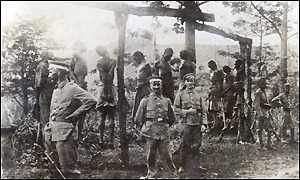
So it was likely on or about this date in 1905 that a handful of those Japanese forces harrying the Russian flight paused on the outskirts of Kaiyuan to behead an alleged spy.

If this individual’s name is known, I have not been able to locate it — but small wonder. In the charnel house of Russia’s catastrophic defeat, the dead were too numerous to bury.

After Mukden, there would not be many more. It was the last major land battle, and after Japan followed it up with a crushing naval victory that May, hostilities came to a close.


“On the Hills of Manchuria”, a mournful 1906 waltz by Ilya Shatrov.

* The pursuit didn’t last much longer; Japanese forces were themselves too battered and exhausted from the Battle of Mukden.

On this day..

1908: Massillon Coicou and the Firminists

On this date in 1908, the octogenarian Haitian president Pierre Nord Alexis had a number of political opponents arrested and, that very night, summarily executed.

Nord Alexis, a career officer risen to the post of Minister of War in a provisional 1902 government* when the previous president Tiresias Simon Sam* resigned to avert a constitutional crisis.

That was a strange affair: a misreading of the constitution had Sam set to rule until 1903, until someone caught the mistake. Sam’s diligently on-time resignation proved not the Rule of Law victory he might have hoped when the resulting power vacuum brought civil war.

The contest for power boiled down to Nord Alexis on one side, and the scholar and diplomat Joseph Auguste Antenor Firmin on the other.**

As one can see, Nord Alexis won it — but the conflict flared again in 1908, with the exiled Fermin making an attempt to return to Haiti. Nord Alexis’s response was ruthless and, for now, effective. (Nord Alexis was ousted later in 1908, however.)

Massillon Coicou

Prominent among the victims of the crackdown this date was the novelist and poet Massillon Coicou (English Wikipedia entry | the more detailed French).

Coicou had been in the diplomatic service in France with Firmin, where the two forged a close affinity, and Coicou became a toast of literary circles.

Coicou and his two brothers Horace and Pierre-Louis, staunch Firminists all, were shot together with a several others at the walls of the Port-au-Prince cemetery on the night of March 14-15. (The exact number of others seems a little hard to come by; there are different counts from around 10-15 ranging up to 27+ total people executed in this incident, although the larger count may encompass executions other than those at the cemetery.)

For Francophones, several of Coicou’s poems can be perused via links at the bottom of this biographical page.

* Sam’s cousin Jean Vilbrun Guillaume Sam held that same office for a brief and bloody interval in 1915.

** Firmin is noted for his 1885 book De l’égalité des races humaines, which mounted a strong defense for the fundamental equality of the races, and also predicted a black U.S. president.

On this day..

1902: A day in the death penalty around the Pacific Northwest

The U.S. states of Washington and Oregon both hanged murderers on this date in 1902.

Oregon

The death knell for local public(ish) hangings in Oregon took place this morning in the courthouse of Portland’s courthouse under the eyes of 400 invited witnesses and numerous additional gawkers who scaled telegraph poles or stationed themselves on nearby rooftops.

Jack Wade and William Dalton hanged together for murdering one James Morrow just three months for two bits. It was an uncomplicated crime: the villains stuck Morrow up as the latter returned one night from paying court to a young lady, then shot him when Morrow made a sudden move.

On hanging day, the pair addressed an ample breakfast of ham, chicken and eggs, knocked out some hymns and an impromptu rendition of “Where Is My Wandering Boy Tonight?”

… and then took a cavalier stroll to the gallows where Wade displeased right-thinking folk with his devil-may-care attitude towards his own execution. He tossed a cigar to the crowd, and played his fingers over the hemp as the rope was fastened, remarking with a wink, “it is tough.”

While the hanging itself went off without a hitch, the curious onlookers pushed through the rail meant to restrain them once the bodies were cut down and began scrabbling for bits of hemp. The sheriff finally had to clear the courtyard.

Even worse, “ten or 12 women witnessed the execution” from atop a building at Fifth and Main street, according to the Oregonian‘s report the next day. “It is doubtful if such a thing ever occurred before at a legal hanging in this country.”

The legislature some years previous had tried to get a handle on execution decorum by moving hangings off public squares and into jails, so this public(ish) execution wasn’t technically public at all. But as seen, these facilities with their barrier-toppling invited mobs and conspicuously feminized illicit peepers surrounding still affronted the alleged solemnity of the moment and led the legislature at its next sitting in 1903 to enact a statute requiring that “all executions should take place within the walls of the [state] penitentiary, out of the hearing and out of sight of all except officials.”

Wade and Dalton weren’t actually the last to hang publicly(ish) in Oregon, however. Since the law wasn’t retroactive, several additional executions occurred after the penitentiary-hanging law was enacted — the last as late as 1905. (See Necktie Parties: A History of Legal Executions in Oregon, 1851-1905).

Washington

Chinese immigrant Lum You was hanged at South Bend, Washington on January 31, 1902. He shot a man named Oscar Bloom during a drinking bout that turned into a drunken bout.

Lum You actually escaped his condemned cell on January 14 when his dinner was being fetched by the jailer and stayed on the lam for a couple of days, but was recaptured on January 17 by a posse. He allegedly begged them to shoot him dead right there, then changed his mind when some business-minded character actually produced a weapon. (Credit to the great Northwest for its highly accommodating vigilantes.)

On this day..

1909: The Pollet gang, breaking the French moratorium

Warning: Graphic severed head pictures await at the bottom of this post.

On this date in 1909, the guillotine returned France after an absence of more than three years.

The sitting president was a staunch death penalty opponent and had blocked all executions since his term began in 1906. That was about the same span of time that the Pollet gang had, in the words of a New York Times wire report,* “infested the Belgian-French frontier, robbing churches, houses, and inns, holding up stage coaches and belated travelers, and torturing and slaying their victims according to the old piratical adage that dead men tell no tales.”

Abel Pollet had been a smuggler who put his native gift for leadership to good use organizing his fellow traffickers into a more lucratively violent line of work. Thanks, presumably, to the syndicate’s pre-existing professional aptitude for evasion, it persisted for years and authored a quantity of robberies and murders that authorities could only guess at. (The official homicide estimation ran north of 50.) It was a spree so atrocious that it helped force the end of the whole death penalty moratorium since sentiment was so strong against the Hazebrouck gang .

Incited by the many depredations and perhaps starved from years without the bloody spectacle of public execution, a vast concourse of 30,000 mobbed the guillotine at Bethune.

“At midnight there were 2,000 watchers in the square,” one report ran. “The main street of the town was crowded as on the eve of a fete. Soon after midnight men brought ladders and benches to the square and mounted them to obtain an uninterrupted view. Others climbed into the branches of trees, where their presence was revealed by the glow of cigarettes and pipes in the dark among the branches.”

Undeterred by the steady winter’s drizzle, they would wait all the night through, their numbers continually augmented as road-trippers arrived by train.

At four in the morning the dread traveling executioner Anton Diebler, who had already plied this trade for a generation and more and would continue in the role for another 30 years, arrived with four assistants to set up the guillotine. It was only with difficulty that police restrained the pawing mob.

By half-past five the public prosecutor officially informed the condemned men what they surely already knew — that there would be no mercy. The crowd on the square would have its prey.

As the first robber, Theophile Deroo, emerged at 7:25 a.m., “there was a painful silence, and then an outbreak of hoots and curses from the crowd.” A wilting Deroo had to be hustled to the board amid the jeers. “A mort! A mort!” came the howls.

Three times in the next eight minutes the executioners furiously scrubbed the apparatus clean while guards (per the Times) “held the crowd back with main force.”

Canut Vromant followed coolly; Auguste Pollet was third, fighting and shouting. His brother, the leader Abel Pollet, went under a rain of curses that he answered with the words “Down with the priests! Long live the Republic!”

People are ghoulish. Far be it from us to deny them.


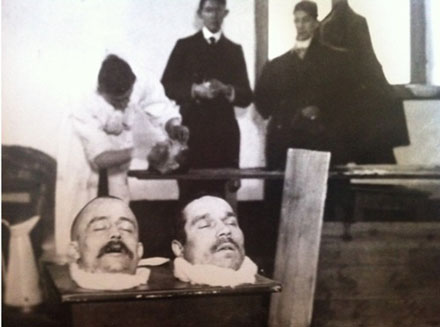
Top: the heads of the Pollet brothers. Middle: The heads of their two accomplices. Bottom: Canut Vromant’s headless trunk awaits autopsy. All images from the invaluable Bois de Justice, via this goregrish forum.


After the quadruple executions, the heads are cleaned up. (Source)

Perhaps, dear reader, you find the public exhibition of these severed heads objectionable. If so, you have an ally in the French state that did the severing.

For years, French elites had been fretting the indecorous behavior of the crowd at what was supposed to be a solemn occasion. The advent of photography only made matters worse, for now the discomfiting head-chopping exercise could be shared with those indisposed to sitting up all night smoking pipes in trees.

But as the moratorium gave way, the rising media form of cinema promised even more debased exhibitions. Enterprising cinematographers were already staging execution re-creations; now there was the prospect for film audiences to be incited to countless bloodlust frenzies by on-the-scene deathporn footage of hated criminals going under the blade. It was in response to just this fear that France a bit later in 1909 promulgated (French link) its first film censorship rules — forbidding in this case the public display of film liable to disturb the public tranquility.

* Jan. 16, 1909 … under the excited headline “THIRST FOR BLOOD AMONG THE FRENCH”,

On this day..

1903: Peter Mortensen, divinely accused

On this date in 1903, Peter Mortensen was shot over a lumber bill.

The evidence against Peter Mortensen was circumstantial: a moonlight witness, some unexplained cash, and a perceived insufficiency of vigor in insisting upon his innocence when suspicion fell upon him.

Though this much sounds pretty speculative, Mortensen’s very direct pecuniary interest in Hay’s death was harder to wave away. Mortensen, a Salt Lake contractor, owed money to George Ernest Romney’s* Pacific Lumber company. On the evening of December 16, 1901, he summoned Romney’s employee James R. Hay — who was also Mortensen’s friend, neighbor, and fellow-teacher at a Mormon Sunday school — to pay up.

Hay never made it home.

The next day, Mortensen had a receipt for the payment in Hay’s hand, and Hay had a cashless grave and a bullet hole in his head. Rarely have means, motive, and opportunity converged so exactly.

Public sentiment against Mortensen was so overwhelming** that selecting an impartial-ish jury proceeded at a weeks-long crawl as Mortensen’s attorney met prospect after prospect by bluntly asking whether they had formed an opinion as to his man’s guilt. Prospect after prospect confirmed that they had done. By the end, the court had been reduced to issuing “open venires” bypassing the regular jury summons process and authorizing anyone handy to be inducted into the jury pool. Deputies scoured Salt Lake City like press gangs, hunting for possible jurymen.

In all, the court dismissed some 600 prospective jurors for bias (which was quite a lot for the time), and ran through $4,500 in that process alone (likewise).

Those finally seated had to weigh, along with the more conventional indicia of guilt, the inflammatory witness testimony of James Hay’s father … who said he didn’t just have a pretty strong suspicion about the defendant, but that he actually knew Mortensen did it. “God revealed it to me,” the elder Hay said with “tears streaming down his cheeks” according to a report in the Idaho Daily Statesman of June 6, 1902.

He appeared to me by the Holy Ghost and put the words of His Spirit into my mouth. I had to utter them, for I knew they were true. I cannot and will not deny it here, neither will I deny it when I meet my God on the last day.

This is not the only manifestation I received. On Tuesday noon I saw the trail of blood leading from the railroad tracks to where my son-in-law was buried. I saw it in a vision just as plainly as when I afterwards visited the spot.

Again, this is judicial testimony in an American courtroom in the 20th century.

The fact that it appeared — and that the trial court refused a defense demand to instruct the jury not to consider supernatural visions in the light of real evidence — formed the central argument of Mortensen’s appeal. In the end, Utah’s Supreme Court refused to vacate the sentence. Still, the weird appearance of “divine revelation evidence” in a Utah courtroom led the Mormon patriarch Joseph F. Smith to issue a finding distancing the Church of Jesus Christ of Latter-Day Saints from any embarrassing mummery:

[N]o member of the Church of Jesus Christ of Latter-day Saints should, for one moment, regard such testimony as admissible in a court of law, and to make the case perfectly clear it may be further stated that such evidence would not be permissible even in a Church court, where rules of evidence, though not so technical, are founded largely upon the same principles that govern the rules of evidence in a court of law. Any attempt, therefore, to make it appear that such evidence is in keeping with the tenets of the “Mormon” faith is wholly unjustified

About six weeks before Mortensen’s execution, a prison break took place at the penitentiary. It’s been given out latterly that the arrogant Mortensen was so unpopular even with his fellow-prisoners that they intentionally left him stuck in his cell. 1903 press accounts appear to indicate otherwise — that he was not the only convict left stuck in his cell, and that Mortensen’s particular rum luck wasn’t a social lack but a digital one: somebody dropped the necessary set of keys. Either way, there was no way out, and neither when Utah’s governor interviewed Mortensen personally to see about his mercy application. Never mind his popularity with prisoners; Mortensen’s continued insistence on innocence while pleading for his life was the real diplomatic failure.

Mortensen selected shooting rather than hanging as his method of death, and went to it “firm as a rock.” He left only a last statement repeating his vociferous and widely disbelieved denial of Hay’s murder.

To the world I want to say and swear by the heavens above, by the earth beneath, and by all I hold near and dear to me on this earth, that I am not guilty of that cowardly murder of my dearest friend. I ask therefore no man’s pardon for aught that I may have done in life. I am confident that my life is an example to most people. I lay no claim — please strike out the last two words — I do not say that I am better or more worthy of respect of the world than the average man, but I have done my duty to my father and mother, my brothers and sister, and to other near relatives. I have done my absolute duty toward my wife and my five little babies. May God keep and care for those sweet darlings.


Salt Lake Telegram, Nov. 20, 1903.

* Yes, those Romneys. George Ernest Romney‘s significantly younger first cousin George Wilcken Romney became Governor of Michigan, and was in turn the father of the 2012 Republican Presidential nominee Mitt Romney. The mutual grandfather of George E. and George W. designed the St. George Tabernacle.

** Even Mortensen’s wife thought him guilty, for he had gone out that fatal evening of the 16th with Hay, and returned an hour later “deathly pale.” However, while God’s hearsay to Mr. Hay was available in open court, Mrs. Mortensen’s evidence was not: Utah law prohibited wives testifying against their husbands.

On this day..

1904: Herero prisoners, at the command of Lothar von Trotha

My initial plan for the operation, which I always adhered to, was to encircle the masses of Hereros at Waterberg, and to annihilate these masses with a simultaneous blow, then to establish various stations to hunt down and disarm the splinter groups who escaped, later to lay hands on the captains by putting prize money on their heads and finally to sentence them to death.

-German General Lothar von Trotha (pdf source)

On this date in 1904, von Trotha did a little of that executing bit, further to doing a whole lot of genocide. It was the very day after von Trotha’s Vernichtungsbefehl, or extermination order, against the Herero people.

We give the narrative here to Jan-Bart Gewald’s “Colonization, Genocide and Resurgence: The Herero of Namibia 1890-1933”, from a collection of papers at a German symposium. Gewald’s complete text is available in scanned pdf form here.

Gewald:


Pocketed by the desert and the German patrols the Herero chiefs and their followers congregated along the Eiseb river. Around the first of October 1904, General Lothar von Trotha, who was actively taking part in the pursuit, and his retinue had reached the waterhole Osombo-Windimbe. During the afternoon of the following day, Sunday 2 October 1904, after the holding of a field service, General von Trotha, addressed his officers. In his address Trotha declared that the war against the Herero would be continued in all earnestness, and read out the following proclamation:

I the great General of the German troops send this letter to the Herero people.

The Herero are no longer German subjects. They have murdered and stolen, they have cut off the ears, noses and other bodyparts of wounded soldiers, now out of cowardice they no longer wish to fight. I say to the people anyone who delivers a captain will receive 1000 Mark, whoever delivers Samuel will receive 5000 Mark. The Herero people must however leave the land. If the populace does not do this I will force them with the Groot Rohr [cannon]. Within the German borders everyHerero, with or without a gun, with or without cattle, will be shot. I will no longer accept women and children, I will drive them back to their people or I will let them be shot at.* These are my words to the Herero people.

The great General of the mighty German Kaiser.

At dawn the following morning, Herero prisoners, who had been sentenced to death by a field court-martial, were hung in the presence of about 30 Herero prisoners, women and children amongst them. After the hanging, Trotha’s proclamation was read out to the prisoners in Otjiherero. Printed copies of the text in Otjiherero were distributed amongst the Herero prisoners. The prisoners were then turned loose and driven out into the Omaheke. [i.e., the western Kalahari desert -ed.]


In a letter the next day, Oct. 4, to the general staff, von Trotha reported on his order the day’s executions, in the context of a detailed tactical and philosophical justification of destroying the entire Herero nation. It’s quoted at length in Absolute Destruction: Military Culture and the Practices of War in Imperial Germany:

For me, it is merely a question of how to end the war with the Herero. My opinion is completely opposite to that of the governor and some “old Africans.” They have wanted to negotiate for a long time and describe the Herero nation as a necessary labor force for the future use of the colony. I am of an entirely different opinion. I believe that the nation mustbe destroyed as such, or since this was not possible using tactical blows, it must be expelled from the land operatively …

Because I neither can treat with these people, nor do I want to, without the express direction of His Majesty, a certain rigorous treatment of all parts of the nation is absolutely necessary, a treatment that I have for the present taken and executed on my own responsibility, and from which, as long as I have command, I shall not detour without a direct order. My detailed knowledge of many Central African tribes, Bantu and others, has taught me the convincing certainty that Negroes never submit to a contract but only to raw force. Yesterday before my departure, I had the warriors who were captured in the last several days [and who were] condemned by court-martial, hanged, and I have chased all the women and children who had gathered here back into the desert, taking with them the proclamation to the Herero people. This proclamation (enclosed), which will unavoidably bcome known, will be attacked … accepting women and children, who are mostly ill, is an eminent danger to the troops, and taking care of them is impossible. Therefore, I think it better that the nation perish rather than infect our troops and affect our water and food. In addition, the Herero would interpret any kindness on my side as weakness.They must now die in the desert or try to cross the Bechuanaland border. This uprising is and remains he beginning of a race war, which I already predicted in 1897 in my reports to the chancellor on East Africa … Whether this uprising was caused by poor treatment [of the Africans] remains irrelevant to its suppression.


It should be added that this explicitly genocidal policy was neither unique to German colonies, nor, as von Trotha himself notes, uncontested within Germany itself.

German Christian missionaries logged a piteous catalog of horrors, “skeletons with hollow eyes, powerless and hopeless,” and their reports of same to their home offices led to church pressure to brake the atrocities.

Gewald also quotes one of von Trotha’s subalterns, undisguisedly revolted at what he was involved in.

Cattle which had died of thirst lay scattered around the wells. These cattle had reached the wells but there had not been enough time to water them. The Herero led ahead of us into the Sandveld. Again and again this terrible scene kept repeating itself … the water became ever sparser, and wells evermore rare. They fled from one well to the next and lost virtually all their cattle and a large number of their people. The people shrunk into small remnants who continually fell into our hands, sections of the people escaped now and later throug the Sandveld into English territory. It was a policy which was equally gruesome as senseless, to hammer the people so much, we could have still saved many of them and their rich herds, if we had pardoned and taken them up again, they had been punished enough. I suggested this to General von Trotha but he wanted their total extermination.

Technically, complete destruction of the Herero was reversed as German policy a few months after von Trotha began implementing it, and the general himself recalled from South West Africa before the end of 1905 — leaving only a “softer” genocide of disease-ridden concentration camps through 1908. Although firm numbers are hard to come by, it’s thought that well over half the Herero population died during this period.

Yet neither was von Trotha a lone butcher. Diary entries of settlers and regular soldiers well before the extermination order record many instances (pdf) of the most cavalier slaying of Herero prisoners and noncombatants, abuses which continued long after von Trotha’s departure.

It’s difficult not to see in the racial ideology and the eliminationist military doctrine prefiguring (pdf) later and better-publicized brutalities. Indeed, even some of the personnel are the same:

  • Hermann Goering‘s father Heinrich was Germany’s first Reichskommissar in South West Africa, plopping his home down right on a Herero burial site.
  • Eugen Fischer, a eugenicist who availed the Namibian concentration camps’ ready supply of subjects to produce career-making research that would influence German race law and make Fischer a big brain in Nazi intellectual circles
  • Franz Ritter von Epp, one of von Trotha’s officers, formed in the aftermath of World War I one of the far-right Freikorps paramilitaries, with many subsequently-influential Nazis among its membership, including Ernst Roehm (who may have cribbed the SA “brown shirt” look from colonial Schutztruppe khakis) and Adolf Hitler himself

* He meant, shooting over their heads to run them off. “I assume absolutely that this proclamation will result in taking no more male prisoners, but will not degenerate into atrocities against women and children,” Lothar explained. “The latter will run away if one shoots at them a couple of times. The troops will remain conscious of the good reputation of the German soldier.”

On this day..

1901: James Edward Brady lynched for criminal assault

(Thanks to Meaghan Good of the Charley Project for the guest post. -ed.)

On this day in 1901, James Edward Brady was hauled out of his jail cell and hanged from a telephone pole on the corner of Main and Lawrence Streets at Haymarket Square in Helena, Montana. He had been arrested three days before in relation to his attack on Hazel Pugsley, a five-year-old girl.

On September 30, Brady, who had arrived in Helena from the city of Boulder, Montana only the day before, waylaid little Hazel while she was on her way to kindergarten. He convinced her to get on a streetcar with him and they didn’t get off until they were three miles outside town.

Hazel’s mother reported her missing after she didn’t arrive home from school, and a search was launched. Later that day, the police found her walking home alone. She was “a nervous wreck, and when the accused man was taken in front of her she began crying hysterically, at the mere sight of him.”

Brady was charged with “criminal assault,” a euphemism for rape.

He had once been a highly respected and influential man in the Yellowstone River area and was credited with bringing the first thoroughbred cattle into Montana, but he developed a drinking problem and somewhere along the line he fell from grace.

Brady had been in and out of trouble in Jefferson County before he moved to Helena, and in Boulder he had become overly familiar with several children. After the Hazel Pugsley incident, it came out that he’d lured at least four little girls to his cabin in Boulder and then molested them.

He was not criminally charged in that instance, but was warned to leave town or else. So he came to Helena.

Although Montana had a long tradition of lynchings and emotions were running high in the aftermath of Hazel’s attack, the sheriff wasn’t worried: Brady was housed in a secure stone jail with five locked doors between him and the outside. On the night of the lynching, the sheriff was asleep with his family as usual.

At 1:30 a.m. on October 2, a mob of thirty masked men pounded on the doors of the jail and demanded the prisoner. When they couldn’t get the jailer to answer the door, they stationed men around the building to keep watch while they started working on the door with a sledgehammer and a crowbar.

The mob easily broke open the outer wooden door, but the next door was barred. Jailer George Mahrt was awakened by the noise and mistakenly opened the barred inner door just as the lynch mob had broken through the outer door. Once inside the building, the men forced Mahrt to hand over his keys, unlocked the last three doors, and barged in on James Brady.

“What is it, gentlemen?” he asked.*

In spite of the early hour, a crowd of about 200 spectators gathered to watch as the vigilantes hustled the helpless Brady out of jail and force-marched him, already noosed, six blocks to Haymarket Square.

The spectators knew what it was.

The lynchers summoned a saloon-keeper who had witnessed Hazel’s abduction, to confirm for the assembling multitude that it was indeed Brady who took her. One of the masked lynchers then forced his way through the crowed and slugged Brady twice in the face; this may have been Peter Pugsley, Hazel’s father. (The same man would later go after Brady again, but the mob held him back.)

“Now, then,” the mob’s leader addressed his prey. “Brady, your time on earth is short. Have you any confession to make?”

Brady had little to say: only to reiterate his innocence, and ask that his last paycheck be sent to the Boulder School for the Blind where his niece was a student.

When asked if he wanted to say a prayer, Brady said he didn’t know how to pray and asked that someone pray for him instead. One of the mob said, “May the Lord help you, Brady; that is all I can say for you.”

Then his time was up.

Several people already positioned on top of the nearby telephone pole jerked Brady up from the ground violently, probably breaking his neck, and as Brady hung twitching and dying, the members of the lynch mob pulled off their masks and melted into the watching crowd.

In addition to the 200-some people who witnessed the lynching, another thousand or so viewed the body by moonlight before it was cut down.


Jackson (Mich.) Citizen Patriot, Oct. 2, 1901.

A coroner’s inquest was held later that day. Several people testified that they’d witnessed Brady’s death, but they all swore they were not part of the lynch mob and developed amnesia when asked if they recognized anyone who was.

The coroner’s jury ruled Brady’s death a homicide.

On October 3, Peter Pugsley — the father — was arrested and charged with murder. Investigators hoped he would provide them with other names, but Pugsley said he hadn’t been present at the lynching and produced an alibi, which friends backed up. He was released the next day on bail, his bond secured by several prominent members of the community.

Ultimately, a grand jury heard testimony from thirty-eight witnesses during an eighteen-day investigation. It then declined to indict Pugsley or any other suspect. Later, some of the jurors said it was impossible to name anybody connected with the crime because so many witnesses refused to answer questions, citing their Fifth Amendment right against self-incrimination.

However, someone did pay for what happened to Brady.

As amateur historian Tom Donovan writes of this case in volume two of book Hanging Around the Big Sky: The Unofficial Guide to Lynching, Strangling and Legal Hangings of Montana, “The Brady incident was the only case where an official was severely disciplined for losing a prisoner to a lynch mob. The Lewis and Clark County grand jury found that Jailer George Mahrt was incompetent and he was apparently fired.”

Not only had Mahrt, an experienced jailer, opened the inside door to the armed mob, he had also failed to notify the sheriff what happened until Brady had already been marched out of the jail. All he would have had to do to arouse the sheriff was press an electric panic button, which would have sounded an alarm at the sheriff’s residence.

In the aftermath of Brady’s death, officials in Butte, Montana announced he was also a suspect in the 1898 abduction and murder of nine-year-old Ethel Gill. She was missing for several days before her body was found in an outhouse.

Gill had been raped, beaten and strangled. Brady lived and worked in the same neighborhood where Ethel’s body was found. He quit his job and left Butte immediately after the murder, but wasn’t considered a suspect until after he was killed. Ethel Gill’s murder was never solved and Brady’s connection to the crime remains a matter of speculation.

* San Jose Evening News, Oct. 2, 1901.

On this day..

1909: Les Chauffeurs de la Drome

At daybreak this date in 1909, three French rural bandits dubbed “Les Chauffeurs de la Drôme” were publicly guillotined in Valence to the hurrahs of a great crowd.

Most of the (plentiful) information online about these charmers is in French; in their day about 1905 to 1908 they enjoyed quite a lot of notoriety in southern France for their bloody crime spree, comprising at least 11 murders amid numerous home invasion burglaries. They were a throwback gang whose niche the 20th century would eradicate as surely as they themselves. In the time before ubiquitous mass communication and high-speed transport, a sufficiently bold band of robbers could have their way with a rural residence miles from any possible aid: this was one of the great terrors of Europe, and early crime broadsheets from centuries previous dwell often on the terrors of an isolated farmer or miller made prey in his own home by a band of cutthroats.*

The root of the word chauffeur is the French verb “to heat” — think stoking an engine, for the word’s familiar meaning of professional driver — and the specialty of the Chauffeurs de la Drome was torturing their hostages by scorching their feet with hot irons until the sufferers yielded up the hidey-holes of whatever treasure they had on premises. Their trial was a fin-de-siecle circus, and their executions likewise to a discomfiting degree. Though nothing specifically scandalous occurred as the chauffeurs were snuffed out on a public street, there are a number of pictures of this event, some of them made into postcards and circulated.

This was a trend not very much appreciated by the French government, but of course such images make arresting historical artifacts.

We’re here featuring select images of Octave David. When David walked the few steps through a sea of early-rising spectators to the portable guillotine erected on the streetcar tracks directly in front of the prison gates, his companion Pierre Berruyer had already been beheaded. (The chauffeurs were nos. 126 through 128 in the prolific Anatole Deibler’s career.)

He would have glimpsed Berruyer’s headless trunk already rolled into the large box that would soon receive his body as well. (The box had accommodations for four.) And while the execution team washed down the blade between uses, the grotesque bloody puddles and remains of fresh gore were a constant source of complaint. All three executions were completed in a six-minute span; it’s safe to assume that the smell and the feel of Pierre Berruyer’s violent death surrounded David as he walked to the used chopper. As the events here transpired, the third robber Urbain Liottard still awaited his own turn just inside the prison walls — in a few moments, Liottard would see two steaming neckless corpses stacked up in the rude bin gaping to receive him.


Looking alarmingly Christlike, the half-naked form of the condemned murderer emerges from the prison’s maw amid a throng of indistinct, black-clad voyeurs.


David reaches the guillotine; the assistant executioners are about to tip him onto the board that will carry him into place. The identification on these photos is from Bois de Justice, an invaluable site on the history of the guillotine; I’m unsure from my own observation whether to equate the figure in these pictures with the one in the first, above.


One of the beheadings (I’m not certain that it’s David’s) has been completed; the body and head are being transferred to their receptacles. Again, Bois de Justice has details on this scene.


Following one of the beheadings, the visibly stained blade is raised for cleaning before the third criminal is brought out.

* For some examples, see Joel Harrington’s The Faithful Executioner, a book we’ve previously profiled.

On this day..

1909: Dervish Vahdeti, for the 31 March Incident

EXECUTIONS IN CONSTANTINOPLE

(From our own correspondent.)

CONSTANTINOPLE July 19.

Cherkess Mehmet Pasha, popularly known as Kaba Sakal — i.e., “twisted beard,” the torturer and former aide-de-camp of [Sultan] Abdul Hamid, Yusuf Pasha, Commandant of Erzerum, the Dervish Vahdeti, chief of the Jemiyeti Mohammadeieh, Hakki Bey, the notorious spy, and eight officers and soldiers who took part in the recent mutiny, were publicly executed at dawn.

London Times, July 20, 1909

The Ottoman Empire in 1908 experienced the Young Turk Revolution, curbing the power of the sultan in a brief constitutional-monarchy era that would take the foundering state through the First World War.

Unsurprisingly, the reigning, formerly-supreme monarch was nonplussed at this brake on executive authority.

He backed the 31 Mart Vakasi, or 31 March Incident,* a counter-coup by conservative and Islamist elements in Istanbul to overthrow the Young Turks and re-establish the sultan’s power. Already the Porte was resorting to an assertion of Islamic political identity to hold the “sick man of Europe” together — and already that had resulted in some appalling atrocities.

For a few days the rightists, incited by Dervish Vahdeti, had Istanbul in hand. Vahdeti was a 40-year-old Cypriot who published Volkan, an Islamist newspaper in Istanbul; the 31 March Incident is sometimes also known as the Revolt of Dervish Vahdeti. (Biographical details source)

Once again, Armenian blood flowed. News of the revolt triggered an attack by Turks in the Anatolian city of Adana upon that city’s Armenian Christians. The resulting Adana Massacre claimed 15,000 to 30,000 lives throughout the Adana province.

Indeed, the Adana massacre quite outlasted the counter-coup, resulting in going debate over the extent to which the Young Turks themselves blessed the pogroms. These guys had their own fraught relations with Turkey’s Armenians; of course, they’d eventually have the Armenian genocide to answer for.

As for the event at hand, Second Army Corps and Third Army Corps dispatched Dervish Vahdeti’s revolt with ease. These units still loyal to the Young Turks reached Istanbul from Salonika within days of the uprising. (Among their number was the 27-year-old Mustafa Kemal — later known as Ataturk, the founding statesman of modern, post-Ottoman Turkey.)

The mutiny collapsed with little effective resistance upon this Macedonian intervention, and the military had the run of the place — not for sack but for a severe clamp-down on the Islamic party. According to Nader Sohrabi, “some two hundred movement participants were hanged en masse, on row after row of scaffolds erected in public space by the order of military courts” in the crackdown.

The 74 constitutionalist soldiers who died to put down the 31 March Incident are honored at a Monument of Liberty in Istanbul.

* The Ottomans were on the Julian calendar-based Rumi calendar, so March 31 in Istanbul corresponded to April 13 in western Europe. Similarly, this date’s hangings took place on July 6, not July 19, per the local Turkish date.

On this day..