1935: George Criner, “anything can happen to anybody”

(Thanks to Robert Elder of Last Words of the Executed — the blog, and the book — for the guest post. Fans of this here site are highly likely to enjoy following Elder’s own pithy, almanac-style collection of last words on the scaffold. -ed.)

“A few minutes before this happened if anyone had told me that I would be here, I would have said they were crazy. But remember, anything can happen to anybody. You can walk out on the street and die of heart trouble. Or you can go out on the street and get run over. I think that will be all.”

-George Criner, convicted of murder, hanging, Montana. Executed October 16, 1935

Criner came home very drunk one night and tried to take his girlfriend’s diamond ring. She refused to let him, and he beat her with an iron poker and cut her with a pocketknife, then shot the police officer who tried to intervene. At the preliminary hearing, Criner said that he very much wished he hadn’t been there.

On this day..

1932: Lee Bong-chang, would-be Hirohito assassin

On this date in 1932, Korean nationalist Lee Bong-chang was hanged at Ichigaya Prison for attempting to assassinate Japanese Emperor Hirohito.


The would-be assassin under arrest.

Remembered now as a patriotic hero, Lee on January 9, 1932 chucked a grenade at an imperial procession in Japan as it passed the imperial palace’s Sakuradamon Gate — the aptly-named Sakuradamon Incident. Korea at that point had been directly ruled by Japan since 1910.*

Lee’s hand grenade targeted the wrong carriage, and didn’t even kill the occupants of that conveyance — it just injured a guard. A second grenade failed to explode altogether.

Three months after Lee’s attempt, another Korean, Yoon Bong-gil, also tried to murder Hirohito with a bomb. Both men are interred with garlands at Seoul’s Hyochang Park. A statue of our man Lee, poised with a grenade in hand, stands in the park.

* Newspapers in China — also under Japanese occupation — expressed regret that Lee’s attempt had missed its mark; this impolite language helped to catalyze a Japanese show of force later that month known as the January 28 Incident or the Shanghai Incident.

On this day..

1937: Alexander Chayanov, economist of the peasantry

On this date in 1937, the Soviet economist Alexander Chayanov was shot during Stalin’s purges.

“Our present capitalist form of economy represents only one particular instance of economic life and the validity of the scientific discipline of the national economics as we understand it today, based on the capitalist form and meant for its scientific investigation, cannot and should not be extended to other organizational forms of economic life.” (via)

A specialist in the rural economy, Chayanov was noted for his forward thinking about Russia’s backwards peasantry.

Prevailing Marxist orthodoxy envisioned this class hurtling inevitably towards capitalism as its members sought their own advantage;* against this, Chayanov emphasized the resilience of the peasantry. And not only that, he postulated that the unwaged peasantry operated in an economic constellation alien to the classical model of value maximization — and would rather tend to relax labor once it reached subsistence production, rather than working ever onwards to attain surplus value and Five-Year Plan quotas.

This theory accurately anticipated difficulty for Soviet agricultural policies like collectivization and grain confiscation.

Denounced as an apologist for the refractory kulaks — official agrarian bogeymen of the early Soviet state — Chayanov was arrested in 1930 and found himself shipped to a labor camp in Kazakhstan. He was re-arrested in 1937, tried, condemned, and shot in a single day; his wife Olga also disappeared into the gulag only to be released in 1955, after Stalin’s death. They were officially rehabilitated in 1987 under Mikhail Gorbachev.

Though Chayanov’s own work was cut short by his suppression, his ideas would resurface in the postwar period and find exponents among western economists and social scientists. Nor have those ideas been exclusively of interest to academics studying peasant societies; Chayanov’s emphasis on the family as an essential economic unit found an echo in the New Home Economics field launched in the 1960s by classical economists like Gary Becker, while his appreciation for maintaining a harmonious relationship to the land has been revived in contemporary Russia by Vladimir Megre‘s “Ringing Cedars” eco-cult.

* Marx wrote in Theories of Surplus Value that the “peasant who produces with his own means of production will either gradually be transformed into a small capitalist who also exploits the labor of others, or he will suffer the loss of his means of production … and be transformed into a wage worker.”

On this day..

1938: Janis Berzins, Soviet military intelligence chief

On this date in 1938, the Soviet intelligence agent Janis Berzin(s) was shot in the basement of Moscow’s Lubyanka Prison.

A Latvian radical back to Riga’s chapter of the 1905 revolution,* Berzins became a trusted associate of Lenin in exile, and transitioned with the 1917 Revolution into a variety of political-security-military leadership positions in the new Soviet state.

For most of the 1924-1937 period, Berzins directed — indeed, practically createdSoviet military intelligence. He’s credited with personally recruiting the legendary World War II spy Richard Sorge; in 1936-1937 he was the chief Soviet military advisor in the Spanish Civil War under the nom de guerre “Grishin”. Russians fighting in Spain just referred to him as “the old man.” (Source)

Of course, no degree of seniority was sufficient safety during the frightful purging years of the Yezhovshchina. Once back in Moscow, Berzins fell instantly, almost randomly, over a spurious accusation of internal espionage.

His conviction was reversed after Stalin died.

* But not one of the Latvian revolutionaries who ended up in a shootout with London police.

On this day..

1938: Vladimir Kirshon, Bulgakov antagonist

On this date in 1938, Soviet playwright Vladimir Kirshon was shot at the Kommunarka “special object” shooting range outside Moscow.

Kirshon (English Wikipedia entry | Russian), purged as a “Trotskyist counter-revolutionary” as one might assume from the date and place. And like many peers in those terrible years, it was Kirshon’s to suffer the martyr’s fate without the merit of the martyr’s service.

In his day — which ran up to the spring 1937 fall of his patron, NKVD chief Genrikh Yagoda — Kirshon had distinguished himself with servility.

In his capacity as a Soviet writer’s guild bigwig, the ideologically rigorous Kirshon had been a point man in the depressing 1929-1932 campaign against the early Soviet Union’s rich literary heterodoxy. (Sample slogan: “For the hegemony of Proletarian literature! Liquidate backwardness!”)

This chilly period drove dystopian novelist Yevgeny Zamyatin to exile, and futurist poet Vladimir Mayakovsky to suicide.* The novelist and playwright Mikhail Bulgakov, a writer whose manuscripts from the furnace of Stalinism were forged for immortality, was also long harried by Kirshon. Kirshon’s pull nearly ruined Bulgakov’s career at what should have been its peak.

Bulgakov returned the contempt of his persecutor from a position of considerable literary superiority. Kirshon’s own work tended to the glorification of doctrinaire communism — he produced a verse celebrating the Civil War’s martyred 26 Baku commissars; Bulgakov has on his c.v. perhaps the signal achievement of 20th century Russian letters, The Master and Margarita. Little wonder to find Bulgakov complaining in private correspondence of the waste Kirshon has made of a trip to Europe, churning out the sort of tendentious and formulaic Soviet-man-abroad literature that any loyal commissar could have written without setting foot from Moscow. But despite the very real injuries Kirshon had done to him, Bulgakov found the baying denunciation theater so distasteful that he declined to say a public word against Kirshon when the latter fell.

The diary of Bulgakov’s wife Elena is not quite so diplomatic.

21 April 1937

A rumour that Kirshon and [Alexander] Afinogenov are in trouble. They say that [Leopold] Averbakh has been arrested. Is it possible that Nemesis has been visited upon Kirshon?

23 April 1937

Yes, Nemesis has come. There are very bad stories in the press about Kirshon and Afinogenov.

(These entries, quoted via J.A.E. Curtis’s Manuscripts Don’t Burn: Michael Bulgakov: a Life in Letters and Diaries, refer only to Kirshon’s professional fall. He was not arrested until that August.)

Kirshon was posthumously rehabilitated in the Khrushchev era and some of his work has even been performed in post-Communist Russia. But according to this Russian-language Bulgakov trove, that old foe made perhaps Kirshon’s lasting literary monument by using him as the model for the character Polievkt Eduardovich in Bulgakov’s short story “It Was May” (Russian link): it’s a story about a foppish critic who returns from abroad with specious critiques that force the narrator to ruin his own play by diverting the story to the arrest and purging of its principal character.

Thanks to friend of the blog Sonechka for translation and background.

* Mayakovsky shot himself at age 37; there’s also a popular hypothesis that he did this to check out at the same age as Pushkin.

On this day..

1936: Arthur Gooch, the only execution under the Lindbergh Law

This date in 1936 marks the first and only occasion that the federal government hanged a (non-murdering) kidnapper under the Lindbergh Law.

Even before the notorious Lindbergh baby kidnapping case, the “snatch racket” of kidnappings for ransom had claimed a firm foothold among Depression-era America’s moral panics. The bill that would become known as the Lindbergh Law was actually introduced in Congress three months before little Charles Lindbergh, Jr. disappeared out the window of his New Jersey nursery. Its sponsors were Missouri lawmakers concerned that gang-ridden St. Louis was becoming a kidnapping hub, like the high-profile 1931 abduction of Dr. Isaac Kelley.*

The theory behind the bill — and this was particularly relevant to St. Louis, a border port right across from Illinois and accessible via the Mississippi River to the whole Midwest — was that kidnappers could more easily ply their nefarious trade by carrying their hostages over a convenient border and exploiting the respective states’ inability to coordinate with one another. By elevating interstate kidnapping to a federal felony, the idea was to put manhunts into the hands of the FBI, whose jurisdiction was the entire United States.

The Lindbergh case provided just the right impetus for Congress to advance into law a bill that might otherwise have died quietly in committee. There’s just something to be said for being the one with a plan at the right time … even though the Lindbergh baby was found dead four miles away from the house he was plucked out of, and probably never crossed a state line himself.

At any rate, the Lindbergh Law also made kidnapping alone a capital crime, even if the abductee was not harmed. And it is for this that Arthur Gooch ascended into barstool trivia.

Gooch’s life and case are the focus of this 125-page Master’s thesis (pdf), but the long and short of it is that Gooch and a buddy named Ambrose Nix were on the lam after busting out of the Holdenville, Okla., jail, and ended up heading south to Texas.

They committed a robbery in Tyler, Texas on November 25, 1934. The next day, while stopped with a flat at a service station in Paris, Texas — close by the Texas-Oklahoma border — two policemen approached the suspicious vehicle. In the ensuing struggle, Nix managed to pull a gun on everyone and force the subdued cops into the back of their own patrol car, which the fugitives then requisitioned to high-tail it over the Oklahoma border. There they released their captives unharmed. There had never been a ransom attempt.

A month later, Gooch was arrested in Oklahoma — while Nix died in the shootout, leaving his partner alone to face the music.

Arthur Gooch was a career criminal, and the fact that he violated the Lindbergh Law was easy to see, but his crime also wasn’t exactly the scenario that legislation’s drafters had foremost in mind. In fact, Gooch also underscores one of the oft-unseen dimensions of the death penalty in practice: the discretionary power of prosecutors and judges at the intake end of the whole process.

Gooch attempted to plead guilty to his charge sheet, but his judge, former Oklahoma governor Robert Lee Williams, refused to accept it. Williams was explicit that his reason was that the Lindbergh Law’s language required a jury verdict to impose a death sentence.

By contrast, in October of 1934 — a month before the legally fateful confrontation at the Paris service station — a black farmhand named Claude Neal suspected of the rape-murder of a white girl was dragged out of protective custody in Alabama and taken across the adjacent Florida state line, where an angry mob lynched him. Despite the urging of the NAACP, FDR’s Attorney General Homer Stille Cummings completely refused to interpret Neal’s abduction as a Lindbergh Law kidnapping. The two cases even turned on the same phrase of the Lindbergh statute: interstate kidnapping “for ransom or otherwise.” While Cummings decided pre-emptively that “or otherwise” didn’t cover lynch law, one of his U.S. attorneys would go to the Supreme Court in January 1936 to argue for a broad interpretation of that phrase in the context of Gooch’s appeal.

But even without a comparison to Claude Neal’s murder, the justice of executing Arthur Gooch was hotly disputed by a vigorous clemency campaign. The chance intercession of a state line had elevated a small-time crime committed further to avoiding arrest into a capital offense, basically on a technicality. “It would be a rotten shame to hang that boy when a short jail term is his desert,” one Oklahoma City society woman argued to the Jeffersonian Club. “Gooch was given an application of the poor man’s law.” It seems clear that for Judge Williams as for President Roosevelt (who denied Gooch’s clemency appeal) the result was heavily influenced by the political exigencies of pushing a tough-on-crime standard, and by Gooch’s previous history as a crook. (He’d broken out of jail in the first place because he was a member of a group of local hoods in Okmulgee that committed several armed robberies.)

Gooch was philosophical at the end. “It’s kind of funny — dying,” he mused. “I think I know what it will be like. I’ll be standing there, and all of a sudden everything will be black, then there’ll be a light again. There’s got to be a light again — there’s got to be.” We can’t speak to what Gooch saw after everything went black, but it definitely wasn’t “all of a sudden”: Oklahoma’s executioner, Richard Earnest Owen, was an old hand with his state’s electric chair, but the federal execution method was hanging, which Owen had never before performed (and never would again). Gooch took 15 minutes to strangle at the end of the rope.
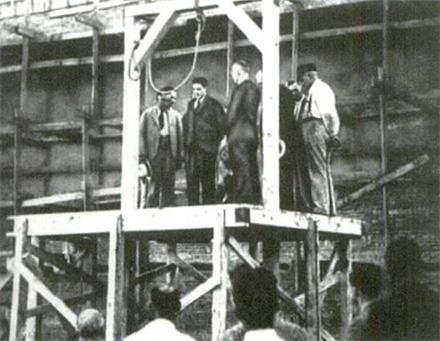

Arthur Gooch on the gallows

* The Kelley kidnapping, unsolved for several years, eventually traced to the strange character Nellie Muench. Readers (at least stateside ones) who follow that trailhead should be sure to keep an eye out for the cameo appearance of Missouri judge Rush Limbaugh, Sr. — grandfather of the present-day talk radio blowhard.

On this day..

1931: The Longhua Martyrs and the Five Martyrs of the League of Left-Wing Writers

On this date in 1931, the Chinese nationalists executed 23 Communists at Longhua, including five members of the League of Left-Wing Writers.

Early in what would prove to be the very long Chinese Civil War, the Koumintang government in 1930 mounted a suppression* of Communist outposts. That included military campaigns attempting to encircle communist-held regions, as well as an internal crackdown. It’s the latter that concerns us here.

A Communist-founded League of Left-Wing Writers operating in Shanghai was formally banned by the Koumintang in September 1930. Threatened with arrest, the writers struggled to stay underground but at a January 17 meeting in the British concession area,** British police arrested Li Weisen, Hu Yepin, Rou Shi, Yin Fu, and Feng Keng. They were handed over to the Chinese authorities.


The Five Martyrs: From left: Hu Yepin, Rou Shi, Feng Keng, Yin Fu, Li Weisen (Li Qiushi)

They became the Five Martyrs of the League when they were shot this date in 1931 along with 18 other Communist prisoners, one of them a pregnant woman.

Among the five martyrs, Rou Shi† was particularly close to the great writer Lu Xun, who was heartbroken when he received word of his young protege’s untimely end — “one of China’s best youths,” in his estimation. In hiding himself, Lu Xun composed a “Lament for Rou Shi”:

To long and sleepless nights I’ve grown
accustomed in the spring;
Fled with a wife and babe in arms,
my temples are graying.
‘Mid dream there comes an image faint —
a loving mother’s tear;
On city walls the overlords’
e’er-changing banners rear.
I can but stand by looking on
as friends become new ghosts,
In anger face bayonet thickets
and search for verse ripostes.
The poem intoned, my gaze turns low —
one cannot write such down.
Moonlight shimmers with watery sheen
upon my jet-black gown.

(as translated by The Lyrical Lu Xun: A Study of His Classical-Style Verse)

The discerning present-day visitor to Longhua can pay respects at the Longhua Revolutionary Martyrs Cemetery.

* The suppression claimed, among others, the life of Mao Zedong’s first wife.

** The extraterritorial British concession in Shanghai was a legacy of the opium wars.

† There’s an English translation of Rou Shi’s short story “A Slave Mother” here.

On this day..

1936: Harry Singer, in the holiday spirit

(Thanks to Robert Elder of Last Words of the Executed — the blog, and the book — for the guest post. This post originally appeared on the Last Words blog. Fans of this here site are highly likely to enjoy following Elder’s own pithy, almanac-style collection of last words on the scaffold. -ed.)

(Said to a guard) “The chair will be a good enough [Christmas] present for me.”

— Harry Singer, convicted of murder, electric chair, Indiana.

Executed December 26, 1936

The twenty-five-year-old former farmhand kept mostly to himself Christmas Day, playing checkers and eating “heartily,” according to the Associated Press. Few details of the crime have survived, except the names of his victims: Mr. and Mrs. John Wesley Kaufman and their daughter, age twelve. In prison, Singer also confessed to the murder of Joseph Bryant, age twenty, of Detroit.

On this day..

1937: Douglas Van Vlack

(Thanks to Robert Elder of Last Words of the Executed — the blog, and the book — for the guest post. This post originally appeared on the Last Words blog here. Fans of this here site are highly likely to enjoy following Elder’s own pithy, almanac-style collection of last words on the scaffold. -ed.)

“I have a right to choose the way I die!”

— Douglas Van Vlack, convicted of murder, hanging, Idaho.
Executed December 9, 1937

Van Vlack kidnapped his ex-wife and killed her, as well as two police officers. A few hours before his hanging was scheduled, Van Vlack broke away from his guards and scrambled over the cell block to cling to the ceiling rafters. He stayed in the ceiling for a half an hour as his lawyer and the prison chaplain begged for him to come down; he jumped thirty feet below just before the guards entered the cell block with a net. Van Vlack’s hanging was unsuccessful; technically he died the next day, December 10, after a few hours in a coma.

On this day..

1934: John and Betty Stam, China missionaries

On this date in 1934, Chinese Communists beheaded John and Betty Stam in the Anhui province town of Miaoshu.

The Stams had settled as China Inland Mission proselytizers in the town of Jingde (at their time generally rendered as “Tsingteh”). Betty Stam (nee Scott) had grown up in China, the daughter of a Presbyterian missionary. John was a New Jersey native who had graduated Moody Bible Institute in 1932. They had a three-month-old daughter named Helen Priscilla.

On December 6, 1934, Communist rebels in China’s long-running civil war entered Jingde and seized the foreign family. According to a tribute page kept by a great-nephew of the, John wrote a short note that evening.

Tsingteh, An.
Dec. 6, 1934

China Inland Mission, Shanghai

Dear Brethren,

My wife, baby and myself are today in the hands of the Communists in the city of Tsingteh. Their demand is twenty thousand dollars for our release.

All our possessions and stores are in their hands, but we praise God for peace in our hearts and a meal tonight. God grant you wisdom in what you do, and us fortitude, courage and peace of heart. He is able-and a wonderful Friend in such a time.

Things happened so quickly this a.m. They were in the city just a few hours after the ever-persistent rumors really became alarming, so that we could not prepare to leave in time. We were just too late.

The Lord bless and guide you, and as for us, may God be glorified whether by life or by death.

In Him,
John C. Stam

The author of John and Betty Stam: Missonary Martyr summarizes his subjects’ “inspiring and instructive story” in a blog post here.

A foreboding message, but Christian evangelizing in China had often proved dangerous to its practitioners.

The next day they were marched 12 miles to Miaoshu where they stopped for the night. Facing martyrdom, the couple stowed their daughter away like Moses, hidden in a sleeping bag with John’s last missive and ten dollars that might serve to care for her.

Miraculously, Helen Priscilla would be overlooked when the Stams’ captors came for them on December 8 and marched them through Miaoshu. It’s said that one Chinese vendor made bold to object, and was added to the doomed party for his trouble. At the end of the march, John was forced to his knees and beheaded before his companions’ eyes; Betty and the shopkeep followed him.

Little Helen survived her parents’ ordeal. A Chinese evangelist named Lo found the girl and carried her 100 miles to a mission hospital. She was taken in from there by Betty’s parents and eventually adopted by Betty’s sister and raised in the Philippines before returning to the United States.

Back in China, another missionary, Frank Houghton, was moved by the sacrifice of the Stams to compose a hymn, “Thou Who Wast Rich Beyond All Splendour” (set to an old French canticle, Quelle est cette odeur agréable?).

On this day..